REVIEW 3 major objections 6 minor 72 references
Towards real-time assessment of infrasound event detection capability using deep learning-based transmission loss estimation
T0 review · 3 major / 6 minor · reviewed 2026-08-07 · deepseek-v4-flash
Pith's one-line read A neural network estimates 4,000-km infrasound transmission loss in 0.045 seconds with ~4 dB error against parabolic-equation simulations, and generalizes to the 2022 Hunga Tonga eruption's unseen conditions.
desk verdict Solid, honest PE-emulator for 4,000 km infrasound TL with believable within-scope metrics, but the cross-date generalization claim outruns the evidence: single-date training and a same-season Tonga test leave year-round operation unproven. read the letter →
The pith
A machine-rendered reading of the paper's core claim, the machinery that carries it, and where it could break.
The reading
What carries the argument
The load-bearing object is the neural network $F_\theta(A_{z,d},f)$, a convolutional recurrent surrogate whose input is the effective sound-speed ratio computed from wind and temperature fields with analytic-spectrum gravity-wave perturbations superimposed, plus the source frequency. Convolutional feature-extraction blocks learn local patterns in the two-dimensional atmospheric slice; the alignment and recurrent block, built from gated recurrent units, propagates information along the range axis so that predicted attenuation at distance $d$ respects the forward direction of travel; dense feature-transformation blocks map the encoded state to 800 output points covering 4,000 km. The training labels come from the parabolic equation solver ePape, and the loss is the root-mean-square error between predicted and simulated ground-level transmission loss.
What would settle it
Train the network on the same January 15, 2021 database and evaluate it on a set of known-yield explosions spread across all four seasons and both hemispheres, comparing predicted transmission loss against either parabolic-equation simulations or observed IMS amplitudes. The paper's own Appendix J provides a miniature version: on August 2019 and 2020 Finnish explosions the January-only model gives a median MRAE around 10% despite the testing-set value of 7%, and adding an August sampling date reduces the error; a decisive seasonal sweep that reproduces this degradation pattern would confirm that single-date training is the binding constraint.
Extended reading notes
Core claim
On the paper's own terms, the central discovery is that a convolutional recurrent neural network trained on parabolic-equation outputs can serve as a near-instantaneous surrogate for infrasound transmission loss over global distances. The architecture uses convolutional blocks to extract spatial features from range-dependent atmospheric slices and gated recurrent units to carry the dependence of attenuation on the atmospheric state ahead of the receiver; the source frequency is injected after the recurrent stage. Evaluated on 6,000 held-out samples, the network achieves a mean RMSE of 4.3 dB and a median MRAE of 7% over 4,000 km, and it also predicts well on the Tonga-set (median MRAE 7.9%), including at five frequencies not used in training. The authors also provide uncertainty estimates, separating epistemic uncertainty (via Monte-Carlo dropout) from data-related uncertainty (via test-time augmentation), and they acknowledge that the network smooths out small-scale variations induced by gravity waves, capturing less of that variability than the parabolic-equation simulations do.
Load-bearing premise
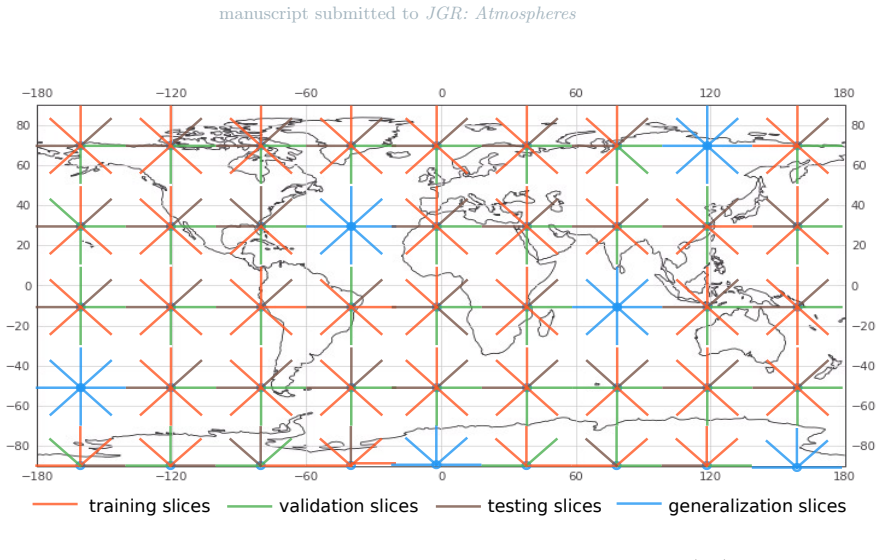
The training database samples the atmosphere on a single date (January 15, 2021) at 162 global locations, and the paper's claim of global, near-real-time generalization assumes that this one-day snapshot, plus synthetic gravity-wave perturbations, is enough to learn the mapping from atmospheric state to transmission loss at any other time.
Editorial extensions
If this is right
- IMS detection-capability maps can be refreshed whenever new atmospheric analyses arrive: a 360-direction transmission-loss map around a source is computed in under 0.3 seconds, versus hours-to-days for full parabolic-equation runs.
- Event monitoring can scan continuous frequency bands rather than five fixed tones, since the model predicts the five held-out Tonga frequencies (0.3–1.4 Hz) with errors in the same range as the training frequencies.
- Uncertainty-aware products are possible: each prediction can carry an epistemic band from Monte-Carlo dropout and a data-related band from gravity-wave augmentation, with the widest bands in upwind, high-frequency cases where errors are largest.
- CTBT compliance screening can move from climatological, station-averaged thresholds to event- and date-specific thresholds computed from the current atmospheric state.
- The speedup (three to four orders of magnitude versus parabolic-equation solvers) makes it practical to compute transmission loss from a global source grid to all receivers, the configuration needed for network-wide detection assessments.
Reading between the lines
- A full seasonal test is the natural next step: because the paper's own Appendix J shows a January-only model loses accuracy on August Finnish explosions and improves when an August sampling date is added, one would expect multi-season and multi-year training to reduce the generalization gap and reveal whether the current 7–8% median errors are a floor of the architecture or an artifact of single-d
- The reported under-capture of gravity-wave variability (predicted data uncertainty around 1.2 dB versus 3.2 dB in the parabolic-equation simulations) implies that operational detection-threshold products should treat the network's transmission loss as a mean field with explicitly inflated uncertainty, or pair it with an ensemble of gravity-wave realizations, rather than using a single deterministi
- Because the architecture is differentiable, the same surrogate could supply the adjoint gradients needed to assimilate infrasound observations into numerical weather prediction, a use the paper mentions as future work but does not demonstrate.
- A testable extension would be to convert the Tonga transmission-loss maps into per-station detection probabilities using the four nearby IMS stations (IS22, IS24, IS36, IS40) and historical noise levels, then compare those probabilities against the actual recorded detections; success there would close the loop from transmission-loss accuracy to operational detection capability.
Editorial analysis
A structured set of objections, weighed in public.
Referee Report
Summary. The paper trains a convolutional recurrent neural network, Fθ(Az,d,f), as a supervised emulator of the parabolic-equation solver ePape for ground-level infrasound transmission loss over 4,000 km. Training inputs are WACCM-derived temperature and wind fields, sampled on a single date (January 15, 2021) at 162 global locations, augmented with stochastic gravity-wave perturbations. The model reports a mean RMSE of 4.3 dB and a median MRAE of 7% on 6,000 held-out test samples with separated stations and unseen gravity-wave realizations, and a median MRAE of 7.9% on the January 15, 2022 Hunga Tonga case. The authors claim near real-time IMS detection-capability assessment as the main application.
Significance. If the claims hold, this is a useful step toward fast infrasound propagation surrogates: the paper explicitly provides a machine-checkable held-out evaluation, separates test stations and gravity-wave realizations from training, extends the prior 1,000 km model to 4,000 km, includes both wind and temperature, and releases preprocessing and testing code. The uncertainty quantification via Monte-Carlo dropout and test-time augmentation is a genuine addition over the prior CNN baseline. The headline numbers are, however, emulator accuracy against ePape, not accuracy against observed infrasound, and the temporal generalization claim is currently supported only for the same seasonal phase as the training date.
major comments (3)
- [§2.1, §6.1, Appendix J, Fig. J1] The single-date training assumption is load-bearing for the generalization claim. Section 2.1 samples the atmosphere only on January 15, 2021; Section 6.1 states the assumption explicitly; Appendix J then shows that adding August 15, 2021 to the training set materially reduces median and quantile MRAE on Finnish explosions from August 2019 and 2020. The Tonga validation (Section 6.2) uses January 15, 2022, which is the same seasonal phase as the January 15 training date and therefore does not test cross-season generalization. The abstract and conclusion claim that the model generalizes to 'new dates'; the evidence supports only same-season dates, and the paper's own Appendix J indicates that year-round operational use requires multi-date training.
- [§6.2, Fig. 13] The Tonga evaluation and all testing/evaluation metrics are computed against ePape simulations, not against observed infrasound arrivals or amplitudes at IMS stations. Because the network is explicitly a supervised emulator, this is not a circularity flaw, but it means that the reported 'prediction capability' is a measure of surrogate fidelity, not an independent physical validation. The manuscript should either state this distinction prominently in the abstract and conclusion, or add at least one comparison with measured station data (e.g., signal-to-noise or amplitude statistics) to support the detection-capability application.
- [§5, Appendix E] The data-uncertainty quantification is under-confident in a specific, reportable way: the predicted standard deviation from test-time augmentation is on average 1.2 dB, while the PE simulations vary by 3.2 dB under the same gravity-wave perturbations. Section 5 presents this as the model acting as a low-pass filter, but the practical consequence is that the reported uncertainty maps (e.g., Fig. 14) underestimate the effect of unresolved atmospheric variability. This should be stated as a limitation in the main text near the uncertainty figures, not only in the appendix.
minor comments (6)
- [§1] Typo: 'herearfter' should be 'hereafter'.
- [Appendix F] The alternative database names are inconsistent: the text uses 'Alt-set-1' and 'Alt-datasets-2', then refers to 'Alt-set-2'; please unify the notation.
- [Appendix D, Fig. D1] The caption uses 'F = 1,6 Hz' with a comma decimal separator, while the rest of the paper uses '1.6 Hz'; please make the decimal notation uniform.
- [Appendix H, Fig. H1] Typo in a panel label: 'Mesopheric' should be 'Mesospheric'.
- [§4.1] The comparison with Brissaud et al. (2023) reports 'consistent' performance, but the ranges differ (4,000 km versus 1,000 km) and the error metrics are averaged over different path lengths; a direct statistical comparison is not established and should be phrased more cautiously.
- [§6.2 and Appendix I] The evaluation at new source frequencies is described only qualitatively in the main text ('slightly larger errors'); please report at least the median and 95th-percentile MRAE for the five new frequencies in the main body or in a table.
Circularity Check
No circularity: the neural network is a supervised emulator of ePape, validated on held-out ePape simulations; the single-date training limitation is a data-coverage concern, not a circular step.
full rationale
Every claimed prediction is evaluated against full parabolic-equation simulations (ePape) on inputs that were not used in fitting. Section 3.1 states 'we develop a supervised neural network designed to emulate the output of the numerical solver ePape'; Section 3.2 withholds five of ten GW realizations and 12 sampling points, giving 6,000 test and 9,600 generalization samples that are never seen during training. The reported 4.3 dB RMSE and 7.9% median MRAE on the Tonga set are direct comparisons to ePape on these held-out samples, which is standard surrogate validation rather than circular reasoning. No parameter is fitted to the Tonga or Finnish data and then renamed a prediction; the Tonga evaluation is an out-of-distribution emulation check, and Appendix J is an explicit ablation showing that adding an August sampling date improves summer generalization. This is an honest limitation of the training-time atmospheric coverage, but the limitation is about distribution shift and does not make the derivation equivalent to its inputs. Self-citations, such as Brissaud et al. (2023), motivate architecture choices and provide an RMSE benchmark, but the central results rest on the paper's own held-out experiments, so no load-bearing circularity is present.
Assumptions & free parameters
free parameters (5)
- Neural network weights (about 27 million parameters) =
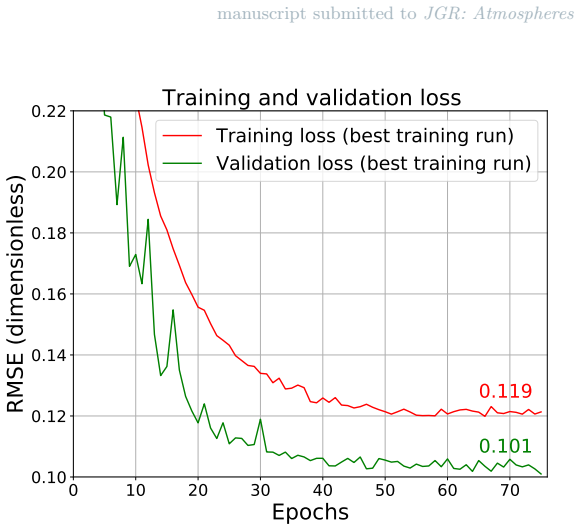
Trained on 42,000 samples, RMSE loss 0.119
- Dropout rate =
0.35
- GRU hidden size =
400
- Initial learning rate =
1e-4 with 10x decay after epoch 10
- Network layer widths =
64/128/256 conv filters, 2048/1536/1024 dense neurons
assumptions (5)
- domain assumption Effective sound speed approximation (Eq. 1): ceff = u0 + c, and cratio(z) >= 1 indicates a waveguide.
- domain assumption The Gardner et al. (1993) vertical spectrum model (Eq. A1) with parameters m*, alpha, and spectral slopes generates realistic gravity-wave perturbations.
- domain assumption ePape parabolic equation solver outputs are treated as ground-truth TL for both training and evaluation.
- ad hoc to paper A single-date (January 15, 2021) global sampling at 162 points with a 20-degree grid captures the atmospheric variability needed for global TL prediction.
- domain assumption The PE modeling simplifications (linear propagation, flat terrain, infinite ground impedance at sea level, Sutherland-Bass absorption, Cartesian coordinates) are acceptable for the simulated TL.
Cite this review
Pith. "Pith review of Towards real-time assessment of infrasound event detection capability using deep learning-based transmission loss estimation." pith.science (2026). https://pith.science/paper/AX36SN5S
@misc{pith2026250606358,
  author       = {Pith},
  title        = {Pith review of: Towards real-time assessment of infrasound event detection capability using deep learning-based transmission loss estimation},
  year         = {2026},
  howpublished = {\url{https://pith.science/paper/AX36SN5S}},
  note         = {Machine review of arXiv:2506.06358}
}
read the original abstract
Accurate modeling of infrasound transmission loss is essential for evaluating the performance of the International Monitoring System, enabling the effective design and maintenance of infrasound stations to support compliance of the Comprehensive Nuclear-Test-Ban Treaty. State-of-the-art propagation modeling tools enable transmission loss to be finely simulated using atmospheric models. However, the computational cost prohibits the exploration of a large parameter space in operational monitoring applications. To address this, recent studies made use of a deep learning algorithm capable of making transmission loss predictions almost instantaneously. However, the use of nudged atmospheric models leads to an incomplete representation of the medium, and the absence of temperature as an input makes the algorithm incompatible with long range propagation. In this study, we address these limitations by using both wind and temperature fields as inputs to a neural network, simulated up to 130 km altitude and 4,000 km distance. We also optimize several aspects of the neural network architecture. We exploit convolutional and recurrent layers to capture spatially and range-dependent features embedded in realistic atmospheric models, improving the overall performance. The neural network reaches an average error of 4 dB compared to full parabolic equation simulations and provides epistemic and data-related uncertainty estimates. Its evaluation on the 2022 Hunga Tonga-Hunga Ha'apai volcanic eruption demonstrates its prediction capability using atmospheric conditions and frequencies not included in the training. This represents a significant step towards near real-time assessment of International Monitoring System detection thresholds of explosive sources.
Figures


Figures from the paper (11 more)


Reference graph
Works this paper leans on
-
[1]
masoftware15 APACrefauthors Abadi, M. , Agarwal, A. , Barham, P. , Brevdo, E. , Chen, Z. , Citro, C. \ Devin, M. APACrefauthors \ 2015 . TensorFlow: Large-Scale Machine Learning [Software]. Tensorflow: Large-scale machine learning [software]. Proc. 12th USENIX Symp. on Operating Syst. Des. Implementation Proc. 12th USENIX symp. on operating syst. des. imp...
-
[2]
sa23 APACrefauthors Albert, S. , Bowman, D. , Silber, E. \ Dannemann Dugick, F. APACrefauthors \ 2023 . The AtmoSOFAR channel: First direct observations of an elevated acoustic duct The atmosofar channel: First direct observations of an elevated acoustic duct . Earth and Space Science 10 10 e2023EA003149
work page 2023
-
[3]
sa20 APACrefauthors Albert, S. \ Linville, L. APACrefauthors \ 2020 . Benchmarking current and emerging approaches to infrasound signal classification Benchmarking current and emerging approaches to infrasound signal classification . Seismological research letters 91 2A 921--929
work page 2020
-
[4]
ma21 APACrefauthors Alexander, M J. APACrefauthors \ 2021 . Observational Validation of Parameterized Gravity Waves from Tropical Convection in the Whole Atmosphere Community Climate Model Observational validation of parameterized gravity waves from tropical convection in the whole atmosphere community climate model . Journal of Geophysical Research: Atmo...
work page 2021
-
[5]
al95 APACrefauthors Allen, S J. \ Vincent, R A. APACrefauthors \ 1995 . Gravity Wave Activity in the Lower Atmosphere: Seasonal and Latitudinal Variations Gravity wave activity in the lower atmosphere: Seasonal and latitudinal variations . Journal of Geophysical Research: Atmospheres 100 D1 1327--1350
work page 1995
-
[6]
ja24 APACrefauthors Amezcua, J. , N \"a sholm, S P. \ Vera Rodriguez, I. APACrefauthors \ 2024 . Using satellite data assimilation techniques to combine infrasound observations and a full ray-tracing model to constrain stratospheric variables Using satellite data assimilation techniques to combine infrasound observations and a full ray-tracing model to co...
work page 2024
-
[7]
aa20 APACrefauthors Ashukha, A. , Lyzhov, A. , Molchanov, D. \ Vetrov, D. APACrefauthors \ 2020 . Pitfalls of In-Domain Uncertainty Estimation and Ensembling in Deep Learning. Pitfalls of in-domain uncertainty estimation and ensembling in deep learning
work page 2020
-
[8]
ja12 APACrefauthors Assink, J D. APACrefauthors \ 2012 . Infrasound as upper atmospheric monitor Infrasound as upper atmospheric monitor . Ph. D. Thesis
work page 2012
Show all 72 references
-
[9]
APACrefauthors \ 2020
agdata19 APACrefauthors Atmospheric Chemistry Observations & Modeling, National Center for Atmospheric Research, University Corporation for Atmospheric Research . APACrefauthors \ 2020 . Whole Atmosphere Community Climate Model (WACCM) Model Output. Whole atmosphere community ...
2020 doi
-
[10]
, Ayarzagüena, B
mb21 APACrefauthors Baldwin, M P. , Ayarzagüena, B. , Birner, T. , Butchart, N. , Butler, A H. , Charlton‐Perez, A J. \ Pedatella, N M. APACrefauthors \ 2021 . Sudden Stratospheric Warmings Sudden stratospheric warmings . Reviews of Geophysics 59 1 e2020RG000708
2021
-
[11]
, Blom, P S
jb22 APACrefauthors Bishop, J W. , Blom, P S. , Webster, J. , Reichard-Flynn, W. \ Lin, Y. APACrefauthors \ 2022 . Deep learning categorization of infrasound array data Deep learning categorization of infrasound array data . The Journal of the Acoustical Society of America 152...
2022
-
[12]
, Ceranna, L
eb18 APACrefauthors Blanc, E. , Ceranna, L. , Hauchecorne, A. , Charlton-Perez, A. , Marchetti, E. , Evers, L G. others APACrefauthors \ 2018 . Toward an improved representation of middle atmospheric dynamics thanks to the ARISE project Toward an improved representation of mid...
2018
-
[13]
, Pol, K
eb19blanc APACrefauthors Blanc, E. , Pol, K. , Le Pichon, A. , Hauchecorne, A. , Keckhut, P. , Baumgarten, G. others APACrefauthors \ 2019 . Middle atmosphere variability and model uncertainties as investigated in the framework of the ARISE project Middle atmosphere variabilit...
2019
-
[14]
, N \"a sholm, S P
eb19 APACrefauthors Blixt, E M. , N \"a sholm, S P. , Gibbons, S J. , Evers, L G. , Charlton-Perez, A J. , Orsolini, Y J. \ Kv rna, T. APACrefauthors \ 2019 . Estimating tropospheric and stratospheric winds using infrasound from explosions Estimating tropospheric and stratosph...
2019
-
[15]
, Waxler, R
pb23 APACrefauthors Blom, P. , Waxler, R. \ Frazier, G. APACrefauthors \ 2023 . Quantification of spatial and seasonal trends in the atmosphere and construction of statistical models for infrasonic propagation Quantification of spatial and seasonal trends in the atmosphere and...
2023
-
[16]
\ Krishnamoorthy, S
db21 APACrefauthors Bowman, D C. \ Krishnamoorthy, S. APACrefauthors \ 2021 . Infrasound from a buried chemical explosion recorded on a balloon in the lower stratosphere Infrasound from a buried chemical explosion recorded on a balloon in the lower stratosphere . Geophysical R...
2021
-
[17]
, Martin, R
qb16 APACrefauthors Brissaud, Q. , Martin, R. , Garcia, R F. \ Komatitsch, D. APACrefauthors \ 2016 . Finite-Difference Numerical Modelling of Gravitoacoustic Wave Propagation in a Windy and Attenuating Atmosphere Finite-difference numerical modelling of gravitoacoustic wave p...
2016
-
[18]
, Martin, R
qb17 APACrefauthors Brissaud, Q. , Martin, R. , Garcia, R F. \ Komatitsch, D. APACrefauthors \ 2017 . Hybrid G alerkin numerical modelling of elastodynamics and compressible N avier-- S tokes couplings: applications to seismo-gravito acoustic waves Hybrid G alerkin numerical m...
2017
-
[19]
, Näsholm, S P
qb23 APACrefauthors Brissaud, Q. , Näsholm, S P. , Turquet, A. \ Le Pichon, A. APACrefauthors \ 2023 . Predicting Infrasound Transmission Loss Using Deep Learning Predicting infrasound transmission loss using deep learning . Geophysical Journal International 232 1 274--286
2023
-
[20]
APACrefauthors \ 1991
wb91 APACrefauthors Buntine, W L. APACrefauthors \ 1991 . Bayesian Backpropagation Bayesian backpropagation . Complex Systems 5 603--643
1991
-
[21]
APACrefauthors \ 2014
kc14 APACrefauthors Cho, K. APACrefauthors \ 2014 . On the Properties of Neural Machine Translation: Encoder-Decoder Approaches. On the properties of neural machine translation: Encoder-decoder approaches
2014
-
[22]
, Veloso, J V
dc22 APACrefauthors Christie, D. , Veloso, J V. , Campus, P. , Bell, M. , Hoffmann, T. , Langlois, A. Carvalho, J. APACrefauthors \ 2022 . Detection of atmospheric nuclear explosions: the infrasound component of the International Monitoring System Detection of atmospheric nucl...
2022
-
[23]
APACrefauthors \ 2018
ch18 APACrefauthors Chu, X. APACrefauthors \ 2018 . Lidar Observations of Stratospheric Gravity Waves from 2011 to 2015 at McMurdo (77.84° S , 166.69° E ), Antarctica : 2. Potential Energy Densities, Lognormal Distributions, and Seasonal Variations Lidar observations of strato...
2018
-
[24]
\ Kulichkov, S
ic19 APACrefauthors Chunchuzov, I. \ Kulichkov, S. APACrefauthors \ 2019 . Internal Gravity Wave Perturbations and Their Impacts on Infrasound Propagation in the Atmosphere Internal gravity wave perturbations and their impacts on infrasound propagation in the atmosphere . Infr...
2019
-
[25]
, Hedlin, M A
gh09 APACrefauthors de Groot-Hedlin, C D. , Hedlin, M A. \ Drob, D P. APACrefauthors \ 2009 . Atmospheric Variability and Infrasound Monitoring Atmospheric variability and infrasound monitoring . Infrasound Monitoring for Atmospheric Studies Infrasound monitoring for atmospher...
2009
-
[26]
, Hedlin, M A
gh11 APACrefauthors de Groot-Hedlin, C D. , Hedlin, M A. \ Walker, K. APACrefauthors \ 2011 . Finite Difference Synthesis of Infrasound Propagation through a Windy, Viscous Atmosphere: Application to a Bolide Explosion Detected by Seismic Networks Finite difference synthesis o...
2011
-
[27]
, Emmert, J T
dd15 APACrefauthors Drob, D P. , Emmert, J T. , Meriwether, J W. , Makela, J J. , Doornbos, E. , Conde, M. \ Klenzing, J H. APACrefauthors \ 2015 . An Update to the Horizontal Wind Model ( HWM ): The Quiet Time Thermosphere An update to the Horizontal Wind Model ( HWM ): The q...
2015
-
[28]
, Waxler, R
dv13 APACrefauthors Fee, D. , Waxler, R. , Assink, J. , Gitterman, Y. , Given, J. , Coyne, J. others APACrefauthors \ 2013 . Overview of the 2009 and 2011 Sayarim infrasound calibration experiments Overview of the 2009 and 2011 sayarim infrasound calibration experiments . Jour...
2013
-
[29]
\ Ghahramani, Z
yg15 APACrefauthors Gal, Y. \ Ghahramani, Z. APACrefauthors \ 2015 . Bayesian Convolutional Neural Networks with Bernoulli Approximate Variational Inference. Bayesian convolutional neural networks with bernoulli approximate variational inference
2015
-
[30]
, Hostetler, C A
cg93 APACrefauthors Gardner, C S. , Hostetler, C A. \ Franke, S J. APACrefauthors \ 1993 . Gravity Wave Models for the Horizontal Wave Number Spectra of Atmospheric Velocity and Density Fluctuations Gravity wave models for the horizontal wave number spectra of atmospheric velo...
1993
-
[31]
, Tassi, C R N
jg23 APACrefauthors Gawlikowski, J. , Tassi, C R N. , Ali, M. , Lee, J. , Humt, M. , Feng, J. \ Zhu, X X. APACrefauthors \ 2023 . A Survey of Uncertainty in Deep Neural Networks A survey of uncertainty in deep neural networks . Artificial Intelligence Review 56 Suppl 1 1513--1589
2023
-
[32]
, Mills, M J
ag19 APACrefauthors Gettelman, A. , Mills, M J. , Kinnison, D E. , Garcia, R R. , Smith, A K. , Marsh, D R. \ Randel, W J. APACrefauthors \ 2019 . The Whole Atmosphere Community Climate Model Version 6 ( WACCM6 ) The whole atmosphere community climate model version 6 ( WACCM6 ...
2019
-
[33]
\ Bengio, Y
xg10 APACrefauthors Glorot, X. \ Bengio, Y. APACrefauthors \ 2010 March . Understanding the Difficulty of Training Deep Feedforward Neural Networks Understanding the difficulty of training deep feedforward neural networks . Proceedings of the Thirteenth International Conferenc...
2010
-
[34]
, Bordes, A
xg11 APACrefauthors Glorot, X. , Bordes, A. \ Bengio, Y. APACrefauthors \ 2011 June . Deep Sparse Rectifier Neural Networks Deep sparse rectifier neural networks . Proceedings of the Fourteenth International Conference on Artificial Intelligence and Statistics Proceedings of t...
2011
-
[35]
\ Bowers, D
dg10 APACrefauthors Green, D N. \ Bowers, D. APACrefauthors \ 2010 . Estimating the Detection Capability of the International Monitoring System Infrasound Network Estimating the detection capability of the International Monitoring System infrasound network . Journal of Geophys...
2010
-
[36]
APACrefauthors \ 1939
gb39 APACrefauthors Gutenberg, B. APACrefauthors \ 1939 . The velocity of sound waves and the temperature in the stratosphere in southern California The velocity of sound waves and the temperature in the stratosphere in southern california . Bulletin of the American Meteorolog...
1939
-
[37]
, Wilson, D K
ch21 APACrefauthors Hart, C R. , Wilson, D K. , Pettit, C L. \ Nykaza, E T. APACrefauthors \ 2021 . Machine-Learning of Long-Range Sound Propagation through Simulated Atmospheric Turbulence Machine-learning of long-range sound propagation through simulated atmospheric turbulen...
2021
-
[38]
, Bell, B
hh05 APACrefauthors Hersbach, H. , Bell, B. , Berrisford, P. , Hirahara, S. , Horányi, A. , Muñoz‐Sabater, J. \ Thépaut, J N. APACrefauthors \ 2020 . The ERA5 Global Reanalysis The ERA5 global reanalysis . Quarterly Journal of the Royal Meteorological Society 146 730 1999--2049
2020
-
[39]
\ Gardner, C S
ho94 APACrefauthors Hostetler, C A. \ Gardner, C S. APACrefauthors \ 1994 . Observations of Horizontal and Vertical Wave Number Spectra of Gravity Wave Motions in the Stratosphere and Mesosphere Over the Mid‐Pacific Observations of horizontal and vertical wave number spectra o...
1994
-
[40]
APACrefauthors \ 2014
dk14 APACrefauthors Kingma, D P. APACrefauthors \ 2014 . Adam: A Method for Stochastic Optimization. Adam: A method for stochastic optimization
2014
-
[41]
, Pritzel, A
bl17 APACrefauthors Lakshminarayanan, B. , Pritzel, A. \ Blundell, C. APACrefauthors \ 2017 . Simple and Scalable Predictive Uncertainty Estimation Using Deep Ensembles Simple and scalable predictive uncertainty estimation using deep ensembles . Advances in Neural Information ...
2017
-
[42]
, Bengio, Y
yl15 APACrefauthors LeCun, Y. , Bengio, Y. \ Hinton, G. APACrefauthors \ 2015 . Deep Learning Deep learning . Nature 521 7553 436--444
2015
-
[43]
, Gatti, F
fl24 APACrefauthors Lehmann, F. , Gatti, F. \ Clouteau, D. APACrefauthors \ 2024 . Multiple-Input F ourier Neural Operator ( MIFNO ) for source-dependent 3 D elastodynamics Multiple-input F ourier neural operator ( MIFNO ) for source-dependent 3 D elastodynamics . arXiv prepri...
2024 arXiv
-
[44]
, Ceranna, L
jv12 APACrefauthors Le Pichon, A. , Ceranna, L. \ Vergoz, J. APACrefauthors \ 2012 1 . Incorporating numerical modeling into estimates of the detection capability of the IMS infrasound network Incorporating numerical modeling into estimates of the detection capability of the i...
2012
-
[45]
, Ceranna, L
lp12 APACrefauthors Le Pichon, A. , Ceranna, L. \ Vergoz, J. APACrefauthors \ 2012 2 . Incorporating Numerical Modelling into Estimates of the Detection Capability of the IMS Infrasound Network Incorporating numerical modelling into estimates of the detection capability of the...
2012
-
[46]
, Herry, P
lp05 APACrefauthors Le Pichon, A. , Herry, P. , Mialle, P. , Vergoz, J. , Brachet, N. , Garcés, M. \ Ceranna, L. APACrefauthors \ 2005 . Infrasound Associated with 2004--2005 Large Sumatra Earthquakes and Tsunami Infrasound associated with 2004--2005 large Sumatra earthquakes ...
2005
-
[47]
, Vergoz, J
lp09 APACrefauthors Le Pichon, A. , Vergoz, J. , Blanc, E. , Guilbert, J. , Ceranna, L. , Evers, L. \ Brachet, N. APACrefauthors \ 2009 . Assessing the Performance of the International Monitoring System's Infrasound Network: Geographical Coverage and Temporal Variabilities Ass...
2009
-
[48]
, Listowski, C
pl24 APACrefauthors Letournel, P. , Listowski, C. , Bocquet, M. , Le Pichon, A. \ Farchi, A. APACrefauthors \ 2024 . Evaluating numerical weather prediction models in the middle atmosphere using coherent oceanic acoustic noise observations Evaluating numerical weather predicti...
2024
-
[49]
, Kovachki, N
lz20 APACrefauthors Li, Z. , Kovachki, N. , Azizzadenesheli, K. , Liu, B. , Bhattacharya, K. , Stuart, A. \ Anandkumar, A. APACrefauthors \ 2020 . Fourier neural operator for parametric partial differential equations Fourier neural operator for parametric partial differential ...
2020 arXiv
-
[50]
, Stephan, C C
cl24 APACrefauthors Listowski, C. , Stephan, C C. , Le Pichon, A. , Hauchecorne, A. , Kim, Y H. , Achatz, U. \ Bölöni, G. APACrefauthors \ 2024 . Stratospheric Gravity Waves Impact on Infrasound Transmission Losses Across the International Monitoring System Stratospheric gravi...
2024
-
[51]
, Martin, R
lm21 APACrefauthors Martire, L. , Martin, R. , Brissaud, Q. \ Garcia, R F. APACrefauthors \ 2022 . SPECFEM2D-DG , an open-source software modelling mechanical waves in coupled solid--fluid systems: the linearized Navier--Stokes approach SPECFEM2D-DG , an open-source software m...
2022
-
[52]
APACrefauthors \ 2019
jm19 APACrefauthors Marty, J. APACrefauthors \ 2019 . The IMS Infrasound Network: Current Status and Technological Developments The IMS infrasound network: Current status and technological developments . Infrasound Monitoring for Atmospheric Studies: Challenges in Middle Atmos...
2019
-
[53]
, Fee, D
rm22 APACrefauthors Matoza, R S. , Fee, D. , Assink, J D. , Iezzi, A M. , Green, D N. , Kim, K. \ Wilson, D C. APACrefauthors \ 2022 . Atmospheric Waves and Global Seismoacoustic Observations of the J anuary 2022 Hunga Eruption, Tonga Atmospheric waves and global seismoacousti...
2022
-
[54]
, Brown, D
pm19 APACrefauthors Mialle, P. , Brown, D. , Arora, N. \ colleagues from IDC. APACrefauthors \ 2019 . Advances in operational processing at the international data centre Advances in operational processing at the international data centre . Infrasound monitoring for atmospheric...
2019
-
[55]
\ Wilson, D K
cp20 APACrefauthors Pettit, C L. \ Wilson, D K. APACrefauthors \ 2020 December . A Physics-Informed Neural Network for Sound Propagation in the Atmospheric Boundary Layer A physics-informed neural network for sound propagation in the atmospheric boundary layer . Proceedings of...
2020
-
[56]
, Hedin, A E
jp02 APACrefauthors Picone, J M. , Hedin, A E. , Drob, D P. \ Aikin, A C. APACrefauthors \ 2002 . NRLMSISE‐00 Empirical Model of the Atmosphere: Statistical Comparisons and Scientific Issues NRLMSISE‐00 empirical model of the atmosphere: Statistical comparisons and scientific ...
2002
-
[57]
APACrefauthors \ 2019
ap19 APACrefauthors Pierce, A D. APACrefauthors \ 2019 . Acoustics: an introduction to its physical principles and applications Acoustics: an introduction to its physical principles and applications . Springer
2019
-
[58]
, Gaebler, P
cp21 APACrefauthors Pilger, C. , Gaebler, P. , Hupe, P. , Kalia, A C. , Schneider, F M. , Steinberg, A. Ceranna, L. APACrefauthors \ 2021 . Yield estimation of the 2020 B eirut explosion using open access waveform and remote sensing data Yield estimation of the 2020 B eirut ex...
2021
-
[59]
APACrefauthors \ 2020
pl20 APACrefauthors Plougonven, R. APACrefauthors \ 2020 . How Does Knowledge of Atmospheric Gravity Waves Guide Their Parameterizations? How does knowledge of atmospheric gravity waves guide their parameterizations? Quarterly Journal of the Royal Meteorological Society 146 72...
2020
-
[60]
, Le Pichon, A
ap22 APACrefauthors Podglajen, A. , Le Pichon, A. , Garcia, R F. , Gérier, S. , Millet, C. , Bedka, K. \ Hertzog, A. APACrefauthors \ 2022 . Stratospheric Balloon Observations of Infrasound Waves from the 15 J anuary 2022 Hunga Eruption, Tonga Stratospheric balloon observation...
2022
-
[61]
, Baratin, A
na19 APACrefauthors Rahaman, N. , Baratin, A. , Arpit, D. , Draxler, F. , Lin, M. , Hamprecht, F. \ Courville, A. APACrefauthors \ 2019 May . On the Spectral Bias of Neural Networks On the spectral bias of neural networks . International Conference on Machine Learning Internat...
2019
-
[62]
, Bowman, D C
es23 APACrefauthors Silber, E A. , Bowman, D C. \ Ronac Giannone, M. APACrefauthors \ 2023 . Detection of the large surface explosion coupling experiment by a sparse network of balloon-borne infrasound sensors Detection of the large surface explosion coupling experiment by a s...
2023
-
[63]
\ Evers, L G
ps14 APACrefauthors Smets, P S. \ Evers, L G. APACrefauthors \ 2014 . The Life Cycle of a Sudden Stratospheric Warming from Infrasonic Ambient Noise Observations The life cycle of a sudden stratospheric warming from infrasonic ambient noise observations . Journal of Geophysica...
2014
-
[64]
, Fritts, D C
sm87 APACrefauthors Smith, S A. , Fritts, D C. \ Vanzandt, T E. APACrefauthors \ 1987 . Evidence for a Saturated Spectrum of Atmospheric Gravity Waves Evidence for a saturated spectrum of atmospheric gravity waves . Journal of Atmospheric Sciences 44 10 1404--1410
1987
-
[65]
\ Bass, H E
ls04 APACrefauthors Sutherland, L C. \ Bass, H E. APACrefauthors \ 2004 . Atmospheric Absorption in the Atmosphere Up to 160 km Atmospheric absorption in the atmosphere up to 160 km . The Journal of the Acoustical Society of America 115 3 1012--1032
2004
-
[66]
APACrefauthors \ 1989 June
t89 APACrefauthors Tishby \ Solla. APACrefauthors \ 1989 June . Consistent Inference of Probabilities in Layered Networks: Predictions and Generalizations Consistent inference of probabilities in layered networks: Predictions and generalizations . International 1989 Joint Conf...
1989
-
[67]
, N \"a sholm, S P
rv20 APACrefauthors Vera Rodriguez, I. , N \"a sholm, S P. \ Le Pichon, A. APACrefauthors \ 2020 . Atmospheric wind and temperature profiles inversion using infrasound: An ensemble model context Atmospheric wind and temperature profiles inversion using infrasound: An ensemble ...
2020
-
[68]
, Hupe, P
jv22 APACrefauthors Vergoz, J. , Hupe, P. , Listowski, C. , Le Pichon, A. , Garcés, M A. , Marchetti, E. \ Mialle, P. APACrefauthors \ 2022 . IMS Observations of Infrasound and Acoustic-Gravity Waves Produced by the J anuary 2022 Volcanic Eruption of Hunga , Tonga : A Global A...
2022
-
[69]
, Assink, J
ev23 APACrefauthors Vorobeva, E. , Assink, J. , Espy, P J. , Renkwitz, T. , Chunchuzov, I. \ N \"a sholm, S P. APACrefauthors \ 2023 . Probing gravity waves in the middle atmosphere using infrasound from explosions Probing gravity waves in the middle atmosphere using infrasoun...
2023
-
[70]
, De Carlo, M
ev15 APACrefauthors Vorobeva, E. , De Carlo, M. , Le Pichon, A. , Espy, P J. \ Näsholm, S P. APACrefauthors \ 2021 June . Benchmarking Microbarom Radiation and Propagation Model against Infrasound Recordings: A Vespagram-Based Approach Benchmarking microbarom radiation and pro...
2021
-
[71]
\ Assink, J
rw19 APACrefauthors Waxler, R. \ Assink, J. APACrefauthors \ 2019 . Propagation Modelling through Realistic Atmosphere and Benchmarking Propagation modelling through realistic atmosphere and benchmarking . Infrasound Monitoring for Atmospheric Studies: Challenges in Middle Atm...
2019
-
[72]
, Hetzer, C
rwsoftware21 APACrefauthors Waxler, R. , Hetzer, C. , Assink, J. \ Velea, D. APACrefauthors \ 2021 . Chetzer-ncpa/ncpaprop-release: NCPAprop (v2. 1.0v2. 1.0). Chetzer-ncpa/ncpaprop-release: NCPAprop (v2. 1.0v2. 1.0). [Software]. Zenodo . APACrefURL https://doi.org/10.5281/zeno...
2021 doi
Reviewed August 7, 2026 · model on record in the stance chip above.
Discussion (0). Sign in to comment.