REVIEW 4 major objections 6 minor 63 references
Discovery of Jet-Bubble-Disk Interaction: Jet Feedback on a Protoplanetary Disk via an Expanding Bubble in WSB 52
T0 review · 4 major / 6 minor · reviewed 2026-08-10 · deepseek-v4-flash
Pith's one-line read This paper reports the first direct evidence that a star's jet can feed back onto its own planet-forming disk, through an expanding bubble that is currently colliding with the disk.
desk verdict A genuinely interesting ALMA shell around WSB 52, but the 'interaction' claim leans on an assumed 3D alignment that isn't tested. read the letter →
The pith
A machine-rendered reading of the paper's core claim, the machinery that carries it, and where it could break.
The reading
What carries the argument
The central object is the expanding bubble model: a shell expanding radially from a center (xbubble, ybubble) at speed ububble = 12.5 km/s, with line-of-sight velocity vLOS = vsys,bubble + ububble (z/rbubble). This model fixes the bubble's three-dimensional location once one assumes its center lies on the disk axis, and it reproduces the observed shell-like channel maps as iso-velocity circles. The companion piece is the shock-boundary model, a power-law surface ζsurf(ρ) = hshock (ρ/1 arcsec)^a + ζ0 that joins the bubble sphere at an intersection angle and produces the concave contour seen on the star side. A Keplerian disk mask provides the baseline against which the disk's deformation and super-escape-velocity gas are judged. Together these models convert channel-by-channel CO images into a single geometrical story: jet, then expanding bubble, then shock, then a deformed and losing disk.
What would settle it
A decisive observation would be a multi-epoch ALMA map of WSB 52: if the bubble's rim is genuinely expanding at about 12.5 km/s around the claimed center and the disk deformation grows or shifts accordingly, the interaction scenario survives; if the apparent shell is static or merely traces unrelated cloud gas, the claim fails. Alternatively, a scattered-light image that places the bubble center off the disk axis would refute the geometric construction.
Extended reading notes
Core claim
The authors report the first evidence that a stellar jet can directly feed back onto its own protoplanetary disk through an intervening expanding bubble. In WSB 52 they identify a nearly spherical, uniformly expanding bubble with radius about 5.5 arcsec (roughly 750 au), expansion velocity 12.5 km/s, and kinetic energy about (0.3–1.6)×$10^{41}$ erg, whose center is offset from the star by roughly 580 au under the assumed geometry. The disk axis points toward the bubble center, and the bubble's surface shows a concave indentation on the side facing the star, which the authors model as a shock boundary between the bubble and the stellar vicinity. The CO gas disk is deformed relative to a Keplerian model and contains velocity components up to about 18 km/s, above the estimated escape speed at 100 au, suggesting the bubble is stripping mass from the disk. The authors conclude that jets, aligned with the disk axis, inflated the bubble and that the bubble is now colliding with the outer disk—the 'jet-bubble-disk interaction.'
Load-bearing premise
The load-bearing premise is that the bubble center lies exactly on the disk axis in three dimensions; if it does not, the derived depth of the star, the 580-au separation, and the apparent alignment between the bubble and disk all collapse.
Editorial extensions
If this is right
- If the scenario is correct, jets are not only accretion byproducts; they can directly deform and strip mass from the outer regions of the very disk that feeds them.
- Disk deformation will be most visible in tenuous gas at large radii while the compact dusty disk remains undisturbed, so gas-dust comparisons become a diagnostic of such events.
- The observed high-velocity CO gas implies ongoing mass loss, so jet-triggered bubbles can shorten the disk's lifetime and reduce its planet-building material budget.
- The event's apparent rarity among the DSHARP targets motivates targeted searches for similar bubbles around young stars with high accretion rates, where jet outbursts are more powerful.
- Follow-up CO isotope and molecular-line observations could reveal the temperature, density, and chemical changes expected at a shock front, providing independent evidence of the interaction.
Reading between the lines
- A testable extension the paper does not pursue is to measure the bubble's three-dimensional motion directly with multi-epoch ALMA observations; a limb expanding at about 12.5 km/s toward the star would confirm the returning-flow geometry, while a lack of inward motion would undermine it.
- If the bubble center turns out not to lie on the disk axis, the same channel maps might be explained by chance superposition of unrelated cloud gas; a scattered-light image of the bubble in the near-infrared could provide an independent, geometry-free check.
- The ram-pressure framework used here could be inverted: with a well-measured vertical displacement profile, the deformation becomes a probe of the disk's surface-density gradient, something the paper only sketches.
- Repeated jet outbursts on roughly 10-year timescales would imply that jet-bubble-disk interactions are episodic, potentially imprinting multiple nested bubbles or repeated stripping events in older disks; searching for such nested shells in other sources would test this.
Signed reviews
Editorial analysis
A structured set of objections, weighed in public.
Referee Report
Summary. The paper revisits ALMA 12CO (J=2-1) observations of the young stellar object WSB 52 and identifies three structures: a shell-like pattern interpreted as a uniformly expanding bubble offset from the star, a concave morphology near the star interpreted as a shock boundary between the bubble and the stellar vicinity, and a deformed protoplanetary disk with high-velocity gas. The authors model the bubble with a linear expansion velocity field, the shock boundary with an axisymmetric power-law surface, and the disk with a Keplerian mask. They combine these to propose a new mechanism, the 'jet-bubble-disk interaction', in which past jet activity drives an expanding bubble that collides with and deforms the protoplanetary disk. The paper includes public data products, a reproducible Keplerian-mask code, and analytical expressions for the model contours.
Significance. If the central interpretation is correct, this would be the first reported case of direct jet feedback on a protoplanetary disk through an expanding bubble, with implications for disk evolution, vertical structure, and mass loss. The paper is clearly written and offers a coherent set of analytical models supported by the ALMA data release. The main strengths are the transparent presentation of the bubble expansion model, the analytical shock-boundary solution in Appendix B, the order-of-magnitude energy budget, and the availability of data and code. However, the central claim rests on a geometric assumption that is stated rather than tested: that the bubble center lies on the disk axis in three-dimensional space. This assumption is used to derive the star's depth, the separation of 580 au, and the axis alignment that constitute the evidence for interaction, so the significance of the paper hinges on whether this assumption can be independently justified or constrained.
major comments (4)
- [Sec. 3.1-3.2, Eq. (5)] The load-bearing geometric premise, that the bubble center lies on the disk axis in three-dimensional space, is asserted rather than derived: Sec. 3.1 states 'We thus assume that the bubble center to be on the line of the disk axis in determining (xbubble, ybubble)', and Eq. (5) then uses that same assumption to compute z_star, the 580 au separation, and the statement that the disk axis points toward the bubble center. Because the later shock-boundary model and the interaction geometry are constructed in the (xi, eta, zeta) frame whose zeta-axis is defined by this assumption, an off-axis bubble center would reduce the apparent symmetry and alignment to a projection effect, and the derived star-inside-bubble geometry would no longer be supported. The paper gives no uncertainty on (xbubble, ybubble) and no test of an alternative off-axis geometry; I would like to see a fit in which z_star is a free parameter, or some other independent constraint, so that the alignment claim is not circular.
- [Sec. 3.2 and Appendix B] The shock-boundary model is numerically optimized by minimizing the sum of distances to manually selected points along the very concave feature it is introduced to explain. No goodness-of-fit statistic, residual map, or comparison against a simpler model (for example, a pure spherical bubble or a different surface shape) is reported. The statement that the model 'reasonably replicates' the observed morphology is therefore not a quantitative test of the interaction hypothesis; the model's success is partly built into the fitting procedure.
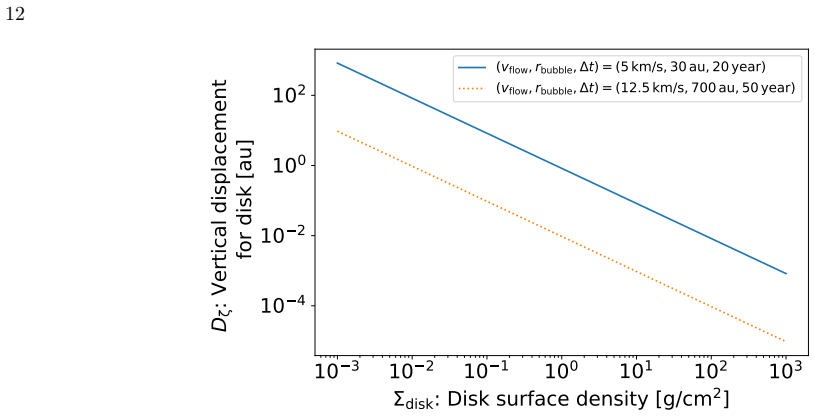
- [Sec. 3.3 and Sec. 4.2, Eqs. (20)-(21)] The quantitative model for disk deformation is in tension with the observational claim. Eq. (20) with the current bubble parameters gives a vertical displacement of only about 0.01 au, which the authors themselves call negligible, while Eq. (21) reaches 0.8 au only by adopting ad hoc early-phase parameters (rbubble = 30 au, Delta t = 20 yr, vrel = 7.5 km/s) with no observational justification that such an early phase occurred. Without evidence that plausible parameters can produce the observed deformation, the qualitative statement in Sec. 3.3 that the disk is deformed by the bubble remains unsupported.
- [Sec. 3.3] The Keplerian-disk comparison is purely visual: dashed iso-velocity contours are overlaid on the channel maps, but no residuals, chi-square values, or systematic variation over the stated uncertainty in vsys,star (0.5-1.0 km/s) are provided. A quantitative model comparison is needed to demonstrate that the deviation is intrinsic disk deformation rather than an artifact of the assumed systemic velocity, disk height profile, or outer radius. The discussion of high-velocity gas would also benefit from an explicit test of whether those components can be separated from unrelated outflow or cloud emission.
minor comments (6)
- [Abstract] The sentence 'While stellar jets and outflows are fueled by accretion from disks, their direct influence on disks remain unexplored' should use the singular verb 'remains'.
- [Sec. 3.1] The sentence 'We thus assume that the bubble center to be on the line of the disk axis' is ungrammatical; it should be 'We thus assume the bubble center to be on the line of the disk axis'.
- [Sec. 3.1] The text states 'if i = 58.4 degrees' for the 580 au separation, but Table 1 lists the disk inclination as i = 54.4 degrees; please clarify which value is used in Eq. (5), since this changes z_star and the separation.
- [Fig. 2] The figure caption contains a local file path ('file:///Users/ryuta/mylab/...'), which should be removed before publication.
- [Appendix B] The word 'analtyical' in the appendix title is a typo and should be 'analytical'.
- [Sec. 4.1] The phrase 'it is reasonably that jets were more powerful in the past' should read 'it is reasonable that jets were more powerful in the past'.
Circularity Check
Bubble-disk interaction geometry is partly forced: the 3D alignment of the bubble center with the disk axis is assumed before Eq. 5, then used to place the star inside the bubble; the shock-boundary model is fitted to the same feature it is said to confirm.
-
self definitional
[Sec 3.1 (bubble model) and Sec 3.2, Eq. (5)]
"Both the bubble and the concave structure appear symmetric with respect to the disk axis... Consequently, the disk axis seems to point toward the bubble center, not only in the sky plane but also in three-dimensional space. We thus assume that the bubble center to be on the line of the disk axis in determining (xbubble, ybubble). ... Under the assumption (b), we estimate the star's line-of-sight depth relative to the bubble center by using the disk inclination and the projected distance on the sky. Specifically... z⋆ = sqrt((x⋆ − xbubble)^2 + (y⋆ − ybubble)^2) / tan i"
The paper's conclusion that 'the disk axis points toward the bubble center' in 3D and that the star lies inside the bubble (separation 580 au) is not derived from the data; it is the same assumption used to determine (xbubble, ybubble) and then to compute z⋆ via Eq. (5). The observed sky-plane symmetry motivates but does not fix the line-of-sight depth: the bubble center is fixed at z = 0 and the 3D alignment is imposed, after which Eq. (5) converts that assumed alignment into z⋆, and the resulting 'stellar location is within the bubble' is quoted as evidence for interaction.
-
fitted input called prediction
[Sec 3.2 shock boundary model, Eqs. (6)-(13) and Table 2]
"We optimize the shell models by comparing the predicted contours (xcontour(vLOS, ρ), ycontour(vLOS, ρ)) with the observed shock boundaries... We minimize this aggregate distance by adjusting the parameters of the bubble model... Our model reasonably replicates the observed shock boundary morphology, supporting our estimation of the stellar position."
The shock-boundary model is numerically fitted to the very concave morphology it is then said to confirm, and it takes the assumed stellar position (z⋆ from Eq. 5) as a fixed input: the ζ-axis is defined to pass through the star and the bubble center, and d is computed from z⋆. The optimized parameters (hshock, a, ζ0, rbubble) are free, so agreement is by construction and cannot independently 'support' the stellar position or the 3D alignment; it only shows that an axisymmetric power-law surface with an offset can reproduce the chosen concave feature. No uncertainty or goodness-of-fit is given, so the confirmation loop is unfalsifiable within the paper.
full rationale
The paper's genuinely independent content is real: the expanding shell is fitted to the channel maps with a uniform-expansion model, the Keplerian model fails to match the observed disk morphology, and high-velocity gas near the disk is identified. Those pieces do not reduce to the interaction claim by construction. However, the central interaction geometry is partly forced. The 3D statement that the disk axis points toward the bubble center is first introduced as an assumption used in determining (xbubble, ybubble), then Eq. (5) uses that same assumption to compute z⋆, the 580 au star-bubble separation, and the star's location inside the bubble, which is then cited as suggesting an interaction. The shock-boundary model compounds this: it is optimized against the concave feature it is later said to validate, and it incorporates the assumed z⋆ as a fixed input, so its agreement cannot serve as independent confirmation of the stellar position. There is no load-bearing self-citation chain: the only author self-citations (Orihara et al. 2023 for the LTE column-density formula, and the authors' Keplerian-mask code) are not central to the novel claim. Weighing all this, the empirical discovery content is substantial, but one key 'prediction' (star inside bubble / aligned disk axis) reduces to the paper's own geometric assumption, and the shock-boundary 'confirmation' reduces to a fit of the feature it explains. This is partial circularity, so the score is 6 rather than 8 or 10.
Assumptions & free parameters
free parameters (14)
- xbubble =
2.50 arcsec
- ybubble =
1.90 arcsec
- rbubble =
5.5 arcsec (bubble model); 6.5 arcsec (shock model)
- vsys,bubble =
-0.25 km/s
- ububble =
12.5 km/s
- hshock =
0.18 arcsec
- a =
2.14
- zeta0 =
-0.28 arcsec
- vsys,star =
3.9 km/s (uncertain by 0.5-1.0 km/s)
- Disk flare height h0 and exponent p =
h0 = 5 au, p = 1
- Sigma_disk =
1 g/cm2
- vrel =
7.5 km/s
- rbubble_early =
30 au
- dt_early =
20 yr
assumptions (7)
- ad hoc to paper Uniformly expanding spherical bubble with velocity profile u(r) = ububble (r / rbubble).
- ad hoc to paper Bubble center lies on the disk axis in three-dimensional space.
- ad hoc to paper Shock boundary is axisymmetric with height given by a power-law surface plus an offset, and the velocity on it is radial with constant amplitude.
- domain assumption 12CO emission is not fully optically thick, LTE applies, and the CO abundance relative to H2 is X = 1e-4.
- domain assumption The compact high-velocity emission near the star at line-of-sight velocities up to about 18 km/s originates from disk material, not from the bubble, an unrelated outflow, or cloud contamination.
- domain assumption The bubble was inflated by a past stellar jet.
- domain assumption The disk surface density and geometry used in the ram-pressure deformation model are representative.
Cite this review
Pith. "Pith review of Discovery of Jet-Bubble-Disk Interaction: Jet Feedback on a Protoplanetary Disk via an Expanding Bubble in WSB 52." pith.science (2026). https://pith.science/paper/AY7QNGFN
@misc{pith2026250110121,
  author       = {Pith},
  title        = {Pith review of: Discovery of Jet-Bubble-Disk Interaction: Jet Feedback on a Protoplanetary Disk via an Expanding Bubble in WSB 52},
  year         = {2026},
  howpublished = {\url{https://pith.science/paper/AY7QNGFN}},
  note         = {Machine review of arXiv:2501.10121}
}
abstract
While stellar jets and outflows are fueled by accretion from disks, their direct influence on disks remain unexplored. Here we revisit ALMA observations of $^{12}\mathrm{CO}\,(J=2-1)$ line emission for the young stellar object WSB 52. We identify an expanding bubble that interacts with its protoplanetary disk. Given that the disk axis points toward the bubble center and the kinetic energy of the bubble is roughly $10^{41}$ erg, we postulate that stellar jets, aligned with the disk axis, have triggered the bubble. The bubble morphology is consistent with uniform expansion with partial concavity, implying the bubble-disk interaction. Correspondingly, the shape and the velocity field of protoplanetary disk appear to be deformed and exhibit high-velocity components, suggesting strong interactions and mass loss from the disk. The discovery of jet feedback onto the disk via the bubble -- which we term the jet-bubble-disk interaction -- sheds new light on the dynamical processes governing star and planet formation.
Figures


Figures from the paper (3 more)


Reference graph
Works this paper leans on
-
[1]
Andrews, S. M., Huang, J., P´ erez, L. M., et al. 2018, ApJL, 869, L41, doi: 10.3847/2041-8213/aaf741 Astropy Collaboration, Robitaille, T. P., Tollerud, E. J., et al. 2013, A&A, 558, A33, doi: 10.1051/0004-6361/201322068 Astropy Collaboration, Price-Whelan, A. M., Sip˝ ocz, B. M., et al. 2018, AJ, 156, 123, doi: 10.3847/1538-3881/aabc4f Astropy Collabora...
-
[2]
2022, arXiv preprint arXiv:2210.13314
Bae, J., Isella, A., Zhu, Z., et al. 2022, arXiv preprint arXiv:2210.13314
arXiv 2022
-
[3]
2016, ARA&A, 54, 491, doi: 10.1146/annurev-astro-081915-023341
Bally, J. 2016, ARA&A, 54, 491, doi: 10.1146/annurev-astro-081915-023341
-
[4]
Bally, J., O’Dell, C. R., & McCaughrean, M. J. 2000, AJ, 119, 2919, doi: 10.1086/301385
doi:10.1086/301385 2000
-
[5]
2015, ApJL, 815, L15, doi: 10.1088/2041-8205/815/1/L15
Banzatti, A., Pinilla, P., Ricci, L., et al. 2015, ApJL, 815, L15, doi: 10.1088/2041-8205/815/1/L15
-
[6]
2023, Faraday Discussions, 245, 164, doi: 10.1039/D3FD00018D
Bianchi, E., L´ opez-Sepulcre, A., Ceccarelli, C., et al. 2023, Faraday Discussions, 245, 164, doi: 10.1039/D3FD00018D
-
[7]
Blandford, R. D., & Payne, D. G. 1982, MNRAS, 199, 883, doi: 10.1093/mnras/199.4.883
-
[8]
2015, The Astrophysical journal letters, 808, L3
Brogan, C., P´ erez, L., Hunter, T., et al. 2015, The Astrophysical journal letters, 808, L3
work page 2015
Show all 63 references
-
[9]
2024, ApJ, 961, 90, doi: 10.3847/1538-4357/ad0f17
Cacciapuoti, L., Testi, L., Podio, L., et al. 2024, ApJ, 961, 90, doi: 10.3847/1538-4357/ad0f17
2024 doi
-
[10]
Chevalier, R. A. 2000, ApJL, 538, L151, doi: 10.1086/312814
2000 doi
-
[11]
A., Casassus, S., Tobin, J., et al
Cieza, L. A., Casassus, S., Tobin, J., et al. 2016, Nature, 535, 258, doi: 10.1038/nature18612
2016 doi
-
[12]
2021, Astrophysics Source Code Library, ascl
Comrie, A., Wang, K.-S., Hsu, S.-C., et al. 2021, Astrophysics Source Code Library, ascl
2021
-
[13]
A., Teague, R., et al
Czekala, I., Loomis, R. A., Teague, R., et al. 2021, ApJS, 257, 2, doi: 10.3847/1538-4365/ac1430
2021 doi
-
[14]
K., Anglada, G., Bl´ azquez-Calero, G., et al
Diaz-Rodriguez, A. K., Anglada, G., Bl´ azquez-Calero, G., et al. 2022, ApJ, 930, 91, doi: 10.3847/1538-4357/ac3b50
2022 doi
-
[15]
E., Podio, L., Kaper, L., et al
Ellerbroek, L. E., Podio, L., Kaper, L., et al. 2013, A&A, 551, A5, doi: 10.1051/0004-6361/201220635
2013 doi
-
[16]
Federrath, C., & Klessen, R. S. 2013, The Astrophysical Journal, 763, 51, doi: 10.1088/0004-637X/763/1/51
2013 doi
-
[17]
P., Cabrit, S., et al
Frank, A., Ray, T. P., Cabrit, S., et al. 2014, in Protostars and Planets VI, ed. H. Beuther, R. S. Klessen, C. P. Dullemond, & T. Henning, 451–474, doi: 10.2458/azu uapress 9780816531240-ch020 Gaia Collaboration, Prusti, T., de Bruijne, J. H. J., et al. 2016, A&A, 595, A1, do...
2014 doi
-
[18]
L., Jones, J
Gardner, C. L., Jones, J. R., & Hodapp, K. W. 2016, ApJ, 830, 113, doi: 10.3847/0004-637X/830/2/113 16
2016 doi
-
[19]
E., Klein, R
Hansen, C. E., Klein, R. I., McKee, C. F., & Fisher, R. T. 2012, The Astrophysical Journal, 747, 22, doi: 10.1088/0004-637X/747/1/22
2012 doi
-
[20]
2023, ApJ, 945, 63, doi: 10.3847/1538-4357/acb930
Harada, N., Tokuda, K., Yamasaki, H., et al. 2023, ApJ, 945, 63, doi: 10.3847/1538-4357/acb930
2023 doi
-
[21]
1995, ApJ, 452, 736, doi: 10.1086/176344 Haugbølle, T., Weber, P., Wielandt, D
Hartigan, P., Edwards, S., & Ghandour, L. 1995, ApJ, 452, 736, doi: 10.1086/176344 Haugbølle, T., Weber, P., Wielandt, D. P., et al. 2019, AJ, 158, 55, doi: 10.3847/1538-3881/ab1591
1995 doi
-
[22]
1985, in Protostars and Planets II, ed
Hayashi, C., Nakazawa, K., & Nakagawa, Y. 1985, in Protostars and Planets II, ed. D. C. Black & M. S. Matthews, 1100–1153
1985
-
[23]
2012, A&A Rv, 20, 55, doi: 10.1007/s00159-012-0055-y
Hennebelle, P., & Falgarone, E. 2012, A&A Rv, 20, 55, doi: 10.1007/s00159-012-0055-y
2012 doi
-
[24]
W., & Chini, R
Hodapp, K. W., & Chini, R. 2014, ApJ, 794, 169, doi: 10.1088/0004-637X/794/2/169
2014 doi
-
[25]
M., Dullemond, C
Huang, J., Andrews, S. M., Dullemond, C. P., et al. 2018, ApJL, 869, L42, doi: 10.3847/2041-8213/aaf740
2018 doi
-
[26]
Hunter, J. D. 2007, Computing in Science and Engineering, 9, 90, doi: 10.1109/MCSE.2007.55
2007 doi
-
[27]
2021, ApJ, 919, 55, doi: 10.3847/1538-4357/ac0dc3
Ichikawa, T., Kido, M., Takaishi, D., et al. 2021, ApJ, 919, 55, doi: 10.3847/1538-4357/ac0dc3
2021 doi
-
[28]
Rosotti, G. P. 2022, MNRAS, 509, 2780, doi: 10.1093/mnras/stab3185
2022 doi
-
[29]
2016, in IOS Press, 87–90, doi: 10.3233/978-1-61499-649-1-87
Kluyver, T., Ragan-Kelley, B., P´ erez, F., et al. 2016, in IOS Press, 87–90, doi: 10.3233/978-1-61499-649-1-87
2016 doi
-
[30]
2000, ApJ, 532, 980, doi: 10.1086/308594
Koyama, H., & Inutsuka, S.-I. 2000, ApJ, 532, 980, doi: 10.1086/308594
2000 doi
-
[31]
E., Stapelfeldt, K
Krist, J. E., Stapelfeldt, K. R., Hester, J. J., et al. 2008, AJ, 136, 1980, doi: 10.1088/0004-6256/136/5/1980
2008 doi
-
[32]
E., Burrows, C
Krist, J. E., Burrows, C. J., Stapelfeldt, K. R., et al. 1997, ApJ, 481, 447, doi: 10.1086/304056
1997 doi
-
[33]
E., Stapelfeldt, K
Krist, J. E., Stapelfeldt, K. R., Burrows, C. J., et al. 1999, ApJL, 515, L35, doi: 10.1086/311961
1999 doi
-
[34]
2020, A&A Rv, 28, 1, doi: 10.1007/s00159-020-0123-7
Lee, C.-F. 2020, A&A Rv, 28, 1, doi: 10.1007/s00159-020-0123-7
2020 doi
-
[35]
2019, Nature Astronomy, 3, 314, doi: 10.1038/s41550-018-0680-0
Lee, J.-E., Lee, S., Baek, G., et al. 2019, Nature Astronomy, 3, 314, doi: 10.1038/s41550-018-0680-0
2019 doi
-
[36]
2006, ApJL, 640, L187, doi: 10.1086/503419
Li, Z.-Y., & Nakamura, F. 2006, ApJL, 640, L187, doi: 10.1086/503419
2006 doi
-
[37]
Machida, M. N. 2014, ApJL, 796, L17, doi: 10.1088/2041-8205/796/1/L17
2014 doi
- [38]
-
[39]
S., & Federrath, C
Mathew, S. S., & Federrath, C. 2021, MNRAS, 507, 2448, doi: 10.1093/mnras/stab2338
2021 doi
- [40]
-
[41]
2010, in Proceedings of the 9th Python in Science Conference, ed
McKinney, W. 2010, in Proceedings of the 9th Python in Science Conference, ed. S. van der Walt & J. Millman, 51 – 56
2010
-
[42]
2007, in Astronomical Society of the Pacific Conference Series, Vol
Golap, K. 2007, in Astronomical Society of the Pacific Conference Series, Vol. 376, Astronomical Data Analysis Software and Systems XVI, ed. R. A. Shaw, F. Hill, & D. J. Bell, 127
2007
-
[43]
2007, ApJ, 662, 395, doi: 10.1086/517515
Nakamura, F., & Li, Z.-Y. 2007, ApJ, 662, 395, doi: 10.1086/517515
2007 doi
-
[44]
2006, A&A, 452, 245, doi: 10.1051/0004-6361:20054706
Natta, A., Testi, L., & Randich, S. 2006, A&A, 452, 245, doi: 10.1051/0004-6361:20054706
2006 doi
-
[45]
1980, ApJ, 238, 158, doi: 10.1086/157969 ¨Oberg, K
Norman, C., & Silk, J. 1980, ApJ, 238, 158, doi: 10.1086/157969 ¨Oberg, K. I., Guzm án, V. V., Walsh, C., et al. 2021, ApJS, in press. https://arxiv.org/abs/2109.06268 O’Dell, C. R., Wen, Z., & Hu, X. 1993, ApJ, 410, 696, doi: 10.1086/172786
1980 arXiv
-
[46]
Offner, S. S. R., & Chaban, J. 2017, ApJ, 847, 104, doi: 10.3847/1538-4357/aa8996
2017 doi
-
[47]
2014, ApJ, 796, 131, doi: 10.1088/0004-637X/796/2/131
Ohashi, N., Saigo, K., Aso, Y., et al. 2014, ApJ, 796, 131, doi: 10.1088/0004-637X/796/2/131
2014 doi
-
[48]
J., Jørgensen, J
Ohashi, N., Tobin, J. J., Jørgensen, J. K., et al. 2023, ApJ, 951, 8, doi: 10.3847/1538-4357/acd384
2023 doi
-
[49]
2023, PASJ, 75, 424, doi: 10.1093/pasj/psad009
Orihara, R., Momose, M., Muto, T., et al. 2023, PASJ, 75, 424, doi: 10.1093/pasj/psad009
2023 doi
-
[50]
J., & Hester, J
Ouellette, N., Desch, S. J., & Hester, J. J. 2007, ApJ, 662, 1268, doi: 10.1086/518102
2007 doi
-
[51]
Pyo, T.-S., Hayashi, M., Takami, M., & Beck, T. L. 2024, ApJ, 963, 159, doi: 10.3847/1538-4357/ad1f59
2024 doi
-
[52]
2001, ARA&A, 39, 403, doi: 10.1146/annurev.astro.39.1.403
Reipurth, B., & Bally, J. 2001, ARA&A, 39, 403, doi: 10.1146/annurev.astro.39.1.403
2001 doi
-
[53]
2014, Nature, 507, 78, doi: 10.1038/nature13000
Sakai, N., Sakai, T., Hirota, T., et al. 2014, Nature, 507, 78, doi: 10.1038/nature13000
2014 doi
-
[54]
2001, The Astrophysical Journal, 548, 1029
Lee, T. 2001, The Astrophysical Journal, 548, 1029
2001
-
[55]
H., Shang, H., & Lee, T
Shu, F. H., Shang, H., & Lee, T. 1996, Science, 271, 1545
1996
-
[56]
N., Shang, H., et al
Tafalla, M., Su, Y. N., Shang, H., et al. 2017, A&A, 597, A119, doi: 10.1051/0004-6361/201629493
2017 doi
-
[57]
M., Schneider, P
Takami, M., G¨ unther, H. M., Schneider, P. C., et al. 2023, ApJS, 264, 1, doi: 10.3847/1538-4365/ac9afc
2023 doi
-
[58]
2020, richteague/keplerian mask: Initial Release, 1.0, Zenodo, doi: 10.5281/zenodo.4321137
Teague, R. 2020, richteague/keplerian mask: Initial Release, 1.0, Zenodo, doi: 10.5281/zenodo.4321137
2020 doi
-
[59]
N., & ichiro Inutsuka, S
Tsukamoto, Y., Machida, M. N., & ichiro Inutsuka, S. 2021, The Astrophysical Journal Letters, 920, L35, doi: 10.3847/2041-8213/ac2b2f van der Walt, S., Colbert, S. C., & Varoquaux, G. 2011, Computing in Science and Engineering, 13, 22, doi: 10.1109/MCSE.2011.37 17
2021 doi
-
[60]
E., et al
Virtanen, P., Gommers, R., Oliphant, T. E., et al. 2020, Nature Methods, 17, 261, doi: 10.1038/s41592-019-0686-2
2020 doi
-
[61]
P., & Cieza, L
Williams, J. P., & Cieza, L. A. 2011, ARA&A, 49, 67, doi: 10.1146/annurev-astro-081710-102548
2011 doi
-
[62]
2014, ApJ, 793, 1, doi: 10.1088/0004-637X/793/1/1
Yen, H.-W., Takakuwa, S., Ohashi, N., et al. 2014, ApJ, 793, 1, doi: 10.1088/0004-637X/793/1/1
2014 doi
-
[63]
A., Galv´ an-Madrid, R., Carrasco-Gonz´ alez, C., et al
Zapata, L. A., Galv´ an-Madrid, R., Carrasco-Gonz´ alez, C., et al. 2015, ApJL, 811, L4, doi: 10.1088/2041-8205/811/1/L4
2015 doi
Reviewed August 10, 2026 · model on record in the stance chip above.
Discussion (0). Continue with ORCID to comment.