REVIEW 4 major objections 6 minor 1 cited by
Beyond Label Semantics: Language-Guided Action Anatomy for Few-shot Action Recognition
T0 review · 4 major / 6 minor · reviewed 2026-08-06 · deepseek-v4-flash
Pith's one-line read This paper claims that few-shot action recognition is pushed to state-of-the-art accuracy when an LLM splits each action label into three atomic steps and videos are matched to them phase by phase.
desk verdict A solid, useful FSAR pipeline that deserves a serious referee, but the SOTA numbers need code, error bars, and a fix to the inconsistent atomic-number table before I'd trust them. read the letter →
The pith
A machine-rendered reading of the paper's core claim, the machinery that carries it, and where it could break.
The reading
What carries the argument
The engine is the correspondence between two three-part anatomies. On the text side, an LLM prompt forces every label into three atomic descriptions that name subject, motion, and object in temporal order. On the video side, CLUSTER-Segment is an agglomerative clustering routine: each frame starts as its own cluster, adjacent clusters with the highest cosine similarity between mean features are merged, and the process stops at exactly three clusters, with overlap frames added across boundaries so that phase transitions are not hard cuts. The fusion step computes cross-attention with query $Q_i = t_i + f_{S_i}$ (an atomic visual feature plus its paired text feature) and key/value matrices built from all atomic visual features, so each phase learns local semantics while staying aware of the whole action, and the fused phases are concatenated into the prototype. The metric that carries classification is AB-MHM (Aligned Bidirectional Mean Hausdorff Metric), a non-parametric, order-aware distance that computes the bidirectional mean Hausdorff distance separately within each of the three phases, so initiation is compared with initiation before any cross-phase matching is allowed. Together the three-phase segmentation, the atomic fusion, and the per-phase distance convert an LLM's commonsense description of an action into measurable video evidence.
What would settle it
Two concrete tests would settle the claim. First, on a held-out set with human-annotated phase boundaries, compute the frame-level agreement (for example, intersection-over-union) between CLUSTER-Segment's segments and the LLM's textual steps; near-chance agreement would mean the reported gains are not coming from the claimed anatomy. Second, replace each atomic description with the label's other steps randomly permuted or with generic descriptions; if accuracy barely changes, the specific content of the LLM anatomy is not doing the work the paper assigns to it.
Extended reading notes
Core claim
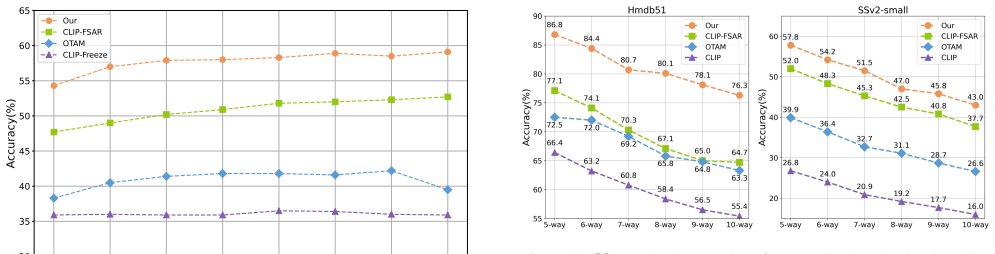
LGA's central claim is that the information a coarse action label discards — the posture, motion, and object interactions that unfold as an action begins, develops, and ends — can be recovered by anatomizing both modalities into the same three-part structure, and that this structure pays for itself in the low-data regime. For each label, an LLM writes three temporally ordered sub-action descriptions focused on subject, motion, and object. For each video, the CLUSTER-Segment algorithm merges the most similar adjacent frame clusters until exactly three phases remain, mirroring the three text steps. A cross-attention fusion layer, in which each atomic visual feature is the query conditioned on its paired text description and attends over all atomic visual features, produces a phase-structured prototype. Matching then uses AB-MHM, an ordered variant of the bidirectional mean Hausdorff distance that evaluates each phase separately, together with per-phase video-text similarity. The paper reports the best published numbers on HMDB51, Kinetics, UCF101, SSv2-Full, and SSv2-Small, with the headline 1-shot gains on HMDB51 (86.8% versus 77.1% for its CLIP-based baseline) and SSv2-Small (58.9% versus 54.6%).
Load-bearing premise
The load-bearing assumption is that the frame clustering produces the same three steps — initiation, progression, conclusion — that the language model writes down as text; the paper reports no quantitative check that visual cluster boundaries actually line up with the textual sub-action descriptions, and if they do not align for a given class or dataset, the atomic fusion and per-phase matching compare misaligned content and the reported gains would not transfer.
Editorial extensions
If this is right
- In the 1-shot setting the semantic anatomy matters most: on HMDB51 the method reports 86.8% versus 77.1% for its CLIP-based baseline, while at 5-shot the gap narrows to 1.6 points, matching the paper's observation that enriched text helps most when visual data are scarce.
- The same LLM decomposition transfers across datasets without retraining or per-class annotation, since the prompt only needs the action label; the paper uses one prompt for all five benchmarks.
- Because AB-MHM is non-parametric and needs no learned alignment module, the gain from ordered phase matching comes without extra trainable parameters and with less computation than alignment-based matching.
- The mechanism has limits: on UCF101, whose classes the CLIP backbone already covers, the gain over the baseline is small (98.2% versus 97.0% at 1-shot), which the paper attributes to the backbone having little headroom left.
Reading between the lines
- Because the text anatomy comes from the LLM's world knowledge rather than from training-set statistics, the same decomposition should apply to zero-shot and open-vocabulary settings where target classes never appear in training episodes; the paper does not test this, but nothing in the method requires the label to have been seen.
- A testable consequence of the three-phase assumption is that actions without a clear beginning-middle-end structure — cyclical or repeated actions such as stirring or cutting — might misalign clusters with text steps; a benchmark of such actions would isolate this failure mode.
- The paper tunes the fusion weight alpha per dataset; a learned or confidence-based weighting of the video-video and video-text scores could remove this per-dataset tuning and may generalize where the optimal balance shifts.
- The reported gains also suggest something about CLIP's frame features themselves: that simple agglomerative clustering on cosine similarity recovers semantically meaningful phase boundaries, which a direct quantitative alignment test between cluster boundaries and human-annotated phases could confirm; the paper reports no such test.
Editorial analysis
A structured set of objections, weighed in public.
Referee Report
Summary. The paper proposes Language-Guided Action Anatomy (LGA), a few-shot action recognition framework that uses a large language model to decompose action labels into ordered atomic text descriptions and a CLUSTER-Segment algorithm to split each video into the same number of temporal phases. A fine-grained multimodal fusion module combines the per-phase visual features with the atomic textual features through cross-attention, and a multimodal matching module integrates video-video matching, via a proposed Aligned Bidirectional Mean Hausdorff Metric (AB-MHM), with video-text matching. The authors report state-of-the-art results on HMDB51, Kinetics, UCF101, SSv2-Full, and SSv2-Small under 5-way 1-shot and 5-shot settings, together with ablations on the fusion scheme, matching strategy, segmentation method, and number of atomic actions.
Significance. If the reported results hold, the core idea of anatomizing both text and video into aligned atomic phases is a useful step beyond treating action labels as flat semantic cues, and the proposed AB-MHM metric offers a simple, non-parametric way to respect temporal order during matching. The paper does not ship code, data, or seeds, and it provides no machine-checked derivations, so the contribution is empirical rather than formal. The motivation is clearly presented and the ablation coverage is broad, including segmentation method, fusion granularity, matching strategy, and LLM/VLM comparisons. However, the central empirical claim is currently undersupported by the absence of variance estimates, a table-level inconsistency in the atomic-number ablation, and the lack of a quantitative check that the unsupervised visual clusters align with the LLM-generated text phases.
major comments (4)
- [§4.2, Table 1] The state-of-the-art claim is reported without standard deviations, number of seeds, or any significance test, and no code or data are provided. Several improvements in Table 1 are small in absolute terms (e.g., UCF101 5-shot is 99.1 for both CLIP-FSAR and the proposed method within rounding, and Kinetics 1-shot is 95.2 vs. 94.8). Without variance estimates across multiple runs, the reader cannot determine whether the reported gains are reliable. Please report mean±std over at least three independent runs for every entry, and release code and evaluation protocols to support reproducibility.
- [§4.3, Table 6] Table 6 contains numbers that are internally inconsistent and that contradict the text claim that performance 'peaks at 3.' As printed, the SSv2-Small columns show 1-shot accuracy of 87.6 at L=2 versus 86.8 at L=3, so performance does not peak at 3 for that dataset, and the HMDB51 columns list values between 54.3 and 58.9 that are far below the corresponding 86.8 result reported in Table 1. The dataset columns appear to be swapped, and after swapping, HMDB51 1-shot accuracy peaks at L=2 (87.6) rather than L=3 (86.8). Please correct the table and revisit the conclusion that L=3 is the best choice.
- [§3.2, §4.3, Table 5] The central mechanism of LGA assumes that the unsupervised CLUSTER-Segment clusters correspond to the LLM's three atomic text descriptions (initiation, progression, conclusion), but no quantitative alignment check is reported. Table 5 directly undermines the claim that CLUSTER-Segment 'consistently outperforms' the baselines: on HMDB51 1-shot, the HARD uniform split achieves 87.3 versus 86.8 for the proposed CLUSTER method. Please provide a quantitative evaluation of text-cluster alignment (for example, agreement between cluster boundaries and human-annotated or LLM-derived phase boundaries) and reconcile the HARD result with the claim that the proposed segmentation is responsible for the gains.
- [§8.1, Table 7 and §3.4] The hyperparameter M, described in the Table 7 caption as the 'attention mask weight in Fine-grained Multimodal Fusion Module,' is never reported, and the alpha values in Table 7 are tuned per dataset on the same benchmarks used for final reporting. Because alpha and M directly control the relative contribution of the two matching branches and the fusion behavior, the experimental protocol should report M, describe how validation splits were used for hyperparameter selection, and include a sensitivity analysis for alpha and M. Without this, the reported gains may be inflated by per-dataset tuning on the test benchmarks.
minor comments (6)
- [Abstract] The word 'multipe' in the final sentence should be corrected to 'multiple.'
- [Eq. (4)] Equation (4) has an extra closing parenthesis after the inner product, and the symbol f^T_k is not defined; the textual feature in the matching branch should be denoted consistently with t_k used in Eq. (1).
- [Algorithm 1] The loop 'for i = 0 to |S|' will access S_{i+1} when i=|S|, which is out of range; the loop bound should be |S|-1. In addition, the overlap-insertion step is only described as 'Add overlap frame within adjacent clusters'; please specify the number of duplicated frames and how they enter the cluster averages.
- [Table 7] The column header 'tate' should read 'rate,' and the abbreviations 'st iter' and 'warm lr' should be expanded in the caption or table notes.
- [§4.3, Figure 3] Figure 3 combines accuracy and inference-time annotations, but the metric for each bar is not stated in the caption; please clarify whether the vertical axis is accuracy and how the inference-time values (e.g., 189.54ms, 3.59s) relate to the bars.
- [Supplementary §8.2] The claim that L=4 generates 'redundant' atomic descriptions is supported only by two qualitative examples; please quantify the redundancy rate over all classes or at least state how many of the generated L=4 descriptions were judged to be redundant by the authors.
Circularity Check
No load-bearing circularity; LGA is an empirical pipeline evaluated on external benchmarks, with only routine per-dataset hyperparameter tuning.
full rationale
LGA's claimed contributions are empirical: LLM-generated atomic text descriptions, an unsupervised temporal clustering module, and fusion/matching equations that combine features. None of the equations (1)-(5) reduce to their inputs by construction: Eq. (1) is a cross-attention fusion of text and video features, Eq. (2) is a non-parametric Hausdorff-style distance, Eq. (4) is a phase-wise cosine similarity, and Eq. (5) is a weighted geometric mean with a scalar alpha. The correspondence between the i-th LLM description and the i-th video cluster is imposed by index order, not derived, and the paper explicitly acknowledges possible misalignment (Sec. 8.2, Fig. 6), which is a correctness risk rather than a circular step. The only self-citation ([28] in Sec. 1) is a background citation among several and is not load-bearing. Per-dataset hyperparameters, including alpha and the attention-mask weight M mentioned only in Table 7's caption, are tuned on the same benchmarks where state-of-the-art results are reported; this is a mild evaluation concern (possible test-set leakage via hyperparameter selection) but not a circular derivation, since no result is obtained by fitting the target numbers themselves. The SOTA claim is checked against external benchmarks and does not reduce to an input of the method. Score 1 reflects the mild hyperparameter-tuning burden, not circularity in the derivation chain.
Assumptions & free parameters
free parameters (4)
- alpha (visual weight in Multimodal Matching, Eq. 5) =
0.0250 (HMDB51), 0.0625 (Kinetics), 0.1125 (UCF101), 0.2 (SSv2-Small), 0.2 (SSv2-Full)
- L (number of atomic actions) =
3
- Attention mask weight M in Fine-grained Multimodal Fusion =
not reported
- Overlap duplication in CLUSTER-Segment =
not specified
assumptions (4)
- domain assumption CLIP ViT-B/16 image features capture enough per-frame appearance to segment actions into meaningful phases by cosine similarity.
- domain assumption LLM-generated atomic descriptions are temporally ordered and consistently follow subject-motion-object, matching the visual phases.
- ad hoc to paper The action phases of all videos in a class can be represented by exactly three clusters.
- domain assumption The weighted geometric mean with per-dataset alpha combines video-video and video-text probabilities.
Cite this review
Pith. "Pith review of Beyond Label Semantics: Language-Guided Action Anatomy for Few-shot Action Recognition." pith.science (2026). https://pith.science/paper/AYUMEYH7
@misc{pith2026250716287,
  author       = {Pith},
  title        = {Pith review of: Beyond Label Semantics: Language-Guided Action Anatomy for Few-shot Action Recognition},
  year         = {2026},
  howpublished = {\url{https://pith.science/paper/AYUMEYH7}},
  note         = {Machine review of arXiv:2507.16287}
}
read the original abstract
Few-shot action recognition (FSAR) aims to classify human actions in videos with only a small number of labeled samples per category. The scarcity of training data has driven recent efforts to incorporate additional modalities, particularly text. However, the subtle variations in human posture, motion dynamics, and the object interactions that occur during different phases, are critical inherent knowledge of actions that cannot be fully exploited by action labels alone. In this work, we propose Language-Guided Action Anatomy (LGA), a novel framework that goes beyond label semantics by leveraging Large Language Models (LLMs) to dissect the essential representational characteristics hidden beneath action labels. Guided by the prior knowledge encoded in LLM, LGA effectively captures rich spatiotemporal cues in few-shot scenarios. Specifically, for text, we prompt an off-the-shelf LLM to anatomize labels into sequences of atomic action descriptions, focusing on the three core elements of action (subject, motion, object). For videos, a Visual Anatomy Module segments actions into atomic video phases to capture the sequential structure of actions. A fine-grained fusion strategy then integrates textual and visual features at the atomic level, resulting in more generalizable prototypes. Finally, we introduce a Multimodal Matching mechanism, comprising both video-video and video-text matching, to ensure robust few-shot classification. Experimental results demonstrate that LGA achieves state-of-the-art performance across multipe FSAR benchmarks.
Figures


Figures from the paper (5 more)


Forward citations
Cited by 1 Pith paper
-
Explainable Action Form Assessment by Exploiting Multimodal Chain-of-Thoughts Reasoning
A new dataset and model for assessing whether exercise/martial-arts actions are performed correctly and explaining why.
Reference graph
Works this paper leans on
-
[1]
TARN: temporal attentive relation network for few-shot and zero-shot action recognition
Mina Bishay, Georgios Zoumpourlis, and Ioannis Patras. TARN: temporal attentive relation network for few-shot and zero-shot action recognition. In BMVC, page 154, 2019. 2
work page 2019
-
[2]
Task-adapter: Task-specific adap- tation of image models for few-shot action recognition
Congqi Cao, Yueran Zhang, Yating Yu, Qinyi Lv, Lingtong Min, and Yanning Zhang. Task-adapter: Task-specific adap- tation of image models for few-shot action recognition. In Proceedings of the 32nd ACM International Conference on Multimedia, pages 9038–9047, 2024. 2, 6, 4
work page 2024
-
[3]
Few-shot video classification via tem- poral alignment
Kaidi Cao, Jingwei Ji, Zhangjie Cao, Chien-Yi Chang, and Juan Carlos Niebles. Few-shot video classification via tem- poral alignment. In CVPR, pages 10618–10627, 2020. 1, 2, 5, 6, 7, 8, 3, 4
work page 2020
-
[4]
Quo vadis, action recognition? a new model and the kinetics dataset
Joao Carreira and Andrew Zisserman. Quo vadis, action recognition? a new model and the kinetics dataset. In pro- ceedings of the IEEE Conference on Computer Vision and Pattern Recognition, pages 6299–6308, 2017. 5
work page 2017
-
[5]
An image is worth 16x16 words: Transformers for image recognition at scale
Alexey Dosovitskiy, Lucas Beyer, Alexander Kolesnikov, Dirk Weissenborn, Xiaohua Zhai, Thomas Unterthiner, Mostafa Dehghani, Matthias Minderer, Georg Heigold, Syl- vain Gelly, Jakob Uszkoreit, and Neil Houlsby. An image is worth 16x16 words: Transformers for image recognition at scale. In International Conference on Learning Representa- tions, 2021. 5, 6
2021
-
[6]
Li Fei-Fei, R. Fergus, and P. Perona. One-shot learning of object categories. IEEE Transactions on Pattern Analysis and Machine Intelligence, page 594–611, 2006. 1
work page 2006
-
[7]
Depth guided adaptive meta-fusion network for few- shot video recognition
Yuqian Fu, Li Zhang, Junke Wang, Yanwei Fu, and Yu-Gang Jiang. Depth guided adaptive meta-fusion network for few- shot video recognition. In Proceedings of the 28th ACM International Conference on Multimedia, pages 1142–1151,
-
[8]
Fine- grained temporal contrastive learning for weakly-supervised temporal action localization
Junyu Gao, Mengyuan Chen, and Changsheng Xu. Fine- grained temporal contrastive learning for weakly-supervised temporal action localization. In Proceedings of the IEEE/CVF Conference on Computer Vision and Pattern Recognition (CVPR), pages 19999–20009, 2022. 2
work page 2022
Show all 59 references
-
[9]
The” something something” video database for learning and evaluating visual common sense
Raghav Goyal, Samira Ebrahimi Kahou, Vincent Michal- ski, Joanna Materzynska, Susanne Westphal, Heuna Kim, Valentin Haenel, Ingo Fruend, Peter Yianilos, Moritz Mueller-Freitag, et al. The” something something” video database for learning and evaluating visual common sense. In ...
2017
-
[10]
Consistency prototype module and motion compensation for few-shot action recognition (clip-cpm2c)
Fei Guo, YiKang Wang, Han Qi, Li Zhu, and Jing Sun. Consistency prototype module and motion compensation for few-shot action recognition (clip-cpm2c). Neurocomputing, 611:128649, 2025. 2, 6, 4
2025
-
[11]
Low-shot visual recognition by shrinking and hallucinating features
Bharath Hariharan and Ross Girshick. Low-shot visual recognition by shrinking and hallucinating features. In Pro- ceedings of the IEEE international conference on computer vision, pages 3018–3027, 2017. 1
2017
-
[12]
Deep residual learning for image recognition
Kaiming He, Xiangyu Zhang, Shaoqing Ren, and Jian Sun. Deep residual learning for image recognition. In Proceed- ings of the IEEE conference on computer vision and pattern recognition, pages 770–778, 2016. 6
2016
-
[13]
Compound proto- type matching for few-shot action recognition
Yifei Huang, Lijin Yang, and Yoichi Sato. Compound proto- type matching for few-shot action recognition. In European Conference on Computer Vision , pages 351–368. Springer,
-
[14]
Matching compound prototypes for few-shot action recognition
Yifei Huang, Lijin Yang, Guo Chen, Hongjie Zhang, Feng Lu, and Yoichi Sato. Matching compound prototypes for few-shot action recognition. International Journal of Com- puter Vision, pages 1–26, 2024. 2, 6, 3
2024
-
[15]
Action genome: Actions as compositions of spatio- temporal scene graphs
Jingwei Ji, Ranjay Krishna, Li Fei-Fei, and Juan Carlos Niebles. Action genome: Actions as compositions of spatio- temporal scene graphs. In Proceedings of the IEEE/CVF Conference on Computer Vision and Pattern Recognition , pages 10236–10247, 2020. 1, 2
2020
-
[16]
Adam: A method for stochastic optimization
Diederik P Kingma and Jimmy Ba. Adam: A method for stochastic optimization. arXiv preprint arXiv:1412.6980 ,
-
[17]
Hmdb: a large video database for human motion recognition
Hildegard Kuehne, Hueihan Jhuang, Est ´ıbaliz Garrote, Tomaso Poggio, and Thomas Serre. Hmdb: a large video database for human motion recognition. In 2011 Inter- national conference on computer vision , pages 2556–2563. IEEE, 2011. 5, 3, 4
2011
-
[18]
Trajectory-aligned space-time tokens for few-shot action recognition
Pulkit Kumar, Namitha Padmanabhan, Luke Luo, Sai Saketh Rambhatla, and Abhinav Shrivastava. Trajectory-aligned space-time tokens for few-shot action recognition. In Eu- ropean Conference on Computer Vision , pages 474–493. Springer, 2024. 4
2024
-
[19]
Temporal alignment-free video matching for few- shot action recognition
SuBeen Lee, WonJun Moon, Hyun Seok Seong, and Jae- Pil Heo. Temporal alignment-free video matching for few- shot action recognition. In Proceedings of the Computer Vi- sion and Pattern Recognition Conference, pages 5412–5421,
-
[20]
Frame order matters: A temporal sequence-aware model for few-shot action recognition
Bozheng Li, Mushui Liu, Gaoang Wang, and Yunlong Yu. Frame order matters: A temporal sequence-aware model for few-shot action recognition. In Proceedings of the AAAI Conference on Artificial Intelligence , pages 18218–18226,
-
[21]
Pastanet: Toward human activity knowledge en- gine
Yong-Lu Li, Liang Xu, Xinpeng Liu, Xijie Huang, Yue Xu, Shiyi Wang, Hao-Shu Fang, Ze Ma, Mingyang Chen, and Cewu Lu. Pastanet: Toward human activity knowledge en- gine. In Proceedings of the IEEE/CVF Conference on Com- puter Vision and Pattern Recognition, pages 382–391, 2020. 1
2020
-
[22]
Bmn: Boundary-matching network for temporal action pro- posal generation
Tianwei Lin, Xiao Liu, Xin Li, Errui Ding, and Shilei Wen. Bmn: Boundary-matching network for temporal action pro- posal generation. In Proceedings of the IEEE/CVF inter- national conference on computer vision , pages 3889–3898,
-
[23]
Lite- mkd: A multi-modal knowledge distillation framework for lightweight few-shot action recognition
Baolong Liu, Tianyi Zheng, Peng Zheng, Daizong Liu, Xi- aoye Qu, Junyu Gao, Jianfeng Dong, and Xun Wang. Lite- mkd: A multi-modal knowledge distillation framework for lightweight few-shot action recognition. In Proceedings 9 of the 31st ACM International Conference on Multimed...
2023
-
[24]
Multidimensional prototype refactor enhanced network for few-shot action recognition
Shuwen Liu, Min Jiang, and Jun Kong. Multidimensional prototype refactor enhanced network for few-shot action recognition. IEEE Transactions on Circuits and Systems for Video Technology, 32(10):6955–6966, 2022. 2
2022
-
[25]
Language models are few-shot learners
Ben Mann, N Ryder, M Subbiah, J Kaplan, P Dhariwal, A Neelakantan, P Shyam, G Sastry, A Askell, S Agarwal, et al. Language models are few-shot learners. arXiv preprint arXiv:2005.14165, 1:3, 2020. 2
2005 arXiv
-
[26]
Multimodal prototype-enhanced network for few- shot action recognition
Xinzhe Ni, Yong Liu, Hao Wen, Yatai Ji, Jing Xiao, and Yu- jiu Yang. Multimodal prototype-enhanced network for few- shot action recognition. In Proceedings of the 2024 Inter- national Conference on Multimedia Retrieval , pages 1–10,
2024
-
[27]
Temporal-relational crosstransformers for few-shot action recognition
Toby Perrett, Alessandro Masullo, Tilo Burghardt, Ma- jid Mirmehdi, and Dima Damen. Temporal-relational crosstransformers for few-shot action recognition. In Pro- ceedings of the IEEE/CVF conference on computer vision and pattern recognition, pages 475–484, 2021. 3, 5, 6
2021
-
[28]
Joint image-instance spatial-temporal attention for few-shot action recognition
Zefeng Qian, Chongyang Zhang, Yifei Huang, Gang Wang, and Jiangyong Ying. Joint image-instance spatial-temporal attention for few-shot action recognition. Computer Vision and Image Understanding, page 104322, 2025. 1
2025
-
[29]
Mvp-shot: Multi-velocity progressive-alignment framework for few-shot action recog- nition
Hongyu Qu, Rui Yan, Xiangbo Shu, Hailiang Gao, Peng Huang, and Guo-Sen Xie. Mvp-shot: Multi-velocity progressive-alignment framework for few-shot action recog- nition. arXiv preprint arXiv:2405.02077, 2024. 6
2024 arXiv
-
[30]
Learning transferable visual models from natural language supervi- sion
Alec Radford, Jong Wook Kim, Chris Hallacy, Aditya Ramesh, Gabriel Goh, Sandhini Agarwal, Girish Sastry, Amanda Askell, Pamela Mishkin, Jack Clark, et al. Learning transferable visual models from natural language supervi- sion. In International conference on machine learning, ...
2021
-
[31]
Exploring the limits of transfer learning with a unified text-to-text transformer
Colin Raffel, Noam Shazeer, Adam Roberts, Katherine Lee, Sharan Narang, Michael Matena, Yanqi Zhou, Wei Li, and Peter J Liu. Exploring the limits of transfer learning with a unified text-to-text transformer. Journal of machine learning research, 21(140):1–67, 2020. 2
2020
-
[32]
Home action genome: Cooperative compositional action understanding
Nishant Rai, Haofeng Chen, Jingwei Ji, Rishi Desai, Kazuki Kozuka, Shun Ishizaka, Ehsan Adeli, and Juan Carlos Niebles. Home action genome: Cooperative compositional action understanding. In Proceedings of the IEEE/CVF Con- ference on Computer Vision and Pattern Recognition, p...
2021
-
[33]
Temporally-weighted hierarchical clustering for unsupervised action segmentation
Saquib Sarfraz, Naila Murray, Vivek Sharma, Ali Diba, Luc Van Gool, and Rainer Stiefelhagen. Temporally-weighted hierarchical clustering for unsupervised action segmentation. In Proceedings of the IEEE/CVF Conference on Computer Vision and Pattern Recognition, pages 11225–1123...
2021
-
[34]
Com- monsense knowledge prompting for few-shot action recog- nition in videos
Yuheng Shi, Xinxiao Wu, Hanxi Lin, and Jiebo Luo. Com- monsense knowledge prompting for few-shot action recog- nition in videos. IEEE Transactions on Multimedia, 2024. 1, 3
2024
-
[35]
Prototypical networks for few-shot learning
Jake Snell, Kevin Swersky, and Richard Zemel. Prototypical networks for few-shot learning. NeurIPS, 30, 2017. 3
2017
-
[36]
Ucf101: A dataset of 101 human actions classes from videos in the wild
Khurram Soomro, Amir Roshan Zamir, and Mubarak Shah. Ucf101: A dataset of 101 human actions classes from videos in the wild. arXiv preprint arXiv:1212.0402, 2012. 5
2012 arXiv
-
[37]
Discriminative clip mining for video anomaly de- tection
Li Sun, Yanjun Chen, Wu Luo, Haiyan Wu, and Chongyang Zhang. Discriminative clip mining for video anomaly de- tection. In 2020 IEEE International Conference on Image Processing (ICIP), pages 2121–2125. IEEE, 2020. 1
2020
-
[38]
Semantic- aware video representation for few-shot action recognition
Yutao Tang, Benjam ´ın B ´ejar, and Ren ´e Vidal. Semantic- aware video representation for few-shot action recognition. In Proceedings of the IEEE/CVF Winter Conference on Ap- plications of Computer Vision (WACV) , pages 6458–6468,
-
[39]
Spatio-temporal relation modeling for few-shot action recognition
Anirudh Thatipelli, Sanath Narayan, Salman Khan, Rao Muhammad Anwer, Fahad Shahbaz Khan, and Bernard Ghanem. Spatio-temporal relation modeling for few-shot action recognition. In Proceedings of the IEEE/CVF Con- ference on Computer Vision and Pattern Recognition, pages 19958–1...
2022
-
[40]
Hybrid relation guided set matching for few-shot action recognition
Xiang Wang, Shiwei Zhang, Zhiwu Qing, Mingqian Tang, Zhengrong Zuo, Changxin Gao, Rong Jin, and Nong Sang. Hybrid relation guided set matching for few-shot action recognition. 2022CVPR, 2022. 1, 5, 6, 7, 3
2022
-
[41]
Task-aware dual-representation network for few-shot action recognition
Xiao Wang, Weirong Ye, Zhongang Qi, Guangge Wang, Jianping Wu, Ying Shan, Xiaohu Qie, and Hanzi Wang. Task-aware dual-representation network for few-shot action recognition. IEEE Transactions on Circuits and Systems for Video Technology, 33(10):5932–5946, 2023. 6
2023
-
[42]
Clip-guided prototype modulating for few-shot action recognition
Xiang Wang, Shiwei Zhang, Jun Cen, Changxin Gao, Yingya Zhang, Deli Zhao, and Nong Sang. Clip-guided prototype modulating for few-shot action recognition. International Journal of Computer Vision (IJCV), 2023. 1, 2, 3, 5, 6, 7, 8, 4
2023
-
[43]
Molo: Motion- augmented long-short contrastive learning for few-shot ac- tion recognition
Xiang Wang, Shiwei Zhang, Zhiwu Qing, Changxin Gao, Yingya Zhang, Deli Zhao, and Nong Sang. Molo: Motion- augmented long-short contrastive learning for few-shot ac- tion recognition. In Proceedings of the IEEE/CVF Confer- ence on Computer Vision and Pattern Recognition , pages...
2023
-
[44]
Few-shot ac- tion recognition with captioning foundation models
Xiang Wang, Shiwei Zhang, Hangjie Yuan, Yingya Zhang, Changxin Gao, Deli Zhao, and Nong Sang. Few-shot ac- tion recognition with captioning foundation models. arXiv preprint arXiv:2310.10125, 2023. 6, 4
2023 arXiv
-
[45]
Cross-modal contrastive learning network for few-shot ac- tion recognition
Xiao Wang, Yan Yan, Hai-Miao Hu, Bo Li, and Hanzi Wang. Cross-modal contrastive learning network for few-shot ac- tion recognition. IEEE Transactions on Image Processing ,
-
[46]
Active exploration of multimodal comple- mentarity for few-shot action recognition
Yuyang Wanyan, Xiaoshan Yang, Chaofan Chen, and Changsheng Xu. Active exploration of multimodal comple- mentarity for few-shot action recognition. In Proceedings of the IEEE/CVF Conference on Computer Vision and Pattern Recognition, pages 6492–6502, 2023. 2
2023
-
[47]
Efficient few-shot action recognition via multi-level post-reasoning
Cong Wu, Xiao-Jun Wu, Linze Li, Tianyang Xu, Zhenhua Feng, and Josef Kittler. Efficient few-shot action recognition via multi-level post-reasoning. In European Conference on Computer Vision, pages 38–56. Springer, 2025. 2, 6, 4
2025
-
[48]
Few-shot video classification via representation fusion 10 and promotion learning
Haifeng Xia, Kai Li, Martin Renqiang Min, and Zhengming Ding. Few-shot video classification via representation fusion 10 and promotion learning. In Proceedings of the IEEE/CVF international conference on computer vision , pages 19311– 19320, 2023. 1, 3
2023
-
[49]
Multimodal adapta- tion of clip for few-shot action recognition
Jiazheng Xing, Mengmeng Wang, Xiaojun Hou, Guang Dai, Jingdong Wang, and Yong Liu. Multimodal adapta- tion of clip for few-shot action recognition. arXiv preprint arXiv:2308.01532, 2023. 2
2023 arXiv
-
[50]
Boosting few-shot action recognition with graph- guided hybrid matching
Jiazheng Xing, Mengmeng Wang, Yudi Ruan, Bofan Chen, Yaowei Guo, Boyu Mu, Guang Dai, Jingdong Wang, and Yong Liu. Boosting few-shot action recognition with graph- guided hybrid matching. In Proceedings of the IEEE/CVF International Conference on Computer Vision (ICCV), pages 1...
2023
-
[51]
Ma-fsar: Multimodal adaptation of clip for few-shot action recognition
Jiazheng Xing, Jian Zhao, Chao Xu, Mengmeng Wang, Guang Dai, Yong Liu, Jingdong Wang, and Xuelong Li. Ma-fsar: Multimodal adaptation of clip for few-shot action recognition. Pattern Recognition, page 111902, 2025. 2, 4
2025
-
[52]
Learning im- plicit temporal alignment for few-shot video classification
Songyang Zhang, Jiale Zhou, and Xuming He. Learning im- plicit temporal alignment for few-shot video classification. arXiv preprint arXiv:2105.04823, 2021. 5
2021 arXiv
-
[53]
Temporal action detection with structured segment networks
Yue Zhao, Yuanjun Xiong, Limin Wang, Zhirong Wu, Xi- aoou Tang, and Dahua Lin. Temporal action detection with structured segment networks. In Proceedings of the IEEE international conference on computer vision , pages 2914– 2923, 2017. 2
2017
-
[54]
Few-shot action recognition with hierarchical matching and contrastive learn- ing
Sipeng Zheng, Shizhe Chen, and Qin Jin. Few-shot action recognition with hierarchical matching and contrastive learn- ing. In ECCV. Springer, 2022. 1, 2, 3, 6
2022
-
[55]
Thinking inside uncertainty: Interest moment perception for diverse temporal grounding
Hao Zhou, Chongyang Zhang, Yan Luo, Chuanping Hu, and Wenjun Zhang. Thinking inside uncertainty: Interest moment perception for diverse temporal grounding. IEEE Transactions on Circuits and Systems for Video Technology, 32(10):7190–7203, 2022. 1
2022
-
[56]
Compound memory networks for few-shot video classification
Linchao Zhu and Yi Yang. Compound memory networks for few-shot video classification. In Proceedings of the Eu- ropean conference on computer vision (ECCV) , pages 751– 766, 2018. 5 11 Beyond Label Semantics: Language-Guided Action Anatomy for Few-shot Action Recognition Supple...
2018
-
[57]
Action La- bel
Prompt Design In our approach, to exploit the rich prior knowledge embed- ded in semantic space, we decompose each action label into an ordered sequence of atomic action descriptions with Vi- sual Anatomy Module. Specifically, we leverage a large language model (GPT-4o) to tra...
-
[58]
Below is a sequence of images showing an action. What action is being performed?
Implementation Details of Experimental 8.1. Network Parameters The hyperparameters of our methods in each dataset are shown in Tab. 7. In this table, ‘lr’ means the learning tate, ‘st iter’ indicates the number of iteration per step, ‘steps’ refers to the number of steps to ch...
2000
-
[59]
lowering the body
Additional Experiment Results 9.1. Visualization of LGA To further evaluate LGA’s ability to perceive the different temporal phases of actions, we visualize how each frame contributes to the overall distance between the video and the action prototype in HMDB51 [17]. As shown i...
Reviewed August 6, 2026 · model on record in the stance chip above.
Discussion (0). Sign in to comment.