REVIEW 3 major objections 1 cited by
XPlainVerse: A Million-Scale Benchmark for Explainable Deepfake Detection
T0 review · 3 major / 0 minor · reviewed 2026-07-12 · grok-4.5
Pith's one-line read XPlainVerse makes grounded explanation quality a measurable part of deepfake detection at million-image scale.
desk verdict Solid million-scale explainable-deepfake benchmark with real engineering and a clear OOD diagnosis; the VLM-on-VLM scoring loop is the main soft spot, not a reason to ignore the work. read the letter →
The pith
A machine-rendered reading of the paper's core claim, the machinery that carries it, and where it could break.
The reading
What carries the argument
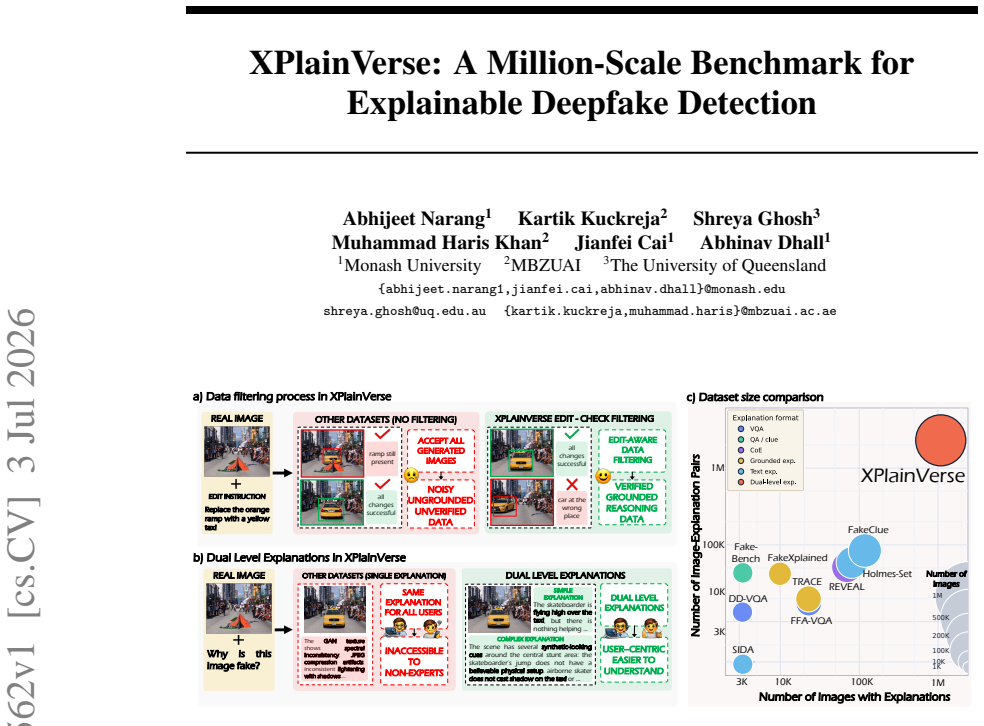
Edit-Check: a multi-stage filter that extracts visible differences between real and generated images, then judges whether those differences match the intended edit and discards off-target rewrites; EntityScore and EvidenceScore then score whether predicted explanations recover the same manipulated entities and visual evidence claims as the reference.
What would settle it
Train and score the same models using only the 2,000 human gold explanations as targets and as the sole Entity/Evidence reference, then check whether the reported ID-to-OOD collapse and the ranking of methods reverse or disappear relative to the silver-label results.
Extended reading notes
Core claim
The paper’s central claim is that explainable deepfake detection becomes a well-posed research problem only when manipulations are edit-verified, explanations are dual-level (expert and lay), and evaluation measures entity and evidence fidelity rather than surface text similarity. Under that regime, fine-tuned vision–language models look strong in distribution but fail under held-out generators, while EntityScore and EvidenceScore drop more than BERTScore—exposing fluent but ungrounded reasoning.
Load-bearing premise
The load-bearing premise is that large-scale VLM-written silver explanations, and VLM judges used for filtering and Entity/Evidence scoring, stay faithful enough to human-visible manipulation evidence to train and rank models.
Editorial extensions
If this is right
- Grounded explanation quality becomes a reported metric alongside detection F1, not an optional narrative.
- Generator-shift evaluation is required; strong in-domain fine-tuning no longer counts as success if Entity/Evidence collapse.
- Dual-level (technical vs simple) explanations become standard so systems can serve experts and non-experts without one style for all.
- Edit-aware filtering is treated as necessary for scalable reasoning supervision, not optional data cleaning.
- Detectors are pushed toward content-level cues (geometry, lighting, placement) as low-level generator artifacts fade.
Reading between the lines
- If silver labels and VLM judges share the same blind spots, reported gains on Entity/Evidence may partly measure agreement with that judge rather than human-grounded forensics.
- The same edit-instruction-plus-difference protocol could transfer to video and audio-visual deepfakes once temporal consistency checks replace still-image difference JSON.
- Deployment systems may need to expose both explanation styles and let users pick, because preference splits by role are large enough that a single default leaves many users underserved.
- Spectral convergence across newer generators implies that pure embedding probes will keep failing; methods that localize entities before explaining may be the practical next step.
Signed reviews
Editorial analysis
A structured set of objections, weighed in public.
Referee Report
Summary. The paper introduces XPlainVerse, a ~1M-image benchmark for joint deepfake detection and natural-language explanation. Real images from five public sources are paired with manipulations from twelve editing/synthesis models; a multi-stage Edit-Check pipeline (VLM difference extraction + text-only alignment judge) retains only edits that match intended instructions and discards off-target rewrites (~56.5% discard). The release provides dual-level explanations (complex forensic and simple lay explanations) plus authenticity explanations for reals, totaling ~1.53M image–explanation pairs, with human gold explanations on 2,000 fakes. The authors propose EntityScore and EvidenceScore—bidirectional VLM-judged coverage of diagnostic entities and visual evidence claims—alongside BERTScore and SLE, and report that fine-tuned VLMs reach high ID detection/explanation scores but drop sharply under generator-held-out OOD, while Entity/Evidence degrade more than surface similarity. Linear probes and spectral analyses suggest reliance on generator-specific low-level artifacts rather than stable visual evidence.
Significance. If the resource and metrics hold up, this is a substantial contribution to explainable deepfake detection: scale far exceeds prior explanation-oriented sets (Table 1), Edit-Check addresses a real source of weakly grounded supervision, dual-level explanations operationalize human-centered XAI needs, and Entity/Evidence scores target a genuine evaluation gap beyond fluency. The ID–OOD collapse and spectral/probe analyses are useful negative results for the community. Strengths include concrete inventories (Tables 8–10), kept-vs-discarded fidelity (Table 2), multi-stage human preference/quality studies (Figures 4–5, Tables 4 and 18), and a detailed appendix of prompts and protocols. The main significance risk is that explanation targets and automatic fidelity metrics are themselves largely VLM-produced, so the claim that grounded quality is now reliably measurable depends on how well those silver labels and judges track human visual evidence.
major comments (3)
- §3.1 Step 5 and §4 / Appendix I: Complex silver explanations are generated with privileged auxiliaries (paired real image, edit instruction, and difference JSON), while EntityScore/EvidenceScore extraction and bidirectional coverage are judged by Qwen3.5-4B. Human gold covers only 2,000 of ~530K fakes; inter-annotator EntityScore/EvidenceScore on a 10-image overlap are 0.5 and 0.44 (§3.2). Preference wins vs SIDA/human (Table 4) do not calibrate whether auto metrics recover the same diagnostic entities and evidence claims humans would mark. Without a reported correlation (or human re-annotation of metric components) on a larger held-out set, the central claim that Entity/Evidence make grounded quality measurable—and that their sharper OOD drop vs BERTScore proves loss of visual grounding rather than shift in VLM-style rationales—is only weakly supported. Please add metric–human agreement
- Table 9 and §5 / Table 5: Training fakes are extremely imbalanced—Gemini-2.0-flash accounts for 354,256 of 360,000 train fakes (~98.4%), with other generators almost entirely deferred to val/test. The reported >50-point F1 OOD drops for fine-tuned models are therefore largely “train-on-Gemini, test-on-other-generators.” That is still a valid robustness finding, but it confounds “generator-specific artifact memorization” with simple single-source overfitting. Please report per-generator ID/OOD breakdowns, retrain or ablate with more balanced multi-generator training subsets, and clarify how much of the collapse remains under multi-source training before attributing failure primarily to low-level spectral shortcuts (Figure 6).
- §3.1 Edit-Check and Appendix E: Filtering and KEEP/DISCARD decisions are fully VLM-driven (difference extractors + DeepSeek/GPT-OSS judges; KEEP if final_score ≥ 4). Table 2 and human edit-fidelity (Figure 4) support that retained pairs are cleaner, but there is no independent non-VLM audit of false KEEP/false DISCARD rates stratified by edit type (Table 11) or generator. Because explanation supervision is only as grounded as retained edit compliance, a quantified error analysis of the judge (e.g., human audit of a few thousand KEEP/DISCARD decisions, agreement with BORDERLINE handling) is load-bearing for the claim that Edit-Check enables reliable reasoning supervision at scale.
Circularity Check
No derivation-by-construction circularity; only a mild self-referential measurement loop (VLM silver labels scored by a VLM judge) that does not force the main empirical claims.
-
other
[§3.1 Step 5; §4; Appendix I (Entity/Evidence extraction & coverage)]
"For manipulated images, we generate two types of explanations. A complex explanation... one model randomly sampled from a pool of four (Gemini-3-Flash, GPT-5-mini, GLM-4.6V, and Qwen3.5-27B) receives the fake image alongside three auxiliary references: the paired real image, the edit-instruction, and the visual-difference... Given a predicted explanation and a reference explanation, we first use Qwen3.5-4B to extract... diagnostic entities and... evidence claims... compute coverage in two directional passes using the same Qwen3.5-4B evaluator."
Silver complex references are VLM-written with privileged edit/difference context, and EntityScore/EvidenceScore are then judged by another VLM (Qwen3.5-4B) for entity/claim coverage against those references. High automatic explanation scores can partly reflect agreement with VLM-preferred cue phrasing rather than independently verified human-grounded evidence. This is a mild self-referential measurement loop, not a definitional identity that forces detection F1, OOD drops, or spectral findings.
full rationale
XPlainVerse is a benchmark/dataset paper, not a first-principles derivation. Detection labels come from real sources plus generator outputs; Edit-Check verifies edit intent against image pairs rather than defining success as matching a fitted parameter; dual-level explanations and EntityScore/EvidenceScore are proposed evaluation constructs, not predictions forced by their own inputs. The main experimental findings—large ID→OOD F1 drops for fine-tuned VLMs, sharper Entity/Evidence degradation than BERTScore, and spectral/probe evidence of generator-specific shortcuts—are empirical comparisons on held-out generators and frozen embeddings, not tautologies. Human preference studies (Table 4, Figs. 4–5) and a 2,000-image gold subset provide external (if limited) anchors. Self-citations (e.g., LayLens, MultiFakeVerse) motivate dual-level explanations and supply some candidates but do not import a uniqueness theorem that forces the results. The only mild circularity-adjacent structure is that silver complex explanations and Entity/Evidence coverage are both VLM-mediated, so automatic explanation scores partly measure consistency with VLM-style rationales; that is a validity risk for the “grounded quality is measurable” claim, not a reduction of a claimed prediction to its defining inputs. Score 1 reflects that minor self-referential measurement structure without elevating it to load-bearing circular derivation.
Assumptions & free parameters
free parameters (4)
- Edit-Check KEEP threshold (final_score >= 4; BORDERLINE at 3)
- Difference salience scale (1–5) and unrelated-change penalty (0–2)
- Perturbation mixture rates and severity schedules by split
- SLE clip/normalize bounds [-1,4] → [0,1]
assumptions (4)
- domain assumption Visible compliance with a natural-language edit instruction (core intent present, no dominant off-target rewrite) is a valid proxy for high-quality manipulation supervision for explanation learning.
- domain assumption Ensemble VLMs can extract verifiable visual differences and produce explanations that, after filtering, approximate human forensic grounding at scale.
- ad hoc to paper Bidirectional semantic coverage of extracted entities and evidence claims (via Qwen3.5-4B) measures explanation fidelity better than surface similarity alone.
- standard math Standard deepfake/XAI evaluation practices: binary F1, BERTScore, human Likert/preference studies, frozen embedding probes, FFT spectral distance to real images.
invented entities (3)
-
Edit-Check multi-stage filtering pipeline
independent evidence
-
EntityScore and EvidenceScore
-
Dual-level (complex vs simple) explanation tracks with SLE for simplicity
independent evidence
Cite this review
Pith. "Pith review of XPlainVerse: A Million-Scale Benchmark for Explainable Deepfake Detection." pith.science (2026). https://pith.science/paper/AYZ4YC25
@misc{pith2026260703562,
  author       = {Pith},
  title        = {Pith review of: XPlainVerse: A Million-Scale Benchmark for Explainable Deepfake Detection},
  year         = {2026},
  howpublished = {\url{https://pith.science/paper/AYZ4YC25}},
  note         = {Machine review of arXiv:2607.03562}
}
read the original abstract
As deepfake detection models increasingly produce natural language explanations, their reasoning often remains weakly grounded in visual artifacts, limiting reliability and user trust. Existing benchmarks mainly evaluate classification accuracy, overlooking whether explanations reflect the actual manipulations. This gap hinders progress toward deployable, explainable deepfake detection systems. To this end, we introduce XPlainVerse, a large-scale benchmark designed for joint deepfake detection and human-centered explanation. XPlainVerse comprises one million real and manipulated images, pairing authentic images from five established sources with forgeries generated by twelve off-the-shelf image editing and synthesis models. We further propose a multi-stage filtering pipeline, Edit-Check, to verify if manipulations satisfy their intended edits, enabling reliable reasoning supervision at scale. Beyond dataset scale, XPlainVerse provides two complementary explanation styles: technical explanations for expert analysis and simplified explanations optimized for non-technical users. To evaluate explanation quality beyond surface similarity, we propose novel metrics, EntityScore and EvidenceScore, that measure reasoning fidelity by checking whether explanations correctly identify manipulated entities and visual evidence. Human annotations on 2,000 explanation pairs validate our dataset quality against human judgment. We believe XPlainVerse will establish grounded explanation quality as a measurable dimension of deepfake detection and support scalable research on trustworthy, interpretable models.
Figures


Figures from the paper (8 more)


Forward citations
Cited by 1 Pith paper
-
Explainable Deepfake Detection Challenge
A joint deepfake detection-and-explanation benchmark shows that classification accuracy and grounded, audience-appropriate explanations are separate capabilities, with Pixel Sleuth winning at 0.7612.
Reference graph
Works this paper leans on
-
[1]
Prompt-to-prompt image editing with cross attention control.arXiv preprint arXiv:2208.01626, 2022
Amir Hertz, Ron Mokady, Jay Tenenbaum, Kfir Aberman, Yael Pritch, and Daniel Cohen-Or. Prompt-to-prompt image editing with cross attention control.arXiv preprint arXiv:2208.01626, 2022
arXiv 2022
-
[2]
Instructpix2pix: Learning to follow image editing instructions
Tim Brooks, Aleksander Holynski, and Alexei A Efros. Instructpix2pix: Learning to follow image editing instructions. InProceedings of the IEEE/CVF conference on computer vision and pattern recognition, pages 18392–18402, 2023
2023
-
[3]
Qwen-image technical report, 2025
Chenfei Wu, Jiahao Li, Jingren Zhou, Junyang Lin, Kaiyuan Gao, Kun Yan, Sheng ming Yin, Shuai Bai, Xiao Xu, Yilei Chen, Yuxiang Chen, Zecheng Tang, Zekai Zhang, Zhengyi Wang, An Yang, Bowen Yu, Chen Cheng, Dayiheng Liu, Deqing Li, Hang Zhang, Hao Meng, Hu Wei, Jingyuan Ni, Kai Chen, Kuan Cao, Liang Peng, Lin Qu, Minggang Wu, Peng Wang, Shuting Yu, Tingkun...
arXiv 2025
-
[4]
Faceforensics++: Learning to detect manipulated facial images, 2019
Andreas Rössler, Davide Cozzolino, Luisa Verdoliva, Christian Riess, Justus Thies, and Matthias Nießner. Faceforensics++: Learning to detect manipulated facial images, 2019. URL https: //arxiv.org/abs/1901.08971
arXiv 2019
-
[5]
The deepfake detection challenge (dfdc) dataset, 2020
Brian Dolhansky, Joanna Bitton, Ben Pflaum, Jikuo Lu, Russ Howes, Menglin Wang, and Cristian Canton Ferrer. The deepfake detection challenge (dfdc) dataset, 2020. URL https: //arxiv.org/abs/2006.07397
arXiv 2020
-
[6]
Zhenglin Huang, Jinwei Hu, Xiangtai Li, Yiwei He, Xingyu Zhao, Bei Peng, Baoyuan Wu, Xiaowei Huang, and Guangliang Cheng. Sida: Social media image deepfake de- tection, localization and explanation with large multimodal model, 2025. URL https: //arxiv.org/abs/2412.04292
arXiv 2025
-
[7]
Genimage: A million-scale benchmark for detecting ai-generated image, 2023
Mingjian Zhu, Hanting Chen, Qiangyu Yan, Xudong Huang, Guanyu Lin, Wei Li, Zhijun Tu, Hailin Hu, Jie Hu, and Yunhe Wang. Genimage: A million-scale benchmark for detecting ai-generated image, 2023. URLhttps://arxiv.org/abs/2306.08571
arXiv 2023
-
[8]
Dire for diffusion-generated image detection, 2023
Zhendong Wang, Jianmin Bao, Wengang Zhou, Weilun Wang, Hezhen Hu, Hong Chen, and Houqiang Li. Dire for diffusion-generated image detection, 2023. URL https://arxiv.org/ abs/2303.09295
arXiv 2023
Show all 110 references
-
[9]
Common sense reasoning for deepfake detection, 2024
Yue Zhang, Ben Colman, Xiao Guo, Ali Shahriyari, and Gaurav Bharaj. Common sense reasoning for deepfake detection, 2024. URLhttps://arxiv.org/abs/2402.00126
2024 arXiv
-
[10]
Ffaa: Multimodal large language model based explainable open-world face forgery analysis assistant,
Zhengchao Huang, Bin Xia, Zicheng Lin, Zhun Mou, Wenming Yang, and Jiaya Jia. Ffaa: Multimodal large language model based explainable open-world face forgery analysis assistant,
-
[11]
URLhttps://arxiv.org/abs/2408.10072
-
[12]
Fakebench: Probing explainable fake image detection via large multimodal models, 2024
Yixuan Li, Xuelin Liu, Xiaoyang Wang, Bu Sung Lee, Shiqi Wang, Anderson Rocha, and Weisi Lin. Fakebench: Probing explainable fake image detection via large multimodal models, 2024. URLhttps://arxiv.org/abs/2404.13306
2024 arXiv
-
[13]
X-transfer attacks: Towards super transferable adversarial attacks on clip, 2025
Hanxun Huang, Sarah Erfani, Yige Li, Xingjun Ma, and James Bailey. X-transfer attacks: Towards super transferable adversarial attacks on clip, 2025. URL https://arxiv.org/abs/ 2505.05528
2025 arXiv
-
[14]
Adversarial attacks against closed-source mllms via feature optimal alignment, 2025
Xiaojun Jia, Sensen Gao, Simeng Qin, Tianyu Pang, Chao Du, Yihao Huang, Xinfeng Li, Yiming Li, Bo Li, and Yang Liu. Adversarial attacks against closed-source mllms via feature optimal alignment, 2025. URLhttps://arxiv.org/abs/2505.21494
2025 arXiv
-
[15]
Reveal: Reasoning-enhanced forensic evidence analysis for explainable ai-generated image detection, 2026
Huangsen Cao, Qin Mei, Zhiheng Li, Yuxi Li, Zhan Meng, Ying Zhang, Chen Li, Zhimeng Zhang, Xin Ding, Yongwei Wang, Jing Lyu, and Fei Wu. Reveal: Reasoning-enhanced forensic evidence analysis for explainable ai-generated image detection, 2026. URL https: //arxiv.org/abs/2511.23158. 10
2026 arXiv
-
[16]
Interpretable and reliable detection of ai-generated images via grounded reasoning in mllms, 2025
Yikun Ji, Hong Yan, Jun Lan, Huijia Zhu, Weiqiang Wang, Qi Fan, Liqing Zhang, and Jianfu Zhang. Interpretable and reliable detection of ai-generated images via grounded reasoning in mllms, 2025. URLhttps://arxiv.org/abs/2506.07045
2025 arXiv
-
[17]
Aigi-holmes: Towards explainable and generalizable ai-generated image detection via multimodal large language models, 2025
Ziyin Zhou, Yunpeng Luo, Yuanchen Wu, Ke Sun, Jiayi Ji, Ke Yan, Shouhong Ding, Xiaoshuai Sun, Yunsheng Wu, and Rongrong Ji. Aigi-holmes: Towards explainable and generalizable ai-generated image detection via multimodal large language models, 2025. URL https: //arxiv.org/abs/2507.02664
2025 arXiv
-
[18]
Spot the fake: Large multimodal model-based synthetic image detection with artifact explanation, 2025
Siwei Wen, Junyan Ye, Peilin Feng, Hengrui Kang, Zichen Wen, Yize Chen, Jiang Wu, Wenjun Wu, Conghui He, and Weijia Li. Spot the fake: Large multimodal model-based synthetic image detection with artifact explanation, 2025. URLhttps://arxiv.org/abs/2503.14905
2025
-
[19]
Locate-then-examine: Grounded region reasoning improves detection of ai-generated images, 2026
Yikun Ji, Yan Hong, Bowen Deng, Jun Lan, Huijia Zhu, Weiqiang Wang, Liqing Zhang, and Jianfu Zhang. Locate-then-examine: Grounded region reasoning improves detection of ai-generated images, 2026. URLhttps://arxiv.org/abs/2510.04225
2026 arXiv
-
[20]
Explanation in artificial intelligence: Insights from the social sciences.Artificial Intelligence, 267:1–38, 2019
Tim Miller. Explanation in artificial intelligence: Insights from the social sciences.Artificial Intelligence, 267:1–38, 2019. ISSN 0004-3702. doi: https://doi.org/10.1016/j.artint.2018.07.007. URLhttps://www.sciencedirect.com/science/article/pii/S0004370218305988
2019 doi
-
[21]
Can we do better explanations? a proposal of user-centered explainable ai
Mireia Ribera Turró and Agata Lapedriza. Can we do better explanations? a proposal of user-centered explainable ai. 03 2019
2019
-
[22]
Vera Liao, Daniel Gruen, and Sarah Miller
Q. Vera Liao, Daniel Gruen, and Sarah Miller. Questioning the ai: Informing design practices for explainable ai user experiences. InProceedings of the 2020 CHI Conference on Human Factors in Computing Systems, CHI ’20, page 1–15, New York, NY , USA, 2020. Association for Compu...
2020 doi
-
[23]
Upol Ehsan and Mark O. Riedl. Human-centered explainable ai: Towards a reflective sociotech- nical approach, 2020. URLhttps://arxiv.org/abs/2002.01092
2020 arXiv
-
[24]
Pentyala, Eric D
Rhema Linder, Sina Mohseni, Fan Yang, Shiva K. Pentyala, Eric D. Ragan, and Xia Ben Hu. How level of explanation detail affects human performance in interpretable intelligent systems: A study on explainable fact checking.Applied AI Letters, 2(4):e49, 2021. doi: https://doi.org...
2021 doi
-
[25]
Laylens: Improving deepfake understanding through simplified explanations
Abhijeet Narang, Parul Gupta, Liuyijia Su, and Abhinav Dhall. Laylens: Improving deepfake understanding through simplified explanations. InProceedings of the 27th International Conference on Multimodal Interaction, ICMI ’25, page 788–790, New York, NY , USA, 2025. Association ...
2025 doi
-
[26]
On the detection of digital face manipulation, 2020
Hao Dang, Feng Liu, Joel Stehouwer, Xiaoming Liu, and Anil Jain. On the detection of digital face manipulation, 2020. URLhttps://arxiv.org/abs/1910.01717
2020 arXiv
-
[27]
Multi- verse through deepfakes: The multifakeverse dataset of person-centric visual and concep- tual manipulations
Parul Gupta, Shreya Ghosh, Tom Gedeon, Thanh-Toan Do, and Abhinav Dhall. Multi- verse through deepfakes: The multifakeverse dataset of person-centric visual and concep- tual manipulations. InProceedings of the 33rd ACM International Conference on Multi- media, MM ’25, page 132...
2025 doi
-
[28]
Semi-truths: A large-scale dataset of ai-augmented images for evaluating robustness of ai-generated image detectors, 2024
Anisha Pal, Julia Kruk, Mansi Phute, Manognya Bhattaram, Diyi Yang, Duen Horng Chau, and Judy Hoffman. Semi-truths: A large-scale dataset of ai-augmented images for evaluating robustness of ai-generated image detectors, 2024. URL https://arxiv.org/abs/2411. 07472
2024
-
[29]
Spatial-phase shallow learning: Rethinking face forgery detection in frequency domain, 2021
Honggu Liu, Xiaodan Li, Wenbo Zhou, Yuefeng Chen, Yuan He, Hui Xue, Weiming Zhang, and Nenghai Yu. Spatial-phase shallow learning: Rethinking face forgery detection in frequency domain, 2021. URLhttps://arxiv.org/abs/2103.01856. 11
2021 arXiv
-
[30]
Face x-ray for more general face forgery detection, 2020
Lingzhi Li, Jianmin Bao, Ting Zhang, Hao Yang, Dong Chen, Fang Wen, and Baining Guo. Face x-ray for more general face forgery detection, 2020. URL https://arxiv.org/abs/ 1912.13458
2020 arXiv
-
[31]
In ictu oculi: Exposing ai generated fake face videos by detecting eye blinking, 2018
Yuezun Li, Ming-Ching Chang, and Siwei Lyu. In ictu oculi: Exposing ai generated fake face videos by detecting eye blinking, 2018. URLhttps://arxiv.org/abs/1806.02877
2018 arXiv
-
[32]
Mesonet: a compact facial video forgery detection network
Darius Afchar, Vincent Nozick, Junichi Yamagishi, and Isao Echizen. Mesonet: a compact facial video forgery detection network. In2018 IEEE International Workshop on Information Forensics and Security (WIFS), page 1–7. IEEE, December 2018. doi: 10.1109/wifs.2018.8630761. URL ht...
2018 doi
-
[33]
David Güera and Edward J. Delp. Deepfake video detection using recurrent neural networks. In 2018 15th IEEE International Conference on Advanced Video and Signal Based Surveillance (AVSS), pages 1–6, 2018. doi: 10.1109/A VSS.2018.8639163
2018 doi
-
[34]
Multi-attentional deepfake detection, 2021
Hanqing Zhao, Wenbo Zhou, Dongdong Chen, Tianyi Wei, Weiming Zhang, and Nenghai Yu. Multi-attentional deepfake detection, 2021. URLhttps://arxiv.org/abs/2103.02406
2021 arXiv
-
[35]
Patch diffusion: a general module for face manipulation detection
Baogen Zhang, Sheng Li, Guorui Feng, Zhenxing Qian, and Xinpeng Zhang. Patch diffusion: a general module for face manipulation detection. InProceedings of the AAAI conference on artificial intelligence, volume 36, pages 3243–3251, 2022
2022
-
[36]
M2tr: Multi-modal multi-scale transformers for deepfake detection
Junke Wang, Zuxuan Wu, Wenhao Ouyang, Xintong Han, Jingjing Chen, Yu-Gang Jiang, and Ser-Nam Li. M2tr: Multi-modal multi-scale transformers for deepfake detection. InProceedings of the 2022 International Conference on Multimedia Retrieval, ICMR ’22, page 615–623, New York, NY ...
2022 doi
-
[37]
Fakeshield: Explainable image forgery detection and localization via multi-modal large language models,
Zhipei Xu, Xuanyu Zhang, Runyi Li, Zecheng Tang, Qing Huang, and Jian Zhang. Fakeshield: Explainable image forgery detection and localization via multi-modal large language models,
-
[38]
URLhttps://arxiv.org/abs/2410.02761
-
[39]
Busterx++: Towards unified cross-modal ai-generated content detection and explanation with mllm, 2026
Haiquan Wen, Tianxiao Li, Zhenglin Huang, Yiwei He, and Guangliang Cheng. Busterx++: Towards unified cross-modal ai-generated content detection and explanation with mllm, 2026. URLhttps://arxiv.org/abs/2507.14632
2026 arXiv
-
[40]
Pixels don’t lie (but your detector might): Bootstrapping mllm-as-a-judge for trustworthy deepfake detection and reasoning supervision, 2026
Kartik Kuckreja, Parul Gupta, Muhammad Haris Khan, and Abhinav Dhall. Pixels don’t lie (but your detector might): Bootstrapping mllm-as-a-judge for trustworthy deepfake detection and reasoning supervision, 2026. URLhttps://arxiv.org/abs/2602.19715
2026
-
[41]
Towards human-centered explainable ai: A survey of user studies for model explanations.IEEE Transactions on Pattern Analysis and Machine Intelligence, 46(4):2104–2122, April 2024
Yao Rong, Tobias Leemann, Thai-Trang Nguyen, Lisa Fiedler, Peizhu Qian, Vaibhav Unhelkar, Tina Seidel, Gjergji Kasneci, and Enkelejda Kasneci. Towards human-centered explainable ai: A survey of user studies for model explanations.IEEE Transactions on Pattern Analysis and Machi...
2024 doi
-
[42]
Vera Liao and Kush R
Q. Vera Liao and Kush R. Varshney. Human-centered explainable ai (xai): From algorithms to user experiences, 2022. URLhttps://arxiv.org/abs/2110.10790
2022 arXiv
-
[43]
Alina Kuznetsova, Hassan Rom, Neil Alldrin, Jasper Uijlings, Ivan Krasin, Jordi Pont-Tuset, Shahab Kamali, Stefan Popov, Matteo Malloci, Alexander Kolesnikov, Tom Duerig, and Vittorio Ferrari. The open images dataset v4: Unified image classification, object detection, and visu...
1956 doi
-
[44]
Context based emotion recognition using emotic dataset.IEEE Transactions on Pattern Analysis and Machine In- telligence, page 1–1, 2019
Ronak Kosti, Jose Alvarez, Adria Recasens, and Agata Lapedriza. Context based emotion recognition using emotic dataset.IEEE Transactions on Pattern Analysis and Machine In- telligence, page 1–1, 2019. ISSN 1939-3539. doi: 10.1109/tpami.2019.2916866. URL http://dx.doi.org/10.11...
2019 doi
-
[45]
Person recognition in personal photo collections, 2015
Seong Joon Oh, Rodrigo Benenson, Mario Fritz, and Bernt Schiele. Person recognition in personal photo collections, 2015. URLhttps://arxiv.org/abs/1509.03502. 12
2015 arXiv
-
[46]
Human-centric relation segmentation: Dataset and solution, 2021
Si Liu, Zitian Wang, Yulu Gao, Lejian Ren, Yue Liao, Guanghui Ren, Bo Li, and Shuicheng Yan. Human-centric relation segmentation: Dataset and solution, 2021. URL https://arxiv. org/abs/2105.11168
2021 arXiv
-
[47]
Kankanhalli
Junnan Li, Yongkang Wong, Qi Zhao, and Mohan S. Kankanhalli. Visual social relationship recognition, 2018. URLhttps://arxiv.org/abs/1812.05917
2018 arXiv
-
[48]
Gpt-4o mini: Advancing cost-efficient intelligence
OpenAI. Gpt-4o mini: Advancing cost-efficient intelligence. OpenAI Blog, 2024. URL https: //openai.com/index/gpt-4o-mini-advancing-cost-efficient-intelligence/
2024
-
[49]
Flux.2-dev
Black Forest Labs. Flux.2-dev. Hugging Face Model Card, 2026. URL https:// huggingface.co/black-forest-labs/FLUX.2-dev
2026
-
[50]
Hunyuanimage 3.0 technical report, 2026
Siyu Cao, Hangting Chen, Peng Chen, Yiji Cheng, Yutao Cui, Xinchi Deng, Ying Dong, Kipper Gong, Tianpeng Gu, Xiusen Gu, Tiankai Hang, Duojun Huang, Jie Jiang, Zhengkai Jiang, Weijie Kong, Changlin Li, Donghao Li, Junzhe Li, Xin Li, Yang Li, Zhenxi Li, Zhimin Li, Jiaxin Lin, Li...
2026 arXiv
-
[51]
Longcat-image technical report, 2025
Meituan LongCat Team, Hanghang Ma, Haoxian Tan, Jiale Huang, Junqiang Wu, Jun-Yan He, Lishuai Gao, Songlin Xiao, Xiaoming Wei, Xiaoqi Ma, Xunliang Cai, Yayong Guan, and Jie Hu. Longcat-image technical report, 2025. URLhttps://arxiv.org/abs/2512.07584
2025 arXiv
-
[52]
Gpt image 1.5 model documentation
OpenAI. Gpt image 1.5 model documentation. OpenAI API Documentation, 2025. URL https://developers.openai.com/api/docs/models/gpt-image-1.5
2025
-
[53]
Seedream 4.5
ByteDance Seed Team. Seedream 4.5. Official Model Page, 2026. URL https://seed. bytedance.com/en/seedream4_5
2026
-
[54]
Wan2.6 image generation and editing
Alibaba Cloud. Wan2.6 image generation and editing. Alibaba Cloud Model Studio Documentation, 2026. URL https://www.alibabacloud.com/help/en/model-studio/ wan-image-generation-api-reference
2026
-
[55]
Build with nano banana 2
Google. Build with nano banana 2. Google Blog, 2026. URL https: //blog.google/innovation-and-ai/technology/developers-tools/ build-with-nano-banana-2/
2026
-
[56]
Introducing nano banana pro
Google DeepMind. Introducing nano banana pro. Google Blog, 2025. URL https://blog. google/innovation-and-ai/products/nano-banana-pro/
2025
-
[57]
Experiment with gemini 2.0 flash native image generation
Google. Experiment with gemini 2.0 flash native image generation. Google Developers Blog, 2025. URL https://developers.googleblog.com/ experiment-with-gemini-20-flash-native-image-generation/ . Accessed: 2026-05-06
2025
-
[58]
Gpt image 1 model
OpenAI. Gpt image 1 model. OpenAI API Documentation, 2025. URL https://developers. openai.com/api/docs/models/gpt-image-1. Accessed: 2026-05-06
2025
-
[59]
In-context edit: Enabling instructional image editing with in-context generation in large scale diffusion transformer, 2025
Zechuan Zhang, Ji Xie, Yu Lu, Zongxin Yang, and Yi Yang. In-context edit: Enabling instructional image editing with in-context generation in large scale diffusion transformer, 2025. URLhttps://arxiv.org/abs/2504.20690
2025 arXiv
-
[60]
Gemini 3 flash: Frontier intelligence built for speed
Google. Gemini 3 flash: Frontier intelligence built for speed. Google Blog, 2025. URL https: //blog.google/products-and-platforms/products/gemini/gemini-3-flash/
2025
-
[61]
Gpt-5 mini model documentation
OpenAI. Gpt-5 mini model documentation. OpenAI API Documentation, 2026. URL https: //developers.openai.com/api/docs/models/gpt-5-mini. 13
2026
-
[62]
Glm-4.6v: Open source multimodal models with native tool use
Z.ai. Glm-4.6v: Open source multimodal models with native tool use. Z.ai Developer Docu- mentation, 2025. URLhttps://docs.z.ai/guides/vlm/glm-4.6v
2025
-
[63]
Qwen3.5: Towards native multimodal agents, February 2026
Qwen Team. Qwen3.5: Towards native multimodal agents, February 2026. URL https: //qwen.ai/blog?id=qwen3.5
2026
-
[64]
DeepSeek-AI, Aixin Liu, Aoxue Mei, Bangcai Lin, Bing Xue, Bingxuan Wang, Bingzheng Xu, Bochao Wu, Bowei Zhang, Chaofan Lin, Chen Dong, Chengda Lu, Chenggang Zhao, Chengqi Deng, Chenhao Xu, Chong Ruan, Damai Dai, Daya Guo, Dejian Yang, Deli Chen, Erhang Li, Fangqi Zhou, Fangyun...
2025 arXiv
-
[65]
Introducing gpt-oss
OpenAI. Introducing gpt-oss. OpenAI Blog, 2025. URL https://openai.com/index/ introducing-gpt-oss/
2025
-
[66]
Gemini 2.5 pro
Google. Gemini 2.5 pro. Google AI for Developers Documentation, 2025. URL https: //ai.google.dev/gemini-api/docs/models/gemini-2.5-pro
2025
-
[67]
Weinberger, and Yoav Artzi
Tianyi Zhang, Varsha Kishore, Felix Wu, Kilian Q. Weinberger, and Yoav Artzi. Bertscore: Evaluating text generation with bert, 2020. URLhttps://arxiv.org/abs/1904.09675
2020 arXiv
-
[68]
Simplicity level estimate (sle): A learned reference-less metric for sentence simplification, 2023
Liam Cripwell, Joël Legrand, and Claire Gardent. Simplicity level estimate (sle): A learned reference-less metric for sentence simplification, 2023. URLhttps://arxiv.org/abs/2310. 08170
2023
-
[69]
Qwen3-vl technical report, 2025
Shuai Bai, Yuxuan Cai, Ruizhe Chen, Keqin Chen, Xionghui Chen, Zesen Cheng, Lianghao Deng, Wei Ding, Chang Gao, Chunjiang Ge, Wenbin Ge, Zhifang Guo, Qidong Huang, Jie 14 Huang, Fei Huang, Binyuan Hui, Shutong Jiang, Zhaohai Li, Mingsheng Li, Mei Li, Kaixin Li, Zicheng Lin, Ju...
2025 arXiv
-
[70]
Internvl3.5: Advancing open-source multimodal models in versatility, reasoning, and efficiency, 2025
Weiyun Wang, Zhangwei Gao, Lixin Gu, Hengjun Pu, Long Cui, Xingguang Wei, Zhaoyang Liu, Linglin Jing, Shenglong Ye, Jie Shao, Zhaokai Wang, Zhe Chen, Hongjie Zhang, Ganlin Yang, Haomin Wang, Qi Wei, Jinhui Yin, Wenhao Li, Erfei Cui, Guanzhou Chen, Zichen Ding, Changyao Tian, Z...
2025 arXiv
-
[71]
Visual instruction tuning, 2023
Haotian Liu, Chunyuan Li, Qingyang Wu, and Yong Jae Lee. Visual instruction tuning, 2023. URLhttps://arxiv.org/abs/2304.08485
2023 arXiv
-
[72]
Llava-next: Improved reasoning, ocr, and world knowledge
LLaV A Team. Llava-next: Improved reasoning, ocr, and world knowledge. Project Blog, 2024. URLhttps://llava-vl.github.io/blog/2024-01-30-llava-next/. 15 Appendix XPlainVerse: A Million-Scale Benchmark for Explainable Deepfake Detection Supplementary Material A Appendix Roadmap...
2024
-
[73]
Image real- ism Judge whether individ- ual images appear real or manipulated Real/fake judgment, confidence, visual realism Choice + 1–5 scale
-
[74]
Edit quality Evaluate paired origi- nal and edited images Core edit presence, edit realism, unrelated off-target changes 1–5 scale
-
[75]
Explana- tion quality Rate one explanation for one image Grounding, specificity, completeness, convincingness, unsupported claims 1–5 scale
-
[76]
Ex- planation preference Compare two explana- tions for the same im- age Grounding, specificity, completeness, fewer unsupported claims, overall usefulness A/B/Tie
-
[77]
generated comparison Compare human- written and generated complex explanations Grounding, specificity, completeness, fewer unsupported claims, overall preference A/B/Tie
Human vs. generated comparison Compare human- written and generated complex explanations Grounding, specificity, completeness, fewer unsupported claims, overall preference A/B/Tie
-
[78]
Readability Evaluate simple/user- facing explanations Ease of understanding, memorability, cognitive load, liking 1–5 scale
-
[79]
not sure
Audience usefulness Compare explanations for different users Personal preference, usefulness for ordinary users, usefulness for technical analysts, clarity/evidence balance, default system choice Choice 26 Original Edited Edit/diff:Add a large construction crane in the backgro...
-
[80]
Subtlety / under-edit risk (MOST IMPORTANT) - Is the intended change small, fine-grained, or easy for models to ignore/half-apply? - If yes, reduce P(success) aggressively, even if the edit sounds “small”
-
[81]
Instance/identity lock (replacement not allowed) - Must remain the same subject/object instance (not swapped for a different-looking one)? - Strongly reduce P(success) if identity must remain stable while only one attribute changes
-
[82]
Locality + collateral-damage intolerance - Must be confined to a specific region while everything else stays identical? - Higher intolerance to spillover => lower P(success)
-
[83]
Structure continuity / reveal-cover requirements - Does the edit require plausible reconstruction of previously occluded areas or seamless continuation of edges/textures/geometry? - If yes, lower P(success), especially when the reconstructed region must align with existing structures
-
[84]
difficulty_scores
Caption underspecification 38 - If the caption doesn’t provide enough detail to judge what “correct” means (placement/appearance), treat the instruction as harder (lower P(success)). Magnitude rule (secondary): - Do NOT automatically rate large changes as hard. If the instruct...
-
[85]
K.4 Visual-Difference Extraction Prompt System prompt You are a Visual Difference Extractor
{instruction_2} ... K.4 Visual-Difference Extraction Prompt System prompt You are a Visual Difference Extractor. INPUTS: - Image A: original/real image - Image B: generated/edited image GOAL: List only the differences that are VISUALLY VERIFIABLE between Image A and Image B. D...
-
[86]
overall_summary
"overall_summary": string
-
[87]
changes": array of objects Each object in
"changes": array of objects Each object in "changes" MUST have exactly: - "entity": string - "salience": integer from 1 to 5 - "differences": array of strings FORMAT for each string in "differences": "A: <what is visible in Image A>; B: <what is visible in Image B>." HOW TO CO...
-
[88]
before/after
Do NOT mention or imply: any other image, comparisons, “before/after”, “edit instruction”, “difference JSON”, “Image A/B”, “original/real/reference”, or “compared to”
-
[89]
- If you only know it because of the auxiliary references, DO NOT include it
Every claim must be directly and clearly supported by visible evidence in the GENERATED_IMAGE alone. - If you only know it because of the auxiliary references, DO NOT include it
-
[90]
explanation
You may use the auxiliary references ONLY to decide where to inspect more carefully. - Do NOT copy wording from DIFFERENCE_JSON. - Do NOT introduce claims that you cannot see in the GENERATED_IMAGE. WHAT TO LOOK FOR (examples): - warped geometry (hands/face asymmetry, bent str...
-
[91]
Write the final explanation as if you only saw the GENERATED_IMAGE
-
[92]
A” or “B
Do NOT mention or hint at: - the original image - a reference image - before/after - edit instruction - difference JSON - intended change - “A” or “B”
-
[93]
Do NOT use comparison phrases like: - changed from - used to - originally - compared to - should be - restored
-
[94]
Do NOT introduce a totally new main person, object, or story that is not connected to the COMPLEX_EXPLANATION and/or DIFFERENCE_JSON
-
[95]
You MAY say new simple things about the same changed thing, as long as they are easy to see in the GENERATED_IMAGE
-
[96]
If you are unsure, choose the clearest and most obvious reason only
-
[97]
explanation
Do not try to sound smart. Sound clear. OUTPUT FORMAT: Return ONLY valid JSON with exactly one key: { "explanation": string } FINAL CHECK BEFORE ANSWERING: - Is this about just one main changed thing? - Is this easy for a five-year-old to understand? - Did I avoid hard words? ...
-
[98]
diagnostic_entities: the entities that are actually used as evidence for the authenticity judgment
-
[99]
the image looks fake
evidence_claims: the specific claims that explain why those entities make the image look fake or real Important: Do NOT extract all entities mentioned in the explanation. Do NOT extract all factual statements. Extract only the entities and claims that function as evidence for ...
-
[100]
Use only information explicitly stated in the explanation
-
[101]
Do not infer unstated causes, intentions, or visual details
-
[102]
Extract only evidence-bearing entities
-
[103]
Extract only evidence-bearing claims
-
[104]
Each claim must be specific and checkable
-
[105]
Keep wording normalized and concise
-
[106]
Do not create entities for minor sub-parts unless the explanation is clearly centered on them
-
[107]
Do not include non-evidential context
-
[108]
diagnostic_entities
Return valid JSON only Output schema: { "diagnostic_entities": [ { "entity_id": "E1", "name": "..." } ], "evidence_claims": [ { "claim_id": "C1", "entity_id": "E1", "claim": "..." } ] } Additional guidance: - Prefer the entity that actually carries the evidence - Do not includ...
-
[109]
a reference JSON containing: - diagnostic_entities - evidence_claims
-
[110]
Would a reasonable human judge say that the candidate explanation covers this same evidence, even if phrased differently?
a candidate explanation Your job is to determine, for each diagnostic entity and each evidence claim in the reference JSON, whether it is present in the candidate explanation. This is a LENIENT SEMANTIC MATCHING task. Do NOT require exact wording. Match based on core meaning. ...
Reviewed July 12, 2026 · model on record in the stance chip above.
Discussion (0). Continue with ORCID to comment.