REVIEW 3 major objections 4 minor 43 references
Sending two chirps lets Rydberg receivers locate moving targets
Reviewed by Pith at T0; open to challenge. T0 means a machine referee read the full paper against a public rubric. the ladder, T0–T4 →
T0 review · deepseek-v4-flash
2026-07-31 23:18 UTC pith:AZNVDVZI
load-bearing objection The multiple-chirp idea is sound, but the simulation model breaks for the advertised ranges, so the headline improvement is not yet credible. the 3 major comments →
Multi-Chirp AFDM for Rydberg Atomic Quantum Receivers: Waveform and Algorithm Design
The pith
A machine-rendered reading of the paper's core claim, the machinery that carries it, and where it could break.
Core claim
The central claim is that the optical ambiguity of Rydberg atomic receivers in doubly-dispersive channels can be removed by using multiple distinct post-chirps in AFDM. In the classical single-chirp scheme, each target produces one fluctuation frequency per frame, giving K equations for 2K unknowns (delay and Doppler). With P≥2 distinct chirp rates, the post-chirp matrix C1—whose rows are [2c~_1^(p), -1]—becomes full-rank, yielding KP equations. The paper also discovers that maximizing the variance of the chirp-rate vector, achieved by placing chirp rates at the minimum and maximum allowed values, minimizes the condition number of C1 and sharpens delay-Doppler estimates. The resulting MC-AFD
What carries the argument
The post-chirp matrix C1, whose p-th row is [2˜c_1^(p), -1], is the central object: it linearly maps each target's channel parameter vector [τ_k−τ_l, ν_k] to the vector of per-frame fluctuation frequencies. Its full-rank condition requires at least two distinct chirp rates (P≥2), and its condition number—minimized by maximizing the variance of the chirp-rate vector, i.e., pushing chirp rates to the edges of the allowed range—controls the amplification of frequency-estimation error in the least-squares delay-Doppler recovery. The CRLB derived from the corresponding Fisher information matrix scales inversely with this variance and with P.
Load-bearing premise
The whole measurement model rests on the strong local-oscillator approximation |E_l| >> |E_s|, which lets the Rydberg optical response be linearized to a cosine of the phase difference; if this linearization breaks when the chirp sweeps the RF frequency across the atomic resonance, the fluctuation-frequency extraction and all subsequent delay-Doppler estimates collapse.
What would settle it
A controlled experiment with a single moving reflector in an anechoic chamber: transmit MC-AFDM with two known post-chirps through a Rydberg receiver, record the output voltage, and compare the two measured fluctuation frequencies against equation (32) using independently measured delay and Doppler. If the extracted frequencies deviate from the predicted linear relation by more than the noise floor, or if the least-squares delay-Doppler estimate is biased, the linearized cosine model (15) is falsified.
If this is right
- Rydberg atomic receivers can jointly estimate delay and Doppler for multiple moving targets in doubly-dispersive channels, which single-chirp AFDM cannot do.
- Edge-distributed post-chirp rates improve range and velocity estimation by up to roughly 2.5- to 4-fold over uniform distribution in multi-target scenarios.
- Increasing the number of post-chirps P lowers both the CRLB and the condition number, so estimation accuracy continues to improve with more chirp diversity.
- The proposed OMP-plus-LS algorithm reaches the derived CRLB across simulated SNR levels, indicating the waveform, not the estimator, is the limiting factor.
- The MC-AFDM design can be extended to integrated sensing and communications, channel estimation, and MIMO systems with Rydberg receivers, as the paper notes in its conclusion.
Where Pith is reading between the lines
- The rank-deficiency argument is generic: any sensing system that maps delay and Doppler into a single frequency measurement with a unique slope faces the same K-equations-for-2K-unknowns ambiguity, so the multi-chirp trick likely transfers to other self-heterodyne or autocorrelation-based receivers beyond Rydberg atoms.
- Because the CRLB scales as 1/Var(c~_1) and 1/P, the fundamental accuracy limit is set by the receiver's instantaneous bandwidth (which bounds the chirp-rate spread) and the number of frames; waveforms with non-linear chirps or intra-frame chirp-rate variations might relax this trade-off.
- The minimum chirp-rate difference required by the OMP grid (Remark 3) implies a direct coupling between grid resolution, target range, and bandwidth; a gridless frequency estimator could reduce the required chirp spread or the number of frames.
- The entire framework hinges on the linearized cosine measurement model, so an experimental calibration of (15) across the full chirp bandwidth is the next logical step before deployment; if the linearization fails near resonance, the fluctuation-frequency extraction would need a different detector model.
Editorial analysis
A structured set of objections, weighed in public.
Referee Report
Summary. The manuscript proposes a multi-chirp AFDM (MC-AFDM) waveform for joint delay-Doppler estimation using Rydberg atomic quantum receivers (RAQRs). The authors model the Rydberg self-heterodyne output as a sum of cosines whose frequencies are affine functions of delay and Doppler. They observe that the standard single-chirp AFDM (SC-AFDM) yields the same frequency vector for all subcarriers, producing only K equations for 2K parameters, and propose using P distinct post-chirps across P frames to make the system overdetermined. They then provide a condition-number-based design rule, an OMP-based frequency estimator followed by least-squares delay-Doppler recovery, and a Cramér–Rao lower bound. Simulations compare SC-AFDM, dual-chirp AFDM, and uniform/edge chirp distributions.
Significance. The core idea—using post-chirp diversity to lift a rank deficiency in the frequency-only delay-Doppler inversion—is simple and plausible, and the paper gives transparent derivations for the post-chirp matrix and the CRLB. The rank-deficiency observation in Remark 1 is correct for the frequency-only model, and the CRLB derivation is internally consistent under its stated asymptotic approximations. If the simulation and the design theorem were fully valid, the paper would be a useful contribution to RAQR waveform design. However, as detailed below, the numerical validation is based on a model that does not describe the simulated delay regime, and the proof of the central design theorem is not valid as stated.
major comments (3)
- [§IV-A and §VI-A] The MC-AFDM measurement model in Eqs. (30)–(32) assumes that, at time t in frame p, both the reference signal and the delayed target echo use the current post-chirp c̃_1^(p). This is valid only for delays smaller than the frame duration T_frame = NΔt = 80 ns. The simulation in §VI-A draws R_k ∈ [10, 1000] m, i.e. τ_k ∈ [66.7 ns, 6.67 μs], with τ_l ≈ 6.7 ns. Thus for essentially all targets the echo arriving during frame p was transmitted in frame p' = p − floor(τ_k/T_frame), which uses a different post-chirp c̃_1^(p') ≠ c̃_1^(p). The phase difference then contains a term (c̃_1^(p') − c̃_1^(p))t², so the beat signal is not a constant-frequency cosine. Consequently Eqs. (32), (49), (53), and the CRLB (58)–(59) do not describe the simulated scenario, and the reported two-order-of-magnitude gains are not validated. The authors should either restrict the simulation to frame-compatible delays
- [§IV-C3 and Appendix A] The proof of Theorem 1 asserts that minimizing D1/√D2 is equivalent to maximizing Var(c̃_1), but D1 = 4Σ(c̃^(p))² + P depends on both the variance and the mean of the chirp-rate vector. The claim is not true in general. For example, with P = 3 and chirp rates restricted to [1,2], the maximal-variance vector (1,2,2) gives κ(C1) ≈ 13.74, while the lower-variance vector (1,1.5,2) gives κ(C1) ≈ 12.99. Thus maximizing variance does not always minimize the condition number. The theorem and the resulting edge-distribution design rule need either a corrected proof under the actual constraints of Eq. (42), or a reformulation that accounts for the dependence of D1 on the chirp-rate values.
- [§III-C, Remark 1, and Eq. (21)] The claim that SC-AFDM 'precludes reliable estimation' is established only for the fluctuation-frequency vector in Eq. (29), not for the complete measurement model in Eq. (26). The phase term φ_{m,k} in Eq. (21) depends on τ_k − τ_l through the subcarrier-dependent term −m/(NΔt)(τ_k − τ_l), so delay information is in principle encoded in phase differences across chirp-subcarriers even with a single post-chirp. The rank-deficiency of C1 and the CRLB derivation in Appendix B treat φ as an independent nuisance parameter and therefore discard this known coupling. If the authors intend a frequency-only estimation strategy, they should state this explicitly and justify why phase information cannot resolve the ambiguity; otherwise the 'optical ambiguity' motivation is overstated.
minor comments (4)
- [Eqs. (32) and (37)] The definition ω_k^(p) = (1/N)Σ_m ω_{m,k}^{(p)} is unnecessary because Eq. (32) already makes ω_{m,k}^{(p)} independent of m. The averaging step in Algorithm 1 could be simplified to avoid implying that there are m-dependent fluctuations in the model.
- [Fig. 4] The horizontal axis is labeled 'normalized variance' but the normalization is not defined. Please specify the normalization, e.g. Var(c̃_1)/(c̃_1^(max) − c̃_1^(min))², so the reader can interpret the condition-number curve.
- [§VI-A] The NRMSE in Eq. (63) normalizes by |ζ_k|². The simulation setup sets R_k ∈ [10,1000] m and v_k ∈ [50,300] m/s, so the normalization is stable, but this should be stated; otherwise the metric can behave erratically for parameters near zero.
- [§VI] Since targets and noise are randomly generated, confidence intervals or Monte-Carlo error bars would strengthen the comparison between MC-AFDM-UD and MC-AFDM-ED, especially in Figs. 5 and 6 where the performance gaps are large but no variance information is reported.
Circularity Check
No circular reduction found; the MC-AFDM derivation is self-contained, with only non-load-bearing self-citations.
full rationale
The derivation chain is self-contained. The Rydberg optical measurement model in (13) and (15) is adopted from the external reference [18], not from the authors' own prior work, so no imported uniqueness theorem or self-citation is load-bearing. The rank-deficiency argument for SC-AFDM (Remark 1) is an algebraic counting argument on the frequency model (28)-(29); the full-rank property of the post-chirp matrix C1 in (37) and Remark 2 is proved directly from the matrix, with [31] cited only as a coincidence. Theorem 1's condition-number minimization is derived in Appendix A from the eigenvalues of C1^T C1, independent of any fitted parameter. The CRLB in (58)-(61) is a direct calculation from the measurement model (Appendix B) and is used only as a benchmark, not as a predicted value fitted to the simulation. The simulations compare estimators to CRLB and to externally specified benchmarks (SC-AFDM, DC-AFDM). The self-citations [16], [20], [27], [28], [31] are background or baseline references and do not carry the central derivation. The frame-duration/delay mismatch noted by the skeptic is a modeling/correctness concern, not a circular reduction of outputs to inputs. Therefore no significant circularity is present; the score reflects only minor, non-load-bearing self-citation.
Axiom & Free-Parameter Ledger
free parameters (1)
- SC-AFDM baseline chirp difference Δc =
1e-3
axioms (4)
- domain assumption Strong local-oscillator approximation and first-order Taylor expansion of the optical bias function (equation (13)).
- domain assumption Optical measurement model: probe-beam output is a deterministic function Π(Ω,Δ) with gain Υ from the four-level steady-state density matrix, taken from Ref. [18].
- domain assumption Asymptotic high-frequency approximations (74)-(76) used to simplify the Fisher information integrals.
- standard math AFDM chirp phase model (18) with piecewise instantaneous frequency and spectrum wrapping.
Cite this review
Pith. "Pith review of Multi-Chirp AFDM for Rydberg Atomic Quantum Receivers: Waveform and Algorithm Design." pith.science (2026). https://pith.science/paper/AZNVDVZI
@misc{pith2026260727903,
  author       = {Pith},
  title        = {Pith review of: Multi-Chirp AFDM for Rydberg Atomic Quantum Receivers: Waveform and Algorithm Design},
  year         = {2026},
  howpublished = {\url{https://pith.science/paper/AZNVDVZI}},
  note         = {Machine review of arXiv:2607.27903}
}
read the original abstract
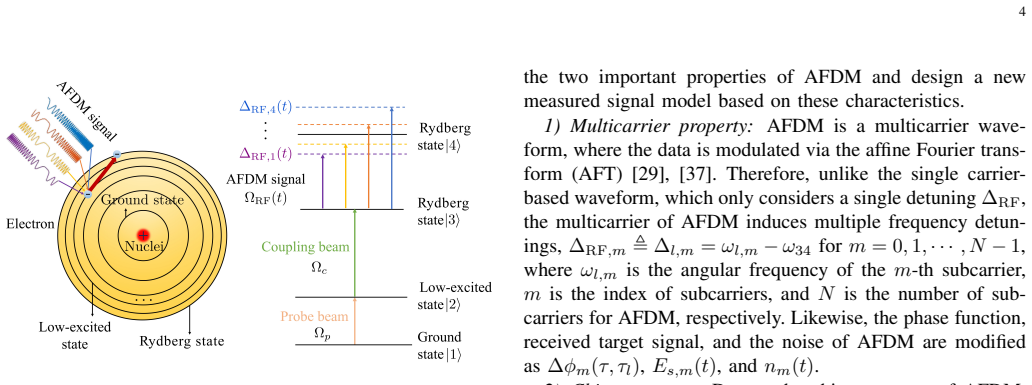
We propose a multi-chirp affine frequency division multiplexing (MC-AFDM) scheme for joint delay-Doppler estimation with Rydberg atomic quantum receivers (RAQRs). The work is motivated by the fact that RAQRs, while offering superior sensitivity and advantageous sensing capabilities, suffer from an optical ambiguity due to Doppler shifts in doubly-dispersive (DD) channel caused by target mobility, which precludes the reliable estimation of delay-Doppler parameters. To resolve this optical ambiguity and unleash the potential of RAQRs in DD channel, the proposed MC-AFDM employs multiple distinct AFDM post-chirp signals to overcome the rank-deficiency problem of the classical single-chirp AFDM (SC-AFDM), thereby enabling accurate delay-Doppler estimation of multiple targets. Our analysis reveals that the edge distribution of the multiple post-chirp parameters can further improve estimation accuracy by minimizing the condition number. Building on the proposed MC-AFDM waveform, we design a sequential signal processing algorithm based on orthogonal matching pursuit (OMP) and least squares (LS), and we derive the theoretical lower bounds for delay and Doppler estimation. Numerical results show that the proposed MC-AFDM improves range and velocity estimation accuracy by up to two orders of magnitude compared to the classical SC-AFDM, and approaches its theoretical bounds through post-chirp optimization, validating the quantum-induced advantage of RAQRs for high-resolution quantum wireless sensing.
Figures


Reference graph
Works this paper leans on
-
[1]
Atomic superheterodyne receiver based on microwave- dressed Rydberg spectroscopy,
M. Jing et al., “Atomic superheterodyne receiver based on microwave- dressed Rydberg spectroscopy,”Nat. Phy., vol. 16, no. 9, pp. 911–915, Jun. 2020
2020
-
[2]
Realization of multiband communications using different Rydberg final states,
Y . Du et al., “Realization of multiband communications using different Rydberg final states,”AIP Adv., vol. 12, no. 6, Jun. 2022
2022
-
[3]
Rydberg atomic receivers for multi-band communications and sensing,
M. Cui et al., “Rydberg atomic receivers for multi-band communications and sensing,”IEEE Trans. Wireless Commun., 2026
2026
-
[4]
Towards atomic MIMO receivers,
M. Cui, Q. Zeng, and K. Huang, “Towards atomic MIMO receivers,” IEEE J. Sel. Areas Commun., vol. 43, no. 3, pp. 659–673, Mar. 2025
2025
-
[5]
Rydberg atomic quantum receivers for classical wireless communication and sensing,
T. Gong et al., “Rydberg atomic quantum receivers for classical wireless communication and sensing,”IEEE Wireless Communications, vol. 32, no. 5, pp. 90–100, Oct. 2025
2025
-
[6]
DeepQ-MIMO: A deep-learned quantum MIMO system with Rydberg atomic receiver in IoT,
J.-M. Kang, S. Yun, and I.-M. Kim, “DeepQ-MIMO: A deep-learned quantum MIMO system with Rydberg atomic receiver in IoT,”IEEE Internet Things J., vol. 13, no. 6, pp. 10601–10604, Mar. 2026
2026
-
[7]
Rydberg atomic quantum receivers for classical wireless communications and sensing: Their models and performance,
T. Gong et al., “Rydberg atomic quantum receivers for classical wireless communications and sensing: Their models and performance,”IEEE Trans. Commun., Apr. 2026
2026
-
[8]
General signal model and capacity limit for Rydberg quantum information system,
J. Zhu and L. Dai, “General signal model and capacity limit for Rydberg quantum information system,”IEEE Trans. Wireless Commun., vol. 25, pp. 8292–8307, Dec. 2025
2025
-
[9]
Rydberg atomic receiver: Next frontier of wireless communications,
M. Cui, Q. Zeng, and K. Huang, “Rydberg atomic receiver: Next frontier of wireless communications,”IEEE Commun. Mag., vol. 64, no. 1, pp. 146–152, Jan. 2026
2026
-
[10]
New paradigm for integrated sensing and communica- tion with Rydberg atomic receiver,
M. Chen et al., “New paradigm for integrated sensing and communica- tion with Rydberg atomic receiver,”IEEE Commun. Mag., vol. 63, no. 12, pp. 104–111, Dec. 2025
2025
-
[11]
RIS-assisted atomic MIMO receiver,
Q. Peng et al., “RIS-assisted atomic MIMO receiver,”IEEE Trans. Veh. Tech., pp. 1–6, Jun. 2026
2026
-
[12]
Enhanced ground–satellite direct access via onboard Rydberg atomic quantum receivers,
Q. Peng et al., “Enhanced ground–satellite direct access via onboard Rydberg atomic quantum receivers,”IEEE Wireless Commun., pp. 1–8, 2026
2026
-
[13]
A Rydberg atom-based mixer: Measuring the phase of a radio frequency wave,
M. T. Simons et al., “A Rydberg atom-based mixer: Measuring the phase of a radio frequency wave,”Appl. Phys. Lett., vol. 114, no. 11, Mar. 2019
2019
-
[14]
Quantum wireless sensing: Principle, design and implementation,
F. Zhang et al., “Quantum wireless sensing: Principle, design and implementation,” inProc. the 29th Annu. Int. Conf. Mob. Comput. Netw. (ACM Mobicom’23), Jun. 2023, pp. 1–15
2023
-
[15]
A multiple-band Rydberg atom-based receiver: AM/FM stereo reception,
C. Holloway et al., “A multiple-band Rydberg atom-based receiver: AM/FM stereo reception,”IEEE Ant. Propag. Mag., vol. 63, no. 3, pp. 63–76, Jun. 2021
2021
-
[16]
Quantum-MUSIC: Multiple signal classification for quantum wireless sensing,
H. Kim, H. Park, and S. Kim, “Quantum-MUSIC: Multiple signal classification for quantum wireless sensing,”IEEE Wireless Commun. Lett., vol. 14, no. 6, pp. 1623–1627, Jun. 2025
2025
-
[17]
Rydberg atomic quantum receivers for multi-target DOA estimation,
T. Gong et al., “Rydberg atomic quantum receivers for multi-target DOA estimation,”IEEE Trans. Veh. Technol., 2025
2025
-
[18]
Realizing quantum wireless sensing without extra ref- erence sources: Architecture, algorithm, and sensitivity maximization,
M. Cui et al., “Realizing quantum wireless sensing without extra ref- erence sources: Architecture, algorithm, and sensitivity maximization,” IEEE Trans. Signal Process., pp. 1–16, 2026
2026
-
[19]
Ultra-high precision leo doppler localization facilitated by rydberg atomic receivers,
M. Guo et al., “Ultra-high precision leo doppler localization facilitated by rydberg atomic receivers,”IEEE Trans. Veh. Technol., vol. 75, no. 3, pp. 5161–5166, Mar. 2026
2026
-
[20]
Multi-band quantum wireless sensing for Rydberg atomic receivers,
H. Kim et al., “Multi-band quantum wireless sensing for Rydberg atomic receivers,”IEEE Commun. Lett., vol. 29, no. 6, pp. 1476–1480, Jun. 2025
2025
-
[21]
Polarization-aware DoA detection relying on a single Rydberg atomic receiver,
Y . Chen et al., “Polarization-aware DoA detection relying on a single Rydberg atomic receiver,”IEEE J. Sel. Areas Commun., pp. 1–1, 2026
2026
-
[22]
AoA detection using a single Rydberg atomic receiver: Leveraging inner-vapor interference,
Y . Guo et al., “AoA detection using a single Rydberg atomic receiver: Leveraging inner-vapor interference,”IEEE Trans. Commun., vol. 73, no. 12, pp. 14828–14844, Dec. 2025
2025
-
[23]
H. Wang et al., “Multi-carrier Rydberg atomic quantum receivers with enhanced bandwidth feature for communication and sensing,”arXiv preprint arXiv:2510.10473, 2025
arXiv 2025
-
[24]
Wideband quantum transduction for Rydberg atomic receivers using six-wave mixing,
Y . Chen, C. Yuen, and C. M. S. See, “Wideband quantum transduction for Rydberg atomic receivers using six-wave mixing,”arXiv preprint arXiv:2602.13955, 2026
Pith/arXiv arXiv 2026
-
[25]
Harnessing Rydberg atomic receivers: From quantum physics to wireless communications,
Y . Chen et al., “Harnessing Rydberg atomic receivers: From quantum physics to wireless communications,”arXiv preprint arXiv:2501.11842, 2025
Pith/arXiv arXiv 2025
-
[26]
MIMO precoding for Rydberg atomic receivers,
M. Cui, Q. Zeng, and K. Huang, “MIMO precoding for Rydberg atomic receivers,”arXiv preprint arXiv:2408.14366, 2024
Pith/arXiv arXiv 2024
-
[27]
The resurrection of spectrum spreading for 6G and beyond: From sinusoids to chirps,
H. S. Rou et al., “The resurrection of spectrum spreading for 6G and beyond: From sinusoids to chirps,”arXiv preprint arXiv:2605.00249, 2026
Pith/arXiv arXiv 2026
-
[28]
Affine frequency division multiplexing (AFDM) for 6G: Properties, features, and challenges,
H. S. Rou et al., “Affine frequency division multiplexing (AFDM) for 6G: Properties, features, and challenges,”IEEE Commun. Stand. Mag., pp. 1–10, 2025
2025
-
[29]
H. S. Rou et al., “From orthogonal time–frequency space to affine frequency-division multiplexing: A comparative study of next-generation waveforms for integrated sensing and communications in doubly disper- sive channels,”IEEE Sig. Process. Mag., vol. 41, no. 5, pp. 71–86, Sep. 2024
2024
-
[31]
Dual-chirp AFDM for joint delay-Doppler estimation with Rydberg atomic quantum receivers,
H. Kim et al., “Dual-chirp AFDM for joint delay-Doppler estimation with Rydberg atomic quantum receivers,” inProc. IEEE Int. Symp. Pers. Indoor Mobile Radio Commun. (PIMRC), 2026, arXiv preprint arXiv:2603.12728
arXiv 2026
-
[32]
A. M. Fox,Quantum optics: an introduction, vol. 15, Oxford University Press, USA, 2006
2006
-
[33]
Rydberg atomic receiver: Next frontier of wireless communications,
M. Cui, Q. Zeng, and K. Huang, “Rydberg atomic receiver: Next frontier of wireless communications,”IEEE Commun. Mag., 2025
2025
-
[34]
Atomic superheterodyne receiver sensitivity estimation based on homodyne readout,
S. Wu et al., “Atomic superheterodyne receiver sensitivity estimation based on homodyne readout,” in2024 IEEE INC-USNC-URSI Radio Science Meeting (Joint with AP-S Symposium), 2024, pp. 193–194
2024
-
[35]
Highly sensitive microwave electrometry with enhanced instantaneous bandwidth,
B. Yang et al., “Highly sensitive microwave electrometry with enhanced instantaneous bandwidth,”Phys. Rev. Appl., vol. 21, no. 3, pp. L031003, Mar. 2024
2024
-
[36]
Approaching the standard quantum limit of a Rydberg- atom microwave electrometer,
H.-T. Tu et al., “Approaching the standard quantum limit of a Rydberg- atom microwave electrometer,”Sci. Adv., vol. 10, no. 51, pp. eads0683, 2024
2024
-
[37]
Affine frequency division multiplexing for next generation wireless communications,
A. Bemani, N. Ksairi, and M. Kountouris, “Affine frequency division multiplexing for next generation wireless communications,”IEEE Trans. Wireless Commun., vol. 22, no. 11, pp. 8214–8229, Nov. 2023
2023
-
[38]
Integrated sensing and communications with affine frequency division multiplexing,
A. Bemani, N. Ksairi, and M. Kountouris, “Integrated sensing and communications with affine frequency division multiplexing,”IEEE Wireless Commun. Lett., vol. 13, no. 5, pp. 1255–1259, Feb. 2024
2024
-
[39]
Ambiguity function analysis of AFDM signals for integrated sensing and communications,
H. Yin et al., “Ambiguity function analysis of AFDM signals for integrated sensing and communications,”IEEE J. Sel. Areas Commun., vol. 44, pp. 196–211, Feb. 2026
2026
-
[40]
A novel and secure AFDM system for high mobility environments,
Y . I. Tek and E. Basar, “A novel and secure AFDM system for high mobility environments,”IEEE Trans. Veh. Tech., vol. 74, no. 12, pp. 19945–19950, Dec. 2025
2025
-
[41]
Origins of Rydberg-atom electrometer transient response and its impact on radio-frequency pulse sensing,
S. M. Bohaichuk et al., “Origins of Rydberg-atom electrometer transient response and its impact on radio-frequency pulse sensing,”Phys. Rev. Appl., vol. 18, no. 3, pp. 034030, Sep. 2022
2022
-
[42]
Eigenvalues and condition numbers of random matrices,
A. Edelman, “Eigenvalues and condition numbers of random matrices,” SIAM J. Matrix Anal. Appl., vol. 9, no. 4, pp. 543–560, 1988
1988
-
[43]
Signal recovery from random measure- ments via orthogonal matching pursuit,
J. A. Tropp and A. C. Gilbert, “Signal recovery from random measure- ments via orthogonal matching pursuit,”IEEE Trans. Inf. Theory, vol. 53, no. 12, pp. 4655–4666, Dec. 2007
2007
-
[44]
Fundamental limits of wideband localiza- tion—Part I: A general framework,
Y . Shen and M. Z. Win, “Fundamental limits of wideband localiza- tion—Part I: A general framework,”IEEE Trans. Inf. Theory, vol. 56, no. 10, pp. 4956–4980, Oct. 2010
2010
discussion (0)
Sign in with ORCID, Apple, or X to comment. Anyone can read and Pith papers without signing in.