REVIEW 3 major objections 6 minor 53 references
Hot and Dense Medium Effects on the $B_s^*$ and $B^*$ Multiplets
T0 review · 3 major / 6 minor · reviewed 2026-08-01 · deepseek-v4-flash
Pith's one-line read In hot, dense matter, B* and B_s* mesons keep most of their mass but lose up to ~78% of their decay constant, while baryon density splits particles from antiparticles
desk verdict Competent six-state QCDSR study of B*/B_s* in hot dense matter with a real density-driven asymmetry claim, but the n=0 CPT inconsistency in Table VII makes the quantitative headline conditional. read the letter →
The pith
A machine-rendered reading of the paper's core claim, the machinery that carries it, and where it could break.
The reading
What carries the argument
The load-bearing machinery is the in-medium two-point correlation function of vector currents, computed twice and matched: on the hadronic side, a pole ansatz with a medium-shifted momentum that introduces the vector self-energy; on the QCD side, an operator product expansion whose quark, gluon, and mixed condensates carry fitted temperature- and density-dependence (Eqs. 15 and 18). Borel transformation and continuum subtraction with an in-medium threshold s0(T,n) close the sum rules, with the threshold scaling linearly with the quark-condensate ratio (Eq. 23) and relaxing toward the heavy-quark mass squared as the condensate melts. The asymmetry mechanism is the vector self-energy itself: i
What would settle it
Recompute the same two-point correlator with a different in-medium threshold prescription — e.g., one tied to a thermal width or to the gluon condensate rather than the quark condensate — and check whether the antiparticle-of-B*0 versus B*0 mass-shift gap (12.9% vs 6.1%) survives; if it collapses or changes sign, the claim is an artifact of Eq. (23). A lattice calculation of the B* spectral function at finite baryon density, or a high-density heavy-ion measurement showing under ~30% decay-constant suppression, would falsify the quantitative predictions.
Extended reading notes
Core claim
The central discovery is a three-part answer to how beauty vector mesons behave in hot, dense matter. Heavy-quark decoupling protects the masses: shifts stay between -0.5% and -1.1% from temperature alone and reach at most ~13% at T = T_c, n = 5n_0. The decay constant gets no such protection and tracks the condensate suppression, falling to 14% of its vacuum value. Baryon density breaks particle-antiparticle symmetry through the vector self-energy, whose sign depends on the light-quark content: the antiparticle of B*0 loses 12.9% of its mass where B*0 loses 6.1%, while the strange pair splits by under a percent. This transplants the kaons' opposite-sign vector interaction into the beauty sec
Load-bearing premise
The load-bearing premise is that the in-medium threshold s0(T,n) scales with the quark-condensate ratio as in Eq. (23) and that the fitted condensates of Eqs. (15) and (18) hold up to n = 5n_0; every reported shift — the ≤13% mass bound, the ~78% decay-constant fall, the 12.9% vs 6.1% gap — flows through this channel, which the paper tests against no independent observable and itself cautions is unreliable near T ≈ T_c, n ≈ 5n_0.
Editorial extensions
If this is right
- If the paper is right, the in-medium mass is a weak diagnostic across the whole multiplet: even at T = T_c and n = 5n_0 no B*-family state loses more than ~13% of its vacuum mass, so mass shifts alone cannot separate temperature effects from density effects.
- The decay constant is the sensitive channel: with suppressions between 69% and 86% at n = 5n_0, B*-state radiative and leptonic decay rates should be strongly suppressed in dense collisions, a measurable signature that tracks condensate melting rather than quark-mass kinematics.
- The decay-constant ordering does not follow the mass ordering: the antiparticle of B*0 keeps the most decay constant (-69%) while suffering the largest mass shift (-12.9%), so the two observables carry independent information about the medium.
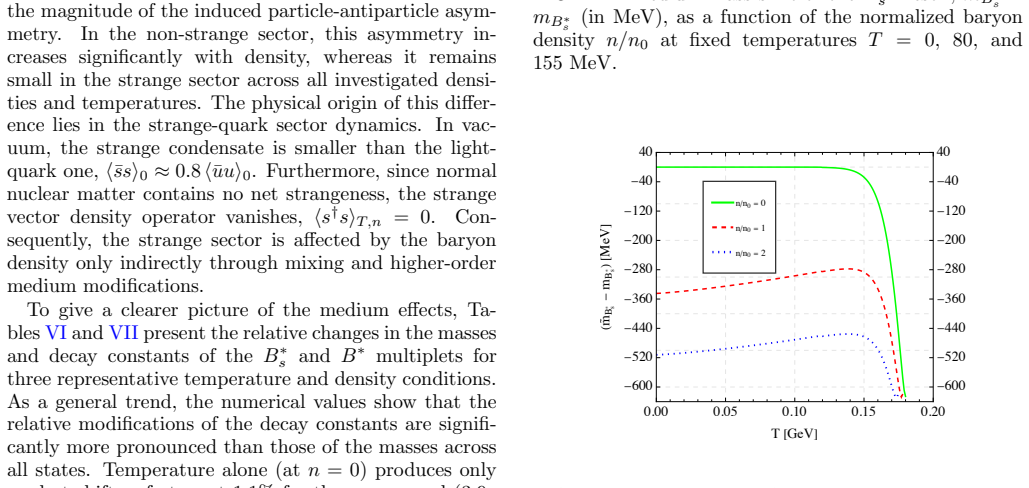
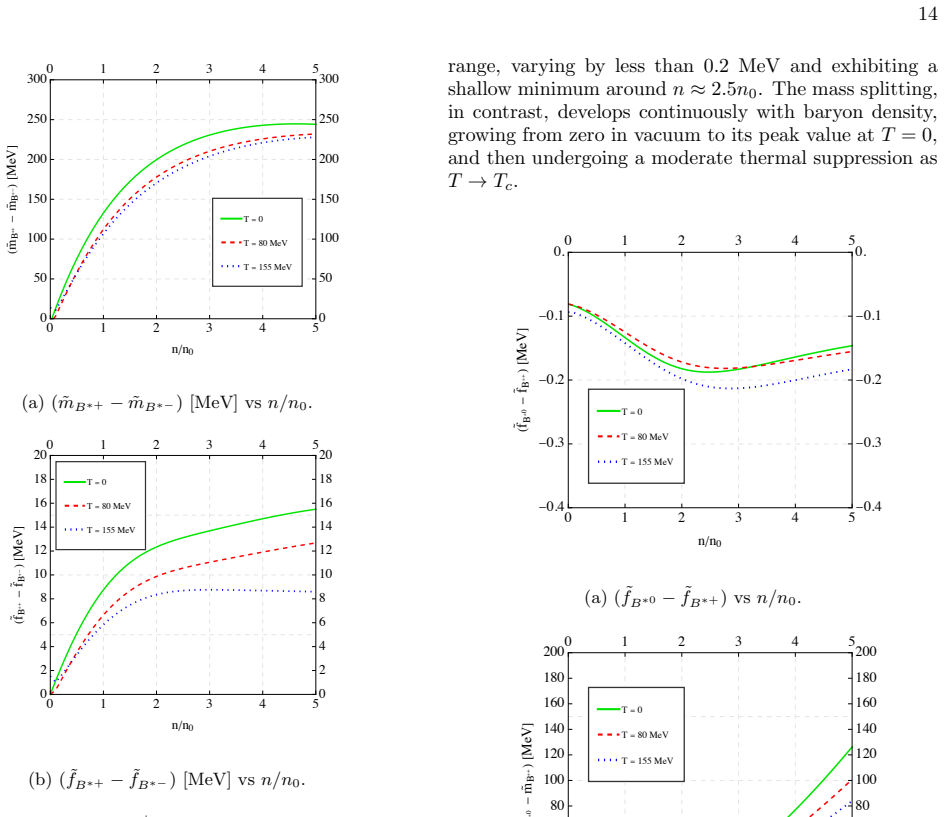
- The particle-antiparticle mass gap is a baryon-density meter: the neutral pair splits by ~350 MeV at 5n_0 (shrinking toward ~300 MeV at T_c), the charged pair by ~240 MeV, the strange pair by only ~42 MeV — and the sign of the gap is tied to the light-quark content, with the antiparticle lighter in the non-strange sector and heavier in the strange sector.
- At zero net baryon density the medium preserves particle-antiparticle degeneracy (uniform -0.5% to -1.1% mass shifts, -3.9% to -5.3% decay-constant shifts), so any observed asymmetry selects a baryon-rich environment.
Reading between the lines
- Editorial extension: the same machinery predicts a flavor hierarchy — D* mesons, with a lighter charm quark, should lose a larger mass fraction than B* mesons under identical conditions, because the protection is kinematic (the heavy-quark mass); running the same sum rules on the charm sector would test this directly.
- Editorial extension: since the asymmetry enters through the light-quark density operator of the medium, the model implies the mass-gap sign should flip in an antibaryon-rich environment — a qualitative prediction the paper does not state.
- Editorial extension: the paper itself warns that results near T ≈ T_c and n ≈ 5n_0 are the least reliable, so the headline numbers (12.9% vs 6.1%) carry least confidence exactly at the advertised extremes; the safer experimental target is the density-driven trend at moderate n, not the endpoint values.
- Editorial extension: the paper defers a term-by-term decomposition of the vector self-energy to future work, so the attribution of the entire asymmetry to that single term is established only at the level of the sum-rule extraction; a microscopic calculation of the vector self-energy in the same effective model would be the direct check.
Editorial analysis
A structured set of objections, weighed in public.
Referee Report
Summary. This paper presents a QCD sum-rule study of the in-medium masses and decay constants of the bottom-vector mesons B_s^*(5415) and B^*(5325), computed for all six charge/flavor states (B_s^{*0}, \bar B_s^{*0}, B^{*+}, B^{*-}, B^{*0}, \bar B^{*0}) at finite temperature and baryon density. The OPE includes thermal and density-dependent quark, gluon, and mixed condensates, with the medium dependence of the quark and gluon condensates taken from analytic fits to chiral SU(3) model results, and the effective continuum threshold s0(T,n) prescribed via the Dominguez-Loewe-Rojas scaling formula (Eq. 23). The main claims are that masses are remarkably resistant to the medium (maximum suppression ~13% at T=T_c, n=5n_0), decay constants are far more sensitive (suppression up to ~78% in the abstract; up to ~86% in the tables), and that a baryon-density-driven particle-antiparticle asymmetry emerges, driven entirely by the vector self-energy. The paper reports temperature alone does not distinguish particles from antiparticles at zero density.
Significance. If the results are correct, they provide a concrete set of predictions for beauty-vector mesons in heavy-ion conditions at RHIC, LHC, FAIR, and NICA, with the physically sensible message that masses are poorly sensitive to the medium while decay constants and the particle-antiparticle mass gap are the informative observables. The paper is comprehensive: it treats the full multiplet, presents explicit OPE expressions and numerical tables, and clearly identifies the role of the heavy quark in protecting the mass. The main caveats are internal consistency issues in the numerical extraction—notably violation of particle-antiparticle degeneracy at zero baryon density—and the strong dependence of all quantitative results on an untested continuum-threshold ansatz.
major comments (3)
- [Table VII; Sec. III.d; Eq. (17)] At n=0 and T=T_c, Table VII reports (m̃−m0)/m0 = −0.6% for B*+ and −1.1% for B*−, and −0.5% for B*0 and −1.1% for B̄*0. In a charge-symmetric medium at zero baryon density, CPT requires equal masses for particle and antiparticle; the text in Sec. III.d explicitly states that 'the medium preserves the particle-antiparticle symmetry' and 'no asymmetry is induced,' so the table directly contradicts the narrative. The same inconsistency appears in isospin: Eq. (17) gives equal u and d densities, so B*0 and B*+ should have identical medium inputs, yet Table VII gives −6.1% vs −8.3% at T=0, n=5n0—a 126 MeV 'isospin splitting' (Eq. 34) with no physical origin in a symmetric bath. The paper acknowledges only a −3 MeV vacuum baseline offset for decay constants (Sec. III.e), not for masses. Because the headline density-driven asymmetry is extracted with the same procedure, these artifacts must be
- [Eq. (23); Eq. (27)] All quantitative claims—the ~13% mass bound, the 78–86% decay-constant suppression, and the 12.9% vs 6.1% asymmetry—depend on the prescribed scaling s0(T,n)/s0 = (⟨q̄q⟩/⟨q̄q⟩0)(1−m_b^2/s0)+m_b^2/s0. The sum rule in Eq. (27) integrates up to s0(T,n), so every reported shift is channeled through this ansatz. The paper provides no sensitivity analysis (e.g., a fixed s0, a different interpolation, or propagation of the 11 fit parameters in Eqs. (15) and (18)). Given that the fitted condensates enter both the OPE and, through Eq. (23), the integration limit, the quantitative predictions are conditional on a prescription that is not independently tested. The authors should either benchmark the ansatz or report an uncertainty band from varying it.
- [Abstract; Table VII] The abstract states that at T=0 and n=5n0 the decay constant is 'losing up to ~78%', but Table VII lists B*− = −86.2% and B*+ = −79.6%; the summary text itself says the decay constant drops to approximately 14% of its vacuum value (i.e., a 86% loss). The abstract understates the maximum suppression in the paper's own tables. This is a factual inconsistency in a headline quantitative claim and should be corrected.
minor comments (6)
- [Abstract; Sec. I] 'F AIR' and 'V FAIR' should be 'FAIR' (the Facility for Antiproton and Ion Research).
- [Sec. II.F; Eq. (29)] The extraction of the physical mass m̃ from μ^2 = m̃^2 − Σ_v^2 + 2p0Σ_v is not explained. Please clarify how m̃^2 and Σ_v are obtained from the five sum-rule equations, especially the treatment of p0.
- [Sec. III; Fig. 1] The paper states the vacuum Borel window M^2 ∈ [12,16] GeV^2 'remains reasonably stable' in medium, but no in-medium Borel-stability plot is shown. A representative stability check in medium would strengthen the extraction.
- [Eq. (12)] The nonlocal quark background-field term ⟨χ_q^a(x) χ̄_q^b(0)⟩ is not defined. State explicitly how it reduces to the local condensates used in the OPE.
- [Table V] Only decay constants are listed for the vacuum; the vacuum masses m0 that define the percentage shifts are not tabulated. Please provide them.
- [General notation] The notation uses m̃ for the mass appearing in the current matrix element and μ for the shifted pole in Eq. (10). This distinction should be defined clearly and used consistently in Eqs. (29).
Circularity Check
No circularity found: in-medium parameters are solved from stated inputs, not re-labeled fits; the n=0 particle-antiparticle split is a correctness inconsistency, not a circular step.
full rationale
Walking the derivation chain: the hadronic side (Eqs. 3-10) is matched to the OPE (Eqs. 11-13 and Appendix) with explicitly stated in-medium condensate inputs (Eqs. 15-22) and the continuum-threshold ansatz (Eq. 23), and the observables are then solutions of the Borel-transformed sum rules in Eq. (29). The paper does not fit any parameter to the in-medium masses or decay constants it reports: the vacuum window (Eq. 30) is calibrated to known vacuum masses, and the in-medium threshold is taken from the published Dominguez-Loewe-Rojas prescription, not from the target observables. Although Eq. (23) ties s0(T,n) to the same quark-condensate fit that also enters the OPE, this is a transparent model input rather than a definitional or fitted-input-called-prediction circularity: the reported shifts are nontrivial outputs of the sum-rule inversion, and the paper explicitly warns that the extreme T,n results should be interpreted with caution. The cited density-dependent condensate corrections include prior work by the same authors (Ref. [46]), but this is normal self-citation of a separate calculation and is not load-bearing in the sense of a self-citation chain or imported uniqueness theorem. I separately flag a serious non-circular internal inconsistency: Table VII gives B*+ shift -0.6% vs B*- -1.1% and B*0 -0.5% vs \barB*0 -1.1% at T=Tc, n=0, while Sec. III.d states that 'the medium preserves the particle-antiparticle symmetry'; this ~30 MeV C-violating split at zero density is a correctness problem that should be resolved before interpreting the density-driven asymmetry, but it is not a circular step. The paper also admits a minor -3 MeV vacuum baseline offset for decay constants and cautions that the extreme-limit numbers are near the practical limit of the sum-rule approach; these limitations lower confidence but do not make the derivation circular.
Assumptions & free parameters
free parameters (7)
- light-quark condensate fit parameters (A, B, kappa, D, phi, alpha, F, beta) =
A=0.5316, B=0.1370, kappa=1.2262, D=0.1345, phi=0.3374, alpha=1.2516, F=0.0554, beta=20.0
- gluon condensate fit parameters (A3, A4, A5) =
A3=-4.131e-3, A4=7.696e-3, A5=-8.530e-4 GeV^4
- vacuum continuum threshold s0 =
33-35 GeV^2 (window); s0(T,n) then follows Eq. (23)
- Borel window M^2 =
12-16 GeV^2
- strangeness suppression factor y =
0.05
- m_0^2 (mixed-condensate scale) =
0.80 ± 0.10 GeV^2
- nuclear density operator coefficients (⟨q†gsσGq⟩, ⟨q†iD0iD0q⟩, ⟨q†iD0q⟩) =
-0.33n GeV^2, 0.031n GeV^2, 0.18n (linear in n)
assumptions (7)
- domain assumption Quark-hadron duality and Borel-transformed dispersion relation connect the OPE to the hadronic spectrum (QCDSR paradigm).
- domain assumption In-medium condensates are given by the chiral SU(3) model outputs of Kumar et al., encoded in Eqs. (15) and (18).
- domain assumption The in-medium continuum threshold s0(T,n) scales with the quark condensate per Eq. (23) (Dominguez-Loewe-Rojas prescription).
- ad hoc to paper The vacuum Borel window M^2 ∈ [12,16] GeV^2 remains valid in medium up to T_c and 5n0.
- domain assumption Mean-field approximation: vector self-energy Sigma_v real, momentum-independent, Sigma'_v = 0.
- domain assumption Equal partitioning of the energy-momentum tensor between quark and gluon sectors, ⟨Θ_g⟩ = ⟨Θ_f⟩ = 1/2 ⟨Θ⟩.
- domain assumption Baryon-density operators at linear order: ⟨q†q⟩ = 3/2 n, ⟨q†D0q⟩ = 0.18n, etc. (Eqs. 17, 22 from Refs. [34, 46]).
Cite this review
Pith. "Pith review of Hot and Dense Medium Effects on the $B_s^*$ and $B^*$ Multiplets." pith.science (2026). https://pith.science/paper/AZNXKS3U
@misc{pith2026260722419,
  author       = {Pith},
  title        = {Pith review of: Hot and Dense Medium Effects on the $B_s^*$ and $B^*$ Multiplets},
  year         = {2026},
  howpublished = {\url{https://pith.science/paper/AZNXKS3U}},
  note         = {Machine review of arXiv:2607.22419}
}
abstract
We present an extensive analysis of the in-medium masses and decay constants of the $B_s^*(5415)$ and $B^*(5325)$ multiplets, including both particles and antiparticles, using QCD sum rules at finite temperature and density. The OPE incorporates the full temperature- and density-dependent contributions from the quark, gluon, and mixed condensates. Computing the strange ($B_s^{*0}$, $\bar{B}_s^{*0}$), charged ($B^{*\pm}$), and neutral ($B^{*0}$, $\bar{B}^{*0}$) doublet properties allows us to study the effects of flavor symmetry breaking, strangeness, and heavy-quark decoupling on the beauty vector mesons in the medium. Our results indicate that the mass is remarkably resistant to the medium across the entire multiplet: no state loses more than $\sim 13\%$ of its vacuum value, even at $T = T_c$ and $n = 5n_0$, the extreme conditions explored here. The decay constant is far more sensitive, losing up to $\sim 78\%$ at the same point. Baryon density clearly dominates the medium response, while temperature plays a secondary role until the system approaches the deconfinement crossover. At zero density, every state loses almost the same fraction of its mass and decay constant: mass shifts lie between $-(0.5$-$1.1)\%$ and decay-constant shifts between $-(3.9$-$5.3)\%$, regardless of charge or flavor, so temperature alone does not distinguish a particle from its antiparticle. At finite baryon density, a clear particle-antiparticle asymmetry emerges: at $T = 0$ and $n = 5n_0$, the $\bar{B}^{*0}$ mass decreases by $12.9\%$, whereas the $B^{*0}$ mass shifts by only $6.1\%$, a gap of nearly seven percentage points driven entirely by the vector self-energy. This provides a theoretical basis for the future heavy-ion collision program at RHIC, LHC, FAIR, and NICA.
Figures


Figures from the paper (9 more)



Reference graph
Works this paper leans on
-
[1]
Quark-gluon plasma and hadronic pro- duction of leptons, photons and psions,
E. V. Shuryak, “Quark-gluon plasma and hadronic pro- duction of leptons, photons and psions,” Phys. Lett. B 78, 150 (1978)
1978
-
[2]
Heavy Ion Collisions: The big picture, and the big questions,
W. Busza, K. Rajagopal and W. van der Schee, “Heavy Ion Collisions: The big picture, and the big questions,” Ann. Rev. Nucl. Part. Sci.68, 339-376 (2018)
2018
-
[3]
Evidence for quark-matter cores in massive neutron stars,
E. Annala, T. Gorda, A. Kurkela, J. N¨ attil¨ a and A. Vuorinen, “Evidence for quark-matter cores in massive neutron stars,” Nature Phys.16, no.9, 907-910 (2020)
2020
-
[4]
From hadrons to quarks in neutron stars: a review,
G. Baym, T. Hatsuda, T. Kojo, P. D. Powell, Y. Song and T. Takatsuka, “From hadrons to quarks in neutron stars: a review,” Rept. Prog. Phys.81, no.5, 056902 (2018)
2018
-
[5]
Properties of hot and dense matter from relativistic heavy ion collisions,
P. Braun-Munzinger, V. Koch, T. Sch¨ afer and J. Stachel, “Properties of hot and dense matter from relativistic heavy ion collisions,” Phys. Rept.621, 76-126 (2016)
2016
-
[6]
Hot-dense Lattice QCD: USQCD whitepaper 2018,
A. Bazavovet al., “Hot-dense Lattice QCD: USQCD whitepaper 2018,” Eur. Phys. J. A55, 194 (2019)
2018
-
[7]
Challenges in QCD mat- ter physics –The scientific programme of the Compressed Baryonic Matter experiment at F AIR,
T. Ablyazimovet al.[CBM], “Challenges in QCD mat- ter physics –The scientific programme of the Compressed Baryonic Matter experiment at F AIR,” Eur. Phys. J. A 53, no.3, 60 (2017)
2017
-
[8]
Status and initial physics performance studies of the MPD experiment at NICA,
V. Abgaryanet al.[MPD], “Status and initial physics performance studies of the MPD experiment at NICA,” Eur. Phys. J. A58, no.7, 140 (2022)
2022
Show all 53 references
-
[9]
Heavy–heavy and heavy–light mesons in cold nuclear matter,
J. J. Cobos-Mart ´ ınez, G. N. Zeminiani and K. Tsushima, “Heavy–heavy and heavy–light mesons in cold nuclear matter,” Symmetry17, no.5, 787 (2025)
2025
-
[10]
Light vector mesons in nuclear matter,
T. Hatsuda, H. Shiomi and H. Kuwabara, “Light vector mesons in nuclear matter,” Prog. Theor. Phys.95, 1009- 1028 (1996)
1996
-
[11]
Heavy- light quark pseudoscalar and vector mesons at finite tem- perature,
C. A. Dominguez, M. Loewe and J. C. Rojas, “Heavy- light quark pseudoscalar and vector mesons at finite tem- perature,” JHEP08, 040 (2007)
2007
-
[12]
Properties of strange vector mesons in dense and hot matter,
A. Ilner, D. Cabrera, P. Srisawad and E. Bratkovskaya, “Properties of strange vector mesons in dense and hot matter,” Nucl. Phys. A927, 249-265 (2014)
2014
-
[13]
Properties of kaon at non-zero temperature and baryon chemical potential,
G. Bozkır, A. T¨ urkan and K. Azizi, “Properties of kaon at non-zero temperature and baryon chemical potential,” Eur. Phys. J. A59, no.11, 267 (2023)
2023
-
[14]
Pion scattering lengths,
S. Weinberg, “Pion scattering lengths,” Phys. Rev. Lett. 17, 616-621 (1966)
1966
-
[15]
Axial vector coupling renormalization and the meson-baryon scattering lengths,
Y. Tomozawa, “Axial vector coupling renormalization and the meson-baryon scattering lengths,” Nuovo Cim. A46, 707-717 (1966)
1966
-
[16]
QCD sum rules and applications to nuclear physics,
T. D. Cohen, R. J. Furnstahl, D. K. Griegel and X. M. Jin, “QCD sum rules and applications to nuclear physics,” Prog. Part. Nucl. Phys.35, 221-298 (1995)
1995
-
[17]
Pion - nucleon and kaon - nucleon scattering lengths in QCD sum rules,
Y. Kondo, O. Morimatsu and Y. Nishino, “Pion - nucleon and kaon - nucleon scattering lengths in QCD sum rules,” Phys. Rev. C53, 1927-1935 (1996)
1927
-
[18]
Kaons in hot and dense QCD,
K. Azizi, G. Bozkır, N. Er and A. T¨ urkan, “Kaons in hot and dense QCD,” Phys. Rev. D113, no.9, 094024 (2026)
2026
-
[19]
Measurement of the in- clusiveB ∗ cross-section above the Υ(4S),
D. S. Akeribet al.[CLEO-II], “Measurement of the in- clusiveB ∗ cross-section above the Υ(4S),” Phys. Rev. Lett.67, 1692-1695 (1991)
1991
-
[20]
Observation ofB s pro- duction at the Υ(5S) resonance,
G. Bonviciniet al.[CLEO], “Observation ofB s pro- duction at the Υ(5S) resonance,” Phys. Rev. Lett.96, 022002 (2006)
2006
-
[21]
Heavy scalar, vector and axial-vector mesons in hot and dense nuclear medium,
A. Kumar, “Heavy scalar, vector and axial-vector mesons in hot and dense nuclear medium,” Adv. High Energy Phys.2014, 549726 (2014)
2014
-
[22]
D mesons in asymmetric nu- clear matter at finite temperatures,
A. Kumar and A. Mishra, “D mesons in asymmetric nu- clear matter at finite temperatures,” Phys. Rev. C81, 065204 (2010)
2010
-
[23]
Thermal QCD Sum Rules study of vector charmonium and bottomonium states,
E. V. Veliev, K. Azizi, H. Sundu, G. Kaya and A. T¨ urkan, “Thermal QCD Sum Rules study of vector charmonium and bottomonium states,” Eur. Phys. J. A47, 110 (2011)
2011
-
[24]
Ther- mal properties of light tensor mesons via QCD sum rules,
K. Azizi, A. T¨ urkan, E. Veli Veliev and H. Sundu, “Ther- mal properties of light tensor mesons via QCD sum rules,” Adv. High Energy Phys.2015, 794243 (2015)
2015
-
[25]
QCD and resonance physics. Theoretical foundations,
M. A. Shifman, A. I. Vainshtein and V. I. Zakharov, “QCD and resonance physics. Theoretical foundations,” Nucl. Phys. B147, 385 (1979)
1979
-
[26]
QCD and resonance physics: Applications,
M. A. Shifman, A. I. Vainshtein and V. I. Zakharov, “QCD and resonance physics: Applications,” Nucl. Phys. B147, 448 (1979)
1979
-
[27]
The spectrum of hot hadronic matter and finite-temperature QCD sum rules,
A. I. Bochkarev and M. E. Shaposhnikov, “The spectrum of hot hadronic matter and finite-temperature QCD sum rules,” Nucl. Phys. B268, 220 (1986)
1986
-
[28]
QCD sum rules at finite temperature,
S. Mallik and K. Mukherjee, “QCD sum rules at finite temperature,” Phys. Rev. D58, 096011 (1998)
1998
-
[29]
Finite tem- perature QCD Sum Rules: A review,
A. Ayala, C. A. Dominguez and M. Loewe, “Finite tem- perature QCD Sum Rules: A review,” Adv. High Energy Phys.2017, 9291623 (2017)
2017
-
[30]
Im- pact of a thermal medium on newly observedZ cs(3985) resonance and its b-partner,
J. Y. S¨ ung¨ u, A. T¨ urkan, H. Sundu and E. V. Veliev, “Im- pact of a thermal medium on newly observedZ cs(3985) resonance and its b-partner,” Eur. Phys. J. C82, 453 (2022)
2022
-
[31]
Scalar fully-charm and bottom tetraquarks under ex- treme temperatures,
A. Aydın, H. Sundu, J. Y. S¨ ung¨ u and E. V. Veliev, “Scalar fully-charm and bottom tetraquarks under ex- treme temperatures,” Eur. Phys. J. C85, 567 (2025)
2025
-
[32]
Light scalar K ∗ 0 (700) meson in vacuum and a hot medium,
K. Azizi, B. Barsbay and H. Sundu, “Light scalar K ∗ 0 (700) meson in vacuum and a hot medium,” Phys. Rev. D100, no.9, 094041 (2019)
2019
-
[33]
Axial-tensor meson family atT̸= 0,
J. Y. S¨ ung¨ u, A. T¨ urkan, E. Sertbakan and E. V. Veliev, “Axial-tensor meson family atT̸= 0,” Eur. Phys. J. C 80, 943 (2020)
2020
-
[34]
Quark and gluon condensates in nuclear matter,
T. D. Cohen, R. J. Furnstahl and D. K. Griegel, “Quark and gluon condensates in nuclear matter,” Phys. Rev. C 45, 1881 (1992)
1992
-
[35]
Modifications on parameters of Z(4430) in a dense medium,
K. Azizi and N. Er, “Modifications on parameters of Z(4430) in a dense medium,” Phys. Lett. B811, 135979 (2020)
2020
-
[36]
Impact of finite density on spectroscopic parameters of decuplet baryons,
K. Azizi, N. Er and H. Sundu, “Impact of finite density on spectroscopic parameters of decuplet baryons,” Phys. Rev. D94, 114002 (2016)
2016
-
[37]
Positive and negative parity hyperons in nuclear medium,
K. Azizi, N. Er and H. Sundu, “Positive and negative parity hyperons in nuclear medium,” Phys. Rev. D92, 054026 (2015)
2015
-
[38]
X(3872): propagating in a dense medium,
K. Azizi, N. Er and H. Sundu, “X(3872): propagating in a dense medium,” Nucl. Phys. B936, 151 (2018)
2018
-
[39]
Effects of a dense medium on pa- rameters of doubly heavy baryons,
K. Azizi and N. Er, “Effects of a dense medium on pa- rameters of doubly heavy baryons,” Phys. Rev. D100, 074004 (2019)
2019
-
[40]
Nuclear medium effects on the 17 properties of Λ(1405),
J. Y. S¨ ung¨ u and N. Er, “Nuclear medium effects on the 17 properties of Λ(1405),” J. Phys. G: Nucl. Part. Phys.51, 125001 (2024)
2024
-
[41]
Matter under extreme con- ditions,
C. Adami and G. E. Brown, “Matter under extreme con- ditions,” Phys. Rept.234, 1-71 (1993)
1993
-
[42]
A new calculation of the in-medium quark condensate at finite density and tem- perature,
H. H. Tang and G. X. Peng, “A new calculation of the in-medium quark condensate at finite density and tem- perature,” Commun. Theor. Phys.56, 1071-1074 (2011)
2011
-
[43]
Light vector corre- lator in medium: Wilson coefficients up to dimension 6 operators,
H. Kim, P. Gubler and S. H. Lee, “Light vector corre- lator in medium: Wilson coefficients up to dimension 6 operators,” Phys. Lett. B772, 194-199 (2017)[erratum: Phys. Lett. B779, 498-498 (2018)]
2017
-
[44]
Chiral spin symmetry and hot/dense QCD,
L. Y. Glozman, “Chiral spin symmetry and hot/dense QCD,” Prog. Part. Nucl. Phys.131, 104049 (2023)
2023
-
[45]
Review of particle physics,
S. Navaset al.[Particle Data Group], “Review of particle physics,” Phys. Rev. D110, 030001 (2024)
2024
-
[46]
Spectroscopic parameters and elec- tromagnetic form factor of kaon in vacuum and a dense medium,
N. Er and K. Azizi, “Spectroscopic parameters and elec- tromagnetic form factor of kaon in vacuum and a dense medium,” Eur. Phys. J. C82, no.5, 397 (2022)
2022
-
[47]
Nuclei in a chiral SU(3) model,
P. Papazoglou, D. Zschiesche, S. Schramm, J. Schaffner- Bielich, H. St¨ ocker and W. Greiner, “Nuclei in a chiral SU(3) model,” Phys. Rev. C59, 411 (1999)
1999
-
[48]
Vector mesons at finite temperature and QCD Sum Rules,
Y. Kwon, C. Sasaki and W. Weise, “Vector mesons at finite temperature and QCD Sum Rules,” Phys. Rev. C 81, 065203 (2010)
2010
-
[49]
Correlation functions in the QCD vac- uum,
E. V. Shuryak, “Correlation functions in the QCD vac- uum,” Rev. Mod. Phys.651-46 (1993)
1993
-
[50]
Modifications on nucleon param- eters at finite temperature,
K. Azizi and G. Kaya, “Modifications on nucleon param- eters at finite temperature,” Eur. Phys. J. Plus130, no.8, 172 (2015)
2015
-
[51]
The QCD equa- tion of state with almost physical quark masses,
M. Cheng, N. H. Christ, S. Datta, J. van der Heide, C. Jung, F. Karsch, O. Kaczmarek, E. Laermann, R. D. Mawhinney and C. Miao,et al.“The QCD equa- tion of state with almost physical quark masses,” Phys. Rev. D77, 014511 (2008)
2008
-
[52]
Hadron properties from QCD Sum Rules,
L. J. Reinders, H. Rubinstein and S. Yazaki, “Hadron properties from QCD Sum Rules,” Phys. Rept.127, 1 (1985)
1985
-
[53]
Gluon condensates and c, b quark masses from quarkonia ratios of moments,
S. Narison, “Gluon condensates and c, b quark masses from quarkonia ratios of moments,” Phys. Lett. B693, 559 (2010), [erratum: Phys. Lett. B705(2011), 544- 544]
2010
Reviewed August 1, 2026 · model on record in the stance chip above.
Discussion (0). Continue with ORCID to comment.