REVIEW 2 major objections 5 minor 1 cited by
Parallel $k$d-tree with Batch Updates
T0 review · 2 major / 5 minor · reviewed 2026-08-12 · deepseek-v4-flash
Pith's one-line read This paper claims that a single kd-tree can be built, batch-updated, and queried in parallel with near-optimal cache behavior and polylogarithmic span, using sampled splitters and local rebuilds to stay weight-balanced.
desk verdict Strong practical and algorithmic contribution, but the theoretical guarantees need an extra assumption for duplicate-heavy inputs. read the letter →
The pith
A machine-rendered reading of the paper's core claim, the machinery that carries it, and where it could break.
The reading
What carries the argument
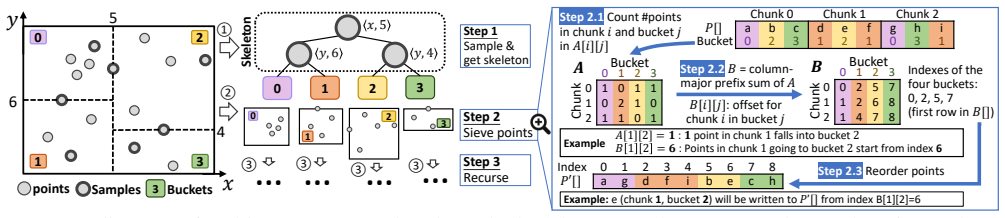
The load-bearing object is the skeleton-and-sieving construction. A skeleton is the first $\lambda$ levels of the tree, built on $2^\lambda \sigma$ samples small enough to fit in cache; its $2^\lambda$ external nodes are buckets. The sieving step divides the input into chunks of size $2^\lambda$, counts how many points of each chunk fall in each bucket, takes a column-major prefix sum to obtain offsets, and writes every point directly to its bucket's slot—one round of data movement per $\lambda$ levels. Updates reuse the same sieve to drop batch points into the relevant buckets; any subtree that would leave the weight-balance window $[0.5-\alpha, 0.5+\alpha]$ of its parent is rebuilt with the construction routine. The parameter $\alpha$ is the dial between update frequency and tree quality.
What would settle it
Construct an initially empty Pkd-tree and apply a thousand batches drawn from a single dense cluster, or from points sharing one coordinate, recording the cumulative size of rebuilt subtrees and the final tree height. If the cumulative rebuild size is superlinear in the final tree size, or the height exceeds the predicted $O(\log n)$ bound, the sampling-balance guarantee behind the amortized update bounds has failed.
Extended reading notes
Core claim
The central claim is that a kd-tree can be made simultaneously parallel, cache-efficient, and dynamic by replacing exact median splits with sample-based approximate splits and by replacing global rebalancing with lazy local rebuilds. The Pkd-tree fixes $\lambda$ levels of splitters at a time from $2^\lambda \sigma$ random samples, sieves all points into the resulting $2^\lambda$ buckets in one round of data movement, and recurses; updates sieve the batch through the existing skeleton and rebuild exactly the subtrees whose child sizes leave $(1/2 \pm \alpha)$ of the parent. Theorem 3.3 states construction of $n$ points has $O(n \log n)$ work and $O((n/B)\log_M n)$ cache complexity with $O(M^\epsilon \log_M n)$ span, all with high probability; Theorem 4.1 states batch updates of size $m = O(n)$ have $O(\log^2 n)$ span with high probability and amortized $O(\log^2 n)$ work and $O(\log(n/m) + (\log n \log_M n)/B)$ cache per element. The reported experiments on up to $1.3 \times 10^9$ points show construction and updates orders of magnitude faster than the tested parallel kd-tree implementations, with queries at parity or better, and the paper's stated conclusion is that the Pkd-tree is the first kd-tree that is highly performant, parallel, and dynamic.
Load-bearing premise
The load-bearing premise is that the random samples used to pick splitters are representative enough that every rebuilt subtree lands inside $(1/2 \pm \alpha/4)$ of its parent with high probability, so a constant fraction $\Theta(\alpha)$ of its points must change before another rebuild is triggered; this representativeness is asserted rather than proven for adversarial or duplicate-heavy batch inputs.
Editorial extensions
If this is right
- A single kd-tree can be dynamic without paying the query overhead of the logarithmic method's $O(\log n)$ trees.
- Construction matches the sorting lower bound in work and cache, so no comparison-based multidimensional index built by splitting can be asymptotically faster.
- Standard static kd-tree query algorithms (k-NN, range report, range count) work unchanged, so existing query optimizations transfer directly.
- Batch updates of up to $O(n)$ points remain highly parallel, with amortized polylogarithmic work per element and near-sorting cache cost.
- Relaxing balance to a constant $\alpha$ buys large constant-factor speedups in practice; choosing $\alpha = O(1/\log n)$ recovers the classical $\log n + O(1)$ height bound when theory demands it.
Reading between the lines
- If the sampling guarantee is robust in practice, the same skeleton-and-sieve construction could be ported to external memory or GPU by tuning $\lambda$ to the device's memory hierarchy; the paper's $\lambda = 6$ choice suggests the technique is not tied to one cache size.
- The amortized analysis assumes updates spread across subtrees; a batch sequence that repeatedly refills one dense region could trigger rebuilds before enough amortized work accumulates. That case deserves stress-testing beyond the printed skewed-data experiments.
- The no-bounding-box design trades query pruning for memory and build speed, and the paper's own measurements show the trade reverses in high dimensions, so a hybrid that stores boxes above some dimension is a natural extension.
- Range count, which only the Pkd-tree supports among the tested implementations, makes the structure useful for aggregate analytics where reporting points is unnecessary.
Signed reviews
Editorial analysis
A structured set of objections, weighed in public.
Referee Report
Summary. The paper proposes the Pkd-tree, a parallel in-memory kd-tree with sampling-based multi-level construction, a sieving step for cache-efficient data movement, and lazy weight-balanced partial rebuilds for batch insertions and deletions. The authors claim optimal O(n log n) work and O(Sort(n)) cache complexity for construction with polylogarithmic span (Theorems 3.3 and 3.4), and amortized O(log^2 n) work per updated element with O(log(n/m) + (log n log_M n)/B) cache cost for batch updates (Theorem 4.1). They support these claims with a C++ implementation, extensive experiments on synthetic and real-world datasets up to 1.3 billion points, and comparisons against CGAL, ParGeo's Log-tree and BHL-tree, Boost R-tree, and Zd-tree.
Significance. If the theoretical bounds hold, the paper is a substantial contribution: it would be the first parallel dynamic kd-tree with simultaneously optimal work and cache complexity for construction and polylogarithmic span, and the engineering results are convincing on their face. The paper deserves credit for releasing its code, for the breadth of experiments (including real-world datasets, out-of-distribution queries, cache-miss profiling, and an ablation of the two construction techniques), and for the concrete algorithmic ideas of sampling-based skeleton construction and sieving. The main concern is that a central lemma used to justify both the height bound and the update amortization does not account for tied coordinates, so the universal form of the theoretical claims is not established. That issue is fixable by adding an explicit general-position assumption or a tie-robust analysis, but it must be addressed before the theorems can be accepted as stated.
major comments (2)
- [§3.2 (Lemma 3.1) and §4.3 / Appendix B] Lemma 3.1's proof silently assumes a strict ordering in the splitting dimension. The set Λ is defined as the smallest (1/2 − ε/4)n′ points, and the bad event is 'more than s/2 samples fall in Λ.' With ties, this event does not track the actual left child: in the sieving step all points with coordinate equal to the splitter are sent to the right. For an input where 90% of the points share coordinate c in the chosen splitting dimension and the remaining 10% are strictly larger, the sample median is c with probability 1 − o(1), so the left child has size 0 (or, with a splitter chosen between c and the next coordinate, size about 0.9n). Either outcome violates the promised (1/2 ± ε/4)n′ balance range for every ε used in the paper. The heavy-leaf mechanism in Appendix C covers only nodes whose points are all duplicates, so it does not repair the balance guarantee for a large-but-not-total tie. Since Lemma 3.1 is used both for the O(log n) height claim (Lemma 3.2) and for the amortized Θ(α n′) rebuild interval in Theorem 4.1 / Appendix B, the claimed bounds are not universal for inputs with tied splitter coordinates. Please either state an explicit distinct-coordinates / general-position assumption and apply it wherever the theorems are invoked, or give a tie-robust version of the sampling argument. As written, the theorems overclaim.
- [§4.3 / Appendix B] There is an algebraic inconsistency in the update analysis. Theorem 4.1 sets σ = (6c log n)/α², but Appendix B writes that a rebuilt subtree contains (1/2 ± sqrt((12c log n)/σ)/4)n′ = (1/2 ± α/4)n′ points whp. Under the stated σ, sqrt((12c log n)/σ) = sqrt(2) α, not α, so the displayed equality is wrong. This does not change the asymptotic amortized bound when α is a constant, but the derivation should be corrected or the parameter σ should be adjusted to match the displayed expression.
minor comments (5)
- [§2] The paragraph on the ideal-cache model says 'we do not control the cache, so the optimal eviction strategy is guaranteed,' which contradicts the immediately following sentence stating that real eviction strategies are more complicated. The intended wording appears to be 'not guaranteed.'
- [§3.2, proof of Lemma 3.1] In the proof, 'Let X = ΣXᵢ for i = 1..|Λ|' should read 'for i = 1..s', since the indicators are over the s sampled points, not over the points of Λ. The subsequent Chernoff calculation is otherwise clear.
- [§4.2] Batch deletion is described only in prose. Since deletion differs from insertion by requiring a first round to identify absent points and then a second round to find unbalanced subtrees, the paper would benefit from either a pseudocode listing or a more detailed formal description of the two rounds and their cost accounting.
- [§5] The text refers to a 'leaf warp size' when describing the leaf wrap threshold φ; this appears to be a typo for 'leaf wrap size.'
- [§6] Reported timings are described as the average of three runs after a warm-up, but no variance, standard deviation, or min/max values are given. Given that some claimed speedups are close to 1.0× or 1.3×, adding error bars or per-run values would make the comparisons more informative.
Circularity Check
No load-bearing circularity: the theoretical results are derived from in-paper sampling and amortization arguments, and the experimental benchmarks are external.
full rationale
The paper's central derivation chain is self-contained rather than circular. Lemma 3.1, which provides the whp balance guarantee used for construction height and update amortization, is proved in the paper via a Chernoff-bound argument on uniformly sampled points; the citation to similar sampling results is for context only and does not carry the proof. Theorem 3.3's work, span, and cache bounds follow directly from the algorithm's parameters (lambda, sigma, chunk size) and from the recurrence on recursive levels, and the optimality argument rests on the standard sorting lower bound. Theorem 4.1 and Appendix B use an amortization argument over the weight-balance trigger, with the rebuild cost charged to the updates that must occur before the next rebuild; no fitted parameter is renamed as a prediction. The experimental section compares against external libraries (CGAL, Boost R-tree, Zd-tree, ParGeo), and while ParGeo shares a co-author, the comparison is to an independent implementation and is not used to justify the theoretical claims. The skeptical concern about duplicate-heavy inputs and ties at the splitter coordinate identifies a possible gap in the proof of Lemma 3.1's applicability, but that is a correctness/robustness issue, not circularity: the proof does not assume its conclusion. Self-citations in the paper (e.g., to prior sampling results and to a tree-traversal lemma) are either proved in the text or are independently established facts, so they do not reduce the central claim to its own inputs.
Assumptions & free parameters
free parameters (4)
- lambda (skeleton height) =
6
- sigma (oversampling rate) =
32
- alpha (balancing parameter) =
0.3
- phi (leaf wrap threshold) =
32
assumptions (5)
- standard math Binary-forking work-span model with a randomized work-stealing scheduler
- standard math Ideal-cache model with optimal offline replacement, with LRU assumed equivalent
- domain assumption Input points are sampled uniformly with replacement for splitter selection
- domain assumption Cache size M is Omega(polylog n) and lambda = epsilon log M with epsilon < 1/2
- domain assumption Median-based splitters give standard balanced kd-tree query bounds
Cite this review
Pith. "Pith review of Parallel $k$d-tree with Batch Updates." pith.science (2026). https://pith.science/paper/AZT5MCJR
@misc{pith2026241109275,
  author       = {Pith},
  title        = {Pith review of: Parallel $k$d-tree with Batch Updates},
  year         = {2026},
  howpublished = {\url{https://pith.science/paper/AZT5MCJR}},
  note         = {Machine review of arXiv:2411.09275}
}
abstract
The $k$d-tree is one of the most widely used data structures to manage multi-dimensional data. Due to the ever-growing data volume, it is imperative to consider parallelism in $k$d-trees. However, we observed challenges in existing parallel kd-tree implementations, for both constructions and updates. The goal of this paper is to develop efficient in-memory $k$d-trees by supporting high parallelism and cache-efficiency. We propose the Pkd-tree (Parallel $k$d-tree), a parallel $k$d-tree that is efficient both in theory and in practice. The Pkd-tree supports parallel tree construction, batch update (insertion and deletion), and various queries including k-nearest neighbor search, range query, and range count. We proved that our algorithms have strong theoretical bounds in work (sequential time complexity), span (parallelism), and cache complexity. Our key techniques include 1) an efficient construction algorithm that optimizes work, span, and cache complexity simultaneously, and 2) reconstruction-based update algorithms that guarantee the tree to be weight-balanced. With the new algorithmic insights and careful engineering effort, we achieved a highly optimized implementation of the Pkd-tree. We tested Pkd-tree with various synthetic and real-world datasets, including both uniform and highly skewed data. We compare the Pkd-tree with state-of-the-art parallel $k$d-tree implementations. In all tests, with better or competitive query performance, Pkd-tree is much faster in construction and updates consistently than all baselines. We released our code.
Figures


Figures from the paper (4 more)


Forward citations
Cited by 1 Pith paper
-
Monitoring Robustness and Individual Fairness
Runtime monitoring of input-output robustness, covering adversarial robustness, semantic robustness, and individual fairness, is implemented as online fixed-radius nearest-neighbor search in the tool Clemont.
Reference graph
Works this paper leans on
-
[1]
Pankaj Agarwal, Kyle Fox, Kamesh Munagala, and Abhinandan Nath. 2016. Par- allel algorithms for constructing range and nearest-neighbor searching data structures. In Principles of Database Systems (PODS) . 429–440
2016
-
[2]
Pankaj K Agarwal, Lars Arge, Andrew Danner, and Bryan Holland-Minkley. 2003. Cache-oblivious data structures for orthogonal range searching. In Proceedings of the nineteenth annual symposium on Computational geometry . 237–245
2003
-
[3]
Alok Aggarwal and S Vitter, Jeffrey. 1988. The input/output complexity of sorting and related problems. Commun. ACM 31, 9 (1988), 1116–1127
1988
-
[4]
I Al-Furajh, Srinivas Aluru, Sanjay Goil, and Sanjay Ranka. 2000. Parallel con- struction of multidimensional binary search trees. IEEE Transactions on Parallel and Distributed Systems 11, 2 (2000), 136–148
2000
-
[5]
Daniel Anderson, Guy E Blelloch, Laxman Dhulipala, Magdalen Dobson, and Yihan Sun. 2022. The problem-based benchmark suite (PBBS), V2. In ACM Symposium on Principles and Practice of Parallel Programming (PPOPP) . 445–447
2022
-
[6]
Arne Andersson. 1989. Improving partial rebuilding by using simple balance criteria. In Workshop on Algorithms and Data Structures (W ADS). Springer, 393– 402
1989
-
[7]
Lars Arge, Gerth Stølting Brodal, and Rolf Fagerberg. 2004. Cache-Oblivious Data Structures. Handbook of Data Structures and Applications 27 (2004)
2004
-
[8]
Lars Arge, Klaus H Hinrichs, Jan Vahrenhold, and Jeffrey Scott Vitter. 2002. Efficient bulk operations on dynamic R-trees. Algorithmica 33 (2002), 104–128
2002
Show all 93 references
-
[9]
Nimar S Arora, Robert D Blumofe, and C Greg Plaxton. 2001. Thread scheduling for multiprogrammed multiprocessors. Theory of Computing Systems (TOCS) 34, 2 (2001), 115–144
2001
-
[10]
Michael A Bender, Erik D Demaine, and Martin Farach-Colton. 2000. Cache- oblivious B-trees. In focs. IEEE, 399–409
2000
-
[11]
Jon Louis Bentley. 1975. Multidimensional binary search trees used for associative searching. Commun. ACM 18, 9 (1975), 509–517
1975
-
[12]
Jon Louis Bentley. 1979. Decomposable searching problems. Inform. Process. Lett. 8, 5 (1979), 244–251
1979
-
[13]
Blelloch
Guy E. Blelloch. 1989. Scans as Primitive Parallel Operations. IEEE Trans. on Comput. 38, 11 (1989)
1989
-
[14]
Blelloch, Daniel Anderson, and Laxman Dhulipala
Guy E. Blelloch, Daniel Anderson, and Laxman Dhulipala. 2020. ParlayLib — a toolkit for parallel algorithms on shared-memory multicore machines. In ACM Symposium on Parallelism in Algorithms and Architectures (SPAA) . 507–509
2020
-
[15]
Guy E Blelloch and Magdalen Dobson. 2022. Parallel Nearest Neighbors in Low Dimensions with Batch Updates. In Algorithm Engineering and Experiments (ALENEX). SIAM, 195–208
2022
-
[16]
Blelloch, Daniel Ferizovic, and Yihan Sun
Guy E. Blelloch, Daniel Ferizovic, and Yihan Sun. 2016. Just Join for Parallel Ordered Sets. In ACM Symposium on Parallelism in Algorithms and Architectures (SPAA)
2016
-
[17]
Blelloch, Jeremy T
Guy E. Blelloch, Jeremy T. Fineman, Yan Gu, and Yihan Sun. 2020. Optimal parallel algorithms in the binary-forking model. In ACM Symposium on Parallelism in Algorithms and Architectures (SPAA). 89–102
2020
-
[18]
Blelloch, Phillip B
Guy E. Blelloch, Phillip B. Gibbons, and Harsha Vardhan Simhadri. 2010. Low depth cache-oblivious algorithms. In ACM Symposium on Parallelism in Algo- rithms and Architectures (SPAA)
2010
-
[19]
Blelloch and Yan Gu
Guy E. Blelloch and Yan Gu. 2020. Improved Parallel Cache-Oblivious Algorithms for Dynamic Programming. In SIAM Symposium on Algorithmic Principles of Computer Systems (APOCS)
2020
-
[20]
Blelloch, Yan Gu, Julian Shun, and Yihan Sun
Guy E. Blelloch, Yan Gu, Julian Shun, and Yihan Sun. 2018. Parallel Write- Efficient Algorithms and Data Structures for Computational Geometry. In ACM Symposium on Parallelism in Algorithms and Architectures (SPAA)
2018
-
[21]
Benjamin Blonder, Cecina Babich Morrow, Brian Maitner, David J Harris, Chris- tine Lamanna, Cyrille Violle, Brian J Enquist, and Andrew J Kerkhoff. 2018. New approaches for delineating n-dimensional hypervolumes. Methods in Ecology and Evolution 9, 2 (2018), 305–319
2018
-
[22]
Blumofe and Charles E
Robert D. Blumofe and Charles E. Leiserson. 1998. Space-Efficient Scheduling of Multithreaded Computations. SIAM J. on Computing 27, 1 (1998)
1998
-
[23]
Christian Böhm, Stefan Berchtold, and Daniel A Keim. 2001. Searching in high- dimensional spaces: Index structures for improving the performance of multime- dia databases. ACM Computing Surveys (CSUR) 33, 3 (2001), 322–373
2001
-
[24]
Russell A Brown. 2014. Building a balanced kd tree in o (kn log n) time. arXiv preprint arXiv:1410.5420 (2014)
2014
-
[25]
Yixi Cai, Wei Xu, and Fu Zhang. 2021. ikd-tree: An incremental kd tree for robotic applications. arXiv preprint arXiv:2102.10808 (2021)
2021 arXiv
-
[26]
Yu Cao, Xiaojiang Zhang, Boheng Duan, Wenjing Zhao, and Huizan Wang
-
[27]
Bapi Chatterjee, Ivan Walulya, and Philippas Tsigas. 2018. Concurrent lineariz- able nearest neighbour search in lock free-kd-tree. In Proceedings of the 19th International Conference on Distributed Computing and Networking . 1–10
2018
-
[28]
Yifei Chen, Yi Li, Rajiv Narayan, Aravind Subramanian, and Xiaohui Xie. 2016. Gene expression inference with deep learning. Bioinformatics 32, 12 (2016), 1832–1839
2016
-
[29]
Byn Choi, Rakesh Komuravelli, Victor Lu, Hyojin Sung, Robert L Bocchino Jr, Sarita V Adve, and John C Hart. 2010. Parallel SAH kD tree construction. In High performance graphics. Citeseer, 77–86
2010
-
[30]
Zhenyun Deng, Xiaoshu Zhu, Debo Cheng, Ming Zong, and Shichao Zhang. 2016. Efficient kNN classification algorithm for big data. Neurocomputing 195 (2016), 143–148
2016
-
[31]
Blelloch, Yan Gu, and Yihan Sun
Laxman Dhulipala, Guy E. Blelloch, Yan Gu, and Yihan Sun. 2022. PaC-trees: Supporting Parallel and Compressed Purely-Functional Collections. In ACM Conference on Programming Language Design and Implementation (PLDI)
2022
-
[32]
Xiaojun Dong, Laxman Dhulipala, Yan Gu, and Yihan Sun. 2024. Parallel Integer Sort: Theory and Practice. InACM Symposium on Principles and Practice of Parallel Programming (PPOPP)
2024
-
[33]
Xiaojun Dong, Yunshu Wu, Zhongqi Wang, Laxman Dhulipala, Yan Gu, and Yihan Sun. 2023. High-Performance and Flexible Parallel Algorithms for Semisort and Related Problems. In ACM Symposium on Parallelism in Algorithms and Architectures (SPAA)
2023
-
[34]
Jordi Fonollosa, Sadique Sheik, Ramón Huerta, and Santiago Marco. 2015. Reser- voir computing compensates slow response of chemosensor arrays exposed to fast varying gas concentrations in continuous monitoring. Sensors and Actuators B: Chemical 215 (2015), 618–629
2015
-
[35]
Jerome H Friedman, Jon Louis Bentley, and Raphael Ari Finkel. 1977. An algorithm for finding best matches in logarithmic expected time. ACM Transactions on Mathematical Software (TOMS) 3, 3 (1977), 209–226
1977
-
[36]
Leiserson, Harald Prokop, and Sridhar Ramachandran
Matteo Frigo, Charles E. Leiserson, Harald Prokop, and Sridhar Ramachandran
-
[37]
Igal Galperin and Ronald Rivest. 1993. Scapegoat Trees.. InACM-SIAM Symposium on Discrete Algorithms (SODA), Vol. 93. 165–174
1993
-
[38]
Junhao Gan and Yufei Tao. 2017. On the hardness and approximation of Euclidean DBSCAN. ACM Transactions on Database Systems (TODS) 42, 3 (2017), 1–45
2017
-
[39]
Kirill Garanzha, Simon Premože, Alexander Bely, and Vladimir Galaktionov. 2011. Grid-based SAH BVH construction on a GPU. The Visual Computer 27 (2011), 697–706
2011
-
[40]
Goetz Graefe. 1993. Query Evaluation Techniques for Large Databases. ACM Comput. Surv. 25, 2 (1993), 73–170
1993
-
[41]
Yan Gu, Ziyang Men, Zheqi Shen, Yihan Sun, and Zijin Wan. 2023. Parallel Longest Increasing Subsequence and van Emde Boas Trees. In ACM Symposium on Parallelism in Algorithms and Architectures (SPAA)
2023
-
[42]
Yan Gu, Zachary Napier, and Yihan Sun. 2022. Analysis of Work-Stealing and Parallel Cache Complexity. In SIAM Symposium on Algorithmic Principles of Computer Systems (APOCS). SIAM, 46–60
2022
-
[43]
Yulan Guo, Ferdous Sohel, Mohammed Bennamoun, Min Lu, and Jianwei Wan
-
[44]
Ralf Hartmut Güting. 1994. An introduction to spatial database systems. the VLDB Journal 3 (1994), 357–399
1994
-
[45]
Antonin Guttman. 1984. R-trees: A dynamic index structure for spatial searching. In ACM SIGMOD International Conference on Management of Data (SIGMOD) . 47–57. 14
1984
-
[46]
Mordechai Haklay and Patrick Weber. 2008. Openstreetmap: User-generated street maps. IEEE Pervasive computing 7, 4 (2008), 12–18
2008
-
[47]
Georges Hebrail and Alice Berard. 2012. Individual household elec- tric power consumption. UCI Machine Learning Repository. DOI: https://doi.org/10.24432/C58K54
2012 doi
-
[48]
Ramon Huerta, Thiago Mosqueiro, Jordi Fonollosa, Nikolai F Rulkov, and Irene Rodriguez-Lujan. 2016. Online decorrelation of humidity and temperature in chemical sensors for continuous monitoring. Chemometrics and Intelligent Labo- ratory Systems 157 (2016), 169–176
2016
-
[49]
Warren Hunt, William R Mark, and Gordon Stoll. 2006. Fast kd-tree construction with an adaptive error-bounded heuristic. In IEEE Symposium on Interactive Ray Tracing. IEEE, 81–88
2006
-
[50]
Jeffrey Ichnowski and Ron Alterovitz. 2020. Concurrent nearest-neighbor search- ing for parallel sampling-based motion planning in SO (3), SE (3), and euclidean spaces. In Algorithmic Foundations of Robotics XIII: Proceedings of the 13th Work- shop on the Algorithmic Foundatio...
2020
-
[51]
Intel Corporation. 2024. VTune Profiler. https://www.intel.com/content/www/ us/en/developer/tools/oneapi/vtune-profiler.html
2024
-
[52]
Intel Threading Building Blocks [n. d.]. Intel Threading Building Blocks (TBB). https://www.threadingbuildingblocks.org
-
[53]
Jaemin Jo, Jinwook Seo, and Jean-Daniel Fekete. 2017. A progressive kd tree for approximate k-nearest neighbors. In 2017 IEEE Workshop on Data Systems for Interactive Analysis (DSIA). IEEE, 1–5
2017
-
[54]
Ibrahim Kamel and Christos Faloutsos. 1992. Parallel R-trees. ACM SIGMOD International Conference on Management of Data (SIGMOD) 21, 2 (1992), 195–204
1992
-
[55]
Tapas Kanungo, David M Mount, Nathan S Netanyahu, Christine D Piatko, Ruth Silverman, and Angela Y Wu. 2002. An efficient k-means clustering algorithm: Analysis and implementation. IEEE transactions on pattern analysis and machine intelligence 24, 7 (2002), 881–892
2002
-
[56]
Jiaxin Li, Ben M Chen, and Gim Hee Lee. 2018. So-net: Self-organizing network for point cloud analysis. In Proceedings of the IEEE conference on computer vision and pattern recognition. 9397–9406
2018
-
[57]
Yujia Li, Chenjie Gu, Thomas Dullien, Oriol Vinyals, and Pushmeet Kohli. 2019. Graph matching networks for learning the similarity of graph structured objects. In International conference on machine learning . PMLR, 3835–3845
2019
-
[58]
Aristidis Likas, Nikos Vlassis, and Jakob J Verbeek. 2003. The global k-means clustering algorithm. Pattern recognition 36, 2 (2003), 451–461
2003
-
[59]
Lin Ma, Dana Van Aken, Ahmed Hefny, Gustavo Mezerhane, Andrew Pavlo, and Geoffrey J Gordon. 2018. Query-based workload forecasting for self-driving database management systems. InProceedings of the 2018 International Conference on Management of Data . 631–645
2018
-
[60]
Yu A Malkov and Dmitry A Yashunin. 2018. Efficient and robust approximate nearest neighbor search using hierarchical navigable small world graphs. IEEE transactions on pattern analysis and machine intelligence 42, 4 (2018), 824–836
2018
-
[61]
Leland McInnes and John Healy. 2017. Accelerated hierarchical density based clustering. In 2017 IEEE International Conference on Data Mining Workshops (ICDMW). IEEE, 33–42
2017
-
[62]
Ziyang Men, Zheqi Shen, Yan Gu, and Yihan Sun. 2024. Parallel 𝑘d-tree with Batch Updates. https://github.com/ucrparlay/Pkd-tree
2024
-
[63]
Marius Muja and David G Lowe. 2014. Scalable nearest neighbor algorithms for high dimensional data. IEEE transactions on pattern analysis and machine intelligence 36, 11 (2014), 2227–2240
2014
-
[64]
Mark H Overmars. 1983. The design of dynamic data structures . Vol. 156. Springer Science & Business Media
1983
-
[65]
Mark H Overmars and Jan Van Leeuwen. 1981. Maintenance of configurations in the plane. Journal of computer and System Sciences 23, 2 (1981), 166–204
1981
-
[66]
Sushil K Prasad, Michael McDermott, Xi He, and Satish Puri. 2015. GPU-based Parallel R-tree Construction and Querying. In 2015 IEEE International Parallel and Distributed Processing Symposium Workshop . IEEE, 618–627
2015
-
[67]
Octavian Procopiuc, Pankaj K Agarwal, Lars Arge, and Jeffrey Scott Vitter. 2003. Bkd-tree: A dynamic scalable kd-tree. In International Symposium on Spatial and Temporal Databases (SSTD). Springer, 46–65
2003
-
[68]
Sanguthevar Rajasekaran and John H. Reif. 1989. Optimal and sublogarithmic time randomized parallel sorting algorithms. SIAM J. on Computing 18, 3 (1989), 594–607
1989
-
[69]
Maximilian Reif and Thomas Neumann. 2022. A scalable and generic approach to range joins. Proceedings of the VLDB Endowment 15, 11 (2022), 3018–3030
2022
-
[70]
John T Robinson. 1981. The KDB-tree: a search structure for large multidimen- sional dynamic indexes. InACM SIGMOD International Conference on Management of Data (SIGMOD). 10–18
1981
-
[71]
Boris Schäling. 2011. The boost C++ libraries . Boris Schäling
2011
-
[72]
Erich Schubert, Jörg Sander, Martin Ester, Hans Peter Kriegel, and Xiaowei Xu
-
[73]
Nick Scoville, H Aussel, Marcella Brusa, Peter Capak, C Marcella Carollo, M Elvis, M Giavalisco, L Guzzo, G Hasinger, C Impey, et al. 2007. The cosmic evolution survey (COSMOS): overview. The Astrophysical Journal Supplement Series 172, 1 (2007), 1
2007
-
[74]
Gregory Shakhnarovich, Trevor Darrell, and Piotr Indyk. 2005. Nearest-neighbor methods in learning and vision: theory and practice . Vol. 3. MIT press Cambridge, MA, USA:
2005
-
[75]
Maxim Shevtsov, Alexei Soupikov, and Alexander Kapustin. 2007. Highly par- allel fast KD-tree construction for interactive ray tracing of dynamic scenes. In Computer Graphics Forum, Vol. 26. Wiley Online Library, 395–404
2007
-
[76]
Jonathan A Silva, Elaine R Faria, Rodrigo C Barros, Eduardo R Hruschka, André CPLF de Carvalho, and Joã o Gama. 2013. Data stream clustering: A survey.ACM Computing Surveys (CSUR) 46, 1 (2013), 1–31
2013
-
[77]
Sleator and Robert E
Daniel D. Sleator and Robert E. Tarjan. 1985. Amortized Efficiency of List Update and Paging Rules. Commun. ACM 28, 2 (1985), 7 pages. https://doi.org/10.1145/ 2786.2793
1985
-
[78]
Mark William Smith, Jonathan L Carrivick, and Duncan J Quincey. 2016. Struc- ture from motion photogrammetry in physical geography. Progress in physical geography 40, 2 (2016), 247–275
2016
-
[79]
Yihan Sun, Daniel Ferizovic, and Guy E Blelloch. 2018. PAM: Parallel Augmented Maps. In ACM Symposium on Principles and Practice of Parallel Programming (PPOPP)
2018
-
[80]
Jian Tang, Jingzhou Liu, Ming Zhang, and Qiaozhu Mei. 2016. Visualizing large- scale and high-dimensional data. InProceedings of the 25th international conference on world wide web . 287–297
2016
-
[81]
The CGAL Project. 2020. CGAL User and Reference Manual (5.1 ed.). CGAL Editorial Board. https://doc.cgal.org/5.1/Manual/packages.html
2020
-
[82]
Marc J van Kreveld and Mark H Overmars. 1991. Divided kd trees. Algorithmica 6 (1991), 840–858
1991
-
[83]
Yiqiu Wang, Shangdi Yu, Laxman Dhulipala, Yan Gu, and Julian Shun. 2022. ParGeo: a library for parallel computational geometry. In European Symposium on Algorithms (ESA)
2022
-
[84]
Yiqiu Wang, Shangdi Yu, Yan Gu, and Julian Shun. 2021. Fast parallel algorithms for euclidean minimum spanning tree and hierarchical spatial clustering. InACM SIGMOD International Conference on Management of Data (SIGMOD) . 1982–1995
2021
-
[85]
Hiroki Yamasaki, Atsushi Nunome, and Hiroaki Hirata. 2018. Parallelizing the Construction of a k-Dimensional Tree. In 2018 IEEE International Conference on Big Data, Cloud Computing, Data Science & Engineering (BCD) . IEEE, 23–30
2018
-
[86]
Simin You, Jianting Zhang, and Le Gruenwald. 2013. Parallel spatial query processing on gpus using r-trees. In Proceedings of the 2Nd ACM SIGSPATIAL international workshop on analytics for big geospatial data . 23–31
2013
-
[87]
Xiao Yue, Huiju Wang, Dawei Jin, Mingqiang Li, and Wei Jiang. 2016. Healthcare data gateways: found healthcare intelligence on blockchain with novel privacy risk control. Journal of medical systems 40 (2016), 1–8
2016
-
[88]
R-tree (seq.)
Yu Zheng, Like Liu, Longhao Wang, and Xing Xie. 2008. Learning transportation mode from raw gps data for geographic applications on the web. In International World Wide Web Conference (WWW). 247–256. 15 A Proof for Tree Height Lemma A.1. Function𝑓(𝑛) =− log𝑛/log(1/2+ 1/log𝑛)− ...
2008
-
[106]
CC”: Cycles, “Inst
Different queries are performed in parallel, and each query searches the tree in serial. “CC”: Cycles, “Inst”: Instructions, “IPC”: Instructions per cycle, “CR”: Cache reference, “CMs”: Cache misses, “BR”: Branches, “BMs”: Branch misses. Tree Time (sec.) Average # of nodes pro...
-
[1999]
In IEEE Symposium on Foundations of Com- puter Science (FOCS)
Cache-Oblivious Algorithms. In IEEE Symposium on Foundations of Com- puter Science (FOCS)
-
[2013]
International journal of computer vision 105 (2013), 63–86
Rotational projection statistics for 3D local surface description and object recognition. International journal of computer vision 105 (2013), 63–86
2013
-
[2017]
ACM Transactions on Database Systems (TODS) 42, 3 (2017), 1–21
DBSCAN revisited, revisited: why and how you should (still) use DBSCAN. ACM Transactions on Database Systems (TODS) 42, 3 (2017), 1–21
2017
-
[2020]
In International Conference on Software Engineering and Service Science (ICSESS)
An improved method to build the KD tree based on presorted results. In International Conference on Software Engineering and Service Science (ICSESS) . IEEE, 71–75
Reviewed August 12, 2026 · model on record in the stance chip above.
Discussion (0). Continue with ORCID to comment.