REVIEW 1 major objections 4 minor 120 references
Higgs-Boson Masses and Mixings in the MSSM with CP Violation and Heavy SUSY Particles
T0 review · 1 major / 4 minor · reviewed 2026-08-14 · deepseek-v4-flash
Pith's one-line read This paper predicts that, in the MSSM with heavy superpartners and complex phases, the lightest Higgs mass swings by almost 20 GeV when the trilinear phase varies, while the CP-odd admixture falls below 0.5% for charged Higgs masses above…
desk verdict A careful, honest NLL EFT calculation of the complex MSSM Higgs sector that is new in combination, but the headline 20 GeV phase effect sits on large one-loop thresholds with no two-loop control. read the letter →
The pith
A machine-rendered reading of the paper's core claim, the machinery that carries it, and where it could break.
The reading
What carries the argument
The load-bearing object is the effective-field-theory chain from the MSSM to a low-energy type-III two-Higgs-doublet model, i.e. a two-Higgs-doublet model in which both doublets couple to up- and down-type fermions. At the SUSY scale $M_s$, one-loop matching produces complex quartic couplings $\lambda_5,\lambda_6,\lambda_7$ and 'wrong'-Yukawa couplings $h'_t,h'_b$ from box, triangle, and wave-function-renormalization diagrams; the field redefinition in Eq. (30) ensures canonically normalized kinetic terms. The two-loop RGEs for the 2HDM carry all phases, and the 'top-down' iterative solution fixes the high-scale MSSM couplings so that SM couplings match their measured values at $M_t$. The pole masses are then computed by one of three methods: (a) one-loop-corrected 2HDM mass matrix at $M_{H^\pm}$, (b) the same at $m_t$, (c) matching to the SM and evaluating a SM pole mass for large $M_{H^\pm}$. The default option (d) adds $\gamma_{\mathrm{resum}}$ to the (1,1), (1,2), and (2,2) entries of the Higgs-basis mass matrix before rotating back, resumming $\ln(M_{H^\pm}/m_t)$ while retaining the full 2HDM mixing information; this is the mechanism that produces the quoted interpolated masses and the CP-odd admixtures.
What would settle it
Compute the missing two-loop threshold corrections for the complex MSSM in the same scheme and re-evaluate $m_h$ as a function of $\phi_A$ at $\tan\beta = 5$ and $|A| = |\mu| = 3M_s$; if the almost-20 GeV swing collapses to below the few-GeV level, the central claim would be refuted, and on the experimental side an HL-LHC measurement of the tau-Yukawa CP angle $\phi_\tau$ would decide whether the predicted admixture near $\phi_\tau \simeq 4^\circ$ for $M_{H^\pm} \sim 500$ GeV is present or excluded.
Extended reading notes
Core claim
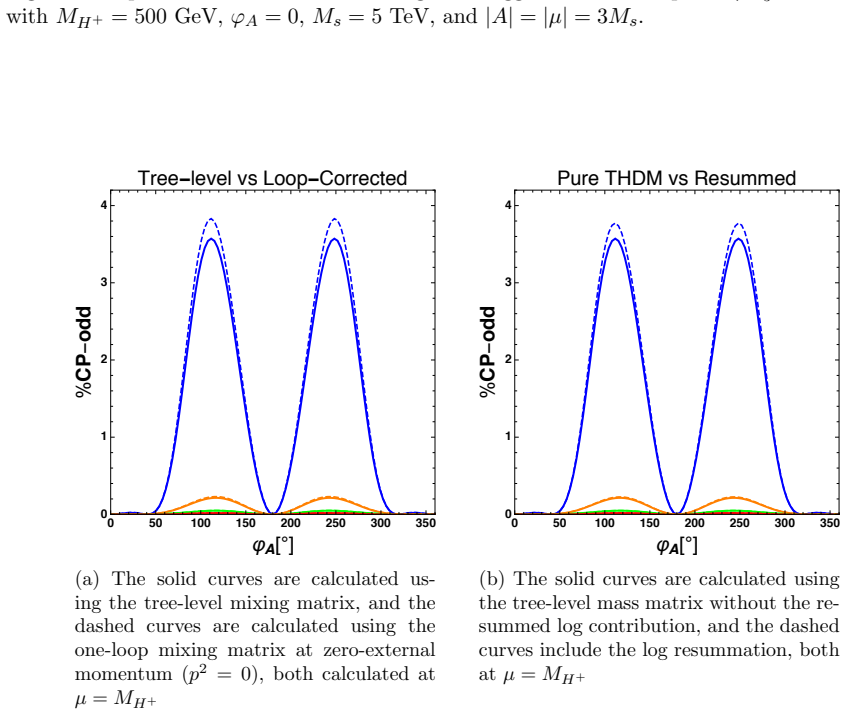
In the paper's own terms, the claim being established is an extension of existing heavy-SUSY Higgs predictions to include CP violation: after one-loop matching of the complex MSSM to a type-III two-Higgs-doublet model and two-loop phase-keeping RGE evolution, the phase $\phi_A$ of the common trilinear coupling is a controlling parameter for the spectrum. For $\tan\beta = 5$ and $|A| = |\mu| = 3M_s$, $m_h$ changes by almost 20 GeV as $\phi_A$ runs from $0$ to $360^\circ$; at $\tan\beta = 20$ the variation shrinks to about 5 GeV, and the sign of the effect depends on the ratio $|A|/M_s$. The gluino phase $\phi_{M_3}$ moves $m_h$ by at most about 1.3 GeV, while the heavy neutral Higgs masses shift by roughly 3.5 GeV ($H_2$) and 1.5 GeV ($H_3$) with $\phi_A$, and their CP-odd content is exchanged between the two states. The CP-odd component of the lightest Higgs is computed from the mixing matrix in the rotated basis; it is maximal near $\phi_A \approx 120^\circ$ and drops below 0.5% already for $M_{H^\pm} \simeq 260$ GeV in the benchmark scenario. The paper also claims that the interpolating pole-mass approximation, which adds the resummed correction $\gamma_{\mathrm{resum}} = v^2(m_t)\lambda_{\rm SM}(m_t) - v^2(M_{H^\pm})\lambda_{\rm SM}(M_{H^\pm})$ to the Higgs-basis mass matrix, agrees well with the pure 2HDM determination at small $M_{H^\pm}$ and with the decoupled-SM determination at large $M_{H^\pm}$, making it a reliable default.
Load-bearing premise
The load-bearing premise is that the omitted two-loop threshold corrections—which are not yet available for complex MSSM parameters in the dimensional-reduction scheme—are small enough not to change the quoted GeV-level phase dependence; the paper does not estimate their size.
Editorial extensions
If this is right
- At $\tan\beta = 5$ with $|A| = |\mu| = 3M_s$, the phase $\phi_A$ changes the predicted lightest-Higgs mass by almost 20 GeV, so fixed-phase scans miss a controlling parameter of the heavy-SUSY Higgs sector.
- The same phase dependence shrinks to about 5 GeV at $\tan\beta = 20$, and its sign depends on $|A|/M_s$, meaning that the CP-phase correction cannot be absorbed into a universal shift.
- The gluino phase $\phi_{M_3}$ shifts $m_h$ by at most about 1.3 GeV in the considered scenarios, so it is a subleading source of CP-driven mass uncertainty.
- For the heavy neutral Higgs bosons, $\phi_A$ moves $m_{H_2}$ by about 3.5 GeV and $m_{H_3}$ by about 1.5 GeV, and the two states exchange their CP-odd character as $\phi_A$ varies, with only weak dependence on $M_{H^\pm}$.
- The CP-odd component of the lightest Higgs falls below 0.5% once $M_{H^\pm} \gtrsim 260$ GeV in the benchmark scenario, so for the experimentally preferred $M_{H^\pm} \geq 500$ GeV the predicted admixture is just below the expected LHC reach of roughly $\phi_\tau \simeq 4^\circ$.
Reading between the lines
- Editorial inference: the missing two-loop thresholds are the main caveat; if they are approximately phase-independent, the quoted differences—like the 20 GeV swing—survive, but if they are phase-sensitive they could either enhance or erase the effect.
- Editorial inference: the low-scale phases of $\lambda_5,\lambda_6,\lambda_7$ generated by complex RGE running feed directly into electric-dipole-moment predictions, so the same calculation provides a route to map which high-scale CP phases are experimentally allowed; the paper explicitly leaves this EDM check for future work.
- Editorial inference: combining the fast drop of the CP-odd component with LHC bounds on low $M_{H^\pm}$ and high $\tan\beta$ suggests that a measurably CP-violating 125 GeV Higgs in this heavy-SUSY setup would require a low charged-Higgs mass or a smaller $M_s$ than the 30 TeV benchmark; an HL-LHC $\tau\tau$ measurement could test this directly.
- Editorial inference: a natural testable extension is to recompute the benchmark with the missing two-loop thresholds and $\tan\beta$ resummation included, or to port the same matching-and-running machinery to the next-to-minimal supersymmetric standard model, and check whether the phase swing remains of order several GeV.
Editorial analysis
A structured set of objections, weighed in public.
Referee Report
Summary. This paper presents an effective-field-theory calculation of the Higgs-boson spectrum in the MSSM with heavy superpartners and complex parameters. The MSSM is matched to a type-III 2HDM at one-loop order at the scale Ms, the 2HDM parameters are evolved down with two-loop RGEs that include complex phases, and the pole masses are computed with several methods: using the 2HDM at MH+, using the 2HDM at mt, matching to the SM for large MH+, and an interpolation method (d) that resums the dominant logarithms while retaining the full 2HDM mass matrix. The central numerical findings are that the mass of the lightest neutral Higgs boson can vary by up to about 20 GeV as the common phase of At and Ab is varied in the extreme benchmark |A|=|µ|=3Ms, tanβ=5, and that the CP-odd admixture of the lightest Higgs boson drops below 0.5% for MH+≈260 GeV in their scenario. The paper also studies the dependence on the gluino phase and the masses and mixings of the heavy Higgs bosons.
Significance. If the quantitative results hold, this work is a valuable step toward next-to-leading-log resummed predictions for the CP-violating MSSM with heavy sfermions. It provides the first complete one-loop matching of the complex MSSM to a type-III 2HDM including field redefinitions, two-loop RGEs with complex phases, and a transparent comparison of different pole-mass schemes. The interpolation method (d) is cross-checked against the pure 2HDM and SM limits for real parameters, and the authors are explicit about the missing two-loop thresholds and the restriction tanβ≤20 without tanβ resummation. The qualitative conclusion that CP phases can shift the lightest Higgs mass by several GeV and can control the size of the CP-odd admixture is plausible and interesting. However, the main numerical claim is made in a benchmark where the one-loop matching is not a small correction, and the absence of any uncertainty estimate limits the quantitative reach of the paper.
major comments (1)
- [Section 4, Eqs. (15)–(21), Fig. 5(b)] The central quantitative claim—that the lightest Higgs mass varies by almost 20 GeV with the phase ϕA—is not controlled by the published calculation. For the benchmark |A|=|µ|=3Ms with h_t(Ms)≈0.8, the one-loop box contributions to the quartics, e.g., Δλ_1^(4) = −κ/2 h_t^4 |µ̂|^4 ≈ −0.1, are comparable to the tree-level values λ_i ≈ 0.1–0.3 in Eq. (13). The CP-violating couplings λ5, λ6, λ7 are entirely loop-induced and receive exactly these A-dependent terms, so the phase sensitivity in Fig. 5(b) is dominated by threshold corrections that are not parametrically small. Section 4 states that two-loop thresholds are unknown for complex parameters in the DR scheme, and no uncertainty estimate is given anywhere. Since two-loop terms are suppressed by only one additional loop factor, the missing O(h_t^4 g_s^2) and O(|A|^6 h_t^6) pieces can plausibly shift m_h by more than 1–2 GeV and can modify the phase dependence itself, not merely the overall mass. The qualitative conclusion that phases can shift m_h by several GeV is likely robust and is a worthwhile result, but the specific magnitude near 20 GeV and the masses close to 105 GeV in Fig. 5(b) are not quantitatively supported. I recommend adding an estimate of the missing higher-order uncertainty, for example by renormalization-scale variation or by using the O(h_t^4 g_s^2) two-loop thresholds of Ref. [92] (converted to DR) as a proxy, and softening the quantitative statements in the abstract and Section 7 accordingly.
minor comments (4)
- [Section 4] There is a typo in the sentence describing the loop-function evaluation: "evalued" should be "evaluated".
- [Eq. (56)] The symbol "γreum" is a typo for "γresum".
- [Section 6.5] Please clarify that the notation P^2_{i3} in the CP-odd percentage definition denotes |P_{i3}|², since the mixing matrix is in general complex.
- [Abstract and Section 6.4] The abstract quotes the phase dependence as "on the order of a couple of GeV," while Fig. 5(b) shows almost 20 GeV for the extreme benchmark |A|=|µ|=3Ms. Please state both the typical and maximal values, and explicitly connect the maximal value to the benchmark at the boundary of the calculation’s validity.
Circularity Check
No significant circularity: the Higgs masses are computed from MSSM inputs via one-loop matching and two-loop RGEs; the phase dependence is an un-fitted output.
full rationale
The central derivation is self-contained: the MSSM soft parameters and phases specified at M_s enter the one-loop matching conditions (Eqs. (15)-(43)) to define 2HDM couplings, which are evolved with two-loop complex RGEs and then converted to pole masses through Eqs. (49), (50), and (57). No parameter is fitted to the target m_h; the numerical minimization in step 2(c) adjusts high-scale gauge and Yukawa couplings to reproduce the low-scale SM gauge and Yukawa observables, not the Higgs mass. The headline phase dependence of m_h follows directly from the loop-induced complex couplings, especially lambda5-lambda7 in Eqs. (19)-(21) and (28)-(29), and their running, and is therefore an independent prediction rather than a renamed input. The only self-referential element is footnote 6, which acknowledges that the SM MS-bar inputs were extracted using M_SM_h = 125.15 GeV without iterating the calculation; this is an external measured value used as input, not the output redefined as an input, and the paper correctly notes that iteration would be the more sophisticated procedure. Missing two-loop threshold corrections are a stated accuracy limitation (Section 4) and a correctness risk, but do not amount to circularity.
Assumptions & free parameters
free parameters (6)
- |A|/Ms =
3 (also 2 in some scans)
- |μ|/Ms =
3 (also 1 in some scans)
- ϕA (common phase of At and Ab) =
2.1 rad ≈ 120°
- tanβ =
5 (also 10, 15, 20)
- MH+ =
500 GeV (also 200-1000 GeV)
- Ms =
3-30 TeV
assumptions (5)
- domain assumption The two-loop RGEs for a general 2HDM with complex parameters, taken from Refs. [99-103], correctly describe the running of all couplings.
- domain assumption One-loop threshold corrections at Ms, computed with all soft masses equal to Ms and neglecting O(g_a g_b^y) terms with a+b=4, are sufficient; two-loop thresholds are not included.
- domain assumption The SM couplings at Mt extracted using MhSM = 125.15 GeV can be used without iterating the conversion.
- ad hoc to paper The phases of M1 and M2 can be chosen to minimize EDM constraints and do not affect the Higgs mass prediction.
- domain assumption For the log resummation in option (d), the 2HDM can be treated as a CP-even type-II 2HDM with only top-Yukawa couplings.
Cite this review
Pith. "Pith review of Higgs-Boson Masses and Mixings in the MSSM with CP Violation and Heavy SUSY Particles." pith.science (2026). https://pith.science/paper/AZY2UKTU
@misc{pith2026190900726,
  author       = {Pith},
  title        = {Pith review of: Higgs-Boson Masses and Mixings in the MSSM with CP Violation and Heavy SUSY Particles},
  year         = {2026},
  howpublished = {\url{https://pith.science/paper/AZY2UKTU}},
  note         = {Machine review of arXiv:1909.00726}
}
read the original abstract
We calculate the Higgs-boson mass spectrum and the corresponding mixing of the Higgs states in the Minimal Supersymmetric Standard Model (MSSM). We assume a mass-hierarchy with heavy SUSY particles and light Higgs bosons. To investigate this scenario, we employ an effective-field-theory approach with a low-energy Two-Higgs-Doublet Model (2HDM) where both Higgs doublets couple to up- as well as down-type fermions. We perform a one-loop matching of the MSSM to the 2HDM and evolve the parameters to the low energy scale by exploiting two-loop renormalization group equations, taking the complex parameters into account. For the calculation of the pole mass, we compare three different options: one suitable for large charged Higgs masses, one for low charged Higgs masses, and one approximation that interpolates between these scenarios. The phase dependence of the mass of the lightest neutral Higgs boson can be sizeable, i.e. on the order of a couple of GeV depending on the scenario. In addition, we discuss the CP composition of the neutral Higgs bosons.
Figures


Figures from the paper (7 more)




Reference graph
Works this paper leans on
- [92]
-
[106]
$Z_2$ breaking effects in 2-loop RG evolution of 2HDM
J. Oredsson and J. Rathsman, Z2 breaking effects in 2-loop RG evolution of 2HDM , JHEP 02 (2019) 152, [ arXiv:1810.02588]
work page Pith review arXiv 2019
-
[1]
A TLASCollaboration, G. Aad et al., Observation of a new particle in the search for the Standard Model Higgs boson with the ATLAS detector at the LHC , Phys. Lett. B716 (2012) 1–29, [ arXiv:1207.7214]
arXiv 2012
-
[2]
CMS Collaboration, S. Chatrchyan et al., Observation of a new boson at a mass of 125 GeV with the CMS experiment at the LHC , Phys. Lett. B716 (2012) 30–61, [arXiv:1207.7235]
arXiv 2012
-
[3]
A TLAS, CMS Collaboration, G. Aad et al., Combined Measurement of the Higgs Boson Mass in pp Collisions at √s = 7 and 8 TeV with the ATLAS and CMS Experiments, Phys. Rev. Lett. 114 (2015) 191803, [ arXiv:1503.07589]
arXiv 2015
-
[4]
H. E. Haber and R. Hempfling, Can the mass of the lightest Higgs boson of the minimal supersymmetric model be larger than m(Z)? , Phys. Rev. Lett. 66 (1991) 1815–1818
1991
-
[5]
J. R. Ellis, G. Ridolfi, and F. Zwirner, Radiative corrections to the masses of supersymmetric Higgs bosons, Phys. Lett. B257 (1991) 83–91
1991
-
[6]
Okada, M
Y. Okada, M. Yamaguchi, and T. Yanagida, Upper bound of the lightest Higgs boson mass in the minimal supersymmetric standard model , Prog. Theor. Phys. 85 (1991) 1–6
1991
Show all 120 references
-
[7]
J. R. Ellis, G. Ridolfi, and F. Zwirner, On radiative corrections to supersymmetric Higgs boson masses and their implications for LEP searches , Phys. Lett. B262 (1991) 477–484
1991
-
[8]
P. H. Chankowski, S. Pokorski, and J. Rosiek, Charged and neutral supersymmetric Higgs boson masses: Complete one loop analysis , Phys. Lett. B274 (1992) 191–198
1992
-
[9]
Brignole, Radiative corrections to the supersymmetric neutral Higgs boson masses , Phys
A. Brignole, Radiative corrections to the supersymmetric neutral Higgs boson masses , Phys. Lett. B281 (1992) 284–294
1992
-
[10]
P. H. Chankowski, S. Pokorski, and J. Rosiek, Complete on-shell renormalization scheme for the minimal supersymmetric Higgs sector , Nucl. Phys. B423 (1994) 437–496, [hep-ph/9303309]
1994 arXiv
-
[11]
Dabelstein, The One loop renormalization of the MSSM Higgs sector and its application to the neutral scalar Higgs masses , Z
A. Dabelstein, The One loop renormalization of the MSSM Higgs sector and its application to the neutral scalar Higgs masses , Z. Phys. C67 (1995) 495–512, [hep-ph/9409375]
1995 arXiv
-
[12]
D. M. Pierce, J. A. Bagger, K. T. Matchev, and R.-j. Zhang, Precision corrections in the minimal supersymmetric standard model , Nucl. Phys. B491 (1997) 3–67, [hep-ph/9606211]
1997 arXiv
-
[13]
Frank, et al., The Higgs boson masses and mixings of the complex MSSM in the Feynman-diagrammatic approach, JHEP 02 (2007) 047, [ hep-ph/0611326]
M. Frank, et al., The Higgs boson masses and mixings of the complex MSSM in the Feynman-diagrammatic approach, JHEP 02 (2007) 047, [ hep-ph/0611326]
2007 arXiv
-
[14]
Heinemeyer, W
S. Heinemeyer, W. Hollik, and G. Weiglein, QCD corrections to the masses of the neutral CP - even Higgs bosons in the MSSM , Phys. Rev. D58 (1998) 091701, [hep-ph/9803277]
1998 arXiv
-
[15]
Heinemeyer, W
S. Heinemeyer, W. Hollik, and G. Weiglein, Precise prediction for the mass of the lightest Higgs boson in the MSSM , Phys. Lett. B440 (1998) 296–304, [ hep-ph/9807423]
1998 arXiv
-
[16]
Zhang, Two loop effective potential calculation of the lightest CP even Higgs boson mass in the MSSM , Phys
R.-J. Zhang, Two loop effective potential calculation of the lightest CP even Higgs boson mass in the MSSM , Phys. Lett. B447 (1999) 89–97, [ hep-ph/9808299]. 27
1999 arXiv
-
[17]
Heinemeyer, W
S. Heinemeyer, W. Hollik, and G. Weiglein, The Masses of the neutral CP - even Higgs bosons in the MSSM: Accurate analysis at the two loop level , Eur. Phys. J. C9 (1999) 343–366, [hep-ph/9812472]
1999 arXiv
-
[18]
J. R. Espinosa and R.-J. Zhang, MSSM lightest CP even Higgs boson mass to O(αsαt): The effective potential approach, JHEP 03 (2000) 026, [ hep-ph/9912236]
2000 arXiv
-
[19]
J. R. Espinosa and R.-J. Zhang, Complete two loop dominant corrections to the mass of the lightest CP even Higgs boson in the minimal supersymmetric standard model , Nucl. Phys. B586 (2000) 3–38, [ hep-ph/0003246]
2000 arXiv
-
[20]
Degrassi, P
G. Degrassi, P. Slavich, and F. Zwirner, On the neutral Higgs boson masses in the MSSM for arbitrary stop mixing , Nucl. Phys. B611 (2001) 403–422, [ hep-ph/0105096]
2001 arXiv
-
[21]
Brignole, G
A. Brignole, G. Degrassi, P. Slavich, and F. Zwirner, On the O(α2 t ) two loop corrections to the neutral Higgs boson masses in the MSSM , Nucl. Phys. B631 (2002) 195–218, [hep-ph/0112177]
2002 arXiv
-
[22]
Brignole, G
A. Brignole, G. Degrassi, P. Slavich, and F. Zwirner, On the two loop sbottom corrections to the neutral Higgs boson masses in the MSSM , Nucl. Phys. B643 (2002) 79–92, [hep-ph/0206101]
2002 arXiv
-
[23]
S. P. Martin, Two loop effective potential for the minimal supersymmetric standard model, Phys. Rev. D66 (2002) 096001, [ hep-ph/0206136]
2002 arXiv
-
[24]
S. P. Martin, Complete two loop effective potential approximation to the lightest Higgs scalar boson mass in supersymmetry , Phys. Rev. D67 (2003) 095012, [ hep-ph/0211366]
2003 arXiv
-
[25]
Dedes and P
A. Dedes and P. Slavich, Two loop corrections to radiative electroweak symmetry breaking in the MSSM , Nucl. Phys. B657 (2003) 333–354, [ hep-ph/0212132]
2003 arXiv
-
[26]
Dedes, G
A. Dedes, G. Degrassi, and P. Slavich, On the two loop Yukawa corrections to the MSSM Higgs boson masses at large tanβ, Nucl. Phys. B672 (2003) 144–162, [hep-ph/0305127]
2003 arXiv
-
[27]
S. P. Martin, Strong and Yukawa two-loop contributions to Higgs scalar boson self-energies and pole masses in supersymmetry , Phys. Rev. D71 (2005) 016012, [hep-ph/0405022]
2005 arXiv
-
[28]
Allanach, A
B. Allanach, A. Djouadi, J. Kneur, W. Porod, and P. Slavich, Precise determination of the neutral Higgs boson masses in the MSSM , JHEP 0409 (2004) 044, [hep-ph/0406166]
2004 arXiv
-
[29]
Heinemeyer, W
S. Heinemeyer, W. Hollik, H. Rzehak, and G. Weiglein, High-precision predictions for the MSSM Higgs sector at O(αbαs), Eur. Phys. J. C39 (2005) 465–481, [ hep-ph/0411114]
2005 arXiv
-
[30]
S. P. Martin, Two-loop scalar self-energies and pole masses in a general renormalizable theory with massless gauge bosons , Phys. Rev. D71 (2005) 116004, [ hep-ph/0502168]
2005 arXiv
-
[31]
Heinemeyer, W
S. Heinemeyer, W. Hollik, H. Rzehak, and G. Weiglein, The Higgs sector of the complex MSSM at two-loop order: QCD contributions , Phys.Lett. B652 (2007) 300–309, [arXiv:0705.0746]
2007 arXiv
-
[32]
Borowka, T
S. Borowka, T. Hahn, S. Heinemeyer, G. Heinrich, and W. Hollik, Momentum-dependent two-loop QCD corrections to the neutral Higgs-boson masses in the MSSM , Eur. Phys. J. C74 (2014), no. 8 2994, [ arXiv:1404.7074]. 28
2014 arXiv
-
[33]
Degrassi, S
G. Degrassi, S. Di Vita, and P. Slavich, Two-loop QCD corrections to the MSSM Higgs masses beyond the effective-potential approximation , Eur. Phys. J. C75 (2015), no. 2 61, [arXiv:1410.3432]
2015 arXiv
-
[34]
Hollik and S
W. Hollik and S. Paßehr, Two-loop top-Yukawa-coupling corrections to the Higgs boson masses in the complex MSSM , Phys. Lett. B733 (2014) 144–150, [ arXiv:1401.8275]
2014 arXiv
-
[35]
Hollik and S
W. Hollik and S. Paßehr, Higgs boson masses and mixings in the complex MSSM with two-loop top-Yukawa-coupling corrections, JHEP 10 (2014) 171, [ arXiv:1409.1687]
2014 arXiv
-
[36]
Hollik and S
W. Hollik and S. Paßehr, Two-loop top-Yukawa-coupling corrections to the charged Higgs-boson mass in the MSSM , Eur. Phys. J. C75 (2015), no. 7 336, [arXiv:1502.02394]
2015 arXiv
-
[37]
Borowka, T
S. Borowka, T. Hahn, S. Heinemeyer, G. Heinrich, and W. Hollik, Renormalization scheme dependence of the two-loop QCD corrections to the neutral Higgs-boson masses in the MSSM , Eur. Phys. J. C75 (2015), no. 9 424, [ arXiv:1505.03133]
2015 arXiv
-
[38]
M. D. Goodsell and F. Staub, The Higgs mass in the CP violating MSSM, NMSSM, and beyond, Eur. Phys. J. C77 (2017), no. 1 46, [ arXiv:1604.05335]
2017 arXiv
-
[39]
Paßehr and G
S. Paßehr and G. Weiglein, Two-loop top and bottom Yukawa corrections to the Higgs-boson masses in the complex MSSM , Eur. Phys. J. C78 (2018), no. 3 222, [arXiv:1705.07909]
2018 arXiv
-
[40]
Borowka, S
S. Borowka, S. Paßehr, and G. Weiglein, Complete two-loop QCD contributions to the lightest Higgs-boson mass in the MSSM with complex parameters , Eur. Phys. J. C78 (2018), no. 7 576, [ arXiv:1802.09886]
2018 arXiv
-
[41]
S. P. Martin, Three-loop corrections to the lightest Higgs scalar boson mass in supersymmetry, Phys. Rev. D75 (2007) 055005, [ hep-ph/0701051]
2007 arXiv
-
[42]
Harlander, P
R. Harlander, P. Kant, L. Mihaila, and M. Steinhauser, Higgs boson mass in supersymmetry to three loops, Phys.Rev.Lett. 100 (2008) 191602, [ arXiv:0803.0672]
2008 arXiv
-
[43]
P. Kant, R. V. Harlander, L. Mihaila, and M. Steinhauser, Light MSSM Higgs boson mass to three-loop accuracy, JHEP 08 (2010) 104, [ arXiv:1005.5709]
2010 arXiv
-
[44]
R. V. Harlander, J. Klappert, and A. Voigt, Higgs mass prediction in the MSSM at three-loop level in a pure DR context, Eur. Phys. J. C77 (2017), no. 12 814, [arXiv:1708.05720]
2017 arXiv
-
[45]
St¨ ockinger and J
D. St¨ ockinger and J. Unger,Three-loop MSSM Higgs-boson mass predictions and regularization by dimensional reduction, Nucl. Phys. B935 (2018) 1–16, [arXiv:1804.05619]
2018 arXiv
-
[46]
A. R. Fazio and E. A. Reyes R., The Lightest Higgs Boson Mass of the MSSM at Three-Loop Accuracy, Nucl. Phys. B942 (2019) 164–183, [ arXiv:1901.03651]
2019 arXiv
-
[47]
E. A. Reyes R. and A. R. Fazio, Comparison of the EFT Hybrid and Three-Loop Fixed-Order Calculations of the Lightest MSSM Higgs Boson Mass , arXiv:1908.00693
1908 arXiv
-
[48]
Degrassi, S
G. Degrassi, S. Heinemeyer, W. Hollik, P. Slavich, and G. Weiglein, Towards high precision predictions for the MSSM Higgs sector , Eur. Phys. J. C28 (2003) 133–143, [hep-ph/0212020]
2003 arXiv
-
[49]
J. P. Vega and G. Villadoro, SusyHD: Higgs mass determination in supersymmetry , JHEP 07 (2015) 159, [ arXiv:1504.05200]. 29
2015 arXiv
-
[50]
H. Bahl, S. Heinemeyer, W. Hollik, and G. Weiglein, Reconciling EFT and hybrid calculations of the light MSSM Higgs-boson mass , Eur. Phys. J. C78 (2018), no. 1 57, [arXiv:1706.00346]
2018 arXiv
-
[51]
B. C. Allanach and A. Voigt, Uncertainties in the Lightest CP Even Higgs Boson Mass Prediction in the Minimal Supersymmetric Standard Model: Fixed Order Versus Effective Field Theory Prediction, Eur. Phys. J. C78 (2018), no. 7 573, [arXiv:1804.09410]
2018 arXiv
-
[52]
Barbieri, M
R. Barbieri, M. Frigeni, and F. Caravaglios, The Supersymmetric Higgs for heavy superpartners, Phys. Lett. B258 (1991) 167–170
1991
-
[53]
Okada, M
Y. Okada, M. Yamaguchi, and T. Yanagida, Renormalization group analysis on the Higgs mass in the softly broken supersymmetric standard model , Phys. Lett. B262 (1991) 54–58
1991
-
[54]
Kodaira, Y
J. Kodaira, Y. Yasui, and K. Sasaki, The Mass of the lightest supersymmetric Higgs boson beyond the leading logarithm approximation , Phys. Rev. D50 (1994) 7035–7041, [hep-ph/9311366]
1994 arXiv
-
[55]
Hempfling and A
R. Hempfling and A. H. Hoang, Two loop radiative corrections to the upper limit of the lightest Higgs boson mass in the minimal supersymmetric model , Phys. Lett. B331 (1994) 99–106, [ hep-ph/9401219]
1994 arXiv
-
[56]
J. A. Casas, J. R. Espinosa, M. Quiros, and A. Riotto, The Lightest Higgs boson mass in the minimal supersymmetric standard model , Nucl. Phys. B436 (1995) 3–29, [hep-ph/9407389]. [Erratum: Nucl. Phys.B439,466(1995)]
1995 arXiv
-
[57]
H. E. Haber, R. Hempfling, and A. H. Hoang, Approximating the radiatively corrected Higgs mass in the minimal supersymmetric model , Z. Phys. C75 (1997) 539–554, [hep-ph/9609331]
1997 arXiv
-
[58]
J. R. Espinosa and M. Quiros, Two loop radiative corrections to the mass of the lightest Higgs boson in supersymmetric standard models , Phys. Lett. B266 (1991) 389–396
1991
-
[59]
Sasaki, M
K. Sasaki, M. Carena, and C. E. M. Wagner, Renormalization group analysis of the Higgs sector in the minimal supersymmetric standard model , Nucl. Phys. B381 (1992) 66–86
1992
-
[60]
P. H. Chankowski, S. Pokorski, and J. Rosiek, Is the lightest supersymmetric Higgs Boson distinguishable from the minimal standard model one? , Phys. Lett. B281 (1992) 100–105
1992
-
[61]
H. E. Haber and R. Hempfling, The renormalization group improved Higgs sector of the minimal supersymmetric model, Phys. Rev. D48 (1993) 4280–4309, [ hep-ph/9307201]
1993 arXiv
-
[62]
Carena, J
M. Carena, J. R. Espinosa, M. Quiros, and C. E. M. Wagner, Analytical expressions for radiatively corrected Higgs masses and couplings in the MSSM , Phys. Lett. B355 (1995) 209–221, [hep-ph/9504316]
1995 arXiv
-
[63]
J. R. Espinosa and I. Navarro, Radiative corrections to the Higgs boson mass for a hierarchical stop spectrum, Nucl. Phys. B615 (2001) 82–116, [ hep-ph/0104047]
2001 arXiv
-
[64]
Pilaftsis and C
A. Pilaftsis and C. E. M. Wagner, Higgs bosons in the minimal supersymmetric standard model with explicit CP violation , Nucl. Phys. B553 (1999) 3–42, [ hep-ph/9902371]. 30
1999 arXiv
-
[65]
Carena, J
M. Carena, J. R. Ellis, A. Pilaftsis, and C. E. M. Wagner, Renormalization group improved effective potential for the MSSM Higgs sector with explicit CP violation , Nucl. Phys. B586 (2000) 92–140, [ hep-ph/0003180]
2000 arXiv
-
[66]
Draper, G
P. Draper, G. Lee, and C. E. M. Wagner, Precise estimates of the Higgs mass in heavy supersymmetry, Phys. Rev. D89 (2014), no. 5 055023, [ arXiv:1312.5743]
2014 arXiv
-
[67]
Lee and C
G. Lee and C. E. M. Wagner, Higgs bosons in heavy supersymmetry with an intermediate mA, Phys. Rev. D92 (2015), no. 7 075032, [ arXiv:1508.00576]
2015 arXiv
-
[68]
Bagnaschi, F
E. Bagnaschi, F. Br¨ ummer, W. Buchm¨ uller, A. Voigt, and G. Weiglein,Vacuum stability and supersymmetry at high scales with two Higgs doublets , JHEP 03 (2016) 158, [arXiv:1512.07761]
2016 arXiv
-
[69]
Gorbahn, S
M. Gorbahn, S. J¨ ager, U. Nierste, and S. Trine, The supersymmetric Higgs sector and B− ¯B mixing for large tan β, Phys. Rev. D84 (2011) 034030, [ arXiv:0901.2065]
2011 arXiv
-
[70]
Bagnaschi, G
E. Bagnaschi, G. F. Giudice, P. Slavich, and A. Strumia, Higgs Mass and Unnatural Supersymmetry, JHEP 09 (2014) 092, [ arXiv:1407.4081]
2014 arXiv
-
[71]
Bagnaschi, J
E. Bagnaschi, J. Pardo Vega, and P. Slavich, Improved determination of the Higgs mass in the MSSM with heavy superpartners , Eur. Phys. J. C77 (2017), no. 5 334, [arXiv:1703.08166]
2017 arXiv
-
[72]
Bagnaschi, G
E. Bagnaschi, G. Degrassi, S. Paßehr, and P. Slavich, Full two-loop QCD corrections to the Higgs mass in the MSSM with heavy superpartners , arXiv:1908.01670
1908 arXiv
-
[73]
J. D. Wells and Z. Zhang, Effective field theory approach to trans-TeV supersymmetry: covariant matching, Yukawa unification and Higgs couplings , JHEP 05 (2018) 182, [arXiv:1711.04774]
2018 arXiv
-
[74]
R. V. Harlander, J. Klappert, A. D. Ochoa Franco, and A. Voigt, The light CP-even MSSM Higgs mass resummed to fourth logarithmic order , Eur. Phys. J. C78 (2018), no. 10 874, [ arXiv:1807.03509]
2018 arXiv
-
[75]
T. Hahn, S. Heinemeyer, W. Hollik, H. Rzehak, and G. Weiglein, High-precision predictions for the light CP-even Higgs boson mass of the Minimal Supersymmetric Standard Model, Phys. Rev. Lett. 112 (2014), no. 14 141801, [ arXiv:1312.4937]
2014 arXiv
-
[76]
Bahl and W
H. Bahl and W. Hollik, Precise prediction for the light MSSM Higgs boson mass combining effective field theory and fixed-order calculations , Eur. Phys. J. C76 (2016), no. 9 499, [ arXiv:1608.01880]
2016 arXiv
-
[77]
Bahl and W
H. Bahl and W. Hollik, Precise prediction of the MSSM Higgs boson masses for low M A, JHEP 07 (2018) 182, [ arXiv:1805.00867]
2018 arXiv
-
[78]
Heinemeyer, W
S. Heinemeyer, W. Hollik, and G. Weiglein, FeynHiggs: A Program for the calculation of the masses of the neutral CP even Higgs bosons in the MSSM , Comput. Phys. Commun. 124 (2000) 76–89, [ hep-ph/9812320]
2000 arXiv
-
[79]
Bahl, et al., Precision calculations in the MSSM Higgs-boson sector with FeynHiggs 2.14, arXiv:1811.09073
H. Bahl, et al., Precision calculations in the MSSM Higgs-boson sector with FeynHiggs 2.14, arXiv:1811.09073
-
[80]
Athron, J.-h
P. Athron, J.-h. Park, D. St¨ ockinger, and A. Voigt,FlexibleSUSY?A spectrum generator generator for supersymmetric models , Comput. Phys. Commun. 190 (2015) 139–172, [arXiv:1406.2319]. 31
2015 arXiv
-
[81]
Athron, et al., FlexibleSUSY 2.0: Extensions to investigate the phenomenology of SUSY and non-SUSY models , Comput
P. Athron, et al., FlexibleSUSY 2.0: Extensions to investigate the phenomenology of SUSY and non-SUSY models , Comput. Phys. Commun. 230 (2018) 145–217, [arXiv:1710.03760]
2018 arXiv
-
[82]
Staub, From Superpotential to Model Files for FeynArts and CalcHep/CompHep , Comput
F. Staub, From Superpotential to Model Files for FeynArts and CalcHep/CompHep , Comput. Phys. Commun. 181 (2010) 1077–1086, [ arXiv:0909.2863]
2010 arXiv
-
[83]
Staub, Automatic Calculation of supersymmetric Renormalization Group Equations and Self Energies , Comput
F. Staub, Automatic Calculation of supersymmetric Renormalization Group Equations and Self Energies , Comput. Phys. Commun. 182 (2011) 808–833, [ arXiv:1002.0840]
2011 arXiv
-
[84]
Staub, SARAH 3.2: Dirac Gauginos, UFO output, and more , Comput
F. Staub, SARAH 3.2: Dirac Gauginos, UFO output, and more , Comput. Phys. Commun. 184 (2013) 1792–1809, [ arXiv:1207.0906]
2013 arXiv
-
[85]
Staub, SARAH 4 : A tool for (not only SUSY) model builders , Comput
F. Staub, SARAH 4 : A tool for (not only SUSY) model builders , Comput. Phys. Commun. 185 (2014) 1773–1790, [ arXiv:1309.7223]
2014 arXiv
-
[86]
Porod, SPheno, a program for calculating supersymmetric spectra, SUSY particle decays and SUSY particle production at e+ e- colliders , Comput
W. Porod, SPheno, a program for calculating supersymmetric spectra, SUSY particle decays and SUSY particle production at e+ e- colliders , Comput. Phys. Commun. 153 (2003) 275–315, [ hep-ph/0301101]
2003 arXiv
-
[87]
Porod and F
W. Porod and F. Staub, SPheno 3.1: Extensions including flavour, CP-phases and models beyond the MSSM , Comput. Phys. Commun. 183 (2012) 2458–2469, [arXiv:1104.1573]
2012 arXiv
-
[88]
Athron, J.-h
P. Athron, J.-h. Park, T. Steudtner, D. St¨ ockinger, and A. Voigt,Precise Higgs mass calculations in (non-)minimal supersymmetry at both high and low scales , JHEP 01 (2017) 079, [ arXiv:1609.00371]
2017 arXiv
-
[89]
Staub and W
F. Staub and W. Porod, Improved predictions for intermediate and heavy Supersymmetry in the MSSM and beyond , Eur. Phys. J. C77 (2017), no. 5 338, [ arXiv:1703.03267]
2017 arXiv
-
[90]
Arbey, J
A. Arbey, J. Ellis, R. M. Godbole, and F. Mahmoudi, Exploring CP Violation in the MSSM, Eur. Phys. J. C75 (2015), no. 2 85, [ arXiv:1410.4824]
2015 arXiv
-
[91]
Li and C
B. Li and C. E. M. Wagner, CP-odd component of the lightest neutral Higgs boson in the MSSM, Phys. Rev. D91 (2015) 095019, [ arXiv:1502.02210]
2015 arXiv
-
[93]
Kobayashi and T
M. Kobayashi and T. Maskawa, CP Violation in the Renormalizable Theory of Weak Interaction, Prog. Theor. Phys. 49 (1973) 652–657
1973
-
[94]
S. P. Martin, A Supersymmetry primer , hep-ph/9709356. [Adv. Ser. Direct. High Energy Phys.18,1(1998)]
1998 arXiv
-
[95]
Drees, An Introduction to supersymmetry , in Current topics in physics
M. Drees, An Introduction to supersymmetry , in Current topics in physics. Proceedings, Inauguration Conference of the Asia-Pacific Center for Theoretical Physics (APCTP), Seoul, Korea, June 4-10, 1996. Vol. 1, 2 , 1996. hep-ph/9611409
1996 arXiv
-
[96]
Hahn, Generating Feynman diagrams and amplitudes with FeynArts 3 , Comput
T. Hahn, Generating Feynman diagrams and amplitudes with FeynArts 3 , Comput. Phys. Commun. 140 (2001) 418–431, [ hep-ph/0012260]
2001 arXiv
-
[97]
Hahn and M
T. Hahn and M. Perez-Victoria, Automated one loop calculations in four-dimensions and D-dimensions, Comput. Phys. Commun. 118 (1999) 153–165, [ hep-ph/9807565]. 32
1999 arXiv
-
[98]
P. W. Angel, Y. Cai, N. L. Rodd, M. A. Schmidt, and R. R. Volkas, Testable two-loop radiative neutrino mass model based on an LLQdcQdc effective operator, JHEP 10 (2013) 118, [ arXiv:1308.0463]. [Erratum: JHEP11,092(2014)]
2013 arXiv
-
[99]
Machacek and M
M. Machacek and M. Vaughn, Two-Loop Renormalization Group Equations in a General Quantum Field Theory (I). Wave Function Renormalization , Nuclear Physics B 222 (1983) 83–103
1983
-
[100]
Machacek and M
M. Machacek and M. Vaughn, Two-Loop Renormalization Group Equations in a General Quantum Field Theory (II). Yukawa Couplings , Nuclear Physics B 236 (1984) 221–232
1984
-
[101]
Machacek and M
M. Machacek and M. Vaughn, Two-Loop Renormalization Group Equations in a General Quantum Field Theory (III). Scalar Quartic Couplings , Nuclear Physics B 249 (1985) 70–92
1985
-
[102]
Luo, H.-w
M.-x. Luo, H.-w. Wang, and Y. Xiao, Two loop renormalization group equations in general gauge field theories , Phys. Rev. D67 (2003) 065019, [ hep-ph/0211440]
2003 arXiv
-
[103]
Schienbein, F
I. Schienbein, F. Staub, T. Steudtner, and K. Svirina, Revisiting RGEs for general gauge theories, Nucl. Phys. B939 (2019) 1–48, [ arXiv:1809.06797]
2019 arXiv
-
[104]
Sperling, D
M. Sperling, D. St¨ ockinger, and A. Voigt,Renormalization of vacuum expectation values in spontaneously broken gauge theories , JHEP 07 (2013) 132, [ arXiv:1305.1548]
2013 arXiv
-
[105]
Sperling, D
M. Sperling, D. St¨ ockinger, and A. Voigt,Renormalization of vacuum expectation values in spontaneously broken gauge theories: Two-loop results , JHEP 01 (2014) 068, [arXiv:1310.7629]
2014 arXiv
-
[107]
G. C. Branco, L. Lavoura, and J. P. Silva, CP Violation, Int. Ser. Monogr. Phys. 103 (1999) 1–536
1999
-
[108]
J. F. Gunion and H. E. Haber, The CP conserving two Higgs doublet model: The Approach to the decoupling limit , Phys. Rev. D67 (2003) 075019, [ hep-ph/0207010]
2003 arXiv
-
[109]
H. E. Haber and O. St˚ al,New LHC benchmarks for the CP -conserving two-Higgs-doublet model, Eur. Phys. J. C75 (2015), no. 10 491, [ arXiv:1507.04281]. [Erratum: Eur. Phys. J.C76,no.6,312(2016)]
2015 arXiv
-
[110]
Buttazzo, et al., Investigating the near-criticality of the Higgs boson , JHEP 12 (2013) 089, [arXiv:1307.3536]
D. Buttazzo, et al., Investigating the near-criticality of the Higgs boson , JHEP 12 (2013) 089, [arXiv:1307.3536]
2013 arXiv
-
[111]
Sirlin, Radiative corrections in the SU (2)L×U(1) theory: A simple renormalization framework, Physical Review D 22 (1980), no
A. Sirlin, Radiative corrections in the SU (2)L×U(1) theory: A simple renormalization framework, Physical Review D 22 (1980), no. 4 971
1980
-
[112]
CMS Collaboration, A. M. Sirunyan et al., Search for additional neutral MSSM Higgs bosons in the ττ final state in proton-proton collisions at √s = 13 TeV, JHEP 09 (2018) 007, [arXiv:1803.06553]
2018 arXiv
-
[113]
A TLASCollaboration, M. Aaboud et al., Search for additional heavy neutral Higgs and gauge bosons in the ditau final state produced in 36 fb −1 of pp collisions at √s = 13 TeV with the ATLAS detector , JHEP 01 (2018) 055, [ arXiv:1709.07242]
2018 arXiv
-
[114]
Bahl, et al., MSSM Higgs Boson Searches at the LHC: Benchmark Scenarios for Run 2 and Beyond
H. Bahl, et al., MSSM Higgs Boson Searches at the LHC: Benchmark Scenarios for Run 2 and Beyond. , arXiv:1808.07542. 33
-
[115]
H. Bahl, S. Liebler, and T. Stefaniak, MSSM Higgs benchmark scenarios for Run 2 and beyond: the low tanβ region, Eur. Phys. J. C79 (2019), no. 3 279, [ arXiv:1901.05933]
2019 arXiv
-
[116]
Arbey, F
A. Arbey, F. Mahmoudi, O. Stal, and T. Stefaniak, Status of the Charged Higgs Boson in Two Higgs Doublet Models , Eur. Phys. J. C78 (2018), no. 3 182, [ arXiv:1706.07414]
2018 arXiv
-
[117]
Berger, et al., CP -violating phenomenological MSSM, Phys
J. Berger, et al., CP -violating phenomenological MSSM, Phys. Rev. D93 (2016), no. 3 035017, [arXiv:1510.08840]
2016 arXiv
-
[118]
T. Abe, N. Omoto, O. Seto, and T. Shindou, Electric dipole moments and dark matter in a CP violating MSSM , Phys. Rev. D98 (2018), no. 7 075029, [ arXiv:1805.09537]
2018 arXiv
-
[119]
Cesarotti, Q
C. Cesarotti, Q. Lu, Y. Nakai, A. Parikh, and M. Reece, Interpreting the Electron EDM Constraint, JHEP 05 (2019) 059, [ arXiv:1810.07736]
2019 arXiv
-
[120]
Berge, W
S. Berge, W. Bernreuther, and S. Kirchner, Prospects of constraining the Higgs boson?s CP nature in the tau decay channel at the LHC , Phys. Rev. D92 (2015) 096012, [arXiv:1510.03850]. 34
2015 arXiv
Reviewed August 14, 2026 · model on record in the stance chip above.
Discussion (0). Continue with ORCID to comment.