Early Prediction of Future Behavioral Strategy from Process Traces
Pith reviewed 2026-06-29 08:48 UTC · model grok-4.3
The pith
Partial traces from two tasks can predict a person's strategy in a held-out third task via a shared latent representation.
A machine-rendered reading of the paper's core claim, the machinery that carries it, and where it could break.
Core claim
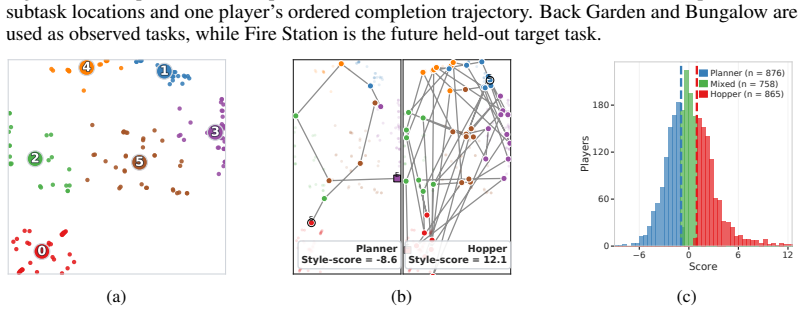
The central claim is that a Process-Level Latent Variable Model which encodes task-specific traces and fuses them into a shared person-level latent representation enables early cross-task prediction of behavioral strategy from partial source-task process traces, demonstrated by distinguishing locally persistent Zone Planner behavior from frequent Zone Hopper behavior in the held-out Fire Station level using partial traces from two other cleaning tasks, with simulations showing that cross-task fusion helps when the source tasks reveal complementary dimensions of a shared latent process.
What carries the argument
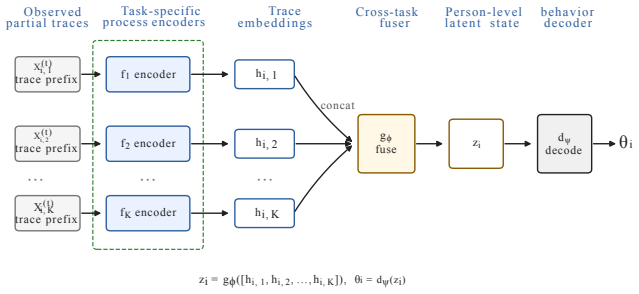
The Process-Level Latent Variable Model (PLVM), which encodes task-specific traces and fuses them into a shared person-level latent representation for cross-task prediction.
If this is right
- Partial traces from two source tasks suffice to predict strategy type in a held-out target task.
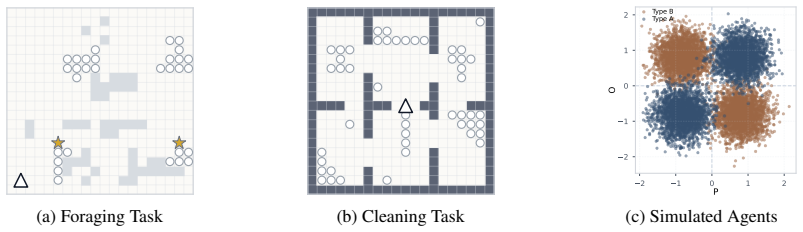
- Cross-task fusion improves prediction when source tasks reveal complementary dimensions of the latent process.
- Process-level traces distinguish behavioral strategies that would collapse into similar outcomes under aggregate summaries.
- Early prediction becomes feasible in settings where collecting full target-task behavior is impractical.
Where Pith is reading between the lines
- The same fusion approach could be tested in tutoring systems to anticipate how a learner will tackle a new problem type after seeing only partial traces on earlier problems.
- If person-level tendencies prove recoverable only when tasks share latent dimensions, the method would be limited to families of tasks that are structurally related rather than arbitrary ones.
- One could run additional simulations that vary the degree of complementarity between source tasks to map the boundary conditions under which fusion stops helping.
Load-bearing premise
Stable person-level tendencies exist and can be recovered from partial source-task process traces without being dominated by task-specific layout and affordances.
What would settle it
An experiment in which cross-task fusion produces no gain in prediction accuracy even when source tasks are known to capture complementary dimensions of the latent process, or in which real data yields no better than chance prediction of target-task strategy from the source traces.
Figures



read the original abstract
Adaptive systems often need to make task-specific decisions about people from limited evidence: a tutor may need to anticipate how a learner will approach a new problem, a game may need to adapt when a player enters a new level, and a human-AI system may need to infer whether a partner will persist with a plan or switch goals. These decisions depend on person-level tendencies that shape how people solve related tasks, but such tendencies are difficult to infer from standard behavioral evidence. One approach is to use aggregate outcome summaries, such as scores, completion rates, or productivity; these summaries are compact and available across tasks, but can collapse distinct behavioral processes into similar outcomes. Another approach is to use process-level traces, which record how behavior unfolds; however, process modeling within one task can entangle stable person-level tendencies with task-specific layout and affordances. In this work, we study early cross-task behavioral inference: whether partial source-task process traces can reveal transferable person-level structure that predicts strategy in a held-out target task. We introduce a Process-Level Latent Variable Model (PLVM), which encodes task-specific traces and fuses them into a shared person-level latent representation for cross-task prediction. In PowerWash Simulator, a naturalistic telemetry dataset of human gameplay, PLVM uses partial traces from two cleaning tasks to predict locally persistent Zone Planner behavior versus frequent Zone Hopper behavior in the held-out Fire Station level. Controlled simulations with known latent types show that cross-task fusion helps when source tasks reveal complementary dimensions of a shared latent process. These results suggest that process-level cross-task modeling can support early prediction of target-task strategy when observing sufficient target-task behavior is impractical.
Editorial analysis
A structured set of objections, weighed in public.
Referee Report
Summary. The paper claims that a Process-Level Latent Variable Model (PLVM) can encode partial process traces from two source cleaning tasks in PowerWash Simulator and fuse them into a shared person-level latent representation to predict locally persistent Zone Planner versus frequent Zone Hopper strategy in the held-out Fire Station target task; controlled simulations with known latent types are used to show that cross-task fusion improves prediction when source tasks reveal complementary dimensions of a shared latent process.
Significance. If the central claim holds, the work offers a process-level approach to early cross-task inference of person-level behavioral tendencies that goes beyond aggregate outcome summaries, with potential value for adaptive systems such as tutors or games. The use of a naturalistic telemetry dataset together with simulations that isolate the complementary-dimensions condition is a methodological strength.
major comments (1)
- [Abstract] Abstract: the claim that fusion improves target-task prediction rests on the premise that the two source cleaning tasks expose complementary dimensions of the same person-level latent strategy tendency in real data, yet the manuscript provides no direct test or evidence that this condition holds for the PowerWash Simulator tasks (as opposed to the controlled simulations); if the source tasks instead share largely overlapping dimensions, the reported fusion benefit would not transfer.
Simulated Author's Rebuttal
We thank the referee for the positive assessment of the work's significance and methodological approach. The major comment correctly identifies a gap between the simulation results and the real-data claims. We address it directly below and will revise accordingly.
read point-by-point responses
-
Referee: [Abstract] Abstract: the claim that fusion improves target-task prediction rests on the premise that the two source cleaning tasks expose complementary dimensions of the same person-level latent strategy tendency in real data, yet the manuscript provides no direct test or evidence that this condition holds for the PowerWash Simulator tasks (as opposed to the controlled simulations); if the source tasks instead share largely overlapping dimensions, the reported fusion benefit would not transfer.
Authors: We agree that no direct test of complementary dimensions is provided for the real PowerWash Simulator tasks. The controlled simulations isolate the complementary-dimensions condition and show fusion improves prediction under that condition, while the real-data results demonstrate that cross-task fusion yields higher target-task prediction accuracy than single-source baselines. However, the observed improvement in real data is consistent with but does not prove complementarity; alternative explanations (e.g., shared dimensions plus noise reduction) cannot be ruled out without additional analyses such as explicit dimension recovery or task-specific ablation of latent factors. We will revise the abstract to state that fusion improves prediction in the empirical setting and that simulations identify complementarity as a sufficient condition for the benefit, rather than asserting that the real-data tasks necessarily expose complementary dimensions. revision: yes
Circularity Check
No significant circularity; model and results are self-contained against external data
full rationale
The paper introduces PLVM as a new encoding-and-fusion architecture, applies it to an external naturalistic telemetry dataset from PowerWash Simulator, and validates the fusion benefit in separate controlled simulations where latent types are known by construction. No equations, fitted-parameter renamings, or self-citation chains are visible that would reduce the target-task predictions to the source-task inputs by definition. The requirement that source tasks expose complementary dimensions is tested rather than presupposed, and the held-out prediction uses real player traces independent of the model definition.
Axiom & Free-Parameter Ledger
Reference graph
Works this paper leans on
-
[1]
The use of process data in large-scale assessments: A literature review.Large-Scale Assessments in Education, 2024
Ella Anghel, Lale Khorramdel, and Matthias von Davier. The use of process data in large-scale assessments: A literature review.Large-Scale Assessments in Education, 2024
2024
-
[2]
Foraging behavior in visual search: A review of theoretical and mathematical models in humans and animals.Psychological research, 2022
Marcos Bella-Fernández, Manuel Suero Sune, and Beatriz Gil-Gómez de Liaño. Foraging behavior in visual search: A review of theoretical and mathematical models in humans and animals.Psychological research, 2022
2022
-
[3]
Mouselab-mdp: A new paradigm for tracing how people plan
Frederick Callaway, Falk Lieder, Paul M Krueger, and Thomas L Griffiths. Mouselab-mdp: A new paradigm for tracing how people plan. InThe 3rd Multidisciplinary Conference on Reinforcement Learning and Decision Making, 2017
2017
-
[4]
Optimal foraging, the marginal value theorem.Theoretical population biology, 1976
Eric L Charnov. Optimal foraging, the marginal value theorem.Theoretical population biology, 1976
1976
-
[5]
Provable multi-task representation learning by two-layer relu neural networks.Proceedings of the 41st International Conference on Machine Learning, 2024
Liam Collins, Hamed Hassani, Mahdi Soltanolkotabi, Aryan Mokhtari, and Sanjay Shakkottai. Provable multi-task representation learning by two-layer relu neural networks.Proceedings of the 41st International Conference on Machine Learning, 2024
2024
-
[6]
Friedman and Akira Miyake
Naomi P. Friedman and Akira Miyake. Unity and diversity of executive functions: Individual differences as a window on cognitive structure.Cortex, 2017
2017
-
[7]
Inferring human intent and predicting human action in human–robot collaboration.Annual Review of Control, Robotics, and Autonomous Systems, 2024
Guy Hoffman, Tapomayukh Bhattacharjee, and Stefanos Nikolaidis. Inferring human intent and predicting human action in human–robot collaboration.Annual Review of Control, Robotics, and Autonomous Systems, 2024
2024
-
[8]
A computational process-tracing method for measuring people’s planning strategies and how they change over time.Behavior Research Methods, 2023
Yash Raj Jain, Frederick Callaway, Thomas L Griffiths, Peter Dayan, Ruiqi He, Paul M Krueger, and Falk Lieder. A computational process-tracing method for measuring people’s planning strategies and how they change over time.Behavior Research Methods, 2023
2023
-
[9]
Bayesian Distributional Models of Executive Functioning
Robert Kasumba, Zeyu Lu, Dom CP Marticorena, Mingyang Zhong, Paul Beggs, Anja Pahor, Geetha Ramani, Imani Goffney, Susanne M Jaeggi, Aaron R Seitz, Jacob R Gardner, and Dennis L Barbour. Bayesian distributional models of executive functioning.arXiv preprint arXiv:2510.00387, 2025
work page internal anchor Pith review Pith/arXiv arXiv 2025
-
[10]
Distributional latent variable models with an application in active cognitive testing.IEEE Transactions on Cognitive and Developmental Systems, 2025
Robert Kasumba, Dom CP Marticorena, Anja Pahor, Geetha Ramani, Imani Goffney, Susanne M Jaeggi, Aaron R Seitz, Jacob R Gardner, and Dennis L Barbour. Distributional latent variable models with an application in active cognitive testing.IEEE Transactions on Cognitive and Developmental Systems, 2025
2025
-
[11]
Goal recognition design for general behavioral agents using machine learning.Transactions on Machine Learning Research, 2025
Robert Kasumba, Guanghui Yu, Chien-Ju Ho, Sarah Keren, and William Yeoh. Goal recognition design for general behavioral agents using machine learning.Transactions on Machine Learning Research, 2025
2025
-
[12]
Domain generalization through meta-learning: a survey.Artificial Intelligence Review, 2024
Arsham Gholamzadeh Khoee, Yinan Yu, and Robert Feldt. Domain generalization through meta-learning: a survey.Artificial Intelligence Review, 2024
2024
-
[13]
Dynamics of visual attention revealed in foraging tasks.Cognition, 2020
Tómas Kristjánsson, Ian M Thornton, Andrey Chetverikov, and Árni Kristjánsson. Dynamics of visual attention revealed in foraging tasks.Cognition, 2020
2020
-
[14]
Inductive biases of multi-task learning and finetuning: multiple regimes of feature reuse.Advances in Neural Information Processing Systems, 2024
Samuel Lippl and Jack Lindsey. Inductive biases of multi-task learning and finetuning: multiple regimes of feature reuse.Advances in Neural Information Processing Systems, 2024
2024
-
[15]
Immersive virtual games: winners for deep cognitive assessment
Dom CP Marticorena, Zeyu Lu, Chris Wissmann, Yash Agarwal, David Garrison, John M Zempel, and Dennis L Barbour. Immersive virtual games: winners for deep cognitive assessment. arXiv preprint arXiv:2502.10290, 2025
-
[16]
Detecting individual decision-making style: Exploring behavioral stylometry in chess.Advances in Neural Information Processing Systems, 2021
Reid McIlroy-Young, Russell Wang, Siddhartha Sen, Jon Kleinberg, and Ashton Anderson. Detecting individual decision-making style: Exploring behavioral stylometry in chess.Advances in Neural Information Processing Systems, 2021
2021
-
[17]
frontal lobe
Akira Miyake, Naomi P Friedman, Michael J Emerson, Alexander H Witzki, Amy Howerter, and Tor D Wager. The unity and diversity of executive functions and their contributions to complex “frontal lobe” tasks: A latent variable analysis.Cognitive psychology, 2000. 10
2000
-
[18]
Game difficulty adaptation and experience personalization: A literature review.International Journal of Human–Computer Interaction, 2023
Panagiotis D Paraschos and Dimitrios E Koulouriotis. Game difficulty adaptation and experience personalization: A literature review.International Journal of Human–Computer Interaction, 2023
2023
-
[19]
Information foraging.Psychological review, 1999
Peter Pirolli and Stuart Card. Information foraging.Psychological review, 1999
1999
-
[20]
The relative effectiveness of human tutoring, intelligent tutoring systems, and other tutoring systems.Educational psychologist, 2011
Kurt VanLehn. The relative effectiveness of human tutoring, intelligent tutoring systems, and other tutoring systems.Educational psychologist, 2011
2011
-
[21]
Attention is all you need.Advances in neural information processing systems, 2017
Ashish Vaswani, Noam Shazeer, Niki Parmar, Jakob Uszkoreit, Llion Jones, Aidan N Gomez, Łukasz Kaiser, and Illia Polosukhin. Attention is all you need.Advances in neural information processing systems, 2017
2017
-
[22]
An intensive longitudinal dataset of in-game player behaviour and well-being in powerwash simulator.Scientific Data, 2023
Matti Vuorre, Kristoffer Magnusson, Niklas Johannes, James Butlin, and Andrew K Przybylski. An intensive longitudinal dataset of in-game player behaviour and well-being in powerwash simulator.Scientific Data, 2023
2023
-
[23]
Multitask learning 1997–2024: Part i fundamentals
Jun Yu, Xiaokang Liu, Chongliang Luo, Jin Huang, Rong Zhou, Yixin Liu, Jie Hu, Jianmin Chen, Ke Zhang, Dazheng Zhang, et al. Multitask learning 1997–2024: Part i fundamentals. Harvard Data Science Review, 2025. 11 A Appendix This appendix provides additional details needed to reproduce and interpret the experiments. B PowerWash Dataset and Label Construct...
1997
discussion (0)
Sign in with ORCID, Apple, or X to comment. Anyone can read and Pith papers without signing in.