Strontium Iodide Radiation Instrument (SIRI) -- Early On-Orbit Results
Pith reviewed 2026-05-24 15:32 UTC · model grok-4.3
The pith
SIRI shows SrI2:Eu scintillator with SiPMs functions in space and reaches 4.3 percent energy resolution at 662 keV.
A machine-rendered reading of the paper's core claim, the machinery that carries it, and where it could break.
Core claim
The Strontium Iodide Radiation Instrument has operated for over 1000 hours by April 2019 and records spectroscopic performance of 4.3 percent FWHM at 662 keV together with clear detection of multiple activation-product lines and a beta continuum, establishing that SrI2:Eu scintillator paired with SiPM readout delivers usable gamma-ray spectroscopy in the space radiation environment.
What carries the argument
Europium-doped strontium iodide crystal with silicon photomultiplier readout, which supplies the measured energy resolution and allows identification of activation features amid orbital background.
If this is right
- Missions that benefit from twice the energy resolution of NaI or CsI can adopt SrI2:Eu without changing the basic instrument architecture.
- The observed activation spectrum from SAA transits and cosmic-ray bombardment sets a baseline for background modeling in similar low-Earth-orbit detectors.
- Rate maps from energy-selected data confirm expected contributions from trapped-particle regions, validating the instrument's response to orbital radiation.
- Continued data collection through December 2019 will test whether performance holds for a full year in orbit.
Where Pith is reading between the lines
- Compact SiPM readout may allow smaller or lower-power spectrometers on future spacecraft that currently use photomultiplier tubes.
- The activation lines identified in the SIRI spectra could guide material choices or shielding strategies for other scintillator instruments in low Earth orbit.
- If long-term stability is confirmed, the same crystal and readout combination could be scaled for planetary or astrophysics payloads needing better line separation than conventional scintillators provide.
Load-bearing premise
The resolution, photo fraction, and background features recorded in the first months accurately represent the detector's intrinsic long-term performance without unaccounted degradation from launch or space environment effects.
What would settle it
A measurable increase in the FWHM beyond 4.3 percent at 662 keV or the appearance of unidentified background features after several additional months of operation would indicate the early data do not represent stable long-term behavior.
Figures


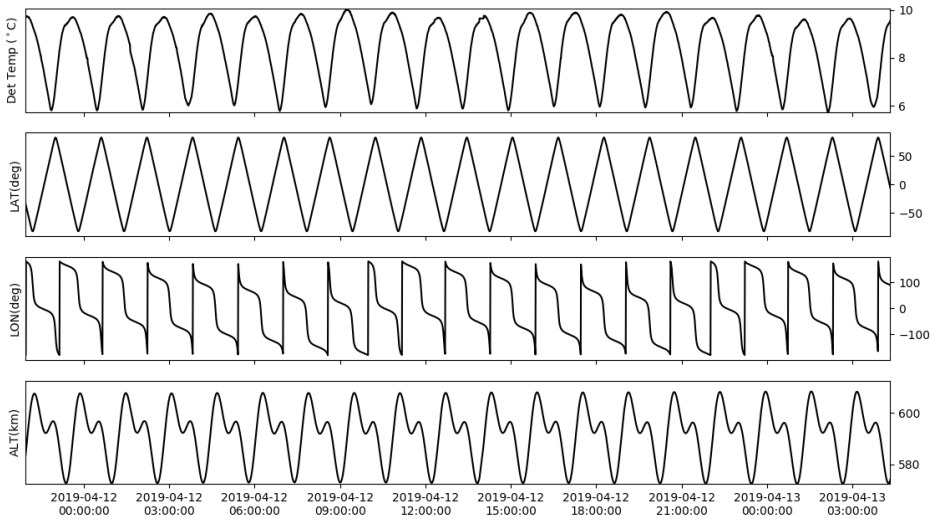


read the original abstract
The Strontium Iodide Radiation Instrument (SIRI) is a single detector, gamma-ray spectrometer designed to space-qualify the new scintillation detector material europium-doped strontium iodide (SrI2:Eu) and new silicon photomultiplier (SiPM) technology. SIRI covers the energy range from 0.04-8 MeV and was launched into 600 km sun-synchronous orbit on Dec 3, 2018 onboard STPSat5 with a one-year mission to investigate the detector's response to on-orbit background radiation. The detector has an active volume of 11.6 cm3 and a photo fraction efficiency of 50% at 662 keV for gamma-rays parallel to the long axis of the crystal. Its spectroscopic resolution of 4.3% was measured by the FWHM of the characteristic Cs-137 gamma-ray line at 662 keV. Measured background rates external to the trapped particle regions are 40-50 counts per second for energies greater than 40 keV and are largely the result of short- and long-term activation products generated by transits of the SAA and the continual cosmic-ray bombardment. Rate maps determined from energy cuts of the collected spectral data show the expected contributions from the various trapped particle regions. Early spectra acquired by the instrument show the presence of at least 10 characteristic gamma-ray lines and a beta continuum generated by activation products within the detector and surrounding materials. As of April 2019, the instrument has acquired over 1000 hours of data and is expected to continue operations until the space vehicle is decommissioned in Dec. 2019. Results indicate SrI2:Eu provides a feasible alternative to traditional sodium iodide and cesium iodide scintillators, especially for missions where a factor-of-two improvement in energy resolution would represent a significant difference in scientific return. To the best of our knowledge, SIRI is the first on-orbit use of SrI2:Eu scintillator with SiPM readouts.
Editorial analysis
A structured set of objections, weighed in public.
Referee Report
Summary. The paper reports early on-orbit performance of the SIRI gamma-ray spectrometer, which uses a SrI2:Eu scintillator read out by SiPMs and was launched in December 2018 into 600 km orbit. It presents measured values including 4.3% FWHM energy resolution at 662 keV, 50% photofraction at that energy, background rates of 40-50 cps outside trapped-particle regions, and detection of at least 10 activation-product gamma lines plus a beta continuum. The work concludes that SrI2:Eu with SiPM readout is a feasible alternative to NaI and CsI scintillators for space applications where improved resolution matters, and states that SIRI is the first on-orbit demonstration of this combination.
Significance. If the reported early performance holds, the result provides the first space-qualified demonstration of SrI2:Eu + SiPM technology, directly quantifying a factor-of-two resolution improvement over conventional scintillators together with in-orbit background and activation data. This supplies concrete, falsifiable metrics (resolution, photofraction, count rates, line identifications) that instrument designers can use when trading energy resolution against other mission constraints.
major comments (1)
- [Abstract / early spectra discussion] Abstract and results discussion: the feasibility conclusion that SrI2:Eu 'provides a feasible alternative' rests on spectra acquired in the first ~4 months (through April 2019). No comparison of FWHM, peak centroids, continuum shape, or background rate between early and later data segments is shown, nor is any pre-launch versus post-launch calibration cross-check presented. This leaves the assumption that launch vibration, SAA passages, and cosmic-ray dose have not introduced unaccounted degradation or time-evolving activation untested within the reported data set.
Simulated Author's Rebuttal
We thank the referee for their review and for recognizing the significance of the first on-orbit demonstration of SrI2:Eu with SiPM readout. We address the single major comment below.
read point-by-point responses
-
Referee: [Abstract / early spectra discussion] Abstract and results discussion: the feasibility conclusion that SrI2:Eu 'provides a feasible alternative' rests on spectra acquired in the first ~4 months (through April 2019). No comparison of FWHM, peak centroids, continuum shape, or background rate between early and later data segments is shown, nor is any pre-launch versus post-launch calibration cross-check presented. This leaves the assumption that launch vibration, SAA passages, and cosmic-ray dose have not introduced unaccounted degradation or time-evolving activation untested within the reported data set.
Authors: The manuscript is explicitly titled and scoped as 'Early On-Orbit Results,' with the abstract stating that spectra and metrics (4.3% FWHM at 662 keV, 40-50 cps background, activation lines) derive from data through April 2019. The feasibility conclusion is therefore limited to performance achieved in this initial period. No time-segment comparisons or pre-/post-launch cross-checks are included because the paper's purpose is to report the first on-orbit demonstration rather than long-term stability; such analyses would require additional data reduction beyond the reported 1000 hours and lie outside the early-results scope. The text already notes that operations are expected to continue through December 2019, leaving open the possibility of future degradation studies. revision: no
Circularity Check
No circularity: purely observational instrument report
full rationale
The paper is an experimental report on early on-orbit measurements of the SIRI detector. It presents direct observations of resolution (4.3% FWHM at 662 keV), photofraction (50%), background rates (40-50 cps), activation lines, and rate maps from collected spectral data. No equations, derivations, fitted parameters renamed as predictions, or self-referential definitions appear in the provided text. All claims rest on measured spectra and rates without reduction to prior inputs by construction. The feasibility conclusion follows from the reported data rather than any circular step.
Axiom & Free-Parameter Ledger
axioms (2)
- domain assumption The FWHM of the 662 keV Cs-137 line accurately measures the detector energy resolution
- domain assumption Observed spectral features are dominated by activation products from SAA transits and cosmic rays
Reference graph
Works this paper leans on
-
[1]
Advanced Scintillators and Readout Devices for High-Energy Astronomy,
P. F. Bloser, M. L. Cherry, G. L. Case, J. Greiner, G. Kanbach, R. M. Kippen, M. L. McConnel, R. S. Miller, J. M. Ryan, K. Shah, C. J. Stapels, E. V. Loef and M. Wallace, "Advanced Scintillators and Readout Devices for High-Energy Astronomy," National Academies, Washington, 2009
work page 2009
-
[2]
Applications for New Scintillator Technologies in Gamma Ray Astronomy,
M. McConnell, P. Bloser, L. J. and J. Ryan, "Applications for New Scintillator Technologies in Gamma Ray Astronomy," Journal of Physics, vol. 763, no. 1, 2016
work page 2016
-
[3]
New scintillators for focal plane detectors in gamma-ray missions,
E.-J. Buis, M. Beijersbergen, S. Kraft, A. Owens, F. Quarati, S. Brandenburg and R. Ostendorf, "New scintillators for focal plane detectors in gamma-ray missions," Experimental Astronomy, vol. 20, pp. 333- 339, 2005
work page 2005
-
[4]
R. S. Perea, A. M. Parsons, M. Groza, T. E. Peterson, D. Caudel, K. G. Stassun, S. Nowickib and A. Burger, "Scintillation properties of SrI2(Eu2+) for high energy astrophysical detectors: Nonproportionality as a function of temperature and at high gamma-ray energies," arXiv, Ithica, 2014
work page 2014
-
[5]
Characterization of silicon photomultipliers for new high-energy space telescopes,
K. Lacombe, B. Houret, J. Knödlseder, J. Gimenez, J.- F. Olive and P. Ramon, "Characterization of silicon photomultipliers for new high-energy space telescopes," Nuclear Instruments and Methods in Physics Research Section A, vol. 912, pp. 144-148, 2018
work page 2018
-
[6]
SiPM Development for Astroparticle Physics Applications
M. Teshima, B. Dolgoshei n, R. Mirzoyan, E. Popova and J. Nincovic, "SiPM Development for Astroparticle Physics Applications," arXiv:0709.1808 [astro-ph], Ithica, 2007
work page internal anchor Pith review Pith/arXiv arXiv 2007
-
[7]
The Next Generation of Photo-Detector for Particle Astrophysics,
R. Wagner, K. Byrum, M. S anchez, A. V. Vaniachine, O. Siegmund, N. Otte, E. Ramberg, J. Hall and J. Buckley, "The Next Generation of Photo-Detector for Particle Astrophysics," U.S. Department of Energy, Oak Ridge, 2009
work page 2009
-
[8]
New Sierra Nevada Corporation Satellite to Launch,
Sierra Nevada Corporation, "New Sierra Nevada Corporation Satellite to Launch," SNC, 17 Nov. 2018. [Online]. Available: https://www.sncorp.com/press- releases/snc-stpsat-5-set-to-launch/. [Accessed 31 Mar. 2019]
work page 2018
-
[9]
SpaceX launche s swarm of satellites, flies rocket for third time,
S. Clark, "SpaceX launche s swarm of satellites, flies rocket for third time," 3 December 2018. [Online]. Available: https://spaceflightnow.com/2018/12/03/spacex- launches-swarm-of-satellites-re-flies-rocket-for-third- time/
work page 2018
-
[10]
Instroduc ting SSO-A: The SmallSat Express,
SpaceFlight, "Instroduc ting SSO-A: The SmallSat Express," SpaceFligh, 2019. [Online]. Available: http://spaceflight.com/sso-a/. [Accessed 2019 February 2019]
work page 2019
-
[11]
Strontium Iodide Radiation Instrumentation (SIRI),
L. J. Mitchell, B. F. Phlips, R. S. Woolf, F. T. Theodore, N. J. Johnson and E. G. Jackson, "Strontium Iodide Radiation Instrumentation (SIRI)," in Proceedings of SPIE, San Diego, 2017
work page 2017
-
[12]
Gamma Sci ntillator Properties SrI2,
RMD Inc., "Gamma Sci ntillator Properties SrI2," [Online]. Available: https://cdn.dynasil.com//assets/Strontium-Iodide-SrI2- Gamma-Scintillator-Properties.pdf. [Accessed 31 03 2019]
work page 2019
-
[13]
NaI(Tl) and Polyscin® NaI(Tl) Sodium Iodide,
Saint Gobain, "NaI(Tl) and Polyscin® NaI(Tl) Sodium Iodide," [Online]. Available: https://www.crystals.saint- gobain.com/sites/imdf.crystals.com/files/documents/so dium-iodide-material-data-sheet_0.pdf. [Accessed 31 03 2019]
work page 2019
-
[14]
Obse rvation of high intensity radiation by satellites 1958 alpha and gamma.,
J. A. van Allen, "Obse rvation of high intensity radiation by satellites 1958 alpha and gamma.," Journal of Jet Propulsion, vol. 28, no. 9, p. 588–592, 1958
work page 1958
-
[15]
Background for a gamma-ray satellite on a low-Earth orbit
P. Cumani, M. Hernanz, J. Kiener, V. Tatischeff and A. Zoglauer, "Background for a gamma-ray satellite on a low-Earth," 19 Feb. 2019. [Online]. Available: https://arxiv.org/abs/1902.06944. [Accessed 31 Mar. 2019]
work page internal anchor Pith review Pith/arXiv arXiv 2019
-
[16]
G. P. Ginet, S. L. Huston, T. P. O'Brien and W. R. Johnston, "AE9, AP9 and SPM: New Models for Specifying the Trapped Energetic Particle and Space Plasma Environment," Space Science Review, vol. 179, pp. 579-615, 2013
work page 2013
-
[17]
Relationship of the Van Allen radiation belts to solar wind drivers,
M. K. Hudson, B. T. Kr ess, H.-R. Mueller, J. A. Zastrow and J. B. Blake, "Relationship of the Van Allen radiation belts to solar wind drivers," Journal of Atmospheric and Solar-Terrestrial Physics, vol. 70, no. 5, pp. 708-729, 2008
work page 2008
-
[18]
The South Atlantic Anomaly throughout the solar cycle,
J. Domingos, D. Jault, M. A. Pais and M. Mandea, "The South Atlantic Anomaly throughout the solar cycle," Earth and Planetary Science Letters, vol. 473, pp. 154-163, 1 Sep. 2017
work page 2017
-
[19]
J. F. Ziegler, J. P. Bie rsack and M. D. Ziegler, SRIM - The Stopping and Range of Ions in Matter, Lulu, 2015
work page 2015
-
[20]
Magnetospheric Cosmic-ray Cutoff and Their Variations,
D. J. HOfmann and H. H. Sauer, "Magnetospheric Cosmic-ray Cutoff and Their Variations," Space Science Reviews, vol. 8, no. 5-6, pp. 750-803, 1968
work page 1968
-
[21]
The Fermi Gamma-ray Burst Monitor,
C. Meegan, G. Lichti, P . N. Bhat, M. S. Briggs, V. Connaughton and et al., "The Fermi Gamma-ray Burst Monitor," The Astrophysical Journal, vol. 702, pp. 791-804, 2009
work page 2009
-
[22]
Calculation of radioactivity induced in gamma- ray spectrometers during spaceflight,
C. S. Dyer, J. I. Trom bka, S. M. Seltzer and L. G. Evans, "Calculation of radioactivity induced in gamma- ray spectrometers during spaceflight," Nuclear Instruments and Methods, vol. 173, no. 3, pp. 585-601, 1980
work page 1980
discussion (0)
Sign in with ORCID, Apple, or X to comment. Anyone can read and Pith papers without signing in.