REVIEW 3 major objections 4 minor 53 references
Fitting, Comparison, and Alignment of Trajectories on Positive Semi-Definite Matrices with Application to Action Recognition
T0 review · 3 major / 4 minor · reviewed 2026-08-14 · deepseek-v4-flash
Pith's one-line read This paper claims that a skeleton-only geometric pipeline—Gram-matrix trajectories on a fixed-rank PSD manifold, denoised by curve fitting and aligned with a Global Alignment Kernel—matches or beats deep learning baselines on three…
desk verdict The closed-form distance in Eq. (4) is wrong as stated (it ignores reflections), and the paper never says whether the headline numbers used the correct M1 or the incorrect M2. read the letter →
The pith
A machine-rendered reading of the paper's core claim, the machinery that carries it, and where it could break.
The reading
What carries the argument
The central object is the manifold $S_+(d,n)$ of $n\times n$ positive-semidefinite matrices of fixed rank $d$, realized as the quotient $\mathbb{R}^{n\times d}_*/O_d$: each Gram matrix $G=ZZ^T$ corresponds to an equivalence class of landmark matrices under right multiplication by orthogonal matrices. The distance between two such classes is the minimal Frobenius distance $\min_{Q\in O_d}\|Z_jQ-Z_i\|_F$, which for $d=2$ admits the closed form involving the entries of $Z_j^T Z_i$. Around this geometry, two mechanisms do the work: curve fitting by composite cubic Bézier curves (with a parameter $\lambda$ trading data fidelity against acceleration) denoises the trajectories, and the Global Alignment Kernel—a positive-semidefinite kernel that sums over all possible temporal alignments—is applied to the resulting distance matrix to produce the PSD kernel $k(i,j) = \frac{1}{2}e^{-D(i,j)/\sigma^2}/(1-\frac{1}{2}e^{-D(i,j)/\sigma^2})$ that is fed to an SVM.
What would settle it
Take any dataset used in the paper, compute the full similarity matrix $K$ from the GAK scores, and test its smallest eigenvalue; if $K$ has a negative eigenvalue, the kernel is not PSD for this manifold distance and the standard SVM argument fails, even if classification accuracy stays high. A sharper test is to sample pairs of Gram matrices in $S_+(d,n)$, compute the local kernel matrix $k(i,j) = \frac{1}{2}e^{-D(i,j)/\sigma^2}/(1-\frac{1}{2}e^{-D(i,j)/\sigma^2})$, and check whether it is positive semidefinite for many random configurations.
Extended reading notes
Core claim
The central claim is that the combination of three ingredients—the quotient geometry of $S_+(d,n)$ identified with $\mathbb{R}^{n\times d}_*/O_d$, composite cubic Bézier curve fitting, and the Global Alignment Kernel—turns Gram-matrix trajectories into a competitive action classifier with a theoretically valid PSD kernel. The paper's key identity is the closed-form Riemannian distance for $d=2$: $d(G_i,G_j)^2 = \operatorname{tr}(G_i) - 2\sqrt{(a+d)^2+(c-b)^2} + \operatorname{tr}(G_j)$, where $Z_j^T Z_i = \begin{pmatrix} a & b \\ c & d \end{pmatrix}$, which arises from minimizing the Frobenius distance over the orthogonal group. The paper claims this PSD kernel supports a standard SVM, rather than the proximity SVM required by DTW, and reports accuracy gains on all three datasets, with the largest margin on UAV-Gesture.
Load-bearing premise
The pipeline's theoretical justification rests on the assumption that the Global Alignment Kernel built from the quotient-manifold distance is positive semidefinite; the paper cites this property from the Euclidean time-series setting [8] without proving it for this manifold distance.
Editorial extensions
If this is right
- On UTKinect-Action3D, the best configuration reaches 97.99% accuracy, above the 96.48% of the direct Gram-matrix predecessor [18].
- On KTH-Action, using GAK instead of DTW improves accuracy from 94.49% to 96.16% in the same pipeline, and curve fitting adds about one point on this noisy 2D data.
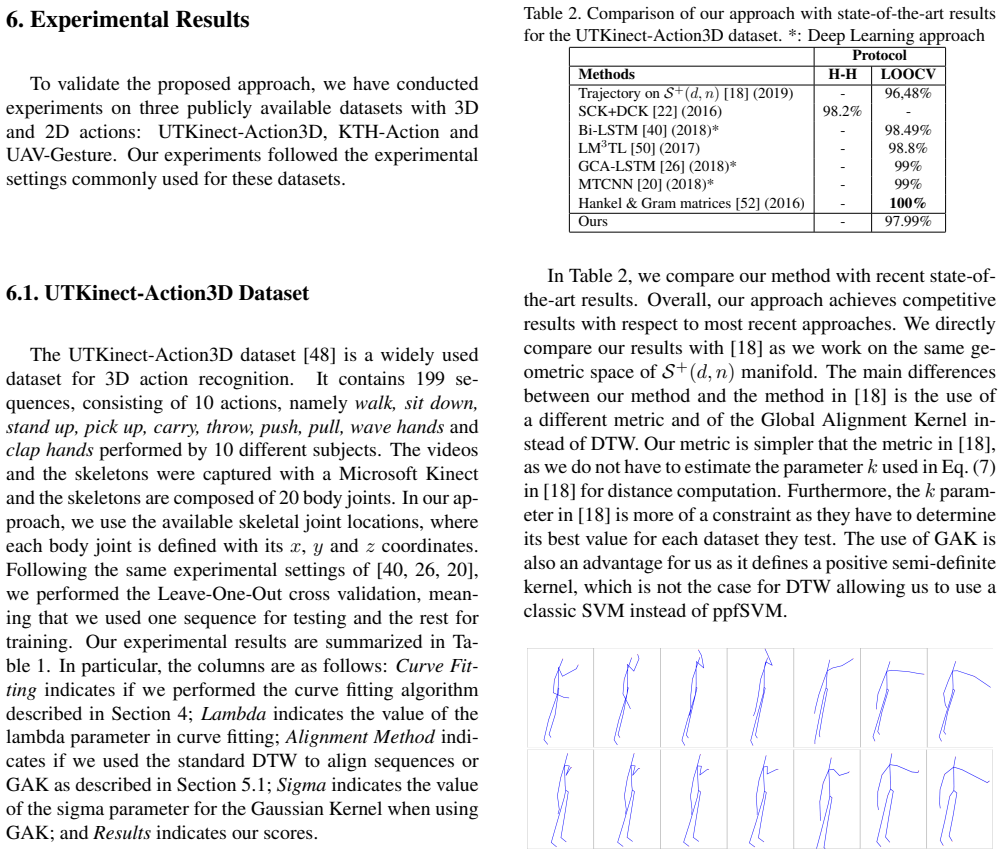
- On UAV-Gesture, the approach reaches 92.44%, outperforming the deep-learning P-CNN baseline of 91.9% while using only skeletons.
- The closed-form distance for two-dimensional skeletons halves the alignment computation time relative to the general quotient distance, making the geometric pipeline practical on modest hardware.
- Because the kernel is claimed positive semidefinite, the same pipeline can use a standard SVM, avoiding the pairwise-proximity SVM that DTW-based methods require.
Reading between the lines
- If the PSD claim transfers, this recipe of quotient metric plus global alignment should apply to any landmark-trajectory task, such as facial expression or sign-language recognition, without retraining a metric.
- The paper's own results hint that curve fitting helps on noisy 2D data and can slightly hurt on clean 3D data; an adaptive choice of $\lambda$ per dataset might push accuracy higher.
- A natural testable extension is to swap the halved Gaussian local kernel for other positive-semidefinite local kernels and check whether the Global Alignment Kernel remains PSD on the quotient manifold, isolating how much of the gain comes from the kernel choice.
- For three-dimensional skeletons, an analogous closed-form distance derived from the $3\times 3$ matrix $Z_j^T Z_i$ would likely speed up 3D pipelines the same way the 2D formula does.
Signed reviews
Editorial analysis
A structured set of objections, weighed in public.
Referee Report
Summary. The manuscript proposes a skeleton-based action recognition pipeline. Each frame's landmarks are mapped to a Gram matrix in the fixed-rank positive semidefinite cone S_+(d,n); a sequence becomes a trajectory on that manifold. The trajectory is denoised with composite Bézier curve fitting, sequences are aligned with a Global Alignment Kernel built from a Riemannian distance, and the resulting kernel matrix is fed to a standard SVM. Experiments on UTKinect-Action3D, KTH-Action, and UAV-Gesture report accuracies of 97.99%, 96.16%, and 92.44% respectively, which the authors describe as competitive with state-of-the-art methods and better than their direct predecessor [18] on UTKinect and better than the P-CNN baseline on UAV-Gesture.
Significance. The paper is a useful engineering contribution if the mathematical components hold: it provides a non-deep, interpretable alternative that achieves competitive accuracy from skeletons only, and the use of GAK rather than DTW is a sensible step toward a valid SVM kernel. However, the closed-form distance in Section 3.2 is incorrect for d=2, and the PSD property of the GAK on this manifold is asserted rather than proved; both issues bear directly on the reported numbers. The paper also includes detailed timing tables and comparison tables, which help reproducibility.
major comments (3)
- [§3.2, Eq. (4), and Appendix] Theorem 3.2 is false as stated. The distance in Eq. (3) minimizes over the full orthogonal group O_2, which includes reflections, but the proof in the Appendix parameterizes Q only as a rotation matrix. For Z_i = I_2 and Z_j = [[0,1],[1,0]], both Gram matrices equal I_2, so the true quotient distance is 0, whereas Eq. (4) returns 2. The correct maximization of tr(Z_i^T Z_j Q^T) over O_2 is the nuclear norm of Z_i^T Z_j, which equals sqrt((a+d)^2+(c-b)^2) only when det(Z_j^T Z_i) >= 0; otherwise it is larger. This error directly affects the d=2 experiments on KTH and UAV-Gesture.
- [§5.1, Eqs. (6)-(8)] The paper asserts without proof that the resulting global alignment kernel is positive semi-definite on S_+(d,n). The cited PSD result in Cuturi et al. [8] applies to local kernels that are positive definite; no argument or reference is given that exp(-d^2/sigma^2) is positive definite for the quotient/Bures metric on fixed-rank PSD matrices. Since the SVM step relies on the kernel matrix being PSD, this is a load-bearing gap. Please provide a proof or a specific citation, or state explicitly that a non-PSD proximity matrix is used with a suitable variant such as ppfSVM.
- [§6, Tables 3 and 5] The accuracy tables for KTH and UAV-Gesture do not state whether Eq. (3) (M1) or Eq. (4) (M2) was used. Because Eq. (4) is incorrect, the reported accuracies are ambiguous; if M2 was used, the numbers may change under the correct O_2 distance. Please specify the metric used for each reported result and rerun the experiments if M2 was used.
minor comments (4)
- [Algorithm 1] There is an indexing mismatch: the loops that fill k(i,j) range over i=0..tau1 and j=0..tau2, while the recurrence for M uses indices i=1..tau1+1 and j=1..tau2+1 without a consistent offset; please clarify the indexing convention.
- [Appendix, Eq. (10)] In Eq. (10) the orthogonal group is written as O_p; it should be O_2, consistent with Section 3.2.
- [§6] The hyperparameters lambda and sigma are tuned per dataset but the selection criterion is not described; please report how these values were chosen (for example, via a validation split) to mitigate overfitting concerns.
- [§5.1] The sentence 'This strategy assures us that the kernel is positive semi-definite' overstates the conclusion; at most the construction inherits the property if the local kernel is positive definite, which is exactly the point that needs to be established.
Circularity Check
No significant circularity: the pipeline is an empirical system whose accuracy claims are measured against external benchmarks, and no prediction reduces to a fitted input or to a self-citation chain.
full rationale
The paper's chain is an empirical recognition pipeline: skeleton positions are mapped to Gram matrices, trajectories are compared with a quotient-manifold distance, smoothed with composite Bezier fitting, aligned with the Global Alignment Kernel, and classified with SVM. At no point is a quantity defined in terms of the result it is later used to predict. Equation (4) is offered as a closed form of the distance in Eq. (3), not as a fitted outcome, and the positive-semidefiniteness of the GAK kernel is transferred from Cuturi et al. [8], an external source, rather than manufactured from the authors' own fitted values. The hyperparameters lambda and sigma are tuned and reported per dataset, but they are not relabeled as predictions, and the reported accuracies are measured against public benchmarks. Several references involve overlapping authors (e.g., [13], [18], [28]), but these supply algorithmic tools that are also anchored in external publications ([4], [8], [17]) and in the Manopt implementation; none is invoked as a uniqueness theorem forcing the paper's choices. The reviewer-identified mathematical issue with Eq. (4) concerns the correctness of the minimization over O_d, which is a correctness risk, not a circularity: the formula is not equivalent to its input by construction. Therefore no circular step is identified.
Assumptions & free parameters
free parameters (2)
- lambda (curve fitting regularization) =
0.5 for UTKinect, 10 for KTH and UAV-Gesture
- sigma (GAK Gaussian kernel bandwidth) =
0.3 or 0.5 for UTKinect, 0.2 for KTH, unreported for UAV-Gesture
assumptions (4)
- standard math The manifold of fixed-rank PSD matrices S+(d,n) is identified with the quotient Rn*d / Od and endowed with the quotient Euclidean metric, yielding the distance in Eq. (2).
- domain assumption The composite cubic blended curve fitting algorithm from [13] can be applied on S+(d,n) using the Riemannian exp and log maps, and the fitted curves improve classification on noisy data.
- domain assumption The local kernel k(i,j) = ktilde / (1 - ktilde), with ktilde = 1/2 exp(-d^2/sigma^2), is positive definite for the quotient manifold distance d.
- domain assumption The Gram matrices of skeleton configurations have rank exactly d (the spatial dimension) in the datasets considered.
Cite this review
Pith. "Pith review of Fitting, Comparison, and Alignment of Trajectories on Positive Semi-Definite Matrices with Application to Action Recognition." pith.science (2026). https://pith.science/paper/B3HS3SZQ
@misc{pith2026190800646,
  author       = {Pith},
  title        = {Pith review of: Fitting, Comparison, and Alignment of Trajectories on Positive Semi-Definite Matrices with Application to Action Recognition},
  year         = {2026},
  howpublished = {\url{https://pith.science/paper/B3HS3SZQ}},
  note         = {Machine review of arXiv:1908.00646}
}
read the original abstract
In this paper, we tackle the problem of action recognition using body skeletons extracted from video sequences. Our approach lies in the continuity of recent works representing video frames by Gramian matrices that describe a trajectory on the Riemannian manifold of positive-semidefinite matrices of fixed rank. In comparison with previous works, the manifold of fixed-rank positive-semidefinite matrices is here endowed with a different metric, and we resort to different algorithms for the curve fitting and temporal alignment steps. We evaluated our approach on three publicly available datasets (UTKinect-Action3D, KTH-Action and UAV-Gesture). The results of the proposed approach are competitive with respect to state-of-the-art methods, while only involving body skeletons.
Figures


Figures from the paper (1 more)

Reference graph
Works this paper leans on
- [18]
- [8]
-
[1]
R. Almeida, Z. K. G. do Patroc ´ınio Jr., and S. J. F. Guimar˜aes. Exploring quantization error to improve human action classification. In 2017 International Joint Conference on Neural Networks, IJCNN 2017, Anchorage, AK, USA, May 14-19, 2017, pages 1354–1360, 2017
work page 2017
-
[2]
R. Anirudh, P. K. Turaga, J. Su, and A. Srivastava. Elastic functional coding of riemannian trajectories. IEEE Trans. on Pattern Analysis and Machine Intelligence , 39(5):922–936, 2017
work page 2017
-
[3]
B. Ben Amor, J. Su, and A. Srivastava. Action recognition using rate-invariant analysis of skeletal shape trajectories. IEEE Trans. on Pattern Analysis and Machine Intelligence , 38(1):1–13, 2016
work page 2016
-
[4]
S. Bonnabel and R. Sepulchre. Riemannian metric and geometric mean for positive semidefinite matrices of fixed rank. SIAM Journal on Matrix Analysis and Applications , 31(3):1055–1070, 2009
work page 2009
- [5]
-
[6]
Z. Cao, G. Hidalgo, T. Simon, S. Wei, and Y . Sheikh. Open- pose: Realtime multi-person 2d pose estimation using part affinity fields. CoRR, abs/1812.08008, 2018
arXiv 2018
Show all 53 references
-
[7]
Z. Cao, T. Simon, S.-E. Wei, and Y . Sheikh. Realtime multi- person 2d pose estimation using part affinity fields. InCVPR, 2017
2017
-
[9]
Devanne, H
M. Devanne, H. Wannous, S. Berretti, P. Pala, M. Daoudi, and A. Del Bimbo. 3-D human action recognition by shape analysis of motion trajectories on Riemannian manifold. IEEE Trans. on Cybernetics, 45(7):1340–1352, 2015
2015
-
[10]
Faraki, M
M. Faraki, M. T. Harandi, and F. Porikli. Image set clas- sification by symmetric positive semi-definite matrices. In Applications of Computer Vision (WACV), 2016 IEEE Win- ter Conference on, pages 1–8. IEEE, 2016
2016
-
[11]
X. Gao, W. Hu, J. Tang, J. Liu, and Z. Guo. Optimized skeleton-based action recognition via sparsified graph re- gression. arXiv:1811.12013, 2019
2019 arXiv
-
[12]
Gilbert, J
A. Gilbert, J. Illingworth, and R. Bowden. Action recog- nition using mined hierarchical compound features. IEEE Trans. Pattern Anal. Mach. Intell., 33(5):883–897, 2011
2011
-
[13]
Gousenbourger, E
P.-Y . Gousenbourger, E. Massart, and P.-A. Absil. Data fitting on manifolds with composite B ´ezier-like curves and blended cubic splines. Journal of Mathematical Imaging and Vision, 61(5):645–671, 2018
2018
-
[14]
Gousenbourger, E
P.-Y . Gousenbourger, E. Massart, A. Musolas, P.-A. Absil, L. Jacques, J. M. Hendrickx, and Y . Marzouk. Piecewise- B´ezier C 1 smoothing on manifolds with application to wind field estimation. Proceedings of the 25th European Sym- posium on Artificial Neural Networks, Computati...
2017
-
[15]
Gritai, Y
A. Gritai, Y . Sheikh, C. Rao, and M. Shah. Matching tra- jectories of anatomical landmarks under viewpoint, anthro- pometric and temporal transforms. Int. Journal of Computer Vision, 84(3):325–343, 2009
2009
-
[16]
Jiang, Z
Z. Jiang, Z. Lin, and L. S. Davis. Recognizing human actions by learning and matching shape-motion prototype trees. IEEE Trans. Pattern Anal. Mach. Intell. , 34(3):533– 547, 2012
2012
-
[17]
Journ ´ee, F
M. Journ ´ee, F. Bach, P.-A. Absil, and R. Sepulchre. Low- rank optimization on the cone of positive semidefinite matri- ces. SIAM Journal on Optimization, 20(5):2327–2351, 2010
2010
-
[19]
Kacem, M
A. Kacem, M. Daoudi, B. Ben Amor, and J. C. ´A. Paiva. A novel space-time representation on the positive semidefinite cone for facial expression recognition. InIEEE International Conference on Computer Vision, ICCV 2017, Venice, Italy, October 22-29, 2017, pages 3199–3208, 2017
2017
-
[20]
Q. Ke, M. Bennamoun, S. An, F. A. Sohel, and F. Boussa ¨ıd. Learning clip representations for skeleton-based 3d action recognition. IEEE Trans. Image Processing , 27(6):2842– 2855, 2018
2018
-
[21]
Kong and Y
Y . Kong and Y . Fu. Human action recognition and prediction: A survey. arXiv:1806.11230, 2018
2018 arXiv
-
[22]
Koniusz, A
P. Koniusz, A. Cherian, and F. Porikli. Tensor representa- tions via kernel linearization for action recognition from 3d skeletons. In Computer Vision - ECCV 2016 - 14th European Conference, Amsterdam, The Netherlands, October 11-14, 2016, Proceedings, Part IV, pages 37–53, 2016
2016
-
[23]
B. Li, X. Li, Z. Zhang, and F. Wu. Spatio-temporal graph routing for skeleton-based action recognition. In AAAI Con- ference on Artificial Intelligence, 2019
2019
-
[24]
C. Li, Q. Zhong, D. Xie, and S. Pu. Skeleton-based action recognition with convolutional neural networks. In IEEE In- ternational Conference on Multimedia & Expo Workshops , page 597–600, 2017
2017
-
[25]
J. Liu, J. Luo, and M. Shah. Recognizing realistic actions from videos. In 2009 IEEE Computer Society Conference on Computer Vision and Pattern Recognition (CVPR 2009), 20-25 June 2009, Miami, Florida, USA , pages 1996–2003, 2009
2009
-
[26]
J. Liu, G. Wang, L. Duan, K. Abdiyeva, and A. C. Kot. Skeleton-based human action recognition with global context-aware attention LSTM networks. IEEE Trans. Im- age Processing, 27(4):1586–1599, 2018
2018
-
[27]
L. Liu, L. Shao, X. Li, and K. Lu. Learning spatio-temporal representations for action recognition: A genetic program- ming approach. IEEE Trans. Cybernetics , 46(1):158–170, 2016
2016
-
[28]
Massart and P.-A
E. Massart and P.-A. Absil. Quotient geometry with simple geodesics for the manifold of fixed-rank positive- semidefinite matrices. Preprint
-
[29]
Massart, P.-Y
E. Massart, P.-Y . Gousenbourger, N. T. Son, T. Stykel, and P.-A. Absil. Interpolation on the manifold of fixed-rank positive-semidefinite matrices for parametric model order re- duction: preliminary results. In Proceedings of the 27th Eu- ropean Symposium on Artifical Neural Net...
2019
-
[30]
Massart, J
E. Massart, J. M. Hendrickx, and P.-A. Absil. Curvature of the manifold of fixed-rank positive-semidefinite matrices en- dowed with the Bures-Wasserstein metric. In Proceedings of the 4th conference on Geometric Sciences of Information (GSI 2019), pages 739–748, 2019
2019
-
[31]
Matikainen, M
P. Matikainen, M. Hebert, and R. Sukthankar. Trajectons: Action recognition through the motion analysis of tracked features. In Workshop on Video-Oriented Object and Event Classification (ICCV), September 2009
2009
-
[32]
Meyer, S
G. Meyer, S. Bonnabel, and R. Sepulchre. Regression on fixed-rank positive semidefinite matrices: a Rieman- nian approach. Journal of Machine Learning Research , 12(Feb):593–625, 2011
2011
-
[33]
Otberdout, A
N. Otberdout, A. Kacem, M. Daoudi, L. Ballihi, and S. Berretti. Automatic analysis of facial expressions based on deep covariance trajectories. CoRR, abs/1810.11392, 2018
2018 arXiv
-
[34]
Otberdout, A
N. Otberdout, A. Kacem, M. Daoudi, L. Ballihi, and S. Berretti. Deep covariance descriptors for facial expres- sion recognition. In British Machine Vision Conference 2018, BMVC 2018, Northumbria University, Newcastle, UK, September 3-6, 2018, page 159, 2018
2018
-
[35]
A. G. Perera, Y . W. Law, and J. S. Chahl. UA V-GESTURE: A dataset for UA V control and gesture recognition. InCom- puter Vision - ECCV 2018 Workshops - Munich, Germany, September 8-14, 2018, Proceedings, Part II, pages 117–128, 2018
2018
-
[36]
Raptis and S
M. Raptis and S. Soatto. Tracklet descriptors for action mod- eling and video analysis. In Computer Vision - ECCV 2010, 11th European Conference on Computer Vision, Heraklion, Crete, Greece, September 5-11, 2010, Proceedings, Part I , pages 577–590, 2010
2010
-
[37]
Sch ¨uldt, I
C. Sch ¨uldt, I. Laptev, and B. Caputo. Recognizing human actions: A local SVM approach. In 17th International Con- ference on Pattern Recognition, ICPR 2004, Cambridge, UK, August 23-26, 2004., pages 32–36, 2004
2004
-
[38]
J. Su, S. Kurtek, E. Klassen, and A. Srivastava. Statistical analysis of trajectories on riemannian manifolds: Bird mi- gration, hurricane tracking and video surveillance. Annals of Applied Statistics, 8(1), 2014
2014
-
[39]
J. Su, A. Srivastava, F. D. M. de Souza, and S. Sarkar. Rate- invariant analysis of trajectories on riemannian manifolds with application in visual speech recognition. In IEEE Conf. on Computer Vision and Pattern Recognition (CVPR) , June 2014
2014
-
[40]
A. B. Tanfous, H. Drira, and B. B. Amor. Coding kendall’s shape trajectories for 3d action recognition. In 2018 IEEE Conference on Computer Vision and Pattern Recognition, CVPR 2018, Salt Lake City, UT, USA, June 18-22, 2018 , pages 2840–2849, 2018
2018
-
[41]
Vandereycken, P.-A
B. Vandereycken, P.-A. Absil, and S. Vandewalle. Embedded geometry of the set of symmetric positive semidefinite ma- trices of fixed rank. In Statistical Signal Processing, 2009. SSP’09. IEEE/SP 15th Workshop on, pages 389–392. IEEE, 2009
2009
-
[42]
Vandereycken, P.-A
B. Vandereycken, P.-A. Absil, and S. Vandewalle. A Rieman- nian geometry with complete geodesics for the set of positive semidefinite matrices of fixed rank. IMA Journal of Numeri- cal Analysis, 33(2):481–514, 2013
2013
-
[43]
Veeriah, N
V . Veeriah, N. Zhuang, and G. Qi. Differential recurrent neu- ral networks for action recognition. In 2015 IEEE Interna- tional Conference on Computer Vision, ICCV 2015, Santi- ago, Chile, December 7-13, 2015, pages 4041–4049, 2015
2015
-
[44]
Vemulapalli, F
R. Vemulapalli, F. Arrate, and R. Chellappa. Human ac- tion recognition by representing 3D skeletons as points in a Lie group. In IEEE Conf. on Computer Vision and Pattern Recognition (CVPR), pages 588–595, 2014
2014
-
[45]
Vemulapalli and R
R. Vemulapalli and R. Chellapa. Rolling rotations for recog- nizing human actions from 3d skeletal data. In IEEE Conf. on Computer Vision and Pattern Recognition (CVPR), pages 4471–4479, 2016
2016
-
[46]
Vrigkas, V
M. Vrigkas, V . Karavasilis, C. Nikou, and I. A. Kakadi- aris. Matching mixtures of curves for human action recog- nition. Computer Vision and Image Understanding, 119:27– 40, 2014
2014
-
[47]
H. Wang, A. Kl ¨aser, C. Schmid, and C. Liu. Action recog- nition by dense trajectories. In The 24th IEEE Conference on Computer Vision and Pattern Recognition, CVPR 2011, Colorado Springs, CO, USA, 20-25 June 2011, pages 3169– 3176, 2011
2011
-
[48]
L. Xia, C. Chen, and J. Aggarwal. View invariant human ac- tion recognition using histograms of 3d joints. In Computer Vision and Pattern Recognition Workshops (CVPRW), 2012 IEEE Computer Society Conference on, pages 20–27. IEEE, 2012
2012
-
[49]
S. Yan, Y . Xiong, and D. Lin. Spatial temporal graph convo- lutional networks for skeleton-based action recognition. In AAAI Conference on Artificial Intelligence, 2018
2018
-
[50]
Y . Yang, C. Deng, D. Tao, S. Zhang, W. Liu, and X. Gao. La- tent max-margin multitask learning with skelets for 3-d ac- tion recognition. IEEE Trans. Cybernetics, 47(2):439–448, 2017
2017
-
[51]
S. M. Yoon and A. Kuijper. Human action recognition using segmented skeletal features. In 20th International Confer- ence on Pattern Recognition, ICPR 2010, Istanbul, Turkey, 23-26 August 2010, pages 3740–3743, 2010
2010
-
[52]
Zhang, Y
X. Zhang, Y . Wang, M. Gou, M. Sznaier, and O. I. Camps. Efficient temporal sequence comparison and classification using gram matrix embeddings on a riemannian manifold. In 2016 IEEE Conference on Computer Vision and Pattern Recognition, CVPR 2016, Las Vegas, NV , USA, June 27-3...
2016
-
[53]
W. Zhu, C. Lan, J. Xing, W. Zeng, Y . Li, L. Shen, and X. Xie. Co-occurrence feature learning for skeleton based action recognition using regularized deep lstm networks. In AAAI Conference on Artificial Intelligence, 2016
2016
Reviewed August 14, 2026 · model on record in the stance chip above.
Discussion (0). Continue with ORCID to comment.