REVIEW 6 major objections 5 minor 51 references
Scalable Explanation of Inferences on Large Graphs
T0 review · 6 major / 5 minor · reviewed 2026-08-14 · deepseek-v4-flash
Pith's one-line read The paper proposes GraphExp, a beam-search method that explains belief-propagation inferences by extracting small trees whose target-node marginal closely matches the full graph's marginal.
desk verdict A clean new problem formulation with a sensible beam search, but the empirical claims outrun the hand-set potentials and the missing user study. read the letter →
The pith
A machine-rendered reading of the paper's core claim, the machinery that carries it, and where it could break.
The reading
What carries the argument
The load-bearing object is the constrained cross-entropy objective of Eq. (4): symmetric KL divergence between the marginal of a target node on the full cyclic MRF and the same marginal on a candidate acyclic subgraph. The search starts from the target node alone and greedily adds one neighbor at a time under an acyclicity constraint, evaluating each extension with a fresh belief-propagation run. Two instantiations are given: GE-G, which directly minimizes the global objective at each step, and GE-L, which back-traces messages and beliefs locally and stops when a prior explains a message. The beam keeps multiple candidate trees to provide diverse explanations, and the safe pruning strategy drops low-ranking candidates without, according to the experiments, degrading faithfulness. The non-submodularity theorem explains why the algorithm cannot rely on a $(1-1/e)$ approximation guarantee and instead must be evaluated empirically.
What would settle it
Run GraphExp and the baselines on the same ten networks with MRF parameters estimated by maximum likelihood or cross-validation rather than hand-set, and compare the symmetric KL values; if the advantage of GraphExp over the baselines narrows or reverses, the claimed superiority depends on the synthetic parameterization.
Extended reading notes
Core claim
The central claim is that explaining a belief-propagation marginal is equivalent to finding a small acyclic subgraph $\tilde{G}$ of the original MRF $G$ that minimizes $d(b_X,\tilde{b}_X)=KL(b_X\|\tilde{b}_X)+KL(\tilde{b}_X\|b_X)$, where $b_X$ is the target marginal on $G$ and $\tilde{b}_X$ the marginal computed on $\tilde{G}$. For any target $X$, a solution is a tree grown from $X$ one node at a time, and the paper proves that every output of its beam search is a tree. The paper also proves that exhaustive search for the optimal subgraph is NP-hard and that the objective is neither monotonic nor submodular, so no greedy algorithm carries a constant-factor guarantee. GraphExp therefore uses beam search to keep several candidate trees, evaluates each extension by rerunning belief propagation on the enlarged tree, and prunes the search space when the graph is dense. The reported result is that on ten networks from four domains the combined explanation reliably produces smaller symmetric KL divergence than the compared alternatives.
Load-bearing premise
The experiments assume that the synthetic model parameters chosen for each network—homophily potentials with 0.9 on the diagonal and 0.9 priors for labeled nodes—reflect the true dependency structure; if they do not, the reported faithfulness rankings may not transfer to deployed systems.
Editorial extensions
If this is right
- On any MRF where belief propagation converges, a user can inspect a tree of at most $C$ nodes and see the message-passing computations that produce an approximation of the target marginal, without tracing the entire call graph.
- Explanations are acyclic by construction, so the recursive self-reference that arises from cycles in loopy belief propagation is avoided.
- Multiple diverse explanations from the beam let users choose the tree that matches their mental model, and the combined explanation (Comb) is the most faithful in the reported experiments.
- The pruning strategy gives a practical speedup on dense graphs while keeping faithfulness roughly unchanged, supporting interactive use on networks with millions of edges.
- The extracted trees can be used to audit a deployed detector, as demonstrated by the finding that some false negatives in Yelp spam detection are driven by reviewer prolificacy.
Reading between the lines
- A natural extension the authors do not pursue is to apply the same extraction objective to other inference algorithms, such as loopy belief propagation with different message schedules or sampling-based marginals, treating the extracted tree as a surrogate that must match the algorithm's output rather than the model's true posterior.
- The symmetric KL objective could be used as a training signal: one could search over trees not only to explain a fixed model but to choose model parameters that make the faithful explanation smaller, connecting explanation length to model simplicity.
- Because the faithfulness measure is only evaluated under hand-set potentials, a testable next step is to compare extracted trees when the MRF parameters are learned from data; the authors' claims would be strengthened if the same advantage persists under calibrated potentials.
- The Yelp security finding suggests the explanations can double as a diagnostic for biased detectors; one could formalize this by measuring whether explanation trees for false negatives systematically overweight high-degree neighbors across multiple datasets.
Signed reviews
Editorial analysis
A structured set of objections, weighed in public.
Referee Report
Summary. This paper addresses interpretability of belief propagation (BP) inferences on Markov random fields (MRFs). The authors formulate the task as finding a small acyclic subgraph that, when used for BP, yields a marginal for a target node close to the full-graph marginal, measured by symmetric KL divergence. They claim that the optimization is NP-hard and that the objective is neither submodular nor monotone, and they propose GraphExp, a beam-search algorithm with two variants (GE-G and GE-L), parallelization, and a pruning strategy. Experiments on 10 networks compare the method against random, DeepWalk-based embedding, and LIME baselines, and a visualization case study is discussed.
Significance. If the claims are fully supported, the paper offers a principled and scalable way to generate diverse, simple explanations for a common inference algorithm, filling an important gap: prior work on graphical-model explanation did not handle cycles or target the inference process itself. The constrained cross-entropy formulation is clean, the local/global search trade-off is a reasonable design contribution, and the scalability analysis is concrete. However, the NP-hardness result is only cited rather than proved, the non-submodularity counterexample is not numerically verified, and the empirical evidence rests on hand-set potentials and an evaluation metric identical to the optimized objective. The significance of the work is therefore potentially high but not yet established.
major comments (6)
- [Section IV-B (Experimental Setting) and Table IV] The MRF parameters for all seven non-Yelp networks are hand-set: compatibility matrices have 0.9 on the diagonal and 0.1/(c-1) elsewhere, and labeled-node priors are 0.9 on the true class. These strongly homophilous potentials make it easy for a small tree containing the target and a few labeled neighbors to reproduce the marginal, so the reported low symmetric KL values and the ranking over baselines may be specific to this parameter choice. The paper's central claim of superior performance on real applications therefore needs support from calibrated models or real posterior distributions.
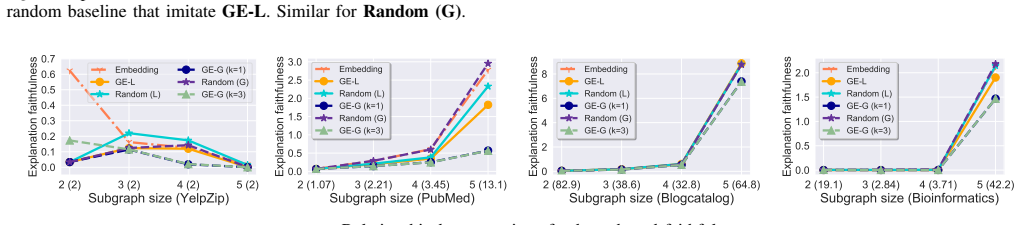
- [Section IV-D and Table IV] The evaluation uses Eq. (4), which is exactly the objective minimized by GE-G. While baselines are compared fairly on the same metric, this measures how well the method achieves its own training target, not an independent notion of explanation quality. More importantly, the comparison is confounded by subgraph size: Comb builds subgraphs of average size 6.1–7.9 while GE-G(k=3) has average size at most 5.0, and the authors note in Section IV-D that faithfulness is positively correlated with size. No error bars or test statistics are reported that would support the claim of statistical significance.
- [Section III and Abstract] The claim that the optimization in Eq. (4) is NP-hard is not proved; the text states it is 'similar to exhaustive feature selection' and cites [11] and [1]. No reduction from a known NP-hard problem (e.g., Steiner tree or k-median on graphs) to the constrained, acyclic subgraph problem is given. The abstract's 'We prove' is therefore misleading.
- [Theorem II.1] The counterexample is asserted but not verified. The proof says 'One can run BP on G_i ... to find \tilde{b}_X' and states an inequality, but it reports neither the beliefs on X nor the resulting symmetric KL distances. As written, the reader cannot check the claimed violation of submodularity and monotonicity; the proof needs explicit numbers or a small script.
- [Section IV and Section IV-G] The manuscript announces a user study ('we conduct user study to demonstrate the usability of GE-G') but no user-study results appear. The utility example on Yelp spam detection also lacks quantitative evidence: the logistic regression model is described but its coefficients, performance, and statistical significance are not provided. Claims about usability and utility are thus unsupported.
- [Section III-B and Fig. 4] The 'safe pruning' claim that pruning does not hurt faithfulness is supported only by three curves on Yelp networks, without error bars, and no formal guarantee is given. The abstract's unconditional phrasing 'without hurting faithfulness' exceeds what the experiments establish.
minor comments (5)
- [Throughout] There are several typos: Section IV has 'demostrate' for 'demonstrate', Section IV-G has 'reivewer' for 'reviewer', Fig. 3 caption has 'exlaining' for 'explaining', and Table II has 'Random varaibles' for 'Random variables'.
- [Section IV-B] 'Compatibility metrics' should be 'compatibility matrices'.
- [Algorithm 1] The pseudocode does not specify how the 'top k extensions' are ranked; this is only described in the text. Please add a pointer or make the pseudocode self-contained.
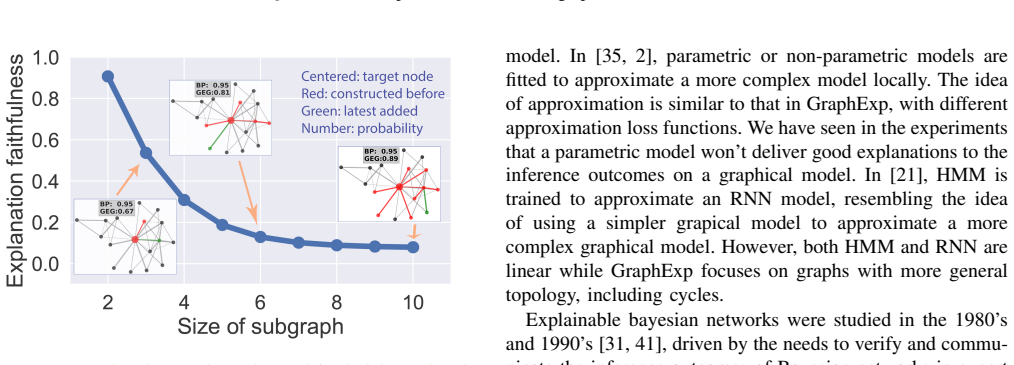
- [Fig. 7 caption] The caption appears garbled ('C e n t e r e d: t a r g e t n o d e'); please fix the formatting.
- [Theorem III.1] The proof of Theorem III.1 is trivial; consider moving it to a remark.
Circularity Check
No significant circularity: the faithfulness objective is both minimized and evaluated, but baselines are compared on the same metric and an external utility check is provided.
full rationale
The paper's derivation chain is self-contained. The central optimization in Eq. (4) defines faithfulness as symmetric KL divergence between the full-graph and subgraph marginals, and the GE-G algorithm explicitly minimizes that same objective during beam search. Table IV then reports that same objective as the evaluation metric. This is a consistent use of a single definition of faithfulness, not a derivation that assumes its conclusion: the random, embedding, LIME, and GE-L baselines are all scored on the same metric without being allowed to optimize it, so the relative comparison is meaningful. No parameters are fitted to data and then renamed as predictions; MRF potentials are either taken from an external source [34] or set by hand in Section IV-B. No load-bearing self-citation appears: the cited Yelp parameters [34], datasets [50], and DeepWalk [33] are external. Theorem III.1, stating that Algorithm 1 outputs a tree, follows immediately from the algorithm's explicit rule of adding one node through one edge without forming a loop; it is a trivial consequence of the construction rather than a circular proof of a substantive claim. The external utility analysis in Section IV-G, which uses the generated subgraphs to identify a security issue in Yelp spam detection, provides an independent check of explanation usefulness and further separates the method's value from its own objective. Hand-set homophily potentials and the absence of a calibrated-model reproduction are correctness and generalization concerns, not circularity.
Assumptions & free parameters
free parameters (5)
- max subgraph size C =
5
- beam size k =
1 or 3
- compatibility matrix diagonal =
0.9
- prior for labeled nodes =
0.9 for true class
- pruning ratio p =
up to 99%
assumptions (4)
- standard math BP converges to a unique fixed point on acyclic graphs, and Eq. (2)-(3) define the inference to be explained.
- domain assumption Symmetric KL divergence d(bX, tilde bX) is the correct faithfulness measure for explanations.
- domain assumption A tree subgraph of at most C nodes is interpretable to humans.
- ad hoc to paper Synthetic compatibility potentials and priors on non-Yelp networks represent realistic MRFs.
Cite this review
Pith. "Pith review of Scalable Explanation of Inferences on Large Graphs." pith.science (2026). https://pith.science/paper/B44APWVO
@misc{pith2026190806482,
  author       = {Pith},
  title        = {Pith review of: Scalable Explanation of Inferences on Large Graphs},
  year         = {2026},
  howpublished = {\url{https://pith.science/paper/B44APWVO}},
  note         = {Machine review of arXiv:1908.06482}
}
read the original abstract
Probabilistic inferences distill knowledge from graphs to aid human make important decisions. Due to the inherent uncertainty in the model and the complexity of the knowledge, it is desirable to help the end-users understand the inference outcomes. Different from deep or high-dimensional parametric models, the lack of interpretability in graphical models is due to the cyclic and long-range dependencies and the byzantine inference procedures. Prior works did not tackle cycles and make \textit{the} inferences interpretable. To close the gap, we formulate the problem of explaining probabilistic inferences as a constrained cross-entropy minimization problem to find simple subgraphs that faithfully approximate the inferences to be explained. We prove that the optimization is NP-hard, while the objective is not monotonic and submodular to guarantee efficient greedy approximation. We propose a general beam search algorithm to find simple trees to enhance the interpretability and diversity in the explanations, with parallelization and a pruning strategy to allow efficient search on large and dense graphs without hurting faithfulness. We demonstrate superior performance on 10 networks from 4 distinct applications, comparing favorably to other explanation methods. Regarding the usability of the explanation, we visualize the explanation in an interface that allows the end-users to explore the diverse search results and find more personalized and sensible explanations.
Figures


Figures from the paper (4 more)


Reference graph
Works this paper leans on
-
[11]
An introduction to variable and feature selection
Isabelle Guyon and Andr ´e Elisseeff. An introduction to variable and feature selection. Journal of machine learning research , 3(Mar):1157–1182, 2003
work page 2003
-
[1]
On the approximability of minimizing nonzero variables or unsatisfied relations in linear systems
Edoardo Amaldi and Viggo Kann. On the approximability of minimizing nonzero variables or unsatisfied relations in linear systems. Theoretical Computer Science , 209(1-2):237–260, 1998
work page 1998
-
[2]
How to explain individual classification decisions
David Baehrens, Timon Schroeter, Stefan Harmeling, Motoaki Kawanabe, Katja Hansen, and Klaus-Robert M ˜Aˇzller. How to explain individual classification decisions. Journal of Machine Learning Research, 11(Jun):1803–1831, 2010
work page 2010
-
[3]
Diverse m-best solutions in markov random fields
Dhruv Batra, Payman Yadollahpour, Abner Guzman-Rivera, and Gregory Shakhnarovich. Diverse m-best solutions in markov random fields. In European Conference on Computer Vision , pages 1–16. Springer, 2012
work page 2012
-
[4]
Case-based explanation of non-case-based learning methods
Rich Caruana, Hooshang Kangarloo, JD Dionisio, Usha Sinha, and David Johnson. Case-based explanation of non-case-based learning methods. In Proceedings of the AMIA Symposium, page
-
[5]
Sensitivity analysis in markov networks
Hei Chan and Adnan Darwiche. Sensitivity analysis in markov networks. In International Joint Conference on Artificial In- telligence, volume 19, page 1300. LAWRENCE ERLBAUM ASSOCIATES LTD, 2005
work page 2005
-
[6]
Reading tea leaves: How humans interpret topic models
Jonathan Chang, Sean Gerrish, Chong Wang, Jordan L Boyd- Graber, and David M Blei. Reading tea leaves: How humans interpret topic models. In Advances in neural information processing systems, pages 288–296, 2009
work page 2009
-
[7]
A differential approach to inference in bayesian networks
Adnan Darwiche. A differential approach to inference in bayesian networks. Journal of the ACM (JACM) , 50(3):280– 305, 2003
work page 2003
Show all 51 references
-
[8]
Sparse inverse covariance estimation with the graphical lasso
Jerome Friedman, Trevor Hastie, and Robert Tibshirani. Sparse inverse covariance estimation with the graphical lasso. Bio- statistics, 9(3):432–441, 2008
2008
-
[9]
Residual splash for optimally parallelizing belief propagation
Joseph Gonzalez, Yucheng Low, and Carlos Guestrin. Residual splash for optimally parallelizing belief propagation. In Artifi- cial Intelligence and Statistics , pages 177–184, 2009
2009
-
[10]
European union regulations on algorithmic decision-making and a right to explanation
Bryce Goodman and Seth Flaxman. European union regulations on algorithmic decision-making and a right to explanation. AI Magazine, 38(3):50–57, 2017
2017
-
[12]
Norm-product belief propa- gation: Primal-dual message-passing for approximate inference
Tamir Hazan and Amnon Shashua. Norm-product belief propa- gation: Primal-dual message-passing for approximate inference. IEEE Transactions on Information Theory , 56(12):6294–6316, 2010
2010
-
[13]
Variable selection for gaussian graphical models
Jean Honorio, Dimitris Samaras, Irina Rish, and Guillermo Cecchi. Variable selection for gaussian graphical models. In Artificial Intelligence and Statistics , pages 538–546, 2012
2012
-
[14]
An efficient network querying method based on conditional random fields
Qiang Huang, Ling-Yun Wu, and Xiang-Sun Zhang. An efficient network querying method based on conditional random fields. Bioinformatics, 27(22):3173–3178, 2011
2011
-
[15]
Fast and scalable distributed loopy belief propagation on real-world graphs
Saehan Jo, Jaemin Yoo, and U Kang. Fast and scalable distributed loopy belief propagation on real-world graphs. In Proceedings of the Eleventh ACM International Conference on Web Search and Data Mining , pages 297–305. ACM, 2018
2018
-
[16]
Composing graphical models with neural networks for structured representations and fast in- ference
Matthew Johnson, David K Duvenaud, Alex Wiltschko, Ryan P Adams, and Sandeep R Datta. Composing graphical models with neural networks for structured representations and fast in- ference. In Advances in neural information processing systems , pages 2946–2954, 2016
2016
-
[17]
Inference of beliefs on billion-scale graphs
U Kang, Duen Horng, et al. Inference of beliefs on billion-scale graphs. 2010
2010
-
[18]
Markov random fields and their applications
Ross Kindermann. Markov random fields and their applications. American mathematical society , 1980
1980
-
[19]
Understanding black-box predictions via influence functions
Pang Wei Koh and Percy Liang. Understanding black-box predictions via influence functions. In Proceedings of the 34th International Conference on Machine Learning-Volume 70, pages 1885–1894. JMLR. org, 2017
2017
-
[20]
Probabilistic graphical models: principles and techniques
Daphne Koller and Nir Friedman. Probabilistic graphical models: principles and techniques . MIT press, 2009
2009
-
[21]
Increasing the in- terpretability of recurrent neural networks using hidden markov models
Viktoriya Krakovna and Finale Doshi-Velez. Increasing the in- terpretability of recurrent neural networks using hidden markov models. arXiv preprint arXiv:1606.05320 , 2016
2016 arXiv
-
[22]
An evaluation of the human-interpretability of explanation
Isaac Lage, Emily Chen, Jeffrey He, Menaka Narayanan, Been Kim, Sam Gershman, and Finale Doshi-Velez. An evaluation of the human-interpretability of explanation. arXiv preprint arXiv:1902.00006, 2019
1902 arXiv
-
[23]
Rationalizing neural predictions
Tao Lei, Regina Barzilay, and Tommi Jaakkola. Rationalizing neural predictions. arXiv preprint arXiv:1606.04155 , 2016
2016 arXiv
-
[24]
Protein– protein interaction site prediction based on conditional random fields
Ming-Hui Li, Lei Lin, Xiao-Long Wang, and Tao Liu. Protein– protein interaction site prediction based on conditional random fields. Bioinformatics, 23(5):597–604, 2007
2007
-
[25]
The structure and function of explanations
Tania Lombrozo. The structure and function of explanations. Trends in cognitive sciences , 10(10):464–470, 2006
2006
-
[26]
Intelligible models for classification and regression
Yin Lou, Rich Caruana, and Johannes Gehrke. Intelligible models for classification and regression. In Proceedings of the 18th ACM SIGKDD international conference on Knowledge discovery and data mining , pages 150–158. ACM, 2012
2012
-
[27]
Reviews, reputation, and revenue: The case of yelp
Michael Luca. Reviews, reputation, and revenue: The case of yelp. com. Com (March 15, 2016). Harvard Business School NOM Unit Working Paper , (12-016), 2016
2016
-
[28]
The magical number seven, plus or minus two: Some limits on our capacity for processing information
George A Miller. The magical number seven, plus or minus two: Some limits on our capacity for processing information. Psychological review, 63(2):81, 1956
1956
-
[29]
Collective graph identification
Galileo Mark Namata, Stanley Kok, and Lise Getoor. Collective graph identification. In Proceedings of the 17th ACM SIGKDD international conference on Knowledge discovery and data mining, pages 87–95. ACM, 2011
2011
-
[30]
An analysis of approximations for maximizing submod- ular set functions
George L Nemhauser, Laurence A Wolsey, and Marshall L Fisher. An analysis of approximations for maximizing submod- ular set functions. Mathematical programming, 14(1):265–294, 1978
1978
-
[31]
An explanation mechanism for bayesian inferencing systems
Steven W Norton. An explanation mechanism for bayesian inferencing systems. In Machine Intelligence and Pattern Recognition, volume 5, pages 165–173. Elsevier, 1988
1988
-
[32]
Probabilistic reasoning in intelligent systems: networks of plausible inference
Judea Pearl. Probabilistic reasoning in intelligent systems: networks of plausible inference . Elsevier, 2014
2014
-
[33]
Deepwalk: Online learning of social representations
Bryan Perozzi, Rami Al-Rfou, and Steven Skiena. Deepwalk: Online learning of social representations. In Proceedings of the 20th ACM SIGKDD international conference on Knowledge discovery and data mining , pages 701–710. ACM, 2014
-
[34]
Collective opinion spam detection: Bridging review networks and metadata
Shebuti Rayana and Leman Akoglu. Collective opinion spam detection: Bridging review networks and metadata. In Pro- ceedings of the 21th acm sigkdd international conference on knowledge discovery and data mining , pages 985–994. ACM, 2015
2015
-
[35]
Why should i trust you?: Explaining the predictions of any classifier
Marco Tulio Ribeiro, Sameer Singh, and Carlos Guestrin. Why should i trust you?: Explaining the predictions of any classifier. In Proceedings of the 22nd ACM SIGKDD international con- ference on knowledge discovery and data mining , pages 1135–
-
[36]
Right for the right reasons: Training differentiable models by constraining their explanations
Andrew Slavin Ross, Michael C Hughes, and Finale Doshi- Velez. Right for the right reasons: Training differentiable models by constraining their explanations. arXiv preprint arXiv:1703.03717, 2017
2017 arXiv
-
[37]
Efficient search for diverse coherent explanations
Chris Russell. Efficient search for diverse coherent explanations. arXiv preprint arXiv:1901.04909 , 2019
1901 arXiv
-
[38]
Constructing the call graph of a pro- gram
Barbara G Ryder. Constructing the call graph of a pro- gram. IEEE Transactions on Software Engineering , (3):216– 226, 1979
1979
-
[39]
Deep inside convolutional networks: Visualising image clas- sification models and saliency maps
Karen Simonyan, Andrea Vedaldi, and Andrew Zisserman. Deep inside convolutional networks: Visualising image clas- sification models and saliency maps. arXiv preprint arXiv:1312.6034, 2013
2013 arXiv
-
[40]
Integrating rich user feedback into intelligent user interfaces
Simone Stumpf, Erin Sullivan, Erin Fitzhenry, Ian Oberst, Weng-Keen Wong, and Margaret Burnett. Integrating rich user feedback into intelligent user interfaces. In Proceedings of the 13th international conference on Intelligent user interfaces , pages 50–59. ACM, 2008
2008
-
[41]
Explanation in bayesian belief networks
Henri J Suermondt. Explanation in bayesian belief networks. 1993
1993
-
[42]
An introduction to conditional random fields
Charles Sutton, Andrew McCallum, et al. An introduction to conditional random fields. Foundations and Trends R© in Machine Learning, 4(4):267–373, 2012
2012
-
[43]
Relational learning via latent social dimensions
Lei Tang and Huan Liu. Relational learning via latent social dimensions. In Proceedings of the 15th ACM SIGKDD inter- national conference on Knowledge discovery and data mining , pages 817–826. ACM, 2009
2009
-
[44]
Learning to infer social ties in large networks
Wenbin Tang, Honglei Zhuang, and Jie Tang. Learning to infer social ties in large networks. In Joint european conference on machine learning and knowledge discovery in databases , pages 381–397. Springer, 2011
2011
-
[45]
An analysis of physi- cian attitudes regarding computer-based clinical consultation systems
Randy L Teach and Edward H Shortliffe. An analysis of physi- cian attitudes regarding computer-based clinical consultation systems. Computers and Biomedical Research , 14(6):542–558, 1981
1981
-
[46]
Counter- factual explanations without opening the black box: Automated decisions and the gpdr
Sandra Wachter, Brent Mittelstadt, and Chris Russell. Counter- factual explanations without opening the black box: Automated decisions and the gpdr. Harv. JL & Tech., 31:841, 2017
2017
-
[47]
influence sketching: Finding influential samples in large-scale regressions
Mike Wojnowicz, Ben Cruz, Xuan Zhao, Brian Wallace, Matt Wolff, Jay Luan, and Caleb Crable. influence sketching: Finding influential samples in large-scale regressions. In 2016 IEEE International Conference on Big Data (Big Data) , pages 3601–
2016
-
[48]
Linear program- ming relaxations and belief propagation–an empirical study
Chen Yanover, Talya Meltzer, and Yair Weiss. Linear program- ming relaxations and belief propagation–an empirical study. Journal of Machine Learning Research , 7(Sep):1887–1907, 2006
1907
-
[49]
Smoke screener or straight shooter: Detecting elite sybil attacks in user-review social networks
Haizhong Zheng, Minhui Xue, Hao Lu, Shuang Hao, Haojin Zhu, Xiaohui Liang, and Keith Ross. Smoke screener or straight shooter: Detecting elite sybil attacks in user-review social networks. arXiv preprint arXiv:1709.06916 , 2017
2017 arXiv
-
[50]
Predicting multicellular function through multi-layer tissue networks
Marinka Zitnik and Jure Leskovec. Predicting multicellular function through multi-layer tissue networks. Bioinformatics, 33(14):i190–i198, 2017
2017
-
[212]
American Medical Informatics Association, 1999
1999
Reviewed August 14, 2026 · model on record in the stance chip above.
Discussion (0). Continue with ORCID to comment.