Modality-Aware Out-of-Distribution Detection for Multi-Modal Action Recognition
Pith reviewed 2026-06-26 00:27 UTC · model grok-4.3
The pith
Multi-modal action recognition gains a stronger OOD detector by contrasting full-model predictions against single-modality branches.
A machine-rendered reading of the paper's core claim, the machinery that carries it, and where it could break.
Core claim
Based on an observed relationship between multi-modal and uni-modal predictions, we propose a post-hoc detector that combines this signal with a feature-space score and normalizes the combination by multi-modal logits; the resulting hybrid detector is compatible with training-time approaches and outperforms the state of the art on average across established datasets from the MultiOOD benchmark, showing the value of explicitly considering different modalities at inference time.
What carries the argument
The relationship between multi-modal and uni-modal predictions, used as an explicit signal and combined with a normalized feature-space score to form a hybrid post-hoc OOD detector.
If this is right
- The detector can be paired directly with any existing training-time OOD regularization method without modification.
- Average OOD detection performance rises across a range of established multi-modal action recognition datasets.
- Explicit use of modality-specific predictions at inference time improves robustness beyond what uni-modal detectors achieve.
- Normalization by multi-modal logits preserves the prediction-gap signal while avoiding new biases in the score.
Where Pith is reading between the lines
- The same prediction-gap idea could be tested in other multi-modal settings such as audio-visual or vision-language models to check whether modality contrast remains useful.
- Deployed systems that combine video, audio, and sensor streams might reduce missed OOD events by adding this lightweight contrast at test time.
- A direct follow-up experiment would replace the logit normalization with alternative scaling factors and measure whether detection margins change.
Load-bearing premise
The gap between multi-modal and uni-modal predictions stays informative and stable for separating in-distribution from out-of-distribution samples across models and datasets.
What would settle it
If the hybrid detector shows no consistent gain over standard uni-modal OOD detectors when evaluated on additional multi-modal action datasets where the uni-modal branches are forced to produce identical outputs to the full model, the claimed utility of the prediction-gap signal would be refuted.
Figures
read the original abstract
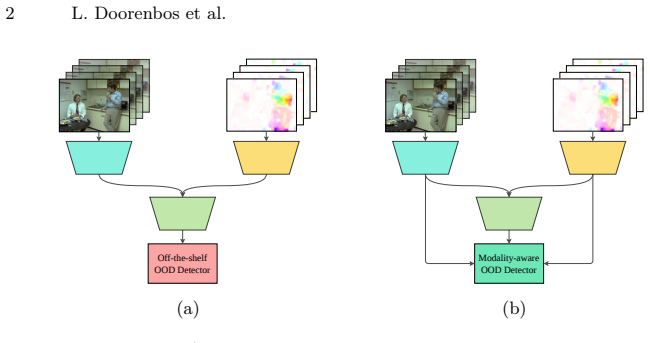
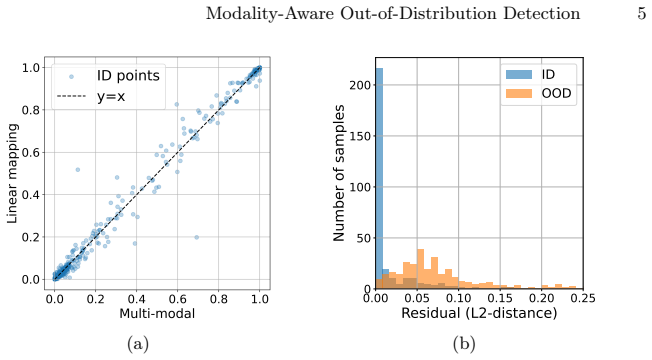
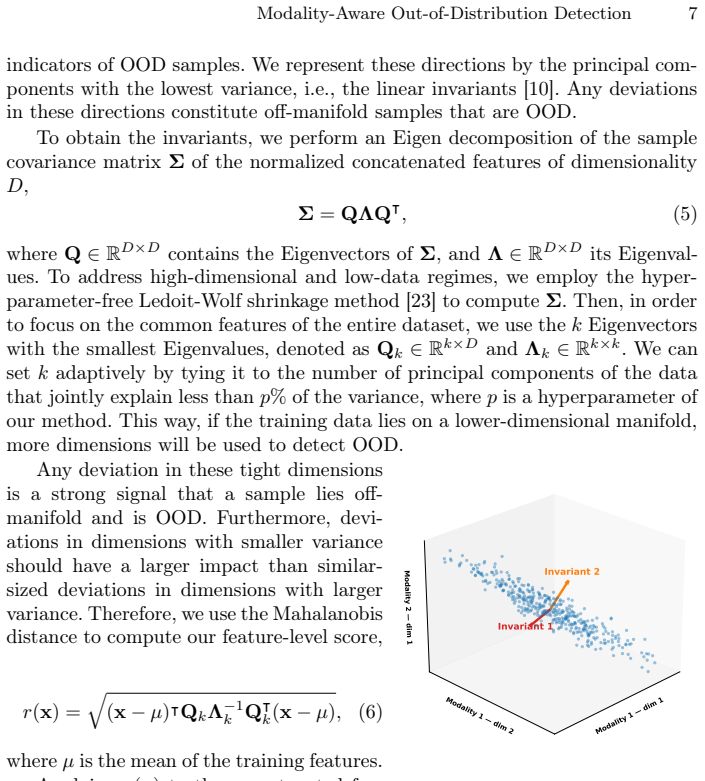
The incorporation of additional modalities into action recognition models increases their performance across a wide range of settings. However, how this additional information can contribute to making the models more robust remains underexplored, particularly for the case of multi-modal out-of-distribution (OOD) detection. While methods exist that regularize the multi-modal training process with OOD detection in mind, they still apply off-the-shelf OOD detectors designed for the uni-modal case during inference, discarding important information. Based on an interesting relationship we find between the multi-modal and uni-modal predictions, we propose to use this signal to build a post-hoc detector explicitly designed for the multi-modal scenario. We combine this new source of information with a feature-space score, which detects off-manifold samples in the multi-modal space, and normalize them by the multi-modal logits. In doing so, the proposed hybrid detector is compatible with existing training-time approaches and consistently improves performance. Experiments on a wide range of established datasets from the MultiOOD benchmark show that, on average, our approach outperforms the state of the art. Our results show the importance of explicitly considering the different modalities at inference time for multi-modal OOD detection.
Editorial analysis
A structured set of objections, weighed in public.
Referee Report
Summary. The paper proposes a post-hoc, modality-aware OOD detector for multi-modal action recognition. It identifies an empirical relationship between multi-modal and uni-modal predictions, combines this signal with a feature-space score for off-manifold detection, and normalizes the result by multi-modal logits. The resulting hybrid detector is presented as compatible with existing training-time OOD methods and is evaluated on datasets from the MultiOOD benchmark, where it reports average outperformance over prior state-of-the-art approaches.
Significance. If the reported average gains hold under scrutiny, the work usefully demonstrates that inference-time exploitation of modality-specific signals can improve OOD detection without retraining. It supplies a practical, plug-in enhancement rather than a new training objective, which could be adopted in multi-modal pipelines where robustness to distribution shift matters.
major comments (2)
- [§4] §4 (Experiments): the central claim of consistent improvement rests on average performance across the MultiOOD benchmark, yet the abstract and summary provide no per-dataset AUROC/FPR95 numbers, standard deviations, or statistical tests; without these, it is impossible to determine whether gains are uniform or driven by a subset of datasets.
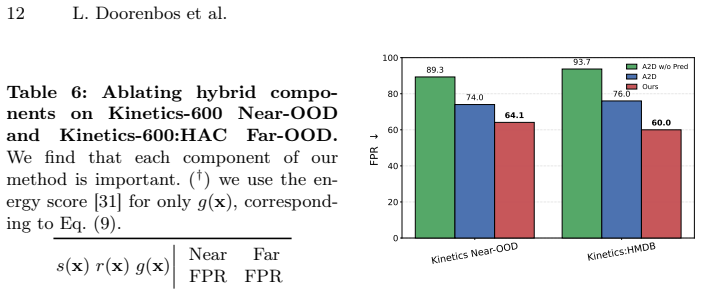
- [§3] §3 (Method): the normalization of the feature-space score by multi-modal logits is asserted to preserve the OOD signal without new biases, but no ablation isolating this step or analysis of its effect on score distributions is referenced; this step is load-bearing for the hybrid detector's claimed advantage.
minor comments (2)
- [Abstract] The phrase 'interesting relationship' in the abstract and introduction should be replaced by a concise statement of the observed correlation (e.g., Pearson coefficient or qualitative pattern) to allow readers to assess its strength before the formal definition appears in §3.
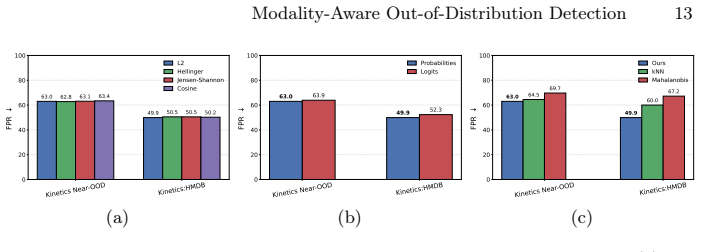
- [Figures] Figure captions and axis labels in the experimental figures should explicitly state whether reported metrics are AUROC or FPR@95 and whether error bars reflect multiple runs or cross-validation folds.
Simulated Author's Rebuttal
We thank the referee for the constructive feedback. We address each major comment below, providing clarifications from the manuscript and indicating where revisions will be made to strengthen the presentation.
read point-by-point responses
-
Referee: [§4] §4 (Experiments): the central claim of consistent improvement rests on average performance across the MultiOOD benchmark, yet the abstract and summary provide no per-dataset AUROC/FPR95 numbers, standard deviations, or statistical tests; without these, it is impossible to determine whether gains are uniform or driven by a subset of datasets.
Authors: The manuscript's Section 4 and associated tables report per-dataset AUROC and FPR95 values on the MultiOOD benchmark, with the average computed across them. The abstract emphasizes the average as the primary reported metric, which is standard for benchmark comparisons. We agree that explicit mention of consistency would improve clarity. In revision we will add a brief statement to the abstract noting that improvements hold on the majority of datasets and include standard deviations from repeated runs in the main results table. Statistical significance testing was not performed in the original submission but can be added if the editor deems it necessary. revision: partial
-
Referee: [§3] §3 (Method): the normalization of the feature-space score by multi-modal logits is asserted to preserve the OOD signal without new biases, but no ablation isolating this step or analysis of its effect on score distributions is referenced; this step is load-bearing for the hybrid detector's claimed advantage.
Authors: The normalization is introduced in Section 3 to scale the off-manifold feature score by the multi-modal logit magnitude, motivated by the observed relationship between uni- and multi-modal predictions. The text provides the mathematical justification but does not contain a dedicated ablation or distribution analysis for this component alone. We will add such an ablation (with and without normalization) together with score-distribution histograms in the revised manuscript to directly address this point. revision: yes
Circularity Check
No significant circularity
full rationale
The paper presents an empirical observation of a relationship between multi-modal and uni-modal predictions, which is then used to construct a post-hoc hybrid OOD detector combined with feature-space scoring and logit normalization. No equations, derivations, fitted parameters renamed as predictions, or self-citations are shown that would reduce the detector score to its own inputs by construction. The approach is described as compatible with existing methods and validated externally on the MultiOOD benchmark, rendering the central claim self-contained without load-bearing circular reductions.
Axiom & Free-Parameter Ledger
Reference graph
Works this paper leans on
-
[1]
In: Proceedings of the AAAI Conference on Artificial Intelligence
Ahmed, F., Courville, A.: Detecting semantic anomalies. In: Proceedings of the AAAI Conference on Artificial Intelligence. vol. 34, pp. 3154–3162 (2020)
2020
-
[2]
Advances in Neural Information Processing Systems36, 38206–38230 (2023)
Behpour, S., Doan, T.L., Li, X., He, W., Gou, L., Ren, L.: Gradorth: A simple yet efficient out-of-distribution detection with orthogonal projection of gradients. Advances in Neural Information Processing Systems36, 38206–38230 (2023)
2023
-
[3]
arXiv preprint arXiv:1808.01340 (2018)
Carreira, J., Noland, E., Banki-Horvath, A., Hillier, C., Zisserman, A.: A short note about kinetics-600. arXiv preprint arXiv:1808.01340 (2018)
Pith/arXiv arXiv 2018
-
[4]
In: proceedings of the IEEE Conference on Computer Vision and Pattern Recognition
Carreira, J., Zisserman, A.: Quo vadis, action recognition? a new model and the kinetics dataset. In: proceedings of the IEEE Conference on Computer Vision and Pattern Recognition. pp. 6299–6308 (2017)
2017
-
[5]
In: Proceedings of the IEEE international conference on computer vision
Chéron, G., Laptev, I., Schmid, C.: P-cnn: Pose-based cnn features for action recognition. In: Proceedings of the IEEE international conference on computer vision. pp. 3218–3226 (2015)
2015
-
[6]
In: Proceedings of the European conference on computer vision (ECCV)
Damen, D., Doughty, H., Farinella, G.M., Fidler, S., Furnari, A., Kazakos, E., Moltisanti, D., Munro, J., Perrett, T., Price, W., et al.: Scaling egocentric vision: The epic-kitchens dataset. In: Proceedings of the European conference on computer vision (ECCV). pp. 720–736 (2018)
2018
-
[7]
arXiv preprint arXiv:1802.04865 (2018)
DeVries, T., Taylor, G.W.: Learning confidence for out-of-distribution detection in neural networks. arXiv preprint arXiv:1802.04865 (2018)
Pith/arXiv arXiv 2018
-
[8]
Advances in Neural Information Processing Systems36, 78674–78695 (2023)
Dong,H.,Nejjar,I.,Sun,H.,Chatzi,E.,Fink,O.:Simmmdg:Asimpleandeffective framework for multi-modal domain generalization. Advances in Neural Information Processing Systems36, 78674–78695 (2023)
2023
-
[9]
Advances in Neural Information Processing Sys- tems37, 129250–129278 (2024)
Dong, H., Zhao, Y., Chatzi, E., Fink, O.: Multiood: Scaling out-of-distribution detection for multiple modalities. Advances in Neural Information Processing Sys- tems37, 129250–129278 (2024)
2024
-
[10]
In: European Conference on Computer Vision
Doorenbos, L., Sznitman, R., Márquez-Neila, P.: Data invariants to understand unsupervised out-of-distribution detection. In: European Conference on Computer Vision. pp. 133–150. Springer (2022)
2022
-
[11]
arXiv preprint arXiv:2411.13619 (2024)
Doorenbos, L., Sznitman, R., Márquez-Neila, P.: Non-linear outlier synthesis for out-of-distribution detection. arXiv preprint arXiv:2411.13619 (2024)
arXiv 2024
-
[12]
Advances in Neural Information Processing Systems36(2024)
Du, X., Sun, Y., Zhu, J., Li, Y.: Dream the impossible: Outlier imagination with diffusion models. Advances in Neural Information Processing Systems36(2024)
2024
-
[13]
In: Proceedings of the International Conference on Learning Representations (2022)
Du, X., Wang, Z., Cai, M., Li, Y.: Vos: Learning what you don’t know by vir- tual outlier synthesis. In: Proceedings of the International Conference on Learning Representations (2022)
2022
-
[14]
In: Proceedings of the IEEE/CVF international conference on computer vision
Feichtenhofer, C., Fan, H., Malik, J., He, K.: Slowfast networks for video recog- nition. In: Proceedings of the IEEE/CVF international conference on computer vision. pp. 6202–6211 (2019)
2019
-
[15]
International Confer- ence on Machine Learning (2022) 16 L
Hendrycks, D., Basart, S., Mazeika, M., Mostajabi, M., Steinhardt, J., Song, D.: Scaling out-of-distribution detection for real-world settings. International Confer- ence on Machine Learning (2022) 16 L. Doorenbos et al
2022
-
[16]
Proceedings of International Conference on Learning Representations (2017)
Hendrycks, D., Gimpel, K.: A baseline for detecting misclassified and out-of- distribution examples in neural networks. Proceedings of International Conference on Learning Representations (2017)
2017
-
[17]
International Conference on Learning Representations (2019)
Hendrycks, D., Mazeika, M., Dietterich, T.: Deep anomaly detection with outlier exposure. International Conference on Learning Representations (2019)
2019
-
[18]
Advances in Neural Information Processing Systems34, 677–689 (2021)
Huang, R., Geng, A., Li, Y.: On the importance of gradients for detecting distribu- tional shifts in the wild. Advances in Neural Information Processing Systems34, 677–689 (2021)
2021
-
[19]
In: Forty-first International Conference on Machine Learning (2024)
Huh, M., Cheung, B., Wang, T., Isola, P.: Position: The platonic representation hypothesis. In: Forty-first International Conference on Machine Learning (2024)
2024
-
[20]
Kamoi, R., Kobayashi, K.: Why is the mahalanobis distance effective for anomaly detection? arXiv preprint arXiv:2003.00402 (2020)
arXiv 2003
-
[21]
In: 2011 International conference on com- puter vision
Kuehne, H., Jhuang, H., Garrote, E., Poggio, T., Serre, T.: Hmdb: a large video database for human motion recognition. In: 2011 International conference on com- puter vision. pp. 2556–2563. IEEE (2011)
2011
-
[22]
In: 2011 IEEE international conference on robotics and automation
Lai, K., Bo, L., Ren, X., Fox, D.: A large-scale hierarchical multi-view rgb-d object dataset. In: 2011 IEEE international conference on robotics and automation. pp. 1817–1824. IEEE (2011)
2011
-
[23]
Journal of multivariate analysis88(2), 365–411 (2004)
Ledoit, O., Wolf, M.: A well-conditioned estimator for large-dimensional covariance matrices. Journal of multivariate analysis88(2), 365–411 (2004)
2004
-
[24]
International Conference on Learning Rep- resentations (2018)
Lee, K., Lee, H., Lee, K., Shin, J.: Training confidence-calibrated classifiers for detecting out-of-distribution samples. International Conference on Learning Rep- resentations (2018)
2018
-
[25]
Advances in neural information processing systems31(2018)
Lee, K., Lee, K., Lee, H., Shin, J.: A simple unified framework for detecting out- of-distribution samples and adversarial attacks. Advances in neural information processing systems31(2018)
2018
-
[26]
In: Proceedings of the Computer Vision and Pattern Recognition Conference
Li, S., Gong, H., Dong, H., Yang, T., Tu, Z., Zhao, Y.: Dpu: Dynamic proto- type updating for multimodal out-of-distribution detection. In: Proceedings of the Computer Vision and Pattern Recognition Conference. pp. 10193–10202 (2025)
2025
-
[27]
Advances in Neural Information Processing Systems (2025)
Liang, J., Hou, R., Hu, M., Chang, H., Shan, S., Chen, X.: Revisiting logit distri- butions for reliable out-of-distribution detection. Advances in Neural Information Processing Systems (2025)
2025
-
[28]
In: Proceedings of the International Conference on Learning Representations (2018)
Liang, S., Li, Y., Srikant, R.: Enhancing the reliability of out-of-distribution image detection in neural networks. In: Proceedings of the International Conference on Learning Representations (2018)
2018
-
[29]
In: Proceedings of the Computer Vision and Pattern Recognition Conference
Ling, Z., Chang, Y., Zhao, H., Zhao, X., Chow, K., Deng, S.: Cadref: Robust out-of-distribution detection via class-aware decoupled relative feature leveraging. In: Proceedings of the Computer Vision and Pattern Recognition Conference. pp. 4968–4977 (2025)
2025
-
[30]
Advances in Neural Information Processing Systems (2025)
Liu, M., Dong, H., Kelly, J., Fink, O., Trapp, M.: Extremely simple multimodal outlier synthesis for out-of-distribution detection and segmentation. Advances in Neural Information Processing Systems (2025)
2025
-
[31]
Advances in Neural Information Processing Systems (2020)
Liu, W., Wang, X., Owens, J., Li, Y.: Energy-based out-of-distribution detection. Advances in Neural Information Processing Systems (2020)
2020
-
[32]
In: Proceedings of the IEEE/CVF conference on computer vision and pattern recognition
Liu, X., Lochman, Y., Zach, C.: Gen: Pushing the limits of softmax-based out-of- distribution detection. In: Proceedings of the IEEE/CVF conference on computer vision and pattern recognition. pp. 23946–23955 (2023)
2023
-
[33]
Internation Conference on Machine Learning (2025) Modality-Aware Out-of-Distribution Detection 17
Mueller, M., Hein, M.: Mahalanobis++: Improving ood detection via feature nor- malization. Internation Conference on Machine Learning (2025) Modality-Aware Out-of-Distribution Detection 17
2025
-
[34]
Neural Computing and Applications36(10), 5499–5513 (2024)
Shaikh, M.B., Chai, D., Islam, S.M.S., Akhtar, N.: Multimodal fusion for audio- image and video action recognition. Neural Computing and Applications36(10), 5499–5513 (2024)
2024
-
[35]
In: European Conference on Computer Vision
Sharifi, S., Entesari, T., Safaei, B., Patel, V.M., Fazlyab, M.: Gradient-regularized out-of-distribution detection. In: European Conference on Computer Vision. pp. 459–478. Springer (2024)
2024
-
[36]
arXiv preprint arXiv:1212.0402 (2012)
Soomro, K., Zamir, A.R., Shah, M.: Ucf101: A dataset of 101 human actions classes from videos in the wild. arXiv preprint arXiv:1212.0402 (2012)
Pith/arXiv arXiv 2012
-
[37]
In: Proceedings of the International Conference on Machine Learning
Sun, Y., Ming, Y., Zhu, X., Li, Y.: Out-of-distribution detection with deep nearest neighbors. In: Proceedings of the International Conference on Machine Learning. pp. 20827–20840 (2022)
2022
-
[38]
IEEE transactions on pattern analysis and machine intelligence45(3), 3200–3225 (2022)
Sun, Z., Ke, Q., Rahmani, H., Bennamoun, M., Wang, G., Liu, J.: Human action recognition from various data modalities: A review. IEEE transactions on pattern analysis and machine intelligence45(3), 3200–3225 (2022)
2022
-
[39]
In: Proceedings of the Computer Vision and Pattern Recognition Conference
Tang, K., Hou, C., Peng, W., Fang, X., Wu, Z., Nie, Y., Wang, W., Tian, Z.: Simpli- fication is all you need against out-of-distribution overconfidence. In: Proceedings of the Computer Vision and Pattern Recognition Conference. pp. 5030–5040 (2025)
2025
-
[40]
In: Proceedings of the IEEE/CVF conference on computer vision and pattern recognition
Wang, H., Li, Z., Feng, L., Zhang, W.: Vim: Out-of-distribution with virtual-logit matching. In: Proceedings of the IEEE/CVF conference on computer vision and pattern recognition. pp. 4921–4930 (2022)
2022
-
[41]
arXiv preprint arXiv:2007.05566 (2020)
Winkens, J., Bunel, R., Roy, A.G., Stanforth, R., Natarajan, V., Ledsam, J.R., MacWilliams, P., Kohli, P., Karthikesalingam, A., Kohl, S., et al.: Contrastive training for improved out-of-distribution detection. arXiv preprint arXiv:2007.05566 (2020)
arXiv 2007
-
[42]
International Journal of Computer Vision132(12), 5635–5662 (2024)
Yang, J., Zhou, K., Li, Y., Liu, Z.: Generalized out-of-distribution detection: A survey. International Journal of Computer Vision132(12), 5635–5662 (2024)
2024
-
[43]
sword" sample happens in a gym court. ID classes such as “dribble
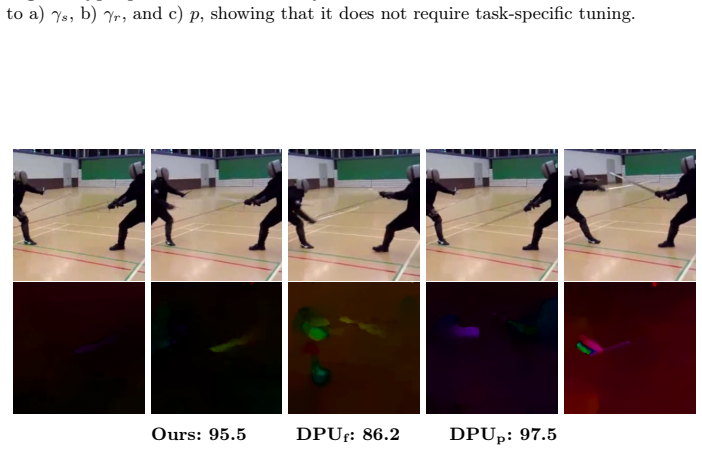
Yang, Y., Xu, H.: Strengthen out-of-distribution detection capability with pro- gressive self-knowledge distillation. In: Forty-second International Conference on Machine Learning (2025) Modality-Aware Out-of-Distribution Detection 1 6 Full Experimental Details We provide more details on the dataset combinations used for the experiments. Alldatasetsfollow...
2025
discussion (0)
Sign in with ORCID, Apple, or X to comment. Anyone can read and Pith papers without signing in.