REVIEW 3 major objections 5 minor 20 references
Black Hole Interiors via Spin Models
T0 review · 3 major / 5 minor · reviewed 2026-08-14 · deepseek-v4-flash
Pith's one-line read Spin model matches black hole interior evolution up to scrambling time
desk verdict A useful numerical probe of the mean-field interior conjecture, but the analytic case is weaker than the abstract implies, and the fast-scrambling evidence rests on small-system fits without error bars. read the letter →
The pith
A machine-rendered reading of the paper's core claim, the machinery that carries it, and where it could break.
The reading
What carries the argument
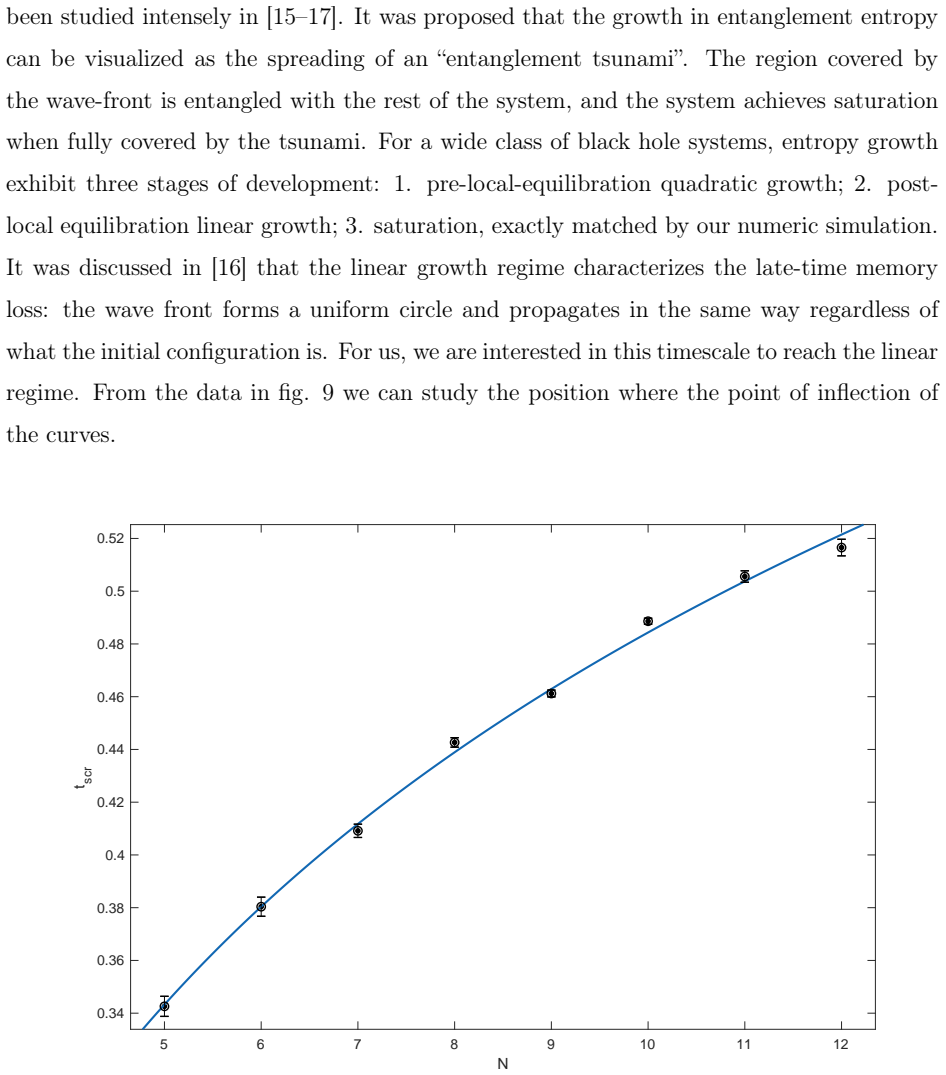
The load-bearing objects are the maximally non-local random four-spin Hamiltonian, whose couplings are drawn from a normal distribution and normalized so that the spectral variance is order one, and the state-dependent mean-field Hamiltonian $H_{\mathrm{MF}}(t)=\sum_i \mathrm{Tr}_{\bar{\imath}}\bigl(H\rho_{\mathrm{MF}}(t)\bigr)$, in which each spin evolves under the partial trace of the full Hamiltonian over all other spins. Because $H_{\mathrm{MF}}$ is a sum of single-spin terms, it preserves the product structure of the initial state, representing a free-falling probe. The argument is carried by the trace distance between the exact and mean-field evolutions: a purity-based Bloch-sphere bound gives the lower limit $8t^2/(3N)$, a Lieb-Robinson bound gives an exponential upper limit, and the numerics show the lower bound is nearly saturated at early times. The scrambling time is extracted from the inflection point of entanglement-entropy growth, which follows a quadratic-then-linear-then-saturated form.
What would settle it
A direct numerical computation of the exact-versus-mean-field trace distance for $N=13$ or $14$ (or for a different ensemble of four-spin couplings) would settle the claim: if the early-time coefficient $a$ moves away from $8/3$, or if the saturation time stops tracking $t_{\mathrm{scr}}=0.21\log N$, the claimed universality fails.
Extended reading notes
Core claim
The central discovery is that the mean-field Hamiltonian provides a local bulk Hamiltonian for a black hole interior. For a random four-spin Hamiltonian $H=\sum_{i<j<k<l} J_{ijkl}\,\vec{s}_i\cdot\vec{s}_j\cdot\vec{s}_k\cdot\vec{s}_l$ with couplings normalized so that $\mathrm{var}(H)=N^0$, the exact time evolution of a probe spin initially in a product state remains close to the mean-field time evolution until a scrambling time that grows as $t_{\mathrm{scr}}=0.21\log N$. Concretely, the trace distance between the exact and mean-field reduced density matrices is bounded below by $D(\rho_1,\rho^{\mathrm{MF}}_1) \ge 8t^2/(3N)$ at early times, and the numerical fit gives $a=2.6$ for the coefficient in $a t^2/N$, close to the predicted $8/3$. The paper interprets this agreement as evidence that the local mean-field viewpoint, and hence a bulk geodesic description, is valid before scrambling, and that decoherence of the infalling state is dual to the disruptive bulk effects near the spacetime singularity.
Load-bearing premise
The results assume that a black hole is well represented by a single randomly chosen pure state of an N-spin system, evolved under a four-spin Hamiltonian with order-one variance, and that the numerical agreement seen for $N\le 12$ persists to large $N$.
Editorial extensions
If this is right
- For times shorter than the scrambling time, bulk geodesic evolution is a good approximation: the probe's decoherence is suppressed as a $1/N$ effect, bounded by $8t^2/(3N)$.
- The model fast scrambles in the high-temperature limit, with a scrambling time $t_{\mathrm{scr}}=0.21\log N$, matching the expected logarithmic fast-scrambling behavior of black holes.
- The early-time purity bound is nearly saturated, so the decoherence of a single probe spin effectively sets the global scrambling timescale in this class of maximally non-local systems.
- The dense random spectrum prevents recurrences on the simulated times, so the mean-field comparison is not contaminated by time-recurrence artifacts seen in simpler two-spin toy models.
- Entanglement entropy shows the three-stage growth (quadratic, linear, saturation) familiar from holographic thermalization, giving a robust numerical handle on scrambling.
Reading between the lines
- If the matching is universal across fast-scrambling ensembles, the smooth infall of an observer can be identified with mean-field evolution, and the information-loss problem is recast as a statement about late-time decoherence rather than a breakdown at the horizon.
- Adding nearest-neighbor couplings—explicitly left for future work—would test whether genuine local bulk field interactions, not just geodesic motion, emerge from the same mean-field logic.
- The early-time coefficient $8/3$ could be measured in other $k$-spin random ensembles; agreement would suggest the coefficient is a universal feature of maximally non-local stretched-horizon dynamics rather than a special property of four-spin couplings.
- A sharper test of fast scrambling would extract the scrambling time from an OTOC crossover at larger $N$; the paper notes the OTOC saturates before exponential growth is clearly separated, so the entanglement-entropy inflection point is currently the more reliable estimator.
Editorial analysis
A structured set of objections, weighed in public.
Referee Report
Summary. The paper studies a spin-1/2 system with long-range random four-spin couplings as a model of a black-hole stretched horizon in the high-temperature limit. It proposes a state-dependent mean-field Hamiltonian H_MF(t) as a candidate local bulk Hamiltonian, and tests this conjecture by numerically solving the exact Schrödinger evolution and comparing the reduced state of a probe spin with the mean-field prediction for N=5...12. The comparison is quantified by the trace distance D(ρ1,ρ1^MF), which the paper bounds from below using an early-time purity expansion and from above using a Lieb-Robinson bound. The authors report numerical saturation of the lower bound, fit the early-time coefficient a≈2.6 against the analytic 8/3, and use the inflection point of the entanglement entropy to define a scrambling time t_scr=0.21 log N. They also study the OTOC and purity as cross-checks, concluding that the mean-field description is valid for timescales smaller than the scrambling time, and that the model fast scrambles.
Significance. If the central claim holds, the paper offers a concrete, testable toy model for black-hole interior holography: it extends the earlier two-spin mean-field framework to a four-spin Hamiltonian with a dense spectrum, and it checks the mean-field bulk Hamiltonian against exact evolution in a non-circular way. The analytic early-time bound in Appendix A is clean and has a parameter-free leading coefficient, and the exact-diagonalization numerics for N up to 12 provide a self-contained testing ground. The significance is currently limited by the small system sizes, the absence of error bars on the fitted exponents, and the fact that smallness of the trace distance is inferred from saturation of a lower bound rather than established by an analytic upper bound. If the requested scaling checks confirm the N-dependence and the log N scrambling time, the paper would be a credible numerical proof of concept; as it stands, it is an interesting pilot study whose central claim is plausible but not yet quantitatively robust.
major comments (3)
- [III, Eq. (10)] The central claim of the paper, that exact evolution matches mean-field evolution up to the scrambling time, rests on numerical saturation of the purity lower bound. The analytic ingredients in Eq. (10) do not by themselves establish smallness, because the displayed upper bound D < c' N e^{ct} grows with N; the statement following Eq. (10) that this ensures decoherence is a 1/N effect is not justified by the inequality as written. I request a quantitative scaling test: report the fitted coefficient a with bootstrap error bars for each N, show a collapse of the ND curves, and demonstrate that the quadratic regime persists up to a time that scales at least as log N. Without this, agreement for N ≤ 12 cannot confidently be extrapolated to the black-hole limit.
- [IV, Figs. 9–10] The scrambling time t_scr = 0.21 log N is extracted from inflection points of the entanglement entropy over only N = 5,...,12. The claim that a one-parameter logarithmic fit is better than a three-parameter power law is not supported by any quantitative model comparison (e.g., chi-squared, AIC, or residual analysis), and no error bars are given for the individual t_scr values. Please provide uncertainties and a statistical comparison that would let the reader assess whether the log N scaling is actually preferred over a power law.
- [IV, Fig. 7] The OTOC data do not show a clear exponential growth regime before saturation, and the text acknowledges this. Since the fast-scrambling claim therefore rests mainly on the entropy inflection analysis, the paper should either present a separate quantitative crossover measure for C2(t) or explicitly state that the OTOC data are consistent with, but do not independently establish, fast scrambling. As written, the section heading 'Evidence for fast scrambling' overstates what the OTOC measurement can support.
minor comments (5)
- [III, purity fit] The text reports fitting P(t) = 1 - a N^{-δ} t^2 with δ = -0.8 and a = -2.8, while the caption of Fig. 6 reports a fit to 1 - a t^2/N with a ≈ 5.3 and a prediction of 16/3. The sign and N-scaling of the fitted coefficient are inconsistent between these two presentations; they should be reconciled and aligned with the early-time expansion of Appendix A.
- [III, Eq. (11)] The exponential-fit parameters a = 5.5, b = 0.5, Δ = 1.8, γ = 0.92 are listed without uncertainties. The statement that some parameters are not well determined should be made quantitative, for example by giving confidence intervals or a residual plot.
- [IV, Fig. 4] The global-state trace distance is described as increasing linearly and being largely independent of N, but no fit or quantitative analysis is provided; please specify how this conclusion was obtained.
- [IV, Fig. 10] The procedure for extracting the inflection point used as the scrambling time should be defined precisely (e.g., the numerical second derivative or a spline fit) so the definition is reproducible from the presented data.
- [Abstract] There are several spacing and OCR-like artifacts in the abstract text (for example 's ystem' and 'Schrodin ger'); these should be cleaned before publication.
Circularity Check
No significant circularity: the mean-field prediction is tested against exact diagonalization, and the analytic purity bound is parameter-free.
full rationale
The central claim—that the mean-field Hamiltonian (8) reproduces the exact evolution of a probe spin for times below the scrambling time—is checked by numerically solving the exact Schrödinger equation and comparing with the mean-field evolution. This is an independent benchmark, not an input to the construction. The analytic lower bound D(rho1,rhoMF1) >= 1/2(1 - sqrt(2P-1)) ~ 8t^2/(3N) is derived from the purity expansion and is parameter-free, so the numerical saturation of this bound is a nontrivial check rather than a fitted prediction. The fits a=2.6 and t_scr=0.21 log N are extracted from the exact numerics and are not used to define the quantities they are claimed to predict. The paper does cite the authors' earlier mean-field framework [4-7], but that prior work supplies the motivation and definition of the ansatz, not the evidence for the agreement; the evidence is the exact-vs-mean-field comparison. No equation reduces by construction to an input, no fitted parameter is renamed as a prediction, and no load-bearing uniqueness claim is imported from a self-citation. Accordingly, no circular step meets the threshold of a quoted reduction.
Assumptions & free parameters
free parameters (6)
- a (trace distance quadratic fit) =
2.6
- a (purity quadratic fit) =
5.3
- a, gamma, delta (entropy fit) =
a ~ 3.7, gamma ~ 1.62, delta ~ 0.67
- t_scr coefficient =
0.21
- a, delta (OTOC fit) =
a ~ 175, delta ~ 2.28
- a, b, Delta, gamma (exponential trace distance fit) =
a=5.5, b=0.5, Delta=1.8, gamma=0.92
assumptions (5)
- domain assumption The four-spin random Hamiltonian (2) with variance normalization var(H)=N^0 (3) is a sufficient model for the stretched horizon of a Schwarzschild black hole.
- domain assumption The black hole limit corresponds to the high-temperature limit where microstates are approximately degenerate and equally likely.
- domain assumption The black hole state is represented by a random pure state (Page state).
- standard math Lieb-Robinson bounds bound the trace distance as in (10).
- domain assumption The 'entanglement tsunami' picture of [16] applies to the entanglement entropy growth in this model.
Cite this review
Pith. "Pith review of Black Hole Interiors via Spin Models." pith.science (2026). https://pith.science/paper/B4J6I4V6
@misc{pith2026190811190,
  author       = {Pith},
  title        = {Pith review of: Black Hole Interiors via Spin Models},
  year         = {2026},
  howpublished = {\url{https://pith.science/paper/B4J6I4V6}},
  note         = {Machine review of arXiv:1908.11190}
}
read the original abstract
To model the interior of a black hole, a study is made of a spin system with long-range random four-spin couplings that exhibits quantum chaos. The black hole limit corresponds to a system where the microstates are approximately degenerate and equally likely, corresponding to the high temperature limit of the spin system. At the leading level of approximation, reconstruction of bulk physics implies that local probes of the black hole should exhibit free propagation and unitary local evolution. We test the conjecture that a particular mean field Hamiltonian provides such a local bulk Hamiltonian by numerically solving the exact Schrodinger equation and comparing the time evolution to the approximate mean field time values. We find excellent agreement between the two time evolutions for timescales smaller than the scrambling time. In earlier work, it was shown bulk evolution along comparable timeslices is spoiled by the presence of the curvature singularity, thus the matching found in the present work provides evidence of the success of this approach to interior holography. The numerical solutions also provide a useful testing ground for various measures of quantum chaos and global scrambling. A number of different observables, such as entanglement entropy, out-of-time-order correlators, and trace distance are used to study these effects. This leads to a suitable definition of scrambling time, and evidence is presented showing a logarithmic variation with the system size.
Figures


Figures from the paper (7 more)


Reference graph
Works this paper leans on
-
[1]
62 ± 0. 01, δ ≈ 0. 67 ± 0. 01 Entanglement entropy growth in a strongly coupled gapless s ystem with a gravity dual has 16 been studied intensely in [15–17]. It was proposed that the g rowth in entanglement entropy can be visualized as the spreading of an “entanglement tsuna mi”. The region covered by the wave-front is entangled with the rest of the syste...
-
[2]
Large N field theories, string theory and gravity,
O. Aharony, S. S. Gubser, J. M. Maldacena, H. Ooguri, and Y . Oz, “Large N field theories, string theory and gravity,” Phys. Rept. 323 (2000) 183–386, arXiv:hep-th/9905111 [hep-th] . 19
arXiv 2000
-
[3]
Lo cal bulk operators in AdS/CFT: A Boundary view of horizons and locality,
A. Hamilton, D. N. Kabat, G. Lifschytz, and D. A. Lowe, “Lo cal bulk operators in AdS/CFT: A Boundary view of horizons and locality,” Phys. Rev. D73 (2006) 086003, arXiv:hep-th/0506118 [hep-th]
arXiv 2006
-
[4]
Ho lographic representation of local bulk operators,
A. Hamilton, D. N. Kabat, G. Lifschytz, and D. A. Lowe, “Ho lographic representation of local bulk operators,” Phys. Rev. D74 (2006) 066009, arXiv:hep-th/0606141 [hep-th]
arXiv 2006
-
[5]
Black hole complementarity : The inside view,
D. A. Lowe and L. Thorlacius, “Black hole complementarity : The inside view,” Phys. Lett. B737 (2014) 320–324, arXiv:1402.4545 [hep-th]
arXiv 2014
-
[6]
Quantum information erasure inside black holes
D. A. Lowe and L. Thorlacius, “Quantum information erasu re inside black holes,” JHEP 12 (2015) 096, arXiv:1508.06572 [hep-th]
work page Pith review arXiv 2015
-
[7]
A holographic model for black hole complementarity
D. A. Lowe and L. Thorlacius, “A holographic model for bla ck hole complementarity,” JHEP 12 (2016) 024, arXiv:1605.02061 [hep-th]
work page Pith review arXiv 2016
-
[8]
Black hole holography and mean field evolution
D. A. Lowe and L. Thorlacius, “Black hole holography and me an field evolution,” JHEP 01 (2018) 049, arXiv:1710.03302 [hep-th]
work page Pith review arXiv 2018
Show all 20 references
-
[9]
Fast scrambling on sparse graphs,
G. Bentsen, Y. Gu, and A. Lucas, “Fast scrambling on sparse graphs,” Proc. Nat. Acad. Sci. 116 no. 14, (2019) 6689–6694, arXiv:1805.08215 [cond-mat.str-el]
2019 arXiv
-
[10]
K. S. Thorne, R. H. Price, and D. A. Macdonald, eds., BLACK HOLES: THE MEMBRANE PARADIGM. 1986
1986
-
[11]
Fast Scramblers,
Y. Sekino and L. Susskind, “Fast Scramblers,” JHEP 10 (2008) 065, arXiv:0808.2096 [hep-th]
2008 arXiv
-
[12]
Towards the Fast Scrambling Conjecture,
N. Lashkari, D. Stanford, M. Hastings, T. Osborne, and P . Hayden, “Towards the Fast Scrambling Conjecture,” JHEP 04 (2013) 022, arXiv:1111.6580 [hep-th]
2013 arXiv
-
[13]
Interferometric Approach to Probing Fast Scrambl ing,
N. Y. Yao, F. Grusdt, B. Swingle, M. D. Lukin, D. M. Stamper -Kurn, J. E. Moore, and E. A. Demler, “Interferometric Approach to Probing Fast Scrambl ing,” arXiv:1607.01801 [quant-ph]
-
[14]
Black holes as mirrors: Quant um information in random subsystems,
P. Hayden and J. Preskill, “Black holes as mirrors: Quant um information in random subsystems,” JHEP 09 (2007) 120, arXiv:0708.4025 [hep-th]
2007 arXiv
-
[15]
Quasiclassical metho d in the theory of superconductivity,
A. Larkin and Y. N. Ovchinnikov, “Quasiclassical metho d in the theory of superconductivity,” Sov Phys JETP 28 no. 6, (1969) 1200–1205
1969
-
[16]
Spread of entanglement and causality,
H. Casini, H. Liu, and M. Mezei, “Spread of entanglement and causality,” JHEP 07 (2016) 077, arXiv:1509.05044 [hep-th] . 20
2016 arXiv
-
[17]
Entanglement Tsunami: Universal S caling in Holographic Thermalization,
H. Liu and S. J. Suh, “Entanglement Tsunami: Universal S caling in Holographic Thermalization,” Phys. Rev. Lett. 112 (2014) 011601, arXiv:1305.7244 [hep-th]
2014 arXiv
-
[18]
Entanglement growth during therma lization in holographic systems,
H. Liu and S. J. Suh, “Entanglement growth during therma lization in holographic systems,” Phys. Rev. D89 no. 6, (2014) 066012, arXiv:1311.1200 [hep-th]
2014 arXiv
-
[19]
Perturbative expansion for coherence loss,
J. I. Kim, M. C. Nemes, A. F. R. de Toledo Piza, and H. E. Borg es, “Perturbative expansion for coherence loss,” Phys. Rev. Lett. 77 (Jul, 1996) 207–210. https://link.aps.org/doi/10.1103/PhysRevLett.77.207
1996 doi
-
[20]
Chapter 3 - classical and quantum information theory,
D. C. Marinescu and G. M. Marinescu, “Chapter 3 - classical and quantum information theory,” in Classical and Quantum Information, D. C. Marinescu and G. M. Marinescu, eds., pp. 221 – 344. Acad emic Press, Boston, 2012. http://www.sciencedirect.com/science/article/pii/B9780123...
2012
Reviewed August 14, 2026 · model on record in the stance chip above.
Discussion (0). Continue with ORCID to comment.