REVIEW 3 major objections 5 minor 17 references
Radio Flares from Collisions of Neutron Stars with Interstellar Asteroids
T0 review · 3 major / 5 minor · reviewed 2026-08-14 · deepseek-v4-flash
Pith's one-line read Collisions between neutron stars and interstellar asteroids could produce roughly ten observable one-jansky radio flares per day in the Milky Way.
desk verdict A transparent, testable rate prediction for a new class of Galactic radio transient, but the headline number is an order-of-magnitude guess built on a two-object extrapolation. read the letter →
The pith
A machine-rendered reading of the paper's core claim, the machinery that carries it, and where it could break.
The reading
What carries the argument
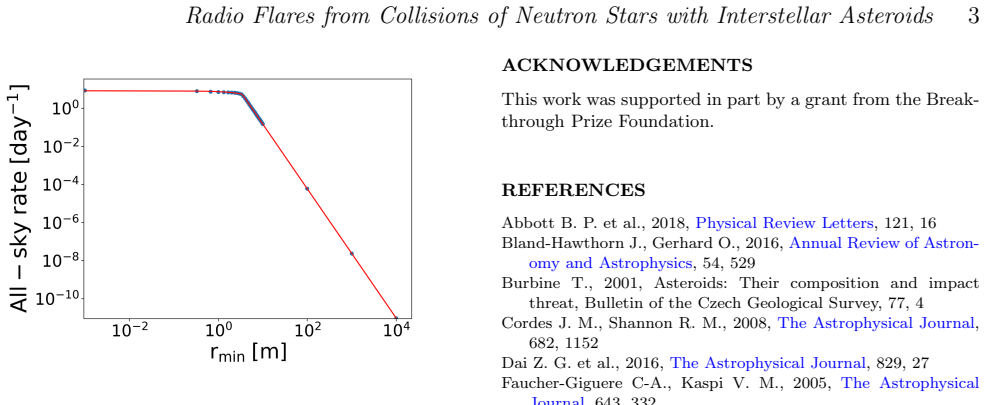
The rate estimate is carried by a chain of three ingredients: the coherent-curvature-radiation luminosity of a neutron star–asteroid impact (millisecond duration, ~1 GHz emission), the gravitational-focusing cross section for such impacts, and an interstellar-asteroid abundance factor $\zeta_{\mathrm{ISA}}$ defined as the ratio of interstellar asteroids to stars. That factor is calibrated from two known interstellar objects and assumed to be dominated by iron-rich bodies; the per-neutron-star event rate is $\dot N_{\mathrm{flare,NS}} = \zeta_{\mathrm{ISA}} n_\star \sigma_a v_{\mathrm{rel}}$, with $v_{\mathrm{rel}}$ drawn from a Monte Carlo sampling of stellar and neutron-star velocity distributions. The minimum asteroid radius that survives to be tidally disrupted, $r_{\min}\sim1$ m, sets the low-size cutoff and shapes the final fitting function.
What would settle it
A year-long all-sky radio survey at 1 GHz with sensitivity near 1 Jy that finds no non-repeating millisecond flares with dispersion measures consistent with Milky Way distances would contradict the claimed $\sim 10$ per day rate; alternatively, a direct measurement of the meter-scale interstellar asteroid density would rescale the prediction and test the same assumption.
Extended reading notes
Core claim
The central claim is that neutron star–interstellar asteroid collisions happen often enough in the Milky Way to produce a detectable all-sky rate of $\sim 10\,\mathrm{day}^{-1}$ at $\sim 1\,\mathrm{GHz}$ with a flux threshold of $\sim 1\,\mathrm{Jy}$. The calculation uses the existing model of an asteroid being tidally disrupted in the strong magnetic field of a neutron star, with the stripped electrons emitting coherent curvature radiation for about a millisecond. The event rate combines the impact cross section with the relative velocity of the two populations and an interstellar asteroid number density calibrated from the known interstellar objects 'Oumuamua and CNEOS 2014-01-08. The resulting rate is summarized by a piecewise fitting function of the minimum asteroid radius, and the paper notes that the same events would not produce detectable X-rays and would be far too rare to explain cosmological fast radio bursts.
Load-bearing premise
The predicted rate is directly proportional to the assumed number density of meter-sized iron interstellar asteroids in the Galaxy, a quantity extrapolated from just two known interstellar visitors; if that density is off by a factor of ten, the daily rate changes by the same factor.
Editorial extensions
If this is right
- The rate of observable flares is roughly $10\,\mathrm{day}^{-1}$ at 1 Jy and 1 GHz, so the prediction is within reach of existing radio transient searches.
- Each flare should be a one-off, millisecond-duration event, so non-repeating single radio pulses are the expected observational signature.
- No X-ray counterpart is expected for meter-sized asteroids, distinguishing these flares from other neutron star transients.
- The estimated rate is too low to explain cosmological fast radio bursts, so the events would constitute a separate, Galactic population.
- Detections would simultaneously calibrate the interstellar asteroid number density and the neutron star population in the Milky Way.
Reading between the lines
- A null result from archival single-pulse searches could be inverted to place an upper limit on the meter-scale interstellar asteroid abundance, because the predicted flare rate is linearly proportional to that abundance.
- A direct measurement of the meter-scale interstellar asteroid density from future surveys would rescale the predicted daily rate by the same factor, making the headline number a testable population constraint rather than a fixed prediction.
- The mechanism may offer a clean observational division: non-repeating bursts from isolated impacts versus repeating bursts from neutron stars passing through dense asteroid belts, which the paper notes as a prior explanation for repeaters.
- Simultaneous X-ray and radio observations of any candidate flare could test the predicted absence of X-ray emission, because that absence is a specific consequence of the chosen impact model.
Signed reviews
Editorial analysis
A structured set of objections, weighed in public.
Referee Report
Summary. This paper proposes that collisions between neutron stars (NSs) and interstellar asteroids (ISAs) such as 'Oumuamua produce millisecond-duration, ~1 GHz radio flares via the coherent curvature radiation mechanism of Dai et al. (2016). The authors derive a rate of such flares detectable at ~1 Jy by combining a Monte Carlo calculation of NS-ISA relative velocities, a model of the Milky Way's stellar and NS distribution, and an ISA abundance calibration from the authors' prior work based on two interstellar objects. They report an all-sky rate of ~10 day^-1 and suggest these events could constitute a subclass of non-repeating Rotating Radio Transients.
Significance. If the rate estimate holds, the paper identifies a new, potentially observable class of Galactic radio transients and a novel probe of both NS and ISA populations. The calculation is transparent, builds on published emission and cross-section results, and makes a falsifiable prediction (millisecond, non-repeating, ~1 Jy radio flares at ~10/day) that can be tested with current and upcoming radio surveys. The main weakness is that the dominant input—the meter-scale ISA number density—is extrapolated from two objects and carries an unquantified, likely order-of-magnitude uncertainty; the headline rate should therefore be read as an order-of-magnitude estimate rather than a precise prediction.
major comments (3)
- [Section 3, Eq. (3), and Eq. (8)] The predicted all-sky rate is directly proportional to ζISA, the ISA-to-star abundance ratio, which is calibrated from only two objects ('Oumuamua and CNEOS 2014-01-08). The calibration in Eq. (3) extrapolates a power law with slope -3.4 from these objects down to r=1 m and multiplies by an assumed 5% iron fraction, with no error bars. Since Eq. (8) is linear in ζISA, the abstract's '~10 day^-1' inherits at least an order-of-magnitude uncertainty; for example, reducing the iron fraction from 5% to 1% alone lowers the rate to ~1.5 day^-1, and a factor-of-10 error in the meter-scale abundance changes the rate to ~1 day^-1. The authors should either propagate these uncertainties, present a sensitivity analysis over a plausible range of ζISA and iron fraction, or explicitly reframe the result as an upper limit under a stated set of assumptions.
- [Section 4, Eq. (9), and Abstract] The abstract's '~10 day^-1' is not reproduced by Eq. (9) at the stated minimum radius rmin=1 m; the fitting function gives 7.4 day^-1 at f=1 Jy. Please clarify whether the headline is a rounded value, specify the values of rmin and f used, and show the underlying Monte Carlo points in Fig. 3. The abrupt break in the fitting function at rmin=3.4 m also needs physical justification.
- [Section 3, Eq. (7)] The ISA abundance ζISA is calibrated locally from Earth impact rates, but the total rate is computed over the entire Galactic disk, with both nISA and nNS assumed proportional to n⋆. The resulting rate scales as the integral of n⋆^2 over the disk, which is dominated by the inner Galaxy where the stellar density is far from the solar-neighborhood calibration. The validity of assuming a constant ζISA throughout the disk—particularly in the inner Galaxy—should be discussed, as this assumption strongly affects the total rate.
minor comments (5)
- [Eq. (1)] The magnetic dipole moment μNS is written with units of G cm^-2; the standard cgs unit for a magnetic dipole moment is G cm^3. The text and equation should be corrected.
- [Eq. (2)] The Gaussian exponents are written as exp(v_NS^2/σ^2), which is positive and missing the factor 1/2. The correct form should be exp(-v_NS^2/(2σ^2)).
- [References] The in-text citations 'Siraj & Loeb 2019a' and 'Siraj & Loeb 2019b' do not have matching labels in the reference list, which lists one 'submitted' paper and one arXiv paper without distinguishing letters. Also, the text cites 'Burbine 2002' but the reference list entry is 'Burbine 2001'.
- [Fig. 3] Figure 3 shows only the fitting function (red line) and not the Monte Carlo data points; please include the actual simulated rates so the reader can judge the quality of the fit.
- [Section 4] The phrase 'piece-wise fitting function' is used; the standard spelling is 'piecewise'.
Circularity Check
Predicted radio-flare rate inherits its ISA-abundance normalization from the authors' own two-object calibration; the headline number is a linear rescaling of that fitted input, though the emission and geometric content are external.
-
self citation load bearing
[Section 3, Eqs. (3) and (8); abstract headline rate]
"The cumulative Earth impact rate for an ISA of radius r is estimated to be 2×10⁻⁴ (r/1 m)−3.4 (Siraj & Loeb 2019b). ... the number density of ISAs of radius ≥ r to be related to the number density of stars by a factor of, ζISA∼ 2.5×10^18 (1 pc−3/n⋆,⊙)(r/1 m)^−3.4. (3) ... We then find the rate at which each NS produces flares ... ˙Nflare,NS = ζISA n⋆ σa vrel. (8)"
The all-sky rate reported as ~10 day−1 in the abstract is obtained by multiplying ζISA, taken from the authors' own prior calibration (Siraj & Loeb 2019b), by external geometric and kinematic factors. Equation (8) is linear in ζISA, so the headline rate is a direct rescaling of that fitted normalization; it is not an independent test of the model. ζISA itself rests on an extrapolation from only two interstellar objects, 'Oumuamua and CNEOS 2014-01-08, down to meter scales, with an assumed 5% iron fraction, and no uncertainty is propagated. Consequently, the central predicted rate is load-bearing on the authors' own unpublished calibration rather than on a first-principles derivation, although the emission mechanism and cross section are external to this chain.
full rationale
The paper's derivation chain is mostly transparent and uses external inputs: the radio luminosity and millisecond duration come from Dai et al. (2016), the impact cross section from Safronov/Dai, the NS velocity distribution from Faucher-Giguere & Kaspi, and the Milky Way disk model is standard. Equation (8) is a forward convolution of these inputs with the ISA abundance ζISA. The only load-bearing self-citation is Eq. (3), where the ISA number-density normalization is adopted from Siraj & Loeb (2019b), an empirical fit to two interstellar objects. Because Eq. (8) is proportional to ζISA, the abstract's rate of ~10 day−1 is not independent of that fit; changing ζISA by an order of magnitude changes the headline rate by the same factor. However, the paper does not use the predicted radio rate to infer ζISA, and the emission and geometry content is external and falsifiable. Thus the circularity is partial: a central input is self-cited and the headline prediction is linearly contingent on it, but the central claim still has independent physical content. No other circular steps were found; the uncertainty in ζISA is a correctness concern rather than an additional circularity.
Assumptions & free parameters
free parameters (7)
- Interstellar asteroid number density normalization zeta_ISA =
2.5e18 (1 pc^-3 / n_stars,solar) at r = 1 m
- Iron fraction among asteroids =
5%
- NS number density fraction zeta_NS =
1.7e-3
- NS magnetic dipole moment mu_NS =
10^30 G cm^-2
- Asteroid tensile strength s =
10^10 dyn cm^-2
- Asteroid mass density rho =
8 g cm^-3
- Minimum asteroid radius r_min =
about 1 m
assumptions (6)
- domain assumption Emission mechanism of Dai et al. (2016): tidally disrupted asteroid material produces coherent curvature radiation with luminosity Eq. (1).
- domain assumption ISA population traces the stellar distribution of the Milky Way disk.
- domain assumption NS population traces the stellar distribution with zeta_NS = 1.7e-3.
- domain assumption Five percent of asteroids are iron-rich.
- domain assumption r_min is approximately 1 m for tidal disruption before melting.
- domain assumption Gravitational focusing cross section from Safronov (1972) via Dai et al. (2016).
Cite this review
Pith. "Pith review of Radio Flares from Collisions of Neutron Stars with Interstellar Asteroids." pith.science (2026). https://pith.science/paper/B4JESY3K
@misc{pith2026190811440,
  author       = {Pith},
  title        = {Pith review of: Radio Flares from Collisions of Neutron Stars with Interstellar Asteroids},
  year         = {2026},
  howpublished = {\url{https://pith.science/paper/B4JESY3K}},
  note         = {Machine review of arXiv:1908.11440}
}
abstract
We propose that collisions between neutron stars and interstellar asteroids, such as `Oumuamua, could power observable radio flares in the Milky Way galaxy. We find the rate of such events at $\sim 1 \mathrm{\; Jy}$ to be $\sim 10 \mathrm{\; day^{-1}}$.
Figures

Reference graph
Works this paper leans on
-
[1]
Abbott B. P. et al., 2018, @doi [Physical Review Letters] 10.1103/PhysRevLett.121.161101 , 121, 16
-
[2]
Bland-Hawthorn J., Gerhard O., 2016, @doi [Annual Review of Astronomy and Astrophysics] 10.1146/annurev-astro-081915-023441 , 54, 529
-
[3]
Burbine T., 2001, Asteroids: Their composition and impact threat, Bulletin of the Czech Geological Survey, 77, 4
work page 2001
-
[4]
Cordes J. M., Shannon R. M., 2008, @doi [The Astrophysical Journal] 10.1086/589425 , 682, 1152
doi:10.1086/589425 2008
-
[5]
Dai Z. G. et al., 2016, @doi [The Astrophysical Journal] 10.3847/0004-637X/829/1/27 , 829, 27
-
[6]
M., 2005, @doi [The Astrophysical Journal] 10.1086/501516 , 643, 332
Faucher-Giguere C-A., Kaspi V. M., 2005, @doi [The Astrophysical Journal] 10.1086/501516 , 643, 332
doi:10.1086/501516 2005
-
[7]
Geng J. J., Huang Y. F., 2015, @doi [The Astrophysical Journal] 10.1088/0004-637X/809/1/24 , 809, 24
-
[8]
Greif S. K. et al., 2019, @doi [Monthly Notices of the Royal Astronomical Society] 10.1093/mnras/stz654 , 485, 5363
Show all 17 references
-
[9]
I, 2019, @doi [Monthly Notices of the Royal Astronomical Society] 10.1093/mnras/stz1250 , 487, 491
Katz J. I, 2019, @doi [Monthly Notices of the Royal Astronomical Society] 10.1093/mnras/stz1250 , 487, 491
2019 doi
-
[10]
McLaughlin M. A. et al., 2006, @doi [Nature] 10.1038/nature04440 , 439, 817
2006 doi
-
[11]
J., et al., 2017, @doi [Nature] 10.1038/nature25020 , 552, 378
Meech K. J., et al., 2017, @doi [Nature] 10.1038/nature25020 , 552, 378
2017 doi
-
[12]
Micheli M., et al., 2018, @doi [Nature] 10.1038/s41586-018-0254-4 , 559, 223
2018 doi
-
[13]
et al., 2019, @doi [Physics Reports] 10.1016/j.physrep.2019.06.003
Platts E. et al., 2019, @doi [Physics Reports] 10.1016/j.physrep.2019.06.003
2019 doi
-
[14]
S., 1972, Evolution of the Protoplanetary Cloud and Formation of the Earth and Planets (Jerusalem: Keter Publishing House)
Safronov V. S., 1972, Evolution of the Protoplanetary Cloud and Formation of the Earth and Planets (Jerusalem: Keter Publishing House)
1972
-
[15]
et al., 2010, @doi [Astronomy & Astrophysics] 10.1051/0004-6361/200912222
Sartore N. et al., 2010, @doi [Astronomy & Astrophysics] 10.1051/0004-6361/200912222
2010 doi
-
[16]
& Loeb A., 2019, submitted to The Astrophysical Journal Letters
Siraj A. & Loeb A., 2019, submitted to The Astrophysical Journal Letters
2019
-
[17]
Siraj A., Loeb A., 2019, ( @eprint arXiv 1906.03270 )
2019 arXiv
Reviewed August 14, 2026 · model on record in the stance chip above.
Discussion (0). Continue with ORCID to comment.