REVIEW 2 major objections 5 minor 2 cited by
The paper claims that for stochastic differential equation reach-avoid tasks, neural certificates and controllers can be trained so that all defining inequalities are globally guaranteed once a bound-based loss reaches zero, or satisfied ex
Reviewed by Pith at T0; open to challenge. T0 means a machine referee read the full paper against a public rubric. the ladder, T0–T4 →
T0 review · deepseek-v4-flash
2026-08-02 20:16 UTC pith:B4MVK7JM
load-bearing objection Useful new methods for SDE certificates, but the hard guarantee hinges on an unproved soundness claim about the generator bounds. the 2 major comments →
Training with Hard Constraints: Learning Neural Certificates and Controllers for SDEs
The pith
A machine-rendered reading of the paper's core claim, the machinery that carries it, and where it could break.
Core claim
The central claim is that certificate inequalities for SDEs can be encoded directly into training. In the first method, the state space is partitioned and interval bounds are computed for the certificate and for its infinitesimal generator; the loss sums worst-case violations over cells. If that loss is zero, the neural certificate satisfies all four defining inequalities and the reach-avoid probability is at least the chosen threshold. In the second method, only the last layer of the certificate is optimized in a linear scenario program; with sample size proportional to (log(1/delta)+d_v)/epsilon, the result holds with confidence 1-delta everywhere except a set of measure at most epsilon un
What carries the argument
The central object is a reach-avoid certificate: a twice-differentiable function V that is nonnegative, at most 1 on the initial set, at least beta on the unsafe set, and whose infinitesimal generator is negative outside the goal and unsafe sets; satisfying these gives reach-avoid probability at least 1-1/beta. The bound-training method uses interval bound propagation through the network and through a second computation graph that exactly reproduces the generator, then aggregates worst-case cell bounds into a loss where ReLU(y)=0 exactly when y<=0. The scenario method exploits linearity of the certificate and generator in the last-layer weights, reducing the sampled constraints to a linear p
Load-bearing premise
The load-bearing premise is that the interval-arithmetic bound the implementation computes for the infinitesimal generator term is a true upper bound on every partition cell; the paper relies on this soundness rather than proving it for the second-order network computation graph.
What would settle it
Take a trained network and one partition cell, compute the implemented bound on the generator over that cell, then evaluate the generator directly at many randomly sampled points inside the cell; if any direct value exceeds the bound, the zero-loss certificate is unsound.
If this is right
- If the bound-based loss reaches zero, the learned certificate is valid on the entire domain X and the reach-avoid probability is certified at the chosen level, with no separate verification step needed.
- For a fixed controller, the paper's benchmarks certify geometric Brownian motion systems up to 5D with the bound-based method and up to 10D with high confidence using the scenario method.
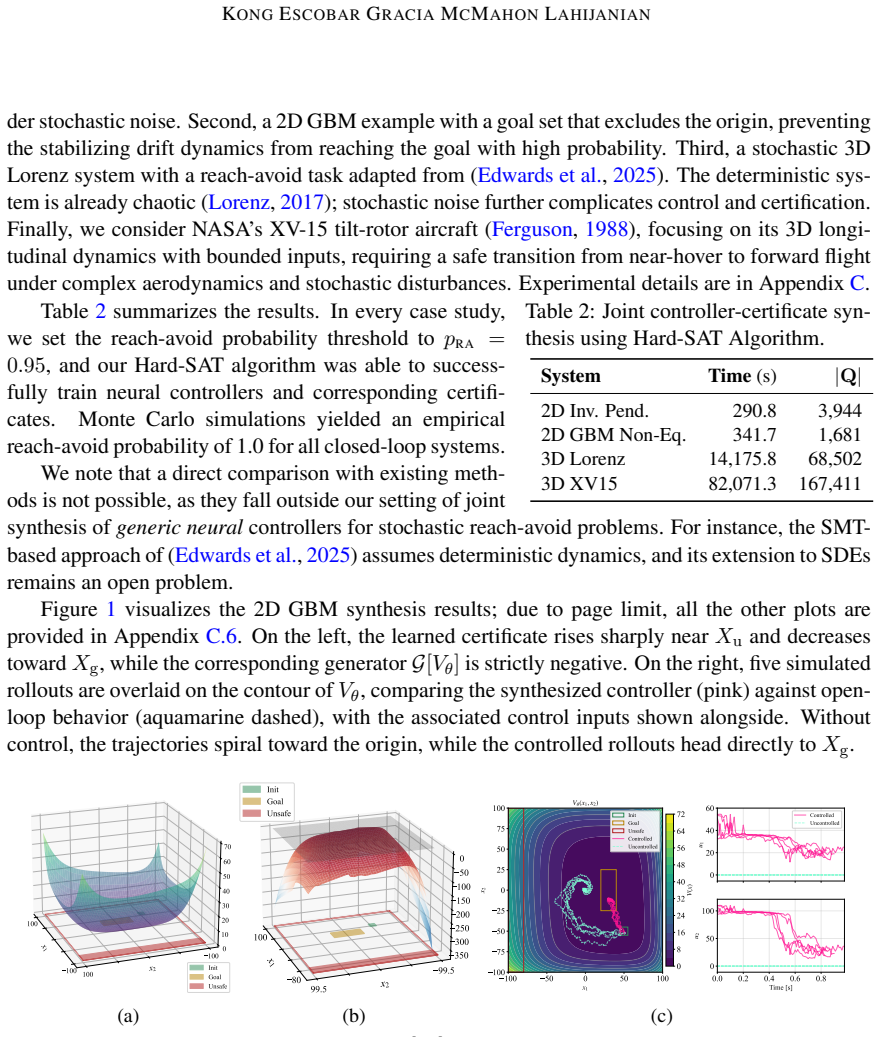
- Joint controller-certificate synthesis can be driven by a single certificate-based objective; the paper reports empirical reach-avoid probability 1.0 in Monte Carlo rollouts for all four synthesized systems.
- Increasing the scenario sample size shrinks the unguaranteed set: in the paper's experiments, going from 10^5 to 10^6 samples reduces epsilon by an order of magnitude.
- Under strict certificate satisfaction and sufficiently fine partitions, the bound-based loss provably becomes zero, giving a completeness-in-the-limit property.
Where Pith is reading between the lines
- A user should treat the soundness of the interval bound on the generator as part of the trusted computing base; if that bound is not a true upper bound on each cell, a zero loss could certify a network that violates the generator inequality somewhere.
- The PAC guarantee is distribution-dependent: if the sampling distribution is not aligned with the states that actually matter for the reach-avoid task, the small measure set could contain trajectories of concern.
- A natural extension is to use the scenario LP as a warm-start layer and then refine only the remaining uncertain cells with the bound-based method, combining scalability with hard verification.
- The same bound-loss template could apply to other differential certificate inequalities, such as barrier certificates or Lyapunov functions, whenever interval bounds on the network and its derivatives are available.
Editorial analysis
A structured set of objections, weighed in public.
Referee Report
Summary. The paper proposes two frameworks for training neural certificates and controllers for reach-avoid specifications of stochastic differential equations (SDEs). The first, Hard-SAT, partitions the state space and uses interval bound propagation to construct a bound-based loss L^Q_bound; if this loss is zero, the certificate inequalities (Theorem 1) are claimed to hold globally, and the same loss is extended to joint controller–certificate synthesis. The second framework is partition-free and uses scenario optimization: after warm-starting a certificate network, only the last-layer weights and the threshold β are optimized, yielding a linear program with PAC guarantees on the measure of the violating set. The paper proves Theorems 2–4 and demonstrates scalability up to 5D for Hard-SAT and 10D for the scenario method, outperforming prior work for SDE certificates.
Significance. The paper addresses an important and timely problem: how to encode hard constraints in neural certificate training for stochastic systems. If the interval bounds used in Hard-SAT are sound, the bound-training loss provides a constructive route to certificates with hard guarantees, and the joint synthesis formulation is a step beyond existing verifier–learner methods. The scenario-based approach is also attractive because it reduces the final certificate search to a convex linear program, making PAC guarantees applicable with moderate sample sizes. The empirical results, especially on systems where prior SMT/partition-based approaches fail, indicate practical value. However, the central guarantee is conditional on an unverified implementation assumption about the soundness of interval bounds for the second-order generator, and the reported scenario-PAC numbers appear inconsistent with the paper's own sample-complexity bound. These issues must be resolved before the claims are fully supported.
major comments (2)
- [§3.1, Eq. (7d), Appendix A] The implication L^Q_bound = 0 ⇒ certificate validity (Theorem 2) is only as strong as the upper bound \overline{G[V_θ]}(q_i) in Eq. (7d). The paper defines Φ_θ as the generator computation graph and states that interval bound propagation via auto-LiRPA yields sound bounds, but no soundness proof is provided for the second-order expression in Appendix A. The graph contains products and sums of interval quantities (e.g., S_{j,k,i}=W2[j,k]·d^{(1)}_k·W1[k,i] and the squared sums in ∂²V/∂x_i²), where standard IBP can be unsound if dependency is not handled correctly. If \overline{G[V_θ]}(q_i) under-approximates the true maximum on q_i, the ReLU term in (7d) can vanish while Eq. (4d) is violated, invalidating Theorem 2. The same gap affects joint synthesis Eq. (9), since f(x,π_{θ_π}(x)) must also be bounded on each cell when the controller is a neural network. Please provide a formal soundness
- [Theorem 4, Table 1] Table 1 reports ε values that are not achievable under the paper's own sample-complexity bound N ≥ 2(log(1/δ)+d_v)/ε. With δ=10^{-9} and the smallest d_v used (16 for 2D Inv. Pend., N=10^5), the bound implies ε ≥ 2(20.72+16)/10^5 ≈ 7.3×10^{-4}, yet the table reports ε=5.6×10^{-4}. For the 2D and 10D GBM rows with d_v=64 and N=10^6, the bound gives ε ≥ 2(20.72+64)/10^6 ≈ 1.7×10^{-4}, but the table reports ε=1.3×10^{-4}. Moreover, the scenario program also optimizes β, so the decision-variable dimension is d_v+1, which further increases the required N. The PAC guarantees claimed in Table 1 are therefore not supported by Theorem 4 as stated. Please either increase N to satisfy the bound, recompute ε from the actual N, or provide a clear justification that a different sample-complexity argument applies.
minor comments (5)
- [Problem 2] Typo: 'reach-void' should be 'reach-avoid'.
- [Eq. (8)] There is a mismatched parenthesis in 'L^Q_bound(Vθ, Φθ, β)' — the displayed formula appears to be missing a closing parenthesis.
- [Theorem 4 / Appendix B.2] The sample-complexity bound in Theorem 4 uses d_v as the dimension of θ_L, but β is also a decision variable. The Campi et al. bound should use the total number of decision variables, i.e., d_v+1. This is a minor issue if N is chosen with the conservative formula, but it should be stated correctly.
- [Appendix C.5] The sentence 'In Eq. 6, all loss weights are set to 1' is slightly ambiguous: the weights w≥0, w0, wu, wgen are defined in Eq. (6) as strictly positive, and the text seems to say that all are set to 1. Please clarify that experiments use equal weights.
- [Lemma/Theorem statements] The phrase 'sound and consistent under refinement' in Theorem 3 is not formally defined. Please state the precise convergence or consistency property required of the bounds.
Circularity Check
No circularity: Theorem 2 is a transparent encoding of constraint violations, Theorem 4 imports the PAC guarantee from external scenario-optimization theory, and no load-bearing self-citation is present.
full rationale
The paper's central certificate guarantees are not circular. Theorem 2 (Definition 2 and Eq. (7a)–(7d), with proof 'ReLU(y) = 0 iff y ≤ 0') is a transparent encoding: the bound-based loss is defined as a sum of ReLU terms measuring bound violations, so zero loss means that each bound satisfies the corresponding certificate inequality, and Theorem 1 then yields the reach-avoid probability bound. This is definitional in the intended, non-hidden sense; it does not rename a fitted quantity as a prediction. Theorem 4's PAC guarantee is imported directly from the external scenario-optimization theory of Campi et al. (2009); the paper explicitly restricts optimization to the last-layer parameters so that the scenario program remains convex/linear and Campi's sample-complexity bound applies. No load-bearing self-citation appears: the reach-avoid certificate theorem is attributed to Neustroev et al. (2025), interval bounds are attributed to auto-LiRPA and interval arithmetic, and the authors' own GitHub/code references are not used to justify any theoretical claim. The skeptical concern about the unproven soundness of the interval bounds on the generator graph Phi_theta in Eq. (7d) is a legitimate correctness/implementation risk, but it is not circularity: it concerns whether an external bound tool is actually sound, not whether the derivation assumes its own conclusion. Therefore no circular step is identified.
Axiom & Free-Parameter Ledger
free parameters (4)
- epsilon_gen =
positive; exact value not reported in text
- refinement and merging hyperparameters =
tuned empirically; values not reported
- input/output scaling ratio s_out/max(s_in) =
selected in range 0.2-1.0
- scenario sampling weights =
0.1 for X0, Xg, Xu; 0.7 for rest
axioms (5)
- domain assumption Assumption 1: drift f, diffusion g, and every controller pi in Pi are globally L-Lipschitz
- domain assumption Reach-avoid certificate theorem (Neustroev et al. 2025, Theorem 1)
- domain assumption Interval-arithmetic bounds computed via auto-LiRPA are sound and differentiable for the NN and for the generator computation graph
- standard math Scenario-optimization theory of Campi et al. (2009)
- domain assumption There exists a twice-differentiable NN (sigmoid architecture) that strictly satisfies the certificate inequalities
Cite this review
Pith. "Pith review of Training with Hard Constraints: Learning Neural Certificates and Controllers for SDEs." pith.science (2026). https://pith.science/paper/B4MVK7JM
@misc{pith2026260223526,
  author       = {Pith},
  title        = {Pith review of: Training with Hard Constraints: Learning Neural Certificates and Controllers for SDEs},
  year         = {2026},
  howpublished = {\url{https://pith.science/paper/B4MVK7JM}},
  note         = {Machine review of arXiv:2602.23526}
}
read the original abstract
Due to their expressive power, neural networks (NNs) are promising templates for functional optimization problems, particularly for reach-avoid certificate generation for systems governed by stochastic differential equations (SDEs). However, ensuring hard-constraint satisfaction remains a major challenge. In this work, we propose two constraint-driven training frameworks with guarantees for supermartingale-based neural certificate construction and controller synthesis for SDEs. The first approach enforces certificate inequalities via domain discretization and a bound-based loss, guaranteeing global validity once the loss reaches zero. We show that this method also enables joint NN controller-certificate synthesis with hard guarantees. For high-dimensional systems where discretization becomes prohibitive, we introduce a partition-free, scenario-based training method that provides arbitrarily tight PAC guarantees for certificate constraint satisfaction. Benchmarks demonstrate scalability of the bound-based method up to 5D, outperforming the state of the art, and scalability of the scenario-based approach to at least 10D with high-confidence guarantees.
Figures


Forward citations
Cited by 2 Pith papers
-
Stochastic Barrier Certificates in the Presence of Dynamic Obstacles
Time-varying stochastic barrier certificates capture temporal obstacle dynamics via Bellman optimality to deliver tighter probabilistic safety bounds than prior methods, formulated as convex sum-of-squares programs.
-
Certified Stochastic Control via Covariance Steering with Pick-to-Learn
CS-P2L couples covariance steering with Pick-to-Learn to synthesize and certify controllers against high-fidelity simulators, certifying a 4.9% violation bound on a spacecraft powered-descent problem.
Reference graph
Works this paper leans on
-
[3]
Applying the input scaling chain rule gives: ∂V ∂xi = 1 sin,i ∂V ∂xnorm,i = sout sin,i m2X j=1 W3[j]·d (2) j m1X k=1 W2[j, k]·d(1) k ·W 1[k, i] To compute∂ 2V /∂x2 i , letq (1) =σ ′′(z(1))andq (2) =σ ′′(z(2))denote element-wise second derivatives, whereσ ′′(z) = (1−2σ(z))σ ′(z). Define the intermediate quantityS j,k,i ≜W 2[j, k]· d(1) k ·W 1[k, i], allowi...
2004
-
[4]
James Kotary and Ferdinando Fioretto. Learning constrained optimization with deep augmented lagrangian methods.arXiv preprint arXiv:2403.03454,
-
[9]
15 KONGESCOBARGRACIAMCMAHONLAHIJANIAN C.2
Layer Connection Type # Neurons Activation Function Input Layer→Hidden Layer 1 Fully Connected 8 Tanh Hidden Layer 1→Output Layer Fully Connected 1 Tanh Table 3: Neural controller of the 2D stochastic inverted pendulum. 15 KONGESCOBARGRACIAMCMAHONLAHIJANIAN C.2. Geometric Brownian Motion (GBM) The SDE of ann-dimensional GBM is: dx= (Ax+π(x))dt+g(x)dw, whe...
2025
-
[10]
The reach–avoid specification (adapted from Edwards et al
The SDE is dx= −10x1 + 10x2 x1(28−x 3)−x 2 x1x2 − 8 3 x3 dt+ 0.1 0.1 0.1 dw. The reach–avoid specification (adapted from Edwards et al. (2025)) is: X= [−6,6] 3, X0 = [−1,1] 3, Xg = [−0.3,0.3] 3, Xs = [−5.5,5.5]
2025
-
[11]
The left shows angle snapshots, the middle shows the certificate contour with both trajectories overlaid, and the right shows the corresponding torque inputs for five rollouts
Figure 3 presents the stochastic inverted pendulum synthesis results, comparing synthesized-controlled and uncon- trolled rollouts in each panel. The left shows angle snapshots, the middle shows the certificate contour with both trajectories overlaid, and the right shows the corresponding torque inputs for five rollouts. Without control, the pendulum does...
2000
-
[2017]
Pablo M´arquez-Neila, Mathieu Salzmann, and Pascal Fua. Imposing hard constraints on deep net- works: Promises and limitations.arXiv preprint arXiv:1706.02025,
-
[2021]
Ali Salamati, Abolfazl Lavaei, Sadegh Soudjani, and Majid Zamani. Data-driven verification and synthesis of stochastic systems through barrier certificates.arXiv preprint arXiv:2111.10330,
-
[2023]
Jason J Choi, Christopher A Strong, Koushil Sreenath, Namhoon Cho, and Claire J Tomlin. Data-driven hamiltonian for direct construction of safe set from trajectory data.arXiv preprint arXiv:2504.03233,
-
[2024]
11 KONGESCOBARGRACIAMCMAHONLAHIJANIAN Sven Gowal, Krishnamurthy Dvijotham, Robert Stanforth, Rudy Bunel, Chongli Qin, Jonathan Uesato, Relja Arandjelovic, Timothy Mann, and Pushmeet Kohli. On the effectiveness of interval bound propagation for training verifiably robust models.arXiv preprint arXiv:1810.12715,
-
[2025]
Mihaela C ˘at˘alina Stoian, Salijona Dyrmishi, Maxime Cordy, Thomas Lukasiewicz, and Eleonora Giunchiglia. How realistic is your synthetic data? constraining deep generative models for tabular data.arXiv preprint arXiv:2402.04823,
-
[2026]
Accessed: 2026-02-16
URLhttps://github.com/sees9730/ Certified-Reach-Avoid-via-Neural-Synthesis. Accessed: 2026-02-16. Peyman Mohajerin Esfahani, Debasish Chatterjee, and John Lygeros. The stochastic reach-avoid problem and set characterization for diffusions.Automatica, 70:43–56,
2026
discussion (0)
Sign in with ORCID, Apple, or X to comment. Anyone can read and Pith papers without signing in.