REVIEW 55 references
Quantum Hall effect induced by electron-phonon interaction
T0 review · reviewed 2026-08-14 · deepseek-v4-flash
Pith's one-line read Strong electron-phonon coupling can spontaneously turn a 2D Dirac semimetal into a Chern insulator with quantized Hall response.
The pith
A machine-rendered reading of the paper's core claim, the machinery that carries it, and where it could break.
The reading
Starting from a low-energy field theory with two Dirac cones, the authors integrate out the phonons, which produces a four-fermion interaction, and then use a saddle-point (mean-field) analysis to find the symmetry-broken ground states. They verify that both states are locally stable against small quantum fluctuations, while a mixed state is not. Next they compute the effective field theory for the fluctuations and identify Chern-Simons terms, the hallmark of topological insulators. The coefficients of these terms are set by the sign of the order parameter. Applying a Kubo formula, they obtain quantized Hall conductivities: the Haldane-like phase has a quantized electrical Hall effect, while the strain-modulated phase has a quantized mixed electromechanical response, not a pure electrical one.
The calculation relies on a strong simplification: the phonon kinetic energy is dropped, turning phonons into instantaneous local fields. This is justified only for optical phonons with a large energy gap.
Extended reading notes
Core claim
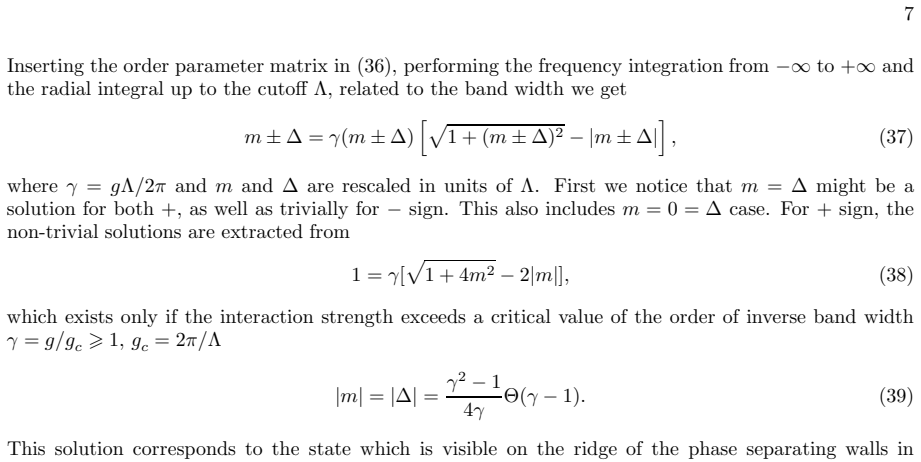
For interaction strength above a critical value γ>1, the coupled electron-phonon system spontaneously develops a spectral gap with broken time-reversal and sublattice symmetry. The two stable ground states (m-phase and Δ-phase) have effective actions containing Chern-Simons terms with coefficients sgn(m)/64π and sgn(Δ)/64π, leading via the Kubo formula to quantized generalized Hall conductivities σ̄^{cd}_{μν} = 64π T_{cd} ε_{μν}: diagonal sgn(m) for the m-phase and off-diagonal sgn(Δ) for the Δ-phase (Eq. 63). If correct, electron-phonon interaction alone can drive a 2D Dirac semimetal into a topological insulating phase with quantized Hall response.
Load-bearing premise
The whole effective action assumes that the phonon fields can be treated as dispersionless and static: the kinetic terms (∂τAμ)^2 and (∇Aμ)^2 are dropped from the phonon action (Eq. 14), an approximation the authors call 'crucial' (Sec. II.A). This turns the phonons into instantaneous local fields, so the resulting four-fermion interaction is local and the uniform saddle-point ansatz is natural. If real optical phonon dispersion or retardation is retained, the interaction becomes momentum- and frequency-dependent, and both the mean-field gap structure and the stability of the m- and Δ-phases could change.
Signed reviews
Editorial analysis
A structured set of objections, weighed in public.
Assumptions & free parameters
assumptions (5)
- domain assumption Low-energy description of honeycomb lattice as two massless Dirac cones with the effective Hamiltonian H_W = p1Σ01 + p2Σ32.
- ad hoc to paper Optical phonon modes are dispersionless and static: the kinetic terms (∂τ Aμ)^2 + (∇ Aμ)^2 are dropped from Eq. (14).
- domain assumption The electron-phonon coupling is minimal, with the phonon field coupled to the internode current operators Π = {Σ13, Σ20} as dictated by C6v symmetry.
- domain assumption Saddle-point (mean-field) approximation with spatially uniform order parameters, and stability assessed only at Gaussian order.
- standard math Divergent momentum integrals are regularized by a spherical cutoff Λ.
Cite this review
Pith. "Pith review of Quantum Hall effect induced by electron-phonon interaction." pith.science (2026). https://pith.science/paper/B57WYIHH
@misc{pith2026190800442,
  author       = {Pith},
  title        = {Pith review of: Quantum Hall effect induced by electron-phonon interaction},
  year         = {2026},
  howpublished = {\url{https://pith.science/paper/B57WYIHH}},
  note         = {Machine review of arXiv:1908.00442}
}
read the original abstract
When phonons couple to fermions in 2D semimetals, the interaction may turn the system into an insulator. There are several insulating phases in which the time reversal and the sublattice symmetries are spontaneously broken. Examples are many-body states commensurate to Haldane's staggered flux model or to lattice models with periodically modulated strain. We find that the effective field theories of these phases exhibit characteristic Chern-Simons terms, whose coefficients are related to the topological invariants of the microscopic model. This implies that the corresponding quantized Hall conductivities characterize these insulating states.
Figures


Reference graph
Works this paper leans on
-
[1]
E. Fradkin, Field theories of condensed matter physics , Cambridge University Press, Cambridge, UK (2013). 11
work page 2013
-
[2]
X. G. Wen, Vacuum degeneracy of chiral spin states in compactified spac e, Phys. Rev. B 40, 7387(R) (1989)
work page 1989
-
[3]
D. J. Thouless. M. Kohmoto, M. P. Nightingale, and M. den N ijs, Quantized Hall Conductance in a Two- Dimensional Periodic Potential , Phys. Rev. Lett. 49, 405 (1982)
work page 1982
-
[4]
G. E. Volovik, Quantized Hall effect in superfluid Helium-3 film , Phys. Lett. A 128, 277 (1988)
work page 1988
-
[5]
G. E. Volovik, An analog of the quantum Hall effect in a superfluid He 3 film, Zh. Eksp. Teor. Fiz. 94, 123 (1988) [Sov. Phys. JETP 67, 1804 (1988)]
work page 1988
-
[6]
D. Vollhardt and P. W¨ olfle, The Superfluid Phases of Helium 3 , Taylor & Francis, London, (1990)
work page 1990
-
[7]
Y. Aharonov and D. Bohm, Significance of electromagnetic potentials in quantum theo ry, Phys. Rev. 115, 485 (1959)
work page 1959
-
[8]
M. V. Berry, Quantal Phase Factors Accompanying Adiabatic Changes , Proc. R. Soc. A 392, 45 (1984)
work page 1984
Show all 55 references
-
[9]
B. I. Halperin, Quantized Hall conductance, current-carrying edge states , and the existence of extended states in a two-dimensional disordered potential , Phys. Rev. B 25, 2185 (1982)
1982
-
[10]
V. M. Yakovenko, Chern-Simons terms and n field in Haldane’s model for the quan tum Hall effect without Landau levels , Phys. Rev. Lett. 65, 251 (1990)
1990
-
[11]
F. D. M. Haldane, Model for a quantum Hall effect without Landau levels: Condens ed-matter realization of the ”parity anomaly” , Phys. Rev. Lett. 61, 2015 (1988)
1988
-
[12]
Zee, Quantum hall fluids , edited by H
A. Zee, Quantum hall fluids , edited by H. B. Geyer Field Theory, Topology and Condensed Matter Physics. Lecture Notes in Physics (Springer, Berlin, Heidelberg, 1995), Vol. 456, 99–153
1995
-
[13]
Fr¨ ohlich and A
J. Fr¨ ohlich and A. Zee, Large scale physics of the quantum Hall fluid , Nucl. Phys. B, 364, 517 (1991)
1991
-
[14]
Hettmansperger, F
H. Hettmansperger, F. Duerr, J. B. Oostinga, C. Gould, B . Trauzettel, and L. W. Molenkamp, Quantum Hall effect in narrow graphene ribbons , Phys. Rev. B 86, 195417 (2012)
2012
-
[15]
E. M. Hankiewicz, J. Li, T. Jungwirth, Q. Niu, S.-Q. Shen , and J. Sinova, Charge Hall effect driven by spin-dependent chemical potential gradients and Onsager r elations in mesoscopic systems , Phys. Rev. B 72, 155305 (2005)
2005
-
[16]
Jacquod, R
P. Jacquod, R. S. Whitney, J. Meair, and M. B¨ uttiker, Onsager relations in coupled electric, thermoelectric, and spin transport: The tenfold way , Phys. Rev. B 86, 155118 (2012)
2012
-
[17]
Nagaosa, J
N. Nagaosa, J. Sinova, S. Onoda, A. H. MacDonald, and N. P . Ong, Anomalous Hall effect , Rev. Mod. Phys. 82, 1539 (2010)
2010
-
[18]
A. N. Redlich, Parity violation and gauge noninvariance of the effective gau ge field action in three dimensions , Phys. Rev. D 29, 2366 (1984)
1984
-
[19]
Jackiw, Fractional charge and zero modes for planar systems in a magn etic field , Phys
R. Jackiw, Fractional charge and zero modes for planar systems in a magn etic field , Phys. Rev. D 29, 2375 (1984)
1984
-
[20]
Fradkin and F
E. Fradkin and F. Schaposnik, The fermion-boson mapping in three-dimensional quantum fie ld theory, Phys. Lett. B 338, 253 (1994)
1994
-
[21]
Dunne, Aspects of Chern-Simons theory , in Topological aspects of low dimensional systems , edited by A
G. Dunne, Aspects of Chern-Simons theory , in Topological aspects of low dimensional systems , edited by A. Comtet, T. Jolicoeur, S. Ouvry, and F. David, Les Houches Sum mer School, (Springer, Berlin, Heidelberg, 1999), Vol. 69, 177–263
1999
-
[22]
X.-L. Qi, T. L. Hughes, and S. C. Zhang, Topological field theory of time-reversal invariant insula tors, Phys. Rev. B 78, 195424 (2008)
2008
-
[23]
Lu and A
Y.-M. Lu and A. Vishwanath, Theory and classification of interacting integer topologic al phases in two di- mensions: A Chern-Simons approach , Phys. Rev. B 86, 125119 (2012)
2012
-
[24]
Zohar, J
E. Zohar, J. I. Cirac, and B. Reznik, Quantum simulations of lattice gauge theories using ultrac old atoms in optical lattices, Rep. Prog. Phys. 79, 014401 (2016)
2016
-
[25]
Heidari, A
Sh. Heidari, A. Cortijo, and R. Asgari, Hall viscosity for optical phonons , Phys. Rev. B 100, 165427 (2019)
2019
-
[26]
D. M. Basko and I. L. Aleiner, Interplay of Coulomb and electron-phonon interactions in g raphene, Phys. Rev. 77, 041409(R) (2008)
2008
-
[27]
Amorim, A
B. Amorim, A. Cortijo, F. de Juan, A. G. Grushin, F. Guine a, A. Gutirrez-Rubio, H. Ochoa, V. Parente, R. Rold´ an, P. San-Jos´ e, J. Schiefele, M. Sturla, and M. A. H. V ozmediano, Novel effects of strains in graphene and other two dimensional materials , Phys. Rep. 617, 1 (2016)
2016
-
[28]
Sinner and K
A. Sinner and K. Ziegler, Emergent Chern-Simons excitations due to electron-phonon interaction, Phys. Rev. B 93, 125112 (2016)
2016
-
[29]
Sinner and K
A. Sinner and K. Ziegler, Spontaneous mass generation due to phonons in a two-dimensi onal Dirac fermion system, Ann. Phys. 400, 262 (2019)
2019
-
[30]
P. K. Wallace, The band theory of graphite , Phys. Rev. 71, 622 (1947)
1947
-
[31]
G. W. Semenoff, Condensed-matter simulation of a three-dimensional anoma ly, Phys. Rev. Lett. 53, 2449 (1984)
1984
-
[32]
Lindner, G
N.H. Lindner, G. Rafael, and V. Galitski, Floquet topological insulator in semiconductor quantum we lls, Nature Phys. 7, 490 (2011)
2011
-
[33]
Cayssol, B
J. Cayssol, B. D´ ora, F. Simon and R. Moessner, Floquet topological insulators , Phys. Status Solidi RRL 7, 101-108 (2013)
2013
-
[34]
M. Knap, M. Babadi, G. Refael, I. Martin, and E. Demler, Dynamical Cooper pairing in nonequilibrium electron-phonon systems, Phys. Rev. B 94, 214504 (2016). 12
2016
-
[35]
Babadi, M
M. Babadi, M. Knap, G. Refael, I. Martin, and E. Demler, Theory of parametrically amplified electron-phonon superconductivity, Phys. Rev. B 96, 014512 (2017)
2017
-
[36]
Buzzi, G
M. Buzzi, G. Jotzu, A. Cavalleri, J. I. Cirac, E. A. Demle r, B. I. Halperin, M. D. Lukin, T. Shi, Y. Wang, and D. Podolsky, Higgs-mediated optical amplification in a non-equilibrium superconductor, arXiv:1908.10879
1908 arXiv
-
[37]
W. P. Su, J. R. Schrieffer, and A. J. Heeger, Solitons in polyacetylene , Phys. Rev. Lett. 42, 1698 (1979)
1979
-
[38]
Zoli, Path integral computation of phonon anharmonicity , Eur
M. Zoli, Path integral computation of phonon anharmonicity , Eur. Phys. J. B 40, 79 (2004)
2004
-
[39]
Zoli, Path integral of the two-dimensional Su-Schrieffer-Heeger m odel, Phys
M. Zoli, Path integral of the two-dimensional Su-Schrieffer-Heeger m odel, Phys. Rev. B 71, 205111 (2005)
2005
-
[40]
A. C. Ferrari, Raman spectroscopy of graphene and graphite: Disorder, ele ctron-phonon coupling, doping and nonadiabatic effects , Sol. St. Comm. 143, 47 (2007)
2007
-
[41]
G. D. Sanders, A. R. T. Nugraha, K. Sato, J.-H. Kim, J. Kon o, R. Saito and C. J. Stanton, Theory of coherent phonons in carbon nanotubes and graphene nanoribbons , J. Phys.: Condens. Matter 25, 144201 (2013)
2013
-
[42]
Jorio, Raman Spectroscopy in Graphene-Based Systems: Prototypes for Nanoscience and Nanometrology , ISRN Nanotechnology, Vol
A. Jorio, Raman Spectroscopy in Graphene-Based Systems: Prototypes for Nanoscience and Nanometrology , ISRN Nanotechnology, Vol. 2012, pp. 1-12 (2012)
2012
-
[43]
Ludwig, M.P.A
A.W.W. Ludwig, M.P.A. Fisher, R. Shankar, and G. Grinst ein, Integer quantum Hall transition: An alter- native approach and exact results , Phys. Rev. B 50, 7526 (1994)
1994
-
[44]
Hatsugai and M
Y. Hatsugai and M. Kohmoto, Energy spectrum and the quantum Hall effect on the square latti ce with next- nearest-neighbor hopping, Phys. Rev. B 42, 8282 (1990)
1990
-
[45]
A. Hill, A. Sinner and K. Ziegler, Valley symmetry breaking and gap tuning in graphene by spin d oping, N. J. Ph. 13, 035023 (2011)
2011
-
[46]
C.-Y. Hou, C. Chamon, and C. Mudry, Electron fractionalization in two-dimensional graphene l ike structures, Phys. Rev. Lett. 98, 186809 (2007)
2007
-
[47]
Allen, Electron Transport, in S.G
P.B. Allen, Electron Transport, in S.G. Louie, M.L. Cohen (Editors), Conceptual Foundations of Materials , Chapter 6, Elsevier B.V. (2006). Appendix A: Exclusion of ∆ 2 parameter Using the ansatz M1 = ∆ 1 2 Σ 01 −i ∆ 2 2 Σ 31 + m 2 Σ 20, M 2 = ∆ 1 2 Σ 32 −i ∆ 2 2 Σ 02 − m 2 Σ ...
2006
-
[48]
+ (q2 0 +q2 + ∆ 2 1 + ∆ 2 2)2, (A7) ∆ 1 = 2∆ 1g ∫ d3Q (2π)3 q2 0 +q2 −m2 + ∆ 2 1 + ∆ 2 2 m4 + 2m2(q2 0 +q2 − ∆ 2 1 − ∆ 2
-
[49]
+ (q2 0 +q2 + ∆ 2 1 + ∆ 2 2)2, (A8) ∆ 2 = −2∆ 2g ∫ d3Q (2π)3 q2 0 +q2 −m2 + ∆ 2 1 + ∆ 2 2 m4 + 2m2(q2 0 +q2 − ∆ 2 1 − ∆ 2
-
[50]
+ (q2 0 +q2 + ∆ 2 1 + ∆ 2 2)2. (A9) If there are any mutually independent non-trivial solutions for ∆ 1 and ∆ 2 then they follow from 1 = 2 g ∫ d3Q (2π)3 q2 0 +q2 −m2 + ∆ 2 1 + ∆ 2 2 m4 + 2m2(q2 0 +q2 − ∆ 2 1 − ∆ 2
-
[51]
+ (q2 0 +q2 + ∆ 2 1 + ∆ 2 2)2, (A10) 1 = −2g ∫ d3Q (2π)3 q2 0 +q2 −m2 + ∆ 2 1 + ∆ 2 2 m4 + 2m2(q2 0 +q2 − ∆ 2 1 − ∆ 2
-
[52]
+ (q2 0 +q2 + ∆ 2 1 + ∆ 2 2)2, (A11) 13 i. e. only one of them can be true and they cannot be fulfilled togethe r. The two possibilities are ∆ 1 = 0, ∆ 2 ⁄= 0; (A12) ∆ 2 = 0, ∆ 1 ⁄= 0. (A13) The scenario of Eq. (A13) is discussed in the main text. Here we cons ider the scenario...
-
[53]
m-phase: Π −1(Q = 0) = M1 ( e1, 1 +e4, 4 +e10, 10 +e11, 11 +e17, 17 +e20, 20 +e26, 26 +e27, 27 ) + M2 ( e2, 2 +e9, 9 +e24, 24 +e31, 31 ) + M3 ( e3, 3 +e8, 8 +e12, 12 +e15, 15 +e18, 18 +e21, 21 +e25, 25 +e30, 30 ) + M4 ( e5, 5 +e14, 14 +e19, 19 +e28, 28 ) + M5 ( e6, 6 +e7, 7 +e...
-
[54]
∆–phase: Π −1(Q = 0) = M1 ( e1, 1 +e10, 10 +e17, 17 +e26, 26 ) +M2 ( e2, 2 +e9, 9 +e24, 24 +e31, 31 ) + M3 ( e3, 3 +e12, 12 +e21, 21 +e30, 30 ) +M4 ( e4, 4 +e11, 11 +e20, 20 +e27, 27 ) + M5 ( e5, 5 +e14, 14 +e19, 19 +e28, 28 ) +M6 ( e6, 6 +e13, 13 +e22, 22 +e29, 29 ) + M7 ( e7...
-
[55]
Each quantity in the Proca matrix means A1 = 1 − √ 1 + 4m2 4 √ 1 + 4m2 , A2 = 1 2 [ 1 + 4m − 2 √ 1 + 4m2 + 1√ 1 + 4m2 ] , A3 = − 1 6m2 [ 1 − √ 1 + 4m2 + 2m2 ( √ 1 + 4m2 − 2m )]
Coexisting phase m = ∆: Π −1(Q = 0) = M1 ( e1, 1 +e10, 10 +e17, 17 +e26, 26 ) +M2 ( e2, 2 +e9, 9 +e24, 24 +e31, 31 ) + M3 ( e3, 3 +e12, 12 +e21, 21 +e30, 30 ) +M4 ( e4, 4 +e11, 11 +e20, 20 +e27, 27 ) + M5 ( e5, 5 +e14, 14 +e19, 19 +e28, 28 ) +M6 ( e6, 6 +e13, 13 +e22, 22 +e29,...
Reviewed August 14, 2026 · model on record in the stance chip above.
Discussion (0). Continue with ORCID to comment.