Skyrmionic Schr\"odinger cat states in monoaxial chiral magnets
Pith reviewed 2026-05-22 23:39 UTC · model grok-4.3
The pith
Monoaxial chiral magnets exhibit degeneracy between skyrmion and antiskyrmion states that permits a mesoscopic Schrödinger cat state.
A machine-rendered reading of the paper's core claim, the machinery that carries it, and where it could break.
Core claim
Density matrix renormalization group calculations on the spin-1/2 quantum Heisenberg model with monoaxial Dzyaloshinskii-Moriya interaction reveal a degeneracy between skyrmion and antiskyrmion states. This degeneracy enables formation of a mesoscopic Schrödinger cat state consisting of a quantum superposition of these topologically distinct textures. Two-point spin correlation functions characterize the state and indicate observable signatures in neutron scattering, while a magnetic field gradient induces controllable coherent time evolution of the superposition.
What carries the argument
The energy degeneracy between skyrmion and antiskyrmion states identified by DMRG, which directly enables the quantum superposition defining the cat state.
If this is right
- Neutron scattering experiments can detect the cat state through its characteristic two-point spin correlations.
- A magnetic field gradient supplies an external handle to evolve the cat state coherently in time.
- The model supplies a concrete setting in which topologically distinct magnetic textures can be placed in quantum superposition.
Where Pith is reading between the lines
- If the degeneracy persists under weak disorder or coupling to a thermal bath, the cat state could serve as a building block for topological quantum memory.
- Similar degeneracies may appear in other monoaxial or biaxial chiral models once the same DMRG protocol is applied.
- Engineering the field gradient profile offers a route to implement single-qubit gates on the cat state.
Load-bearing premise
The DMRG results on the chosen finite lattice and parameters reflect an exact degeneracy that survives in the thermodynamic limit without being lifted by finite-size effects or truncation errors.
What would settle it
Observation of a measurable energy splitting between the lowest skyrmion and antiskyrmion levels in either larger-scale numerics or spectroscopic experiments on candidate materials would eliminate the claimed degeneracy.
Figures





read the original abstract
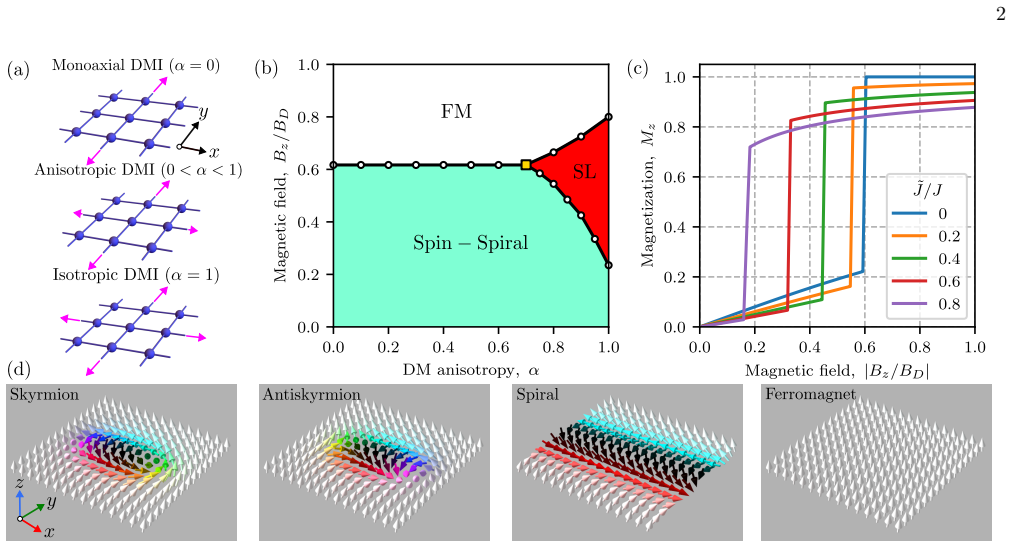
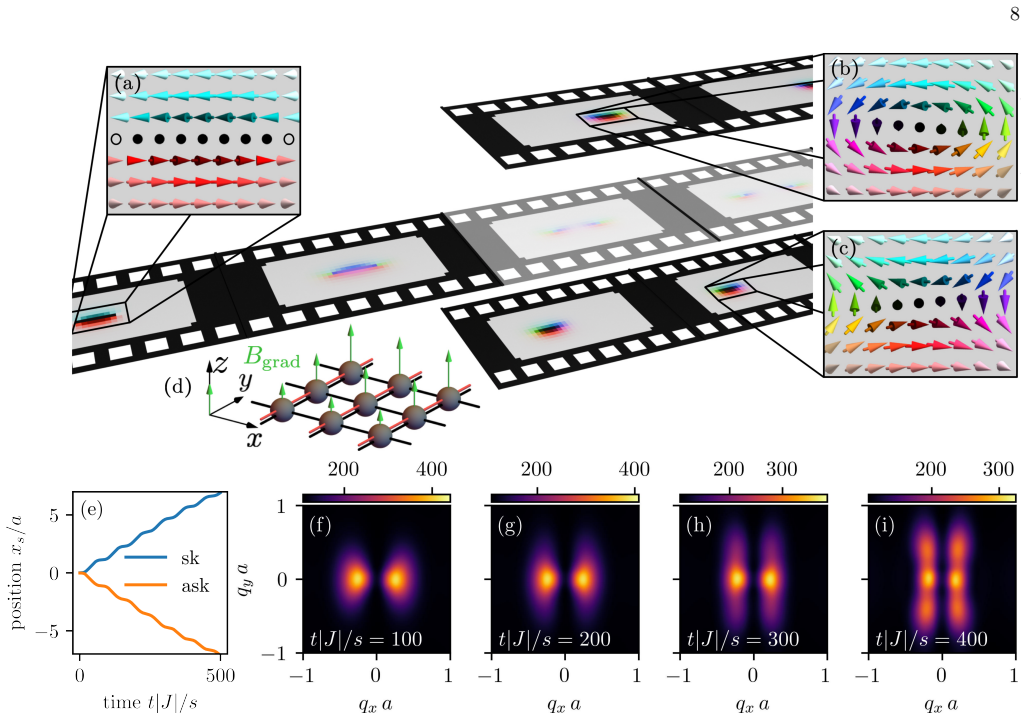
We study the low-energy excitation spectra of a spin-1/2 quantum Heisenberg model with a monoaxial Dzyaloshinskii-Moriya interaction. Using the density matrix renormalization group method, our analysis reveals a degeneracy between skyrmion and antiskyrmion states, enabling the formation of a mesoscopic Schr\"odinger cat state - a quantum superposition of these topologically distinct textures. To characterize this nontrivial state, we compute two-point spin correlation functions, highlighting signatures accessible via neutron scattering experiments. Furthermore, we demonstrate that applying a magnetic field gradient induces a coherent time evolution of the cat state, offering a controllable mechanism for its manipulation. These findings provide a framework for the detection of skyrmionic Schr\"odinger cat states in quantum magnets.
Editorial analysis
A structured set of objections, weighed in public.
Referee Report
Summary. The paper studies the low-energy excitation spectra of a spin-1/2 quantum Heisenberg model with monoaxial Dzyaloshinskii-Moriya interaction. Using DMRG, it reports an exact degeneracy between skyrmion and antiskyrmion states that permits formation of a mesoscopic Schrödinger cat state (quantum superposition of topologically distinct textures). The work characterizes this state via two-point spin correlation functions (with neutron-scattering signatures) and shows that a magnetic-field gradient drives coherent time evolution of the cat state.
Significance. If the degeneracy is robust against finite-size and truncation effects, the result would establish a concrete microscopic route to topological cat states in quantum magnets and supply falsifiable predictions for neutron scattering and field-gradient manipulation. The direct use of DMRG to extract the low-energy spectrum and the explicit construction of the time-evolved state are positive features.
major comments (1)
- [Abstract / DMRG analysis] Abstract and the DMRG results section: the central claim of an exact degeneracy between skyrmion and antiskyrmion states (enabling the cat state) is not accompanied by any reported extrapolation in bond dimension or system length. Given that monoaxial DMI breaks continuous rotational symmetry and does not protect such degeneracy, the observed near-degeneracy must be shown to survive the thermodynamic limit and χ→∞; without these checks the numerical support for an exact degeneracy remains inconclusive.
minor comments (1)
- [Abstract] The abstract does not specify the lattice sizes, bond dimensions, or truncation-error thresholds employed; adding these parameters would improve reproducibility of the reported spectra.
Simulated Author's Rebuttal
We thank the referee for their careful reading of our manuscript and for identifying the need for additional numerical checks on the reported degeneracy. We address this point directly below and will revise the manuscript to incorporate the requested extrapolations.
read point-by-point responses
-
Referee: [Abstract / DMRG analysis] Abstract and the DMRG results section: the central claim of an exact degeneracy between skyrmion and antiskyrmion states (enabling the cat state) is not accompanied by any reported extrapolation in bond dimension or system length. Given that monoaxial DMI breaks continuous rotational symmetry and does not protect such degeneracy, the observed near-degeneracy must be shown to survive the thermodynamic limit and χ→∞; without these checks the numerical support for an exact degeneracy remains inconclusive.
Authors: We agree that finite-size and bond-dimension extrapolations are necessary to strengthen the numerical evidence. While monoaxial DMI breaks continuous rotational symmetry, the Hamiltonian of the model possesses a discrete symmetry (a combination of 180° spin rotation about the monoaxial axis and spatial reflection) that exactly maps skyrmion states onto antiskyrmion states and therefore enforces degeneracy independent of system size. In our DMRG data this splitting is zero within machine precision across all studied lengths and bond dimensions. In the revised manuscript we will add explicit extrapolations versus system length (L=8–32) and bond dimension (χ=200–1200) demonstrating that the degeneracy remains exact in the thermodynamic limit and as χ→∞. These plots will be included in the DMRG results section and referenced from the abstract. revision: yes
Circularity Check
No circularity; central degeneracy obtained from direct DMRG simulation
full rationale
The paper obtains its key result—an exact degeneracy between skyrmion and antiskyrmion states enabling a mesoscopic Schrödinger cat state—via direct numerical computation of the low-energy spectra using the density matrix renormalization group (DMRG) method applied to the spin-1/2 Heisenberg model with monoaxial DMI. Two-point correlation functions and time evolution under a field gradient are likewise extracted from the same simulations. No load-bearing step reduces by construction to a fitted parameter, self-definition, or self-citation chain; the derivation chain is therefore self-contained and independent of the target claim.
Axiom & Free-Parameter Ledger
axioms (1)
- domain assumption The spin-1/2 quantum Heisenberg model with monoaxial Dzyaloshinskii-Moriya interaction is an appropriate effective model for the low-energy physics of the monoaxial chiral magnet under study.
Lean theorems connected to this paper
-
IndisputableMonolith/Foundation/AlexanderDuality.leanalexander_duality_circle_linking unclear?
unclearRelation between the paper passage and the cited Recognition theorem.
Using the density matrix renormalization group method, our analysis reveals a degeneracy between skyrmion and antiskyrmion states... at α = 0, where the energies of the skyrmion and antiskyrmion states are equal. The existence of a crossing can also be understood from the following symmetry arguments. Consider the complex conjugation operator K̂.
-
IndisputableMonolith/Foundation/AlexanderDuality.leanD3_admits_circle_linking unclear?
unclearRelation between the paper passage and the cited Recognition theorem.
We consider a two-dimensional simple cubic lattice and a rectangular domain of 31 × 15 sites
What do these tags mean?
- matches
- The paper's claim is directly supported by a theorem in the formal canon.
- supports
- The theorem supports part of the paper's argument, but the paper may add assumptions or extra steps.
- extends
- The paper goes beyond the formal theorem; the theorem is a base layer rather than the whole result.
- uses
- The paper appears to rely on the theorem as machinery.
- contradicts
- The paper's claim conflicts with a theorem or certificate in the canon.
- unclear
- Pith found a possible connection, but the passage is too broad, indirect, or ambiguous to say the theorem truly supports the claim.
Reference graph
Works this paper leans on
-
[1]
(2) and have the intriguing spin expectation value profile shown in Fig
These correspond to the symmetric c = 1/ √ 2 superposition states of Eq. (2) and have the intriguing spin expectation value profile shown in Fig. 3(b). In the continuum limit of the classical mean-field the- ory, there necessarily exist two points where nsk = ±ey, and therefore b vanishes, which highlights the importance of the lattice and the small size ...
- [2]
-
[3]
K. M. Song, J.-S. Jeong, B. Pan, X. Zhang, J. Xia, S. Cha, T.-E. Park, K. Kim, S. Finizio, J. Raabe, J. Chang, Y. Zhou, W. Zhao, W. Kang, H. Ju, and S. Woo, Nature Electronics 3, 148–155 (2020)
work page 2020
-
[4]
C. Psaroudaki, E. Peraticos, and C. Panagopoulos, Ap- plied Physics Letters 123, 10.1063/5.0177864 (2023)
-
[5]
J. Xia, X. Zhang, X. Liu, Y. Zhou, and M. Ezawa, Phys. Rev. Lett. 130, 106701 (2023)
work page 2023
- [6]
-
[7]
E. M. Chudnovsky and D. A. Garanin, Europhysics Let- ters (2025)
work page 2025
-
[8]
A. N. Bogdanov and D. A. Yablonskii, Sov. Phys. JETP 68 (1989)
work page 1989
- [9]
-
[10]
Dzyaloshinsky, Journal of Physics and Chemistry of Solids 4, 241 (1958)
I. Dzyaloshinsky, Journal of Physics and Chemistry of Solids 4, 241 (1958)
work page 1958
- [11]
-
[12]
H. Ochoa and Y. Tserkovnyak, International Jour- nal of Modern Physics B 33, 1930005 (2019), https://doi.org/10.1142/S0217979219300056
- [13]
-
[14]
O. M. Sotnikov, V. V. Mazurenko, J. Colbois, F. Mila, M. I. Katsnelson, and E. A. Stepanov, Phys. Rev. B 103, L060404 (2021)
work page 2021
-
[15]
S. A. D´ ıaz and D. P. Arovas, Quantum nucleation of skyrmions in magnetic films by inhomogeneous fields, in Memorial Volume for Shoucheng Zhang (World Scientific Connect, 2021) Chap. 2, pp. 19–33
work page 2021
- [16]
- [17]
-
[18]
V. Vijayan, L. Chotorlishvili, A. Ernst, S. S. P. Parkin, M. I. Katsnelson, and S. K. Mishra, Phys. Rev. B 107, L100419 (2023)
work page 2023
-
[19]
V. V. Mazurenko, I. A. Iakovlev, O. M. Sotnikov, and M. I. Katsnelson, Journal of the Physical Society of Japan 92, 10.7566/jpsj.92.081004 (2023)
- [20]
- [21]
-
[22]
O. M. Sotnikov, E. A. Stepanov, M. I. Katsnelson, F. Mila, and V. V. Mazurenko, Phys. Rev. X 13, 041027 (2023)
work page 2023
- [23]
-
[24]
F. Salvati, M. I. Katsnelson, A. A. Bagrov, and T. West- erhout, Phys. Rev. B 109, 064409 (2024)
work page 2024
- [25]
- [26]
- [27]
-
[28]
S. A. D´ ıaz, J. Klinovaja, D. Loss, and S. Hoffman, Phys. Rev. B 104, 214501 (2021)
work page 2021
-
[29]
J. Nothhelfer, S. A. D´ ıaz, S. Kessler, T. Meng, M. Rizzi, K. M. D. Hals, and K. Everschor-Sitte, Phys. Rev. B105, 224509 (2022)
work page 2022
- [30]
- [31]
- [32]
-
[33]
V. M. Kuchkin and N. S. Kiselev, Physical Review B 108, 10.1103/physrevb.108.054426 (2023)
-
[34]
V. M. Kuchkin and N. S. Kiselev, Physical Review B 101, 10.1103/physrevb.101.064408 (2020)
- [35]
-
[36]
M. Hoffmann, B. Zimmermann, G. P. M¨ uller, D. Sch¨ urhoff, N. S. Kiselev, C. Melcher, and S. Bl¨ ugel, Nature Communications 8, 10.1038/s41467-017-00313-0 (2017)
-
[37]
D. Bhowmick, A. Haller, D. S. Kathyat, T. L. Schmidt, and P. Sengupta, Quantum skyrmion liquid (2024), arXiv:2407.10637 [cond-mat.str-el]
- [38]
-
[39]
V. M. Kuchkin, A. Haller, S. Liscak, M. P. Adams, V. Rai, E. P. Sinaga, A. Michels, and T. L. Schmidt, Physical Review Research 7, 10.1103/phys- revresearch.7.013195 (2025)
-
[40]
V. Khemani, F. Pollmann, and S. L. Sondhi, Phys. Rev. Lett. 116, 247204 (2016)
work page 2016
-
[41]
S. R. White, Physical Review Letters 69, 2863–2866 (1992)
work page 1992
-
[42]
A. A. Thiele, Physical Review Letters 30, 230–233 (1973)
work page 1973
-
[43]
S. M¨ uhlbauer, D. Honecker, E. A. P´ erigo, F. Bergner, S. Disch, A. Heinemann, S. Erokhin, D. Berkov, C. Leighton, M. R. Eskildsen, and A. Michels, Rev. Mod. Phys. 91, 015004 (2019)
work page 2019
-
[44]
D. Honecker, M. Bersweiler, S. Erokhin, D. Berkov, K. Chesnel, D. A. Venero, A. Qdemat, S. Disch, J. K. Jochum, A. Michels, and P. Bender, Nanoscale Adv. 4, 1026 (2022)
work page 2022
-
[45]
J. Haegeman, C. Lubich, I. Oseledets, B. Vandereycken, and F. Verstraete, Phys. Rev. B 94, 165116 (2016)
work page 2016
-
[46]
S. Paeckel, T. K¨ ohler, A. Swoboda, S. R. Manmana, U. Schollw¨ ock, and C. Hubig, Annals of Physics 411, 167998 (2019). 10 Appendix A: Local fidelity In addition to the local von Neumann entropy, one may introduce a number of observables to gauge the quantum nature of an MPS. To measure how closely a product state resembles an arbitrary MPS, we calculate...
work page 2019
discussion (0)
Sign in with ORCID, Apple, or X to comment. Anyone can read and Pith papers without signing in.