REVIEW 2 major objections 5 minor 61 references
Magnetic field Controlled Anderson Delocalization in a Spinful Non-Hermitian Chain
T0 review · 2 major / 5 minor · reviewed 2026-07-15 · grok-4.5
Pith's one-line read An external magnetic field can delocalize Anderson-localized states in a spinful non-Hermitian chain and restore skin accumulation when disorder is anti-correlated across spins.
desk verdict Solid, transparent result: Zeeman field suppresses effective disorder and re-enters NHSE, but only for engineered anti-symmetric spin disorder. read the letter →
The pith
A machine-rendered reading of the paper's core claim, the machinery that carries it, and where it could break.
The reading
What carries the argument
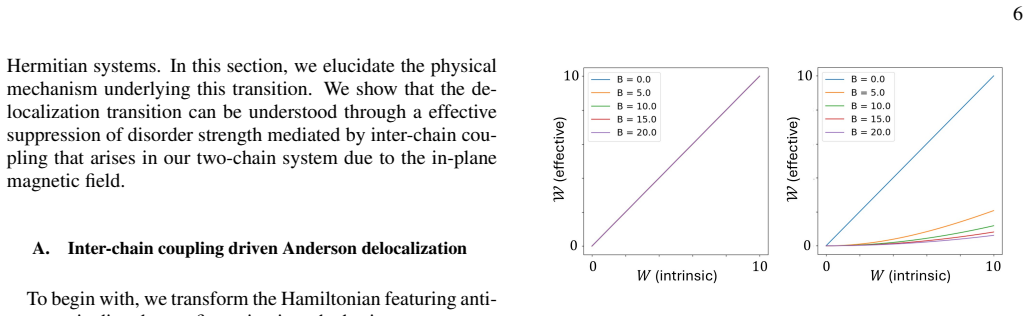
Zeeman-mediated inter-chain coupling under anti-symmetric disorder: after a site-dependent unitary rotation that diagonalizes the onsite terms, the effective potentials become ±√(Δ_n^{2} + B^{2}), whose fluctuation width W_eff = √(B^{2} + W^{2}/4) − B is strictly smaller than the bare disorder W and shrinks further with increasing B.
What would settle it
Prepare a spinful Hatano-Nelson chain with deliberately anti-correlated onsite disorder, apply an in-plane field, and check whether the inverse-participation-ratio and mean-center-of-mass diagnostics cross from bulk Anderson localization into directional skin accumulation at the predicted W_eff(B) threshold; the same field applied to symmetrically correlated or uncorrelated disorder must leave the states Anderson-localized.
Extended reading notes
Core claim
Under anti-symmetrically correlated disorder, an external in-plane magnetic field drives Anderson delocalization and re-entrant non-Hermitian skin effect even at strong disorder, by suppressing the effective disorder strength through Zeeman-induced inter-chain coupling.
Load-bearing premise
The two spin sectors must be prepared with exactly opposite random potentials; without that engineered anti-correlation the magnetic field does not suppress disorder and the delocalization fails.
Editorial extensions
If this is right
- Magnetic field strength becomes a continuous experimental dial that can restore skin modes without changing bare disorder or hopping asymmetry.
- Stronger bare disorder simply shifts the critical field upward; stronger non-Hermiticity lowers it, giving a quantitative three-parameter phase diagram.
- Even reciprocal (real-gauge) spinful chains can acquire effective non-reciprocity and skin accumulation once the Zeeman field is turned on.
- The same mechanism is strictly non-Hermitian: in the Hermitian limit the identical disorder suppression leaves the system Anderson-localized because directional bias is absent.
Reading between the lines
- Cold-atom or photonic lattices that already engineer synthetic spin-dependent gauge fields could test the predicted W_eff(B) formula by ramping an external field while monitoring boundary accumulation.
- If disorder correlations can be dynamically reconfigured (for example by spin-dependent optical potentials), the same platform could switch between localized and skin regimes on demand.
- The Creutz-ladder mapping suggests that related ladder or multi-leg non-Hermitian models with inter-leg Zeeman-like terms may host analogous field-controlled localization transitions.
Editorial analysis
A structured set of objections, weighed in public.
Referee Report
Summary. The manuscript studies a disordered spinful Hatano–Nelson chain with synthetic Abelian gauge fields and an in-plane Zeeman field. It first recovers the known smooth AL–NHSE crossover in the spinless limit, then shows that, for anti-symmetrically correlated onsite disorder (Δ↑_n = −Δ↓_n), a finite magnetic field drives Anderson delocalization and re-entrant NHSE even at strong disorder. The mechanism is an exact site-dependent unitary map onto a Creutz ladder whose effective onsite potentials are ±√(Δ_n² + B²), yielding a reduced disorder width W_eff = √(B² + W²/4) − B that shrinks with B. Symmetric or uncorrelated disorder does not produce the effect. The triple interplay of W, non-Hermiticity, and B is mapped with ensemble-averaged IPR and mean center of mass.
Significance. If the stated conditions hold, the work supplies a clean, experimentally motivated control knob (in-plane B) for the AL–NHSE crossover in spinful non-Hermitian chains, extending the inter-chain-coupling idea of Jin et al. to two non-Hermitian sectors realized by Zeeman coupling. The effective-disorder formula is elementary, parameter-free once the anti-symmetric ensemble is fixed, and matches the IPR/mcom phase diagrams. The Hermitian-limit counter-check (Appendix A.3) correctly shows that disorder suppression alone is insufficient without non-reciprocity. These are solid, falsifiable theoretical results for a synthetic-platform audience.
major comments (2)
- [Secs. III B, IV, Appendix A.2] Secs. III B, IV and Appendix A.2: the delocalization and point-gap reappearance are demonstrated only for the specially prepared ensemble Δ↑_n = −Δ↓_n. For symmetric (Δ↑_n = Δ↓_n) or uncorrelated disorder the same B leaves states Anderson-localized (Fig. 3a–b). The abstract and title frame magnetic-field control as a general enrichment of the AL–NHSE interplay; the manuscript should state more prominently that the effect is conditional on this non-generic correlation, and should discuss how (or whether) such anti-correlations can be engineered in the platforms listed in the outlook (cold atoms, topolectrical circuits, photonics).
- [Appendix A.1, Eqs. (A.4)–(A.5); Sec. IV] Appendix A.1, Eqs. (A.4)–(A.5): after the unitary transformation the hopping matrices themselves become site-dependent through ϕ_n(B, Δ_n). The main-text mechanism (Sec. IV) attributes delocalization solely to the reduction of the onsite width W_eff. The paper should clarify whether hopping renormalization contributes appreciably to the AL→NHSE crossover (e.g., by comparing numerics with the onsite-only Creutz ladder versus the full transformed hoppings), or explicitly argue that W_eff suppression dominates in the regimes of Figs. 4–5.
minor comments (5)
- [Figs. 2 and 5] Fig. 2a and Fig. 5 use the same color scale language (red = skin, white = AL) but different non-Hermiticity parameters; a short note in the captions that the spinless and spinful boundaries are not quantitatively comparable would help the reader.
- [Sec. III C, Fig. 4] Notation: θ_L is called both a complex gauge flux and ‘non-Hermiticity’ (e.g. Fig. 4b,e). Stating once that Im(θ_L) is the non-reciprocity parameter would avoid ambiguity.
- [Appendix A; Sec. III C; Acknowledgments] Typographical: ‘hoping’ appears for ‘hopping’ in several places in Appendix A; ‘quanitfy’ in Sec. III C; ‘PARAM SHA V AK’ spacing in Acknowledgments.
- [Sec. III C] The winding-number remark in Sec. III C is useful; a brief numerical check that the point-gap winding tracks the mcom red regions in Fig. 5 would strengthen the topological interpretation without changing the diagnostics.
- [Introduction] Reference [49] is the closest prior work (inter-chain coupling induced delocalization). A one-sentence contrast in the introduction—Hermitian partner chain versus two NH chains coupled by Zeeman B—would sharpen the novelty claim.
Circularity Check
No load-bearing circularity: effective-disorder suppression W_eff = √(B² + W²/4) − B is an algebraic consequence of the unitary transformation under the stated anti-symmetric ensemble, not a fitted or self-defined prediction.
-
self citation load bearing
[Sec. III D and Ref. [52]]
"Increasing the magnetic field eventually aligns both sectors to the same direction, as also reported in our earlier work [52]."
Minor self-citation of the authors’ prior gauge-field paper for a secondary observation (spin-polarized bidirectional NHSE). It is not used to justify the central effective-disorder formula or the AL o NHSE crossover under anti-symmetric disorder, so it does not raise the score above 1.
full rationale
The paper’s central derivation (Secs. III B, IV and Appendix A) starts from the spinful Hatano–Nelson Hamiltonian with Zeeman term B σ_x and anti-symmetrically correlated onsite potentials Δ↑_n = −Δ↓_n. A site-dependent unitary rotation that diagonalizes the onsite block maps the potentials to ±√(Δ_n² + B²). Because Δ_n is drawn uniformly from [−W/2, W/2], the support of the transformed potentials is exactly [B, √(B² + W²/4)], yielding the reduced width W_eff = √(B² + W²/4) − B by elementary range arithmetic. This identity is parameter-free and independent of the subsequent IPR/mcom diagnostics; the numerics merely confirm that the reduced disorder allows the pre-existing non-reciprocity to dominate. Self-citations ([52] for the gauge construction and bidirectional skin effect, [58] for reciprocal-case NHSE) supply model ingredients or side remarks but are not invoked as uniqueness theorems or as premises that force the delocalization claim. No parameters are fitted to localization data and then re-used as predictions, and no known empirical pattern is merely renamed. The requirement of anti-symmetric disorder is an external modeling assumption (explicitly contrasted with the symmetric case that yields no suppression), not a circular step. Hence the derivation chain is self-contained against its own inputs.
Assumptions & free parameters
free parameters (2)
- disorder strength W and magnetic field B (in units of J)
- gauge fluxes θ_L (imaginary), θ_R (real)
assumptions (4)
- domain assumption 1D Hermitian systems are Anderson-localized for any infinitesimal disorder (Abrahams et al. scaling theory).
- domain assumption Point-gap topology under PBC implies NHSE under OBC (Okuma, Zhang et al.).
- ad hoc to paper Anti-symmetric disorder Δ↑_n = −Δ↓_n can be prepared across spin sectors.
- domain assumption Orbital magnetic effects are absent in strictly 1D geometry; only Zeeman term appears.
Cite this review
Pith. "Pith review of Magnetic field Controlled Anderson Delocalization in a Spinful Non-Hermitian Chain." pith.science (2026). https://pith.science/paper/B5SLM2JZ
@misc{pith2026260325700,
  author       = {Pith},
  title        = {Pith review of: Magnetic field Controlled Anderson Delocalization in a Spinful Non-Hermitian Chain},
  year         = {2026},
  howpublished = {\url{https://pith.science/paper/B5SLM2JZ}},
  note         = {Machine review of arXiv:2603.25700}
}
abstract
Anderson localization (AL) and the non-Hermitian skin effect (NHSE) represent two paradigmatic localization phenomena driven, respectively, by disorder and non-Hermiticity. In one-dimensional (1D) non-Hermitian systems, these factors are known to compete and provide a smooth crossover between AL and NHSE upon parameter tuning. Here, we show that this interplay is fundamentally enriched in spinful systems, where an external magnetic field acts as an additional degree to manipulate the localization behavior. By investigating a disordered 1D spinful non-Hermitian chain, we demonstrate that under appropriately correlated disorder configurations across spin sectors, the magnetic field enhances the AL $\rightarrow$ NHSE crossover. Interestingly, this facilitates the Anderson delocalization transition even in strongly disordered systems where states would otherwise be Anderson localized. By analyzing the inverse participation ratio and the mean center of mass, we map the resulting triple interplay between disorder, non-Hermiticity, and the magnetic field strength, identifying regimes of Anderson localization and skin accumulation. We further reveal that this magnetic field driven delocalization phenomenon originates from an effective suppression of disorder strength via Zeeman-induced inter-chain coupling across the spin sectors.
Figures


Figures from the paper (2 more)

Reference graph
Works this paper leans on
-
[1]
Basis transformation and the Transformed Hamiltonian The generic Hamiltonian in Eqn. 2, expressed explicitly un- der our choice of gaugeσ L, σR =σ z andB=B ˆireads H= N−1X n=1 (J eiθLσz c† ncn+1 +J e iθRσz c† n+1cn) + NX n=1 (∆(↑) n c† n,↑cn,↑ + ∆(↓) n c† n,↓cn,↓) + NX n=1 (Bσx)c† ncn. (A.1) a. Case: Anti-symmetrically correlated disorder Starting with th...
-
[2]
Magnetic field suppressed effective disorder strength Under anti-symmetrically correlated disorder, the ladder hosts effective disordered onsite potentials of the form: ±(∆2 n +B 2)1/2 in thea, bchain respectively. As the random potentials∆ n are uniformly distributed in[−W/2, W/2], the values of the effective potentials, ina-chain for instance, con- sequ...
-
[3]
Absence of Anderson delocalization in the Hermitian limit In the Hermitian limitθ R =−θ L (θL,R ∈R),H † − =H −. BecauseU † nJ eiθLσz Un+1 andU † n+1J eiθRσz Un become Her- mitian conjugates of each other, the hopping amplitudes are reciprocal (this can also be verified directly from the explicit matrix expressions in Eqs. A.4 and A.5). Even though the mag...
-
[4]
Real spectra in non- hermitian hamiltonians having p t symmetry.Physical review letters, 80(24):5243, 1998
Carl M Bender and Stefan Boettcher. Real spectra in non- hermitian hamiltonians having p t symmetry.Physical review letters, 80(24):5243, 1998
1998
-
[5]
Non-hermitian skin effect induced by on-site gain and loss in the optically coupled cavity array.Results in Physics, 57:107372, 2024
Ming-Jie Liao, Mei-Song Wei, Zijian Lin, Jingping Xu, and Yaping Yang. Non-hermitian skin effect induced by on-site gain and loss in the optically coupled cavity array.Results in Physics, 57:107372, 2024
2024
-
[6]
Observation of parity–time symmetry in optics.Nature physics, 6(3):192–195, 2010
Christian E R ¨uter, Konstantinos G Makris, Ramy El-Ganainy, Demetrios N Christodoulides, Mordechai Segev, and Detlef Kip. Observation of parity–time symmetry in optics.Nature physics, 6(3):192–195, 2010
2010
-
[7]
Exceptional points enhance sensing in an optical microcavity.Nature, 548(7666):192–196, 2017
Weijian Chen, S ¸ahin Kaya ¨Ozdemir, Guangming Zhao, Jan Wiersig, and Lan Yang. Exceptional points enhance sensing in an optical microcavity.Nature, 548(7666):192–196, 2017
2017
-
[8]
Topological funneling of light.Science, 368(6488):311–314, 2020
Sebastian Weidemann, Mark Kremer, Tobias Helbig, To- bias Hofmann, Alexander Stegmaier, Martin Greiter, Ronny Thomale, and Alexander Szameit. Topological funneling of light.Science, 368(6488):311–314, 2020
2020
Show all 61 references
-
[9]
Optical force enhancement using an imag- inary vector potential for photons.Physical Review Letters, 119(13):137402, 2017
Lana Descheemaeker, Vincent Ginis, Sophie Viaene, and Philippe Tassin. Optical force enhancement using an imag- inary vector potential for photons.Physical Review Letters, 119(13):137402, 2017
2017
-
[10]
Twist-induced non-hermitian skin effect in opti- cal waveguide arrays.Applied Physics Letters, 123(15), 2023
Chuang Jiang, Yang Liu, Xiaohong Li, Yiling Song, and Shaolin Ke. Twist-induced non-hermitian skin effect in opti- cal waveguide arrays.Applied Physics Letters, 123(15), 2023
2023
-
[11]
Ananya Ghatak, Martin Brandenbourger, Jasper Van Wezel, and Corentin Coulais. Observation of non-hermitian topol- ogy and its bulk–edge correspondence in an active mechani- cal metamaterial.Proceedings of the National Academy of Sci- ences, 117(47):29561–29568, 2020
2020
-
[12]
Generalized bulk–boundary correspon- dence in non-hermitian topolectrical circuits.Nature Physics, 16(7):747–750, 2020
Tobias Helbig, Tobias Hofmann, S Imhof, M Abdelghany, T Kiessling, LW Molenkamp, CH Lee, A Szameit, M Gre- iter, and R Thomale. Generalized bulk–boundary correspon- dence in non-hermitian topolectrical circuits.Nature Physics, 16(7):747–750, 2020
2020
-
[13]
Non-abelian gauge fields in circuit systems.Nature Electronics, 5(10):635–642, 2022
Jiexiong Wu, Zhu Wang, Yuanchuan Biao, Fucong Fei, Shuai Zhang, Zepeng Yin, Yejian Hu, Ziyin Song, Tianyu Wu, Fengqi Song, et al. Non-abelian gauge fields in circuit systems.Nature Electronics, 5(10):635–642, 2022
2022
-
[14]
Observation of hybrid higher-order skin-topological effect in non-hermitian topolec- trical circuits.Nature Communications, 12(1):7201, 2021
Deyuan Zou, Tian Chen, Wenjing He, Jiacheng Bao, Ching Hua Lee, Houjun Sun, and Xiangdong Zhang. Observation of hybrid higher-order skin-topological effect in non-hermitian topolec- trical circuits.Nature Communications, 12(1):7201, 2021
2021
-
[15]
Observa- tion of size-dependent boundary effects in non-hermitian elec- tric circuits.Chinese Physics B, 32(3):038401, 2023
Luhong Su, Cui-Xian Guo, Yongliang Wang, Li Li, Xinhui Ruan, Yanjing Du, Shu Chen, and Dongning Zheng. Observa- tion of size-dependent boundary effects in non-hermitian elec- tric circuits.Chinese Physics B, 32(3):038401, 2023
2023
-
[16]
Reciprocal skin effect and its realization in a topolectrical circuit.Physical re- view research, 2(2):023265, 2020
Tobias Hofmann, Tobias Helbig, Frank Schindler, Nora Salgo, Marta Brzezi ´nska, Martin Greiter, Tobias Kiessling, David Wolf, Achim V ollhardt, Anton Kabaˇsi, et al. Reciprocal skin effect and its realization in a topolectrical circuit.Physical re- view research, 2(2):023265, 2020
2020
-
[17]
Non-hermitian skin effect in a non-hermitian electrical circuit.Research, 2021
Shuo Liu, Ruiwen Shao, Shaojie Ma, Lei Zhang, Oubo You, Haotian Wu, Yuan Jiang Xiang, Tie Jun Cui, and Shuang Zhang. Non-hermitian skin effect in a non-hermitian electrical circuit.Research, 2021
2021
-
[18]
Manipulating the non-hermitian skin effect in optical ring resonators.Physical Review B, 107(16):165401, 2023
Haoran Xin, Wange Song, Shengjie Wu, Zhiyuan Lin, Shining Zhu, and Tao Li. Manipulating the non-hermitian skin effect in optical ring resonators.Physical Review B, 107(16):165401, 2023
2023
-
[19]
Parity–time synthetic photonic lattices.Nature, 488(7410):167–171, 2012
Alois Regensburger, Christoph Bersch, Mohammad-Ali Miri, Georgy Onishchukov, Demetrios N Christodoulides, and Ulf Peschel. Parity–time synthetic photonic lattices.Nature, 488(7410):167–171, 2012
2012
-
[20]
Parity-time–symmetric microring lasers.Science, 346(6212):975–978, 2014
Hossein Hodaei, Mohammad-Ali Miri, Matthias Hein- rich, Demetrios N Christodoulides, and Mercedeh Kha- javikhan. Parity-time–symmetric microring lasers.Science, 346(6212):975–978, 2014
2014
-
[21]
Parity–time-symmetric whispering-gallery microcavities.Nature Physics, 10(5):394– 398, 2014
Bo Peng, S ¸ahin Kaya ¨Ozdemir, Fuchuan Lei, Faraz Monifi, Mariagiovanna Gianfreda, Gui Lu Long, Shanhui Fan, Franco Nori, Carl M Bender, and Lan Yang. Parity–time-symmetric whispering-gallery microcavities.Nature Physics, 10(5):394– 398, 2014
2014
-
[22]
Non-hermitian photonics based on parity–time symmetry.Nature Photonics, 11(12):752–762, 2017
Liang Feng, Ramy El-Ganainy, and Li Ge. Non-hermitian photonics based on parity–time symmetry.Nature Photonics, 11(12):752–762, 2017
2017
-
[23]
Non-abelian effects in dissipa- 10 tive photonic topological lattices.Nature Communications, 14(1):1440, 2023
Midya Parto, Christian Leefmans, James Williams, Franco Nori, and Alireza Marandi. Non-abelian effects in dissipa- 10 tive photonic topological lattices.Nature Communications, 14(1):1440, 2023
2023
-
[24]
Geometry-dependent skin effects in reciprocal photonic crys- tals.Nanophotonics, 11(15):3447–3456, 2022
Zhening Fang, Mengying Hu, Lei Zhou, and Kun Ding. Geometry-dependent skin effects in reciprocal photonic crys- tals.Nanophotonics, 11(15):3447–3456, 2022
2022
-
[26]
Engineer- ing non-hermitian skin effect with band topology in ultracold gases.Communications Physics, 5(1):252, 2022
Lihong Zhou, Haowei Li, Wei Yi, and Xiaoling Cui. Engineer- ing non-hermitian skin effect with band topology in ultracold gases.Communications Physics, 5(1):252, 2022
2022
-
[27]
Dynamic signatures of non-hermitian skin effect and topology in ultracold atoms
Qian Liang, Dizhou Xie, Zhaoli Dong, Haowei Li, Hang Li, Bryce Gadway, Wei Yi, and Bo Yan. Dynamic signatures of non-hermitian skin effect and topology in ultracold atoms. Physical review letters, 129(7):070401, 2022
2022
-
[28]
Theoretical prediction of a non-hermitian skin effect in ultracold-atom systems.Physical Review A, 106(6):L061302, 2022
Sibo Guo, Chenxiao Dong, Fuchun Zhang, Jiangping Hu, and Zhesen Yang. Theoretical prediction of a non-hermitian skin effect in ultracold-atom systems.Physical Review A, 106(6):L061302, 2022
2022
-
[29]
Non-hermitian skin effect in periodically driven dissipative ultracold atoms
Zhao-Fan Cai, Tao Liu, and Zhongmin Yang. Non-hermitian skin effect in periodically driven dissipative ultracold atoms. Physical Review A, 109(6):063329, 2024
2024
-
[30]
Two-dimensional non-hermitian skin effect in an ultracold fermi gas.Nature, 637(8046):565–573, 2025
Entong Zhao, Zhiyuan Wang, Chengdong He, Ting Fung Jef- frey Poon, Ka Kwan Pak, Yu-Jun Liu, Peng Ren, Xiong-Jun Liu, and Gyu-Boong Jo. Two-dimensional non-hermitian skin effect in an ultracold fermi gas.Nature, 637(8046):565–573, 2025
2025
-
[31]
A non-hermitian hamilton operator and the physics of open quantum systems.Journal of Physics A: Math- ematical and Theoretical, 42(15):153001, 2009
Ingrid Rotter. A non-hermitian hamilton operator and the physics of open quantum systems.Journal of Physics A: Math- ematical and Theoretical, 42(15):153001, 2009
2009
-
[32]
Non-hermitian skin effect and chiral damping in open quantum systems.arXiv preprint arXiv:1904.08432, 2019
Fei Song, Shunyu Yao, and Zhong Wang. Non-hermitian skin effect and chiral damping in open quantum systems.arXiv preprint arXiv:1904.08432, 2019
1904 arXiv
-
[33]
Liouvil- lian skin effect in an exactly solvable model.Physical Review Research, 4(2):023160, 2022
Fan Yang, Qing-Dong Jiang, and Emil J Bergholtz. Liouvil- lian skin effect in an exactly solvable model.Physical Review Research, 4(2):023160, 2022
2022
-
[34]
Symmetry and topology in non-hermitian physics.Phys- ical Review X, 9(4):041015, 2019
Kohei Kawabata, Ken Shiozaki, Masahito Ueda, and Masatoshi Sato. Symmetry and topology in non-hermitian physics.Phys- ical Review X, 9(4):041015, 2019
2019
-
[35]
Topolog- ical phases of non-hermitian systems.Physical Review X, 8(3):031079, 2018
Zongping Gong, Yuto Ashida, Kohei Kawabata, Kazuaki Takasan, Sho Higashikawa, and Masahito Ueda. Topolog- ical phases of non-hermitian systems.Physical Review X, 8(3):031079, 2018
2018
-
[36]
Non-hermitian topo- logical phenomena: A review.Annual Review of Condensed Matter Physics, 14(1):83–107, 2023
Nobuyuki Okuma and Masatoshi Sato. Non-hermitian topo- logical phenomena: A review.Annual Review of Condensed Matter Physics, 14(1):83–107, 2023
2023
-
[37]
Non-hermitian topological phases: princi- ples and prospects.Journal of Physics: Condensed Matter, 35(33):333001, 2023
Ayan Banerjee, Ronika Sarkar, Soumi Dey, and Awad- hesh Narayan. Non-hermitian topological phases: princi- ples and prospects.Journal of Physics: Condensed Matter, 35(33):333001, 2023
2023
-
[38]
Non- hermitian topology in hermitian topological matter.Physical Review Letters, 133(26):266604, 2024
Shu Hamanaka, Tsuneya Yoshida, and Kohei Kawabata. Non- hermitian topology in hermitian topological matter.Physical Review Letters, 133(26):266604, 2024
2024
-
[39]
Anomalous edge state in a non-hermitian lattice
Tony E Lee. Anomalous edge state in a non-hermitian lattice. Physical review letters, 116(13):133903, 2016
2016
-
[40]
Topological origin of non-hermitian skin ef- fects.Physical review letters, 124(8):086801, 2020
Nobuyuki Okuma, Kohei Kawabata, Ken Shiozaki, and Masatoshi Sato. Topological origin of non-hermitian skin ef- fects.Physical review letters, 124(8):086801, 2020
2020
-
[41]
Correspondence be- tween winding numbers and skin modes in non-hermitian sys- tems.Physical Review Letters, 125(12):126402, 2020
Kai Zhang, Zhesen Yang, and Chen Fang. Correspondence be- tween winding numbers and skin modes in non-hermitian sys- tems.Physical Review Letters, 125(12):126402, 2020
2020
-
[42]
A review on non-hermitian skin effect.Advances in Physics: X, 7(1):2109431, 2022
Xiujuan Zhang, Tian Zhang, Ming-Hui Lu, and Yan-Feng Chen. A review on non-hermitian skin effect.Advances in Physics: X, 7(1):2109431, 2022
2022
-
[43]
The non-hermitian skin effect: A perspective.arXiv preprint arXiv:2410.23845, 2024
Julius T Gohsrich, Ayan Banerjee, and Flore K Kunst. The non-hermitian skin effect: A perspective.arXiv preprint arXiv:2410.23845, 2024
2024 arXiv
-
[44]
Absence of diffusion in certain ran- dom lattices.Physical review, 109(5):1492–1505, 1958
Philip W Anderson et al. Absence of diffusion in certain ran- dom lattices.Physical review, 109(5):1492–1505, 1958
1958
-
[45]
Localization transitions in non-hermitian quantum mechanics.Physical review letters, 77(3):570, 1996
Naomichi Hatano and David R Nelson. Localization transitions in non-hermitian quantum mechanics.Physical review letters, 77(3):570, 1996
1996
-
[46]
Interplay of non-hermitian skin effects and anderson localization in non-reciprocal quasiperiodic lattices.arXiv preprint arXiv:1901.09399, 2019
Hui Jiang, Li-Jun Lang, Chao Yang, Shi-Liang Zhu, and Shu Chen. Interplay of non-hermitian skin effects and anderson localization in non-reciprocal quasiperiodic lattices.arXiv preprint arXiv:1901.09399, 2019
1901 arXiv
-
[47]
Anderson localization transitions in dis- ordered non-hermitian systems with exceptional points.Physi- cal Review B, 107(2):024202, 2023
C Wang and XR Wang. Anderson localization transitions in dis- ordered non-hermitian systems with exceptional points.Physi- cal Review B, 107(2):024202, 2023
2023
-
[48]
Anderson localization in the non-hermitian aubry-andr´e-harper model with physical gain and loss.Physical Review A, 95(6):062118, 2017
Qi-Bo Zeng, Shu Chen, and Rong L ¨u. Anderson localization in the non-hermitian aubry-andr´e-harper model with physical gain and loss.Physical Review A, 95(6):062118, 2017
2017
-
[49]
Metal-insulator phase transition in a non-hermitian aubry-andre-harper model.arXiv preprint arXiv:1908.03371, 2019
Stefano Longhi. Metal-insulator phase transition in a non-hermitian aubry-andre-harper model.arXiv preprint arXiv:1908.03371, 2019
1908 arXiv
-
[50]
Skin effect and winding number in disordered non-hermitian systems.Physical Review B, 103(14):L140201, 2021
Jahan Claes and Taylor L Hughes. Skin effect and winding number in disordered non-hermitian systems.Physical Review B, 103(14):L140201, 2021
2021
-
[51]
Abrahams, P
E. Abrahams, P. W. Anderson, D. C. Licciardello, and T. V . Ra- makrishnan. Scaling theory of localization: Absence of quan- tum diffusion in two dimensions.Phys. Rev. Lett., 42:673–676, Mar 1979
1979
-
[52]
Anderson delocalization in strongly coupled disordered non-hermitian chains.Physical Review Letters, 135(7):076602, 2025
Wei-Wu Jin, Jin Liu, Xin Wang, Yu-Ran Zhang, Xueqin Huang, Xiaomin Wei, Wenbo Ju, Zhongmin Yang, Tao Liu, and Franco Nori. Anderson delocalization in strongly coupled disordered non-hermitian chains.Physical Review Letters, 135(7):076602, 2025
2025
-
[53]
Critical non-hermitian skin effect.Nature communications, 11(1):5491, 2020
Linhu Li, Ching Hua Lee, Sen Mu, and Jiangbin Gong. Critical non-hermitian skin effect.Nature communications, 11(1):5491, 2020
2020
-
[54]
Scaling rule for the critical non-hermitian skin effect.Physical Review B, 104(16):165117, 2021
Kazuki Yokomizo and Shuichi Murakami. Scaling rule for the critical non-hermitian skin effect.Physical Review B, 104(16):165117, 2021
2021
-
[55]
Gauge field induced skin effect in spinful non-hermitian sys- tems.Physical Review B, 112(12):125149, 2025
Moirangthem Sanahal, Subhasis Panda, and Snehasish Nandy. Gauge field induced skin effect in spinful non-hermitian sys- tems.Physical Review B, 112(12):125149, 2025
2025
-
[56]
Synthetic non-abelian gauge fields for non-hermitian systems
Zehai Pang, Bengy Tsz Tsun Wong, Jinbing Hu, and Yi Yang. Synthetic non-abelian gauge fields for non-hermitian systems. Physical Review Letters, 132(4):043804, 2024
2024
-
[57]
Joannopoulos, Bo Zhen, and Marin Soljaˇci´c
Yi Yang, Chao Peng, Di Zhu, Hrvoje Buljan, John D. Joannopoulos, Bo Zhen, and Marin Soljaˇci´c. Synthesis and ob- servation of non-abelian gauge fields in real space.Science, 365(6457):1021–1025, 2019
2019
-
[58]
Non-abelian lattice gauge fields in photonic synthetic frequency dimensions
Dali Cheng, Kai Wang, Charles Roques-Carmes, Eran Lustig, Olivia Y Long, Heming Wang, and Shanhui Fan. Non-abelian lattice gauge fields in photonic synthetic frequency dimensions. Nature, 637(8044):52–56, 2025
2025
-
[59]
Topological phase transition in fluctuating imaginary gauge fields.Phys
Bikashkali Midya. Topological phase transition in fluctuating imaginary gauge fields.Phys. Rev. A, 109:L061502, Jun 2024
2024
-
[60]
Anomalous skin effects in disordered systems with a sin- gle non-hermitian impurity.Physical Review Research, 5(3):033058, 2023
Paolo Molignini, Oscar Arandes, and Emil J Bergholtz. Anomalous skin effects in disordered systems with a sin- gle non-hermitian impurity.Physical Review Research, 5(3):033058, 2023
2023
-
[61]
Skin effect in non-hermitian systems with su (2) gauge fields.Physical Review B, 112(12):125164, 2025
Wenna Zhang, Yutao Hu, Hongyi Zhang, Xiang Liu, Yuecheng Shen, Georgios Veronis, Andrea Al`u, Yin Huang, and Wenchen Luo. Skin effect in non-hermitian systems with su (2) gauge fields.Physical Review B, 112(12):125164, 2025. 11
2025
-
[62]
End states, ladder compounds, and domain- wall fermions.Phys
Michael Creutz. End states, ladder compounds, and domain- wall fermions.Phys. Rev. Lett., 83:2636–2639, Sep 1999
1999
Reviewed July 15, 2026 · model on record in the stance chip above.
Discussion (0). Sign in to comment.