REVIEW 2 major objections 4 minor 1 cited by
Multi-Dictionary Learning for Low Rank Sparse Coding
T0 review · 2 major / 4 minor · reviewed 2026-08-04 · deepseek-v4-flash
Pith's one-line read This paper establishes that a low-rank structure on the encoding matrices turns two-dictionary sparse coding into a learnable, provably convergent problem and yields representations up to 90% sparser at fixed reconstruction quality.
desk verdict The empirical work and problem formulation are worth engaging with, but the theoretical results are not proven as written; major revision. read the letter →
The pith
A machine-rendered reading of the paper's core claim, the machinery that carries it, and where it could break.
The reading
What carries the argument
The central object is the low-rank coding decomposition X_s ≈ L Y_s W_s R^T, with shared dictionaries L,R and product-structured coding matrices of rank k. The arguments rest on three pieces: (i) a uniform-convergence (covering-number) bound on the loss class, which yields the sample complexity; (ii) an equivalence theorem showing any solution of the L1-regularized objective is also a solution of the original constrained sparse-coding problem; and (iii) an alternating direction optimization (AODL) that solves each subproblem in closed form via eigendecompositions and matrix inversions, with proven monotone convergence.
What would settle it
Generate a large validation dataset whose sampling distribution is full-rank rather than low-rank (e.g., matrices with iid Gaussian entries, which are almost surely full rank), train AODL and CMOD at matched coefficient budgets, and test whether AODL still achieves lower RMSE or matches the claimed 90% coefficient saving; the model's own limitation section predicts its advantage vanishes in this regime.
Extended reading notes
Core claim
The discovery is that the two-dictionary sparse coding problem can be restructured as a low-rank coding model in which each sample X_s ∈ R^{N×M} is approximated as L Y_s W_s R^T, with shared left/right dictionaries L ∈ R^{N×P}, R ∈ R^{M×Q} and per-sample matrices Y_s ∈ R^{P×k}, W_s ∈ R^{k×Q}. The paper's claims are: (1) this hypothesis class is PAC-learnable, with the generalization error bounded by a uniform-convergence result whose sample complexity grows like (NP + MQ) log(S)/S; (2) the constrained sparse-coding problem with a bound on max{||Y_s||_1, ||W_s||_1} is exactly solvable by an L1-regularized objective for suitable regularization weights (Theorem 2); (3) alternating between conve
Load-bearing premise
The method's compactness advantage assumes the data samples are actually close to low-rank coding with a small k; when the data is not low-rank, k must approach min(P,Q) and AODL loses its sparsity and scalability edge over full-rank CMOD.
Editorial extensions
If this is right
- Dictionary learning for 2D data is sample-efficient: enough iid samples make ERM provably close to the best dictionary pair in the class, with dimension-dependent sample size.
- Practitioners can fix a coefficient budget and tune the L1 regularizers until the learned coding matrices respect it, because the regularized and constrained problems share solutions.
- The low-rank coding 'slim' matrices mean model size scales as k(P+Q) instead of PQ for full-rank Z, so learned dictionaries can compress matrix-valued signals with many atoms.
- Because the model learns dictionaries rather than relying on hand-designed transforms, it can be used for missing-value imputation and yields interpretable temporal and spatial atoms.
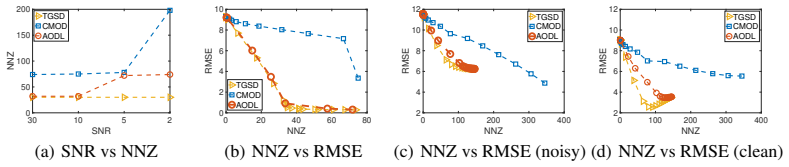
- Low-rank coding also acts as a noise filter: on noisy synthetic data AODL recovers ground-truth dictionaries with high alignment and represents the clean signal better than full-rank dictionary learning.
Reading between the lines
- Not in the paper: The advantage of AODL likely sharpens when both dictionary dimensions are large relative to k; when one dictionary is tiny, the coefficient count k(P+Q) approaches PQ and the model's edge over full-rank coding disappears—the paper itself notes this in a time-slicing experiment.
- Not in the paper: A natural extension is to make k data-dependent, chosen by eigenvalue decay or cross-validation, since the paper tunes k by grid search while the theory treats it as fixed.
- Not in the paper: The large gap between empirical error and the Theorem 1 bound suggests distribution-dependent sample complexity bounds may be derivable, which could tighten the theory for structured spatio-temporal data.
- Not in the paper: The same low-rank product encoding could extend to tensors with three or more modes by adding more dictionary factors, though the paper only studies two-way data.
Editorial analysis
A structured set of objections, weighed in public.
Referee Report
Summary. The paper proposes a two-dictionary sparse coding model in which each sample X is approximated as L Y W R^T, with shared dictionaries L, R and sample-specific low-rank, sparse encoding factors Y, W. The main claims are: (1) a distribution-independent sample-complexity bound for the ERM learning rule (Theorem 1); (2) an exact equivalence between the constrained sparse-coding problem and an L1-regularized problem (Theorem 2); (3) convergence of the proposed alternating optimization algorithm AODL (Theorem 3); and (4) large empirical gains in reconstruction compactness, missing-value imputation, and interpretability on several real-world datasets. The paper includes proofs in appendices, an implementation link, and extensive experiments.
Significance. The low-rank coding model L Y W R^T is a natural and potentially useful extension of two-way dictionary learning, and the empirical results, if reliable, show consistent gains over the compared baselines. A correct sample-complexity bound for this problem would be a genuine contribution to the dictionary-learning literature. The authors are also transparent about the low-rank assumption and its limitations. However, the theoretical backbone of the paper is currently not sound: the proof of Theorem 1 relies on a false Lipschitz lemma and an invalid covering-number argument; Theorem 2's equivalence is not established; and the convergence theorem does not match the algorithm as implemented. Because these theoretical results are advertised as central contributions, the current version cannot be accepted.
major comments (2)
- [Theorem 1, Appendix A (Lemma 4)] The proof only establishes that for a particular γ there exists some κ such that F(γ) ⊆ G(κ), and even this is shown only for one selected element of F(γ), not for the whole argmin set. The converse direction required by Theorem 2 — for every κ there exists (λ1,λ2) — is not proven. The monotonicity claim in Eq. (38) is false in general: for f(x)=(x−1)^2, F(0)={1} and F(1)={0.5}, so F(γ̂)⊄F(γ). Moreover, in Eq. (41) the regularization parameters are allowed to depend on (L,R,X_j), so the jump to the global dictionary-learning equivalence in Eq. (42) is unjustified. Theorem 2 is therefore unsupported as stated.
- [Theorem 3, Appendix C/D and Algorithm 1] The convergence proof assumes each alternating step exactly minimizes the objective and therefore decreases it. This does not hold for Algorithm 1 as implemented. The sparse coding stage (Eq. 10) is not jointly convex in (Y,W); for scalar y,w the term (1-yw)^2 is nonconvex, contradicting the claim in Appendix D that 'the problem is jointly convex'. Thus the ADMM solver is not guaranteed to return a global minimizer and may not decrease the objective. In addition, the dictionary update in Steps 8-9 normalizes atoms without rescaling Y_s,W_s; normalization after the least-squares update can increase the reconstruction error. Therefore the monotone-decrease argument in Appendix C does not apply to AODL, and Theorem 3 is not established.
minor comments (4)
- [Definition 3] The operator norm formula in Eq. (17) divides by ||x||_W; it should likely be ||x||_V. This looks like a typo, but it matters for the intended L1→L2 norm.
- [Appendix D, Algorithm 2] In line 13, the update for W_s uses 'Π3' where the surrounding text defines Π2; the indices are inconsistent.
- [Section 6, Fig. 3(a)] The 'theoretical bound evaluation' is not a meaningful validation of Theorem 1: the stated bound is roughly 10^4, while the reported empirical error is below 1. Any reasonable algorithm would satisfy such a loose bound. The authors acknowledge this in the text, but the claim of 'empirical support' for the bound should be softened or the experiment redesigned.
- [Appendix A, final paragraph] The sentence 'Our experimental analysis of the bound (Fig. 3(a)) supports the main Theorem 2' appears to refer to Theorem 1; please correct.
Circularity Check
No circularity: the sample-complexity bound and the empirical comparisons do not reduce to their inputs; the Theorem 2 proof issue is a quantifier/omitted-proof gap, not a self-definitional reduction.
full rationale
The main derivation chain is self-contained. Theorem 1 is a uniform-convergence argument: it bounds sup_h |R(h)-Rhat(h)| via covering numbers of the hypothesis class and a claimed Lipschitz property of the loss; the normalization ||L_i (R^T)_j||_2 <= 1, the data bound ||X||_F <= C, and kappa enter as stated assumptions, and the bound is distribution-free. Nothing in the loss class F is fitted to the empirical risk or to the target generalization gap, so the bound is not a renamed input. The empirical validation of Theorem 1 is admittedly weak—the text says 'the test error is much lower than the bound since the sample distribution corresponds to an easy setting'—but using an easy distribution is a weakness in demonstration, not circularity. The optimization claims are also not circular: Theorem 3 is a monotone-decreasing bounded sequence argument, and the algorithm's alternating updates are standard least-squares/sparse-coding steps. The compactness advantage is structural (k(P+Q) vs PQ coefficients) and the Limitations section explicitly concedes that if the data is not low-rank the advantage disappears; this is a disclosed conditional premise, not a conclusion built into the model. The only self-referential moment is in Appendix B: Lemma 5 sets kappa_j := ||x^(0)_j||_1 and then concludes F(gamma) subset G(kappa), which is true by construction; however, the theorem statement needs the converse quantification (for every kappa, some gamma), which the proof does not supply. This is a quantifier/omitted-proof gap in a secondary theoretical claim, not a reduction of the central empirical or statistical claims to their inputs. Self-citations to [26,27] are related-work/baseline citations and no load-bearing uniqueness theorem is imported. The possible invalidity of Lemma 4's Lipschitz bound (operator-norm mismatch, dropped factor) is a mathematical correctness issue, orthogonal to circularity. Accordingly, no circular step reaches the threshold required by the rubric.
Assumptions & free parameters
free parameters (3)
- λ1 =
grid searched in [10^{-3}, ..., 10^3] per dataset
- λ2 =
grid searched in [10^{-3}, ..., 10^3] per dataset
- k =
chosen from {3, 5, 15, 30, 45} per dataset
assumptions (4)
- domain assumption Data samples are iid from an unknown distribution D and satisfy ∥X∥_F ≤ C almost surely.
- domain assumption Dictionary pairs satisfy the normalization condition ∥L_i (R^T)_j∥_2 ≤ 1 for all i,j.
- ad hoc to paper The sparse coding subproblem is jointly convex in (Y, W).
- ad hoc to paper The alternating optimization steps, including dictionary normalization, monotonically decrease the objective.
Cite this review
Pith. "Pith review of Multi-Dictionary Learning for Low Rank Sparse Coding." pith.science (2026). https://pith.science/paper/B5WLE5XM
@misc{pith2026250910033,
  author       = {Pith},
  title        = {Pith review of: Multi-Dictionary Learning for Low Rank Sparse Coding},
  year         = {2026},
  howpublished = {\url{https://pith.science/paper/B5WLE5XM}},
  note         = {Machine review of arXiv:2509.10033}
}
abstract
Sparse dictionary coding represents signals as linear combinations of a few dictionary atoms. It has been applied to images, time series, graph signals and multi-way spatio-temporal data by jointly employing temporal and spatial dictionaries. Data-agnostic analytical dictionaries, such as the discrete Fourier transform, wavelets and graph Fourier, have seen wide adoption due to efficient implementations and good practical performance. On the other hand, dictionaries learned from data offer sparser and more accurate solutions but require learning of both the dictionaries and the coding coefficients. This becomes especially challenging for multi-dictionary scenarios since encoding coefficients correspond to all atom combinations from the dictionaries. To address this challenge, we propose a low-rank coding model for 2-dictionary scenarios and study its data complexity. Namely, we establish upper and lower bounds on the number of samples needed to learn dictionaries that generalize to unseen samples from the same distribution. We propose an alternating convex optimization solution, called AODL, which employs alternating optimization between the sparse coding matrices and the learned dictionaries. We demonstrate its quality for data reconstruction and missing value imputation in both synthetic and real-world datasets. For a fixed reconstruction quality, AODL learns up to $90\%$ sparser solutions compared to non-low-rank and analytical (fixed) dictionary baselines. In addition, the learned dictionaries reveal interpretable insights into patterns from training samples.
Figures


Figures from the paper (4 more)



Forward citations
Cited by 1 Pith paper
-
York's Cavity Formalism and Quantum Modified Thermodynamics of (2+1)D Black Holes
The paper claims Barrow entropy corrections reshape BTZ black hole thermodynamics in a cavity, but the free energy analysis rests on a wrong extrinsic curvature term and an incorrect zero-crossing interpretation.
Reference graph
Works this paper leans on
-
[1]
Wikipedia page views statistics http://dumps.wikimedia.org/other/ pagecounts-raw/
-
[2]
Sparse coding with anomaly detection
Amir Adler, Michael Elad, Y acov Hel-Or, and Ehud Rivlin. Sparse coding with anomaly detection. Journal of Signal Processing Systems , 79:179–188, 2015
2015
-
[3]
K-svd: An algorithm for designing overcomplete dictionaries for sparse representation
Michal Aharon, Michael Elad, and Alfred Bruckstein. K-svd: An algorithm for designing overcomplete dictionaries for sparse representation. IEEE Transactions on signal processing , 54(11):4311–4322, 2006
2006
-
[4]
Robust kronecker component analysis
Mehdi Bahri, Y annis Panagakis, and Stefanos Zafeiriou. Robust kronecker component analysis. IEEE transactions on pattern analysis and machine intelligence , 41(10):2365–2379, 2018
2018
-
[5]
A fast iterative shrinkage-thresholding algorithm for linear inverse problems
Amir Beck and Marc Teboulle. A fast iterative shrinkage-thresholding algorithm for linear inverse problems. SIAM journal on imaging sciences , 2(1):183–202, 2009
2009
-
[6]
Traffic flow on a freeway network
Peter Bickel, Chao Chen, Jaimie Kwon, John Rice, and Erik Zwet. Traffic flow on a freeway network. 01 2002
2002
-
[7]
Distributed op- timization and statistical learning via the alternating direction method of multipliers
Stephen Boyd, Neal Parikh, Eric Chu, Borja Peleato, and Jonathan Eckstein. Distributed op- timization and statistical learning via the alternating direction method of multipliers. F ound. Trends Mach. Learn., 3(1):1–122, January 2011
2011
-
[8]
On the mathematical foundations of learning
Felipe Cucker and Steve Smale. On the mathematical foundations of learning. Bulletin of the American Mathematical Society, 39, 11 2001
2001
Show all 49 references
-
[9]
Sparsity analysis using a mixed approach with greedy and ls algorithms on channel estimation
Nilson Maciel de Paiva, Elaine Crespo Marques, and Lirida Alves de Barros Naviner. Sparsity analysis using a mixed approach with greedy and ls algorithms on channel estimation. In 2017 3rd International Conference on Frontiers of Signal Processing (ICFSP) , pages 91–95. IEEE, 2017
2017
-
[10]
Learning graphs from data: A signal representation perspective
Xiaowen Dong, Dorina Thanou, Michael Rabbat, and Pascal Frossard. Learning graphs from data: A signal representation perspective. IEEE Signal Processing Magazine, 36(3):4463, May 2019
2019
-
[11]
Reality mining: sensing complex social systems
Nathan Eagle and Alex Sandy Pentland. Reality mining: sensing complex social systems. Personal and ubiquitous computing, 10(4):255–268, 2006
2006
-
[12]
Image denoising via sparse and redundant representations over learned dictionaries
Michael Elad and Michal Aharon. Image denoising via sparse and redundant representations over learned dictionaries. IEEE Transactions on Image processing, 15(12):3736–3745, 2006
2006
-
[13]
Method of optimal directions for frame design
Kjersti Engan, Sven Ole Aase, and J Hakon Husoy. Method of optimal directions for frame design. In 1999 IEEE International Conference on Acoustics, Speech, and Signal Processing. Proceedings. ICASSP99 (Cat. No. 99CH36258) , volume 5, pages 2443–2446. IEEE, 1999
1999
-
[14]
Sparse coding with multi-layer decoders using variance regularization
Katrina Evtimova and Y ann LeCun. Sparse coding with multi-layer decoders using variance regularization. arXiv preprint arXiv:2112.09214, 2021
2021 arXiv
-
[15]
2d sparse signal recovery via 2d orthogonal match- ing pursuit
Y ong Fang, JiaJi Wu, and BorMin Huang. 2d sparse signal recovery via 2d orthogonal match- ing pursuit. Science China Information Sciences , 55:889–897, 2012
2012
-
[16]
Sparse decomposition of two dimensional signals
Aboozar Ghaffari, Massoud Babaie-Zadeh, and Christian Jutten. Sparse decomposition of two dimensional signals. In 2009 IEEE international conference on acoustics, speech and signal processing, pages 3157–3160. IEEE, 2009
2009
-
[17]
A low-rank tensor dictionary learning method for hyper- spectral image denoising
Xiao Gong, Wei Chen, and Jie Chen. A low-rank tensor dictionary learning method for hyper- spectral image denoising. IEEE Transactions on Signal Processing, 68:1168–1180, 2020. 10
2020
-
[18]
Sample complexity of dictionary learning and other matrix factorizations
Rémi Gribonval, Rodolphe Jenatton, Francis Bach, Martin Kleinsteuber, and Matthias Seibert. Sample complexity of dictionary learning and other matrix factorizations. IEEE Transactions on Information Theory, 61(6):3469–3486, 2015
2015
-
[19]
Separable dictionary learning
Simon Hawe, Matthias Seibert, and Martin Kleinsteuber. Separable dictionary learning. In Proceedings of the IEEE Conference on Computer Vision and Pattern Recognition , pages 438– 445, 2013
2013
-
[20]
Bayesian compressive sensing
Shihao Ji, Y a Xue, and Lawrence Carin. Bayesian compressive sensing. IEEE Transactions on signal processing, 56(6):2346–2356, 2008
2008
-
[21]
Dictionary learning with low- rank coding coefficients for tensor completion
Tai-Xiang Jiang, Xi-Le Zhao, Hao Zhang, and Michael K Ng. Dictionary learning with low- rank coding coefficients for tensor completion. IEEE Transactions on Neural Networks and Learning Systems, 34(2):932–946, 2021
2021
-
[22]
Sparse signal recovery via tree search matching pursuit
Jaeseok Lee, Jun Won Choi, and Byonghyo Shim. Sparse signal recovery via tree search matching pursuit. Journal of Communications and Networks , 18(5):699–712, 2016
2016
-
[23]
The augmented lagrange multiplier method for exact recovery of corrupted low-rank matrices
Zhouchen Lin, Minming Chen, and Y uliang Ma. The augmented lagrange multiplier method for exact recovery of corrupted low-rank matrices. ArXiv, abs/1009.5055, 2013
2013 arXiv
-
[24]
Gist: Graph inference for structured time series
Boya Ma, Maxwell McNeil, and Petko Bogdanov. Gist: Graph inference for structured time series. In Proceedings of the 2023 SIAM International Conference on Data Mining (SDM) , pages 433–441. SIAM, 2023
2023
-
[25]
A review of sparse recovery algorithms
Elaine Crespo Marques, Nilson Maciel, Lirida Naviner, Hao Cai, and Jun Y ang. A review of sparse recovery algorithms. IEEE access, 7:1300–1322, 2018
2018
-
[26]
Multi-dictionary tensor decomposition
Maxwell McNeil and Petko Bogdanov. Multi-dictionary tensor decomposition. In 2023 IEEE International Conference on Data Mining (ICDM) , pages 1217–1222. IEEE, 2023
2023
-
[27]
Temporal graph signal decomposition
Maxwell J McNeil, Lin Zhang, and Petko Bogdanov. Temporal graph signal decomposition. In Proceedings of the 27th ACM SIGKDD Conference on Knowledge Discovery & Data Mining , pages 1191–1201, 2021
2021
-
[28]
Or- thogonal matching pursuit: Recursive function approximation with applications to wavelet de- composition
Y agyensh Chandra Pati, Ramin Rezaiifar, and Perinkulam Sambamurthy Krishnaprasad. Or- thogonal matching pursuit: Recursive function approximation with applications to wavelet de- composition. In Proceedings of 27th Asilomar conference on signals, systems and computers , pages...
1993
-
[29]
Jointly using low-rank and sparsity priors for sparse inverse synthetic aperture radar imaging
Wei Qiu, Jianxiong Zhou, and Qiang Fu. Jointly using low-rank and sparsity priors for sparse inverse synthetic aperture radar imaging. IEEE Transactions on Image Processing , 29:100– 115, 2019
2019
-
[30]
Dynamic texture recognition via orthogonal tensor dictio- nary learning
Y uhui Quan, Y an Huang, and Hui Ji. Dynamic texture recognition via orthogonal tensor dictio- nary learning. In Proceedings of the IEEE international conference on computer vision , pages 73–81, 2015
2015
-
[31]
Recommendation on live-streaming plat- forms: Dynamic availability and repeat consumption
Jérémie Rappaz, Julian McAuley, and Karl Aberer. Recommendation on live-streaming plat- forms: Dynamic availability and repeat consumption. In Fifteenth ACM Conference on Rec- ommender Systems, pages 390–399, 2021
2021
-
[32]
Dictionaries for sparse representation modeling
Ron Rubinstein, Alfred M Bruckstein, and Michael Elad. Dictionaries for sparse representation modeling. Proceedings of the IEEE , 98(6):1045–1057, 2010
2010
-
[33]
Sandryhaila and J
A. Sandryhaila and J. M. F. Moura. Big data analysis with signal processing on graphs: Repre- sentation and processing of massive data sets with irregular structure. IEEE Signal Processing Magazine, 31(5):80–90, 2014
2014
-
[34]
New dictio- nary learning methods for two-dimensional signals
Firooz Shahriari-Mehr, Javad Parsa, Massoud Babaie-Zadeh, and Christian Jutten. New dictio- nary learning methods for two-dimensional signals. In 2020 28th European Signal Processing Conference (EUSIPCO). IEEE, 2021
2020
-
[35]
Understanding Machine Learning: From Theory to Algorithms
Shai Shalev-Shwartz and Shai Ben-David. Understanding Machine Learning: From Theory to Algorithms. Cambridge University Press, USA, 2014. 11
2014
-
[36]
The emerging field of signal processing on graphs: Extending high-dimensional data analysis to networks and other irregular domains
David I Shuman, Sunil K Narang, Pascal Frossard, Antonio Ortega, and Pierre V andergheynst. The emerging field of signal processing on graphs: Extending high-dimensional data analysis to networks and other irregular domains. IEEE signal processing magazine, 2013
2013
-
[37]
Crowdsourced air traffic data from the opensky network 2019–2020
Martin Strohmeier, Xavier Olive, Jannis Lübbe, Matthias Schäfer, and Vincent Lenders. Crowdsourced air traffic data from the opensky network 2019–2020. Earth System Science Data, 13(2):357–366, 2021
2019
-
[38]
Adversarial robustness of supervised sparse coding
Jeremias Sulam, Ramchandran Muthukumar, and Raman Arora. Adversarial robustness of supervised sparse coding. Advances in neural information processing systems , 33:2110–2121, 2020
2020
-
[39]
M. Tan, I. Tsang, L. Wang, and X. Zhang. Convex matching pursuit for large-scale sparse coding and subset selection. Proceedings of the Aaai Conference on Artificial Intelligence , 26:1119–1125, 2021
2021
-
[40]
Tenneti and P
Srikanth V . Tenneti and P . P . V aidyanathan. Nested periodic matrices and dictionaries: New signal representations for period estimation. IEEE Trans. Signal Processing , 63(14):3736– 3750, 2015
2015
-
[41]
Time-varying graph mode decomposition
Naveed ur Rehman. Time-varying graph mode decomposition. arXiv preprint arXiv:2301.03496, 2023
2023 arXiv
-
[42]
Bruckstein
Daniel V ainsencher, Shie Mannor, and Alfred M. Bruckstein. The sample complexity of dic- tionary learning. Journal of Machine Learning Research , 12(100):3259–3281, 2011
2011
-
[43]
Generalized orthogonal matching pursuit
Jian Wang, Seokbeop Kwon, and Byonghyo Shim. Generalized orthogonal matching pursuit. IEEE Transactions on signal processing, 60(12):6202–6216, 2012
2012
-
[44]
Robust face recogni- tion via sparse representation
John Wright, Allen Y Y ang, Arvind Ganesh, S Shankar Sastry, and Yi Ma. Robust face recogni- tion via sparse representation. IEEE transactions on pattern analysis and machine intelligence, 31(2):210–227, 2008
2008
-
[45]
Joint-2d-sl0 algorithm for joint sparse matrix reconstruction
Dong Zhang, Y ongshun Zhang, Cunqian Feng, et al. Joint-2d-sl0 algorithm for joint sparse matrix reconstruction. International Journal of Antennas and Propagation , 2017, 2017
2017
-
[46]
Improved separable dic- tionary learning
Fengzhen Zhang, Yigang Cen, Ruizhen Zhao, and Hengyou Wang. Improved separable dic- tionary learning. In 2016 IEEE 13th International Conference on Signal Processing (ICSP) , pages 884–889. IEEE, 2016
2016
-
[47]
Analytic separable dictionary learning based on oblique manifold
Fengzhen Zhang, Yigang Cen, Ruizhen Zhao, Hengyou Wang, Yi Cen, LiHong Cui, and Shao- Hai Hu. Analytic separable dictionary learning based on oblique manifold. Neurocomputing, 236:32–38, 2017
2017
-
[48]
A survey of sparse repre- sentation: algorithms and applications
Zheng Zhang, Y ong Xu, Jian Y ang, Xuelong Li, and David Zhang. A survey of sparse repre- sentation: algorithms and applications. IEEE access, 3:490–530, 2015
2015
-
[49]
F. Zhou, S. Huang, and Y . Xing. Deep semantic dictionary learning for multi-label image classification. Proceedings of the AAAI Conference on Artificial Intelligence , 35:3572–3580, 2021. 12 Appendix In this Appendix we provide supplemental content including proofs of the theor...
2021
Reviewed August 4, 2026 · model on record in the stance chip above.
Discussion (0). Continue with ORCID to comment.