Unraveling the mysteries of supernovae with SKA+VLBI
Pith reviewed 2026-06-26 03:57 UTC · model grok-4.3
The pith
SKA-Mid phased into global VLBI will enable routine imaging of nearby extragalactic supernovae to measure deceleration indices and axial ratios to 5-10 percent and test explosion mechanisms.
A machine-rendered reading of the paper's core claim, the machinery that carries it, and where it could break.
Core claim
SKA-Mid phased into global VLBI supplies sub-microJansky sensitivity and milliarcsecond resolution, plus visibility-domain model fitting, that lets observers follow the expanding shocks of stripped-envelope supernovae out to about 25 megaparsecs, measure deceleration indices m and axial ratios to roughly 5-10 percent accuracy, and thereby directly test jet-assisted versus neutrino-driven explosion mechanisms while also resolving clumpy and toroidal circumstellar material around Type IIn and Ibn supernovae.
What carries the argument
Sub-microJansky sensitivity and mas-scale SKA+VLBI imaging with visibility-domain model fitting for sub-beam radius measurements at 5-15 GHz.
If this is right
- Follow expanding shocks of stripped-envelope supernovae out to roughly 25 megaparsecs.
- Measure deceleration indices m and axial ratios to approximately 5-10 percent precision.
- Resolve clumpy and toroidal circumstellar medium on progenitor scales for interacting supernovae.
- Place tight limits on single-degenerate models from deep non-detections of Type Ia supernovae.
- Search for nascent compact remnants and pulsar wind nebulae in late-time images.
Where Pith is reading between the lines
- Combining these radio measurements with optical, X-ray, and gravitational-wave data would create time-resolved multi-messenger laboratories for shock physics.
- Geometry constraints on pre-explosion mass loss could be compared directly with stellar evolution models for the same progenitor stars.
- The same imaging approach could be tested on other classes of radio-bright transients once the sensitivity targets are met.
Load-bearing premise
The planned sub-microJansky sensitivity and milliarcsecond resolution will actually be achieved and the radio emission from the targeted supernovae will remain bright enough and simple enough to interpret at the distances considered.
What would settle it
If SKA+VLBI observations of a sample of nearby supernovae yield no measurable difference in deceleration indices or axial ratios between events expected to follow jet-assisted versus neutrino-driven mechanisms, the claim that these measurements can distinguish the mechanisms would be refuted.
Figures
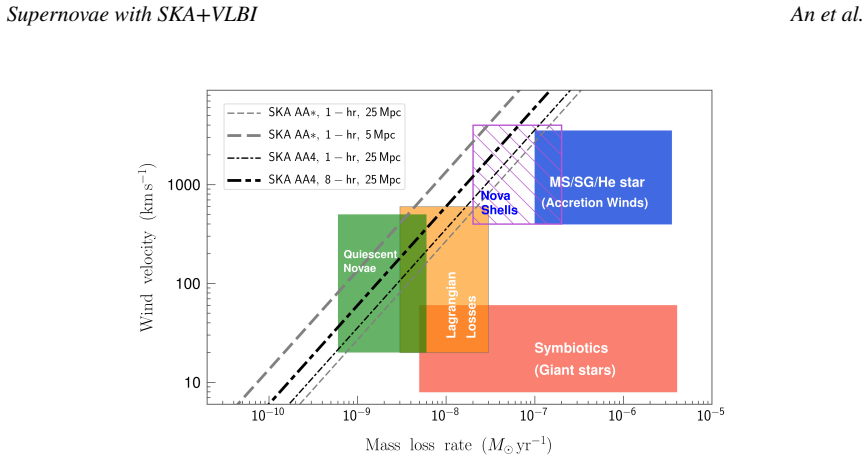
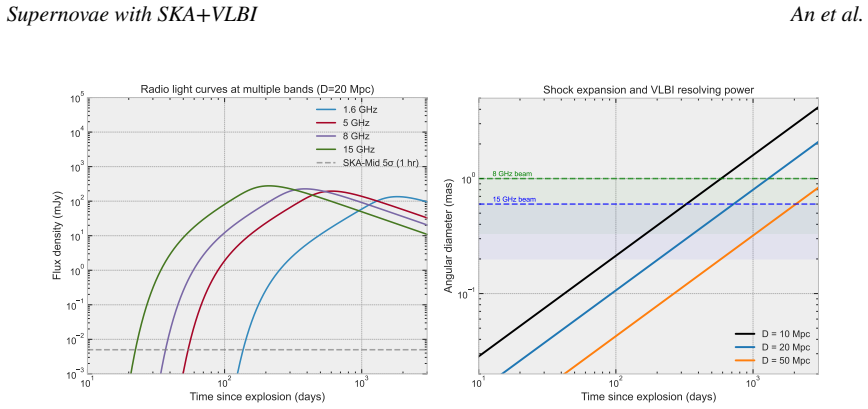
read the original abstract
Supernovae (SNe) drive cosmic chemical enrichment and shape galactic feedback, yet the link between progenitors and explosion outcomes remains poorly constrained because the earliest phases are rarely resolved. Radio emission traces synchrotron radiation where the fastest ejecta interact with the circumstellar medium (CSM), providing a uniquely penetrating probe of these phases. SKA-Mid phased into global VLBI will move from simple detections to routine interferometric imaging of nearby extragalactic SNe. Sub-$\mu$Jy sensitivity and mas-scale SKA+VLBI imaging, complemented by visibility-domain model fitting for sub-beam radius measurements at 5-15 GHz will allow us to follow the expanding shocks of stripped-envelope SNe out to $\sim$25 Mpc, measure deceleration indices ($m$) and axial ratios to $\approx 5-10\%$, and directly test jet-assisted versus neutrino-driven explosion mechanisms. For interacting SNe (Type IIn/Ibn), SKA+VLBI will resolve clumpy and toroidal CSM on progenitor scales, constraining the timing and geometry of eruptive pre-explosion mass loss. Deep limits on Type Ia SNe will tightly restrict the allowed single-degenerate parameter space, while late-time imaging will search for nascent compact remnants and pulsar wind nebulae. In synergy with optical, X-ray and gravitational wave facilities, SKA+VLBI will turn nearby SNe into laboratories for time-resolved shock physics and progenitor mapping.
Editorial analysis
A structured set of objections, weighed in public.
Referee Report
Summary. The manuscript argues that SKA-Mid phased into global VLBI will transition radio observations of supernovae from detections to routine interferometric imaging of nearby extragalactic events. Sub-μJy sensitivity and mas-scale resolution at 5-15 GHz, combined with visibility-domain model fitting, will enable tracking of expanding shocks in stripped-envelope SNe out to ~25 Mpc, yielding deceleration indices (m) and axial ratios measured to ≈5-10% precision to distinguish jet-assisted from neutrino-driven mechanisms; additional applications include resolving clumpy/toroidal CSM in Type IIn/Ibn events, constraining single-degenerate channels for Type Ia SNe, and searching for compact remnants.
Significance. If the projected instrumental performance is realized and the source assumptions hold, the work identifies a clear path for radio observations to provide direct, time-resolved constraints on supernova explosion physics and progenitor mass-loss histories that complement optical, X-ray, and gravitational-wave data. The emphasis on quantitative precision targets (5-10%) and specific distance limits makes the projections falsifiable once SKA+VLBI data become available.
major comments (2)
- [Abstract] Abstract: the central claim that SKA+VLBI will deliver m and axial-ratio measurements to ≈5-10% precision is unsupported by any error budget, simulated visibility fits, or assessment of systematic biases arising from clumpy or toroidal CSM, time-variable optical depth, or departures from spherical symmetry, all of which are documented in existing SN radio data and could dominate the uncertainty at the stated distances and frequencies.
- [Abstract] Abstract: the feasibility statement that stripped-envelope SNe at ~25 Mpc will be both detectable at sub-μJy levels and sufficiently simple (smooth, optically thin synchrotron shells) for reliable model fitting at 5-15 GHz is presented without reference to specific prior VLBI detections, flux-density distributions, or source-structure statistics that would justify the required signal-to-noise and simplicity assumptions.
minor comments (1)
- The text would be strengthened by explicit citations to existing VLBI radius and shape measurements of nearby SNe (e.g., SN 1993J, SN 2011dh) to anchor the projected improvements.
Simulated Author's Rebuttal
We thank the referee for the constructive and detailed comments. We address each point below and have revised the manuscript to strengthen the justification for the claims in the abstract.
read point-by-point responses
-
Referee: [Abstract] Abstract: the central claim that SKA+VLBI will deliver m and axial-ratio measurements to ≈5-10% precision is unsupported by any error budget, simulated visibility fits, or assessment of systematic biases arising from clumpy or toroidal CSM, time-variable optical depth, or departures from spherical symmetry, all of which are documented in existing SN radio data and could dominate the uncertainty at the stated distances and frequencies.
Authors: We agree the abstract would benefit from explicit reference to the underlying assumptions. The 5-10% precision targets are scaled from published VLBI model fits to SN 1993J and SN 2011dh (cited in Sections 2-3), where comparable fractional uncertainties were achieved on m and geometry. No new simulated visibility fits or full error budget were generated for this manuscript. In revision we will (i) add a qualifying clause to the abstract and (ii) insert a short paragraph in the discussion that cites existing literature on CSM clumpiness, optical-depth evolution, and asymmetry effects, while noting these as potential systematics that future data will test. revision: partial
-
Referee: [Abstract] Abstract: the feasibility statement that stripped-envelope SNe at ~25 Mpc will be both detectable at sub-μJy levels and sufficiently simple (smooth, optically thin synchrotron shells) for reliable model fitting at 5-15 GHz is presented without reference to specific prior VLBI detections, flux-density distributions, or source-structure statistics that would justify the required signal-to-noise and simplicity assumptions.
Authors: The manuscript already cites specific prior VLBI detections (SN 1993J, SN 2011dh) and radio light-curve compilations in the introduction and Section 2 to anchor the assumptions of smooth, optically thin shells at 5-15 GHz. The 25 Mpc horizon follows directly from SKA-Mid sensitivity curves applied to those observed flux-density distributions. To improve clarity we have added explicit citations to the relevant flux-density statistics and source-structure papers directly in the revised abstract and expanded the methods paragraph that summarizes the fraction of events expected to remain simple enough for visibility-domain fitting. revision: yes
Circularity Check
No circularity; entirely prospective with no derivation chain
full rationale
The manuscript contains no equations, fitted parameters, quantitative predictions, or derivation steps that could reduce to inputs by construction. All claims are forward-looking statements about future SKA+VLBI capabilities for measuring m and axial ratios; no self-definitional relations, fitted-input predictions, or load-bearing self-citations appear. The text is self-contained as an observational prospectus and receives the default non-finding.
Axiom & Free-Parameter Ledger
Reference graph
Works this paper leans on
-
[1]
doi: 10.1088/0004-637X/807/2/169. G.E.Andersonetal. InAdvancingAstrophysicswiththeSKA–II(AASKAII).2026. arXivsearch: Report number AASKAII/GemmaAnderson01. D.Arnett.SupernovaeandNucleosynthesis: AnInvestigationoftheHistoryofMatterfromtheBig Bang to the Present
-
[2]
doi: 10.1088/1538-3873/aaecbe. E. Bempong-Manful et al. InAdvancing Astrophysics with the SKA – II (AASKAII)
-
[3]
S.J.Boos,D.M.Townsley,andK.J.Shen.ApJ,972(2):200,Sept.2024
doi: 10.1088/0004-637X/751/2/125. S.J.Boos,D.M.Townsley,andK.J.Shen.ApJ,972(2):200,Sept.2024. doi: 10.3847/1538-4357/ ad5da2. M.C.P.Bours,S.Toonen,andG.Nelemans.A&A,552:A24,Apr.2013. doi: 10.1051/0004-6361/ 201220692. R.Braunetal.arXive-prints,art.arXiv:1912.12699,Dec.2019. doi: 10.48550/arXiv.1912.12699. A. Burrows.Reviews of Modern Physics, 85(1):245–261, Jan
-
[4]
doi: 10.1103/RevModPhys. 85.245. P. Chandra et al. InAdvancing Astrophysics with the SKA – II (AASKAII)
-
[5]
W.Chenetal
arXiv search: Report number AASKAII/Chandra01. W.Chenetal. InAdvancingAstrophysicswiththeSKA–II(AASKAII).2026. arXivsearch: Report number AASKAII/Chen01. R. A. Chevalier.ApJ, 258:790–797, July
2026
-
[6]
doi: 10.1086/160126. R. A. Chevalier.ApJ, 499(2):810–819, May
-
[7]
doi: 10.1086/305676. R. A. Chevalier.ApJL, 752(1):L2, June
-
[8]
doi: 10.1088/2041-8205/752/1/L2. R. A. Chevalier and C. Fransson.ApJ, 651(1):381–391, Nov
-
[9]
doi: 10.1086/507606. R.A.ChevalierandC.M.Irwin.ApJL,729(1):L6, Mar.2011. doi: 10.1088/2041-8205/729/1/L6. L. Chomiuk et al.ApJ, 750(2):164, May
-
[10]
doi: 10.1088/0004-637X/750/2/164. D. L. Coppejans et al.ApJ, 856(1):56, Mar
-
[11]
doi: 10.3847/1538-4357/aab36e. A. de Witt et al.MNRAS, 455(1):511–517, Jan
-
[12]
doi: 10.1093/mnras/stv2306. T. Eftekhari et al.ApJL, 876(1):L10, May
-
[13]
doi: 10.3847/2041-8213/ab18a5. B. M. Gaensler and P. O. Slane.ARA&A, 44(1):17–47, Sept
-
[14]
Measuring Average Treatment Effect from Heavy-tailed Data
doi: 10.1146/annurev.astro.44. 051905.092528. A. Gal-Yam.Science, 337(6097):927, Aug
work page internal anchor Pith review Pith/arXiv arXiv doi:10.1146/annurev.astro.44
-
[15]
13 Supernovae with SKA+VLBI An et al
doi: 10.1126/science.1203601. 13 Supernovae with SKA+VLBI An et al. A. Gal-Yam et al.Nature, 462(7273):624–627, Dec
-
[16]
doi: 10.1038/nature08579. J. D. Gelfand et al. InAdvancing Astrophysics with the SKA – II (AASKAII)
-
[17]
D.A.Green.BulletinoftheAstronomicalSocietyofIndia,37(1):45–61,Mar.2009
arXiv search: Report number AASKAII/Gelfand01. D.A.Green.BulletinoftheAstronomicalSocietyofIndia,37(1):45–61,Mar.2009. doi: 10.48550/ arXiv.0905.3699. H. E. S. S. Collaboration et al.A&A, 626:A57, June
Pith/arXiv arXiv 2009
-
[18]
doi: 10.1051/0004-6361/201935242. Z. Han and P. Podsiadlowski.MNRAS, 350(4):1301–1309, June
-
[19]
doi: 10.1111/j.1365-2966. 2004.07713.x. S. Horiuchi et al.ApJ, 738(2):154, Sept
-
[20]
doi: 10.1088/0004-637X/738/2/154. I. Iben, Jr. and A. V. Tutukov.ApJSS, 54:335–372, Feb
-
[21]
doi: 10.1086/190932. A. Ingallinera et al. InAdvancing Astrophysics with the SKA – II (AASKAII)
-
[22]
doi: 10.3847/1538-4357/ab042c. H.-T. Janka.Annual Review of Nuclear and Particle Science, 62(1):407–451, Nov
-
[23]
doi: 10.1146/annurev-nucl-102711-094901. M. Kadler et al. InAdvancing Astrophysics with the SKA – II (AASKAII)
-
[24]
doi: 10.1088/0004-637X/717/1/245. E. C. Kool et al.Nature, 617(7961):477–482, May
-
[25]
doi: 10.1038/s41586-023-05916-w. K. Maeda et al.Science, 319(5867):1220, Feb
-
[26]
doi: 10.1126/science.1149437. F. Mannucci, M. Della Valle, and N. Panagia.MNRAS, 377(3):1229–1235, May
-
[27]
doi: 10.1111/j.1365-2966.2007.11676.x. D. Maoz, F. Mannucci, and G. Nelemans.ARA&A, 52:107–170, Aug
-
[28]
doi: 10.1051/0004-6361/200912133. I. Martí-Vidal et al.A&A, 535:L10, Nov
-
[29]
doi: 10.1051/0004-6361/201118195. I. Martí-Vidal, M. A. Pérez-Torres, and A. P. Lobanov.A&A, 541:A135, May
-
[30]
doi: 10.1051/0004-6361/201322633. S. Mattila et al.ApJ, 756(2):111, Sept
-
[31]
doi: 10.1088/0004-637X/756/2/111. T. J. Moriya, E. I. Sorokina, and R. A. Chevalier.Space Sci. Rev., 214(2):59, Mar
-
[32]
doi: 10.1007/s11214-018-0493-6. N. Panagia et al.ApJ, 646(1):369–377, July
-
[33]
doi: 10.1086/504710. M. Perez-Torres et al. InAdvancing Astrophysics with the Square Kilometre Array (AASKA14), page 60, Apr
-
[34]
doi: 10.22323/1.215.0060. M. A. Pérez-Torres et al.ApJ, 792(1):38, Sept
-
[35]
doi: 10.1088/0004-637X/792/1/38. S. Perlmutter et al.ApJ, 517(2):565–586, June
-
[36]
doi: 10.1086/307221. A. G. Riess et al.AJ, 116:1009–1038, Sept
work page internal anchor Pith review doi:10.1086/307221
-
[37]
doi: 10.1086/300499. S. K. Sarbadhicary et al.MNRAS, 464(2):2326–2340, Jan
work page internal anchor Pith review doi:10.1086/300499
-
[38]
doi: 10.1093/mnras/stw2566. N. Smith.ARA&A, 52:487–528, Aug
-
[39]
doi: 10.1146/annurev-astro-081913-040025. N. Soker.arXiv e-prints, art. arXiv:2507.16757, July
-
[40]
doi: 10.48550/arXiv.2507.16757. L. Wang and J. C. Wheeler.ARA&A, 46:433–474, Sept
-
[41]
14 Supernovae with SKA+VLBI An et al
doi: 10.1146/annurev.astro.46. 14 Supernovae with SKA+VLBI An et al. 060407.145139. R. F. Webbink.ApJ, 277:355–360, Feb
-
[42]
doi: 10.1086/161701. K. W. Weiler, N. Panagia, M. J. Montes, and R. A. Sramek.ARA&A, 40:387–438, Jan
-
[43]
doi: 10.1146/annurev.astro.40.060401.093744. J. Whelan and I. Iben, Jr.ApJ, 186:1007–1014, Dec
-
[44]
doi: 10.1086/152565. S. Woosley and T. Janka.Nature Physics, 1(3):147–154, Dec
-
[45]
doi: 10.1038/nphys172. 15
discussion (0)
Sign in with ORCID, Apple, or X to comment. Anyone can read and Pith papers without signing in.