Nonlinear Decay of Fast Magnetosonic Waves through Weak Turbulence: Force-Free Electrodynamics Simulations
Pith reviewed 2026-06-26 19:32 UTC · model grok-4.3
The pith
Fast magnetosonic waves undergo efficient nonlinear conversion into secondary FMS and Alfvén waves via parametric decay instability.
A machine-rendered reading of the paper's core claim, the machinery that carries it, and where it could break.
Core claim
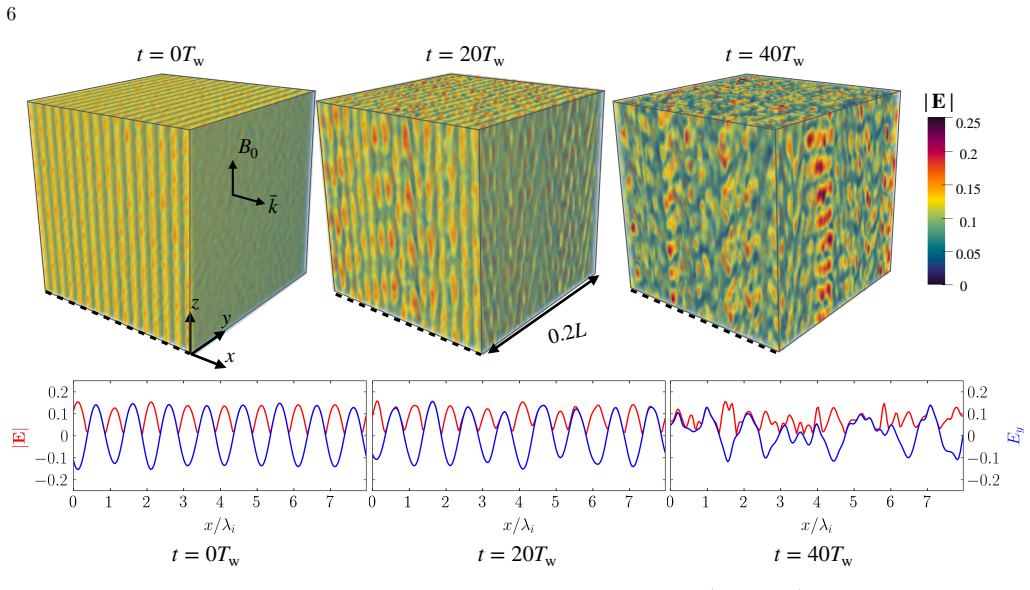
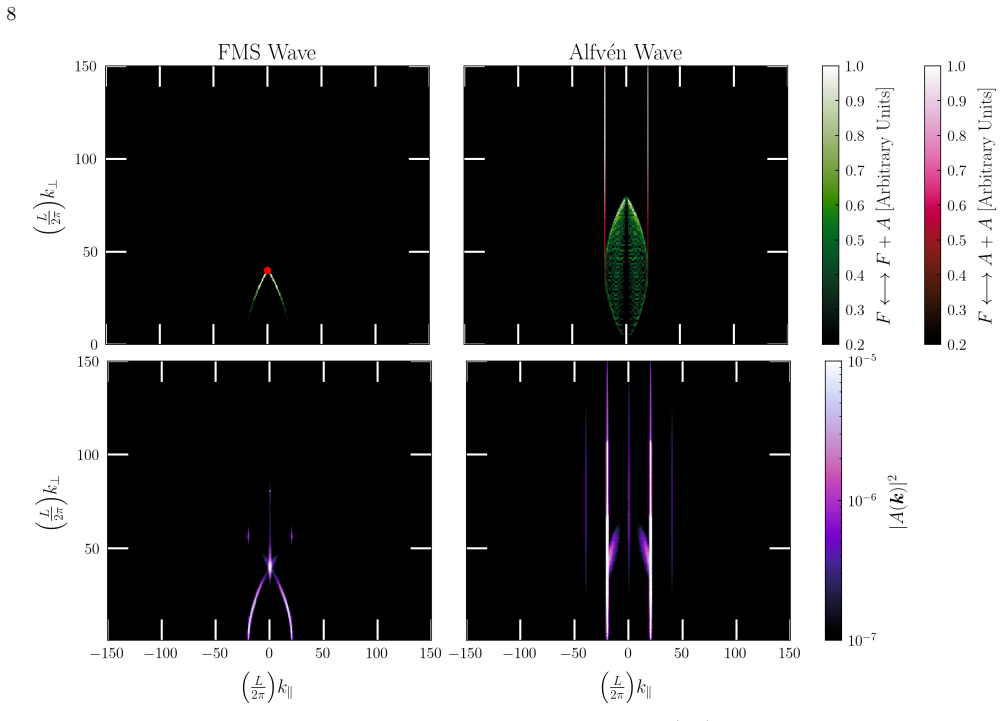
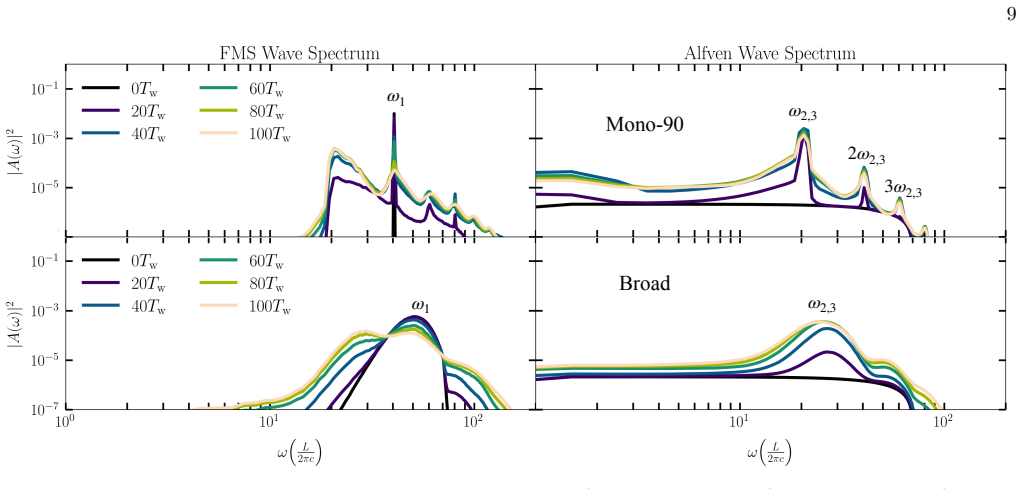
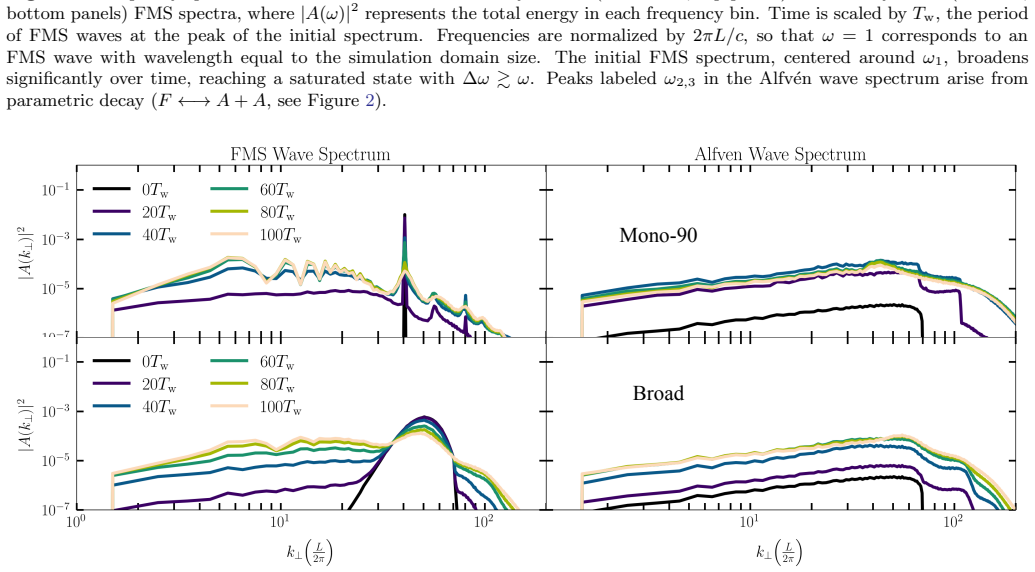
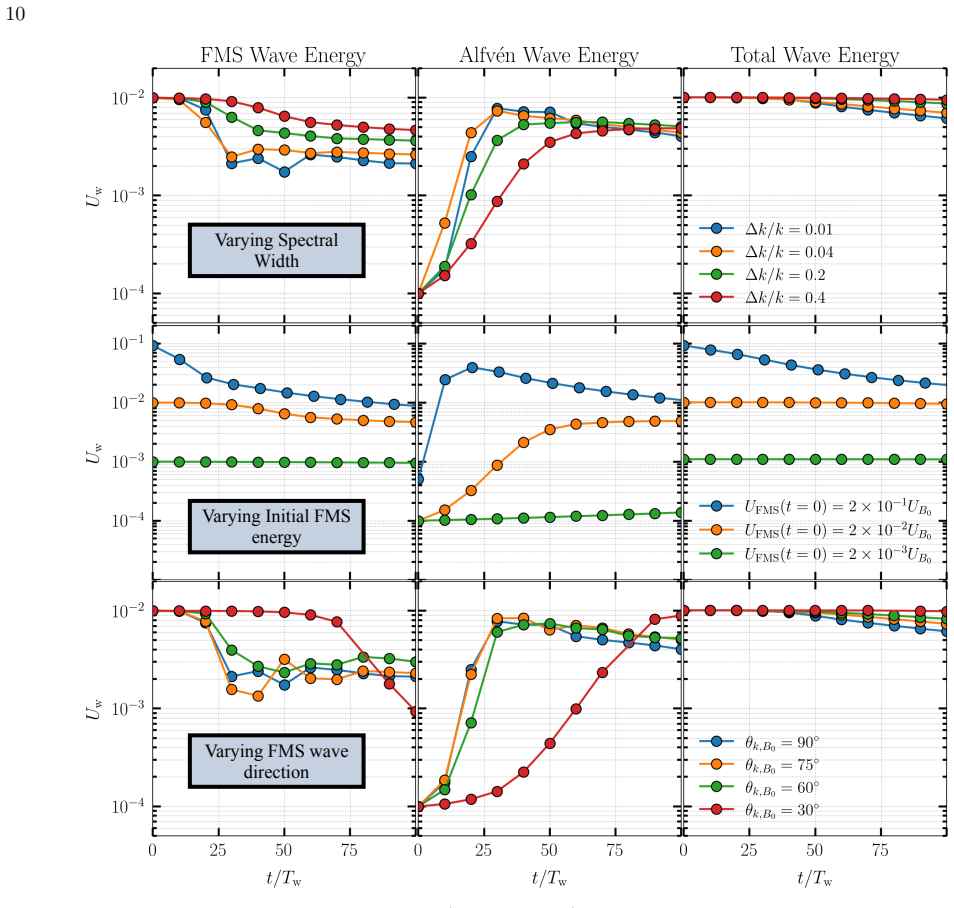
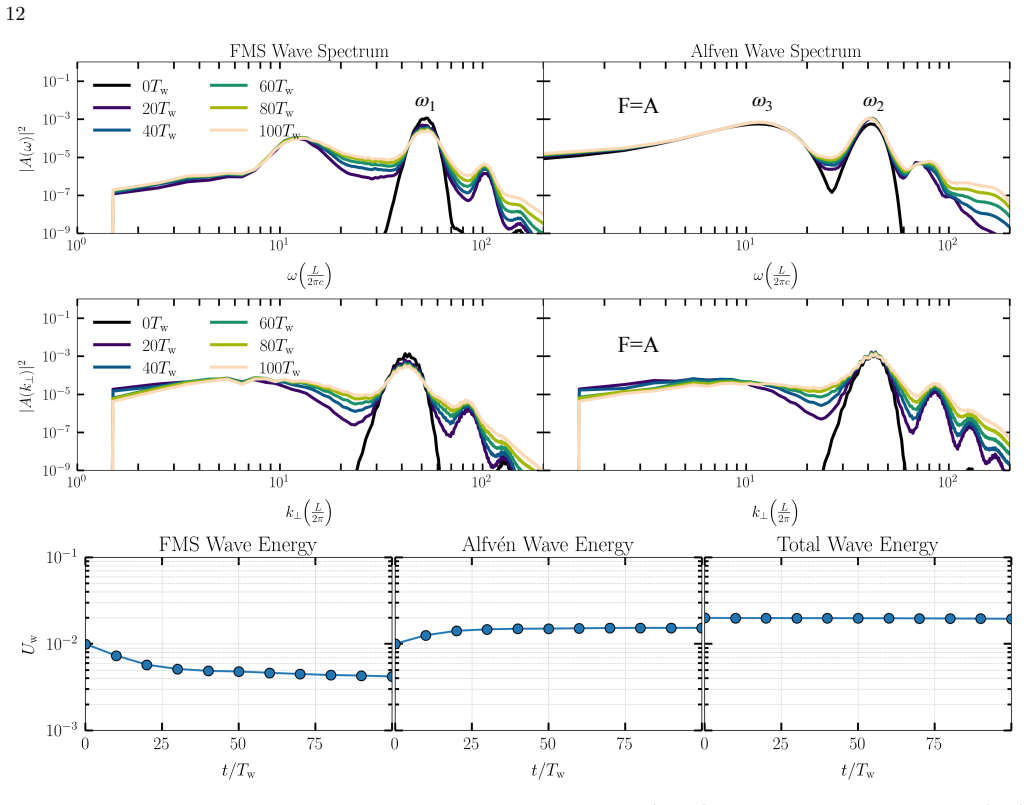
FMS waves undergo efficient nonlinear conversion into secondary FMS and Alfvén waves via the parametric decay instability. This process continues to drain energy from the primary FMS waves even after approximate energy equipartition between the FMS and Alfvén components is established. The resulting spectrum of excited waves is broad, extending across much of the inertial range in k-space within the simulation domain.
What carries the argument
Parametric decay instability of fast magnetosonic waves in force-free electrodynamics simulations.
If this is right
- FMS waves likely do not escape magnetar magnetospheres without substantial dissipation and spectral broadening.
- The spectrum of excited waves becomes broad across much of the inertial range in k-space.
- Energy continues to drain from primary FMS waves after approximate equipartition with Alfvén waves is reached.
Where Pith is reading between the lines
- The same instability could operate in other strongly magnetized astrophysical plasmas and limit wave escape.
- Fast radio burst spectra observed from magnetars may carry signatures of this broadening process.
- Varying the initial amplitudes or wavelengths in similar simulations would test how the decay efficiency scales.
Load-bearing premise
The force-free electrodynamics approximation and the chosen initial wave amplitudes and wavelengths accurately capture the conditions inside a real magnetar magnetosphere at the relevant frequencies.
What would settle it
Detection of undissipated narrow-spectrum FMS waves escaping a magnetar magnetosphere at the simulated frequencies without evidence of conversion to secondary waves would falsify the claim.
Figures
read the original abstract
We investigate the propagation of low-frequency fast-magnetosonic (FMS) waves in highly magnetized environments. Such conditions are relevant to the escape of GHz fast radio bursts potentially produced in the inner magnetospheres of magnetars. It remains an open question whether such waves can escape without substantial reprocessing. Using relativistic force-free electrodynamics simulations, we confirm the key theoretical predictions of Golbraikh & Lyubarsky (2023) and demonstrate that FMS waves undergo efficient nonlinear conversion into secondary FMS and Alfv\'en waves via the parametric decay instability. This process continues to drain energy from the primary FMS waves even after approximate energy equipartition between the FMS and Alfv\'en components is established. The resulting spectrum of excited waves is broad, extending across much of the inertial range in $k$-space within the simulation domain. Our results indicate that FMS waves likely do not escape magnetar magnetospheres without substantial dissipation and spectral broadening.
Editorial analysis
A structured set of objections, weighed in public.
Referee Report
Summary. The manuscript presents relativistic force-free electrodynamics (FFE) simulations of low-frequency fast-magnetosonic (FMS) waves propagating in highly magnetized plasmas relevant to magnetar magnetospheres. It confirms the parametric decay instability (PDI) predictions of Golbraikh & Lyubarsky (2023) by demonstrating efficient nonlinear conversion of primary FMS waves into secondary FMS and Alfvén waves. The process is shown to continue draining energy from the primary FMS component even after approximate equipartition between FMS and Alfvén energies is reached, producing a broad spectrum spanning much of the inertial range in k-space. The authors conclude that FMS waves are unlikely to escape without substantial dissipation and spectral broadening.
Significance. If the mechanism identification holds, the work supplies numerical support for analytic weak-turbulence theory in the force-free regime and carries direct implications for fast radio burst propagation models. The simulations test the persistence of PDI beyond equipartition, a regime not fully explored in the original theory paper. Credit is due for performing controlled FFE runs that reproduce the expected three-wave resonances and for exploring the resulting broadband spectrum.
major comments (1)
- [Results] Results section (around the discussion of post-equipartition evolution): The attribution of continued primary-FMS energy loss specifically to the parametric decay instability requires quantitative verification. The manuscript should report measured growth rates of the secondary waves, demonstrate resonant k-matching, or present controlled runs that suppress PDI channels. Without these diagnostics, the identification rests on the presence of secondary waves and spectral broadening, which could arise from other nonlinear interactions present in the full FFE system.
minor comments (2)
- [Abstract] Abstract: The phrase 'approximate energy equipartition' should be defined quantitatively (e.g., the ratio of energies at which the drain is still observed) so readers can assess how far beyond equipartition the PDI persists.
- [Methods] Methods: A brief statement on numerical resolution, dissipation scale, and convergence tests would strengthen that the observed spectral broadening is physical rather than numerical.
Simulated Author's Rebuttal
We thank the referee for their constructive comments and for recognizing the relevance of our force-free simulations to the parametric decay instability. We address the single major comment below and outline the revisions we will make.
read point-by-point responses
-
Referee: [Results] Results section (around the discussion of post-equipartition evolution): The attribution of continued primary-FMS energy loss specifically to the parametric decay instability requires quantitative verification. The manuscript should report measured growth rates of the secondary waves, demonstrate resonant k-matching, or present controlled runs that suppress PDI channels. Without these diagnostics, the identification rests on the presence of secondary waves and spectral broadening, which could arise from other nonlinear interactions present in the full FFE system.
Authors: We agree that quantitative verification would strengthen the identification of the parametric decay instability (PDI) as the driver of continued primary-FMS energy loss. In the revised manuscript we will add two new analyses to the Results section: (1) measured growth rates obtained by fitting the early-time exponential rise in the energy contained in the secondary FMS and Alfvén modes, and (2) explicit demonstration of resonant k-matching by overlaying the observed wavevector spectra against the three-wave resonance conditions derived in Golbraikh & Lyubarsky (2023). These additions will be presented as new panels in the existing spectral figures together with a short paragraph quantifying the agreement. We do not plan to add controlled runs that artificially suppress PDI channels, as the existing runs already isolate the low-frequency FMS driver and the observed secondary modes match the predicted resonances; however, we will note this limitation explicitly. revision: yes
Circularity Check
No significant circularity: simulations provide independent numerical confirmation of external theory
full rationale
The paper's derivation consists of performing new relativistic force-free electrodynamics simulations whose outputs (energy transfer rates, post-equipartition drain, and spectral broadening) are generated by evolving the FFE equations from specified initial conditions. These outputs are compared to predictions from the independent 2023 theory paper by Golbraikh & Lyubarsky. No parameters are fitted to the simulation data and then relabeled as predictions, no self-citations form a load-bearing chain, and no result is defined in terms of itself. The central claim therefore remains self-contained against external benchmarks.
Axiom & Free-Parameter Ledger
axioms (1)
- domain assumption Force-free electrodynamics is an adequate description of the plasma dynamics for the wave amplitudes and frequencies considered.
Reference graph
Works this paper leans on
-
[1]
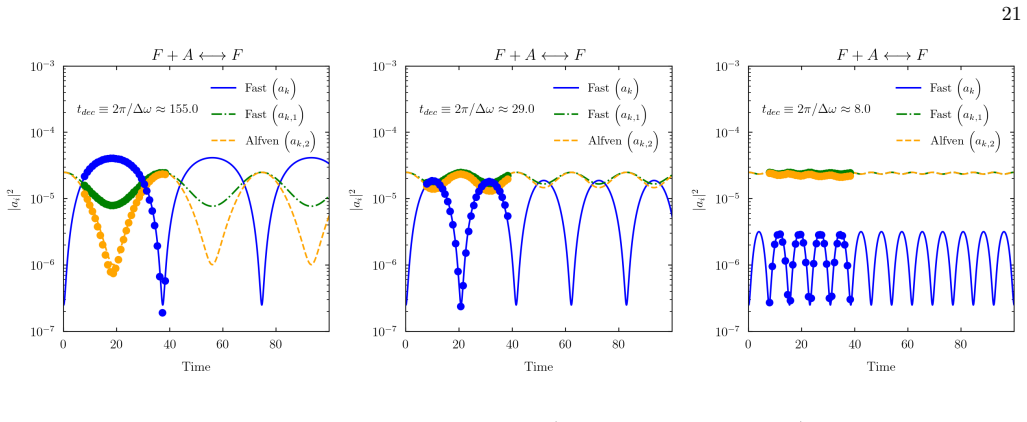
Beloborodov, A. M. 2013, ApJ, 762, 13, doi: 10.1088/0004-637X/762/1/13 —. 2021, ApJL, 922, L7, doi: 10.3847/2041-8213/ac2fa0 —. 2023, arXiv e-prints, arXiv:2307.12182, doi: 10.48550/arXiv.2307.12182 —. 2024, ApJ, 975, 223, doi: 10.3847/1538-4357/ad698c 21 Figure 9.Numerical solutions to a triad of nearly resonant waves (solid and dashed colored lines) and...
-
[2]
Bernardi, D., Yuan, Y., & Chen, A. Y. 2025, ApJ, 980, 222, doi: 10.3847/1538-4357/adabe5
-
[3]
Blandford, R. D. 2002, in Lighthouses of the Universe: The Most Luminous Celestial Objects and Their Use for Cosmology, ed. M. Gilfanov, R. Sunyeav, & E. Churazov, 381, doi: 10.1007/10856495 59
-
[4]
Chandran, B. D. G. 2005, PhRvL, 95, 265004, doi: 10.1103/PhysRevLett.95.265004
-
[5]
2023, ApJ, 957, 102, doi: 10.3847/1538-4357/acfa78
Golbraikh, E., & Lyubarsky, Y. 2023, ApJ, 957, 102, doi: 10.3847/1538-4357/acfa78
-
[6]
Goldreich, P., & Julian, W. H. 1969, ApJ, 157, 869, doi: 10.1086/150119
-
[7]
Goodale, T., Allen, G., Lanfermann, G., et al. 2003, in Vector and Parallel Processing – VECPAR’2002, 5th International Conference, Lecture Notes in Computer Science (Springer), 197–227, doi: doi.org/10.1007/3-540-36569-9 13
-
[8]
Stability in Force-Free Electrodynamics
Gruzinov, A. 1999, arXiv e-prints, astro, doi: 10.48550/arXiv.astro-ph/9902288
work page internal anchor Pith review Pith/arXiv arXiv doi:10.48550/arxiv.astro-ph/9902288 1999
-
[9]
Howes, G. G., & Nielson, K. D. 2013, Physics of Plasmas, 20, 072302, doi: 10.1063/1.4812805
-
[10]
2024, The Astrophysical Journal, 975, 226
Huang, Y.-C., & Dai, Z.-G. 2024, The Astrophysical Journal, 975, 226
2024
-
[11]
Komissarov, S. S. 2011, MNRAS, 418, L94, doi: 10.1111/j.1745-3933.2011.01150.x
-
[12]
2020, MNRAS, 494, 2385, doi: 10.1093/mnras/staa774
Kumar, P., & Boˇ snjak,ˇZ. 2020, MNRAS, 494, 2385, doi: 10.1093/mnras/staa774 22
-
[13]
Li, X., Zrake, J., & Beloborodov, A. M. 2019, ApJ, 881, 13, doi: 10.3847/1538-4357/ab2a03 L¨ offler, F., Faber, J., Bentivegna, E., et al. 2012, Classical quant. grav., 29, 115001, doi: 10.1088/0264-9381/29/11/115001
-
[14]
2020, MNRAS, 498, 1397, doi: 10.1093/mnras/staa2450
Lu, W., Kumar, P., & Zhang, B. 2020, MNRAS, 498, 1397, doi: 10.1093/mnras/staa2450
-
[15]
2019, MNRAS, 483, 1731, doi: 10.1093/mnras/sty3233 —
Lyubarsky, Y. 2019, MNRAS, 483, 1731, doi: 10.1093/mnras/sty3233 —. 2021, Universe, 7, 56, doi: 10.3390/universe7030056
-
[16]
2021, arXiv e-prints, arXiv:2110.08435, doi: 10.48550/arXiv.2110.08435
Lyutikov, M. 2021, arXiv e-prints, arXiv:2110.08435, doi: 10.48550/arXiv.2110.08435
-
[17]
Mahlmann, J. F., Aloy, M. ´A., & Li, X. 2024, ApJ, 972, 139, doi: 10.3847/1538-4357/ad60c4
-
[18]
Mahlmann, J. F., Aloy, M. A., Mewes, V., & Cerd´ a-Dur´ an, P. 2021a, A&A, 647, A57, doi: 10.1051/0004-6361/202038907 —. 2021b, A&A, 647, A58, doi: 10.1051/0004-6361/202038908
-
[19]
McKinney, J. C. 2006, MNRAS, 367, 1797, doi: 10.1111/j.1365-2966.2006.10087.x
-
[20]
Meurer, et al., SymPy: symbolic computing in Python, PeerJ Comp
Meurer, A., Smith, C. P., Paprocki, M., et al. 2017, PeerJ Computer Science, 3, e103, doi: 10.7717/peerj-cs.103
-
[21]
Nishiura, R., Kamijima, S. F., Iwamoto, M., & Ioka, K. 2025, PhRvD, 111, 063055, doi: 10.1103/PhysRevD.111.063055
-
[22]
2022, Monthly Notices of the Royal Astronomical Society, 515, 2020
Qu, Y., Kumar, P., & Zhang, B. 2022, Monthly Notices of the Royal Astronomical Society, 515, 2020
2022
-
[23]
2024, ApJ, 972, 124, doi: 10.3847/1538-4357/ad5d5b
Qu, Y., & Zhang, B. 2024, ApJ, 972, 124, doi: 10.3847/1538-4357/ad5d5b
-
[24]
Ripperda, B., Mahlmann, J. F., Chernoglazov, A., et al. 2021a, Journal of Plasma Physics, 87, 905870512, doi: 10.1017/S0022377821000957 —. 2021b, Journal of Plasma Physics, 87, 905870512, doi: 10.1017/S0022377821000957
-
[25]
Schekochihin, A. A., Nazarenko, S. V., & Yousef, T. A. 2012, PhRvE, 85, 036406, doi: 10.1103/PhysRevE.85.036406
-
[26]
Schnetter, E., Hawley, S. H., & Hawke, I. 2004, Classical quant. grav., 21, 1465, doi: 10.1088/0264-9381/21/6/014
-
[27]
T., et al
Stanzione, D., West, J., Evans, R. T., et al. 2020, in Practice and Experience in Advanced Research
2020
-
[28]
1997, Journal of Computational Physics, 136, 83, doi: https://doi.org/10.1006/jcph.1997.5745
Suresh, A., & Huynh, H. 1997, Journal of Computational Physics, 136, 83, doi: https://doi.org/10.1006/jcph.1997.5745
-
[29]
M., Ripperda, B., Chernoglazov, A., et al
TenBarge, J. M., Ripperda, B., Chernoglazov, A., et al. 2021, Journal of Plasma Physics, 87, 905870614, doi: 10.1017/S002237782100115X
-
[30]
1998, PhRvD, 57, 3219, doi: 10.1103/PhysRevD.57.3219
Thompson, C., & Blaes, O. 1998, PhRvD, 57, 3219, doi: 10.1103/PhysRevD.57.3219
-
[31]
2025, PhRvL, 134, 035201, doi: 10.1103/PhysRevLett.134.035201
Vanthieghem, A., & Levinson, A. 2025, PhRvL, 134, 035201, doi: 10.1103/PhysRevLett.134.035201
-
[32]
Zakharov, V. E., L’vov, V. S., & Falkovich, G. 1992, Statistical Description of Weak Wave Turbulence (Berlin, Heidelberg: Springer Berlin Heidelberg), 63–82, doi: 10.1007/978-3-642-50052-7 3
-
[33]
2022, ApJ, 925, 53, doi: 10.3847/1538-4357/ac3979
Zhang, B. 2022, ApJ, 925, 53, doi: 10.3847/1538-4357/ac3979 —. 2023, Reviews of Modern Physics, 95, 035005, doi: 10.1103/RevModPhys.95.035005
discussion (0)
Sign in with ORCID, Apple, or X to comment. Anyone can read and Pith papers without signing in.