Decomposing Ensemble Spread in Lorenz '96 With Learned Stochastic Parameterizations
Pith reviewed 2026-05-22 08:25 UTC · model grok-4.3
The pith
Ensemble perturbations regulate trajectory decorrelation rates in Lorenz '96 rather than increasing long-term variance, while persistent stochastic parameterizations improve early spread growth and spread-error consistency.
A machine-rendered reading of the paper's core claim, the machinery that carries it, and where it could break.
Core claim
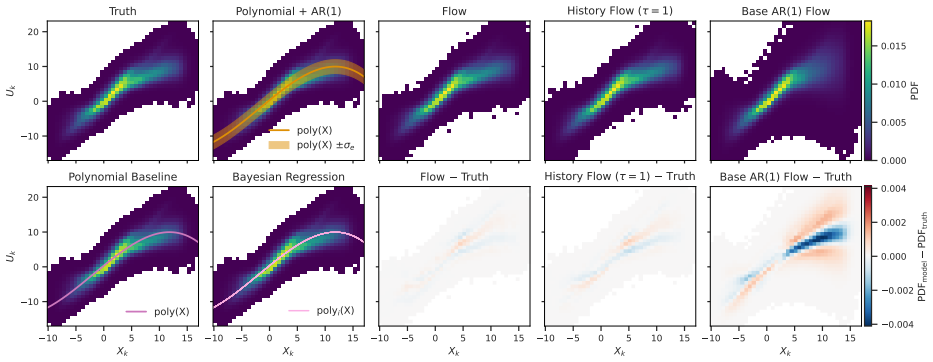
Using the two-scale Lorenz 1996 system, we design a systematic approach to disentangle intrinsic variability, initial-condition perturbations, and stochastic model uncertainty. We compare multiple ensemble configurations and parameterization strategies, including existing deterministic and autoregressive as well as novel Bayesian and flow-based approaches. Our results show that ensemble perturbations do not increase the system's long-term variance; rather, they regulate how rapidly trajectories decorrelate and explore the invariant measure. Stochastic parameterizations, particularly those with temporally persistent structure, enhance early spread growth and improve spread-error consistency.
What carries the argument
Decomposition of ensemble spread into intrinsic variability, initial-condition perturbations, and stochastic model uncertainty by comparing deterministic, autoregressive, Bayesian, and flow-based parameterizations in the two-scale Lorenz '96 system.
If this is right
- Ensemble perturbations mainly control the speed at which trajectories explore the invariant measure.
- Temporally persistent stochastic parameterizations accelerate early spread growth.
- Persistent structures in stochastic terms improve alignment between spread and forecast error.
- The decomposition offers concrete guidance for designing stochastic parameterizations in operational models.
Where Pith is reading between the lines
- The emphasis on persistence times suggests that correlation structure of noise terms could be a high-leverage tuning knob in full-scale models.
- Similar spread-decomposition experiments could be performed in other low-dimensional chaotic systems to test how far the decorrelation mechanism generalizes.
- Operational ensembles might benefit from replacing white-noise stochastic schemes with ones that carry short-term memory even if total variance is unchanged.
Load-bearing premise
The two-scale Lorenz '96 system is a sufficient controlled testbed whose uncertainty interactions generalize to real weather and climate models.
What would settle it
Running the same decomposition in a higher-fidelity global climate model and finding that ensemble perturbations increase long-term variance or that non-persistent stochastic schemes match persistent ones in spread-error consistency would falsify the central claim.
Figures


read the original abstract
Weather and climate forecasts are inherently uncertain due to chaotic dynamics, imperfect initial conditions, and incomplete representation of the underlying physical processes. Operational ensemble forecasts aim to represent these uncertainties through forecast spread, yet many approaches yield underdispersive estimates, with spread that grows too slowly relative to forecast error. Using the two-scale Lorenz 1996 system as a widely used, controlled testbed, we design a systematic approach to disentangle intrinsic variability, initial-condition perturbations, and stochastic model uncertainty. We compare multiple ensemble configurations and parameterization strategies, including existing deterministic and autoregressive as well as novel Bayesian and flow-based approaches. Our results show that ensemble perturbations do not increase the system's long-term variance; rather, they regulate how rapidly trajectories decorrelate and explore the invariant measure. Stochastic parameterizations, particularly those with temporally persistent structure, enhance early spread growth and improve spread-error consistency. Overall, we bring clarity to how different sources of uncertainty interact in a chaotic system and provide guidance for the design and evaluation of stochastic parameterizations in weather and climate models.
Editorial analysis
A structured set of objections, weighed in public.
Referee Report
Summary. The paper uses the two-scale Lorenz '96 system as a testbed to decompose sources of ensemble spread arising from initial-condition perturbations and different stochastic parameterization strategies (deterministic, autoregressive, Bayesian, and flow-based). It claims that ensemble perturbations regulate the rate at which trajectories decorrelate and explore the invariant measure without increasing long-term variance, and that temporally persistent stochastic parameterizations improve early spread growth and spread-error consistency.
Significance. If the central claims hold, the work offers a controlled, systematic framework for isolating uncertainty contributions in chaotic systems and supplies concrete guidance on the design of stochastic parameterizations for weather and climate ensembles. The explicit comparison across parameterization families and the focus on spread-error diagnostics are strengths that could inform operational ensemble design.
major comments (2)
- [Methods and Results sections] The central claim that ensemble perturbations 'do not increase the system's long-term variance' (abstract and results) rests on the implicit assumption that the learned stochastic terms preserve the invariant measure of the reference deterministic system. The manuscript does not state whether the training objectives for the Bayesian and flow-based parameterizations enforce zero conditional mean (or moment matching) with respect to the subgrid forcing; temporally persistent noise can accumulate systematic drifts that alter climatological statistics. Without explicit verification (e.g., comparison of long-term means, variances, or attractor statistics across configurations), the reported invariance of long-term variance could be an artifact of the specific training rather than a general property.
- [Experimental setup] The comparison of spread-error consistency across parameterization families would be strengthened by reporting the actual ensemble size, the precise definition of 'spread' (e.g., standard deviation of the ensemble mean or of individual members), and whether error is measured against a high-resolution truth or against the deterministic reference run. These details are necessary to assess whether the reported improvement for persistent stochastic schemes is robust or sensitive to these choices.
minor comments (2)
- [Section 2] Notation for the two-scale Lorenz '96 variables (X, Y) and the subgrid forcing term should be introduced once with a clear equation reference and then used consistently; occasional redefinition of symbols reduces readability.
- [Figures 3-5] Figure captions should explicitly state the ensemble size, forecast lead time range, and whether shaded regions represent one standard deviation across multiple realizations or across ensemble members.
Simulated Author's Rebuttal
We thank the referee for their constructive and positive review. The comments help clarify key aspects of our methodology and results. We address each major comment below and have revised the manuscript to incorporate additional details and verifications.
read point-by-point responses
-
Referee: [Methods and Results sections] The central claim that ensemble perturbations 'do not increase the system's long-term variance' (abstract and results) rests on the implicit assumption that the learned stochastic terms preserve the invariant measure of the reference deterministic system. The manuscript does not state whether the training objectives for the Bayesian and flow-based parameterizations enforce zero conditional mean (or moment matching) with respect to the subgrid forcing; temporally persistent noise can accumulate systematic drifts that alter climatological statistics. Without explicit verification (e.g., comparison of long-term means, variances, or attractor statistics across configurations), the reported invariance of long-term variance could be an artifact of the specific training rather than a general property.
Authors: We agree that explicit verification of invariant-measure preservation strengthens the central claim. Our training objectives for the Bayesian and flow-based parameterizations include explicit moment-matching terms that enforce zero conditional mean and variance matching with respect to the subgrid forcing (see Section 3). To address the concern directly, we have added a new subsection in the revised Results that compares long-term means, variances, and attractor statistics (e.g., power spectra and correlation dimensions) across all configurations, confirming that none of the stochastic schemes introduce measurable climatological drift relative to the deterministic reference. These diagnostics show that the reported invariance of long-term variance is a robust outcome rather than an artifact of training. revision: yes
-
Referee: [Experimental setup] The comparison of spread-error consistency across parameterization families would be strengthened by reporting the actual ensemble size, the precise definition of 'spread' (e.g., standard deviation of the ensemble mean or of individual members), and whether error is measured against a high-resolution truth or against the deterministic reference run. These details are necessary to assess whether the reported improvement for persistent stochastic schemes is robust or sensitive to these choices.
Authors: We appreciate the request for these operational details. In the revised manuscript we now explicitly state that all ensembles use 50 members, that spread is defined as the standard deviation of the individual ensemble members (not the ensemble-mean standard deviation), and that forecast error is computed against the deterministic reference integration at the same resolution (rather than a higher-resolution truth). These choices are consistent with the controlled nature of the Lorenz '96 testbed. We have also added a short sensitivity test confirming that the reported advantages of temporally persistent schemes remain qualitatively unchanged for ensemble sizes between 20 and 100 members. revision: yes
Circularity Check
No significant circularity; results from direct numerical experiments
full rationale
The paper conducts controlled numerical experiments on the two-scale Lorenz '96 system to compare ensemble configurations and learned stochastic parameterizations (deterministic, autoregressive, Bayesian, flow-based). Central claims about spread growth, decorrelation rates, and invariant measure exploration are presented as outcomes of simulation outputs rather than algebraic reductions or fitted quantities renamed as predictions. No equations or sections in the provided text reduce results to self-definitions, self-citations as load-bearing premises, or ansatzes smuggled via prior work. The derivation chain remains self-contained against the testbed benchmarks with independent empirical content.
Axiom & Free-Parameter Ledger
Reference graph
Works this paper leans on
-
[1]
2023, PeerJ Computer Science, 9, e1516, doi: 10.7717/peerj-cs.1516
Oriol Abril-Pla et al. “PyMC: A Modern, and Comprehensive Probabilistic Programming Framework in Python.” In:PeerJ Computer Science9 [Sept. 2023], e1516.doi:10.7717/peerj-cs.1516
-
[2]
American Meteorological Society, 2026:Climate.Glossary of Meteorology.url: https://glossary. ametsoc.org/wiki/climate/
work page 2026
-
[3]
American Meteorological Society, 2026:Climate Model.Glossary of Meteorology.url: https : / / glossary.ametsoc.org/wiki/climate-model/
work page 2026
-
[4]
American Meteorological Society, 2026:Climate Prediction.Glossary of Meteorology.url: https: //glossary.ametsoc.org/wiki/climate-prediction/
work page 2026
-
[5]
American Meteorological Society, 2026:Ensemble Forecast.Glossary of Meteorology.url: https : //glossary.ametsoc.org/wiki/ensemble-forecast/
work page 2026
-
[6]
American Meteorological Society, 2026:Forecast.Glossary of Meteorology.url: https://glossary. ametsoc.org/wiki/forecast/
work page 2026
-
[7]
American Meteorological Society, 2026:Grid.Glossary of Meteorology.url: https : / / glossary . ametsoc.org/wiki/grid/
work page 2026
-
[8]
American Meteorological Society, 2026:Lead Time.Glossary of Meteorology.url: https://glossary. ametsoc.org/wiki/lead-time/
work page 2026
-
[9]
American Meteorological Society, 2026:Model Resolution.Glossary of Meteorology.url: https : //glossary.ametsoc.org/wiki/model-resolution/
work page 2026
-
[10]
American Meteorological Society, 2026:Numerical Forecasting.Glossary of Meteorology.url:https: //glossary.ametsoc.org/wiki/numerical-forecasting/
work page 2026
-
[11]
American Meteorological Society, 2026:Parameterization.Glossary of Meteorology.url: https:// glossary.ametsoc.org/wiki/parameterization/
work page 2026
-
[12]
American Meteorological Society, 2026:Subgrid-Scale Process.Glossary of Meteorology.url:https: //glossary.ametsoc.org/wiki/subgrid-scale-process/
work page 2026
-
[13]
American Meteorological Society, 2026:Tendency.Glossary of Meteorology.url: https://glossary. ametsoc.org/wiki/tendency/
work page 2026
-
[14]
American Meteorological Society, 2026:Turbulence Closure.Glossary of Meteorology.url: https: //glossary.ametsoc.org/wiki/turbulence-closure/
work page 2026
-
[15]
American Meteorological Society, 2026:Weather.Glossary of Meteorology.url: https://glossary. ametsoc.org/wiki/weather/
work page 2026
-
[16]
American Meteorological Society, 2026:Weather Forecast.Glossary of Meteorology.url: https : //glossary.ametsoc.org/wiki/weather-forecast/
work page 2026
-
[17]
Stochastic Parametrizations and Model Uncertainty in the Lorenz ’96 System
H. M. Arnold, I. M. Moroz, and T. N. Palmer. “Stochastic Parametrizations and Model Uncertainty in the Lorenz ’96 System.” In:Philosophical Transactions of the Royal Society A: Mathematical, Physical and Engineering Sciences371.1991 [May 2013], p. 20110479.doi:10.1098/rsta.2011.0479
-
[18]
Gunnar Behrens et al. “Simulating Atmospheric Processes in Earth System Models and Quantifying Uncertainties With Deep Learning Multi-Member and Stochastic Parameterizations.” In:Journal of Advances in Modeling Earth Systems17.4 [2025], e2024MS004272.doi:10.1029/2024MS004272
-
[19]
Stochastic Parameterization: Toward a New View of Weather and Climate Models
Judith Berner et al. “Stochastic Parameterization: Toward a New View of Weather and Climate Models.” In:Bulletin of the American Meteorological Society98.3 [Mar. 2017], pp. 565–588.doi: 10.1175/BAMS-D-15-00268.1
-
[20]
H. M. Christensen, I. M. Moroz, and T. N. Palmer. “Simulating Weather Regimes: Impact of Stochastic and Perturbed Parameter Schemes in a Simple Atmospheric Model.” In:Climate Dynamics44.7 [Apr. 2015], pp. 2195–2214.doi:10.1007/s00382-014-2239-9
-
[21]
Machine Learning for Stochastic Parametrization
Hannah M. Christensen et al. “Machine Learning for Stochastic Parametrization.” In:Environmental Data Science3 [Jan. 2024], e38.doi:10.1017/eds.2024.45. 12
-
[22]
Resampling with Neural Networks for Stochastic Parameteri- zation in Multiscale Systems
Daan Crommelin and Wouter Edeling. “Resampling with Neural Networks for Stochastic Parameteri- zation in Multiscale Systems.” In:Physica D: Nonlinear Phenomena422 [Aug. 2021], p. 132894.doi: 10.1016/j.physd.2021.132894
-
[23]
Subgrid-Scale Parameterization with Conditional Markov Chains
Daan Crommelin and Eric Vanden-Eijnden. “Subgrid-Scale Parameterization with Conditional Markov Chains.” In:Journal of the Atmospheric Sciences65.8 [Aug. 2008], pp. 2661–2675.doi:10.1175/ 2008JAS2566.1
work page 2008
-
[24]
Clara Deser. ““Certain Uncertainty: The Role of Internal Climate Variability in Projections of Regional Climate Change and Risk Management”.” In:Earth’s Future8.12 [2020], e2020EF001854.doi:10. 1029/2020EF001854
work page 2020
-
[25]
Density Estimation Using Real NVP
Laurent Dinh, Jascha Sohl-Dickstein, and Samy Bengio. “Density Estimation Using Real NVP.” In: International Conference on Learning Representations. Feb. 2017
work page 2017
-
[26]
Stochastic Parameterization of Shallow Cumulus Convection Estimated from High-Resolution Model Data
Jesse Dorrestijn et al. “Stochastic Parameterization of Shallow Cumulus Convection Estimated from High-Resolution Model Data.” In:Theoretical and Computational Fluid Dynamics27.1 [Feb. 2013], pp. 133–148.doi:10.1007/s00162-012-0281-y
-
[27]
David John Gagne II et al. “Machine Learning for Stochastic Parameterization: Generative Adversarial Networks in the Lorenz ’96 Model.” In:Journal of Advances in Modeling Earth Systems12.3 [2020], e2019MS001896.doi:10.1029/2019MS001896
-
[28]
Rood.Demystifying Climate Models
Andrew Gettelman and Richard B. Rood.Demystifying Climate Models. Vol. 2. Earth Systems Data and Models. Berlin, Heidelberg: Springer Berlin Heidelberg, 2016.doi:10.1007/978-3-662-48959-8
-
[29]
Georg A. Gottwald, Daan T. Crommelin, and Christian L. E. Franzke. “Stochastic Climate Theory.” In: Nonlinear and Stochastic Climate Dynamics. Ed. by Christian L. E. Franzke and Terence J. O’Kane. Cambridge: Cambridge University Press, 2017, pp. 209–240.doi:10.1017/9781316339251.009
-
[30]
Deep Learning Based Cloud Cover Parameterization for ICON
Arthur Grundner et al. “Deep Learning Based Cloud Cover Parameterization for ICON.” In:Journal of Advances in Modeling Earth Systems14.12 [2022].doi:10/gs5rbs
work page 2022
-
[31]
Flexible Tails for Normalizing Flows
Tennessee Hickling and Dennis Prangle. “Flexible Tails for Normalizing Flows.” In:Forty-Second International Conference on Machine Learning. June 2025
work page 2025
-
[32]
The No-U-Turn Sampler: Adaptively Setting Path Lengths in Hamiltonian Monte Carlo
Matthew D. Hoffman and Andrew Gelman. “The No-U-Turn Sampler: Adaptively Setting Path Lengths in Hamiltonian Monte Carlo.” In:Journal of Machine Learning Research15.47 [2014], pp. 1593–1623
work page 2014
-
[33]
Tails of Lipschitz Triangular Flows
Priyank Jaini et al. “Tails of Lipschitz Triangular Flows.” In:Proceedings of the 37th International Conference on Machine Learning. PMLR, Nov. 2020, pp. 4673–4681
work page 2020
-
[34]
Adam: A Method for Stochastic Optimization
Diederik P. Kingma and Jimmy Ba, 2017:Adam: A Method for Stochastic Optimization.url:http: //arxiv.org/abs/1412.6980
work page internal anchor Pith review Pith/arXiv arXiv 2017
-
[35]
Chapter 11 - Near-term Climate Change: Projections and Predictability
B. Kirtman et al. “Chapter 11 - Near-term Climate Change: Projections and Predictability.” In: ed. by IPCC. Cambridge: Cambridge University Press, 2013
work page 2013
-
[36]
Flavio Lehner and Clara Deser. “The Importance of Internal Variability for the Uncertainty in Climate Change Projections and Decision-Making.” In:Uncertainty in Climate Change Research: An Integrated Approach. Ed. by Linda O. Mearns et al. Cham: Springer Nature Switzerland, 2025, pp. 177–183.doi: 10.1007/978-3-031-85542-9_17
-
[37]
Partitioning Climate Projection Uncertainty with Multiple Large Ensembles and CMIP5/6
Flavio Lehner et al. “Partitioning Climate Projection Uncertainty with Multiple Large Ensembles and CMIP5/6.” In:Earth System Dynamics11.2 [May 2020], pp. 491–508.doi:10.5194/esd-11-491-2020
-
[38]
M. Leutbecher and T. N. Palmer. “Ensemble Forecasting.” In:Journal of Computational Physics. Predicting Weather, Climate and Extreme Events 227.7 [Mar. 2008], pp. 3515–3539.doi:10.1016/j. jcp.2007.02.014
work page doi:10.1016/j 2008
-
[39]
Stochastic Representations of Model Uncertainties at ECMWF: State of the Art and Future Vision
Martin Leutbecher et al. “Stochastic Representations of Model Uncertainties at ECMWF: State of the Art and Future Vision.” In:Quarterly Journal of the Royal Meteorological Society143.707 [2017], pp. 2315–2339.doi:10.1002/qj.3094
-
[40]
Jerry Lin et al. “Navigating the Noise: Bringing Clarity to ML Parameterization Design With \boldsym- bol\mathcalO\(100) Ensembles.” In:Journal of Advances in Modeling Earth Systems17.4 [2025], e2024MS004551.doi:10.1029/2024MS004551
-
[41]
Christopher Bishop.Pattern Recognition and Machine Learning
Edward N. Lorenz. “Deterministic Nonperiodic Flow.” In:Journal of the Atmospheric Sciences20.2 [Mar. 1963], pp. 130–141.doi:10.1175/1520-0469(1963)020<0130:DNF>2.0.CO;2
-
[42]
Predictability – a Problem Partly Solved
Edward N. Lorenz. “Predictability – a Problem Partly Solved.” In:Predictability of Weather and Climate. Ed. by Renate Hagedorn and Tim Palmer. Cambridge: Cambridge University Press, 2006, pp. 40–58. doi:10.1017/CBO9780511617652.004. 13
-
[43]
Characterizing Uncertainty in Deep Convection Triggering Using Explainable Machine Learning
Greta A. Miller, Philip Stier, and Hannah M. Christensen. “Characterizing Uncertainty in Deep Convection Triggering Using Explainable Machine Learning.” In:Journal of the Atmospheric Sciences 82.6 [May 2025], pp. 1093–1111.doi:10.1175/JAS-D-24-0085.1
-
[44]
Paul A. O’Gorman and John G. Dwyer. “Using Machine Learning to Parameterize Moist Convection: Potential for Modeling of Climate, Climate Change, and Extreme Events.” In:Journal of Advances in Modeling Earth Systems10.10 [2018], pp. 2548–2563.doi:10/gfdc2j
work page 2018
-
[45]
Stochastic Parametrization and Model Uncertainty
T. N. Palmer et al. “Stochastic Parametrization and Model Uncertainty.” In:ECMWF Technical Memorandum598 [2009]
work page 2009
-
[46]
Tim Palmer. “The ECMWF Ensemble Prediction System: Looking Back (More than) 25 Years and Projecting Forward 25 Years.” In:Quarterly Journal of the Royal Meteorological Society145.S1 [2019], pp. 12–24.doi:10.1002/qj.3383
-
[47]
Masked Autoregressive Flow for Density Estimation
George Papamakarios, Theo Pavlakou, and Iain Murray. “Masked Autoregressive Flow for Density Estimation.” In:Advances in Neural Information Processing Systems. Vol. 30. Curran Associates, Inc., 2017
work page 2017
-
[48]
Raghul Parthipan et al. “Using Probabilistic Machine Learning to Better Model Temporal Patterns in Parameterizations: A Case Study with the Lorenz 96 Model.” In:Geoscientific Model Development 16.15 [Aug. 2023], pp. 4501–4519.doi:10.5194/gmd-16-4501-2023
-
[49]
Stephan Rasp. “Coupled Online Learning as a Way to Tackle Instabilities and Biases in Neural Network Parameterizations: General Algorithms and Lorenz 96 Case Study (v1.0).” In:Geoscientific Model Development13.5 [May 2020], pp. 2185–2196.doi:10.5194/gmd-13-2185-2020
-
[50]
Deep Learning to Represent Subgrid Processes in Climate Models
Stephan Rasp, Michael S. Pritchard, and Pierre Gentine. “Deep Learning to Represent Subgrid Processes in Climate Models.” In:Proceedings of the National Academy of Sciences115.39 [Sept. 2018], pp. 9684– 9689.doi:10/gfcpxb
work page 2018
-
[51]
Climate Goals and Computing the Future of Clouds
Tapio Schneider et al. “Climate Goals and Computing the Future of Clouds.” In:Nature Climate Change 7.1 [Jan. 2017], pp. 3–5.doi:10/gf9pkz
work page 2017
-
[52]
Smith.Uncertainty Quantification: Theory, Implementation, and Applications
Ralph C. Smith.Uncertainty Quantification: Theory, Implementation, and Applications. Computational Science & Engineering. Philadelphia: Society for Industrial and Applied Mathematics, 2014
work page 2014
-
[53]
Climate Model Projections from the Scenario Model Intercomparison Project (ScenarioMIP) of CMIP6
Claudia Tebaldi et al. “Climate Model Projections from the Scenario Model Intercomparison Project (ScenarioMIP) of CMIP6.” In:Earth System Dynamics12.1 [Mar. 2021], pp. 253–293.doi:10/gh6k9m
work page 2021
-
[54]
Conditional Density Estimation with Bayesian Normalising Flows
Brian L. Trippe and Richard E. Turner, 2018:Conditional Density Estimation with Bayesian Normalising Flows.url:http://arxiv.org/abs/1802.04908
work page internal anchor Pith review Pith/arXiv arXiv 2018
-
[55]
Effects of Stochastic Parametrizations in the Lorenz ’96 System
Daniel S. Wilks. “Effects of Stochastic Parametrizations in the Lorenz ’96 System.” In:Quarterly Journal of the Royal Meteorological Society131.606 [Jan. 2005], pp. 389–407.doi:10.1256/qj.04.03
-
[56]
Forced Component Estimation Statistical Method Intercomparison Project (ForceSMIP)
Robert C. J. Wills et al. “Forced Component Estimation Statistical Method Intercomparison Project (ForceSMIP).” In:Journal of Climate39.8 [Apr. 2026], pp. 1927–1953.doi:10.1175/JCLI- D- 25- 0326.1
-
[57]
Yi Wu et al. “Quantifying the Uncertainty Sources of Future Climate Projections and Narrowing Uncertainties With Bias Correction Techniques.” In:Earth’s Future10.11 [2022], e2022EF002963.doi: 10.1029/2022EF002963
-
[58]
Janni Yuval and Paul A. O’Gorman. “Stable Machine-Learning Parameterization of Subgrid Processes for Climate Modeling at a Range of Resolutions.” In:Nature Communications11.1 [July 2020].doi: 10/gngc7t
work page 2020
-
[59]
Uncertainty in Projection of Climate Extremes: A Comparison of CMIP5 and CMIP6
Shaobo Zhang and Jie Chen. “Uncertainty in Projection of Climate Extremes: A Comparison of CMIP5 and CMIP6.” In:Journal of Meteorological Research35.4 [Aug. 2021], pp. 646–662.doi: 10.1007/s13351-021-1012-3. 14 Decomposing Ensemble Spread in Lorenz ’96 With Learned Stochastic Parameterizations Appendix A Glossary B Flow Variations Tail flow.As an addition...
discussion (0)
Sign in with ORCID, Apple, or X to comment. Anyone can read and Pith papers without signing in.