REVIEW 4 major objections 6 minor 16 references
Simulating Human Behavior with the Psychological-mechanism Agent: Integrating Feeling, Thought, and Action
T0 review · 4 major / 6 minor · reviewed 2026-08-07 · deepseek-v4-flash
Pith's one-line read A three-module agent architecture layers short- and long-term affect with goal-directed and wandering thought and reproduces classic psychology experiment results.
desk verdict Architectural integration is new, but validation is post-hoc and the human-participant claim is unsupported. read the letter →
The pith
A machine-rendered reading of the paper's core claim, the machinery that carries it, and where it could break.
The reading
What carries the argument
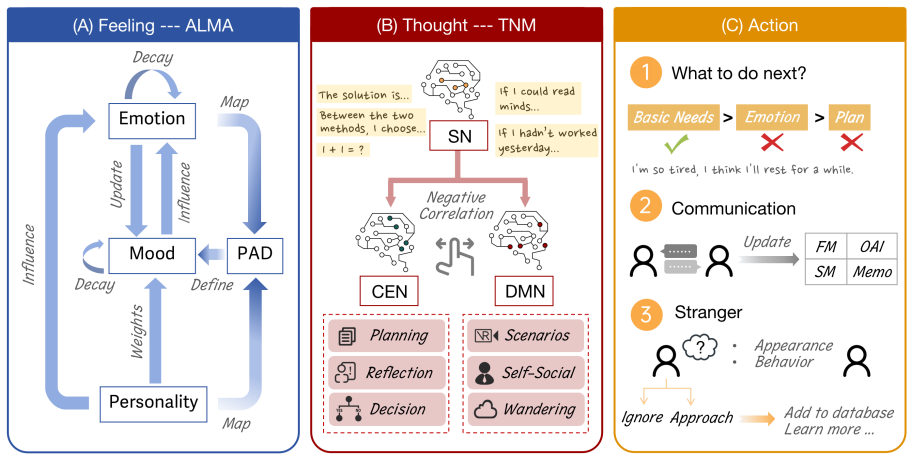
The load-bearing machinery is the coupling of the Layered Model of Affect (ALMA) with the Triple Network Model (TNM). ALMA maps six basic emotions, mood, and Big-Five personality into a PAD (Pleasure-Arousal-Dominance) space; individual emotions decay, and their intensity-weighted sum forms a 'virtual emotion center' that slowly drags mood in PAD space, which is why failed escape attempts accumulate into persistent helplessness rather than bouncing back. TNM splits the agent's thought into a Central Executive Network (goal-directed planning, reflection, and decision), a Default Mode Network (scenario simulation, self-social cognition, and mind-wandering), and a Salience Network that switches between the two with random disturbances. The action module then combines graded needs, current emotion, and plan priority through a hybrid policy $\pi(s) = \arg\max(P_t, P_n, P_e)$ when the maximum exceeds a threshold, otherwise following the schedule. The role of this machinery is to make behavior temporally coherent (emotions persist), socially sensitive (self-image and others' perspectives enter decisions), and naturally noisy (mind-wandering and mode switches add variability).
What would settle it
Run PSYA-Full on a classic experiment it was not selected or tuned for—for example, Asch's line-judgment conformity or Milgram's obedience paradigm—without modifying the prompts. If the human pattern fails to appear while the five tuned experiments still reproduce, then the framework is reproducing its tuned task descriptions rather than a general psychological mechanism; conversely, checking the NE group's traced emotions (Figure A5) for the predicted monotone decline in happiness and rise in sadness/anger/fear would test whether ALMA accumulation is genuinely the cause of the helplessness effect.
Extended reading notes
Core claim
On the paper's own terms, the discovery is that a Cognitive-Triangle agent—Feeling, Thought, Action—can replicate the headline results of classic human experiments when each module plays its assigned role. The Feeling module uses ALMA: emotions decay, accumulate into a 'virtual emotion center,' and shift mood in PAD space, so that inescapable noise produces lingering negative affect and passivity rather than a quick return to baseline. The Thought module separates CEN (planning, reflection, decision) from DMN (scenario simulation, self-social cognition, mind-wandering) with a salience network that switches modes and injects randomness; this lets agents anticipate future events, weigh self-image, and think off-task, which the ablations tie to specific effects—DMN scenario simulation to the bystander effect, DMN self-social cognition to foot-in-the-door compliance and social-exclusion responses, mind-wandering to behavioral diversity. With the full framework, escape-group failure in learned helplessness reaches 55% (human 50%), foot-in-the-door compliance 55.6% (human 52.8%), and bystander helping rates 92/69/31% across 2/3/6-person groups (human 85/62/31%). The authors thus claim PSYA 'provides an alternative to human participants in psychological experiments,' with the module-wise ablations as the evidence that the psychological mechanisms, not the underlying LLM, are doing the work.
Load-bearing premise
The load-bearing premise is that a text description of an experimental task given to an LLM agent preserves the psychological meaning of the original human setup—that helplessness, compliance, and diffusion of responsibility survive the swap of physical stimuli and response times for natural-language descriptions and action sequences.
Editorial extensions
If this is right
- If PSYA works as claimed, generative agents can serve as low-cost, ethically safer stand-ins for human participants in psychological studies that involve stress, deception, or social exclusion.
- Each module's ablation results pin specific psychological phenomena to specific machinery: ALMA to learned helplessness, DMN scenario simulation to diffusion of responsibility, DMN self-social cognition to foot-in-the-door and social exclusion, and mind-wandering to behavioral diversity—so future agent designers can add modules selectively.
- The extended experiments (stronger control loss, door-in-the-face, hierarchical groups, bystander observers) show the framework can generate testable hypotheses about behavior—for example, that hierarchy changes responsibility diffusion—before they are run with human subjects.
- The cognitive dissonance replication only succeeded after adding a value system ('an activity is either meaningful or earns money, otherwise not worth doing'), implying that PSYA-style agents may require explicit value prompts to show motivation-dependent attitude change.
Reading between the lines
- The strongest reading of the authors' claim—that PSYA 'offers an alternative to human participants'—is best treated as covering directional group differences rather than exact effect sizes: the cognitive dissonance case required prompt surgery and a hand-added value system, so transfer to new experiments likely demands similar engineering per study.
- A testable extension the paper leaves implicit: the DMN's stochastic mode-switching could be compared against simple random plan perturbation to check whether the brain-inspired switching adds predictive value beyond generic stochasticity.
- Because the paper replaces human response-time measures with ordered action sequences (six steps), the framework's correspondence is about choice patterns, not reaction timing; a longitudinal daily-life study with logged action timestamps would test whether the agents' hesitation dynamics also match human data.
- The emergent emotions (guilt, gratitude) that appear only in agents' reflection traces suggest the LLM's priors are contributing content beyond the six designed emotions; ablating the reflection module and observing whether guilt-driven door-in-the-face compliance disappears would isolate how much of the 'emotional' result is architecture versus language-model priors.
Editorial analysis
A structured set of objections, weighed in public.
Referee Report
Summary. The paper proposes the Psychological-mechanism Agent (PSYA), a generative-agent framework whose architecture is organized around the Cognitive Triangle of Feeling, Thought, and Action. The Feeling module uses the ALMA layered affect model to combine short-term emotion, medium-term mood, and long-term personality in PAD space; the Thought module maps planning, reflection, and decision-making onto the Central Executive Network and introduces a Default Mode Network for scenario simulation, self-social cognition, and mind-wandering; the Action module combines these with needs and plans through a priority-based decision policy. The authors evaluate PSYA in a daily-life simulation with human-rated metrics and in five classic psychology experiments (learned helplessness, cognitive dissonance, foot-in-the-door, social exclusion, and diffusion of responsibility), reporting that the full framework replicates human outcomes and offering the framework as an alternative to human participants in psychological experiments.
Significance. If the causal claims were established, this would be a useful contribution to social simulation and computational psychology: the architecture is psychologically motivated, the extension of evaluation to self-, one-, and group-influence is sensible, and the manuscript is unusually transparent about the initial failure of its cognitive-dissonance simulation, about the need for prompt and value-system adjustments, and about the framework's limitations in modeling emotions such as regret and shame. The extensive appendices also document the experimental protocols and ablation variants in detail. However, the central claim that the Feeling-Thought-Action architecture causes the successful replications is not supported by the current evidence: the cognitive-dissonance result was obtained only after post-hoc prompt and value-system tuning, the baseline is confounded with prompt framing, the free parameters of the decision and emotion models are not reported, and the agent-level results lack variance information and statistical testing.
major comments (4)
- [Appendix G.2 and §4.3] The cognitive-dissonance replication is post-hoc fitted rather than predictive. The appendix states that, regardless of framework, 'none of them successfully replicated the human results,' and that the authors then 'adjusted the prompts' and introduced an ad hoc value system ('An activity is either meaningful or can earn an appropriate amount of money; otherwise, it is not worth doing') before obtaining the target pattern in Table A4 and Figure A7. This value rule is not derived from the Feeling, Thought, or Action modules, and the prompts were changed after observing the failure, so the favorable results cannot be used as evidence that PSYA replicates the effect. A falsifiable test would require the prompts and value system to be fixed before simulation or validated on a different, out-of-sample experiment.
- [§4.1, §4.4, §4.5, Appendices G.3.2 and G.5.2] The PSYA-Based (GA) baseline is not a clean control. The paper defines it as the standard Generative Agent framework lacking the hierarchical emotion model and DMN modules, but the simulation protocols given to the agents embed the target psychological constructs and differ in framing (for example, the foot-in-the-door simulation adds a combined Simulate and Self-Judge framework in Appendix G.3.2). Differences between PSYA-Full and PSYA-Based can therefore be due to richer prompt content or to the fact that Llama-3-70B has been trained on these canonical experiments and their known outcomes, rather than to the modules themselves. The claims in §4.4 and §4.5 that the DMN scenario-simulation and self-social-cognition modules cause the observed effects are not supported unless the prompts are held identical except for the module under test.
- [§4.1, Tables A5 and A7, Figures 2 and 3] The quantitative evidence rests on very small samples with no reported variance or inferential statistics. For instance, 36 agents divided into four conditions gives nine agents per condition, so the reported foot-in-the-door compliance rates of 55.6% versus 5.6% correspond to differences of a few agents; similarly, 26 agents divided into three group-size conditions gives small cells in the diffusion-of-responsibility experiment. The paper says 'All experiments were repeated ten times and the average values were taken,' but no distribution, confidence interval, or test statistic is reported for the agent results, and the p-values cited in §4.4 and §4.5 are either for the human comparisons or lack any methodological detail. Without this information, the claim that PSYA 'successfully replicates' human experimental outcomes is not quantitatively assessable.
- [§3.2.1, Appendix A.2, Appendix D] The decision policy in Eq. (1), the emotion and mood update rules in Appendix A.2, and the DMN function selection rules in Appendix D depend on a large set of free parameters—decision threshold τ, task-priority weight α, need-function coefficients β, γ, δ and n_min, emotion-priority parameter e_max, emotion and mood decay rates, and DMN selection probabilities—but the manuscript reports neither the values used nor any sensitivity analysis. Given that the cognitive-dissonance experiment also required a separately introduced value-system prompt, the reported matches to human data could plausibly result from parameter or prompt fitting rather than from the architecture. The causal claim that the Feeling-Thought-Action structure drives the replication needs at least a sensitivity analysis and, preferably, parameter values fixed before the simulations.
minor comments (6)
- [Abstract and §1] The abstract says the framework 'offers an alternative to human participants in psychological experiments,' while the Ethics Statement says it 'is not intended to replace human participants in psychological experiments but to complement existing methods'; this contradiction should be resolved.
- [§4.2] The heading 'Daliy life simulate' contains spelling errors; 'Daliy' should be 'Daily' and 'simulate' should be 'simulation.' Similar typos appear in the introduction ('provid an alternative') and abstract ('selection five classic').
- [§4.1 and Appendix E] The statement that all experiments were repeated ten times and averaged is ambiguous about whether the 20–36 agents per experiment are per repetition or total; the sample sizes in Tables A4–A7 should be clarified.
- [Figures 2 and 3] The figures referenced in the foot-in-the-door and diffusion-of-responsibility sections need error bars or confidence intervals, and the captions should state the number of agents per condition and the aggregation rule.
- [General] No code, prompts, parameter values, or data are provided in the manuscript; given that the results depend on undisclosed prompt details and free parameters, a public repository is needed for reproducibility.
- [References] The Gebhard reference contains a typo ('F ourth'), and several references lack complete publisher information or venue details; the reference list should be carefully formatted.
Circularity Check
Cognitive-dissonance 'replication' was achieved only after prompt adjustments and an ad hoc value system, making that central result fitted rather than predicted.
-
fitted input called prediction
[Section 4.3 'Self-influence' and Appendix G.2 'Cognitive Dissonance']
"By modifying the prompts and introducing a value system, we successfully replicated the human experimental results. 'we adjusted the prompts so that agents could select specific actions to alleviate dissonance' and 'To address this, we introduced a value system for the agents: "An activity is either meaningful or can earn an appropriate amount of money; otherwise, it is not worth doing." With this new condition, we repeated the experiment.'"
The paper first reports that 'Regardless of the framework used, none of them successfully replicated the human results.' The target pattern was then engineered: agents were prompted to take dissonance-alleviating actions, and a value rule was added specifically because 'the large model did not factor in the monetary reward, resulting in the agents failing to distinguish between experimental conditions.' The subsequent one-dollar-over-twenty-dollar pattern is therefore built into the intervention rather than predicted by the PSYA modules. The replication claim for cognitive dissonance reduces, by the paper's own account, to a post-hoc fit.
full rationale
Most of the evaluation is a legitimate external-benchmark comparison: the learned-helplessness, foot-in-the-door, social-exclusion, and diffusion-of-responsibility simulations use human data as targets and compare ablation variants. That design is self-contained and not circular. The one clear circularity is the cognitive-dissonance experiment, where the paper's own appendix documents initial failure followed by prompt adjustment and an added value system before reporting a successful replication; the reported pattern is thus a fitted outcome. The GA/PSYA ablation also confounds prompt content with module differences, but that is a control weakness rather than a definitional circularity. No load-bearing self-citation chain was found; cited psychological models (ALMA, Triple Network) are external. Overall score reflects partial circularity confined to one central replication claim.
Assumptions & free parameters
free parameters (7)
- Decision threshold tau =
Not reported
- Task priority weight alpha =
Not reported
- Need function parameters beta, gamma, delta, n_min =
Not reported
- Emotion priority parameters e_max =
Not reported
- Emotion and mood decay rates =
Not reported
- Value-system prompt for cognitive dissonance =
An activity is either meaningful or can earn an appropriate amount of money; otherwise, it is not worth doing.
- DMN selection rule probabilities =
Not reported
assumptions (6)
- domain assumption The Cognitive Triangle (Beck 2011) is a valid model for simulating human behavior.
- domain assumption ALMA layered affect model and its PAD mappings (including Mehrabian 1996 weights) are valid transpositions to LLM agents.
- domain assumption The Triple Network Model with mutual inhibition and SN gatekeeping is an appropriate computational metaphor for agent thought.
- domain assumption Llama-3-70B can faithfully implement the designed emotional and cognitive processes and produce stable behaviors.
- domain assumption The human benchmark results from the cited classic studies are accurate and applicable to the agent simulations.
- domain assumption Six basic emotions with fixed PAD values (Table A3) are sufficient to capture the relevant affect.
invented entities (2)
-
PSYA framework (integrated agent architecture)
-
Virtual emotion center M_c in PAD space
Cite this review
Pith. "Pith review of Simulating Human Behavior with the Psychological-mechanism Agent: Integrating Feeling, Thought, and Action." pith.science (2026). https://pith.science/paper/B7I26S2X
@misc{pith2026250719495,
  author       = {Pith},
  title        = {Pith review of: Simulating Human Behavior with the Psychological-mechanism Agent: Integrating Feeling, Thought, and Action},
  year         = {2026},
  howpublished = {\url{https://pith.science/paper/B7I26S2X}},
  note         = {Machine review of arXiv:2507.19495}
}
read the original abstract
Generative agents have made significant progress in simulating human behavior, but existing frameworks often simplify emotional modeling and focus primarily on specific tasks, limiting the authenticity of the simulation. Our work proposes the Psychological-mechanism Agent (PSYA) framework, based on the Cognitive Triangle (Feeling-Thought-Action), designed to more accurately simulate human behavior. The PSYA consists of three core modules: the Feeling module (using a layer model of affect to simulate changes in short-term, medium-term, and long-term emotions), the Thought module (based on the Triple Network Model to support goal-directed and spontaneous thinking), and the Action module (optimizing agent behavior through the integration of emotions, needs and plans). To evaluate the framework's effectiveness, we conducted daily life simulations and extended the evaluation metrics to self-influence, one-influence, and group-influence, selection five classic psychological experiments for simulation. The results show that the PSYA framework generates more natural, consistent, diverse, and credible behaviors, successfully replicating human experimental outcomes. Our work provides a richer and more accurate emotional and cognitive modeling approach for generative agents and offers an alternative to human participants in psychological experiments.
Figures


Reference graph
Works this paper leans on
-
[1]
Emotion P A D Happiness 0.4 0.2 0.1 Sadness -0.6 -0.4 -0.5 Anger -0.51 0.59 0.25 Fear -0.64 0.6 -0.43 Disgust -0.4 0.2 0.1 Surprise 0.2 0.5 0.1 Table A3: PAD values for basic emotions (Gebhard, 2005). A.2 Mapping Relationships Map personality into the PAD spaceThe initial mapping of emotions to the PAD space is based on the definition of personality trait...
work page 2005
- [2]
-
[3]
Afspp: Agent framework for shaping preference and personality with large language models.arXiv preprint arXiv:2401.02870. D. Huang, Q. Bu, J. M. Zhang, and et al
-
[6]
Evolving agents: In- teractive simulation of dynamic and diverse human personalities.arXiv preprint arXiv:2404.02718. R. R. McCrae and O. P. John
-
[8]
From individual to society: A survey on social simu- lation driven by large language model-based agents. Preprint, arXiv:2412.03563. N.G. Muller and R.T. Knight
-
[10]
Simulating human-like daily activities with desire-driven auton- omy.arXiv preprint arXiv:2412.06435. Z. Wang, Y . Y . Chiu, and Y . C. Chiu
-
[11]
Humanoid agents: Platform for simulating human-like genera- tive agents.arXiv preprint arXiv:2310.05418. Lisa Zadro, Kipling D. Williams, and Rick Richard- son
-
[15]
a" represents the phase when the indicator light is on, and
The initial value of energy is set to 1, while the other four needs are ini- tialized at 0.5. Additionally, the agents’ emotions are defined with seven types: happiness, sadness, anger, fear, disgust, and surprise, all of which have a range from 0 to 1, with an initial value of 0.5. C Memory Our study adopts a hybrid structure of long and short-term memor...
work page 1967
Show all 16 references
-
[20]
participant
Control -3.9 2.2 2.8 -4 One Dollar -3.6 1.8 2.3 -3.8 Twenty Dollars -4.1 2.1 2.4 -3.8 Table A6: Results of Enjoyability, Learning, Scientific Importance, and Participation Across Human and PSYA Models. GA refers to Generative Agent. the PSY-based framework, which lacks an emo-...
1964
-
[1996]
virtual emotion center,
established the mapping relationships between the Big Five personal- ity traits and the PAD dimensions as follows: Mk =W T k C where k∈[P, A, D] , and W represents the weight vector for each dimension, defined as: WP = [0.21,0.59,0.19,0,0] , WA = [0,0.30,−0.57,0.15,0] , WD = [...
2005
-
[2004]
How low can you go? ostracism by a computer is sufficient to lower self-reported levels of belonging, control, self-esteem, and meaningful ex- istence.Journal of Experimental Social Psychology, 40(4):560–567. H. Zhang, J. Yin, M. Jiang, et al. 2024a. Can agents spontaneously f...
-
[2009]
L Q Uddin
The common neural basis of autobiographical memory, prospection, navigation, theory of mind, and the de- fault mode: a quantitative meta-analysis.Journal of Cognitive Neuroscience, 21:489–510. L Q Uddin. 2016.Salience network of the human brain. Academic Press. P. Vannini, J. ...
2016
-
[2013]
The costs and benefits of mind-wandering: a review.Canadian Journal of Experimental Psychology/Revue canadi- enne de psychologie expérimentale, 67(1):11. W. N. Morris. 1989.Mood: The Frame of Mind. Springer-Verlag, New York. Xinyi Mou, Xuanwen Ding, Qi He, Liang Wang, Jing- co...
1989
-
[2016]
purposeful
Mind-wandering is unguided at- tention: Accounting for the “purposeful” wanderer. Philosophical Studies, 173:547–571. Irving L. Janis. 1972.Victims of Groupthink: A Psy- chological Study of F oreign-Policy Decisions and Fiascoes. Houghton Mifflin. Etienne Koechlin and Christop...
1972
-
[2023]
Agent- coder: Multi-agent-based code generation with it- erative testing and optimisation.arXiv preprint, arXiv:2312.13010. Z. C. Irving
-
[2024]
Researchagent: Iterative research idea generation over scientific literature with large language models.Preprint, arXiv:2404.07738. J. S. Beck
Reviewed August 7, 2026 · model on record in the stance chip above.
Discussion (0). Sign in to comment.