REVIEW 3 major objections 5 minor 34 references
DIY-MKG: An LLM-Based Polyglot Language Learning System
T0 review · 3 major / 5 minor · reviewed 2026-08-06 · deepseek-v4-flash
Pith's one-line read The paper argues that a user-built multilingual knowledge graph, with LLM-suggested words chosen by the learner, gives reliable vocabulary expansion and mostly accurate quizzes across three languages.
desk verdict A genuinely useful open-source polyglot vocabulary tool with an honest design, wrapped in an evaluation section that overreaches on quiz accuracy because the only judge is another LLM. read the letter →
The pith
A machine-rendered reading of the paper's core claim, the machinery that carries it, and where it could break.
The reading
What carries the argument
The central object is the multilingual knowledge graph (MKG): a graph whose nodes are words, whose edges record linguistic or personal connections between words across languages, and whose hyper-edges attach documents such as quizzes. Its load-bearing property is that it is built selectively by the learner rather than filled automatically, so LLM expansions and quiz items enter only through human choice and can be flagged when wrong. The three mechanisms that carry the argument are the expansion prompt, which asks the LLM for related words in the same language or another language; click counts as a proxy for how well each word is known, which drives the review schedule; and the question-flagging loop, which converts evaluation failures into data for prompt refinement. The evaluation scripts and data are released so the same checks can be rerun on other models.
What would settle it
Have native speakers of Spanish, Korean, and Japanese independently grade the 300 generated question-answer pairs; if their pass rates fall materially below the 76-98% reported by the automated judge, or the human raters disagree with one another, then the paper's accuracy claim is not established.
Extended reading notes
Core claim
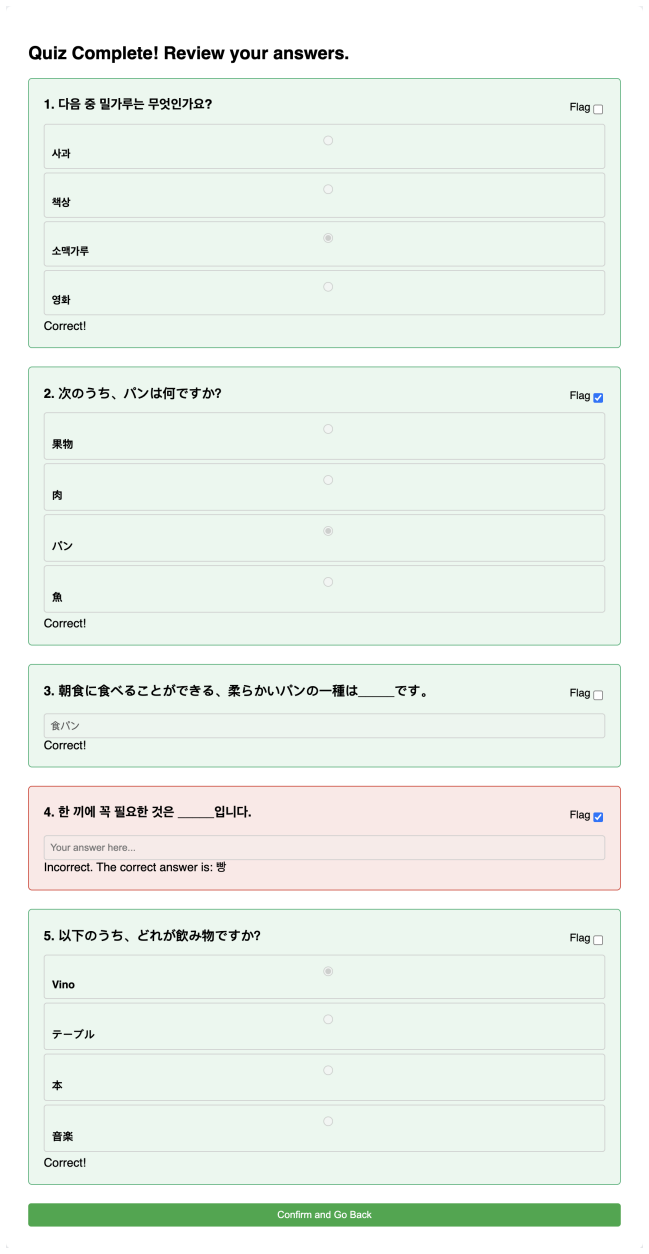
DIY-MKG's core claim is that vocabulary acquisition can be organized around a learner-owned multilingual knowledge graph in which LLM suggestions are a creative but controlled ingredient. The evaluation, run with a temperature-zero instruction-tuned LLM, shows the vocabulary-expansion prompt repeatedly finds new related words over 500 iterations without saturation, reaching roughly 3,000 words per language with small variance across languages and starting words. For adaptive review, multiple-choice question-answer pairs are correct 98% of the time in all three tested languages, while fill-in-the-blank pairs are correct 82%, 84%, and 76% for Spanish, Korean, and Japanese, respectively; manual inspection attributes the failures to ambiguous questions rather than wrong answers. The paper's design response is question flagging, which saves bad items locally and feeds prompt refinement. Taken together, the authors claim this validates the reliability of DIY-MKG as a support system, not as a replacement for the learner.
Load-bearing premise
The accuracy claims rest on the assumption that the automated judge used to grade whether a generated question-answer pair is correct is itself trustworthy, since no human grader or agreement check is reported.
Editorial extensions
If this is right
- Vocabulary expansion does not plateau quickly: after 500 iterations the graph still gains new words, so a learner can keep using the system long-term.
- Results are consistent across Spanish, Korean, and Japanese and across different starting words, so the tool is fair to learners of these languages.
- Multiple-choice quizzes are dependable enough for self-testing at 98% accuracy in all three languages.
- Fill-in-the-blank quizzes are usable but require oversight; the 16-24% error rate is handled by flagging rather than by trusting the LLM.
- Because all data is saved locally in JSON, a learner can version-control their knowledge graph and export it for analysis.
Reading between the lines
- The design's real test is whether cross-lingual edges improve retention over list-based apps; the paper measures generation quality, not learning outcomes, so a controlled user study would be the natural next experiment.
- The flagging loop could be automated: if flagged questions accumulate, the system could cluster failure modes and rewrite the quiz prompt or filter by part of speech, something the paper lists as future work rather than a demonstrated feature.
- The same selective-expansion pattern may transfer to fields beyond language learning, such as medical or legal terminology, where a learner-curated graph of related concepts could replace predefined flashcard decks.
- Click counts are a plausible but unvalidated proxy for memory strength; correlating them with spaced-repetition recall data would show whether the review scheduler is genuinely adaptive.
Editorial analysis
A structured set of objections, weighed in public.
Referee Report
Summary. The paper presents DIY-MKG, a modular, open-source language-learning system in which learners build a personalized multilingual knowledge graph. The system uses LLM prompts to suggest related words for selective expansion, supports node-, edge-, and hyper-edge-level annotations, and provides adaptive reviewing through click counts and LLM-generated multiple-choice and fill-in-the-blank quizzes, with a user-flagging mechanism for identifying bad items. The authors evaluate the two LLM-based components: vocabulary expansion is simulated for Spanish, Korean, and Japanese across 10 starting words and 500 iterations, and 300 quiz questions are judged for correctness by GPT-4.1. The reported results are monotonic vocabulary growth that does not saturate, small variance across languages and starting words, 98% multiple-choice accuracy, and fill-in-the-blank accuracies of 76-84%, from which the abstract concludes that the LLM components are reliable and highly accurate.
Significance. If the evaluation were independently validated, DIY-MKG would be a useful contribution to computer-assisted language learning: it is open-source under an MIT license, it releases the evaluation scripts and data, and its design addresses a real gap for polyglot vocabulary learning while incorporating a defensible mechanism against cognitive offloading through user selection and question flagging. The knowledge-graph visualization and annotation features are well motivated by the vocabulary acquisition literature. However, the current evidence does not establish the abstract's validation claim: the quiz-correctness measurement depends entirely on an LLM judge, and the vocabulary-expansion simulation checks neither the lexical validity nor the semantic relatedness of generated strings. The system itself is promising, but the evaluation section needs substantial strengthening before the paper's central claims can be accepted.
major comments (3)
- [Section 4.2, Table 1, Appendix Figure 11] The correctness of the 300 generated quiz items is established solely by GPT-4.1 with a binary prompt that asks only whether the answer is correct; the judge never assesses whether the question is meaningful, unambiguous, or answerable from the given context. The system's own example in Appendix C contains a tautological multiple-choice question and an ambiguous fill-in-the-blank question, both of which would likely pass such a judge, so the reported 76-98% figures conflate answer validity with question quality. This evidence does not support the abstract's claim that quizzes are 'highly accurate' or that the robustness of DIY-MKG has been validated. I recommend adding human annotation with inter-annotator agreement statistics, or at minimum a manual error analysis with a clear taxonomy, and reporting agreement between the LLM judge and human graders.
- [Section 4.2, first paragraph] The text says 'we conduct human study on the generated multiple-choice questions and fill-in-the-blank questions,' but no human participants are involved; all correctness labels come from an LLM judge. This wording is inaccurate and should be corrected, and the absence of human evaluation should be stated explicitly rather than implied by the term 'human study.'
- [Section 4.1, Figure 5] The vocabulary-expansion simulation measures only whether generated strings have not previously appeared in the accumulated set; it does not verify that the strings are valid words in the target language, are semantically related to the query word, or are appropriate for language learning. A model that produces plausible-looking but malformed or off-topic strings would inflate the growth curves, so the 'reliable expansion' claim is not yet established. The paper should report a human or externally validated sample of generated words and their relation types, and it should report the numerical standard deviations behind the fairness claim instead of describing them qualitatively.
minor comments (5)
- [Appendix C] The quiz example is generated by gpt-4o-mini, while Section 4.2 generates questions with Llama-3.3-70B-Instruct and judges them with GPT-4.1; please clarify whether the example is intended to be representative of the evaluated setup.
- [Table 1] Each correctness figure is based on only 50 items per language-question-type cell, and no confidence intervals are reported, so differences such as 76% versus 84% for fill-in-the-blank items are not interpretable.
- [Section 3.3, footnote 3] The click-count proxy for understanding is acknowledged as a heuristic, but the paper should state more directly that this assumption has not been validated with user data.
- [Section 3.3, 'Question Flagging'] The flagging feedback loop is described as a route to prompt refinement in future versions, but no experiment tests this loop; consider framing it as a design affordance rather than a validated mechanism.
- [Figure 5] The fairness claim relies on small standard deviations, but the figure does not show error bars or interval bands and the text gives no numerical values; adding them would make the claim checkable.
Circularity Check
No significant circularity: the evaluation measures the system's own behavior empirically, and the only self-citation is not load-bearing.
full rationale
The central claims in the paper are empirical measurements rather than derivations from fitted inputs. The vocabulary-expansion evaluation (Section 4.1) repeatedly applies the published prompt, counts newly generated words, and computes standard deviations across languages and starting words; no parameter is fitted to the outcome being claimed, so the reliability and fairness results are not forced by construction. The quiz-accuracy evaluation (Section 4.2) uses gpt-4.1 with a YES/NO judge prompt to assess question-answer pairs generated by Llama-3.3-70B-Instruct; the judge is a separate model, and the paper discloses the judge prompt in Appendix A. Whether an LLM judge is a valid substitute for human annotation is a measurement-validity concern, not a circularity: there is no equation or definition that makes the reported accuracy identical to the evaluation input. The only self-citation, Tang et al. (2024), is used to support the general statement that LLMs have high creativity and vocabulary knowledge (Section 3.1); it is not load-bearing for any specific evaluation result or design choice, and the paper does not invoke a uniqueness theorem or ansatz from prior work. The paper is also transparent about limitations, explicitly noting its quiz example contains a tautology and an ambiguous question (Appendix C) and stating that no large-scale user study has been conducted. Under the strict standard requiring a exhibited reduction of a claim to its own inputs, no circular step is present; the small residual score reflects only the minor non-load-bearing self-citation.
Assumptions & free parameters
assumptions (4)
- domain assumption Multilingual vocabulary connections (cognates, shared roots, borrowed words) improve vocabulary acquisition.
- domain assumption A node's click count is a usable proxy for how well a word is memorized and therefore for review scheduling.
- ad hoc to paper GPT-4.1 with a YES/NO prompt provides a valid correctness label for generated quiz questions.
- domain assumption LLM-suggested related words are pedagogically appropriate and at appropriate difficulty for the learner.
Cite this review
Pith. "Pith review of DIY-MKG: An LLM-Based Polyglot Language Learning System." pith.science (2026). https://pith.science/paper/B7NJGVUB
@misc{pith2026250701872,
  author       = {Pith},
  title        = {Pith review of: DIY-MKG: An LLM-Based Polyglot Language Learning System},
  year         = {2026},
  howpublished = {\url{https://pith.science/paper/B7NJGVUB}},
  note         = {Machine review of arXiv:2507.01872}
}
read the original abstract
Existing language learning tools, even those powered by Large Language Models (LLMs), often lack support for polyglot learners to build linguistic connections across vocabularies in multiple languages, provide limited customization for individual learning paces or needs, and suffer from detrimental cognitive offloading. To address these limitations, we design Do-It-Yourself Multilingual Knowledge Graph (DIY-MKG), an open-source system that supports polyglot language learning. DIY-MKG allows the user to build personalized vocabulary knowledge graphs, which are constructed by selective expansion with related words suggested by an LLM. The system further enhances learning through rich annotation capabilities and an adaptive review module that leverages LLMs for dynamic, personalized quiz generation. In addition, DIY-MKG allows users to flag incorrect quiz questions, simultaneously increasing user engagement and providing a feedback loop for prompt refinement. Our evaluation of LLM-based components in DIY-MKG shows that vocabulary expansion is reliable and fair across multiple languages, and that the generated quizzes are highly accurate, validating the robustness of DIY-MKG.
Figures


Figures from the paper (8 more)




Reference graph
Works this paper leans on
-
[1]
Joe Barcroft. 2004. Second language vocabulary acquisition: A lexical input processing approach. Foreign Language Annals, 37(2):200--208
work page 2004
-
[2]
James Bartolotti and Viorica Marian. 2017. Bilinguals’ existing languages benefit vocabulary learning in a third language. Language learning, 67(1):110--140
work page 2017
-
[3]
Thomas S Brown and Fred L Perry Jr. 1991. A comparison of three learning strategies for esl vocabulary acquisition. Tesol Quarterly, 25(4):655--670
work page 1991
-
[4]
Key-Sun Choi, Hee-Sook Bae, Wonseok Kang, Juho Lee, Eunhe Kim, Hekyeong Kim, Donghee Kim, Youngbin Song, and Hyosik Shin. 2004. https://aclanthology.org/L04-1513/ K orean- C hinese- J apanese multilingual W ordnet with shared semantic hierarchy . In Proceedings of the Fourth International Conference on Language Resources and Evaluation ( LREC ' 04) , Lisb...
work page 2004
-
[5]
Zhendong Chu, Shen Wang, Jian Xie, Tinghui Zhu, Yibo Yan, Jinheng Ye, Aoxiao Zhong, Xuming Hu, Jing Liang, Philip S Yu, and 1 others. 2025. Llm agents for education: Advances and applications. arXiv preprint arXiv:2503.11733
arXiv 2025
-
[6]
Amy C Crosson and Margaret G McKeown. 2016. Middle school learners' use of latin roots to infer the meaning of unfamiliar words. Cognition and Instruction, 34(2):148--171
work page 2016
-
[7]
Amy C Crosson, Margaret G McKeown, Debra W Moore, and Feifei Ye. 2019. Extending the bounds of morphology instruction: Teaching latin roots facilitates academic word learning for english learner adolescents. Reading and Writing, 32(3):689--727
work page 2019
-
[8]
Nick C Ellis. 1995. The psychology of foreign language vocabulary acquisition: Implications for call. Computer Assisted Language Learning, 8(2-3):103--128
work page 1995
Show all 34 references
-
[9]
Gonzalo Garcia-Castro, Daniela S Avila-Varela, Ignacio Castillejo, and Nuria Sebastian-Galles. 2025. Cognate beginnings to bilingual lexical acquisition. Child Development, 96(1):286--300
2025
-
[10]
Gemini Team . 2025. Gemini 2.5: Pushing the frontier with advanced reasoning, multimodality, long context, and next generation agentic capabilities
2025
-
[11]
Jieun Han, Haneul Yoo, Yoonsu Kim, Junho Myung, Minsun Kim, Hyunseung Lim, Juho Kim, Tak Yeon Lee, Hwajung Hong, So-Yeon Ahn, and 1 others. 2023 a . Recipe: How to integrate chatgpt into efl writing education. In Proceedings of the tenth ACM conference on learning@ scale, page...
2023
-
[12]
Jieun Han, Haneul Yoo, Junho Myung, Minsun Kim, Tak Yeon Lee, So-Yeon Ahn, and Alice Oh. 2024 a . https://aclanthology.org/2024.lrec-main.1193/ RECIPE 4 U : Student- C hat GPT interaction dataset in EFL writing education . In Proceedings of the 2024 Joint International Confere...
2024
-
[13]
Jieun Han, Haneul Yoo, Junho Myung, Minsun Kim, Tak Yeon Lee, So-Yeon Ahn, Alice Oh, and Acknowledgment Negotiation Answer. 2023 b . Exploring student-chatgpt dialogue in efl writing education. In 37th Conference on Neural Information Processing Systems. Neural Information Pro...
2023
-
[14]
Jieun Han, Haneul Yoo, Junho Myung, Minsun Kim, Hyunseung Lim, Yoonsu Kim, Tak Yeon Lee, Hwajung Hong, Juho Kim, So-Yeon Ahn, and Alice Oh. 2024 b . https://doi.org/10.18653/v1/2024.customnlp4u-1.21 LLM -as-a-tutor in EFL writing education: Focusing on evaluation of student- L...
2024 doi
-
[15]
Patrick Heinrich and 1 others. 2020. Language modernization in the chinese character cultural sphere: China, japan, korea and vietnam. In The Cambridge handbook of language standardization, pages 576--596. Cambridge University Press
2020
-
[16]
Marcella Hu Hsueh-Chao and Paul Nation. 2000. Unknown vocabulary density and reading comprehension. Reading in a Foreign Language, 13(1):403--30
2000
-
[17]
Aaron Hurst, Adam Lerer, Adam P Goucher, Adam Perelman, Aditya Ramesh, Aidan Clark, AJ Ostrow, Akila Welihinda, Alan Hayes, Alec Radford, and 1 others. 2024. Gpt-4o system card. arXiv preprint arXiv:2410.21276
2024 arXiv
-
[18]
Eun Hee Jeon. 2011. Contribution of morphological awareness to second-language reading comprehension. The Modern Language Journal, 95(2):217--235
2011
-
[19]
Nataliya Kosmyna, Eugene Hauptmann, Ye Tong Yuan, Jessica Situ, Xian-Hao Liao, Ashly Vivian Beresnitzky, Iris Braunstein, and Pattie Maes. 2025. Your brain on chatgpt: Accumulation of cognitive debt when using an ai assistant for essay writing task. arXiv preprint arXiv:2506.08872
2025 arXiv
-
[20]
Michael J Lawson and Donald Hogben. 1996. The vocabulary-learning strategies of foreign-language students. Language learning, 46(1):101--135
1996
-
[21]
George A Miller. 1995. Wordnet: a lexical database for english. Communications of the ACM, 38(11):39--41
1995
-
[22]
William E Nagy, Georgia Earnest Garc \' a, Aydin Y Durguno g lu, and Barbara Hancin-Bhatt. 1993. Spanish-english bilingual students' use of cognates in english reading. Journal of Reading Behavior, 25(3):241--259
1993
-
[23]
David Qian. 1999. Assessing the roles of depth and breadth of vocabulary knowledge in reading comprehension. Canadian modern language review, 56(2):282--308
1999
-
[24]
David D Qian. 2002. Investigating the relationship between vocabulary knowledge and academic reading performance: An assessment perspective. Language learning, 52(3):513--536
2002
-
[25]
No \`e lia Sanahuja and Kepa Erdocia. 2024. The impact of cognate vocabulary on explicit l2 rule learning. Language Teaching Research, page 13621688241254617
2024
-
[26]
Norbert Schmitt. 2014. Size and depth of vocabulary knowledge: What the research shows. Language learning, 64(4):913--951
2014
-
[27]
Guowei Shen. 2022. Modern reorganization and language contact of the chinese vocabulary system. Cultura, 19(1):137--162
2022
-
[28]
Danning Sun, Zihan Chen, and Shanhua Zhu. 2023. What affects second language vocabulary learning? evidence from multivariate analysis. In Frontiers in Education, volume 8, page 1210640. Frontiers Media SA
2023
-
[29]
Kenan Tang, Peiyang Song, Yao Qin, and Xifeng Yan. 2024. https://doi.org/10.18653/v1/2024.findings-emnlp.544 Creative and context-aware translation of E ast A sian idioms with GPT -4 . In Findings of the Association for Computational Linguistics: EMNLP 2024, pages 9285--9305, ...
2024 doi
-
[30]
Kexin Xiong, Rinus G Verdonschot, and Katsuo Tamaoka. 2020. The time course of brain activity in reading identical cognates: an erp study of chinese-japanese bilinguals. Journal of Neurolinguistics, 55:100911
2020
-
[31]
Ahmed Zaidi, Andrew Caines, Russell Moore, Paula Buttery, and Andrew Rice. 2020. Adaptive forgetting curves for spaced repetition language learning. In Artificial Intelligence in Education: 21st International Conference, AIED 2020, Ifrane, Morocco, July 6--10, 2020, Proceeding...
2020
-
[32]
Haomin Zhang, Yuting Han, Xi Cheng, Jie Sun, and Shoran Ohara. 2024. Unpacking cross-linguistic similarities and differences in third language japanese vocabulary acquisition among chinese college students. Journal of Multilingual and Multicultural Development, 45(2):101--113
2024
-
[33]
online" 'onlinestring :=
ENTRY address archivePrefix author booktitle chapter edition editor eid eprint eprinttype howpublished institution journal key month note number organization pages publisher school series title type volume year doi pubmed url lastchecked label extra.label sort.label short.list...
-
[34]
write newline
" write newline "" before.all 'output.state := FUNCTION n.dashify 't := "" t empty not t #1 #1 substring "-" = t #1 #2 substring "--" = not "--" * t #2 global.max substring 't := t #1 #1 substring "-" = "-" * t #2 global.max substring 't := while if t #1 #1 substring * t #2 gl...
Reviewed August 6, 2026 · model on record in the stance chip above.
Discussion (0). Sign in to comment.