REVIEW 4 major objections 6 minor 67 references
CDI: Blind Image Restoration Fidelity Evaluation based on Consistency with Degraded Image
T0 review · 4 major / 6 minor · reviewed 2026-08-10 · deepseek-v4-flash
Pith's one-line read A restored image's fidelity should be judged by how well it re-explains the degraded photo, not by similarity to a pristine reference; a wavelet consistency score does this without knowing the degradation.
desk verdict A promising but self-referential metric: the paper defines fidelity as consistency with the degraded image and then validates on a dataset that asks raters for exactly that judgment. read the letter →
The pith
A machine-rendered reading of the paper's core claim, the machinery that carries it, and where it could break.
The reading
What carries the argument
The load-bearing mechanism is the wavelet-domain consistency transform $F(x,y)=\mu_A x/\sqrt{1+\sigma_D^2/\sigma_H^2}$, built on a two-step degradation model $y=\mu_A x+n_D$ for wavelet coefficients and an HVS mutual-information model. Reference-guided noise removal splits the degraded image into an attenuated signal and independent noise, the noise-equivalent attenuation step turns noise-induced information loss into an equivalent extra attenuation, and adaptive attenuation picks the least-squares coefficient $\mu_M$ that best fits the restoration to the attenuated reference before computing PSNR. RGCDI's idempotency and cascade-degradation properties make the transform stable under repeated and combined degradations. The reference-agnostic version replaces the reference-guided noise removal with a denoising backbone trained to predict $F(x,y)$ from the degraded image alone, so consistency becomes computable without a reference.
What would settle it
A decisive test would be a preference study where raters choose which restoration is more faithful to the original scene, with the pristine original shown as reference, among restorations that have identical low-frequency consistency with the degraded image but different high-frequency realism; if raters consistently prefer one, CDI misses part of fidelity. A simpler check is to compute CDI on a dataset whose ground truth was collected against the pristine original rather than by re-degrading restorations.
Extended reading notes
Core claim
The paper's central claim is that full-reference fidelity evaluation is the wrong yardstick for blind image restoration. Because the original image is lost during degradation, any restoration that re-degrades to the observed degraded image is a legitimate solution, and high-frequency details generated by restoration are unverifiable in principle. The paper therefore defines fidelity as the consistency between the restored image and the degraded image in low-frequency content, and constructs RGCDI to compute that consistency without knowing the degradation parameters: it decomposes the degraded wavelet coefficients into attenuation plus noise, converts the noise into equivalent attenuation through an HVS mutual-information model, adaptively attenuates the restoration to best match the attenuated reference, and reports PSNR in the image domain. RACDI replaces the reference-guided part with a trained attenuation network, so the same consistency score is available without any reference image. The paper's experiments on DISDCD show these scores track human fidelity choices substantially better than PSNR, SSIM, LPIPS, and DISTS, and also better than running those full-reference metrics on the re-degraded image.
Load-bearing premise
The load-bearing premise is that DISDCD's subjective choices—'which re-degraded restoration looks closer to the degraded image'—are a valid operationalization of fidelity; if human fidelity judgment includes anything beyond low-frequency closeness to the degraded image, the experimental support weakens.
Editorial extensions
If this is right
- RGCDI and RACDI reach higher 2AFC agreement with human fidelity judgments on DISDCD than PSNR, SSIM, LPIPS, DISTS, and FR-IQA computed on re-degraded images.
- Full-reference scores demonstrably reward blurring a restoration, so evaluation pipelines built on them will push blind restoration methods toward smoother, less faithful outputs.
- RACDI's mean error relative to RGCDI stays below roughly 2.7 dB across deblurring, super-resolution, denoising, and blind restoration tasks, making reference-free fidelity evaluation practical.
- Because CDI deliberately ignores generated high-frequency content, the paper positions it as orthogonal to no-reference quality assessment; a complete BIR evaluation would supplement a CDI fidelity score with an NR-IQA perceptual quality score.
Reading between the lines
- Editorial inference: DISDCD asks raters which re-degraded restoration is closer to the degraded image, which is exactly what CDI measures; a fidelity benchmark where raters compare against the pristine original could give reference-based metrics more credit than this protocol does.
- Editorial inference: The paper does not test combining CDI with NR-IQA, though its orthogonality claim suggests a two-axis evaluation (fidelity versus perceptual quality) rather than a single score.
- Editorial inference: The proven inequality RGCDI PSNR >= PSNR means CDI values are on a different scale from classical PSNR; adopters should compare CDI differences within one evaluation rather than against published PSNR tables.
- Editorial inference: If CDI is used as a training loss, it will reward restorations that re-degrade to the input and ignore the realism of invented detail, an interaction with the perception-distortion tradeoff the paper does not discuss.
Editorial analysis
A structured set of objections, weighed in public.
Referee Report
Summary. The paper proposes a new fidelity metric for blind image restoration (BIR) that compares a restored image with the degraded image rather than with the reference image. The method, called Consistency with Degraded Image (CDI), is implemented in two variants: RGCDI, a wavelet-domain algorithm that removes noise from the degraded image with reference guidance and applies information-equivalent attenuation, and RACDI, a reference-agnostic variant that approximates RGCDI using a trained Attenuation Net. The authors construct a new subjective dataset, DISDCD, based on pairwise (2AFC) judgments of which re-degraded restored image is closer to the degraded image, and report that RGCDI and RACDI achieve higher agreement with these judgments than existing FR-IQA and NR-IQA methods.
Significance. The core idea of anchoring fidelity evaluation on the degraded image is practically appealing for BIR, where a reference is unavailable. The information-theoretic derivation in Sec. 4, in particular the equivalence between additive noise and equivalent signal attenuation (Eq. 4c = 4d), is a clean theoretical contribution under the stated Gaussian assumptions, and the proposed algorithm has attractive invariance properties if they are correctly proven. The DISDCD dataset is a potentially useful resource for the community, although its design currently conflates the metric's target with the ground-truth protocol. If the authors can validate CDI against an independent measure of human fidelity judgment, the approach would be a valuable complement to existing IQA methods for BIR.
major comments (4)
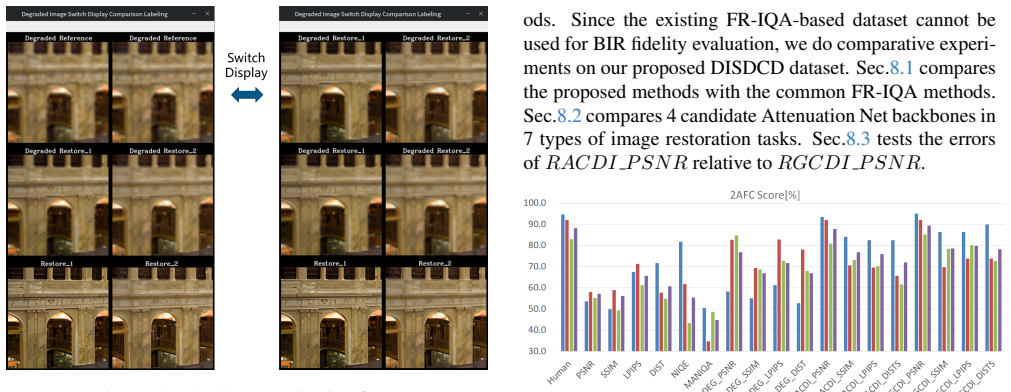
- [Sec. 7 and Sec. 8.1, Fig. 11] The DISDCD subjective task asks raters to choose which of two re-degraded restored images is closer to the degraded image. This is precisely the quantity that RGCDI computes: RGCDI adaptively attenuates the restored image (Eq. 5) and compares it with the noise-removed, equivalently attenuated degraded image (Sec. 5). Consequently, the high 2AFC agreement in Fig. 11 largely verifies that RGCDI approximates its own target, not that the CDI construct is the correct operationalization of BIR fidelity. The paper must validate CDI against an independent subjective protocol, for example a preference task where raters rank restored images by fidelity to a reference (when available) or by overall perceptual quality, and demonstrate that CDI-predicted rankings correlate with those judgments.
- [Sec. 5.3, Fig. 12 and Sec. 6, Table 1] The hyperparameter λ is tuned by maximizing 2AFC agreement on DISDCD (Fig. 12), and the recommended value of 0.3 is then used for the reported comparisons. Since DISDCD is the same benchmark on which the metric is evaluated, this tuning does not provide independent evidence of generalization. Similarly, RACDI is trained with RGCDI-generated pseudo-labels (Sec. 6) and evaluated only against RGCDI (Table 1), so the reported mean errors measure approximation of RGCDI rather than alignment with human fidelity judgments. The claim of 'significantly superior' would be supported by evaluation on at least one external dataset or a held-out portion of DISDCD using a distinct subjective protocol.
- [Sec. 8.1, Fig. 11] Fig. 11 reports point estimates of 2AFC accuracy without error bars, confidence intervals, or any significance test. The number of raters in DISDCD is not stated, and no inter-rater agreement statistics are provided. The observation that RGCDI scores 'even exceed human scores' is not discussed; a deterministic metric will often exceed the human consistency measure of Eq. 9, which is the expected agreement between two raters, and this should be interpreted carefully. A proper statistical comparison with confidence intervals and a test of differences between methods is needed before the word 'significantly' is used.
- [Sec. 1.2 and Sec. 9] The paper explicitly redefines BIR fidelity as low-frequency consistency with the degraded image and states that CDI does not evaluate high-frequency signals, which are left to NR-IQA. This is a legitimate design choice, but it changes the meaning of 'fidelity' relative to the standard FR-IQA notion. The conclusion that CDI is 'markedly superior' to FR-IQA methods is then partly a consequence of measuring a different construct. The paper should prominently and consistently frame CDI as a new, complementary evaluation axis rather than as a general replacement for fidelity assessment, and the experimental comparisons should be interpreted in that light.
minor comments (6)
- [Abstract, Sec. 4.2, Sec. 6, Fig. 4] There are several typos and inconsistent terms: 'In stead' in the abstract, 'Gussian' in the Fig. 4 caption, 'HSV' should be 'HVS' in Sec. 4.2, and 'Noise Equivalent Attention' should be 'Noise Equivalent Attenuation' in Sec. 6.
- [Sec. 7] The DISDCD dataset description lacks important experimental details: the number of raters, rater screening and training, the number of trials per rater, and the exact meaning of '5 pairwise judgments for each sample' need to be specified so that the reliability of the subjective ground truth can be assessed.
- [Sec. 8.1] The comparison with NR-IQA methods (NIQE, MANIQA) is not a like-for-like comparison because these methods measure perceptual naturalness, not fidelity. The statement that they 'cannot evaluate fidelity' is true, but the figure and text should acknowledge that the comparison spans different constructs.
- [Supplementary Material, Sec. 12, Eq. 17] The proof of idempotency for the case F(F(x,y), y) contains an algebraic error: when computing μ'_A F(x,y) = COV(y, F(x,y)) / COV(F(x,y), F(x,y)), the factor α = μ_A / sqrt(1 + σ_D²/σ_H²) is omitted, leading to the incorrect intermediate assertion μ'_A F(x,y) = μ_A x. The final equality F(F(x,y), y) = F(x,y) holds only after the correction, so the derivation as written should be revised.
- [Abstract and Sec. 7] The paper states that the source code and DISDCD dataset will be publicly available 'shortly'. For reproducibility, please provide a URL or a clear availability statement, and include the dataset creation details (e.g., degradation parameters, seed handling, and image sources) in the supplementary material.
- [Table 1 and Tables 8-10] The reported mean errors between RACDI and RGCDI lack standard deviations and sample sizes. Adding these statistics would help the reader judge the consistency of the approximation across different tasks and images.
Circularity Check
DISDCD's ground truth asks raters for the same quantity RGCDI computes, so the headline comparison is largely self-fulfilling; RACDI adds no independent validation because it is trained on RGCDI-generated targets.
-
self definitional
[Sec. 7 (DISDCD annotation task) vs. Sec. 5.1 (RGCDI definition, Eq. 5)]
"To better observe the differences between the degraded images, we apply the same degradation operation on the two restored images, producing the degraded restored images. Then a rater is asked to determine which is closer to the degraded image, and the response is recorded. ... Therefore, CDI should disregard high-frequency information and focus on assessing the consistency of low-frequency information."
RGCDI's score is PSNR(IDWT(µM x), IDWT(µAx/sqrt(1+σD^2/σH^2))) (Eq.5): it adaptively attenuates the restored image and compares it with an attenuated, noise-removed version of the degraded image. DISDCD asks raters to re-degrade two restored images with the same degradation and choose which is closer to the degraded image. The paper further defines fidelity as low-frequency consistency with the degraded image (Sec.1.2). So the subjective labels operationalize the same construct RGCDI computes; high 2AFC agreement largely verifies RGCDI matches its own target, not that this target is independently the correct meaning of BIR fidelity. The comparison is partly self-fulfilling, though the implementation is nontrivial.
-
fitted input called prediction
[Sec. 6 and Sec. 8.3, Table 1]
"paired ( y, µAx/p 1 + σ2 D/σ2 H ) training images of various types of degradation can be generated through the RGCDI system. After end-to-end training, the Attenuation Net is able to predictµAx/p 1 + σ2 D/σ2 H from y. ... the number on the left represents RACDI PSNR and the number on the right represents the mean error of RACDIPSNR relative to RGCDI PSNR."
RACDI is trained end-to-end on RGCDI-generated pairs (y, µAx/sqrt(1+σD^2/σH^2)), and Table 1 reports 'the mean error of RACDIPSNR relative to RGCDI PSNR'. Small error therefore measures how well the attenuation net regresses its own training target; it is an approximation check, not an independent fidelity validation. RACDI's DISDCD score (Fig.11) inherits the same construct-alignment between RGCDI and DISDCD. Presenting this as 'enabling BIR fidelity evaluation without reference images' is an engineering claim, not additional empirical support for CDI.
full rationale
The paper's analytic core is largely self-contained: the HVS information model (Eqs.4a-4d) is a straightforward derivation, the noise-equivalent attenuation identity is algebraic, and the idempotency/cascade/PSNR-inequality properties follow from the stated definitions in the supplementary material. There is no load-bearing self-citation chain. The circularity is in the external-validity argument: DISDCD labels are constructed as the very consistency judgment CDI computes, and RACDI is trained and evaluated against RGCDI. Because the paper's headline claim of 'significantly superior' fidelity evaluation rests on DISDCD results, the empirical support is partly self-fulfilling. If one accepts the paper's own definition of fidelity as low-frequency consistency with the degraded image, RGCDI is a reasonable implementation; but the dataset cannot independently establish that definition against alternative fidelity notions such as high-frequency plausibility, semantic correctness, or naturalness.
Assumptions & free parameters
free parameters (3)
- lambda (HVS noise scale) =
0.3 (recommended)
- Attenuation Net weights =
trained network weights (SCUNet backbone)
- Per-image attenuation coefficient mu_A and noise variance sigma_D squared =
estimated per image from Eq.3
assumptions (6)
- domain assumption Image degradation can be modeled as y = mu_A x + n_D with noise n_D independent of the signal x (Eq.1, Sec.4.1).
- domain assumption Wavelet coefficients of natural images follow a Gaussian Scale Mixture (Eq.2, Sec.4.1).
- domain assumption The HVS can be modeled as an additive Gaussian noise channel with variance sigma_H squared (Eq.4, Sec.4.2).
- ad hoc to paper Information-equivalent attenuation preserves perceived fidelity; replacing noise with attenuation that gives the same mutual information is valid (Eq.4c=4d).
- domain assumption Re-degrading restored images with the same degradation, with fixed random seed, gives a fair subjective comparison in DISDCD (Sec.7).
- standard math Orthogonal wavelet transform preserves L2 distance (Supplementary, Eq.22-24).
Cite this review
Pith. "Pith review of CDI: Blind Image Restoration Fidelity Evaluation based on Consistency with Degraded Image." pith.science (2026). https://pith.science/paper/B7UXDYOK
@misc{pith2026250114264,
  author       = {Pith},
  title        = {Pith review of: CDI: Blind Image Restoration Fidelity Evaluation based on Consistency with Degraded Image},
  year         = {2026},
  howpublished = {\url{https://pith.science/paper/B7UXDYOK}},
  note         = {Machine review of arXiv:2501.14264}
}
read the original abstract
Recent advancements in Blind Image Restoration (BIR) methods, based on Generative Adversarial Networks and Diffusion Models, have significantly improved visual quality. However, they present significant challenges for Image Quality Assessment (IQA), as the existing Full-Reference IQA methods often rate images with high perceptual quality poorly. In this paper, we reassess the Solution Non-Uniqueness and Degradation Indeterminacy issues of BIR, and propose constructing a specific BIR IQA system. In stead of directly comparing a restored image with a reference image, the BIR IQA evaluates fidelity by calculating the Consistency with Degraded Image (CDI). Specifically, we propose a wavelet domain Reference Guided CDI algorithm, which can acquire the consistency with a degraded image for various types without requiring knowledge of degradation parameters. The supported degradation types include down sampling, blur, noise, JPEG and complex combined degradations etc. In addition, we propose a Reference Agnostic CDI, enabling BIR fidelity evaluation without reference images. Finally, in order to validate the rationality of CDI, we create a new Degraded Images Switch Display Comparison Dataset (DISDCD) for subjective evaluation of BIR fidelity. Experiments conducted on DISDCD verify that CDI is markedly superior to common Full Reference IQA methods for BIR fidelity evaluation. The source code and the DISDCD dataset will be publicly available shortly.
Figures


Figures from the paper (7 more)




Reference graph
Works this paper leans on
-
[1]
Recommendation itu-r bt.500-15, 2023. 7
work page 2023
-
[2]
Ntire 2017 challenge on single image super-resolution: Dataset and study
Eirikur Agustsson and Radu Timofte. Ntire 2017 challenge on single image super-resolution: Dataset and study. In2017 IEEE Conference on Computer Vision and Pattern Recogni- tion Workshops (CVPRW), pages 1122–1131, 2017. 2, 6
work page 2017
-
[3]
The perception-distortion tradeoff
Yochai Blau and Tomer Michaeli. The perception-distortion tradeoff. In 2018 IEEE/CVF Conference on Computer Vision and Pattern Recognition, pages 6228–6237, 2018. 3
work page 2018
-
[4]
Real-world blind super-resolution via feature matching with implicit high- resolution priors
Chaofeng Chen, Xinyu Shi, Yipeng Qin, Xiaoming Li, Xi- aoguang Han, Tao Yang, and Shihui Guo. Real-world blind super-resolution via feature matching with implicit high- resolution priors. 2022. 7, 8
work page 2022
-
[5]
Pre-trained image processing transformer
Hanting Chen, Yunhe Wang, Tianyu Guo, Chang Xu, Yip- ing Deng, Zhenhua Liu, Siwei Ma, Chunjing Xu, Chao Xu, and Wen Gao. Pre-trained image processing transformer. In Proceedings of the IEEE/CVF Conference on Computer Vi- sion and Pattern Recognition (CVPR), pages 12299–12310,
-
[6]
Liangyu Chen, Xiaojie Chu, X. Zhang, and Jian Sun. Simple baselines for image restoration. In European Conference on Computer Vision, 2022. 8
work page 2022
-
[7]
Exploring efficient asymmetric blind-spots for self- supervised denoising in real-world scenarios
Shiyan Chen, Jiyuan Zhang, Zhaofei Yu, and Tiejun Huang. Exploring efficient asymmetric blind-spots for self- supervised denoising in real-world scenarios. In 2024 IEEE/CVF Conference on Computer Vision and Pattern Recognition (CVPR), pages 2814–2823, 2024. 8
work page 2024
-
[8]
Rethinking coarse-to-fine approach in sin- gle image deblurring
Sung-Jin Cho, Seoyoun Ji, Jun-Pyo Hong, Seung-Won Jung, and Sung-Jea Ko. Rethinking coarse-to-fine approach in sin- gle image deblurring. 2021 IEEE/CVF International Confer- ence on Computer Vision (ICCV), pages 4621–4630, 2021. 8
work page 2021
Show all 67 references
-
[9]
Second-order attention network for single image super-resolution
Tao Dai, Jianrui Cai, Yongbing Zhang, Shu-Tao Xia, and Lei Zhang. Second-order attention network for single image super-resolution. In 2019 IEEE/CVF Conference on Com- puter Vision and Pattern Recognition (CVPR), pages 11057– 11066, 2019. 1, 8
2019
-
[10]
Simoncelli
Keyan Ding, Kede Ma, Shiqi Wang, and Eero P. Simoncelli. Image quality assessment: Unifying structure and texture similarity. IEEE Transactions on Pattern Analysis and Ma- chine Intelligence, 44(5):2567–2581, 2022. 2, 3, 7
2022
-
[11]
Davis, and Abhinav Shrivastava
Max Ehrlich, Ser-Nam Lim, Larry S. Davis, and Abhinav Shrivastava. Quantization guided jpeg artifact correction. In European Conference on Computer Vision, 2020. 8
2020
-
[12]
Jinjin Gu, Haoming Cai, Haoyu Chen, Xiaoxing Ye, Jimmy S. J. Ren, and Chao Dong. Pipal: a large-scale image qual- ity assessment dataset for perceptual image restoration. In European Conference on Computer Vision, 2020. 3, 6
2020
-
[13]
Towards flexible blind jpeg artifacts removal
Jiaxi Jiang, Kai Zhang, and Radu Timofte. Towards flexible blind jpeg artifacts removal. In 2021 IEEE/CVF Interna- tional Conference on Computer Vision (ICCV), pages 4977– 4986, 2021. 8
2021
-
[14]
Beyond color difference: Residual in- terpolation for color image demosaicking
Daisuke Kiku, Yusuke Monno, Masayuki Tanaka, and Masatoshi Okutomi. Beyond color difference: Residual in- terpolation for color image demosaicking. IEEE Transac- tions on Image Processing, 25(3):1288–1300, 2016. 1, 8
2016
-
[15]
Larson and Damon M
Eric C. Larson and Damon M. Chandler. Most apparent dis- tortion: full-reference image quality assessment and the role of strategy. J. Electronic Imaging, 19:011006, 2010. 3, 6
2010
-
[16]
A simple baseline for video restoration with grouped spatial- temporal shift
Dasong Li, Xiaoyu Shi, Yi Zhang, Ka Chun Cheung, Simon See, Xiaogang Wang, Hongwei Qin, and Hongsheng Li. A simple baseline for video restoration with grouped spatial- temporal shift. In 2023 IEEE/CVF Conference on Computer Vision and Pattern Recognition (CVPR) , pages 9822–9832,
2023
-
[17]
Spatially adap- tive self-supervised learning for real-world image denoising
Junyi Li, Zhilu Zhang, Xiaoyu Liu, Chaoyu Feng, Xiao- tao Wang, Lei Lei, and Wangmeng Zuo. Spatially adap- tive self-supervised learning for real-world image denoising. 2023 IEEE/CVF Conference on Computer Vision and Pat- tern Recognition (CVPR), pages 9914–9924, 2023. 8
2023
-
[18]
Efficient and explicit modelling of image hierarchies for image restora- tion
Yawei Li, Yuchen Fan, Xiaoyu Xiang, Denis Demandolx, Rakesh Ranjan, Radu Timofte, and Luc Gool. Efficient and explicit modelling of image hierarchies for image restora- tion. pages 18278–18289, 2023. 8
2023
-
[19]
Swinir: Image restoration using swin transformer
Jingyun Liang, Jiezhang Cao, Guolei Sun, Kai Zhang, Luc Van Gool, and Radu Timofte. Swinir: Image restoration using swin transformer. arXiv preprint arXiv:2108.10257 ,
-
[20]
Efficient and degradation-adaptive network for real-world image super- resolution
Jie Liang, Hui Zeng, and Lei Zhang. Efficient and degradation-adaptive network for real-world image super- resolution. In European Conference on Computer Vision ,
-
[21]
Details or artifacts: A locally discriminative learning approach to realistic image super-resolution
Jie Liang, Huiyu Zeng, and Lei Zhang. Details or artifacts: A locally discriminative learning approach to realistic image super-resolution. 2022 IEEE/CVF Conference on Computer Vision and Pattern Recognition (CVPR) , pages 5647–5656,
2022
-
[22]
Qiao, and Chao Dong
Xin Yu Lin, Jingwen He, Zi-Yuan Chen, Zhaoyang Lyu, Ben Fei, Bo Dai, Wanli Ouyang, Y . Qiao, and Chao Dong. Diff- bir: Towards blind image restoration with generative diffu- sion prior. ArXiv, abs/2308.15070, 2023. 1, 2, 7, 8
2023 arXiv
-
[23]
Invertible de- noising network: A light solution for real noise removal
Yang Liu, Zhenyue Qin, Saeed Anwar, Pan Ji, Dongwoo Kim, Sabrina Caldwell, and Tom Gedeon. Invertible de- noising network: A light solution for real noise removal. In 2021 IEEE/CVF Conference on Computer Vision and Pat- tern Recognition (CVPR), pages 13360–13369, 2021. 8
2021
-
[24]
No-reference image quality assessment in the spa- tial domain
Anish Mittal, Anush Krishna Moorthy, and Alan Conrad Bovik. No-reference image quality assessment in the spa- tial domain. IEEE Transactions on Image Processing , 21 (12):4695–4708, 2012. 3
2012
-
[25]
Single Image Super-Resolution via a Holistic Attention Network, pages 191–207
Ben Niu, Weilei Wen, Wenqi Ren, Xiangde Zhang, Lianping Yang, Shuzhen Wang, Kaihao Zhang, Xiaochun Cao, and Haifeng Shen. Single Image Super-Resolution via a Holistic Attention Network, pages 191–207. 2020. 1, 8
2020
-
[26]
Random sub-samples generation for self- supervised real image denoising
Yizhong Pan, Xiao Liu, Xiangyu Liao, Yuanzhouhan Cao, and Chao Ren. Random sub-samples generation for self- supervised real image denoising. 2023 IEEE/CVF Inter- national Conference on Computer Vision (ICCV) , pages 12116–12125, 2023. 8
2023
-
[27]
Multi-temporal recurrent neural networks for progres- sive non-uniform single image deblurring with incremental temporal training
Dongwon Park, Dong un Kang, Jisoo Kim, and Se Young Chun. Multi-temporal recurrent neural networks for progres- sive non-uniform single image deblurring with incremental temporal training. In European Conference on Computer Vi- sion, 2019. 8
2019
-
[28]
Nikolay Ponomarenko, Lina Jin, Oleg Ieremeiev, Vladimir Lukin, Karen Egiazarian, Jaakko Astola, Benoit V ozel, Kacem Chehdi, Marco Carli, Federica Battisti, and C.-C. Jay Kuo. Image database tid2013: Peculiarities, results and per- spectives. Signal Processing: Image Communica...
2015
-
[29]
Ponomarenko, Vladimir V
Nikolay N. Ponomarenko, Vladimir V . Lukin, and Alexan- der A. Zelensky. Tid2008 – a database for evaluation of full- reference visual quality assessment metrics. 2004. 3
2004
-
[30]
Pieapp: Perceptual image-error assessment through pairwise preference
Ekta Prashnani, Hong Cai, Yasamin Mostofi, and Pradeep Sen. Pieapp: Perceptual image-error assessment through pairwise preference. In 2018 IEEE/CVF Conference on Computer Vision and Pattern Recognition , pages 1808– 1817, 2018. 3, 6
2018
-
[31]
Blattmann, Dominik Lorenz, Patrick Esser, and Bj ¨orn Ommer
Robin Rombach, A. Blattmann, Dominik Lorenz, Patrick Esser, and Bj ¨orn Ommer. High-resolution image synthesis with latent diffusion models. 2022 IEEE/CVF Conference on Computer Vision and Pattern Recognition (CVPR), pages 10674–10685, 2021. 7
2022
-
[32]
Sheikh and A.C
H.R. Sheikh and A.C. Bovik. Image information and visual quality. IEEE Transactions on Image Processing, 15(2):430– 444, 2006. 4, 6
2006
-
[33]
Sheikh, M.F
H.R. Sheikh, M.F. Sabir, and A.C. Bovik. A statistical eval- uation of recent full reference image quality assessment al- gorithms. IEEE Transactions on Image Processing, 15(11): 3440–3451, 2006. 3, 6
2006
-
[34]
Rajiv Soundararajan and Alan C. Bovik. Rred indices: Re- duced reference entropic differencing for image quality as- sessment. IEEE Transactions on Image Processing , 21(2): 517–526, 2012. 3
2012
-
[35]
Wainwright, Eero P
Martin J. Wainwright, Eero P. Simoncelli, and Alan S. Will- sky. Random cascades on wavelet trees and their use in ana- lyzing and modeling natural images. Applied and Computa- tional Harmonic Analysis, 11(1):89–123, 2001. 4
2001
-
[36]
Chan, and Chen Change Loy
Jianyi Wang, Zongsheng Yue, Shangchen Zhou, Kelvin C.K. Chan, and Chen Change Loy. Exploiting diffusion prior for real-world image super-resolution. 2024. 1, 2, 7, 8
2024
-
[37]
Real-esrgan: Training real-world blind super-resolution with pure synthetic data
Xintao Wang, Liangbin Xie, Chao Dong, and Ying Shan. Real-esrgan: Training real-world blind super-resolution with pure synthetic data. In 2021 IEEE/CVF International Con- ference on Computer Vision Workshops (ICCVW) , pages 1905–1914, 2021. 1, 2, 4, 6, 7, 8
2021
-
[38]
Zero-shot im- age restoration using denoising diffusion null-space model
Yinhuai Wang, Jiwen Yu, and Jian Zhang. Zero-shot im- age restoration using denoising diffusion null-space model. ArXiv, abs/2212.00490, 2022. 4
2022 arXiv
-
[39]
Bovik, H.R
Zhou Wang, A.C. Bovik, H.R. Sheikh, and E.P. Simoncelli. Image quality assessment: from error visibility to structural similarity. IEEE Transactions on Image Processing , 13(4): 600–612, 2004. 2, 3, 7
2004
-
[40]
Orientation selectivity based visual pattern for reduced-reference image quality assessment
Jinjian Wu, Weisi Lin, Guangming Shi, Leida Li, and Yum- ing Fang. Orientation selectivity based visual pattern for reduced-reference image quality assessment. Information Sciences, 351:18–29, 2016. 3
2016
-
[41]
Seesr: Towards semantics- aware real-world image super-resolution
Rongyuan Wu, Tao Yang, Lingchen Sun, Zhengqiang Zhang, Shuai Li, and Lei Zhang. Seesr: Towards semantics- aware real-world image super-resolution. In2024 IEEE/CVF Conference on Computer Vision and Pattern Recognition (CVPR), pages 25456–25467, 2024. 1, 2, 7, 8
2024
-
[42]
Cgnet: A light-weight context guided network for semantic segmentation
Tianyi Wu, Sheng Tang, Rui Zhang, Juan Cao, and Yong- dong Zhang. Cgnet: A light-weight context guided network for semantic segmentation. IEEE Transactions on Image Processing, 30:1169–1179, 2021. 8
2021
-
[43]
Maniqa: Multi-dimension at- tention network for no-reference image quality assessment
Sidi Yang, Tianhe Wu, Shu Shi, Shan Gong, Ming Cao, Ji- ahao Wang, and Yujiu Yang. Maniqa: Multi-dimension at- tention network for no-reference image quality assessment. 2022 IEEE/CVF Conference on Computer Vision and Pat- tern Recognition Workshops (CVPRW) , pages 1190–1199,
2022
-
[44]
Pixel- aware stable diffusion for realistic image super-resolution and personalized stylization
Tao Yang, Peiran Ren, Xuansong Xie, and Lei Zhang. Pixel- aware stable diffusion for realistic image super-resolution and personalized stylization. ArXiv, abs/2308.14469, 2023. 7
2023 arXiv
-
[45]
Variational denoising network: Toward blind noise modeling and removal
Zongsheng Yue, Hongwei Yong, Qian Zhao, Lei Zhang, and Deyu Meng. Variational denoising network: Toward blind noise modeling and removal. ArXiv, abs/1908.11314, 2019. 8
1908 arXiv
-
[46]
Dual adversarial network: Toward real-world noise removal and noise generation, 2020
Zongsheng Yue, Qian Zhao, Lei Zhang, and Deyu Meng. Dual adversarial network: Toward real-world noise removal and noise generation, 2020. 8
2020
-
[47]
Resshift: Efficient diffusion model for image super- resolution by residual shifting.ArXiv, abs/2307.12348, 2023
Zongsheng Yue, Jianyi Wang, and Chen Change Loy. Resshift: Efficient diffusion model for image super- resolution by residual shifting.ArXiv, abs/2307.12348, 2023. 7
2023 arXiv
-
[48]
Restormer: Efficient transformer for high-resolution image restoration
Syed Waqas Zamir, Aditya Arora, Salman Khan, Mu- nawar Hayat, Fahad Shahbaz Khan, and Ming Hsuan Yang. Restormer: Efficient transformer for high-resolution image restoration. In Proceedings - 2022 IEEE/CVF Conference on Computer Vision and Pattern Recognition, CVPR 2022 , page...
2022
-
[49]
Multi-stage progressive image restoration
Syed Waqas Zamir, Aditya Arora, Salman Khan, Munawar Hayat, Fahad Shahbaz Khan, Ming-Hsuan Yang, and Ling Shao. Multi-stage progressive image restoration. In 2021 IEEE/CVF Conference on Computer Vision and Pattern Recognition (CVPR), pages 14816–14826, 2021. 8
2021
-
[50]
Deep stacked hierarchical multi-patch network for im- age deblurring
Hongguang Zhang, Yuchao Dai, Hongdong Li, and Piotr Ko- niusz. Deep stacked hierarchical multi-patch network for im- age deblurring. In 2019 IEEE/CVF Conference on Computer Vision and Pattern Recognition (CVPR) , pages 5971–5979,
2019
-
[51]
Blur- aware spatio-temporal sparse transformer for video deblur- ring
Huicong Zhang, Haozhe Xie, and Hongxun Yao. Blur- aware spatio-temporal sparse transformer for video deblur- ring. 2024 IEEE/CVF Conference on Computer Vision and Pattern Recognition (CVPR), pages 3616–3626, 2024. 1
2024
-
[52]
Designing a practical degradation model for deep blind image super-resolution
Kai Zhang, Jingyun Liang, Luc Van Gool, and Radu Timo- fte. Designing a practical degradation model for deep blind image super-resolution. In IEEE International Conference on Computer Vision, pages 4791–4800, 2021. 1, 2, 7, 8
2021
-
[53]
Practical blind denoising via swin-conv-unet and data synthesis, 2022
Kai Zhang, Yawei Li, Jingyun Liang, Jiezhang Cao, Yulun Zhang, Hao Tang, Radu Timofte, and Luc Gool. Practical blind denoising via swin-conv-unet and data synthesis, 2022. 6, 8
2022
-
[55]
Plug-and-play image restora- tion with deep denoiser prior
Kai Zhang, Yawei Li, Wangmeng Zuo, Lei Zhang, Luc Van Gool, and Radu Timofte. Plug-and-play image restora- tion with deep denoiser prior. IEEE Transactions on Pat- tern Analysis and Machine Intelligence , 44(10):6360–6376,
-
[56]
Lin Zhang, Lei Zhang, and Alan C. Bovik. A feature- enriched completely blind image quality evaluator. IEEE Transactions on Image Processing, 24(8):2579–2591, 2015. 3
2015
-
[57]
The unreasonable effectiveness of deep features as a perceptual metric
Richard Zhang, Phillip Isola, Alexei A Efros, Eli Shechtman, and Oliver Wang. The unreasonable effectiveness of deep features as a perceptual metric. In CVPR, 2018. 3, 6
2018
-
[58]
Efros, Eli Shecht- man, and Oliver Wang
Richard Zhang, Phillip Isola, Alexei A. Efros, Eli Shecht- man, and Oliver Wang. The unreasonable effectiveness of deep features as a perceptual metric. In 2018 IEEE/CVF Conference on Computer Vision and Pattern Recognition , pages 586–595, 2018. 2, 3, 7, 8
2018
-
[59]
Image super-resolution using very deep residual channel attention networks
Yulun Zhang, Kunpeng Li, Kai Li, Lichen Wang, Bineng Zhong, and Yun Fu. Image super-resolution using very deep residual channel attention networks. In Computer Vision – ECCV 2018: 15th European Conference, Munich, Ger- many, September 8–14, 2018, Proceedings, Part VII , page 2...
2018
-
[60]
Vi- sual quality assessment for super-resolved images: Database and method
Fei Zhou, Rongguo Yao, Bozhi Liu, and Guoping Qiu. Vi- sual quality assessment for super-resolved images: Database and method. IEEE Transactions on Image Processing, 28(7): 3528–3541, 2019. 3, 6
2019
-
[61]
Zhang, Jingyun Liang, Jiezhang Cao, Bi- han Wen, Radu Timofte, and Luc Van Gool
Yuanzhi Zhu, K. Zhang, Jingyun Liang, Jiezhang Cao, Bi- han Wen, Radu Timofte, and Luc Van Gool. Denois- ing diffusion models for plug-and-play image restoration. 2023 IEEE/CVF Conference on Computer Vision and Pat- tern Recognition Workshops (CVPRW) , pages 1219–1229,
2023
-
[63]
Use gradient descent to minimize L and update Iˆx
Image Restoration Algorithm of Fig.2 Given: k = Kernel (size = 9 × 9, σ= 5) Iy = conv (Ix, k) (10) Using existing BIR algorithms to restore Ix: Iˆx0 = BIR (Iy) (11) Design Loss function: L = ∥conv(Iˆx, k) − Iy∥ + λ∥Iˆx − Iˆx0∥ (12) Set Iˆx0 as the initial value of Iˆx. Use gra...
-
[64]
Use gradient descent to minimize L and update Iˆx
Image Restoration Algorithm of Fig.3 Given: k1 = Kernel (size = 13 × 13, σ= 1.0) k2 = Kernel (size = 13 × 13, σ= 1.06, 1.12 or 1.18) Iy = conv (Ix, k1) (13) Design Loss function: L = ∥conv(Iˆx, k2) − Iy∥ + λ∥Iˆx − Ix∥ (14) Set Ix as the initial value of Iˆx. Use gradient desce...
-
[65]
Multiple F operations are equivalent to a single operation, F (x, y) = µAx√ 1+σ2 D/σ2 H
Proof of RGCDI Property Idempotency. Multiple F operations are equivalent to a single operation, F (x, y) = µAx√ 1+σ2 D/σ2 H . Given: µA = COV (y, x) /COV (x, x) nD = y − µAx σ2 D = COV (y, y) − µACOV (y, x) (15) Calculating F (x, F(x, y)): µ′ A = COV (F (x, y), x)/COV (x, x) ...
-
[66]
Under this condition, RGCDI P SN Ris bigger than P SN R. Given: x = DW T[Ix] y = DW T[Iy] ˆx = DW T[Iˆx] µA = COV (y, x) /COV (x, x) σ2 D = COV (y, y) − µACOV (y, x) µD = 1/ q 1 + σ2 D/σ2 H µM = arg min µM ∥µM ˆx − µAµDx∥ (21) Calculating ∥IDW T(µM ˆx) − IDW T(µAµDx)∥: (Note: ...
-
[67]
Attenuation Net Backbones Selection (De- tailed Experimental Data) Detailed experimental data of attenuation net backbones se- lection experiments are as follows: Table.2,3,4,5,6,7
-
[68]
Table.8 shows RACDI test for Classic SR on the BSD100 and Manga109 datasets
RACDI Testing (Supplementary Experi- mental Results) We apply SCUNet as the Attenuation Net backbone, and test the RACDI on more Datsets. Table.8 shows RACDI test for Classic SR on the BSD100 and Manga109 datasets. Similar to the results on the Urban100 dataset, the max- imum ...
-
[2023]
4 CDI: Blind Image Restoration Fidelity Evaluation based on Consistency with Degraded Image Supplementary Material
Reviewed August 10, 2026 · model on record in the stance chip above.
Discussion (0). Continue with ORCID to comment.