REVIEW 2 major objections 4 minor 63 references
Two-phonon pairing and superconductivity in $SrTiO_3$
T0 review · 2 major / 4 minor · reviewed 2026-08-05 · deepseek-v4-flash
Pith's one-line read Two-phonon pairing cannot explain superconductivity in doped SrTiO3: the high-energy cutoff, not the soft mode, controls the coupling.
desk verdict Dispersive two-phonon Eliashberg treatment kills the naive Ngai mechanism in STO, but the negative conclusion leans on an unquantified local-coupling assumption. read the letter →
The pith
A machine-rendered reading of the paper's core claim, the machinery that carries it, and where it could break.
The reading
What carries the argument
The load-bearing object is the two-phonon Eliashberg function α²F(Q,Ω), built from the soft TO-phonon dispersion ω_q = √(ω_Γ,TO² + c²q²) and the momentum-dependent Debye cutoff ω_D(Q), whose zone-center value is ω_DΓ = c q_D ≈ 50 meV. It replaces the naive local estimate V ≈ -(αl²)²/2ℏω₀, which diverges as 1/ω₀³ with the soft frequency, with the momentum-averaged interaction V_eff ∝ (V₀/2) log[(Ω² + 4ω²_{Q/2})/(Ω² + 4ω²_D(Q))], where V₀ = 3ℏα²/(8μ_S² ω_DΓ³). Because V₀ carries 1/ω_DΓ³, the high-energy cutoff suppresses the attraction by roughly five orders of magnitude relative to the soft-mode estimate, leaving only a logarithmic singularity at the quantum critical point. That ratio—soft-mo
What would settle it
A first-principles computation of the full momentum dependence of the quadratic electron–phonon coupling α(q,q′) for the Slater mode: if the vertex is sharply enhanced at small momenta, the effective coupling could exceed the paper's estimate by the needed factor of about three and push Tc into the observed range. Conversely, superconductivity in a doped hafnia or skutterudite whose soft phonon stays soft across the whole Brillouin zone—with Tc tracking the soft-mode energy rather than the high-frequency cutoff—would directly test the paper's prediction that two-phonon pairing needs flat soft
Extended reading notes
Core claim
On its own terms, the paper's central claim is negative: Ngai's two-phonon mechanism cannot explain superconductivity in doped STO. The paper derives the two-phonon Eliashberg function for the soft transverse (Slater) modes and shows that, despite a quadratic deformation potential α ≈ 40 eV/Ų that is large by any measure, the dimensionless coupling Λ ≈ 0.08 is roughly three times too small to yield the observed Tc. The reason is that the two-phonon spectral function averages over all momenta, so the coupling's energy denominator is the Debye-like cutoff ω_DΓ ≈ 50 meV, not the soft-mode frequency ≈ 1 meV; approaching the ferroelectric quantum critical point enhances the attraction only logar
Load-bearing premise
The calculation assumes the quadratic electron–phonon coupling is local and momentum-independent apart from the phonon-frequency factors; if the true coupling were strongly peaked near the zone center, the soft modes could dominate the momentum average and the conclusion could flip.
Editorial extensions
If this is right
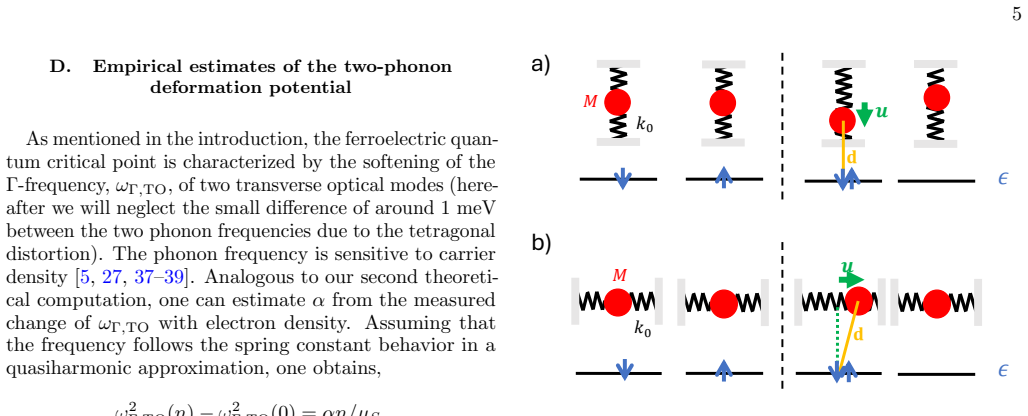
- Within the paper's model, the two-phonon channel alone produces a Tc far below the observed range in STO even when parameters are chosen in its favor, with α above the experimental estimates and phonons softer than the accurate dispersions.
- The effective coupling is set by the high-energy cutoff of the two-phonon spectrum: softening near the zone center contributes only logarithmically, so proximity to the ferroelectric quantum critical point does not control Tc.
- The theory's Tc rises monotonically with doping, so the two-phonon mechanism cannot be the sole driver of the measured superconducting dome, which peaks at intermediate density and falls at high doping.
- Two-phonon pairing is not disproven as a contributing channel; the paper leaves open a subdominant contribution, consistent with other recent proposals for STO and KTaO₃.
- Materials with soft optical modes that stay soft throughout the Brillouin zone—flat phonon bands in hafnia, Einstein-like phonons in filled skutterudites—are identified as the conditions under which the mechanism could become dominant.
Reading between the lines
- The negative result is generic for any pairing channel mediated by a strongly dispersive boson: if the boson softens only in a tiny region of the Brillouin zone, phase space dilutes it. The paper's machinery could be read as a screening criterion—estimate the Brillouin-zone average of the coupling, not the zone-center value, before predicting Tc.
- A nonlocal, momentum-dependent quadratic coupling with the vertex peaked at small momentum transfer would break the paper's locality assumption and could restore soft-mode dominance; computing the full q-dependence of α(q,q′) beyond the local approximation is a direct test of that possibility.
- The doping-dependence mismatch suggests the experimental dome in STO is set by a different ingredient—possibly the one-phonon soft-mode channel, multiband effects, or a competing boson—with two-phonon exchange acting only as a small correction.
- The same Eliashberg construction could be applied to KTaO₃ and to doped hafnia; if a flat soft-band material shows a dome whose Tc tracks the soft-mode energy rather than the high-frequency cutoff, that would validate the mechanism where STO cannot.
Editorial analysis
A structured set of objections, weighed in public.
Referee Report
Summary. This paper tests the Ngai two-phonon pairing mechanism in doped SrTiO3. The authors obtain the two-phonon deformation potential α from four independent routes—DFT eigenvalue shifts, DFT total-energy spring-constant hardening, and two empirical fits—that agree to within a factor of 2–3. They derive the effective electron-electron interaction mediated by exchange of two transverse optical phonons via a Schrieffer–Wolff transformation and solve a one-loop Eliashberg equation with a momentum-dependent Debye cutoff. The central result is that, although α is large, the phase-space average in the two-phonon Eliashberg function is controlled by the high-energy cutoff ω_DΓ ≈ 50 meV rather than by the soft-mode frequency. The resulting coupling is weak (Λ ≈ 0.08), the computed Tc is negligible, and the predicted Tc increases monotonically with doping, in contrast to the observed dome. The paper concludes that the Ngai mechanism cannot explain superconductivity in STO and proposes conditions—flat soft modes across the Brillouin zone—under which the mechanism could be effective in other materials.
Significance. If accepted, this is an important negative result for an actively discussed candidate mechanism in doped STO. The paper is self-contained: the Eliashberg derivation is detailed and internally consistent, the parameter choices are conservative (α = 40 eV/Ų, f̄ = 2, ωΓ,TO = 0), and the DFT and empirical estimates cross-check the deformation potential. The predicted monotonic doping dependence is falsifiable. The main limitation is the local, q-independent form of the electron–two-phonon coupling, which is not quantitatively bounded. Because that approximation enters the central negative conclusion, the significance of the paper is conditional on its validity for finite-q phonons.
major comments (2)
- [Sec. II A, Eq. (7); Sec. IV, Eq. (54)] The local, momentum-independent deformation potential α is load-bearing. Table I, Eq. (11), and Sec. II D all probe uniform (q=0) displacements. The smallness of Tc follows from the phase-space cancellation at Q=0: with g ∝ α/√(ω_q ω_q'), the p² factor cancels the soft 1/ω_p² divergence and α²F is cutoff-dominated (Eqs. (61)–(64)). If the physical α(q,q') is enhanced near the zone center, the integrand becomes |α(p)|²/c² and the 1/ω_Γ³ enhancement of the toy model can be restored; a momentum-dependent form factor could supply the factor ~3 in Λ that separates the computed Tc from observable values. The manuscript explicitly notes the local approximation but does not bound its error. I request a finite-q calculation (DFPT or frozen-phonon supercell) or a symmetry/causality-based bound on α(q,q').
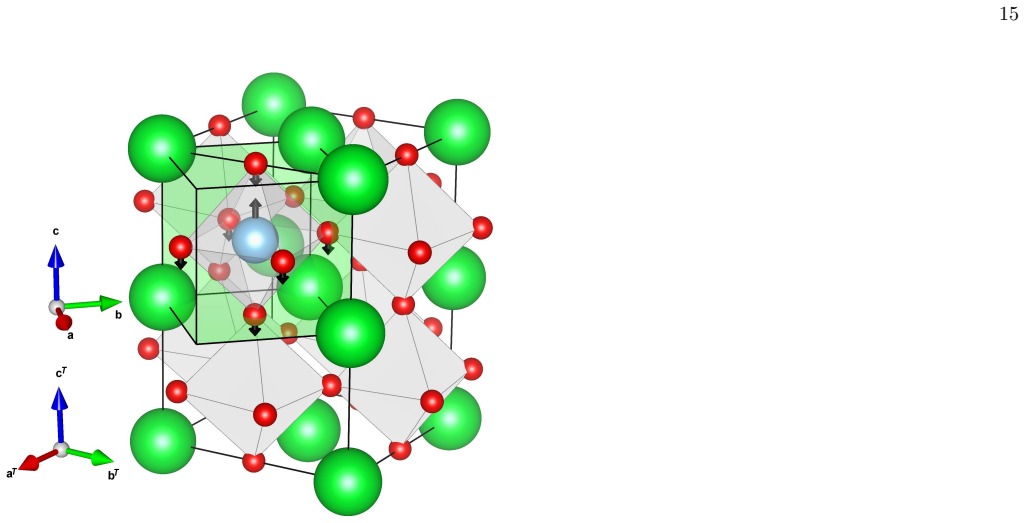
- [Sec. II B, Table I] Restricting the soft-mode pattern to the Slater mode alone may be consequential. The text states that the Last and oxygen-octahedra modes have α ≈ 10–40 eV/Ų but are neglected because their weights in the soft mode are small; no quantitative weights or finite-q matrix elements are given. Since all estimates of α are obtained at Γ, these modes could contribute to the finite-q vertex discussed above. The statement that the weights are small should be quantified, e.g., from the mode eigenvectors of Refs. [34,35] or from explicit frozen-phonon calculations, before the conclusion can be regarded as robust.
minor comments (4)
- [Abstract and Sec. VII] The wording 'cannot be excluded based on Tc magnitude' and 'too small to explain superconductivity' is slightly ambiguous; 'cannot be excluded as the dominant/sole mechanism' would clarify the intended meaning.
- [Eq. (27)] The definition of the angular factor f̄ is terse. Please state explicitly whether |g(q,q')|² carries f or √f, since later the bound 1 ≤ f̄ ≤ 2 is used in V0.
- [Sec. VI, Fig. 11] The monotonicity comparison with the experimental dome is made in a one-band model held at the QCP for all doping. Multi-band effects enter at the upper end of the dome, so the doping-shape mismatch is weaker evidence than the smallness of Tc; the text could say so.
- [Sec. II D] The empirical estimates of α are based on different dopants, temperatures, and assumptions about carrier count; the factor-of-2–3 spread is material. Reporting fit ranges/error bars for the values extracted from Refs. [37,38] would make the comparison more quantitative.
Circularity Check
No significant circularity: the negative two-phonon result is computed from independently determined parameters and compared with experiment as a falsifiable prediction.
full rationale
The central derivation chain is self-contained rather than circular. The two-phonon deformation potential α is obtained from DFT band-shift and total-energy calculations (Secs. II B and II C, Table I) and from empirical phonon-frequency data (Sec. II D); the phonon dispersion/cutoff ωDΓ is taken from neutron scattering (Ref. [46], Eq. (58)); and the mass/bandwidth W is taken from independent quantum-oscillation and specific-heat data. These inputs feed the derived two-phonon Eliashberg function (Eqs. (54), (61), (62)), from which Tc is computed as a function of doping. No parameter is fitted to the experimental Tc: the paper explicitly finds a monotonically increasing Tc(x) that disagrees with the observed superconducting dome, so the central negative claim is a falsifiable prediction rather than a fit. The conclusion that soft phonons do not control Tc follows analytically from the phase-space average of the local vertex (Eq. (10)) with the dispersive TO phonon (Eq. (20)), not from an input already containing the conclusion. The main genuine limitation—the local, q-independent vertex in Eq. (7)—is acknowledged in the text ('for the sake of simplicity, we are assuming that the electron-two-phonon interaction is local') and could change the magnitude if α(q) were strongly momentum dependent; but an unvalidated approximation is a correctness risk, not circularity. Self-citations to the authors' earlier DFT and strong-coupling work (Refs. [17,18,27]) are contextual and are not load-bearing for the present negative claim.
Assumptions & free parameters
free parameters (3)
- Two-phonon deformation potential α =
40 eV/Ų
- Angular factor f̄ =
2 (upper bound)
- Soft-mode gap ωΓ,TO =
0 (ferroelectric QCP)
assumptions (5)
- domain assumption The soft mode is well represented by the Slater mode; contributions from the Last and oxygen-octahedra modes to the two-phonon deformation potential are small.
- domain assumption The electron-two-phonon interaction is local with a single scalar deformation potential α, so the coupling vertex g(q,q') ∝ 1/√(ωqωq') has no additional momentum dependence.
- domain assumption The TO phonon branches are isotropic, degenerate, and follow ωq = sqrt(ωΓ² + c²q²) up to a Debye cutoff.
- domain assumption The one-loop Eliashberg equations with Z=1, χ=0 and the interaction evaluated at the Fermi momentum give a quantitatively reliable Tc in the weak-coupling regime, despite Migdal's theorem not applying.
- domain assumption The density of two-phonon states can be modeled with a momentum-dependent Debye cutoff ωD(Q) defined by Eq. (57).
Cite this review
Pith. "Pith review of Two-phonon pairing and superconductivity in $SrTiO_3$." pith.science (2026). https://pith.science/paper/BA3DZYZB
@misc{pith2026260803823,
  author       = {Pith},
  title        = {Pith review of: Two-phonon pairing and superconductivity in $SrTiO_3$},
  year         = {2026},
  howpublished = {\url{https://pith.science/paper/BA3DZYZB}},
  note         = {Machine review of arXiv:2608.03823}
}
abstract
We explore the possibility that the two-phonon pairing mechanism proposed by Ngai can explain superconductivity in doped strontium titanate (STO). The two-phonon deformation potential is evaluated using two distinct theoretical estimates based on first-principles calculations and two empirical estimates based on experimental data, yielding very large values of the same order of magnitude. We derive the effective electron-electron interaction mediated by two-phonon exchange. Crucial to our computations is the strong dispersion of the involved soft phonons. Because the scale of the two-phonon interaction is much larger than the Fermi energy, the Migdal theorem does not apply. We obtain a one-loop Eliashberg equation that can be solved in the weak-coupling limit. We find that despite the significant electron-phonon matrix element, phase space considerations considerably reduce the effective coupling. A two-phonon mechanism can not be excluded based on the $T_c$ magnitude, but its value is dominated by the high-energy-frequency physics and is weakly affected by the soft-phonon behavior. The theory predicts a $T_c$ that monotonously increases with doping, which is not in accordance with the experiment. We identify the conditions for a two-phonon mechanism to be effective in other materials and discuss possible candidates.
Figures


Figures from the paper (8 more)


Reference graph
Works this paper leans on
-
[1]
Instead, for the quadratic model, it scales as 1 /ω3
This coincides with the finding in BCS theory based on the standard linear electron-phonon coupling. Instead, for the quadratic model, it scales as 1 /ω3
-
[2]
This suggests that the quadratic model can benefit more from soft- phonon effects as found near the FE instability. Indeed, making the replacements ℏω0 →ℏω Γ,TO ≈ 1 meV (valid for undoped STO [ 4]), l→l s ≈ 0.3 ˚A, and α = 40 eV/˚A2 one gets αl2 ≈ 3.6 eV and V2p ≈ −6000 eV, a surprisingly large value. Taking the more realistic value ωΓ,TO ≈ 6 meV measured...
-
[3]
K. A. M¨ uller and H. Burkard,SrTiO3: An intrinsic quan- tum paraelectric below 4 K, Phys. Rev. B19, 3593 (1979)
work page 1979
-
[4]
G. G. Guzm´ an-Verri, C. H. Liang, and P. B. Littlewood, Lamellar fluctuations melt ferroelectricity, Phys. Rev. Lett.131, 046801 (2023)
work page 2023
-
[5]
Metallicity and superconductivity in doped strontium titanate
C. Collignon, X. Lin, C. W. Rischau, B. Fauqu´ e, and K. Behnia, Metallicity and superconductivity in doped strontium titanate, Annu. Rev. Condens. Matter Phys. 10, 25 (2019), arXiv:1804.07067
work page Pith review arXiv 2019
-
[6]
M. N. Gastiasoro, J. Ruhman, and R. M. Fernandes, Superconductivity in dilute SrTiO 3 : A review, Ann. Phys. (N. Y).417, 168107 (2020), arXiv:1912.01509
work page Pith review arXiv 2020
-
[7]
J. M. Edge, Y. Kedem, U. Aschauer, N. A. Spaldin, and A. V. Balatsky, Quantum Critical Origin of the Supercon- ducting Dome in SrTiO 3, Phys. Rev. Lett.115, 247002 (2015), arXiv:1507.08275
work page Pith review arXiv 2015
-
[8]
P. W¨ olfle and A. V. Balatsky, Superconductivity at low density near a ferroelectric quantum critical point: Doped SrTiO3, Phys. Rev. B98, 104505 (2018)
work page 2018
Show all 63 references
-
[9]
Stucky, G
A. Stucky, G. Scheerer, Z. Ren, D. Jaccard, J. Poumirol, C. Barreteau, E. Giannini, and D. van der Marel, Iso- tope effect in superconducting n-doped SrT iO3, Sci Rep , 122203 (2016)
2016
-
[10]
Enderlein, J
C. Enderlein, J. F. de Oliveira, D. A. Tompsett, E. B. Saitovitch, S. S. Saxena, G. G. Lonzarich, and S. E. Row- ley, Superconductivity mediated by polar modes in ferro- electric metals, Nat. Commun.11, 4852 (2020)
2020
-
[11]
Ahadi, L
K. Ahadi, L. Galletti, Y. Li, S. Salmani-Rezaie, W. Wu, and S. Stemmer, Enhancing superconductivity in SrTiO 3 films with strain, Science Advances5, eaaw0120 (2019), https://www.science.org/doi/pdf/10.1126/sciadv.aaw0120
2019 doi
-
[12]
Russell, N
R. Russell, N. Ratcliff, K. Ahadi, L. Dong, S. Stemmer, and J. W. Harter, Ferroelectric enhancement of supercon- ductivity in compressively strained SrTiO3 films, Physical Review Materials3, 10.1103/physrevmaterials.3.091401 (2019)
2019 doi
-
[13]
Franklin, B
J. Franklin, B. Xu, D. Davino, A. Mahabir, A. V. Bal- atsky, U. Aschauer, and I. Sochnikov, Giant Gr¨ uneisen parameter in a superconducting quantum paraelectric, Phys. Rev. B103, 1 (2021)
2021
-
[14]
C. W. Rischau, D. Pulmannov´ a, G. W. Scheerer, A. Stucky, E. Giannini, and D. van der Marel, Isotope tuning of the superconducting dome of strontium titanate, Phys. Rev. Res.4, 1 (2022), arXiv:2112.09751
2022 arXiv
-
[15]
P. W. Anderson and E. I. Blount, Symmetry considera- tions on martensitic transformations: ”ferroelectric” met- als?, Phys. Rev. Lett.14, 217 (1965)
1965
-
[16]
Klein, V
A. Klein, V. Kozii, J. Ruhman, and R. M. Fernandes, Theory of criticality for quantum ferroelectric metals, Phys. Rev. B107, 165110 (2023)
2023
-
[17]
G. D. Mahan,Many-Particle Phys.(Springer US, Boston, MA, 2000)
2000
-
[18]
M. N. Gastiasoro, T. V. Trevisan, and R. M. Fernandes, Anisotropic superconductivity mediated by ferroelectric fluctuations in cubic systems with spin-orbit coupling, Phys. Rev. B101, 1 (2020), arXiv:2001.04919
2020 arXiv
-
[19]
M. N. Gastiasoro, M. E. Temperini, P. Barone, and J. Lorenzana, Theory of superconductivity mediated by Rashba coupling in incipient ferroelectrics, Phys. Rev. B 105, 1 (2022)
2022
-
[20]
M. N. Gastiasoro, M. E. Temperini, P. Barone, and J. Lorenzana, Generalized Rashba electron-phonon cou- pling and superconductivity in strontium titanate, Phys. Rev. Res.5, 37 (2023), arXiv:2210.05753
2023 arXiv
-
[21]
M. R. Norman, A. S. Botana, J. Karp, A. Hampel, H. LaBollita, A. J. Millis, G. Fabbris, Y. Shen, and M. P. M. Dean, Orbital polarization, charge transfer, and fluorescence in reduced-valence nickelates, Phys. Rev. B107, 165124 (2023)
2023
-
[22]
Venditti, M
G. Venditti, M. E. Temperini, P. Barone, J. Lorenzana, and M. N. Gastiasoro, Anisotropic Rashba coupling to polar modes in KTaO 3, JPhys Mater.6, 10.1088/2515- 7639/acb017 (2023)
2023 doi
-
[23]
Venditti, F
G. Venditti, F. Macheda, P. Barone, J. Lorenzana, and M. N. Gastiasoro, Spin-dependent anisotropic electron- phonon coupling in KTaO 3, Phys. Rev. Res.8, 13087 (2025), arXiv:2510.25655
2025
-
[24]
M. R. Norman, Superconductivity from the Slater mode : Application to KTaO 3 heterostructures, Phys. Rev. B 113, 224506 (2026)
2026
-
[25]
K. L. Ngai and E. J. Johnson, Two-phonon deformation potential in InSb, Phys. Rev. Lett.29, 1607 (1972)
1972
-
[26]
van der Marel, F
D. van der Marel, F. Barantani, and C. W. Rischau, Pos- sible mechanism for superconductivity in doped SrTiO3, Phys. Rev. Res.1, 013003 (2019), arXiv:1903.08394
2019 arXiv
-
[27]
D. E. Kiselov and M. V. Feigel’man, Theory of super- conductivity due to Ngai’s mechanism in lightly doped SrTiO3, Phys. Rev. B104, L220506 (2021)
2021
-
[28]
P. A. Volkov, P. Chandra, and P. Coleman, Supercon- ductivity from energy fluctuations in dilute quantum critical polar metals, Nat. Commun.13, 4599 (2022), arXiv:2106.11295
2022 arXiv
-
[29]
S. K. Saha, M. N. Gastiasoro, J. Ruhman, and A. Klein, Strong coupling theory of superconductivity and ferroelec- tric quantum criticality in metallic SrTiO 3, npj Quantum Materials10, 82 (2025)
2025
-
[30]
Z. Han, S. A. Kivelson, and P. A. Volkov, Quantum bipo- laron superconductivity from quadratic electron-phonon coupling, Phys. Rev. Lett.132, 226001 (2024)
2024
-
[31]
Zappacosta, M
I. Zappacosta, M. Houtput, and J. Tempere, Nonlinear electron-phonon interactions in the migdal-eliashberg the- ory, Phys. Rev. B111, 214525 (2025)
2025
-
[32]
Ragni, T
S. Ragni, T. Hahn, Z. Zhang, N. Prokof’ev, A. Kuklov, S. Klimin, M. Houtput, B. Svistunov, J. Tempere, N. Na- gaosa, C. Franchini, and A. S. Mishchenko, Polaron with quadratic electron-phonon interaction, Phys. Rev. B107, L121109 (2023)
2023
-
[33]
Kresse and J
G. Kresse and J. Furthm¨ uller, Efficient iterative schemes for ab initio total-energy calculations using a plane-wave basis set, Phys. Rev. B54, 11169 (1996), arXiv:0927- 0256(96)00008 [10.1016]
1996
-
[34]
Kresse and D
G. Kresse and D. Joubert, From ultrasoft pseudopotentials to the projector augmented-wave method, Phys. Rev. B 59, 1758 (1999)
1999
-
[35]
J. P. Perdew, A. Ruzsinszky, G. I. Csonka, O. A. Vydrov, G. E. Scuseria, L. A. Constantin, X. Zhou, and K. Burke, Restoring the Density-Gradient Expansion for Exchange in Solids and Surfaces, Phys. Rev. Lett.100, 136406 (2008)
2008
-
[36]
Harada, J
J. Harada, J. D. Axe, and G. Shirane, Determination of the normal vibrational displacements in several per- 17 ovskites by inelastic neutron scattering, Acta Crystallogr. Sect. A26, 608 (1970)
1970
-
[37]
Vogt, Hyper-raman tensors of the zone-center optical phonons in SrTiO 3 and KTaO3, Phys
H. Vogt, Hyper-raman tensors of the zone-center optical phonons in SrTiO 3 and KTaO3, Phys. Rev. B38, 5699 (1988)
1988
-
[38]
P. E. Bl¨ ochl, O. Jepsen, and O. K. Andersen, Improved tetrahedron method for brillouin-zone integrations, Phys. Rev. B49, 16223 (1994)
1994
-
[39]
B¨ auerle, D
D. B¨ auerle, D. Wagner, M. W¨ ohlecke, B. Dorner, and H. Kraxenberger, Soft modes in semiconducting SrTiO 3: II. The ferroelectric mode, Zeitschrift f¨ ur Physik B Con- densed Matter38, 335 (1980)
1980
-
[40]
J. T. Devreese, S. N. Klimin, J. L. M. Van Mechelen, and D. van der Marel, Many-body large polaron optical conductivity in SrTi1−xNbx O3, Phys. Rev. B81, 125119 (2010), arXiv:1003.1003
2010 arXiv
-
[41]
Fauqu´ e, S
B. Fauqu´ e, S. Jiang, T. Fennell, B. Roessli, A. Ivanov, C. Roux-Byl, B. Baptiste, P. Bourges, K. Behnia, and Y. Tomioka, Doping dependence of the dipolar correlation length scale in metallic SrTiO 3, Nat. Commun.16, 2301 (2025)
2025
-
[42]
J. G. Bednorz and K. A. M¨ uller, Sr1−xCaxTiO3 : An XY Quantum Ferroelectric with Transition to Randomness, Phys. Rev. Lett.52, 2289 (2010)
2010
-
[43]
La Sapienza
C. Muzzi, Superconductivity mediated by quadratic soft phonons in SrTiO3 (Master thesis. University of Rome “La Sapienza”. 2020/2021)
2020
-
[44]
M. N. Gastiasoro, T. V. Trevisan, and R. M. Fernandes, Anisotropic superconductivity mediated by ferroelectric fluctuations in cubic systems with spin-orbit coupling, Phys. Rev. B101, 174501 (2020)
2020
-
[45]
Bardeen and D
J. Bardeen and D. Pines, Electron-phonon interaction in metals, Phys. Rev.99, 1140 (1955)
1955
-
[46]
P. B. Allen and B. Mitrovi´ c, Theory of superconducting TC (Academic Press, 1983) pp. 1–92
1983
-
[47]
Marsiglio, Eliashberg theory: A short review, Annals of Physics417, 168102 (2020)
F. Marsiglio, Eliashberg theory: A short review, Annals of Physics417, 168102 (2020)
2020
-
[48]
Shirane and Y
G. Shirane and Y. Yamada, Lattice-dynamical study of the 110◦K phase transition in SrTiO 3, Physical Review 177, 858 (1969)
1969
-
[49]
X. Lin, G. Bridoux, A. Gourgout, G. Seyfarth, S. Kr¨ amer, M. Nardone, B. Fauqu´ e, and K. Behnia, Critical dop- ing for the onset of a two-band superconducting ground state in SrTiO 3−δ, Phys. Rev. Lett.112, 207002 (2014), arXiv:1401.4278
2014 arXiv
-
[50]
Pietronero, S
L. Pietronero, S. Str¨ assler, and C. Grimaldi, Nonadiabatic superconductivity. I. Vertex corrections for the electron- phonon interactions, Phys. Rev. B52, 10516 (1995)
1995
-
[51]
Grimaldi, L
C. Grimaldi, L. Pietronero, and S. Str¨ assler, Nonadiabatic superconductivity. II. Generalized Eliashberg equations beyond Migdal’s theorem, Phys. Rev. B52, 10530 (1995)
1995
-
[52]
Cappelluti, S
E. Cappelluti, S. Ciuchi, C. Grimaldi, L. Pietronero, and S. Str¨ assler, HighTc Superconductivity in MgB2 by Nona- diabatic Pairing, Phys. Rev. Lett.88, 117003 (2002)
2002
-
[53]
Schrodi, P
F. Schrodi, P. M. Oppeneer, and A. Aperis, Full- bandwidth Eliashberg theory of superconductivity be- yond Migdal’s approximation, Phys. Rev. B102, 024503 (2020)
2020
-
[54]
McCalla, M
E. McCalla, M. N. Gastiasoro, G. Cassuto, R. M. Fernan- des, and C. Leighton, Low-temperature specific heat of doped SrTiO 3: Doping dependence of the effective mass and Kadowaki-Woods scaling violation, Phys. Rev. Mater. 3, 022001(R) (2019)
2019
-
[55]
Verdi, L
C. Verdi, L. Ranalli, C. Franchini, and G. Kresse, Quan- tum paraelectricity and structural phase transitions in strontium titanate beyond density functional theory, Phys. Rev. Mater.7, L030801 (2023), arXiv:2211.09616
2023 arXiv
-
[56]
Esswein and N
T. Esswein and N. Spaldin, First-principles calculation of electron-phonon coupling in doped KTaO 3, Open Re- search Europe3, 177 (2023)
2023
-
[57]
H. J. Lee, M. Lee, K. Lee, J. Jo, H. Yang, Y. Kim, S. C. Chae, U. Waghmare, and J. H. Lee, Scale-free ferroelectricity induced by flat phonon bands in HfO2, Science (80-. ).369, 1343 (2020)
2020
-
[58]
Qi and K
Y. Qi and K. M. Rabe, Competing Phases of HfO2 from Unstable Flat Phonon Bands of an Unconventional High- Symmetry Structure, Phys. Rev. Lett.135, 46101 (2025)
2025
-
[59]
Duan and S
X. Duan and S. Liu, Emergent superconductivity in doped ferroelectric hafnia, Phys. Rev. B108, 1 (2023), arXiv:2306.02008
2023 arXiv
-
[60]
R. P. Hermann, R. Jin, W. Schweika, F. Grandjean, D. Mandrus, B. C. Sales, and G. J. Long, Einstein oscilla- tors in thallium filled antimony skutterudites, Phys. Rev. Lett.90, 88 (2003)
2003
-
[61]
M. B. Maple, Z. Henkie, R. E. Baumbach, T. A. Sayles, N. P. Butch, T. Yanagisawa, W. M. Yuhasz, R. Wawryk, T. Cichorek, and A. Pietraszko, Correlated electron phe- nomena in Ce- and Pr-based filled skutterudite arsenides and antimonides, J. Phys. Soc. Jpn. Suppl. A77, 7 (2008)
2008
-
[62]
Mizukami, M
Y. Mizukami, M. Ko´ nczykowski, O. Tanaka, J. Juraszek, Z. Henkie, T. Cichorek, and T. Shibauchi, Suppression of anharmonic phonons and s-wave superconductivity by defects in the filled skutterudite LaRu 4As12, Phys. Rev. Res.2, 043428 (2020)
2020
-
[63]
Sundaramoorthy, B
M. Sundaramoorthy, B. Joseph, G. Lingannan, P. Kumar Mondal, C. Nung Kuo, C. Shan Lue, and S. Arumugam, Pressure Effects on Superconducting Quasiskutterudite Sr3Rh4Sn13 Compared to the Ambient Pressure Proper- ties of Ca 3Rh4Sn13 and La3Rh4Sn13 Compounds, Phys. Status Solidi -...
2023
Reviewed August 5, 2026 · model on record in the stance chip above.
Discussion (0). Continue with ORCID to comment.