REVIEW 4 major objections 4 minor 1 cited by
Cooperative Gradient Coding
T0 review · 4 major / 4 minor · reviewed 2026-08-06 · deepseek-v4-flash
Pith's one-line read The paper claims that cooperative gradient sharing among clients can replace dataset replication in gradient coding, and that a complementary decoder, GC+, salvages failed rounds by recovering solvable subsets of local models.
desk verdict GC+ is a genuinely new and interesting salvage-decoding idea with credible simulations, but the outage analysis, the three-sigma convergence claim, and the uniformity assumption behind Theorem 2 are all broken as written, so the paper needs real revision before any accept. read the letter →
The pith
A machine-rendered reading of the paper's core claim, the machinery that carries it, and where it could break.
The reading
What carries the argument
The load-bearing object is the cyclic gradient code pair $(A,B)$ with $AB=\mathbf{1}$, where $B$ has $s+1$ nonzero entries per row and each row of $A$ corresponds to one straggler pattern. Each client $m$ sums the $s$ neighbour updates it hears and sends the partial sum $s_{m,r}$ to the parameter server; with the standard decoder the server combines complete partial sums according to the matching row of $A$, recovering the exact sum if at least $M-s$ complete sums arrive. GC+ additionally treats the received, partially erased coefficient matrix $\hat{B}(r)$, formed by vertical concentration of $t_r$ independent code matrices, as a linear system over the local models; a reduced-row-echelon search finds the largest determined submatrix, and the server updates from the decoded model set $K_4(r)$. Two structural facts carry the argument: client-to-client outages can only raise the rank of $\hat{B}(r)$ above the base $M-s$, and vertical concentration raises it further to $\min\{(M-s-1)t_r+1, M\}$.
What would settle it
Enumerate all erasure patterns for a small instance, say $M=5$, $s=2$, with a cyclic gradient code and i.i.d. link failures, and record the decoded sets $K_4(r)$ produced by Algorithm 2 from each pattern. If subsets of the same cardinality occur with different frequencies for some erasure probability, the uniform-subsets assumption behind Lemma 5 is violated and the unbiasedness of update (23) would need a different weighting.
Extended reading notes
Core claim
On the paper's own terms, the central discovery is that the coding matrices of cyclic gradient codes do two jobs at once: they make the exact global update decodable when at least $M-s$ complete partial sums arrive, and, once partially erased, they become full-rank systems that expose individual local models. CoGC exploits the first job by replacing dataset replication with gradient sharing, giving strictly binary outcomes—exact recovery of $\frac{1}{M}\sum_m \Delta g_{m,r}$ via (9), or no update. GC+ exploits the second job by stacking the received coefficient matrices $\hat{B}(r)$ from repeated communication attempts, detecting a maximal invertible submatrix, and updating the global model as the average of the decoded local models in (23). The paper proves that client-to-client outages never decrease the rank of the received coefficient matrix, that vertical concentration of repeated rounds increases it, and that under the standard homogeneous-network assumption the update (23) is unbiased; it then derives convergence bounds, a $99.86\%$ probability guarantee for CoGC, and a dominance result showing full recovery is the typical GC+ outcome when $(M-s)t_r \gg M$.
Load-bearing premise
The GC+ convergence guarantee assumes that, whenever a fixed number $K_r$ of local models is decodable, every subset of that size is equally likely to be the one actually decoded—the paper attributes this to homogeneous unreliable communication, but the decodable set is determined by the rank pattern of a coded coefficient matrix, and equal-size subsets need not be equally probable.
Editorial extensions
If this is right
- Federated learning can use gradient coding without replicating or sharing raw data: each client trains only its own dataset and exchanges updates with $s$ neighbours, so the parameter server never sees individual data.
- When a CoGC round succeeds, the recovered global update is exactly $\frac{1}{M}\sum_m \Delta g_{m,r}$, so the training objective is not shifted by communication heterogeneity.
- Failed rounds follow a geometric pattern with mean $1/(1-P_O)$, so the closed-form outage probability directly predicts expected communication cost and convergence slowdown.
- GC+ turns failed rounds into useful updates: even a subset of decoded local models yields a partial global update, and full recovery of all $M$ models becomes the dominant case when $(M-s)t_r \gg M$.
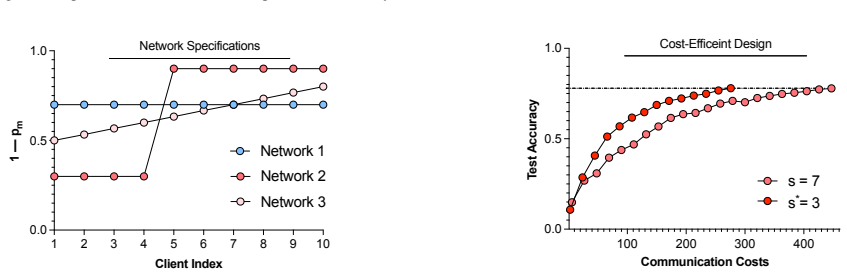
- The cost-efficient design chooses the smallest code parameter $s$ meeting a target outage probability, and the reported simulations show roughly a $39.6\%$ communication saving to reach the same accuracy.
Reading between the lines
- The fairness of the GC+ average is really a symmetry condition on the decoder's subset distribution; if real erasure patterns break it, weighting each decoded model by its selection probability instead of $1/|K_4(r)|$ would restore unbiasedness at the price of knowing those probabilities.
- Because erasures raise the rank of the received coefficient matrix, an outage pattern that hurts standard gradient coding becomes useful code randomness for GC+; this suggests designing the repeated matrices actively, e.g. randomizing coefficients across rounds to accelerate rank growth.
- The paper's own privacy remark implies a clean trade-off: standard CoGC hides individuals from the parameter server while GC+ reveals them, so combining GC+ with additive noise would blur individual models while keeping the convergence bounds meaningful only if the noise budget enters the analysis.
- A direct experimental check of the dominance claim would measure the empirical frequency of full versus partial recovery across the four network settings; the claimed asymptotic dominance should already be visible with small $t_r$ if the rank analysis is right.
Editorial analysis
A structured set of objections, weighed in public.
Referee Report
Summary. This paper proposes CoGC, a gradient-sharing-based gradient coding framework for distributed and federated learning that avoids dataset replication, and GC+, a complementary decoding scheme that reuses otherwise discarded incomplete partial sums to recover subsets of local models. The paper develops an outage analysis for the standard GC decoding mechanism, a secure aggregation analysis, a cost-efficient code design problem, and convergence bounds for both CoGC and GC+. The claims are supported by simulations on MNIST and CIFAR-10 under heterogeneous data distributions and various network conditions.
Significance. CoGC addresses a real limitation of prior gradient coding work—its reliance on dataset replication—and the proposed gradient-sharing implementation is a sensible step toward making GC applicable to federated learning. GC+ is an interesting attempt to improve robustness under poor client-to-client channels by recycling information that standard GC discards. The simulation results are extensive and the empirical gains of GC+ under poor client-to-client connectivity are noteworthy. However, several load-bearing theoretical components are currently not established: the outage probability formula contains a substantive error, the three-sigma argument in the convergence proof is misapplied, and the convergence bound for GC+ relies on an unproved and likely false uniformity assumption about the decoded set. If these issues can be fixed, the paper would be a valuable contribution to distributed learning.
major comments (4)
- [Appendix B, Lemma 5, Eqs. (48)-(49)] The proof of unbiasedness and the coefficient ᾱ_m rely on the assertion that, conditioned on |K4(r)| = K_r, the decoded set is uniformly distributed over all subsets of size K_r. This is stated as 'induced by unreliable communications in the homogeneous network' in the proof, but K4(r) is the set of columns recoverable from the rank pattern of the received coefficient matrix, which depends on the cyclic code structure and the specific erasure pattern. Different subsets of the same size need not be equally likely. If uniformity fails, the inner expectation in (48b) is not the global average, so (30) is false; likewise (31) and ᾱ_m = 1/(M K̄) fail. Since Theorem 2's bound (32) is derived directly from Lemma 5, the central convergence guarantee for GC+ is unsupported.
- [Section IV-A, Eq. (14)] P32 is not the probability that more than s−v1 client-to-PS links are in outage. The expression contains factors 1 − ∏_{k3∈K1(m)}(1 − P_{mk3}), which are probabilities of failing to hear from all neighbors, using client-to-client outage probabilities, and it omits the success factors for clients not in S3. Moreover, in (11) and (13), the set K1(m) is used where K2(m) (the neighbors from which client m needs to hear) is required. Consequently, P3 and PO in (15)-(16) are incorrect, invalidating the outage analysis and the cost-efficient design problem in (21).
- [Appendix A, Eqs. (46)-(47) and Theorem 1] The three-sigma rule is misapplied. Equation (46) defines σ²_max as an upper bound on the variance of the ratio, but the text then states that J̄2/J̄1 ≤ μJ2/μJ1 + 3σ²_max with probability greater than 99.86%, and the bound in (18) uses the same 3σ²_max term. For a Gaussian random variable, the corresponding one-sided 99.86% bound is μ + 3σ (standard deviation), not μ + 3σ². As written, the proof establishes neither the stated probability guarantee nor the convergence bound in (18).
- [Section VI-C, Theorem 2] The proof sketch states: 'It can be verified that Lemmas 2–4 from the supplementary material of [29] remain valid. Therefore, Theorem 2 can be proved by following similar steps to those of [29, Theorem 1].' This delegates the central proof to prior work without showing how the coded-network structure preserves those lemmas. Since Lemma 5, which is used in the derivation, is flawed as noted above, the convergence bound (32) is not established. A self-contained proof or a detailed verification of the transferred lemmas is needed.
minor comments (4)
- [Section IV-A, Eq. (14)] S3 is described as 'links from clients to the PS' but is formally a subset of clients; the text should clarify that S3 denotes the set of clients whose client-to-PS links are in outage.
- [Section VI-B1, Lemma 2] The quantity n_ir appears in the rank formula (24) but is only defined in Appendix C; the proof sketch's assertion that 'any M-s consecutive perturbed rows are of rank M-s' requires a more detailed justification, especially because erasures can destroy the triangular structure.
- [Section VI-B3, Eq. (29) and Lemma 4] The lower bound ̄P_M in (29) is zero whenever (M−s)t_r < M, and the condition (M−s)t_r ≫ M is not satisfied in the simulation settings (M=10, s=7, t_r=2). Thus Lemma 4's claimed dominance of full recovery is vacuous in the tested regime, and a different argument is needed to support the observed behavior in Fig. 6.
- [General] There are numerous typos and inconsistent notations, e.g., 'and teh set' in Section III, 'data patc' and 'optimility gap' in Section II, and inconsistent use of K1/K2 in the outage analysis; a thorough proofreading pass is recommended.
Circularity Check
The central convergence theorems for CoGC and GC+ are not derived in the paper: Theorem 1 imports its key bound from the authors' own [22], and Theorem 2 delegates its proof to 'Lemmas 2–4' and 'Theorem 1' of the authors' own [29]. This makes the theoretical guarantees load-bearing on a self-citation chain, even though the CoGC mechanism and outage analysis have independent content.
-
self citation load bearing
[Section VI-C, Theorem 2 Proof Sketch]
"Proof Sketch. It can be verified that Lemmas 2–4 from the supplementary material of [29] remain valid. Therefore, Theorem 2 can be proved by following similar steps to those of [29, Theorem 1]."
The main theoretical guarantee for GC+—the non-convex convergence bound (32)—is not proved in this manuscript. Its proof sketch reduces to 'Lemmas 2–4 from the supplementary material of [29]' and '[29, Theorem 1]', where [29] is an IEEE WCL paper by the same four authors. No statement or proof of these lemmas appears here, so a reader cannot check the bound without taking the authors' prior work as given. The convergence result is therefore load-bearing on a self-citation chain rather than a first-principles derivation.
-
self citation load bearing
[Appendix A, Proof of Theorem 1]
"With the help of Lemma 2 ∼4 in [22], the first half proof of Theorem 1 is the same as in [22], here, we begin with the preliminary bound acquired in (28) in [22]"
Theorem 1, the 99.86% convergence guarantee for CoGC, is not derived from the system model in the present paper. The proof starts by importing 'the preliminary bound acquired in (28) in [22]' and states that the first half is 'the same as in [22]', using 'Lemma 2∼4 in [22]'. Since [22] is the authors' own preliminary arXiv paper, the theorem's key bound and lemmas are inherited from prior self-citation rather than established in the present derivation.
full rationale
The paper has substantial non-circular content: the CoGC gradient-sharing implementation, the outage probability decomposition (11)–(16), the rank-enhancement lemmas (Lemmas 2–3), the secure aggregation analysis, and the simulations are self-contained and can be checked against the text. The circularity concern is concentrated in the convergence theory. Theorem 1 is explicitly built on 'Lemma 2∼4 in [22]' and 'the preliminary bound acquired in (28) in [22]', while Theorem 2 is dispatched with 'It can be verified that Lemmas 2–4 from the supplementary material of [29] remain valid. Therefore, Theorem 2 can be proved by following similar steps to those of [29, Theorem 1].' Both [22] and [29] are works whose author lists overlap with the present paper, and the lemmas are neither reproduced nor machine-checked in this manuscript. Thus the central convergence guarantees reduce to a self-citation chain. The Lemma 5 uniformity issue—where the proof asserts that K4(r) 'can be viewed as a specific realization of uniformly sampling Kr clients from [M] without replacement, but induced by unreliable communications in the homogeneous network'—is a serious correctness gap, but it is an unsupported assumption rather than a circular reduction, so it does not by itself raise the circularity score. Overall, the CoGC/GC+ mechanism is not definitionally identical to its inputs, but the two headline convergence theorems are load-bearing on the authors' own prior results, giving a score of 6 rather than 0–2.
Assumptions & free parameters
assumptions (6)
- domain assumption Assumptions 1-3: L-smoothness, unbiased stochastic gradients with bounded variance, bounded heterogeneity.
- domain assumption Cyclic GC code properties from [11]: rank(B)=M-s, any M-s rows linearly independent w.p.1, and the all-one vector lies in the row space.
- ad hoc to paper Lemmas 2-4 of [22] and Lemmas 2-4 of [29] remain valid.
- ad hoc to paper K4(r) is uniformly distributed over subsets of a given size, conditioned on |K4(r)|.
- domain assumption Local models are independent Gaussian vectors for the privacy analysis.
- domain assumption Channel erasures are i.i.d. Bernoulli and independent across links and rounds.
Cite this review
Pith. "Pith review of Cooperative Gradient Coding." pith.science (2026). https://pith.science/paper/BASWHEQ4
@misc{pith2026250705230,
  author       = {Pith},
  title        = {Pith review of: Cooperative Gradient Coding},
  year         = {2026},
  howpublished = {\url{https://pith.science/paper/BASWHEQ4}},
  note         = {Machine review of arXiv:2507.05230}
}
abstract
This work studies gradient coding (GC) in the context of distributed training problems with unreliable communication. We propose cooperative GC (CoGC), a novel gradient-sharing-based GC framework that leverages cooperative communication among clients. This approach ultimately eliminates the need for dataset replication, making it both communication- and computation-efficient and suitable for federated learning (FL). By employing the standard GC decoding mechanism, CoGC yields strictly binary outcomes: either the global model is exactly recovered, or the decoding fails entirely, with no intermediate results. This characteristic ensures the optimality of the training and demonstrates strong resilience to client-to-server communication failures when the communication channels among clients are in good condition. However, it may also result in communication inefficiency and hinder convergence due to its lack of flexibility, especially when communication channels among clients are in poor condition. To overcome this limitation and further harness the potential of GC matrices, we propose a complementary decoding mechanism, termed GC$^+$, which leverages information that would otherwise be discarded during GC decoding failures. This approach significantly improves system reliability under unreliable communication, as the full recovery of the global model typically dominates in GC$^+$. To conclude, this work establishes solid theoretical frameworks for both CoGC and GC$^+$. We provide complete outage analyses for each decoding mechanism, along with a rigorous investigation of how outages affect the structure and performance of GC matrices. Building on these analyses, we derive convergence bounds for both decoding mechanisms. Finally, the effectiveness of CoGC and GC$^+$ is validated through extensive simulations.
Figures


Figures from the paper (7 more)




Forward citations
Cited by 1 Pith paper
-
Coding-Enforced Robust Secure Aggregation for Federated Learning Under Unreliable Communication
SecCoGC combines cooperative gradient coding with real-field zero-sum privacy noise, giving exact global model reconstruction in federated learning under unreliable communication without a privacy-utility trade-off.
Reference graph
Works this paper leans on
-
[29]
Coded cooperative networks for semi-decentralized federated learning,
S. Weng, M. Xiao, C. Ren, and M. Skoglund, “Coded cooperative networks for semi-decentralized federated learning,” IEEE Wireless Communications Letters, pp. 1–1, 2024
work page 2024
-
[1]
Distributed learning in wireless networks: Recent progress and future challenges,
M. Chen, D. G ¨und¨uz, K. Huang, W. Saad, M. Bennis, A. V . Feljan, and H. V . Poor, “Distributed learning in wireless networks: Recent progress and future challenges,” IEEE Journal on Selected Areas in Communications, vol. 39, no. 12, pp. 3579–3605, 2021
2021
-
[2]
Distributed learning for wireless communications: Methods, applications and challenges,
L. Qian, P. Yang, M. Xiao, O. A. Dobre, M. Di Renzo, J. Li, Z. Han, Q. Yi, and J. Zhao, “Distributed learning for wireless communications: Methods, applications and challenges,” IEEE Journal of Selected Topics in Signal Processing , vol. 16, no. 3, pp. 326–342, 2022
work page 2022
-
[3]
Efficient distributed learning with sparsity,
J. Wang, M. Kolar, N. Srebro, and T. Zhang, “Efficient distributed learning with sparsity,” in Proceedings of the 34th International Conference on Machine Learning , ser. Proceedings of Machine Learning Research, D. Precup and Y . W. Teh, Eds., vol. 70. PMLR, 06–11 Aug 2017, pp. 3636–3645. [Online]. Available: https://proceedings.mlr.press/v70/wang17f.html
work page 2017
-
[4]
Fedbcd: A communication-efficient collaborative learning framework for distributed features,
Y . Liu, X. Zhang, Y . Kang, L. Li, T. Chen, M. Hong, and Q. Yang, “Fedbcd: A communication-efficient collaborative learning framework for distributed features,” IEEE Transactions on Signal Processing , vol. 70, pp. 4277–4290, 2022
work page 2022
-
[5]
Federated learning in heterogeneous networks with unreliable communication,
P. Zheng, Y . Zhu, Y . Hu, Z. Zhang, and A. Schmeink, “Federated learning in heterogeneous networks with unreliable communication,” IEEE Transactions on Wireless Communications , 2023
work page 2023
-
[6]
Quantized federated learning under transmission delay and outage constraints,
Y . Wang, Y . Xu, Q. Shi, and T.-H. Chang, “Quantized federated learning under transmission delay and outage constraints,” IEEE Journal on Selected Areas in Communications , vol. 40, no. 1, pp. 323–341, 2021
2021
-
[7]
Federated learning over wireless channels: Dynamic resource allocation and task scheduling,
S. Chu, J. Li, J. Wang, Z. Wang, M. Ding, Y . Zhang, Y . Qian, and W. Chen, “Federated learning over wireless channels: Dynamic resource allocation and task scheduling,” IEEE Transactions on Cognitive Com- munications and Networking , vol. 8, no. 4, pp. 1910–1924, 2022
work page 1910
Show all 33 references
-
[8]
Colrel: Collaborative relaying for federated learning over intermittently con- nected networks,
R. Saha, M. Yemini, E. Ozfatura, D. Gunduz, and A. Goldsmith, “Colrel: Collaborative relaying for federated learning over intermittently con- nected networks,” in Workshop on Federated Learning: Recent Advances and New Challenges (in Conjunction with NeurIPS 2022) , 2022
2022
-
[9]
Robust semi-decentralized federated learning via collaborative relay- ing,
M. Yemini, R. Saha, E. Ozfatura, D. G ¨und¨uz, and A. J. Goldsmith, “Robust semi-decentralized federated learning via collaborative relay- ing,” IEEE Transactions on Wireless Communications , 2023
2023
-
[10]
Distributed learning over unreliable networks,
C. Yu, H. Tang, C. Renggli, S. Kassing, A. Singla, D. Alistarh, C. Zhang, and J. Liu, “Distributed learning over unreliable networks,” in International Conference on Machine Learning . PMLR, 2019, pp. 7202–7212
2019
-
[11]
Gradient coding: Avoiding stragglers in distributed learning,
R. Tandon, Q. Lei, A. G. Dimakis, and N. Karampatziakis, “Gradient coding: Avoiding stragglers in distributed learning,” in International Conference on Machine Learning . PMLR, 2017, pp. 3368–3376
2017
-
[12]
Sequential gradient coding for packet-loss networks,
M. N. Krishnan, E. Hosseini, and A. Khisti, “Sequential gradient coding for packet-loss networks,” IEEE Journal on Selected Areas in Information Theory, vol. 2, no. 3, pp. 919–930, 2021
2021
-
[13]
Heterogeneity-aware gradient coding for straggler tolerance,
H. Wang, S. Guo, B. Tang, R. Li, and C. Li, “Heterogeneity-aware gradient coding for straggler tolerance,” in 2019 IEEE 39th International Conference on Distributed Computing Systems (ICDCS) . IEEE, 2019, pp. 555–564
2019
-
[14]
Heterogeneity-aware gradient coding for tolerating and leveraging stragglers,
H. Wang, S. Guo, B. Tang, R. Li, Y . Yang, Z. Qu, and Y . Wang, “Heterogeneity-aware gradient coding for tolerating and leveraging stragglers,” IEEE Transactions on Computers , vol. 71, no. 4, pp. 779– 794, 2021
2021
-
[15]
Optimal communication- computation trade-off in heterogeneous gradient coding,
T. Jahani-Nezhad and M. A. Maddah-Ali, “Optimal communication- computation trade-off in heterogeneous gradient coding,” IEEE Journal on Selected Areas in Information Theory , vol. 2, no. 3, pp. 1002–1011, 2021
2021
-
[16]
Communication-computation efficient gradient coding,
M. Ye and E. Abbe, “Communication-computation efficient gradient coding,” in International Conference on Machine Learning . PMLR, 2018, pp. 5610–5619
2018
-
[17]
Communication- efficient gradient coding for straggler mitigation in distributed learning,
S. Kadhe, O. O. Koyluoglu, and K. Ramchandran, “Communication- efficient gradient coding for straggler mitigation in distributed learning,” in 2020 IEEE International Symposium on Information Theory (ISIT) . IEEE, 2020, pp. 2634–2639
2020
-
[18]
Adaptive gradient coding,
H. Cao, Q. Yan, X. Tang, and G. Han, “Adaptive gradient coding,” IEEE/ACM Transactions on Networking , vol. 30, no. 2, pp. 717–734, 2022
2022
-
[19]
Design and optimization of hierarchical gradient coding for distributed learning at edge devices,
W. Tang, J. Li, L. Chen, and X. Chen, “Design and optimization of hierarchical gradient coding for distributed learning at edge devices,” IEEE Transactions on Communications , 2024
2024
-
[20]
Optimal communication-computation trade-off in hierarchical gradient coding,
A. Gholami, T. Jahani-Nezhad, K. Wan, and G. Caire, “Optimal communication-computation trade-off in hierarchical gradient coding,” arXiv preprint arXiv:2502.18251 , 2025
2025
-
[21]
Codedpaddedfl and codedsecagg: Straggler mitigation and secure aggregation in feder- ated learning,
R. Schlegel, S. Kumar, E. Rosnes, and A. G. i Amat, “Codedpaddedfl and codedsecagg: Straggler mitigation and secure aggregation in feder- ated learning,” IEEE Transactions on Communications , 2023
2023
-
[22]
Supplementary file: Cooperative gradient coding for semi-decentralized federated learning,
S. Weng, C. Li, M. Xiao, and M. Skoglund, “Supplementary file: Cooperative gradient coding for semi-decentralized federated learning,”
-
[23]
Tackling the objective inconsistency problem in heterogeneous federated optimiza- tion,
J. Wang, Q. Liu, H. Liang, G. Joshi, and H. V . Poor, “Tackling the objective inconsistency problem in heterogeneous federated optimiza- tion,” Advances in neural information processing systems , vol. 33, pp. 7611–7623, 2020
2020
-
[24]
Cooperative gradient coding for collaborative federated learning,
S. Weng, C. Li, M. Xiao, and M. Skoglund, “Cooperative gradient coding for collaborative federated learning,” 2024
2024
-
[25]
Gradient coding from cyclic mds codes and expander graphs,
N. Raviv, I. Tamo, R. Tandon, and A. G. Dimakis, “Gradient coding from cyclic mds codes and expander graphs,” IEEE Transactions on Information Theory, vol. 66, no. 12, pp. 7475–7489, 2020
2020
-
[26]
Context-aware local informa- tion privacy,
B. Jiang, M. Seif, R. Tandon, and M. Li, “Context-aware local informa- tion privacy,”IEEE Transactions on Information Forensics and Security, vol. 16, pp. 3694–3708, 2021
2021
-
[27]
Minimax optimal quantization of linear models: Information-theoretic limits and efficient algorithms,
R. Saha, M. Pilanci, and A. J. Goldsmith, “Minimax optimal quantization of linear models: Information-theoretic limits and efficient algorithms,” 2022. [Online]. Available: https://arxiv.org/abs/2202.11277 JOURNAL OF LATEX CLASS FILES, VOL. 18, NO. 9, SEPTEMBER 2020 16
2022 arXiv
-
[28]
Gradient coding,
R. Tandon, Q. Lei, A. G. Dimakis, and N. Karampatziakis, “Gradient coding,” 2017. [Online]. Available: https://arxiv.org/abs/1612.03301
2017 arXiv
-
[30]
Heterogeneity-aware client sampling: A unified solution for consistent federated learning,
S. Weng, C. Ren, M. Xiao, and M. Skoglund, “Heterogeneity-aware client sampling: A unified solution for consistent federated learning,”
-
[31]
On the convergence of fedavg on non-iid data,
X. Li, K. Huang, W. Yang, S. Wang, and Z. Zhang, “On the convergence of fedavg on non-iid data,” arXiv preprint arXiv:1907.02189 , 2019
1907 arXiv
-
[2024]
Available: https://arxiv.org/abs/2404.00780
[Online]. Available: https://arxiv.org/abs/2404.00780
-
[2025]
Available: https://arxiv.org/abs/2505.11304
[Online]. Available: https://arxiv.org/abs/2505.11304
Reviewed August 6, 2026 · model on record in the stance chip above.
Discussion (0). Continue with ORCID to comment.