REVIEW 1 major objections 2 minor 30 references
Reference-Governed Distributed Safe Gradient Flow for Safe Optimal Output Agreement of Multi-Agent Systems
T0 review · 1 major / 2 minor · reviewed 2026-07-03 · grok-4.3
Pith's one-line read A reference-governed two-layer architecture ensures safe optimal output agreement without changing the steady-state optimum.
desk verdict The two-layer reference-governed architecture with first-order CBF filtering and DSMs from the internal-model Lyapunov function is the main new piece, but optimality preservation still rests on DSM-compatibility conditions that look assumed rather than guaranteed by the construction. read the letter →
The pith
A machine-rendered reading of the paper's core claim, the machinery that carries it, and where it could break.
The reading
What carries the argument
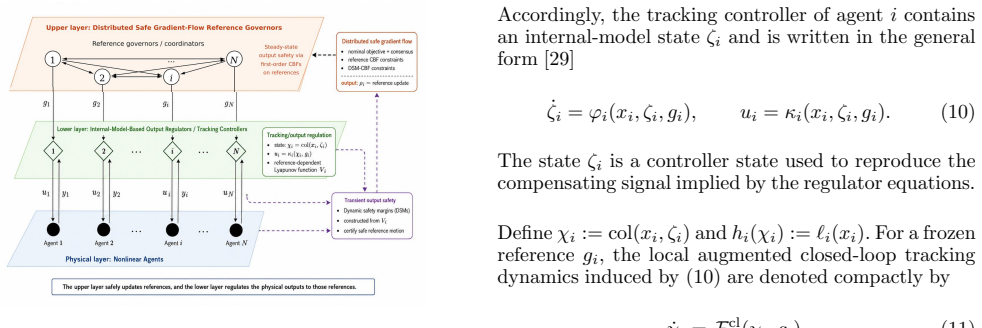
The reference-governed two-layer architecture that applies first-order control barrier functions to the reference gradient flow and derives dynamic safety margins from a reference-dependent Lyapunov function in the internal-model-based regulator.
What would settle it
Finding a case where the system reaches a steady-state different from the unconstrained optimal solution despite satisfying the DSM-compatibility conditions would falsify the preservation of optimality.
Extended reading notes
Core claim
The central claim is that the reference-governed distributed safe gradient flow, implemented via a two-layer architecture, filters the gradient flow with first-order CBFs in the upper layer and constructs DSMs from the lower-layer regulator to ensure safety and optimality preservation under DSM-compatibility conditions, with convergence shown by Lyapunov small-gain.
Load-bearing premise
The DSM-compatibility conditions hold so that the constructed dynamic safety margins do not alter the steady-state optimal solution of the original agreement problem.
Editorial extensions
If this is right
- Forward invariance of the safe output sets is proven.
- The original optimal solution is preserved if DSM-compatibility conditions hold.
- Convergence to the optimal agreement is guaranteed by the small-gain argument.
- Simulations show better performance than HOCBF methods and ability to escape spurious equilibria.
Reading between the lines
- This separation of layers could simplify implementation in physical systems by allowing independent tuning of safety and optimization.
- The approach might apply to other multi-agent tasks like formation control or resource allocation with safety needs.
- Using dynamic safety margins could lead to less conservative safety enforcement compared to static barriers.
Signed reviews
Editorial analysis
A structured set of objections, weighed in public.
Referee Report
Summary. The manuscript proposes a reference-governed two-layer architecture for safe optimal output agreement of nonlinear multi-agent systems subject to output safety constraints. The upper layer implements distributed gradient flow filtered by first-order CBF constraints; the lower layer uses an internal-model regulator whose reference-dependent Lyapunov function yields dynamic safety margins (DSMs). The central claims are proofs of forward invariance, preservation of the original optimal solution under DSM-compatibility conditions, and convergence via a Lyapunov small-gain argument, supported by simulations that also illustrate adaptive tangential shaping to escape spurious equilibria.
Significance. If the DSM-compatibility conditions can be shown to hold identically for the constructed margins and the small-gain argument is fully rigorous, the two-layer separation would constitute a useful alternative to direct HOCBF feedback optimization, offering easier tuning while retaining steady-state optimality. The explicit construction of DSMs from the regulator Lyapunov function and the handling of nonconvex obstacles are potentially valuable contributions.
major comments (1)
- [Abstract / main theorems section] Abstract and the section stating the main theorems: the optimal-solution preservation result is stated to hold only under DSM-compatibility conditions, yet the manuscript treats these conditions as an external requirement rather than proving that the DSMs constructed from the reference-dependent Lyapunov function satisfy them for general output safety constraints and nonconvex objectives. Because this condition is load-bearing for the claim that the architecture does not alter the steady-state optimum, the preservation theorem remains conditional.
minor comments (2)
- [Abstract] The abstract states that simulations validate the claims but reports neither quantitative metrics, baseline comparisons, nor specific parameter values, making it difficult to assess the practical advantage over HOCBF methods.
- [Preliminaries / notation section] Notation for the DSM-compatibility condition and the precise definition of the dynamic safety margins should be introduced with explicit equations before the main theorems to improve readability.
Simulated Author's Rebuttal
We thank the referee for the thorough review and constructive feedback. We address the single major comment below.
read point-by-point responses
-
Referee: [Abstract / main theorems section] Abstract and the section stating the main theorems: the optimal-solution preservation result is stated to hold only under DSM-compatibility conditions, yet the manuscript treats these conditions as an external requirement rather than proving that the DSMs constructed from the reference-dependent Lyapunov function satisfy them for general output safety constraints and nonconvex objectives. Because this condition is load-bearing for the claim that the architecture does not alter the steady-state optimum, the preservation theorem remains conditional.
Authors: We agree that the preservation theorem is stated conditionally on DSM-compatibility. The DSMs are explicitly constructed from the reference-dependent Lyapunov function of the internal-model regulator, and the compatibility conditions are introduced precisely to guarantee that these margins do not alter the equilibria of the upper-layer gradient flow. The manuscript does not claim or prove that the constructed DSMs satisfy the conditions identically for arbitrary nonconvex objectives and general output safety constraints, because satisfaction depends on the specific regulator design, the chosen Lyapunov function, and the geometry of the constraints. Instead, the conditions are presented as verifiable design requirements that can be checked for given problem data. Simulations confirm satisfaction in the considered cases. We will revise the main theorems section to add a remark stating sufficient conditions (e.g., sufficiently small DSM scaling) under which compatibility holds and to clarify the scope of the result. This is a partial revision. revision: partial
Circularity Check
DSM-compatibility stated as external assumption; no reduction by construction or self-citation load-bearing
full rationale
The provided abstract and reader summary indicate the central preservation result is explicitly conditioned on DSM-compatibility conditions rather than derived from the DSM construction itself. No equations are shown reducing to fitted inputs or self-citations by construction. The architecture separates layers with Lyapunov small-gain convergence, which is independent of the compatibility assumption. This qualifies as a minor external requirement (score 2) rather than circularity, as the paper does not claim the conditions hold identically or derive them from the result.
Assumptions & free parameters
free parameters (1)
- CBF gain parameters
assumptions (2)
- standard math Lyapunov small-gain theorem applies to the interconnected optimization and regulation layers
- domain assumption Internal-model principle holds for the output regulator design
invented entities (1)
-
Dynamic Safety Margins (DSMs)
Cite this review
Pith. "Pith review of Reference-Governed Distributed Safe Gradient Flow for Safe Optimal Output Agreement of Multi-Agent Systems." pith.science (2026). https://pith.science/paper/BATJZVE5
@misc{pith2026260702192,
  author       = {Pith},
  title        = {Pith review of: Reference-Governed Distributed Safe Gradient Flow for Safe Optimal Output Agreement of Multi-Agent Systems},
  year         = {2026},
  howpublished = {\url{https://pith.science/paper/BATJZVE5}},
  note         = {Machine review of arXiv:2607.02192}
}
read the original abstract
This paper studies safe optimal output agreement for nonlinear multi-agent systems with output safety constraints. Existing safe feedback optimization methods often implement gradient-flow dynamics directly through the plant input, which may require high-order control barrier functions (HOCBFs). The resulting derivative-chain design is tuning-sensitive and can introduce additional equilibrium conditions that alter the steady-state optimal solution. We propose a reference-governed two-layer architecture that separates lower-layer output regulation from upper-layer distributed optimization. The upper layer filters the reference gradient flow through first-order control barrier function constraints, which are easier to tune and preserve the steady-state optimality structure of the original agreement problem. The lower layer uses an internal-model-based output regulator with a reference-dependent Lyapunov function, from which dynamic safety margins (DSMs) are constructed to certify transient output safety. We prove forward invariance, optimal-solution preservation under DSM-compatibility conditions, and convergence via a Lyapunov small-gain argument. Simulations validate safe convergence, show advantages over HOCBF-based feedback optimization, and demonstrate adaptive tangential objective shaping for escaping spurious equilibria induced by nonconvex obstacles.
Figures


Figures from the paper (2 more)


Reference graph
Works this paper leans on
-
[1]
Marcello Colombino, Emiliano Dall’Anese, and An- drey Bernstein. Online optimization as a feedback controller: Stability and tracking.IEEE Transac- tions on Control of Network Systems, 7(1):422–432, 2019
work page 2019
-
[2]
Tong Liu, Tengfei Liu, and Zhong-Ping Jiang. Feed- back optimization of nonlinear strict-feedback sys- tems.Journal of Systems Science and Complexity, 38(2):717–738, 2025
work page 2025
-
[3]
Event-triggered and periodic event- triggered extremum seeking control.Automatica, 174:112161, 2025
Victor Hugo Pereira Rodrigues, Tiago Roux Oliveira, Liu Hsu, Mamadou Diagne, and Miroslav Krstic. Event-triggered and periodic event- triggered extremum seeking control.Automatica, 174:112161, 2025
work page 2025
-
[4]
Yijing Xie and Zongli Lin. Global optimal con- sensus for higher-order multi-agent systems with bounded controls.Automatica, 99:301–307, 2019
work page 2019
-
[5]
Lorenzo Pichierri, Guido Carnevale, Lorenzo Sforni, and Giuseppe Notarstefano. Multi-robot target monitoring and encirclement via triggered dis- tributed feedback optimization.IEEE Transactions on Robotics, 2026
work page 2026
-
[6]
Andrey Bernstein and Emiliano Dall’Anese. Real- time feedback-based optimization of distribution grids: A unified approach.IEEE Transactions on Control of Network Systems, 6(3):1197–1209, 2019
work page 2019
-
[7]
Ming Li, Zhaojian Wang, Mengshuo Jia, Feng Liu, Bo Yang, and Xinping Guan. Distributed control to steer dynamical systems to the generalized nash equilibria for monotone aggregative games with 14 operational constraints.Automatica, 185:112794, 2026
work page 2026
-
[8]
Angelia Nedi´ c and Ji Liu. Distributed optimization for control.Annual Review of Control, Robotics, and Autonomous Systems, 1(1):77–103, 2018
work page 2018
Show all 30 references
-
[9]
Nonconvex distributed feedback op- timization for aggregative cooperative robotics.Au- tomatica, 167:111767, 2024
Guido Carnevale, Nicola Mimmo, and Giuseppe Notarstefano. Nonconvex distributed feedback op- timization for aggregative cooperative robotics.Au- tomatica, 167:111767, 2024
2024
-
[10]
Yongqiang Wang and Angelia Nedi´ c. Robust con- strained consensus and inequality-constrained dis- tributed optimization with guaranteed differential privacy and accurate convergence.IEEE Trans- actions on Automatic Control, 69(11):7463–7478, 2024
2024
-
[11]
Control barrier function based quadratic programs for safety critical sys- tems.IEEE Transactions on Automatic Control, 62 (8):3861–3876, 2016
Aaron D Ames, Xiangru Xu, Jessy W Grizzle, and Paulo Tabuada. Control barrier function based quadratic programs for safety critical sys- tems.IEEE Transactions on Automatic Control, 62 (8):3861–3876, 2016
2016
-
[12]
High-order control bar- rier functions.IEEE Transactions on Automatic Control, 67(7):3655–3662, 2021
Wei Xiao and Calin Belta. High-order control bar- rier functions.IEEE Transactions on Automatic Control, 67(7):3655–3662, 2021
2021
-
[13]
Control-barrier- function-based design of gradient flows for con- strained nonlinear programming.IEEE Transac- tions on Automatic Control, 69(6):3499–3514, 2023
Ahmed Allibhoy and Jorge Cort´ es. Control-barrier- function-based design of gradient flows for con- strained nonlinear programming.IEEE Transac- tions on Automatic Control, 69(6):3499–3514, 2023
2023
-
[14]
Continuous approximations of projected dynamical systems via control bar- rier functions.IEEE Transactions on Automatic Control, 2024
Giannis Delimpaltadakis, Jorge Cort´ es, and WPMH Heemels. Continuous approximations of projected dynamical systems via control bar- rier functions.IEEE Transactions on Automatic Control, 2024
2024
-
[15]
Feedback optimiza- tion with state constraints through control barrier functions
Giannis Delimpaltadakis, Pol Mestres, Jorge Cort´ es, and WPMH Heemels. Feedback optimiza- tion with state constraints through control barrier functions. In2025 IEEE 64th Conference on Deci- sion and Control (CDC), pages 7234–7239. IEEE, 2025
2025
-
[16]
Small-gain theorem for iss systems and applica- tions.Mathematics of Control, Signals and Systems, 7(2):95–120, 1994
Z-P Jiang, Andrew R Teel, and Laurent Praly. Small-gain theorem for iss systems and applica- tions.Mathematics of Control, Signals and Systems, 7(2):95–120, 1994
1994
-
[17]
Small gain theorems for large scale systems and construction of iss lyapunov functions
Sergey N Dashkovskiy, Bj¨ orn S R¨ uffer, and Fabian R Wirth. Small gain theorems for large scale systems and construction of iss lyapunov functions. SIAM Journal on Control and Optimization, 48(6): 4089–4118, 2010
2010
-
[18]
Distributed optimization of non- linear multiagent systems: A small-gain approach
Tengfei Liu, Zhengyan Qin, Yiguang Hong, and Zhong-Ping Jiang. Distributed optimization of non- linear multiagent systems: A small-gain approach. IEEE Transactions on Automatic Control, 67(2): 676–691, 2021
2021
-
[19]
Distributed feedback op- timization of nonlinear uncertain systems subject to inequality constraints.IEEE Transactions on Automatic Control, 69(6):3989–3996, 2023
Zhengyan Qin, Tengfei Liu, Tao Liu, Zhong-Ping Jiang, and Tianyou Chai. Distributed feedback op- timization of nonlinear uncertain systems subject to inequality constraints.IEEE Transactions on Automatic Control, 69(6):3989–3996, 2023
2023
-
[20]
Distributed optimal output consensus control of heterogeneous multi-agent systems with safety constraints.IEEE Transactions on Automatic Control, 2025
Ji Ma, Shu Liang, and Yiguang Hong. Distributed optimal output consensus control of heterogeneous multi-agent systems with safety constraints.IEEE Transactions on Automatic Control, 2025
2025
-
[21]
The ex- plicit reference governor: A general framework for the closed-form control of constrained nonlinear systems.IEEE Control Systems Magazine, 38(4): 89–107, 2018
Marco M Nicotra and Emanuele Garone. The ex- plicit reference governor: A general framework for the closed-form control of constrained nonlinear systems.IEEE Control Systems Magazine, 38(4): 89–107, 2018
2018
-
[22]
Explicit reference governor for constrained nonlinear sys- tems.IEEE Transactions on Automatic Control, 61 (5):1379–1384, 2015
Emanuele Garone and Marco M Nicotra. Explicit reference governor for constrained nonlinear sys- tems.IEEE Transactions on Automatic Control, 61 (5):1379–1384, 2015
2015
-
[23]
Using dynamic safety margins as control barrier functions.IEEE Transactions on Automatic Control, 2026
Victor Freire and Marco M Nicotra. Using dynamic safety margins as control barrier functions.IEEE Transactions on Automatic Control, 2026
2026
-
[24]
Optimization-free constrained con- trol with guaranteed recursive feasibility: A cbf- based reference governor approach.arXiv preprint arXiv:2604.04001, 2026
Satoshi Nakano, Emanuele Garone, and Gennaro Notomista. Optimization-free constrained con- trol with guaranteed recursive feasibility: A cbf- based reference governor approach.arXiv preprint arXiv:2604.04001, 2026
2026 arXiv
-
[25]
On the un- desired equilibria induced by control barrier func- tion based quadratic programs.Automatica, 159: 111359, 2024
Xiao Tan and Dimos V Dimarogonas. On the un- desired equilibria induced by control barrier func- tion based quadratic programs.Automatica, 159: 111359, 2024
2024
-
[26]
Reis and A
Matheus F. Reis and A. Pedro Aguiar. On the sta- bility of undesirable equilibria in the quadratic pro- gram framework for safety-critical control.Auto- matica, 190:113032, 2026. ISSN 0005-1098
2026
-
[27]
Zhanglin Shangguan, Wei Xiao, Qi Li, Bo Yang, and Xinping Guan. Synthesizing safety in infinite- horizon optimal control for disturbed high-relative- degree systems via barrier-regulating auxiliary vari- ables.arXiv preprint arXiv:2604.09004, 2026
2026 arXiv
-
[28]
SIAM, 2004
Jie Huang.Nonlinear output regulation: theory and applications. SIAM, 2004
2004
-
[29]
A general framework for tackling the output regulation problem.IEEE Transactions on Automatic Control, 49(12):2203– 2218, 2004
Jie Huang and Zhiyong Chen. A general framework for tackling the output regulation problem.IEEE Transactions on Automatic Control, 49(12):2203– 2218, 2004
2004
-
[30]
Consensus of linear multi-agent systems by distributed event- triggered strategy.IEEE transactions on cybernet- ics, 46(1):148–157, 2015
Wenfeng Hu, Lu Liu, and Gang Feng. Consensus of linear multi-agent systems by distributed event- triggered strategy.IEEE transactions on cybernet- ics, 46(1):148–157, 2015. 15
2015
Reviewed July 3, 2026 · model on record in the stance chip above.
Discussion (0). Continue with ORCID to comment.