Controlling langle hat{S}² rangle in Broken-symmetry Density Functional Theory Calculations via Constrained Optimization
Pith reviewed 2026-06-28 11:44 UTC · model grok-4.3
The pith
A Lagrange multiplier constraint on ⟨S²⟩ in broken-symmetry DFT calculations produces lower and more consistent magnetic exchange couplings J across density functionals.
A machine-rendered reading of the paper's core claim, the machinery that carries it, and where it could break.
Core claim
Imposing a constraint on the DFT energy functional via a Lagrange multiplier that enforces a target ⟨S²⟩ allows explicit control over the spin character of the electronic state in broken-symmetry calculations; the resulting energies, when mapped to the Heisenberg-Dirac-van Vleck Hamiltonian, produce exchange couplings that are systematically lower and more consistent across density functional approximations than those obtained from conventional broken-symmetry energy differences.
What carries the argument
Lagrange multiplier constraint on the expectation value ⟨S²⟩ within the generalized Kohn-Sham energy functional, together with the derived analytical gradient expressions for ⟨S²⟩ with respect to spin-resolved density matrices.
If this is right
- The constrained energies yield systematically lower J values than standard broken-symmetry calculations.
- J values become more consistent across different density functional approximations.
- The analytical gradient expressions for ⟨S²⟩ are valid for arbitrary spin states and any single-determinant method.
- The approach applies directly to model systems such as H₂He, equilateral H₃He₃, and bis(μ-hydroxo) Cu(II) complexes.
Where Pith is reading between the lines
- The method could be combined with existing mapping schemes rather than replacing them entirely.
- Extension to periodic systems or larger polynuclear complexes would test whether the consistency benefit persists at greater computational scale.
- The same constrained optimization machinery could be applied to other expectation values, such as local spin projections, without changing the underlying DFT code structure.
Load-bearing premise
Enforcing a chosen target ⟨S²⟩ via the Lagrange multiplier produces an electronic state whose energy difference correctly maps onto the Heisenberg-Dirac-van Vleck Hamiltonian without introducing new systematic bias in the J extraction.
What would settle it
Direct numerical comparison, on the same test molecules, of the constrained J values against reference J values obtained from high-level wave-function methods or from experiment; systematic deviation larger than the spread among unconstrained mappings would falsify the claim of improved consistency without new bias.
Figures
read the original abstract
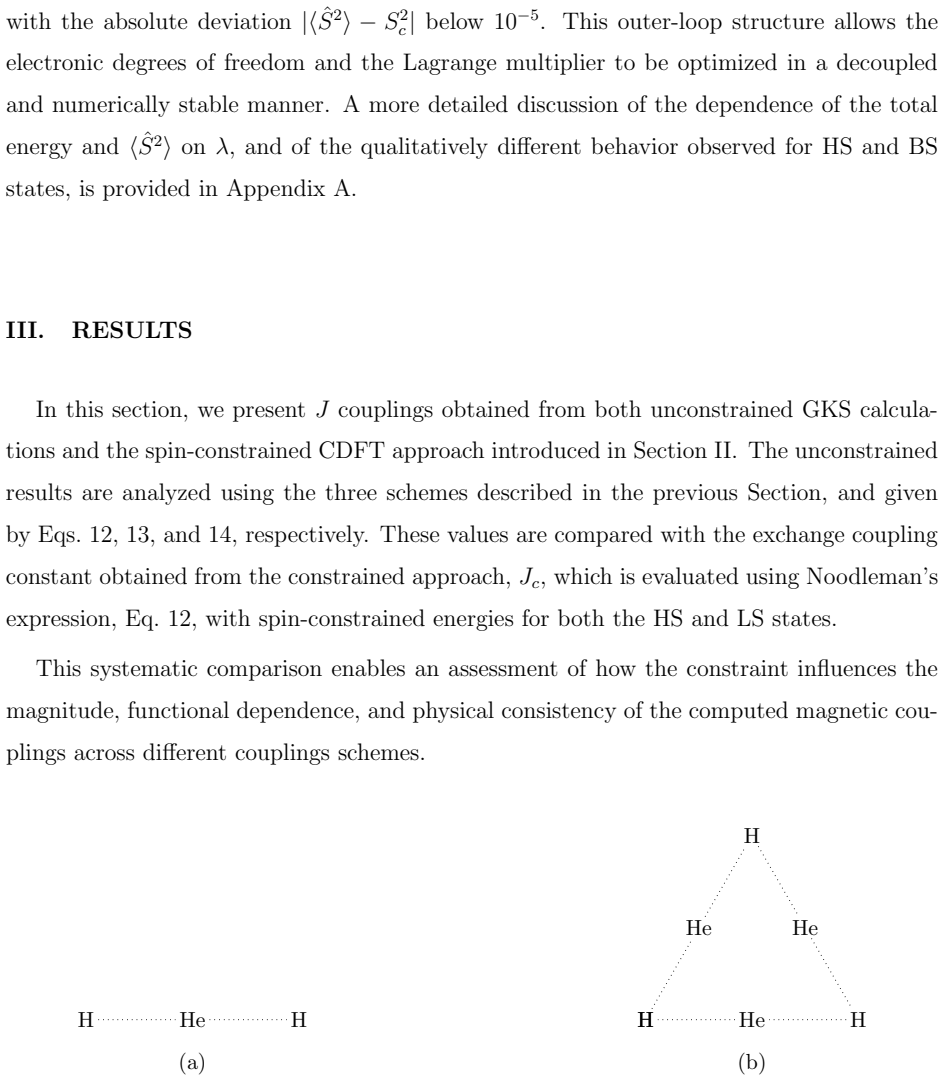
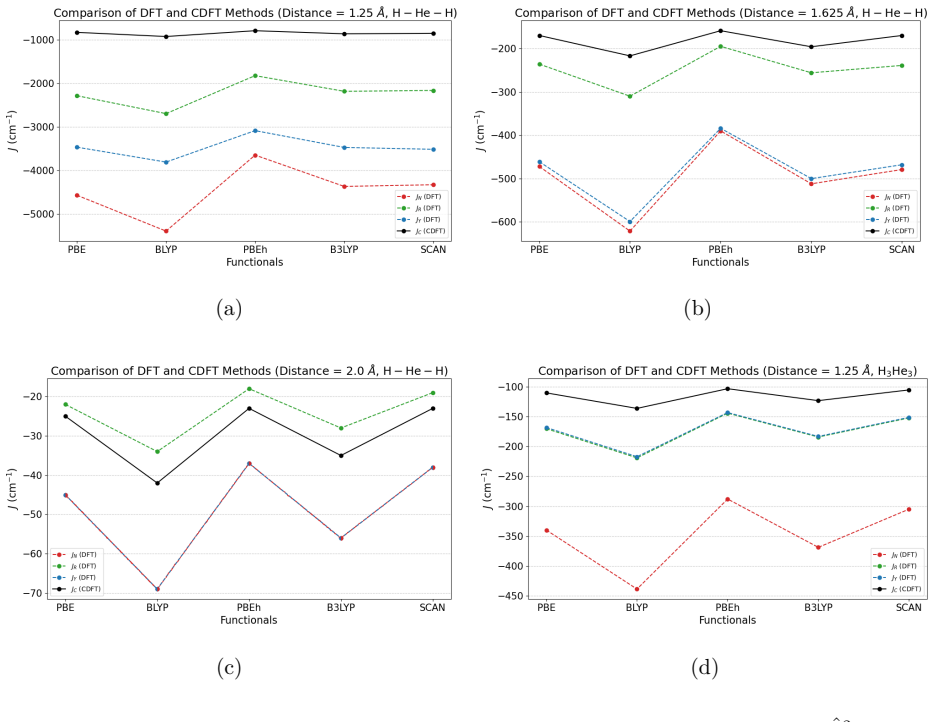
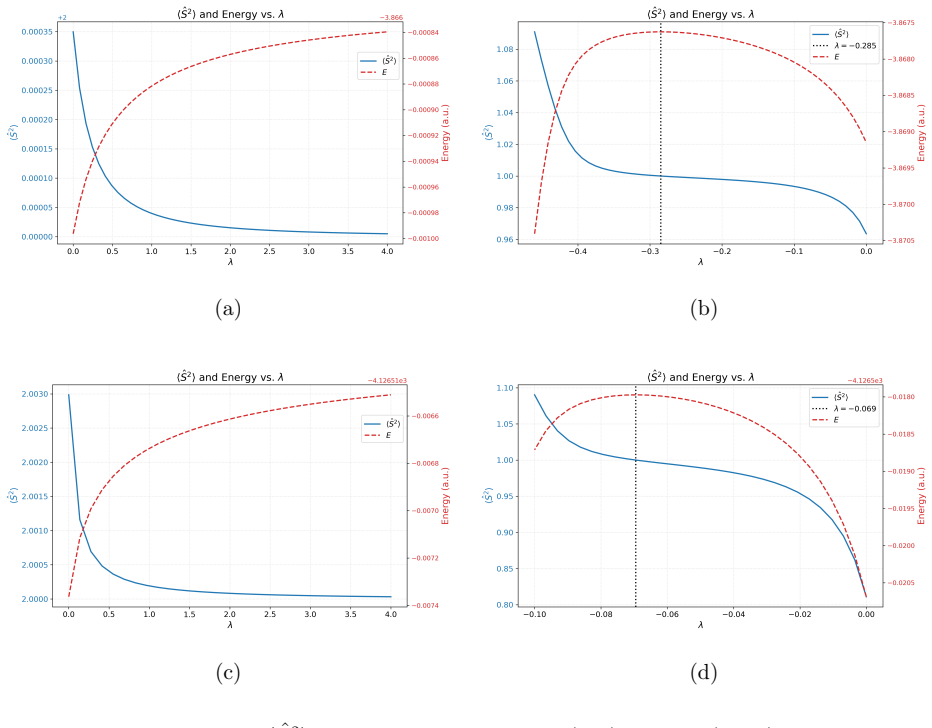
Accurate determination of magnetic exchange coupling constants ($J$) from density functional theory (DFT) remains challenging, particularly for open-shell systems where broken-symmetry (BS) solutions suffer from spurious spin contamination that systematically exaggerates $J$ values. Several methods have been proposed to address this problem by adjusting the mapping scheme from the DFT energies to the Heisenberg-Dirac-van Vleck effective spin Hamiltonian energies. In this work, we explore a different route by imposing a constraint to the DFT energy that enforces a target value of the spin-squared expectation, $\langle \hat{S}^2 \rangle$, using a Lagrange multiplier approach. By explicitly controlling the spin character of the electronic state, the method attempts to overcome limitations of standard BS calculations to describe magnetic interactions. As part of the theoretical formulation, we derive analytical expressions for the gradient of the spin-squared expectation value with respect to the spin-resolved density matrices, which are required for the practical implementation of the constraint within a generalized Kohn-Sham scheme. These expressions are general to any single-determinant method and remain valid for arbitrary spin states. We apply the spin-constrained approach to the calculation of $J$ couplings and compare with three energy-difference-based schemes for a set of representative systems, including H$_2$He, H$_3$He$_3$ arranged in an equilateral triangle, and a bis($\mu$-hydroxo) Cu(II) complex. Across all cases, the constrained formulation yields systematically lower and more consistent exchange couplings across different density functional approximations. This work establishes a robust and general route for incorporating spin-state constraints into DFT-based studies of magnetic exchange interactions.
Editorial analysis
A structured set of objections, weighed in public.
Referee Report
Summary. The manuscript proposes controlling spin contamination in broken-symmetry DFT by imposing a Lagrange-multiplier constraint on ⟨S²⟩ during the SCF optimization. Analytical gradients of ⟨S²⟩ with respect to spin-resolved density matrices are derived for use in generalized Kohn-Sham implementations. The constrained energies are then used to extract Heisenberg exchange couplings J for three test systems (H₂He, equilateral H₃He₃, and a bis(μ-hydroxo) Cu(II) complex) and compared against three standard energy-difference mapping schemes; the central claim is that the constrained results are systematically lower and more consistent across density-functional approximations.
Significance. Derivation of general, single-determinant analytical gradients for ⟨S²⟩ is a reusable technical contribution. If the constrained energies can be shown to map to the HDvV model without introducing new bias, the approach would offer a direct route to mitigating spin-contamination effects in J calculations rather than relying solely on post-hoc corrections.
major comments (2)
- [Abstract] Abstract (paragraph on mapping schemes): the claim that constrained energies yield J values that correctly reflect the HDvV Hamiltonian is load-bearing, yet no demonstration is given that the Lagrange-multiplier term can be subtracted or that the standard (E_HS − E_LS)/denominator formulas remain valid once the effective potential is modified by the constraint.
- [Abstract] Abstract (application paragraph): the central result that the constrained formulation produces “systematically lower and more consistent” J values across functionals rests on numerical comparisons that are not shown; no tables, raw energies, error metrics, or explicit J values versus unconstrained BS results are provided to support the claim.
minor comments (1)
- The derivation of the ⟨S²⟩ gradients should be cross-referenced to the specific equations used in the implementation section so that readers can verify the expressions for arbitrary spin states.
Simulated Author's Rebuttal
We thank the referee for their careful reading and constructive comments. We address each major comment below and indicate the revisions we will make to the manuscript.
read point-by-point responses
-
Referee: [Abstract] Abstract (paragraph on mapping schemes): the claim that constrained energies yield J values that correctly reflect the HDvV Hamiltonian is load-bearing, yet no demonstration is given that the Lagrange-multiplier term can be subtracted or that the standard (E_HS − E_LS)/denominator formulas remain valid once the effective potential is modified by the constraint.
Authors: We agree that additional justification is needed for why the standard mapping formulas remain applicable. In the revised manuscript we will add a concise paragraph in the theory section (and a corresponding sentence in the abstract) explaining that the Lagrange multiplier modifies the effective potential only during the SCF procedure to reach the target ⟨S²⟩; the converged energy is the physical energy of that constrained single-determinant state. Consequently the usual (E_HS − E_LS) differences can be inserted directly into the HDvV mapping expressions without subtracting the multiplier term. We will also supply a brief numerical verification for one of the model systems to illustrate that the mapping is unchanged. revision: yes
-
Referee: [Abstract] Abstract (application paragraph): the central result that the constrained formulation produces “systematically lower and more consistent” J values across functionals rests on numerical comparisons that are not shown; no tables, raw energies, error metrics, or explicit J values versus unconstrained BS results are provided to support the claim.
Authors: The referee correctly notes that the abstract summarizes a numerical finding without the supporting data being visible. Although the results section of the manuscript contains the comparisons, we will revise the abstract to reference the specific figures and tables and will add an explicit summary table (or expanded table in the main text) listing the raw energies, unconstrained and constrained J values, and consistency metrics across functionals for all three test systems. This will make the central claim directly verifiable from the presented data. revision: yes
Circularity Check
No circularity: constraint is external input; J extraction uses unmodified mapping on resulting energies
full rationale
The paper defines a Lagrange-multiplier constraint that enforces a user-chosen target value of ⟨S²⟩ as an external input to the DFT energy functional. Analytical gradients of ⟨S²⟩ are derived once and applied; the resulting constrained energies are inserted into the standard energy-difference formulas for J. No step equates the reported J to a fitted parameter, renames a prior result, or reduces the central claim to a self-citation chain. The derivation remains independent of the output J values.
Axiom & Free-Parameter Ledger
free parameters (1)
- target ⟨S²⟩ value
axioms (1)
- domain assumption The generalized Kohn-Sham scheme permits direct imposition of the ⟨S²⟩ constraint via a Lagrange multiplier.
Reference graph
Works this paper leans on
-
[1]
Inhomogeneous Electron Gas , author =. Phys. Rev. , volume =. 1964 , month = nov, publisher =
1964
-
[2]
Self-Consistent Equations Including Exchange and Correlation Effects , author =. Phys. Rev. , volume =. 1965 , month = nov, publisher =
1965
-
[3]
and Kortus, Jens and Myneni, Hemanadhan and Ivanov, Aleksei V
Trepte, Kai and Schwalbe, Sebastian and Liebing, Simon and Schulze, Wanja T. and Kortus, Jens and Myneni, Hemanadhan and Ivanov, Aleksei V. and Lehtola, Susi , title =. J. Chem. Phys. , volume =. 2021 , month = dec, abstract =
2021
-
[4]
Ruiz, Eliseo and Alvarez, Santiago and Cano, Joan and Polo, Víctor , title =. J. Chem. Phys. , volume =. 2005 , month = oct, abstract =
2005
-
[5]
Bryenton, Kyle R. and Adeleke, Adebayo A. and Dale, Stephen G. and Johnson, Erin R. , title =. WIREs Comput. Mol. Sci. , volume =. doi:10.1002/wcms.1631 , abstract =
-
[6]
Localization and Delocalization Errors in Density Functional Theory and Implications for Band-Gap Prediction , author =. Phys. Rev. Lett. , volume =. 2008 , month = apr, publisher =
2008
-
[7]
Theoretical and computational photochemistry , pages=
Density-functional theory for electronic excited states , author=. Theoretical and computational photochemistry , pages=. 2023 , publisher=
2023
-
[8]
Constrained density functional theory , author=. Chem. Rev. , volume=. 2012 , publisher=
2012
-
[9]
Constrained density functional theory and its application in long-range electron transfer , author=. J. Chem. Theory Comput. , volume=. 2006 , publisher=
2006
-
[10]
The calculations of excited-state properties with Time-Dependent Density Functional Theory , author=. Chem. Soc. Rev. , volume=. 2013 , publisher=
2013
-
[11]
von Barth, Ulf and Hedin, Lars , journal =
-
[12]
Self-interaction correction to density-functional approximations for many-electron systems , author =. Phys. Rev. B , volume =. 1981 , month = may, publisher =
1981
-
[13]
Chattaraj, Pratim Kumar , editor =
-
[14]
and Bogdanov, Nikolay A
Sun, Qiming and Zhang, Xing and Banerjee, Samragni and Bao, Peng and Barbry, Marc and Blunt, Nick S. and Bogdanov, Nikolay A. and Booth, George H. and Chen, Jia and Cui, Zhi-Hao and Eriksen, Janus J. and Gao, Yang and Guo, Sheng and Hermann, Jan and Hermes, Matthew R. and Koh, Kevin and Koval, Peter and Lehtola, Susi and Li, Zhendong and Liu, Junzi and Ma...
2020
-
[15]
Recent developments in libxc — A comprehensive library of functionals for density functional theory , journal =. 2018 , issn =. doi:10.1016/j.softx.2017.11.002 , author =
-
[16]
Ground states of constrained systems: application to cerium impurities , author=. Phys. Rev. Lett. , volume=. 1984 , publisher=
1984
-
[17]
Reliable prediction of charge transfer excitations in molecular complexes using time-dependent density functional theory , author=. J. Am. Chem. Soc. , volume=. 2009 , publisher=
2009
-
[18]
Ensemble generalized Kohn--Sham theory: The good, the bad, and the ugly , author=. J. Chem. Phys. , volume=. 2021 , publisher=
2021
-
[19]
Improving results by improving densities: Density-corrected density functional theory , author=. J. Am. Chem. Soc. , volume=. 2022 , publisher=
2022
-
[20]
ACS Catal
Beyond density functional theory: the multiconfigurational approach to model heterogeneous catalysis , author=. ACS Catal. , volume=. 2019 , publisher=
2019
-
[21]
Direct calculation of electron transfer parameters through constrained density functional theory , author=. J. Phys. Chem. A , volume=. 2006 , publisher=
2006
-
[22]
Physica E , volume=
Self-consistent electronic structure, coulomb interaction, and spin effects in self-assembled strained InAs--GaAs quantum dot structures , author=. Physica E , volume=. 1998 , publisher=
1998
-
[23]
Many-body projector orbitals for electronic structure theory of strongly correlated electrons , author=. Int. J. Quantum Chem. , volume=. 2005 , publisher=
2005
-
[24]
2010 , organization=
Hourahine, B and Aradi, B and Frauenheim, T , booktitle=. 2010 , organization=
2010
-
[25]
Magnetic exchange couplings from constrained density functional theory: An efficient approach utilizing analytic derivatives , author=. J. Chem. Phys. , volume=. 2011 , publisher=
2011
-
[26]
Visible light enhanced thermocatalytic reverse water gas shift reaction via localized surface plasmon resonance of copper nanoparticles , author=. Sep. Purif. Technol. , volume=. 2025 , publisher=
2025
-
[27]
Broken symmetry approach to calculation of exchange coupling constants for homobinuclear and heterobinuclear transition metal complexes , author=. J. Comput. Chem. , volume=. 1999 , publisher=
1999
-
[28]
Spin decontamination of broken-symmetry density functional theory calculations: deeper insight and new formulations , author=. Phys. Chem. Chem. Phys. , volume=. 2015 , publisher=
2015
-
[29]
Consistent spin decontamination of broken-symmetry calculations of diradicals , author=. J. Chem. Phys. , volume=. 2020 , publisher=
2020
-
[30]
2000 , publisher=
Soda, T and Kitagawa, Y and Onishi, T and Takano, Y and Shigeta, Y and Nagao, H and Yoshioka, Y and Yamaguchi, K , journal=. 2000 , publisher=
2000
-
[31]
Magnetic exchange coupling in Cu dimers studied with modern multireference methods and broken-symmetry coupled cluster theory , author=. Theor. Chem. Acc. , volume=. 2021 , publisher=
2021
-
[32]
Valence bond description of antiferromagnetic coupling in transition metal dimers , author=. J. Chem. Phys. , volume=. 1981 , publisher=
1981
-
[33]
Simple spin correction of unrestricted density-functional calculation , author=. Phys. Rev. A , volume=. 1996 , publisher=
1996
-
[34]
Spin contamination in single-determinant wavefunctions , author=. Chem. Phys. Lett. , volume=. 1991 , publisher=
1991
-
[35]
Constrained active space unrestricted mean-field methods for controlling spin-contamination , author=. J. Chem. Phys. , volume=. 2011 , publisher=
2011
-
[36]
Molecules , volume=
An overview of self-consistent field calculations within finite basis sets , author=. Molecules , volume=. 2020 , publisher=
2020
-
[37]
Controlling spin contamination using constrained density functional theory , author=. J. Chem. Phys. , volume=. 2008 , publisher=
2008
-
[38]
2025 , publisher=
Perdew, John P , journal=. 2025 , publisher=
2025
-
[39]
Many-electron self-interaction error in approximate density functionals , author=. J. Chem. Phys. , volume=. 2006 , publisher=
2006
-
[40]
Generalized gradient approximation made simple , author=. Phys. Rev. Lett. , volume=. 1996 , publisher=
1996
-
[41]
Density-functional exchange-energy approximation with correct asymptotic behavior , author=. Phys. Rev. A , volume=. 1988 , publisher=
1988
-
[42]
1999 , publisher=
Adamo, Carlo and Barone, Vincenzo , journal=. 1999 , publisher=
1999
-
[43]
1993 , publisher=
Becke, Axel D , journal=. 1993 , publisher=
1993
-
[44]
Strongly constrained and appropriately normed semilocal density functional , author=. Phys. Rev. Lett. , volume=. 2015 , publisher=
2015
-
[45]
2006 , publisher=
Numerical optimization , author=. 2006 , publisher=
2006
-
[46]
Self-consistent molecular orbital methods. XX. A basis set for correlated wave functions , author=. J. Chem. Phys. , volume=. 1980 , publisher=
1980
-
[47]
Accurate magnetic exchange couplings in transition-metal complexes from constrained density-functional theory , author=. J. Chem. Phys. , volume=. 2006 , publisher=
2006
-
[48]
Balanced basis sets of split valence, triple zeta valence and quadruple zeta valence quality for H to Rn: Design and assessment of accuracy , author=. Phys. Chem. Chem. Phys. , volume=. 2005 , doi=
2005
-
[49]
Density functional studies of molecular magnets , author=. phys. Status solidi (b) , volume=. 2006 , publisher=
2006
-
[50]
Remarks on the proper use of the broken symmetry approach to magnetic coupling , author=. J. Phys. Chem. A , volume=. 1997 , publisher=
1997
-
[51]
Reliability of range-separated hybrid functionals for describing magnetic coupling in molecular systems , author=. J. Chem, Phys. , volume=. 2008 , publisher=
2008
-
[52]
Comparative density functional theory study of magnetic exchange couplings in dinuclear transition-metal complexes , author=. J. Chem. Theory Comput. , volume=. 2023 , publisher=
2023
-
[53]
Polyhedron , volume=
Electronic and magnetic signatures of low-lying spin-flip excitonic states of Mn12O12-acetate , author=. Polyhedron , volume=. 2021 , publisher=
2021
-
[54]
Angular Momentum Wavefunctions Constructed by Projector Operators , author=. Rev. Mod. Phys. , volume=. 1964 , publisher=
1964
-
[55]
A unified view of the theoretical description of magnetic coupling in molecular chemistry and solid state physics , author=. Phys. Chem. Chem. Phys. , volume=. 2006 , publisher=
2006
discussion (0)
Sign in with ORCID, Apple, or X to comment. Anyone can read and Pith papers without signing in.