REVIEW 3 major objections 4 minor 22 references
Comparison Reveals Commonality: Customized Image Generation through Contrastive Inversion
T0 review · 3 major / 4 minor · reviewed 2026-08-05 · deepseek-v4-flash
Pith's one-line read By training one auxiliary token per input image and repelling those tokens with a contrastive loss, Contrastive Inversion isolates the concept the images share, then fine-tunes the generator so text edits preserve it.
desk verdict The core idea—contrastive auxiliary tokens plus detachable cross-attention layers—is genuinely new and worth a look; but the 'outperforming' claim collapses in Table 1, where Ours and DisenBooth are statistically indistinguishable. read the letter →
The pith
A machine-rendered reading of the paper's core claim, the machinery that carries it, and where it could break.
The reading
What carries the argument
Dual machinery carries the argument. First, Contrastive Inversion: an InfoNCE loss (Eq. 2) over frozen CLIP space attracts each auxiliary token $A^*_i$ to its own image embedding and repels it from the others; with the LDM denoising loss (Eq. 1) in the background, this forces per-image content out of the shared token $S^*$ without external guidance. Second, disentangled cross-attention fine-tuning: the key/value matrices of cross-attention are duplicated, originals trained only on $S^*$, copies only on the auxiliary tokens, outputs summed during training (Eq. 3) and the auxiliary copy discarded at inference — so auxiliary content never reaches the deployed weights. Auxiliary capacity $n$ (to
What would settle it
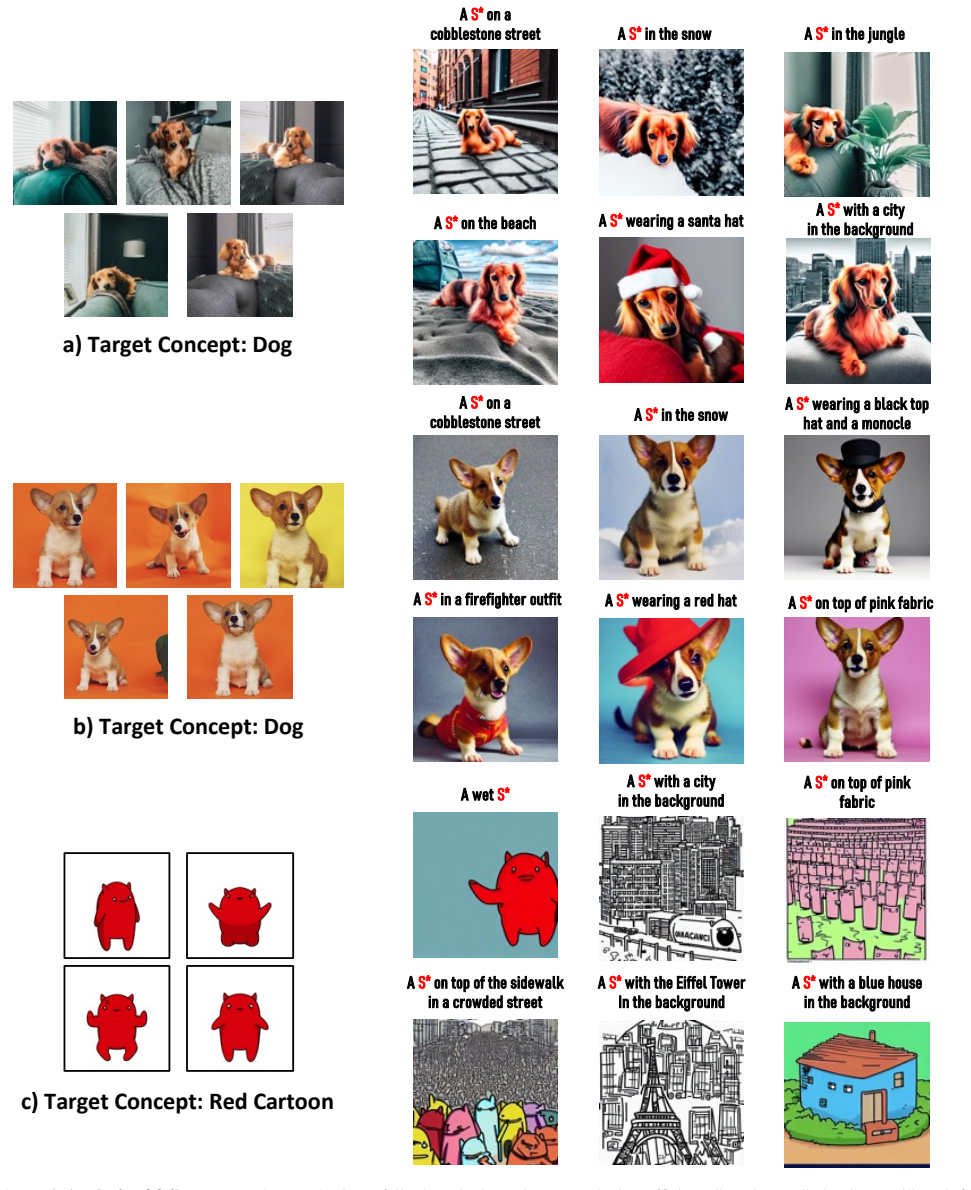
Use an input set designed for failure: the same object, same pose, same background across all photos (e.g., the consistently lying-down dog of Figure 6a). The paper predicts the pose will fuse into the identity token and the prompt 'a standing $S^*$' will still produce a lying dog; if instead the subject edits freely, the contrastive separation has done more than claimed. A complementary check: generate 'a photo of $A^*_i$' and test whether the target subject ever appears in the result — if it does, the auxiliary tokens have leaked the shared concept.
Extended reading notes
Core claim
This paper claims that concept disentanglement in personalized image generation can be achieved purely by comparison. Training a target token $S^*$ alongside $N$ image-wise auxiliary tokens $A^*_i$ with the latent-diffusion denoising loss plus an InfoNCE contrastive term — each $(A^*_i,\ \text{its own image})$ a positive pair, all cross pairs negative — drives auxiliary tokens to encode what distinguishes each image from the set (background, pose, lighting) while $S^*$ keeps what they share. A second stage fine-tunes duplicated cross-attention key/value matrices: originals trained only with $S^*$, copies only with the auxiliary tokens, copies discarded at inference. The paper reports fidelit
Load-bearing premise
The central assumption is that the contrastive loss in CLIP space will push every image-specific detail into the auxiliary tokens and leave the common concept cleanly in the target token — a separation that works only when the input images differ enough in background, pose, and context, which the paper's own failure analysis (Appendix B.2) shows breaks down for too-similar or too-plain photo sets.
Editorial extensions
If this is right
- Concept personalization no longer needs manual guidance: if the claim holds, the diversity of the input photo set supplies all the supervision for separating the subject from its context.
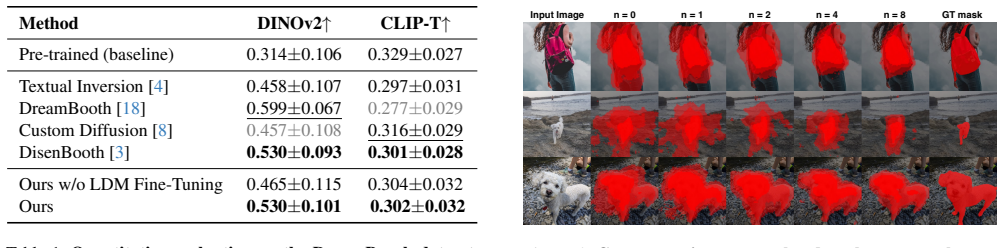
- The reported scores — concept fidelity (DINOv2) 0.530 with prompt alignment (CLIP-T) 0.302, stable across fine-tuning — imply that the fidelity–editability trade-off seen in prior methods is not intrinsic, but a symptom of auxiliary leakage.
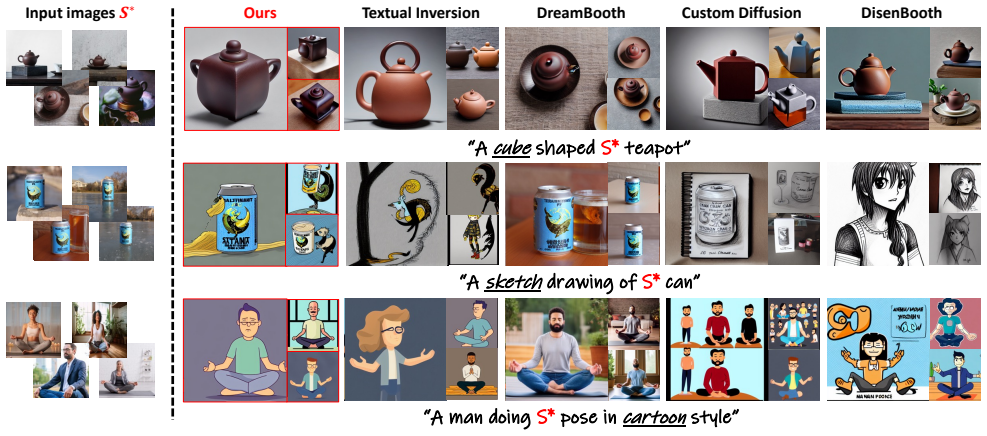
- Because $S^*$ composes with prompts that reshape the subject (cube, sketch, cartoon), the learned token carries semantic content rather than a stored image, so it can recombine with arbitrary text conditions.
- Discarding the auxiliary attention pathway means the deployed model's weights are free of the training images' backgrounds and poses; outputs should be invariant to those specifics.
- Auxiliary token capacity is a single interpretable knob: more capacity per auxiliary token improves disentanglement, which tells practitioners exactly where to look when the subject leaks.
Reading between the lines
- Reading the paper's failure modes (Appendix B.2) as a data-quality checklist, I would expect the method's reliability to be predictable before training: a preprocessing step that selects or warps inputs to maximize contextual diversity should remove most failures.
- The auxiliary tokens' emergent ability to regenerate a single image's environment ('a window frame', 'an office interior') suggests the contrastive objective performs an implicit scene decomposition; that decomposition could be borrowed for segment-free editing, such as transplanting one image's background via its $A^*_i$ token.
- A direct probe of the core claim would be embedding-level: measure how much $S^*$'s representation shifts under structured perturbations (pose, background, lighting) of the same subject. If the token is invariant to those changes, the disentanglement is real; if not, it is incomplete despite good image metrics.
- Because the method only requires the shared concept to be the stable invariant across images, the same recipe should transfer from objects to abstract concepts such as artistic style — a direction the authors explicitly leave open.
Editorial analysis
A structured set of objections, weighed in public.
Referee Report
Summary. The paper proposes Contrastive Inversion, a training scheme for customized text-to-image generation that learns a target text token from a small set of images without additional guidance (text prompts, masks, or class nouns). The method introduces image-wise auxiliary text tokens and optimizes them with an InfoNCE contrastive loss (Eq. 2) so that they absorb image-specific features, leaving the shared concept in the target token S*. A second stage fine-tunes duplicated cross-attention K/V matrices, using the auxiliary tokens only in separate attention pathways that are discarded at inference. Experiments on DreamBench report DINOv2 and CLIP-T scores, with qualitative comparisons and ablation studies showing improved disentanglement when auxiliary token capacity increases and the importance of the second fine-tuning stage. Appendix B.2 documents failure cases when input images share spurious correlations or lack sufficient auxiliary diversity.
Significance. If the central claim is sustained, the method offers a fully guidance-free approach to subject-disentangled personalization, which would be a useful advance over methods requiring class nouns, masks, or image-conditioning priors. The paper's strengths include a clear two-stage formulation, a novel use of contrastive learning on token embeddings, and an honest appendix section describing failure modes. The authors also provide ablation evidence (Fig. 4, Table 1) supporting the role of auxiliary-token capacity and the benefit of the disentangled cross-attention fine-tuning. The main weaknesses are the empirical support for the claimed outperformance and the limited theoretical grounding of the disentanglement mechanism.
major comments (3)
- [Table 1 and Abstract] The abstract and Section 3.1 claim that the method 'outperforms existing techniques,' but the only quantitative table does not support this. For Ours vs. DisenBooth, DINOv2 is 0.530 ± 0.101 vs. 0.530 ± 0.093 and CLIP-T is 0.302 ± 0.032 vs. 0.301 ± 0.028 — statistically indistinguishable. The 'best-performing epoch' protocol noted in the table footnote is a favorable selection criterion that can inflate scores. To substantiate the outperformance claim, the authors should provide a fixed-schedule comparison (or validation-based early stopping) and report confidence intervals on the difference between methods. Without this, the value proposition of the paper rests on anecdotal qualitative examples.
- [Eq. (2) and Appendix B.2] The core mechanism is that the InfoNCE loss (Eq. 2) drives the auxiliary tokens to encode only image-specific features, leaving the common concept in S*. However, the contrastive objective alone does not guarantee this decomposition; it only encourages each A*_i to be more similar to its own CLIP image embedding than to others, and the CLIP embedding itself contains both common and auxiliary features. The disentanglement is an emergent property of jointly minimizing Eq. (1) and Eq. (2). The paper does not analyze when this property holds, and Appendix B.2 acknowledges that the method fails when inputs are too similar (consistent pose/background) or lack distinct auxiliary information. This limitation is potentially central to the method's applicability, and should be discussed in the main text with a more precise statement of the conditions under which contrastive inversion can disentang
- [Section 3.1 / Table 1 footnote] The reporting of metrics 'at the best-performing epoch for each method' is methodologically problematic. It selects favorable checkpoints post hoc, which is not a standard protocol for comparing personalized models, and it makes the reported error bars misleading, because they do not account for the selection. The authors should either adopt a pre-determined training schedule for all methods or use a validation set for early stopping, and report the actual epoch at which each score was obtained. This is a load-bearing issue because the paper's main quantitative conclusion depends on it.
minor comments (4)
- [Eq. (1)] The weighting factor w_t is not defined. State the noise schedule weighting used (e.g., standard LDM epsilon prediction weighting).
- [Appendix A] Training steps for DisenBooth are not given; specify the hyperparameters used for the comparison baselines, including DisenBooth, so that the comparison is reproducible.
- [Figure 3] The qualitative comparison would be more convincing with multiple seeds or a larger set of examples for each method. The current figure shows only single outputs per prompt, which is insufficient to support claims of systematic differences.
- [Table 1] The dual underlining of the 'best' score for each metric is ambiguous when multiple methods are tied; add a note explaining how ties are treated.
Circularity Check
No significant circularity: the proposed method's training objectives and evaluation metrics are distinct, and no self-citation chain is load-bearing.
full rationale
The paper's central claim is that Contrastive Inversion disentangles a common concept from per-image auxiliary features by jointly optimizing the target token S* with image-wise auxiliary tokens A*_i. The target token is trained only with the standard LDM reconstruction loss (Eq. 1); the contrastive InfoNCE loss (Eq. 2) supervises only the auxiliary tokens, pulling each A*_i toward its own image embedding and away from other image embeddings. This does not by construction force S* to equal the evaluation metrics. Concept fidelity is measured with DINOv2, an external visual feature model, and prompt alignment with CLIP-T, both of which are not directly optimized in the training losses. The CLIP space is used in the contrastive loss and in CLIP-T, but the contrastive loss does not supervise the target token's representation against a CLIP-based target, so the evaluation is not equivalent to the training objective. The paper contains no self-citations that carry a load-bearing uniqueness or ansatz argument; all cited prior methods are external. The quantitative comparison is weakened by measuring at each method's best-performing epoch and by the near-tie with DisenBooth (0.530 vs 0.530 DINOv2, 0.302 vs 0.301 CLIP-T), but that is a concern about statistical support for the 'outperforming' claim, not about circular derivation. Appendix B.2 candidly lists failure modes, further indicating the method is not trivially guaranteed by its objective. Overall, no step in the claimed derivation reduces to its own inputs by construction.
Assumptions & free parameters
free parameters (4)
- lambda (auxiliary attention weight)
- auxiliary token capacity n
- InfoNCE temperature
- Training steps and learning rates =
2000 and 150 steps; 5e-4 and 5e-6
assumptions (4)
- domain assumption CLIP text and image encoders share a meaningful embedding space where cosine similarity reflects visual-semantic correspondence
- ad hoc to paper InfoNCE contrastive loss drives auxiliary tokens to encode only image-specific features, leaving commonality to S*
- domain assumption The LDM denoising objective can be optimized over text tokens while freezing the generator to encode visual concepts
- domain assumption Fine-tuning only K and V in cross-attention layers, with a duplicated auxiliary pathway that is discarded, preserves editability while improving fidelity
invented entities (1)
-
Image-wise auxiliary text tokens A*_i
independent evidence
Cite this review
Pith. "Pith review of Comparison Reveals Commonality: Customized Image Generation through Contrastive Inversion." pith.science (2026). https://pith.science/paper/BB35AEKW
@misc{pith2026250807755,
  author       = {Pith},
  title        = {Pith review of: Comparison Reveals Commonality: Customized Image Generation through Contrastive Inversion},
  year         = {2026},
  howpublished = {\url{https://pith.science/paper/BB35AEKW}},
  note         = {Machine review of arXiv:2508.07755}
}
read the original abstract
The recent demand for customized image generation raises a need for techniques that effectively extract the common concept from small sets of images. Existing methods typically rely on additional guidance, such as text prompts or spatial masks, to capture the common target concept. Unfortunately, relying on manually provided guidance can lead to incomplete separation of auxiliary features, which degrades generation quality.In this paper, we propose Contrastive Inversion, a novel approach that identifies the common concept by comparing the input images without relying on additional information. We train the target token along with the image-wise auxiliary text tokens via contrastive learning, which extracts the well-disentangled true semantics of the target. Then we apply disentangled cross-attention fine-tuning to improve concept fidelity without overfitting. Experimental results and analysis demonstrate that our method achieves a balanced, high-level performance in both concept representation and editing, outperforming existing techniques.
Figures


Figures from the paper (3 more)

Reference graph
Works this paper leans on
-
[1]
Break-a-scene: Extracting multi- ple concepts from a single image
Omri Avrahami, Kfir Aberman, Ohad Fried, Daniel Cohen- Or, and Dani Lischinski. Break-a-scene: Extracting multi- ple concepts from a single image. In SIGGRAPH Asia 2023 Conference Papers, pages 1–12, 2023. 1
work page 2023
-
[2]
Diffusion self-distillation for zero-shot customized image generation
Shengqu Cai, Eric Chan, Yunzhi Zhang, Leonidas Guibas, Jiajun Wu, and Gordon Wetzstein. Diffusion self-distillation for zero-shot customized image generation. arXiv preprint arXiv:2411.18616, 2024. 1
arXiv 2024
-
[3]
Disenbooth: Identity- preserving disentangled tuning for subject-driven text-to- image generation
Hong Chen, Yipeng Zhang, Simin Wu, Xin Wang, Xuguang Duan, Yuwei Zhou, and Wenwu Zhu. Disenbooth: Identity- preserving disentangled tuning for subject-driven text-to- image generation. arXiv preprint arXiv:2305.03374 , 2023. 1, 4
arXiv 2023
-
[4]
An image is worth one word: Personalizing text-to-image gener- ation using textual inversion
Rinon Gal, Yuval Alaluf, Yuval Atzmon, Or Patashnik, Amit Haim Bermano, Gal Chechik, and Daniel Cohen-or. An image is worth one word: Personalizing text-to-image gener- ation using textual inversion. In The Eleventh International Conference on Learning Representations. 1, 3, 4
-
[5]
Svdiff: Compact parame- ter space for diffusion fine-tuning
Ligong Han, Yinxiao Li, Han Zhang, Peyman Milanfar, Dim- itris Metaxas, and Feng Yang. Svdiff: Compact parame- ter space for diffusion fine-tuning. In Proceedings of the IEEE/CVF International Conference on Computer Vision , pages 7323–7334, 2023. 1
work page 2023
-
[6]
Classifier-free diffusion guidance
Jonathan Ho and Tim Salimans. Classifier-free diffusion guidance. In NeurIPS 2021 Workshop on Deep Generative Models and Downstream Applications. 6
work page 2021
-
[7]
Taming encoder for zero fine-tuning image customization with text-to-image diffusion models
Xuhui Jia, Yang Zhao, Kelvin CK Chan, Yandong Li, Han Zhang, Boqing Gong, Tingbo Hou, Huisheng Wang, and Yu-Chuan Su. Taming encoder for zero fine-tuning image customization with text-to-image diffusion models. arXiv preprint arXiv:2304.02642, 2023. 1
arXiv 2023
-
[8]
Multi-concept customization of text- to-image diffusion
Nupur Kumari, Bingliang Zhang, Richard Zhang, Eli Shecht- man, and Jun-Yan Zhu. Multi-concept customization of text- to-image diffusion. In Proceedings of the IEEE/CVF con- ference on computer vision and pattern recognition , pages 1931–1941, 2023. 1, 3, 4
work page 1931
Show all 22 references
-
[9]
Direct consistency optimization for robust customiza- tion of text-to-image diffusion models
Kyungmin Lee, Sangkyung Kwak, Kihyuk Sohn, and Jinwoo Shin. Direct consistency optimization for robust customiza- tion of text-to-image diffusion models. Advances in Neural Information Processing Systems, 37:103269–103304, 2025. 1
2025
-
[10]
Customizable image synthesis with multiple sub- jects
Zhiheng Liu, Yifei Zhang, Yujun Shen, Kecheng Zheng, Kai Zhu, Ruili Feng, Yu Liu, Deli Zhao, Jingren Zhou, and Yang Cao. Customizable image synthesis with multiple sub- jects. Advances in neural information processing systems , 36:57500–57519, 2023. 1
2023
-
[11]
Decoupled weight decay regularization
Ilya Loshchilov and Frank Hutter. Decoupled weight decay regularization. arXiv preprint arXiv:1711.05101, 2017. 6
2017 arXiv
-
[12]
Dreammatcher: appearance matching self-attention for semantically-consistent text-to- image personalization
Jisu Nam, Heesu Kim, DongJae Lee, Siyoon Jin, Seungry- ong Kim, and Seunggyu Chang. Dreammatcher: appearance matching self-attention for semantically-consistent text-to- image personalization. In Proceedings of the IEEE/CVF Conference on Computer Vision and Pattern Recognition...
2024
-
[13]
Repre- sentation learning with contrastive predictive coding
Aaron van den Oord, Yazhe Li, and Oriol Vinyals. Repre- sentation learning with contrastive predictive coding. arXiv preprint arXiv:1807.03748, 2018. 2
2018 arXiv
-
[14]
Dinov2: Learning robust visual features without supervision
Maxime Oquab, Timoth ´ee Darcet, Th ´eo Moutakanni, Huy V o, Marc Szafraniec, Vasil Khalidov, Pierre Fernandez, Daniel Haziza, Francisco Massa, Alaaeldin El-Nouby, et al. Dinov2: Learning robust visual features without supervision. arXiv preprint arXiv:2304.07193, 2023. 3
2023 arXiv
-
[15]
Learning transferable visual models from natural language supervi- sion
Alec Radford, Jong Wook Kim, Chris Hallacy, Aditya Ramesh, Gabriel Goh, Sandhini Agarwal, Girish Sastry, Amanda Askell, Pamela Mishkin, Jack Clark, et al. Learning transferable visual models from natural language supervi- sion. In International conference on machine learning, ...
2021
-
[16]
Hierarchical text-conditional image gener- ation with clip latents
Aditya Ramesh, Prafulla Dhariwal, Alex Nichol, Casey Chu, and Mark Chen. Hierarchical text-conditional image gener- ation with clip latents. arXiv preprint arXiv:2204.06125, 1 (2):3, 2022. 1
2022 arXiv
-
[17]
High-resolution image synthesis with latent diffusion models
Robin Rombach, Andreas Blattmann, Dominik Lorenz, Patrick Esser, and Bj ¨orn Ommer. High-resolution image synthesis with latent diffusion models. In Proceedings of the IEEE/CVF conference on computer vision and pattern recognition, pages 10684–10695, 2022. 1, 2
2022
-
[18]
Dreambooth: Fine tuning text-to-image diffusion models for subject-driven generation
Nataniel Ruiz, Yuanzhen Li, Varun Jampani, Yael Pritch, Michael Rubinstein, and Kfir Aberman. Dreambooth: Fine tuning text-to-image diffusion models for subject-driven generation. In Proceedings of the IEEE/CVF conference on computer vision and pattern recognition , pages 2250...
2023
-
[19]
Hyperdreambooth: Hypernetworks for fast personalization of text-to-image models
Nataniel Ruiz, Yuanzhen Li, Varun Jampani, Wei Wei, Tingbo Hou, Yael Pritch, Neal Wadhwa, Michael Rubinstein, and Kfir Aberman. Hyperdreambooth: Hypernetworks for fast personalization of text-to-image models. In Proceedings of the IEEE/CVF conference on computer vision and pat...
2024
-
[20]
Photorealistic text-to-image diffusion models with deep language understanding
Chitwan Saharia, William Chan, Saurabh Saxena, Lala Li, Jay Whang, Emily L Denton, Kamyar Ghasemipour, Raphael Gontijo Lopes, Burcu Karagol Ayan, Tim Salimans, et al. Photorealistic text-to-image diffusion models with deep language understanding. Advances in neural information...
2022
-
[21]
De- noising diffusion implicit models
Jiaming Song, Chenlin Meng, and Stefano Ermon. De- noising diffusion implicit models. arXiv preprint arXiv:2010.02502, 2020. 6
2010 arXiv
-
[22]
a window frame
Yuxiang Wei, Yabo Zhang, Zhilong Ji, Jinfeng Bai, Lei Zhang, and Wangmeng Zuo. Elite: Encoding visual con- cepts into textual embeddings for customized text-to-image generation. In Proceedings of the IEEE/CVF International Conference on Computer Vision, pages 15943–15953, 2023...
2023
Reviewed August 5, 2026 · model on record in the stance chip above.
Discussion (0). Sign in to comment.