Sampling the Schwinger Model with Gauge-Equivariant Diffusion
Pith reviewed 2026-06-29 01:16 UTC · model grok-4.3
The pith
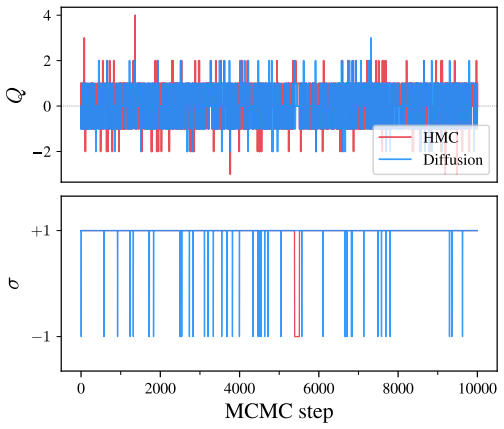
Gauge-equivariant diffusion generates unbiased Schwinger model samples that match MCMC observables and reduce topological freezing.
A machine-rendered reading of the paper's core claim, the machinery that carries it, and where it could break.
Core claim
A U(1)-equivariant score-based generative model is trained to sample gauge-link configurations from the marginal Schwinger model; the resulting model likelihoods produce unbiased observable estimates that closely match those obtained from MCMC, while the generated ensembles show a reduction in topological freezing relative to HMC near critical parameters.
What carries the argument
U(1)-equivariant score-based generative model that learns the target Boltzmann distribution while preserving gauge symmetry
If this is right
- Likelihood evaluation replaces additional Monte Carlo sampling for observable estimation.
- Topological freezing is reduced near critical parameters compared with hybrid Monte Carlo.
- The method addresses critical slowing down in lattice field theory ensemble generation.
Where Pith is reading between the lines
- The same equivariant diffusion construction could be tested on non-Abelian or higher-dimensional gauge theories.
- Integration with existing acceleration methods might further improve mixing times.
- The approach may lower the computational cost of generating large ensembles for lattice QED studies.
Load-bearing premise
The trained generative model has captured the exact target distribution so that likelihood-based estimates remain unbiased.
What would settle it
A statistically significant mismatch between observables computed from model likelihoods and those from independent, converged MCMC runs on the same lattice volumes would falsify the unbiased-estimate claim.
Figures
read the original abstract
We present a first study of a diffusion-based approach to accelerated sampling of the $N_f = 2$ lattice Schwinger model. Our work is inspired by recent and growing successes in developing such generative models for ensemble generation in LFT to overcome the well-known critical slowing down problem. We train a U(1)-equivariant score-based generative model to sample gauge link configurations from the marginal Schwinger model. By computing model likelihoods, we obtain unbiased estimates for observables that closely match those produced by MCMC simulations. We also demonstrate improvement over HMC as measured qualitatively by a reduction in topological freezing near critical parameters.
Editorial analysis
A structured set of objections, weighed in public.
Referee Report
Summary. The paper presents a first study applying a U(1)-equivariant score-based diffusion model to sample gauge-link configurations from the marginal distribution of the N_f=2 lattice Schwinger model. It reports that model likelihoods yield unbiased observable estimates in close agreement with MCMC results and that the method qualitatively reduces topological freezing relative to HMC near critical parameters.
Significance. If the central claim holds, the work would demonstrate a viable generative-model route to mitigating critical slowing down in a simple but non-trivial lattice gauge theory, with the equivariant architecture and likelihood-based unbiased estimation constituting clear technical strengths. The approach could serve as a template for more complex theories once quantitative validation is supplied.
minor comments (2)
- The abstract supplies no quantitative metrics, error bars, training hyperparameters, or explicit description of the likelihood computation and normalization procedure; these details are required to assess the strength of the agreement claims.
- Because the model is trained on MCMC-generated data and observables are subsequently compared to the same MCMC ensemble, the manuscript should include explicit checks (e.g., held-out validation sets, independent runs, or mode-coverage diagnostics) to demonstrate that the reported agreement is not circular.
Simulated Author's Rebuttal
We thank the referee for their careful reading and positive summary of our work on gauge-equivariant diffusion models for the Schwinger model. The report accurately captures the main results and technical contributions. No explicit major comments are enumerated in the provided report, so we offer a brief clarification on the central claims and the basis for the 'uncertain' recommendation.
- The referee notes that the central claim would be significant 'if it holds' and calls for 'quantitative validation' beyond the qualitative topological freezing comparison; the manuscript already supplies direct likelihood-based unbiased observable matches to MCMC, but if the referee seeks additional metrics (e.g., integrated autocorrelation times or scaling studies), these are not detailed in the current report and would require further clarification to address.
Circularity Check
No significant circularity identified
full rationale
The abstract describes training a U(1)-equivariant diffusion model on Schwinger model configurations and using computed model likelihoods to produce unbiased observable estimates that are then compared to independent MCMC runs. No equations, self-citations, or load-bearing steps are supplied that reduce any claimed result to a fit or to the training data by construction. Validation against external MCMC benchmarks is standard and does not constitute circularity under the enumerated patterns.
Axiom & Free-Parameter Ledger
Reference graph
Works this paper leans on
-
[1]
K. G. Wilson,Confinement of quarks,Phys. Rev. D10(1974) 2445
1974
-
[2]
Wolff,Critical Slowing Down,Nucl
U. Wolff,Critical Slowing Down,Nucl. Phys. B Proc. Suppl.17(1990) 93
1990
-
[3]
Woit,Topological Charge in Lattice Gauge Theory,Phys
P. Woit,Topological Charge in Lattice Gauge Theory,Phys. Rev. Lett.51(1983) 638
1983
-
[4]
B. Allés, G. Boyd, M. D’Elia, A. Di Giacomo, and E. Vicari,Hybrid Monte Carlo and topological modes of full QCD,Phys. Lett. B389(1996) 107 [hep-lat/9607049]
Pith/arXiv arXiv 1996
-
[5]
Schwinger,Gauge Invariance and Mass
J. Schwinger,Gauge Invariance and Mass. II,Phys. Rev.128(1962) 2425
1962
-
[6]
D. Rezende and S. Mohamed,Variational Inference with Normalizing Flows,PMLR37(2015) 1530 [1505.05770]
Pith/arXiv arXiv 2015
-
[7]
L. Dinh, J. Sohl-Dickstein and S. Bengio,Density Estimation Using Real NVP,1605.08803
-
[8]
G. Papamakarios, E. Nalisnick, D. J. Rezende, S. Mohamed, and B. Lakshminarayanan,Normal- izing Flows for Probabilistic Modeling and Inference,JMLR22(2021) 2617 [1912.02762]
arXiv 2021
-
[9]
Duane, A
S. Duane, A. D. Kennedy, B. J. Pendleton, and D. Roweth,Hybrid Monte Carlo,Phys. Lett. B 195(1987) 216
1987
-
[10]
R. T. Q. Chen, Y . Rubanova, J. Bettencourt, and D. Duvenaud,Neural ordinary differential equations,Adv. Neural Inf. Process. Syst.31(2018) 6572 [1806.07366]
Pith/arXiv arXiv 2018
-
[11]
M. S. Albergo, D. Boyda, K. Cranmer, D. C. Hackett, G. Kanwar, S. Racanière, D. J. Rezende, F. Romero-López, P. E. Shanahan, and J. M. Urban,Flow-Based Sampling in the Lattice Schwinger Model at Criticality,Phys. Rev. D106(2022) 014514 [2202.11712]
arXiv 2022
-
[12]
J. Finkenrath,Tackling critical slowing down using global correction steps with equivariant flows: the case of the Schwinger model, 2201.02216
-
[13]
J. Sohl-Dickstein, E. Weiss, N. Maheswaranathan, S. Ganguli,Deep Unsupervised Learning using Nonequilibrium Thermodynamics,PMLR37(2015) 2256 [1503.03585]
Pith/arXiv arXiv 2015
-
[14]
J. Ho, A. Jain, and P. Abbeel,Denoising diffusion probabilistic models,Adv. Neural Inf. Process. Syst.33(2020) 6840 [2006.11239]
Pith/arXiv arXiv 2020
-
[15]
Y . Song, J. Sohl-Dickstein, D. P. Kingma, A. Kumar, S. Ermon, and B. Poole,Score-Based Generative Modeling through Stochastic Differential Equations,ICLR(2021) [2011.13456]
Pith/arXiv arXiv 2021
-
[16]
Y . Song and S. Ermon,Generative modeling by estimating gradients of the data distribution, Adv. Neural Inf. Process. Syst.32(2019) 11918 [1907.05600]
Pith/arXiv arXiv 2019
-
[17]
L. Wang, G. Aarts and K. Zhou,Diffusion models as stochastic quantization in lattice field theory,JHEP05(2024) 060 [2309.17082]
arXiv 2024
-
[18]
Q. Zhu, G. Aarts, W. Wang, K. Zhou, and L. Wang,Physics-Conditioned Diffusion Models for Lattice Gauge Theory,JHEP03(2026) 111 [2502.05504]
arXiv 2026
-
[19]
O. Vega, J. Komijani, A. El-Khadra, and M. Marinkovic,Group-Equivariant Diffusion Models for Lattice Field Theory,2510.26081
-
[20]
G. Kanwar and O. Vega,Spectral Diffusion for Sampling on SU(N),PoSLATTICE2025 (2026) 040 [2512.19877]
arXiv 2026
- [21]
-
[22]
H. Alharazin, J. Y . Panteleeva and B. D. Sun,Diffusion Models forSU(2) Lattice Gauge Theory in Two Dimensions,2602.09045
-
[23]
J. Komijani, M. K. Marinkovic and L. Turgut,Diffusion model for SU(N) gauge theories, 2605.06134. 5
-
[24]
C. R. Gattringer, I. Hip, and C. B. Lang,Topological charge and the spectrum of the fermion matrix in lattice QED2,Nucl. Phys. B508(1997) 329 [hep-lat/9707011]
Pith/arXiv arXiv 1997
-
[25]
C. Gattringer and C. Lang,Quantum Chromodynamics on the Lattice: An Introduc- tory Presentation,Lecture Notes in Physics788, Springer Berlin, Heidelberg (2010) [DOI:10.1007/978-3-642-01850-3]
-
[26]
O. Ronneberger, P. Fischer, and T. Brox,U-Net: Convolutional Networks for Biomedical Image Segmentation,Proc. MICCAI(2015) [1505.04597]
Pith/arXiv arXiv 2015
- [27]
-
[28]
D. P. Kingma and J. Ba,Adam: A Method for Stochastic Optimization,1412.6980
-
[29]
The Eigenvalues of Mega-dimensional Matrices
J. Skilling,Maximum Entropy and Bayesian Methods,Fundamental Theories of Physics36, Springer Netherlands, Dordrecht (1989) [DOI:10.1007/978-94-015-7860-8_48]
-
[30]
M. F. Hutchinson,A Stochastic Estimator of the Trace of the Influence Matrix for Laplacian Smoothing Splines,Commun. Stat. Simul. Comput.18(1989) 1059
1989
-
[31]
F. Yu and V . Koltun,Multi-Scale Context Aggregation by Dilated Convolutions,ICLR(2016) [1511.07122]
Pith/arXiv arXiv 2016
-
[32]
J. Ho, N. Kalchbrenner, D. Weissenborn, and T. Salimans,Axial Attention in Multidimensional Transformers,1912.12180
arXiv 1912
-
[33]
A. Doucet, N. Freitas, and N. Gordon,Sequential Monte Carlo Methods in Practice, Springer New York (2001) [DOI:10.1007/978-1-4757-3437-9]
-
[34]
Metropolis, A
N. Metropolis, A. W. Rosenbluth, M. N. Rosenbluth, A. H. Teller, and E. Teller,Equation of State Calculations by Fast Computing Machines,J. Chem. Phys.21(1953) 1087
1953
-
[35]
J. S. Liu,Metropolized independent sampling with comparisons to rejection sampling and importance sampling,Stat. Comput.6(1996) 113
1996
-
[36]
M. S. Albergo, G. Kanwar, S. Racanière, D. J. Rezende, J. M. Urban, D. Boyda, K. Cranmer, D. C. Hackett, and P. E. Shanahan,Flow-based sampling for fermionic lattice field theories, Phys. Rev. D104(2021) 114507 [2106.05934]
arXiv 2021
-
[37]
R. Abbott, M. S. Albergo, D. Boyda, K. Cranmer, D. C. Hackett, G. Kanwar, S. Racanière, D. J. Rezende, F. Romero-López, P. E. Shanahan, B. Tian, and J. M. Urban,Gauge-Equivariant Flow Models for Sampling in Lattice Field Theories with Pseudofermions,Phys. Rev. D106 (2022) 074506 [2207.08945]
arXiv 2022
-
[38]
A. Paszke, S. Gross, F. Massa, A. Lerer et al.,PyTorch: An Imperative Style, High-Performance Deep Learning Library,Adv. Neural Inf. Process. Syst.32(2019) 8026 [1912.01703]
Pith/arXiv arXiv 2019
-
[39]
C. R. Harris, K. J. Millman, S. J. van der Walt, R. Gommers, P. Virtanen, D. Cournapeau et al., Array programming with NumPy,Nature585(2020) 357 [2006.10256]
Pith/arXiv arXiv 2020
-
[40]
J. D. Hunter,Matplotlib: A 2D Graphics Environment,Comp. Sci. Eng.9(2007) 90. 6
2007
discussion (0)
Sign in with ORCID, Apple, or X to comment. Anyone can read and Pith papers without signing in.