REVIEW 4 major objections 5 minor 69 references
General method for calculating transport properties of disordered mesoscopic systems based on the nonequilibrium Green's function formalism
T0 review · 4 major / 5 minor · reviewed 2026-08-07 · deepseek-v4-flash
Pith's one-line read Disorder-averaged transport can be computed analytically from a truncated Dyson series, without brute-force ensemble averaging.
desk verdict Useful bookkeeping scheme for disorder-averaged NEGF transport, but the 'only approximation' claim overreaches for nonlinear conductances and the Padé parameters don't reproduce the series. read the letter →
The pith
A machine-rendered reading of the paper's core claim, the machinery that carries it, and where it could break.
The reading
What carries the argument
The engine of the method is the Dyson equation expansion of the Green's function, G^r = g^r + g^r V g^r + g^r V g^r V g^r + ..., combined with factorization of disorder averages of products of on-site potentials. For Anderson disorder the key identities are <V_i V_j> = delta_ij $W^{2}$ / 12, <$V_i^{4}$> = $W^{4}$ / 80, and vanishing odd moments, which convert every averaged term into traces of disorder-free matrices. The fourth-order factorization in Eq. (18) is what decomposes products of four disorder matrices into products of two-point averages plus the fourth-order single-site moment, producing the analytic coefficients a2 and a4.
What would settle it
Take a two-terminal system with the same parameters as in Section III A and compare Eq. (21) with brute-force averages over 10,000 samples for W values beyond the quoted Wmax. If the fourth-order polynomial deviates from the brute-force curve in a way that the sixth-order term from the Appendix does not reduce, then the truncation assumption, not the disorder model, is the limiting step.
Extended reading notes
Core claim
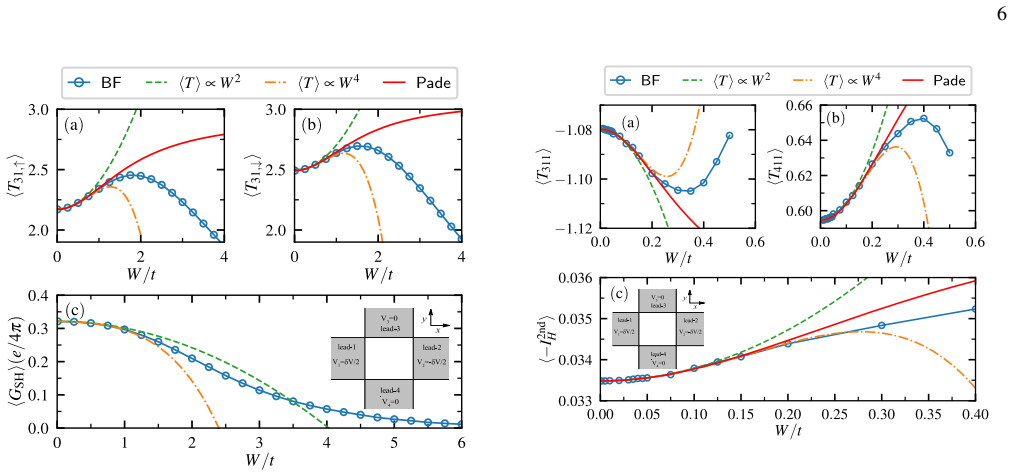
The central claim is that, for noninteracting disordered mesoscopic systems, the disorder average of any transport observable expressible as products of retarded and advanced Green's functions can be obtained analytically to any finite order in the disorder strength, with the only approximation being truncation of the Dyson expansion. Working with Anderson on-site disorder, the average linear conductance takes the form of Eq. (21), <T> = a0 + a2 $W^{2}$ + a4 $W^{4}$ + O($W^{6}$), where a0 is the clean conductance and a2 and a4 are traces of products of disorder-free Green's functions and lead linewidth functions. The same structure is derived for the second-order conductance <T311> in a four-terminal Hall setup. Numerical tests on a normal metal, a Rashba spin-orbit-coupled system, and a tilted Dirac model show that fourth-order truncation tracks brute-force results up to disorder strengths of about W = 0.2 to 1 depending on the quantity, and that a simple Padé treatment extends agreement to stronger disorder.
Load-bearing premise
The load-bearing premise is that on-site disorder values at different sites are statistically independent and that all disorder averages factor according to Eqs. (10)-(11) and (17)-(19), so the analytically computed coefficients are exact in the truncated order; the authors note in the Appendix that off-diagonal disorder is handled only for simple types.
Editorial extensions
If this is right
- Instead of 10,000 to 100,000 disorder samples, one deterministic matrix calculation gives the disorder-averaged linear conductance, spin Hall conductance, and second-order nonlinear conductance to fourth order in W.
- Truncation at fourth order matches brute-force results for W up to roughly 0.2 to 1 depending on the quantity, and higher-order terms can be added recursively to extend the range.
- The Padé-resummed fourth-order expression provides a convenient analytic curve for the disorder-averaged transport coefficient over a wider range of disorder strength.
- The analytic coefficients a0, a2, and a4 make explicit how each transport quantity depends on disorder strength, which is useful for interpreting disorder-enhancement effects such as the second-order nonlinear Hall current.
- Because the expansion is built from disorder-free Green's functions and lead self-energies, the same procedure applies to different noninteracting models and to observables containing any number of Green's functions.
Reading between the lines
- If the W-series is only asymptotic rather than convergent, the apparent success of the Padé extension may not persist at much larger disorder; a direct test would compare the sixth-order truncation from the Appendix against brute-force data beyond the stated Wmax values.
- The same factorization machinery could be applied to disorder-averaged shot noise and full counting statistics, since those observables are also traces of products of Green's functions.
- For short-range-correlated or off-diagonal disorder, the coefficients must be re-derived with modified moment factorizations; the claimed generality is therefore best read as generality across models and observables, not across arbitrary disorder statistics.
- The numerical confirmation of disorder-enhanced second-order Hall current in a four-terminal quantum transport setup suggests an experimental test in tilted Dirac or twisted bilayer systems, where phase relaxation and interactions would probe whether the enhancement survives beyond the noninteracting model.
Signed reviews
Editorial analysis
A structured set of objections, weighed in public.
Referee Report
Summary. The paper develops an analytical disorder-averaging method for noninteracting mesoscopic transport. Starting from the NEGF/Landauer-Büttiker expressions, the authors expand retarded/advanced Green's functions in powers of an on-site Anderson disorder potential V via the Dyson equation. Using the moment structure of independent uniform disorder, they obtain coefficients a0, a2, a4 in the disorder-strength expansion of the average conductance, spin Hall conductance, and second-order nonlinear conductance. They compare the truncated expansion with brute-force ensemble averages for three model systems and find that fourth-order truncation plus a Padé treatment describes the brute-force curves over a useful range of disorder strengths. The central claim is that the only approximation is truncation of the Dyson series, and that higher orders can be added recursively.
Significance. If the derivation is correct, the method has real value: it replaces expensive ensemble averaging with a single computation of Green's-function traces, gives explicit analytical dependence on disorder strength, and is in principle extendable to arbitrary order. The paper also provides useful numerical evidence for disorder enhancement of second-order Hall responses in mesoscopic four-terminal systems. The second-order contraction formulas for the linear conductance are internally consistent, and the odd-moment cancellation for Anderson disorder is correctly exploited. However, several load-bearing points need correction before the significance claimed in the abstract and conclusions can be accepted.
major comments (4)
- [Sec. II B, Eq. (22)] The formula for T_{\alpha\beta\gamma} used for all nonlinear results is the wide-band-limit second-order conductance, not the exact second-order response. As written, Eq. (22) contains only products G^a\Gamma_\alpha G^r G^r and G^a G^a\Gamma_\alpha G^r, which corresponds to energy derivatives dG^r/dE = -G^rG^r and dG^a/dE = -G^aG^a with the lead self-energies and linewidth functions treated as energy-independent. For the tight-binding leads used in this paper the self-energies are obtained from the transfer-matrix method, so d\Sigma^r_\alpha/dE and d\Gamma_\alpha/dE are not zero. Consequently the coefficients a0, a2, a4 reported for T211, T311, T411 and for the second-order Hall current are coefficients of an approximate nonlinear-response expression, and the statement that 'the only approximation involved is the truncation of the Dyson equation' is not correct for the nonlinear results. The authors should either use the exact nonlinear-response formula (including energy derivatives of lead self-energies) or explicitly state and justify that Eq. (22) is the wide-band-limit approximation; in the latter case the abstract and conclusions must be qualified. The linear conductance and spin Hall results are not affected by this issue.
- [Sec. III A, Eq. (26)] The Padé parameters cited for the two-terminal conductance do not reproduce the series coefficients given in Eq. (21). For \langle T\rangle, the values \alpha_1=4.36\times10^5, \alpha_2=7.91\times10^5, \beta_1=43.57, \beta_2=3.59 imply \langle T(0)\rangle = \beta_1/\alpha_1 \approx 9.99\times10^{-5}, whereas Eq. (21) gives a0=1; the linear coefficient is also about \beta_2/\alpha_1 - \beta_1\alpha_2/\alpha_1^2 \approx -1.73\times10^{-4}, not a2=-0.997. For T211 the cited parameters give a positive second-order coefficient (approximately +13.53) while the stated series has a2=-13.524. The Padé expression in Eq. (26) therefore cannot be the [2/2] approximant of the displayed fourth-order series. This is a quantitative contradiction, not a cosmetic typo; please provide corrected Padé parameters or explain any normalization convention for W in Eq. (26), and verify that the Padé curves in Figs. 2-4 are generated from the corrected expression.
- [Sec. II A, Eqs. (18) and (20)] The fourth-order contraction formula appears to overcount the all-equal disorder configuration. For i=j, Eq. (18) gives \epsilon_{iikl} = (W^4/144)\delta_{kl} + (W^4/80)\delta_{ik}\delta_{kl}. The exact average for independent uniform disorder is E[V_i V_k V_l V_i] = (W^4/144)\delta_{kl} + W^4(1/80 - 1/144)\delta_{ik}\delta_{il}, because when k=l=i the full fourth moment W^4/80 replaces the three pairwise products, not adds to them. Correspondingly, in Eq. (20) the coefficient of [B_m]_{ii}[g^a]^2_{ii} should be 1/80 - 1/144 rather than 1/80, unless the sum over k in the preceding term is explicitly restricted to k\neq i. As written, the displayed formulas overcount the diagonal element by W^4/144, which directly affects the reported a4 coefficients and the entries in Table I. Please correct the formulas or state the intended summation convention and re-derive the affected numerical coefficients.
- [Sec. III A-C, Figs. 2-4 and Table I] The brute-force reference curves are presented without error bars or convergence measures. The paper reports 10,000 samples for two-terminal and spin-Hall calculations and 100,000 samples for second-order conductances, but no standard deviation, standard error, or convergence diagnostic is shown. The claimed quantitative agreement and the Wmax values in Table I therefore lack statistical justification, especially for the second-order conductances where the perturbations are smaller and the brute-force averages are noted to be harder to converge. Please add error bars or confidence intervals (at least for representative points) and state a criterion for the claimed range of agreement.
minor comments (5)
- [Abstract and Sec. I] The abstract and introduction claim broad applicability to 'different types of disorder', but footnote 58 and the Appendix restrict off-diagonal disorder to 'some simple disorder types'. Please qualify the generality claim accordingly.
- [Sec. II A, text before Eq. (4)] The phrase 'the functions fn denote the expanded terms in the nth-order of V' is ambiguous because a1 and a3 vanish for Anderson disorder; the text later makes this clear, but a brief comment here would help the reader.
- [Appendix] There are several typos: 'exmaple' in the appendix, 'matirx V' in Eq. (31) discussion, and 'Anderson-tpye' in Ref. 58. Please proofread.
- [Table I] The heading 'Wmax/t' and the entry for Model C, along with the sentence 'Wmax is the maximum disorder strength blow which...', contain typos; also the definition of Wmax is not a precise numerical criterion.
- [Sec. III A, second paragraph after Fig. 2] The statement that 'the Padé expansion ... has higher accuracy and wider applicable range' is not supported with a quantitative error measure; please define 'accuracy' in terms of deviation from the brute-force reference and report the maximum deviation over the claimed range.
Circularity Check
No demonstrated circularity: the disorder-averaged coefficients are derived from clean Green's functions and independently checked against brute-force sampling.
full rationale
The central derivation is self-contained. The coefficients a0, a2, a4 in Eq. (21) and Table I are obtained by expanding the Dyson series and using the exact disorder moments (Eqs. (11), (19), (33)); they are not fitted to the brute-force data. The BF comparison uses independent disorder realizations (10,000 to 100,000 samples), so the central predictions have external benchmark support. The nonlinear response formula in Eq. (22) is taken from Refs. [60] and [61] as an input observable; even though Ref. [61] shares authors, the paper's contribution is the disorder-averaging method rather than the derivation of that formula, so citing it does not reduce the method's output to its own input. No uniqueness theorem is imported from the authors' prior work, and no ansatz is smuggled in as though it were derived here. Two caveats are correctness concerns, not circularity: (i) Eq. (22) is the wide-band-limit form (no energy derivatives of lead self-energies), so the nonlinear coefficients are coefficients of that approximate response; (ii) the Padé parameters in Sec. III.A (alpha1=4.36e5, alpha2=7.91e5, beta1=43.57, beta2=3.59) do not reproduce the Taylor expansion of Eq. (21) (they give f(0) about 1e-4, not a0=1), so the claim that this Padé is 'based on the analytic result' is unsupported; if those numbers were instead fitted to BF data, that particular claim would be circular, but there is no direct textual evidence of fitting and the core coefficients remain independently derived. Therefore no significant circularity is demonstrated, and the score is 0.
Assumptions & free parameters
free parameters (1)
- Pade parameters alpha1, alpha2, beta1, beta2 for Eq. (26) =
For <T>: alpha1=4.36e5, alpha2=7.91e5, beta1=43.57, beta2=3.59.
assumptions (4)
- domain assumption The disorder matrix V is diagonal on-site Anderson disorder with independent, uniformly distributed V_i in [-W/2,W/2]; all odd moments vanish and <V_i^2>=W^2/12, <V_i^4>=W^4/80.
- ad hoc to paper The perturbation series in V for Green's functions converges and can be truncated at fourth (or sixth) order with negligible remainder over the claimed W ranges.
- domain assumption The NEGF formula for the second-order conductance T_{alpha beta gamma} in Eq. (22), taken from Ref. [61], is correct.
- ad hoc to paper The [2/2] Pade approximant in Eq. (26) faithfully continues the truncated series and extends its validity range.
Cite this review
Pith. "Pith review of General method for calculating transport properties of disordered mesoscopic systems based on the nonequilibrium Green's function formalism." pith.science (2026). https://pith.science/paper/BBR43KMF
@misc{pith2026250209904,
  author       = {Pith},
  title        = {Pith review of: General method for calculating transport properties of disordered mesoscopic systems based on the nonequilibrium Green's function formalism},
  year         = {2026},
  howpublished = {\url{https://pith.science/paper/BBR43KMF}},
  note         = {Machine review of arXiv:2502.09904}
}
read the original abstract
Disorder scattering plays important roles in quantum transport as well as various Hall effects, including the second-order nonlinear Hall effect induced by Berry curvature dipole. Calculation of disorder-averaged transport properties usually requires substantial computational resources, especially for higher-order effects. Existing methods are either limited by approximation conditions or constrained by numerical stability, making it difficult to conveniently obtain average physical quantities over a wide range of disorder strength. In this work, we develop a general method for noninteracting system to obtain analytical expressions of disorder averages in finite orders of disorder strength. This method utilizes the Dyson equation to expand physical quantities expressed in terms of the Green's functions into series of disorder-averaged matrices, and the only approximation involved is the truncation of the Dyson equation. Therefore, this method not only avoids the brute force calculation of disorder samples, but also widely applies to different model systems, types of disorder, and the number of Green's functions in the expressions. We demonstrate the applicability of this general method by calculating averages of the linear conductance of a two-terminal system, the spin Hall conductance and the second-order nonlinear conductance of four-terminal Hall setups. It is found that truncation at the fourth order of disorder strength provides a reasonable accuracy and a convenient Pad\'{e} treatment effectively extends its applicable range. Numerical results also confirms disorder enhancement of the second-order nonlinear Hall current in four-terminal systems. Moreover, more accurate predictions for a broader range of disorder strength can be achieved by including higher-order terms in a similar manner.
Figures


Reference graph
Works this paper leans on
-
[1]
P. W. Anderson, Absence of Diffusion in Certain Random Lattices, Phys. Rev. 109, 1492 (1958)
1958
-
[2]
P. A. Lee and T. V. Ramakrishnan, Disordered electronic systems, Rev. Mod. Phys. 57, 287 (1985)
1985
-
[3]
Reinhold, Disorder for spintronics: magnetic materials, Materials Today, 4, 10 (2007)
C. Reinhold, Disorder for spintronics: magnetic materials, Materials Today, 4, 10 (2007)
work page 2007
- [4]
-
[5]
A. R. Rocha, M. Rossi, A. Fazzio, and Antonio J. R. da Silva, Designing Real Nanotube-Based Gas Sensors, Phys. Rev. Lett. 100, 176803 (2008)
work page 2008
-
[6]
F. Schedin, A. K. Geim, S. V. Morozov, E. W. Hill, P. Blake, M. I. Katsnelson, and K. S. Novoselov, Detection of individual gas molecules adsorbed on graphene, Nat. Mater. 6, 652 (2007)
work page 2007
-
[7]
B. L. Altshuler, Fluctuations in the extrinsic conductivity of disordered conductors, JETP Lett. 41, 648 (1985)
work page 1985
-
[8]
P. A. Lee and A. D. Stone, Universal Conductance Fluctuations in Metals, Phys. Rev. Lett. 55, 1622 (1985)
work page 1985
Show all 69 references
-
[9]
P. A. Lee, A. D. Stone, and H. Fukuyama, Universal conductance fluctuations in metals: Effects of finite temperature, interactions, and magnetic field, Phys. Rev. B 35, 1039 (1987)
1987
-
[10]
C. W. J. Beenakker, Random-matrix theory of quantum transport, Rev. Mod. Phys. 69, 731 (1997)
1997
-
[11]
Z. Qiao, Y. Xing, and J. Wang, Universal conductance fluctuation of mesoscopic systems in the metal-insulator crossover regime, Phys. Rev. B 81, 085114 (2010)
2010
-
[12]
W. Ren, Z. Qiao, J. Wang, Q.-f. Sun, and H. Guo, Universal Spin-Hall Conductance Fluctuations in Two Dimensions, Phys. Rev. Lett. 97, 066603 (2006)
2006
-
[13]
Z. Qiao, J. Wang, Y. Wei, and H. Guo, Universal Quantized Spin-Hall Conductance Fluctuation in Graphene, Phys. Rev. Lett. 101, 016804 (2008)
2008
-
[14]
Li, R.-L
J. Li, R.-L. Chu, J. K. Jain, and S.-Q. Shen, Topological Anderson Insulator, Phys. Rev. Lett. 102, 136806 (2009)
2009
-
[15]
C. W. Groth, M. Wimmer, A. R. Akhmerov, J. Tworzydlo, and C. W. J. Beenakker, Theory of the Topological Anderson Insulator, Phys. Rev. Lett. 103, 196805 (2009)
2009
-
[16]
H.-M. Guo, G. Rosenberg, G. Refael, and M. Franz, Topological Anderson Insulator in Three Dimensions, Phys. Rev. Lett. 105, 216601 (2010)
2010
-
[17]
Y. Xing, L. Zhang, and J. Wang, Topological Anderson insulator phenomena, Phys. Rev. B 84, 035110 (2011)
2011
-
[18]
Nagaosa, J
N. Nagaosa, J. Sinova, S. Onoda, A. H. MacDonald, and N. P. Ong, Anomalous Hall effect, Rev. Mod. Phys. 82, 1539 (2010)
2010
-
[19]
Sinova, S
J. Sinova, S. O. Valenzuela, J. Wunderlich, C. H. Back, and T. Jungwirth, Spin Hall effects, Rev. Mod. Phys. 87, 1213 (2015)
2015
-
[20]
Z. Z. Du, C. M. Wang, S. Li, H.-Z. Lu, and X. C. Xie, Disorder-induced nonlinear Hall effect with time-reversal symmetry, Nat. Commun. 10, 3047 (2019)
2019
-
[21]
Z. Z. Du, C. M. Wang, H.-P. Sun, H.-Z. Lu, and X. C. Xie, Quantum theory of the nonlinear Hall effect, Nat. Commun. 12, 5038 (2021)
2021
-
[22]
J. Duan, Y. Jian, Y. Gao, H. Peng, J. Zhong, Q. Feng, J. Mao, and Y. Yao, Giant Second-Order Nonlinear Hall Effect in Twisted Bilayer Graphene, Phys. Rev. Lett. 129, 186801 (2022)
2022
-
[23]
M. Wei, L. Xiang, L. Wang, F. Xu, and J. Wang, Quantum third-order nonlinear Hall effect of a four-terminal device with time-reversal symmetry, Phys. Rev. B 106, 035307 (2022)
2022
-
[24]
Landauer, Spatial variation of currents and fields due to localized scatterers in metalic conduction, IBM J
R. Landauer, Spatial variation of currents and fields due to localized scatterers in metalic conduction, IBM J. Res. Dev. 1, 233 (1957)
1957
-
[25]
B\"uttiker, Y
M. B\"uttiker, Y. Imry, R. Landauer, and S. Pinhas, Generalized many-channel conductance formula with application to small rings, Phys. Rev. B. 31, 6207 (1985)
1985
-
[26]
Datta, Electonic Transport in Mesoscopic Systems, (Cambridge University Press, New York, 1995)
S. Datta, Electonic Transport in Mesoscopic Systems, (Cambridge University Press, New York, 1995)
1995
-
[27]
D. J. Thouless and S. Kirkpatrick, Conductivity of the disordered linear chain, J. Phys. C: Solid State Phys. 14, 235 (1981)
1981
-
[28]
P. S. Drouvelis, P. Schmelcher, and P. Bastian, Parallel implementation of the recursive Green's function method, J. Comp. Phys. 215, 741 (2006)
2006
-
[29]
MacKinnon and B
A. MacKinnon and B. Kramer, One-Parameter Scaling of Localization Length and Conductance in Disordered Systems, Phys. Rev. Lett. 47 1546 (1981)
1981
-
[30]
H. U. Baranger, D. P. DiVincenzo, R. A. Jalabert, and A. D. Stone, Classical and quantum ballistic-transport anomalies in microjunctions, Phys. Rev. B 44, 10637 (1991)
1991
-
[31]
F. Sols, M. Macucci, U. Ravaioli, and K. Hess, Theory for a quantum modulated transistor, J. Appl. Phys. 66, 3892 (1989)
1989
-
[32]
Kazymyrenko and X
K. Kazymyrenko and X. Waintal, Knitting algorithm for calculating Green functions in quantum systems, Phys. Rev. B 77, 115119 (2008)
2008
-
[33]
D. K. Ferry and S. M. Goodnick, Transport in Nanostructures, (Cambridge University Press, Cambridge, 1997)
1997
-
[34]
The recursive Green's function method is suitable for both clean and disordered systems
-
[35]
Soven, Coherent-Potential Model of Substitutional Disordered Alloys, Phys
P. Soven, Coherent-Potential Model of Substitutional Disordered Alloys, Phys. Rev. 156, 809 (1967)
1967
-
[36]
D. W. Taylor, Vibrational Properties of Imperfect Crystals with Large Defect Concentrations, Phys. Rev. 156, 1017 (1967)
1967
-
[37]
Velicky, Theory of Electronic Transport in Disordered Binary Alloys: Coherent-Potential Approximation, Phys
B. Velicky, Theory of Electronic Transport in Disordered Binary Alloys: Coherent-Potential Approximation, Phys. Rev. 184, 614 (1969)
1969
-
[38]
R. J. Elliott, J. A. Krumhansl, and P. L. Leath, The theory and properties of randomly disordered crystals and related physical systems, Rev. Mod. Phys. 46, 465 (1974)
1974
-
[39]
Cheng, M
Z. Cheng, M. Sang, J. Zhai, and Y. Ke, Phonon dispersion of binary alloys with auxiliary coherent potential approximation, Phys. Rev. B 100, 214206 (2019)
2019
-
[40]
Li and J
G. Li and J. Wang, Spin transport study in a disordered-metal/ferromagnetic-insulator heterostructure based on full counting statistics within the coherent potential approximation, Phys. Rev. B 109, 125403 (2024)
2024
-
[41]
Y. Ke, K. Xia, and H. Guo, Disorder Scattering in Magnetic Tunnel Junctions: Theory of Nonequilibrium Vertex Correction, Phys. Rev. Lett. 100, 166805 (2008)
2008
-
[42]
Y. Ke, K. Xia, and H. Guo, Oxygen-Vacancy-Induced Diffusive Scattering in Fe/MgO/Fe Magnetic Tunnel Junctions, Phys. Rev. Lett. 105, 236801 (2010)
2010
-
[43]
Yan and Y
J. Yan and Y. Ke, Generalized nonequilibrium vertex correction method in coherent medium theory for quantum transport simulation of disordered nanoelectronics, Phys. Rev. B 94, 045424 (2016)
2016
-
[44]
J. Yan, S. Wang, K. Xia, and Y. Ke, First-principles quantum transport method for disordered nanoelectronics: Disorder-averaged transmission, shot noise, and device-to-device variability, Phys. Rev. B 95, 125428 (2017)
2017
-
[45]
J. Zhai, R. Xue, Z. Cheng, and Y. Ke, Direct comparison of auxiliary and itinerant coherent potential approximations for disordered lattice vibration: Phonon spectral and transport properties, Phys. Rev. B 104, 024205 (2021)
2021
-
[46]
Cheng, J
Z. Cheng, J. Zhai, Q. Zhang, and Y. Ke, Auxiliary coherent medium theory for lattice vibrations in random binary alloys with mass and force-constant disorders, Phys. Rev. B 99, 134202 (2019)
2019
-
[47]
A. V. Kalitsov, M. G. Chshiev, and J. P. Velev, Nonequilibrium coherent potential approximation for electron transport, Phys. Rev. B 85, 235111 (2012)
2012
-
[48]
Y. Zhu, L. Liu, and H. Guo, Quantum transport theory with nonequilibrium coherent potentials, Phys. Rev. B 88, 205415 (2013)
2013
-
[49]
B. Fu, L. Zhang, Y. Wei, and J. Wang, Full counting statistics of conductance for disordered systems, Phys. Rev. B 96, 115410 (2017)
2017
-
[50]
Zhang, F
C. Zhang, F. Xu, and J. Wang, Full counting statistics of phonon transport in disordered systems, Front. Phys. 16, 33502 (2021)
2021
-
[51]
Zhang, J
Y. Zhang, J. Zhai, Z. Chen, Q. Zhang, and Y. Ke, First-principles nonequilibrium dynamical cluster theory for quantum transport simulations of disordered nanoelectronic devices, Phys. Rev. B 104, 115412 (2021)
2021
-
[52]
Zhang, Q
Y. Zhang, Q. Zhang, Y. Ke, and K. Xia, Giant influence of clustering and anti-clustering of disordered surface roughness on electronic tunneling, Chin. Phys. Lett. 39, 087301 (2022)
2022
-
[53]
S. G. de Castro, A. Ferreira, and D. A. Bahamon, Efficient Chebyshev polynomial approach to quantum conductance calculations: Application to twisted bilayer graphene, Phys. Rev. B 107, 045418 (2023)
2023
-
[54]
S. G. de Castro, J. M. V. P. Lopes, A. Ferreira, and D. A. Bahamon, Fast Fourier-Chebyshev Approach to Real-Space Simulations of the Kubo Formula, Phys. Rev. Lett. 132, 076302 (2024)
2024
-
[55]
Zhang, B
L. Zhang, B. Fu, B. Wang, Y. Wei, and J. Wang, Frequency-dependent transport properties in disordered systems: A generalized coherent potential approximation approach, Phys. Rev. B 99, 155406 (2019)
2019
-
[56]
D. H. Lee and J. D. Joannopoulos, Simple scheme for surface-band calculations. I, Phys. Rev. B 23, 4988 (1981)
1981
-
[57]
D. H. Lee and J. D. Joannopoulos, Simple scheme for surfaceband calculations. II. The Green's function, Phys. Rev. B 23, 4997 (1981)
1981
-
[58]
For other diagonal-disorder, Eqs
In this work, we use Anderson-tpye disorder to illustrate our method. For other diagonal-disorder, Eqs. ( eq:V2 ) and ( eq:V4 ) become V_ ii V_ jj = 1 W _ -W/2 ^ W/2 d V (V)V^2 _ ij and V_ ii V_ jj V_ kk V_ ll = 1 W _ -W/2 ^ W/2 d V (V)V^4 _ ij _ jk _ kl , respectively. Here (...
-
[59]
B\"uttiker, Four-Terminal Phase-Coherent Conductance, Phys
M. B\"uttiker, Four-Terminal Phase-Coherent Conductance, Phys. Rev. Lett. 57, 1761 (1986)
1986
-
[60]
B. Wang, J. Wang, and H. Guo, Nonlinear I-V characteristics of a mesoscopic conductor, J. Appl. Phys. 86, 5094 (1999)
1999
-
[61]
M. Wei, B. Wang, Y. Yu, F. Xu, and J. Wang, Nonlinear Hall effect induced by internal Coulomb interaction and phase relaxation process in a four-terminal system with time-reversal symmetry, Phys. Rev. B 105, 115411 (2022)
2022
-
[62]
Sheng, D
L. Sheng, D. N. Sheng, and C. S. Ting, Spin-Hall Effect in Two-Dimensional Electron Systems with Rashba Spin-Orbit Coupling and Disorder, Phys. Rev. Lett. 94, 016602 (2005)
2005
-
[63]
Wang, Thermodynamic properties of the two-dimensional spin-1/2 Heisenberg antiferromagnet at finite temperature: A finite-cluster-expansion approach, Phys
J. Wang, Thermodynamic properties of the two-dimensional spin-1/2 Heisenberg antiferromagnet at finite temperature: A finite-cluster-expansion approach, Phys. Rev. B 45, 2282 (1992)
1992
-
[64]
Xing, Q.-f
Y. Xing, Q.-f. Sun, and J. Wang, Symmetry and transport property of spin current induced spin-Hall effect, Phys. Rev. B 75, 075324 (2007)
2007
-
[65]
Z. Qiao, W. Ren, J. Wang, and H. Guo, Low-Field Phase Diagram of the Spin Hall Effect in the Mesoscopic Regime, Phys. Rev. Lett. 98, 196402 (2007)
2007
-
[66]
Souma and B
S. Souma and B. K. Nikolic, Spin Hall Current Driven by Quantum Interferences in Mesoscopic Rashba Rings, Phys. Rev. Lett. 94, 106602 (2005)
2005
-
[67]
Papaj and L
M. Papaj and L. Fu, Magnus Hall Effect, Phys. Rev. Lett. 123, 216802 (2019)
2019
-
[68]
Sodemann and L
I. Sodemann and L. Fu, Quantum nonlinear Hall effect induced by Berry curvature dipole in time-reversal invariant materials, Phys. Rev. Lett. 115, 216806 (2015)
2015
-
[69]
Tanaka, Z
Y. Tanaka, Z. Ren, T. Sato, K. Nakayama, S. Souma, T. Takahashi, K. Segawa, and Y. Ando, Experimental realization of a topological crystalline insulator in SnTe, Nat. Phys. 8, 800 (2012)
2012
Reviewed August 7, 2026 · model on record in the stance chip above.
Discussion (0). Continue with ORCID to comment.