REVIEW 4 major objections 6 minor 107 references
Deep Sparse Band Selection for Hyperspectral Face Recognition
T0 review · 4 major / 6 minor · reviewed 2026-08-14 · deepseek-v4-flash
Pith's one-line read A CNN regularized with group Lasso automatically selects a small set of spectral bands for face recognition, and on three public hyperspectral datasets this selection beats both all-band training and prior band-selection methods.
desk verdict A coherent group-Lasso band-selection method whose reported state-of-the-art advantage is not verifiable from the paper as written. read the letter →
The pith
A machine-rendered reading of the paper's core claim, the machinery that carries it, and where it could break.
The reading
What carries the argument
The load-bearing mechanism is group-Lasso regularization applied to the weights of the first convolutional layer. Each group consists of all first-layer weights that share the same input channel, and since each input channel is one spectral band, zeroing a group removes that band from the network. The total loss is the face-recognition loss (softmax plus center loss) plus a scaled $\ell_{1,2}$ norm of the groups; the $\ell_1$ part encourages entire groups to vanish while the $\ell_2$ part keeps weights within a surviving group intact. During training the optimizer jointly minimizes recognition error and this structured sparsity penalty, so the network itself decides which wavelengths are redundant. The center loss pulls features of the same subject together, supplying the discriminative signal that the band-selection penalty is balanced against.
What would settle it
Re-run PLS* and S-CNN+SVM* under the exact gallery/probe splits, preprocessing, and random seeds used for Deep-SSL on all three datasets. If either baseline reaches or exceeds Deep-SSL's accuracy under identical conditions, the paper's central state-of-the-art claim fails; if Deep-SSL still wins, the claim stands even under scrutiny.
Extended reading notes
Core claim
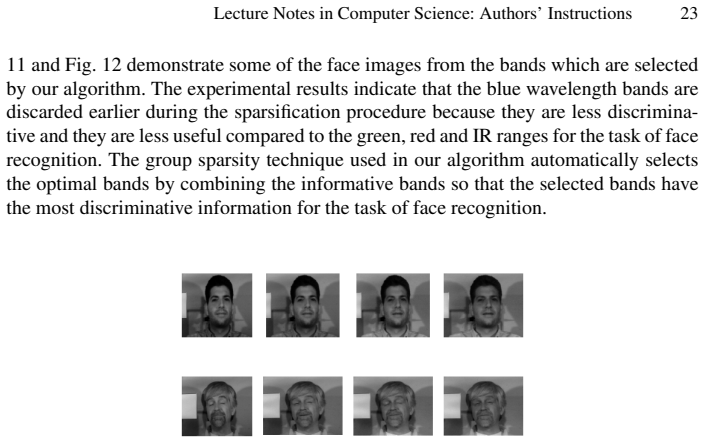
The central claim is that Deep-SSL, a CNN whose first convolutional layer is regularized by a group-Lasso term, achieves the highest face recognition accuracy reported on the CMU, HK PolyU, and UWA hyperspectral face datasets, outperforming prior methods including PLS-based regression and a CNN with AdaBoost band selection. The same network without the sparsity term already scores in the high 99% range, and adding the group-Lasso penalty raises accuracy by roughly 0.3 to 0.6 percentage points while shrinking the input from 33 or 65 bands to 3 or 4 bands. The selected bands cluster in the green, red, and infrared portions of the spectrum, and the blue bands are zeroed out first. The paper presents this as evidence that jointly optimizing band selection and face recognition, rather than selecting bands greedily or manually, yields both higher accuracy and a smaller, cheaper spectral acquisition requirement.
Load-bearing premise
The claim that Deep-SSL beats prior methods rests on the assumption that the accuracies reported for PLS*, S-CNN+SVM*, and other baselines were measured under exactly the same gallery/probe splits, preprocessing, and evaluation protocol as Deep-SSL; the paper states that the setup was consistent but does not re-run the baselines or publish the splits and seeds.
Editorial extensions
If this is right
- If Deep-SSL's results hold, hyperspectral face recognition systems can drop the majority of their captured bands and still match or slightly exceed all-band accuracy, which simplifies sensor design and reduces data volume.
- The selected bands from all three datasets fall in the green, red, and near-infrared range and exclude blue, suggesting those wavelengths carry the most identity information for faces under indoor illumination.
- Because the sparsity penalty acts on the first layer of any CNN, the same training scheme can be transplanted to other deep backbones and other hyperspectral tasks without changing the network's task-specific layers.
- The comparison table places Deep-SSL above PLS-based regression and CNN-plus-AdaBoost band selection on all three datasets, making it the current best reported method for hyperspectral face recognition when all methods use their optimal bands.
Reading between the lines
- Beyond the paper, the same group-Lasso channel-selection trick could be applied to hyperspectral remote sensing or medical imaging, where the selected wavelengths would be task-specific rather than tied to faces.
- A testable extension is to verify whether the selected band set is stable across illumination conditions, skin types, and sensor hardware; the paper's three datasets are all indoor, and outdoor or cross-session data could shift the optimal wavelengths.
- The accuracy gains over using all bands are small, so the practical value may lie less in raw accuracy and more in the ability to build cheaper multi-spectral cameras that capture only the selected bands.
Editorial analysis
A structured set of objections, weighed in public.
Referee Report
Summary. The manuscript proposes Deep-SSL, a VGG-19-based CNN for hyperspectral face recognition with automatic spectral-band selection. The first convolutional layer has one input channel per spectral band, and a group-Lasso (structural sparsity learning) penalty Rg(w1) in Eqs. (5)-(6) is added to the softmax-plus-center loss in Eqs. (3)-(4), so that groups of first-layer weights corresponding to redundant bands are driven to zero during joint training; band selection is therefore end-to-end rather than manual or greedy. The method is evaluated on three public datasets (CMU-HSFD, HK PolyU-HSFD, UWA-HSFD) with reported accuracies of 99.9%, 99.8%, and 99.9%, respectively. The central assertion (Section 9.9, Table 4) is that Deep-SSL outperforms state-of-the-art methods including PLS* and S-CNN+SVM*, and that band selection improves accuracy over the all-band deep baseline by 0.32-0.59 percentage points (Section 9.8, Table 3).
Significance. If the comparison were controlled, this would be a useful contribution: Eqs. (3)-(6) give a clear group-Lasso formulation for channel-level band selection trained jointly with recognition, avoiding manual and greedy selection, and the evaluation covers three public datasets with a broad slate of comparison methods in Table 4. Credit is due for the clean formulation and the multi-dataset effort. However, the marginal gain of the band-selection mechanism over the all-band deep baseline is only 0.32-0.59 percentage points at near-ceiling accuracy (99.3-99.9%), so the substantive advantage claimed for band selection is small and not yet shown to be statistically stable; the dominant effect is the strength of the deep baseline itself. The headline state-of-the-art claim is not robustly evidenced, and several internal inconsistencies weaken the experimental record. The core idea is plausible and publishable, but the evidence needs substantial strengthening.
major comments (4)
- [Section 9.9, Table 4] The headline assertion that Deep-SSL outperforms PLS* and S-CNN+SVM* is based on accuracies taken from the original papers rather than on re-runs under the protocol used for Deep-SSL. The sentence 'we have been consistent with other compared methods in experimental setup' asserts protocol matching, but no split definitions, random seeds, preprocessing details (e.g., alignment, cropping, image resolution), or per-split results are given for the prior methods, and code is not released. Because the prior methods use entirely different feature pipelines (e.g., 3D-DCT and PLS in [3]) and possibly different gallery/probe compositions, the numbers in Table 4 cannot be verified as comparable; if the prior-method results come from different splits, the stated state-of-the-art advantage fails even if the group-Lasso mechanism itself works. The authors should either re-run all baselines under the single evaluation protocol used for Deep-SSL and report per-split and mean accuracy, or explicitly downgrade the claim to 'competitive with previously published results.'
- [Sections 9.4, 9.7, 9.9; Tables 1 and 2] The experimental description is internally inconsistent in several places. Section 9.4 states that the HK PolyU dataset contains 300 hyperspectral cubes from 24 subjects, while Table 1 and Section 9.9 state 113 cubes. Section 9.9 says the PolyU gallery uses two cubes per subject (48 cubes) with 'the remaining 63 cubes' as probes, but 113 - 48 = 65. Section 9.7 reports three selected UWA bands {570, 650, 680}, while Table 2 lists four UWA bands {570, 650, 680, 710}. These discrepancies are not merely typographical: the probe-count error changes the interpretation of the claimed 0.36% improvement (a fraction of one probe image), and the band-list conflict makes the selected-band result ambiguous. All of these numbers must be reconciled before the evaluation can be assessed.
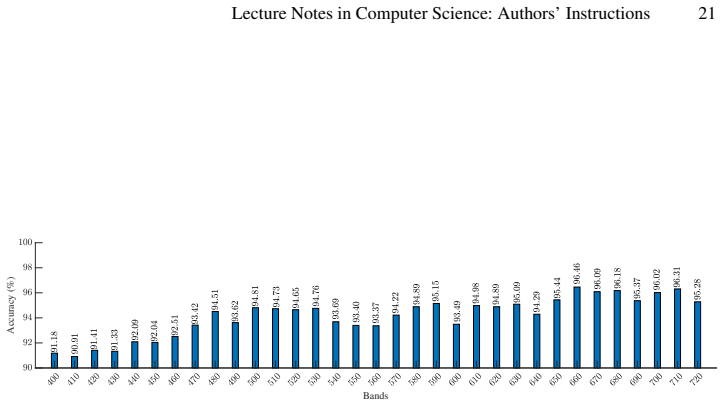
- [Section 9.8, Tables 3 and 4] No error bars or multiple-run statistics are reported, although gallery images are chosen randomly (Section 9.9) and lambda_g is selected by cross-validation (Section 9.3). With probe sets of approximately 99 (CMU), 63 or 65 (PolyU), and 50 (UWA) images, the reported SSL gains over the all-band baseline (0.59%, 0.36%, and 0.32%, respectively) correspond to less than one probe image per dataset, so the improvement attributed to band selection is within plausible split-to-split noise unless demonstrated otherwise. In addition, Table 4 reports Deep-SSL PolyU accuracy as 99.8%, while Table 3 reports 99.88%, which rounds to 99.9%; the discrepancy should be resolved. Report mean and standard deviation over multiple random splits and per-split accuracies for Deep-Baseline and Deep-SSL.
- [Sections 8.4-8.5, 9.2, 9.7] The mapping from the trained weights to the selected-band lists in Table 2 is not specified. Since the network is trained with Adam rather than a proximal-gradient method, the group norms likely only approach zero in practice; the paper does not state the threshold used to declare a band zeroed out, nor whether the network is retrained after the claimed depth reduction C' << C (Section 8.5), and the specific lambda_g values used per dataset are not reported (Fig. 8 gives only a sensitivity range). The initialization of the first-layer filters by duplicating the ImageNet RGB filters (Section 9.2) is an unvalidated heuristic that could bias which input channels survive group sparsification. An ablation with random initialization and a precise description of how the band lists are extracted from the trained filters are needed for the band-selection result to be reproducible.
minor comments (6)
- [Section 9.4 vs. Table 1] The CMU spectral range is stated as 450-1100 nm in the text but 450-1090 nm in Table 1; since 65 bands at 10-nm steps implies 450-1090 nm, the text should be corrected.
- [Section 9.8 vs. Figs. 9-10] The text assigns Fig. 9 to CMU and Fig. 10 to PolyU, while the figure captions assign Fig. 9 to HK PolyU-HSFD and Fig. 10 to CMU-HSFD; the assignments should be made consistent.
- [Section 2.2] An unfinished citation placeholder '[?,?,?,?]' appears in the deep-learning face-recognition sentence and must be completed.
- [References; Eqs. (1) and (3)] References [41] and [86] both cite Simonyan and Zisserman (VGG) and should be merged; the notation L(w) is used for two different losses in Eqs. (1) and (3) and should be disambiguated.
- [Section 8.4, Eq. (5)] The notation 'l_12 norm' for the group penalty in Eq. (5) is non-standard; since Eq. (6) is an l1 sum of l2 norms, the standard notation is l2,1 (or group Lasso), and this should be stated explicitly.
- [Section 9.9] The stray footnote marker in 'Please email us 1' should be removed, and the offer of code and data only by email limits reproducibility; public release of the code and split definitions is recommended.
Circularity Check
No significant circularity: the band-selection pipeline is a trained CNN output and accuracies are measured on held-out probes; protocol inconsistencies concern validity, not circular reasoning.
full rationale
The paper's core derivation is self-contained. Equations (3)-(6) define a training objective that combines a face-recognition loss with a group-Lasso penalty on the first convolutional layer, whose channel groups correspond to spectral bands. The selected bands are the sparsity pattern induced by training, and the reported accuracies in Tables 3 and 4 are obtained on gallery/probe splits that are separate from the training process that produces the sparsity pattern. No equation defines the selected bands in terms of the final accuracies, and no reported accuracy is a fitted parameter renamed as a prediction. Tuning the hyperparameter lambda_g by cross-validation is a standard model-selection procedure, not a circular step. The paper contains many self-citations, mostly in the related-work survey, but none is load-bearing: the group-Lasso mechanism is cited to Yuan and Lin [54], the center loss to Wen et al. [95], the base network to Simonyan and Zisserman, and the main baselines to Uzair et al. [3] and Sharma et al. [51], none of whom are the present authors. There are genuine validity concerns outside circularity: Table 4 imports prior-method accuracies without re-running them, no split seeds are provided, and the dataset counts are internally inconsistent (PolyU reported as both 300 and 113 cubes; Section 9.9 says 63 remaining probes when 113-48=65; UWA selected bands are listed as 3 in the text but 4 in Table 2). These issues undermine the reliability of the state-of-the-art comparison, but they do not exhibit the specific reduction of a prediction to its own input that circularity requires. Therefore no circular step is established.
Assumptions & free parameters
free parameters (3)
- lambda_g (sparsity weight) =
not reported; cross-validated over {10, 1, 0.1, 0.01, 0.001}
- gamma (center loss weight) =
not reported
- center update learning rate =
0.001
assumptions (5)
- standard math Group Lasso can zero out entire groups of weights during optimization.
- domain assumption First-layer weight groups indexed by channel correspond one-to-one with spectral bands.
- ad hoc to paper Duplicating pretrained RGB VGG-19 filters is a valid initialization for hyperspectral depth.
- domain assumption Prior-method accuracies in Table 4 are comparable under the same experimental setup.
- domain assumption Hyperspectral cubes are co-registered across bands and can be fed directly as channels.
Cite this review
Pith. "Pith review of Deep Sparse Band Selection for Hyperspectral Face Recognition." pith.science (2026). https://pith.science/paper/BBT7DDS2
@misc{pith2026190809630,
  author       = {Pith},
  title        = {Pith review of: Deep Sparse Band Selection for Hyperspectral Face Recognition},
  year         = {2026},
  howpublished = {\url{https://pith.science/paper/BBT7DDS2}},
  note         = {Machine review of arXiv:1908.09630}
}
read the original abstract
Hyperspectral imaging systems collect and process information from specific wavelengths across the electromagnetic spectrum. The fusion of multi-spectral bands in the visible spectrum has been exploited to improve face recognition performance over all the conventional broad band face images. In this book chapter, we propose a new Convolutional Neural Network (CNN) framework which adopts a structural sparsity learning technique to select the optimal spectral bands to obtain the best face recognition performance over all of the spectral bands. Specifically, in this method, images from all bands are fed to a CNN, and the convolutional filters in the first layer of the CNN are then regularized by employing a group Lasso algorithm to zero out the redundant bands during the training of the network. Contrary to other methods which usually select the useful bands manually or in a greedy fashion, our method selects the optimal spectral bands automatically to achieve the best face recognition performance over all spectral bands. Moreover, experimental results demonstrate that our method outperforms state of the art band selection methods for face recognition on several publicly-available hyperspectral face image datasets.
Figures


Figures from the paper (9 more)




Reference graph
Works this paper leans on
-
[3]
Hyperspectral face recognition with spatiospectral information fusion and PLS regression,
M. Uzair, A. Mahmood, and A. Mian, “Hyperspectral face recognition with spatiospectral information fusion and PLS regression,” IEEE Transactions on Image Processing, vol. 24, no. 3, pp. 1127–1137, 2015
2015
-
[1]
An overview of spectral imaging of human skin toward face recognition,
D. W. Allen, “An overview of spectral imaging of human skin toward face recognition,” in Face Recognition Across the Imaging Spectrum, pp. 1–19, Springer, 2016
2016
-
[2]
Face recognition in hyperspectral images,
Z. Pan, G. Healey, M. Prasad, and B. Tromberg, “Face recognition in hyperspectral images,” IEEE Transactions on Pattern Analysis and Machine Intelligence, vol. 25, no. 12, pp. 1552– 1560, 2003
2003
-
[4]
Comparison of A VIRIS and Hyperion for hyperspectral mineral map- ping,
F. A. Kruse et al., “Comparison of A VIRIS and Hyperion for hyperspectral mineral map- ping,” in11th JPL Airborne Geoscience Workshop, vol. 4, 2002
2002
-
[5]
Comparison of spectral-only and spectral/spatial face recognition for personal identity verification,
Z. Pan, G. Healey, and B. Tromberg, “Comparison of spectral-only and spectral/spatial face recognition for personal identity verification,” EURASIP journal on Advances in Signal Processing, vol. 2009, p. 8, 2009
2009
-
[6]
Quest hierarchy for hyperspectral face recognition,
D. M. Ryer, T. J. Bihl, K. W. Bauer, and S. K. Rogers, “Quest hierarchy for hyperspectral face recognition,”Advances in Artificial Intelligence, vol. 2012, p. 1, 2012
2012
-
[7]
Gross, J
R. Gross, J. Shi, and J. F. Cohn, Quo vadis face recognition? Carnegie Mellon University, The Robotics Institute, 2001
2001
-
[8]
Appearance-based face recognition and light-fields,
R. Gross, I. Matthews, and S. Baker, “Appearance-based face recognition and light-fields,” IEEE Transactions on Pattern Analysis and Machine Intelligence, vol. 26, no. 4, pp. 449– 465, 2004
2004
Show all 107 references
-
[9]
Recognizing imprecisely localized, partially occluded, and expression variant faces from a single sample per class,
A. M. Mart ´ınez, “Recognizing imprecisely localized, partially occluded, and expression variant faces from a single sample per class,” IEEE Transactions on Pattern Analysis & Machine Intelligence, no. 6, pp. 748–763, 2002
2002
-
[10]
Comparison of visible and infra-red im- agery for face recognition,
J. Wilder, P. J. Phillips, C. Jiang, and S. Wiener, “Comparison of visible and infra-red im- agery for face recognition,” in Proceedings of the Second International Conference on Au- tomatic Face and Gesture Recognition, pp. 182–187, IEEE, 1996
1996
-
[11]
Face identification across different poses and illu- minations with a 3D morphable model,
V . Blanz, S. Romdhani, and T. Vetter, “Face identification across different poses and illu- minations with a 3D morphable model,” in Proceedings of Fifth IEEE International Con- ference on Automatic Face Gesture Recognition, pp. 202–207, IEEE, 2002
2002
-
[12]
The optics of human skin,
R. R. Anderson and J. A. Parrish, “The optics of human skin,” Journal of investigative dermatology, vol. 77, no. 1, pp. 13–19, 1981
1981
-
[13]
The pigments and color of living human skin,
E. A. Edwards and S. Q. Duntley, “The pigments and color of living human skin,”American Journal of Anatomy, vol. 65, no. 1, pp. 1–33, 1939
1939
-
[14]
Independent-component analysis of skin color image,
N. Tsumura, H. Haneishi, and Y . Miyake, “Independent-component analysis of skin color image,”JOSA A, vol. 16, no. 9, pp. 2169–2176, 1999
1999
-
[15]
Multispectral skin color modeling,
E. Angelopoulo, R. Molana, and K. Daniilidis, “Multispectral skin color modeling,” inPro- ceedings of the 2001 IEEE Computer Society Conference on Computer Vision and Pattern Recognition. CVPR 2001, vol. 2, pp. II–II, IEEE, 2001
2001
-
[16]
Review of snapshot spectral imaging technologies,
N. A. Hagen and M. W. Kudenov, “Review of snapshot spectral imaging technologies,” Optical Engineering, vol. 52, no. 9, p. 090901, 2013
2013
-
[17]
Toward hyperspectral face recognition,
S. A. Robila, “Toward hyperspectral face recognition,” in Image Processing: Algorithms and Systems VI, vol. 6812, p. 68120X, International Society for Optics and Photonics, 2008
2008
-
[18]
Studies on hyperspectral face recognition in visible spectrum with feature band selection,
W. Di, L. Zhang, D. Zhang, and Q. Pan, “Studies on hyperspectral face recognition in visible spectrum with feature band selection,” IEEE Transactions on Systems, Man, and Cybernetics-Part A: Systems and Humans, vol. 40, no. 6, pp. 1354–1361, 2010
2010
-
[19]
Hyperspectral face recognition using 3D Gabor wavelets,
L. Shen and S. Zheng, “Hyperspectral face recognition using 3D Gabor wavelets,” in Pat- tern Recognition (ICPR), 2012 21st International Conference on , pp. 1574–1577, IEEE, 2012. Lecture Notes in Computer Science: Authors’ Instructions 27
2012
-
[20]
Methodology for hyperspectral band selection,
P. Bajcsy and P. Groves, “Methodology for hyperspectral band selection,”Photogrammetric Engineering & Remote Sensing, vol. 70, no. 7, pp. 793–802, 2004
2004
-
[21]
A joint band prioritization and band- decorrelation approach to band selection for hyperspectral image classification,
C.-I. Chang, Q. Du, T.-L. Sun, and M. L. Althouse, “A joint band prioritization and band- decorrelation approach to band selection for hyperspectral image classification,” IEEE transactions on geoscience and remote sensing, vol. 37, no. 6, pp. 2631–2641, 1999
1999
-
[22]
Classification of hyperspectral remote sensing images with support vector machines,
F. Melgani and L. Bruzzone, “Classification of hyperspectral remote sensing images with support vector machines,” IEEE Transactions on geoscience and remote sensing , vol. 42, no. 8, pp. 1778–1790, 2004
2004
-
[23]
Best bands selection for detection in hyperspectral processing,
N. Keshava, “Best bands selection for detection in hyperspectral processing,” in Acoustics, Speech, and Signal Processing, 2001. Proceedings.(ICASSP’01). 2001 IEEE International Conference on, vol. 5, pp. 3149–3152, IEEE, 2001
2001
-
[24]
Band selection and its impact on target detection and classification in hyperspectral image analysis,
Q. Du, “Band selection and its impact on target detection and classification in hyperspectral image analysis,” in Advances in Techniques for Analysis of Remotely Sensed Data, 2003 IEEE Workshop on, pp. 374–377, IEEE, 2003
2003
-
[25]
Automatic reduction of hyperspectral im- agery using wavelet spectral analysis,
S. Kaewpijit, J. Le Moigne, and T. El-Ghazawi, “Automatic reduction of hyperspectral im- agery using wavelet spectral analysis,”IEEE transactions on Geoscience and Remote Sens- ing, vol. 41, no. 4, pp. 863–871, 2003
2003
-
[26]
Spectral band selection for visible-near infrared remote sensing: spectral- spatial resolution tradeoffs,
J. C. Price, “Spectral band selection for visible-near infrared remote sensing: spectral- spatial resolution tradeoffs,” IEEE Transactions on Geoscience and Remote Sensing , vol. 35, no. 5, pp. 1277–1285, 1997
1997
-
[27]
Reliable face anti-spoofing using multispectral swir imaging,
H. Steiner, A. Kolb, and N. Jung, “Reliable face anti-spoofing using multispectral swir imaging,” inBiometrics (ICB), 2016 International Conference on, pp. 1–8, IEEE, 2016
2016
-
[28]
Dynamic best spectral bands selection for face recognition,
H. J. Bouchech, S. Foufou, and M. Abidi, “Dynamic best spectral bands selection for face recognition,” in Information Sciences and Systems (CISS), 2014 48th Annual Conference on, pp. 1–6, IEEE, 2014
2014
-
[29]
Restoring highly corrupted images by impulse noise using radial basis functions interpolation,
F. Taherkhani and M. Jamzad, “Restoring highly corrupted images by impulse noise using radial basis functions interpolation,”IET Image Processing, vol. 12, no. 1, pp. 20–30, 2017
2017
-
[30]
Hyperspectral image classification via ker- nel sparse representation,
Y . Chen, N. M. Nasrabadi, and T. D. Tran, “Hyperspectral image classification via ker- nel sparse representation,” IEEE Transactions on Geoscience and Remote sensing, vol. 51, no. 1, pp. 217–231, 2013
2013
-
[31]
Attribute-guided coupled gan for cross-resolution face recognition,
V . Talreja, F. Taherkhani, M. C. Valenti, and N. M. Nasrabadi, “Attribute-guided coupled gan for cross-resolution face recognition,”arXiv preprint arXiv:1908.01790, 2019
1908 arXiv
-
[32]
Facial attribute guided deep cross- modal hashing for face image retrieval,
F. Taherkhani, V . Talreja, H. Kazemi, and N. Nasrabadi, “Facial attribute guided deep cross- modal hashing for face image retrieval,” in2018 International Conference of the Biometrics Special Interest Group (BIOSIG), pp. 1–6, IEEE, 2018
2018
-
[33]
Using deep cross modal hashing and error correcting codes for improving the efficiency of attribute guided facial image retrieval,
V . Talreja, F. Taherkhani, M. C. Valenti, and N. M. Nasrabadi, “Using deep cross modal hashing and error correcting codes for improving the efficiency of attribute guided facial image retrieval,” in 2018 IEEE Global Conference on Signal and Information Processing (GlobalSIP), ...
2018
-
[34]
Matrix completion for graph-based deep semi-supervised learning,
F. Taherkhani, H. Kazemi, and N. M. Nasrabadi, “Matrix completion for graph-based deep semi-supervised learning,” inThirty-Third AAAI Conference on Artificial Intelligence, 2019
2019
-
[35]
Unsupervised image-to-image translation using domain-specific variational information bound,
H. Kazemi, S. Soleymani, F. Taherkhani, S. Iranmanesh, and N. Nasrabadi, “Unsupervised image-to-image translation using domain-specific variational information bound,” in Ad- vances in Neural Information Processing Systems, pp. 10369–10379, 2018
2018
-
[36]
Unsupervised facial geometry learning for sketch to photo synthesis,
H. Kazemi, F. Taherkhani, and N. M. Nasrabadi, “Unsupervised facial geometry learning for sketch to photo synthesis,” in 2018 International Conference of the Biometrics Special Interest Group (BIOSIG), pp. 1–5, IEEE, 2018
2018
-
[37]
Multibiometric secure system based on deep learning,
V . Talreja, M. C. Valenti, and N. M. Nasrabadi, “Multibiometric secure system based on deep learning,” in 2017 IEEE Global conference on signal and information processing (globalSIP), pp. 298–302, IEEE, 2017. 28 Lecture Notes in Computer Science: Authors’ Instructions
2017
-
[38]
Biometrics-as-a-service: A framework to promote innovative biometric recognition in the cloud,
V . Talreja, T. Ferrett, M. C. Valenti, and A. Ross, “Biometrics-as-a-service: A framework to promote innovative biometric recognition in the cloud,” in 2018 IEEE International Con- ference on Consumer Electronics (ICCE), pp. 1–6, IEEE, 2018
2018
-
[39]
Deep residual learning for image recognition,
K. He, X. Zhang, S. Ren, and J. Sun, “Deep residual learning for image recognition,” in Proc. IEEE Conference on Computer Vision and Pattern Recognition , pp. 770–778, June 2016
2016
-
[40]
Imagenet classification with deep convo- lutional neural networks,
A. Krizhevsky, I. Sutskever, and G. E. Hinton, “Imagenet classification with deep convo- lutional neural networks,” in Proc. Advances in Neural Information Processing Systems , pp. 1097–1105, Dec. 2012
2012
-
[42]
Scalable object detection using deep neural networks,
D. Erhan, C. Szegedy, A. Toshev, and D. Anguelov, “Scalable object detection using deep neural networks,” in Proc. IEEE Conference on Computer Vision and Pattern Recognition, June 2014
2014
-
[43]
Faster r-cnn: Towards real-time object detection with region proposal networks,
S. Ren, K. He, R. Girshick, and J. Sun, “Faster r-cnn: Towards real-time object detection with region proposal networks,” in Proc. Advances in Neural Information Processing Sys- tems, pp. 91–99, Dec. 2015
2015
-
[44]
Defending against adversarial iris examples using wavelet decomposition,
S. Soleymani, A. Dabouei, J. Dawson, and N. M. Nasrabadi, “Defending against adversarial iris examples using wavelet decomposition,”arXiv preprint arXiv:1908.03176, 2019
1908 arXiv
-
[45]
Prosodic-enhanced siamese convolutional neural networks for cross-device text-independent speaker verification,
S. Soleymani, A. Dabouei, S. M. Iranmanesh, H. Kazemi, J. Dawson, and N. M. Nasrabadi, “Prosodic-enhanced siamese convolutional neural networks for cross-device text-independent speaker verification,” in 2018 IEEE 9th International Conference on Bio- metrics Theory, Application...
2018
-
[46]
Adversarial examples to fool iris recognition systems,
S. Soleymani, A. Dabouei, J. Dawson, and N. M. Nasrabadi, “Adversarial examples to fool iris recognition systems,”arXiv preprint arXiv:1906.09300, 2019
1906 arXiv
-
[47]
Mastering the game of go with deep neural networks and tree search,
D. Silver, A. Huang, C. J. Maddison, A. Guez, L. Sifre, G. Van Den Driessche, J. Schrit- twieser, I. Antonoglou, V . Panneershelvam, M. Lanctot,et al., “Mastering the game of go with deep neural networks and tree search,”Nature, vol. 529, p. 484, Jan. 2016
2016
-
[48]
Deep residual networks for hyperspectral image classification,
Z. Zhong, J. Li, L. Ma, H. Jiang, and H. Zhao, “Deep residual networks for hyperspectral image classification,” inGeoscience and Remote Sensing Symposium (IGARSS), 2017 IEEE International, pp. 1824–1827, IEEE, 2017
2017
-
[49]
Hyperspectral band selection based on deep convolu- tional neural network and distance density,
Y . Zhan, D. Hu, H. Xing, and X. Yu, “Hyperspectral band selection based on deep convolu- tional neural network and distance density,”IEEE Geoscience and Remote Sensing Letters, vol. 14, no. 12, pp. 2365–2369, 2017
2017
-
[50]
A new hyperspec- tral band selection approach based on convolutional neural network,
Y . Zhan, H. Tian, W. Liu, Z. Yang, K. Wu, G. Wang, P. Chen, and X. Yu, “A new hyperspec- tral band selection approach based on convolutional neural network,” in Geoscience and Remote Sensing Symposium (IGARSS), 2017 IEEE International , pp. 3660–3663, IEEE, 2017
2017
-
[51]
Hyperspectral cnn for image classifi- cation & band selection, with application to face recognition,
V . Sharma, A. Diba, T. Tuytelaars, and L. Van Gool, “Hyperspectral cnn for image classifi- cation & band selection, with application to face recognition,” 2016
2016
-
[52]
A novel deep convolutional neural network for spectral-spatial classification of hyperspectral data.,
N. Li, C. Wang, H. Zhao, X. Gong, and D. Wang, “A novel deep convolutional neural network for spectral-spatial classification of hyperspectral data.,” International Archives of the Photogrammetry, Remote Sensing & Spatial Information Sciences, vol. 42, no. 3, 2018
2018
-
[53]
Feature band selection for online multispectral palmprint recognition,
Z. Guo, D. Zhang, L. Zhang, and W. Liu, “Feature band selection for online multispectral palmprint recognition,” IEEE Transactions on Information Forensics and Security, vol. 7, no. 3, pp. 1094–1099, 2012
2012
-
[54]
Model selection and estimation in regression with grouped variables,
M. Yuan and Y . Lin, “Model selection and estimation in regression with grouped variables,” Journal of the Royal Statistical Society: Series B (Statistical Methodology) , vol. 68, no. 1, pp. 49–67, 2006. Lecture Notes in Computer Science: Authors’ Instructions 29
2006
-
[55]
Comparing biases for minimal network construction with back-propagation,
S. J. Hanson and L. Y . Pratt, “Comparing biases for minimal network construction with back-propagation,” in Advances in neural information processing systems , pp. 177–185, 1989
1989
-
[56]
Second order derivatives for network pruning: Optimal brain surgeon,
B. Hassibi and D. G. Stork, “Second order derivatives for network pruning: Optimal brain surgeon,” inAdvances in neural information processing systems, pp. 164–171, 1993
1993
-
[57]
Learning both weights and connections for efficient neural network,
S. Han, J. Pool, J. Tran, and W. Dally, “Learning both weights and connections for efficient neural network,” in Advances in neural information processing systems , pp. 1135–1143, 2015
2015
-
[58]
Learning structured sparsity in deep neural networks,
W. Wen, C. Wu, Y . Wang, Y . Chen, and H. Li, “Learning structured sparsity in deep neural networks,” inAdvances in neural information processing systems, pp. 2074–2082, 2016
2016
-
[59]
Pruning filters for efficient convnets,
H. Li, A. Kadav, I. Durdanovic, H. Samet, and H. P. Graf, “Pruning filters for efficient convnets,”arXiv preprint arXiv:1608.08710, 2016
2016 arXiv
-
[60]
Auto-sizing neural networks: With applications to n-gram lan- guage models,
K. Murray and D. Chiang, “Auto-sizing neural networks: With applications to n-gram lan- guage models,”arXiv preprint arXiv:1508.05051, 2015
2015 arXiv
-
[61]
Learning the structure of deep convolutional networks,
J. Feng and T. Darrell, “Learning the structure of deep convolutional networks,” in Pro- ceedings of the IEEE international conference on computer vision, pp. 2749–2757, 2015
2015
-
[62]
The indian buffet process: An introduction and review,
T. L. Griffiths and Z. Ghahramani, “The indian buffet process: An introduction and review,” Journal of Machine Learning Research, vol. 12, no. Apr, pp. 1185–1224, 2011
2011
-
[63]
Network trimming: A data-driven neuron pruning approach towards efficient deep architectures,
H. Hu, R. Peng, Y .-W. Tai, and C.-K. Tang, “Network trimming: A data-driven neuron pruning approach towards efficient deep architectures,” arXiv preprint arXiv:1607.03250, 2016
2016 arXiv
-
[64]
Structured pruning of deep convolutional neural net- works,
S. Anwar, K. Hwang, and W. Sung, “Structured pruning of deep convolutional neural net- works,” ACM Journal on Emerging Technologies in Computing Systems (JETC) , vol. 13, no. 3, p. 32, 2017
2017
-
[65]
Optimal brain damage,
Y . LeCun, J. S. Denker, and S. A. Solla, “Optimal brain damage,” in Advances in neural information processing systems, pp. 598–605, 1990
1990
-
[66]
High-performance neural networks for visual object classification,
D. C. Cires ¸an, U. Meier, J. Masci, L. M. Gambardella, and J. Schmidhuber, “High-performance neural networks for visual object classification,” arXiv preprint arXiv:1102.0183, 2011
2011 arXiv
-
[67]
Deep roots: Improving cnn effi- ciency with hierarchical filter groups,
Y . Ioannou, D. Robertson, R. Cipolla, and A. Criminisi, “Deep roots: Improving cnn effi- ciency with hierarchical filter groups,” inProceedings of the IEEE Conference on Computer Vision and Pattern Recognition, pp. 1231–1240, 2017
2017
-
[68]
Mobilenets: Efficient convolutional neural networks for mobile vision ap- plications,
A. G. Howard, M. Zhu, B. Chen, D. Kalenichenko, W. Wang, T. Weyand, M. Andreetto, and H. Adam, “Mobilenets: Efficient convolutional neural networks for mobile vision ap- plications,”arXiv preprint arXiv:1704.04861, 2017
2017 arXiv
-
[69]
Provable bounds for learning some deep repre- sentations,
S. Arora, A. Bhaskara, R. Ge, and T. Ma, “Provable bounds for learning some deep repre- sentations,” inInternational Conference on Machine Learning, pp. 584–592, 2014
2014
-
[70]
Compressing deep convolutional networks using vector quantization,
Y . Gong, L. Liu, M. Yang, and L. Bourdev, “Compressing deep convolutional networks using vector quantization,”arXiv preprint arXiv:1412.6115, 2014
2014 arXiv
-
[71]
Fixed point optimization of deep convolutional neural networks for object recognition,
S. Anwar, K. Hwang, and W. Sung, “Fixed point optimization of deep convolutional neural networks for object recognition,” in 2015 IEEE International Conference on Acoustics, Speech and Signal Processing (ICASSP), pp. 1131–1135, IEEE, 2015
2015
-
[72]
Compressing neural networks with the hashing trick,
W. Chen, J. Wilson, S. Tyree, K. Weinberger, and Y . Chen, “Compressing neural networks with the hashing trick,” inInternational Conference on Machine Learning, pp. 2285–2294, 2015
2015
-
[73]
DSD: regularizing deep neural networks with dense-sparse-dense training flow,
S. Han, J. Pool, S. Narang, H. Mao, S. Tang, E. Elsen, B. Catanzaro, J. Tran, and W. J. Dally, “DSD: regularizing deep neural networks with dense-sparse-dense training flow,” arXiv preprint arXiv:1607.04381, vol. 3, no. 6, 2016
2016 arXiv
-
[74]
Exploiting linear structure within convolutional networks for efficient evaluation,
E. L. Denton, W. Zaremba, J. Bruna, Y . LeCun, and R. Fergus, “Exploiting linear structure within convolutional networks for efficient evaluation,” in Advances in neural information processing systems, pp. 1269–1277, 2014. 30 Lecture Notes in Computer Science: Authors’ Instructions
2014
-
[75]
Speeding up convolutional neural networks with low rank expansions,
M. Jaderberg, A. Vedaldi, and A. Zisserman, “Speeding up convolutional neural networks with low rank expansions,”arXiv preprint arXiv:1405.3866, 2014
2014 arXiv
-
[76]
Speeding- up convolutional neural networks using fine-tuned CP-decomposition,
V . Lebedev, Y . Ganin, M. Rakhuba, I. Oseledets, and V . Lempitsky, “Speeding- up convolutional neural networks using fine-tuned CP-decomposition,” arXiv preprint arXiv:1412.6553, 2014
2014 arXiv
-
[77]
Accelerating very deep convolutional networks for classification and detection,
X. Zhang, J. Zou, K. He, and J. Sun, “Accelerating very deep convolutional networks for classification and detection,” IEEE transactions on pattern analysis and machine intelli- gence, vol. 38, no. 10, pp. 1943–1955, 2016
1943
-
[78]
Compression of deep con- volutional neural networks for fast and low power mobile applications,
Y .-D. Kim, E. Park, S. Yoo, T. Choi, L. Yang, and D. Shin, “Compression of deep con- volutional neural networks for fast and low power mobile applications,” arXiv preprint arXiv:1511.06530, 2015
2015 arXiv
-
[79]
Regularization of neural networks using dropconnect,
L. Wan, M. Zeiler, S. Zhang, Y . Le Cun, and R. Fergus, “Regularization of neural networks using dropconnect,” inInternational conference on machine learning, pp. 1058–1066
-
[80]
Training skinny deep neural networks with iterative hard thresholding methods,
X. Jin, X. Yuan, J. Feng, and S. Yan, “Training skinny deep neural networks with iterative hard thresholding methods,”arXiv preprint arXiv:1607.05423, 2016
2016 arXiv
-
[81]
Human tracking using convolutional neural networks,
J. Fan, W. Xu, Y . Wu, and Y . Gong, “Human tracking using convolutional neural networks,” IEEE Transactions on Neural Networks, vol. 21, no. 10, pp. 1610–1623, 2010
2010
-
[82]
Deeppose: Human pose estimation via deep neural net- works,
A. Toshev and C. Szegedy, “Deeppose: Human pose estimation via deep neural net- works,” inProceedings of the IEEE conference on computer vision and pattern recognition, pp. 1653–1660, 2014
2014
-
[83]
Saliency detection by multi-context deep learn- ing,
R. Zhao, W. Ouyang, H. Li, and X. Wang, “Saliency detection by multi-context deep learn- ing,” inProceedings of the IEEE Conference on Computer Vision and Pattern Recognition, pp. 1265–1274, 2015
2015
-
[84]
Decaf: A deep convolutional activation feature for generic visual recognition,
J. Donahue, Y . Jia, O. Vinyals, J. Hoffman, N. Zhang, E. Tzeng, and T. Darrell, “Decaf: A deep convolutional activation feature for generic visual recognition,” in International conference on machine learning, pp. 647–655, 2014
2014
-
[85]
Object detection with deep learning: A review,
Z.-Q. Zhao, P. Zheng, S.-t. Xu, and X. Wu, “Object detection with deep learning: A review,” IEEE transactions on neural networks and learning systems, 2019
2019
-
[86]
Very deep convolutional networks for large-scale image recognition,
K. Simonyan and A. Zisserman, “Very deep convolutional networks for large-scale image recognition,”arXiv preprint arXiv:1409.1556, 2014
2014 arXiv
-
[87]
Visualizing and understanding convolutional networks,
M. D. Zeiler and R. Fergus, “Visualizing and understanding convolutional networks,” in European conference on computer vision, pp. 818–833, Springer, 2014
2014
-
[88]
Stochastic pooling for regularization of deep convolutional neural networks,
M. D. Zeiler and R. Fergus, “Stochastic pooling for regularization of deep convolutional neural networks,”arXiv preprint arXiv:1301.3557, 2013
2013 arXiv
-
[89]
Spectral representations for convolutional neural networks,
O. Rippel, J. Snoek, and R. P. Adams, “Spectral representations for convolutional neural networks,” inAdvances in neural information processing systems, pp. 2449–2457, 2015
2015
-
[90]
Deep neural networks are easily fooled: High con- fidence predictions for unrecognizable images,
A. Nguyen, J. Yosinski, and J. Clune, “Deep neural networks are easily fooled: High con- fidence predictions for unrecognizable images,” in Proceedings of the IEEE conference on computer vision and pattern recognition, pp. 427–436, 2015
2015
-
[91]
Multi-scale orderless pooling of deep con- volutional activation features,
Y . Gong, L. Wang, R. Guo, and S. Lazebnik, “Multi-scale orderless pooling of deep con- volutional activation features,” in European conference on computer vision , pp. 392–407, Springer, 2014
2014
-
[92]
Striving for simplicity: The all convolutional net,
J. T. Springenberg, A. Dosovitskiy, T. Brox, and M. Riedmiller, “Striving for simplicity: The all convolutional net,”arXiv preprint arXiv:1412.6806, 2014
2014 arXiv
-
[93]
Wide residual networks,
S. Zagoruyko and N. Komodakis, “Wide residual networks,” arXiv preprint arXiv:1605.07146, 2016
2016 arXiv
-
[94]
Imagenet classification with deep convolu- tional neural networks,
A. Krizhevsky, I. Sutskever, and G. E. Hinton, “Imagenet classification with deep convolu- tional neural networks,” in Advances in neural information processing systems, pp. 1097– 1105, 2012. Lecture Notes in Computer Science: Authors’ Instructions 31
2012
-
[95]
A discriminative feature learning approach for deep face recognition,
Y . Wen, K. Zhang, Z. Li, and Y . Qiao, “A discriminative feature learning approach for deep face recognition,” in European Conference on Computer Vision , pp. 499–515, Springer, 2016
2016
-
[96]
Learning face representation from scratch,
D. Yi, Z. Lei, S. Liao, and S. Z. Li, “Learning face representation from scratch,” arXiv preprint arXiv:1411.7923, 2014
2014 arXiv
-
[97]
Adam: A method for stochastic optimization,
D. P. Kingma and J. Ba, “Adam: A method for stochastic optimization,” arXiv preprint arXiv:1412.6980, 2014
2014 arXiv
-
[98]
L. J. Denes, P. Metes, and Y . Liu,Hyperspectral face database. Carnegie Mellon University, The Robotics Institute, 2002
2002
-
[99]
Hyperspectral face recognition using 3D-DCT and partial least squares.,
M. Uzair, A. Mahmood, and A. S. Mian, “Hyperspectral face recognition using 3D-DCT and partial least squares.,” inBMVC, 2013
2013
-
[100]
Discriminative learning and recognition of image set classes using canonical correlations,
T.-K. Kim, J. Kittler, and R. Cipolla, “Discriminative learning and recognition of image set classes using canonical correlations,” IEEE Transactions on Pattern Analysis and Machine Intelligence, vol. 29, no. 6, pp. 1005–1018, 2007
2007
-
[101]
Manifold-manifold distance with application to face recognition based on image set,
R. Wang, S. Shan, X. Chen, and W. Gao, “Manifold-manifold distance with application to face recognition based on image set,” in Computer Vision and Pattern Recognition, 2008. CVPR 2008. IEEE Conference on, pp. 1–8, IEEE, 2008
2008
-
[102]
Manifold discriminant analysis,
R. Wang and X. Chen, “Manifold discriminant analysis,” in Computer Vision and Pattern Recognition, 2009. CVPR 2009. IEEE Conference on, pp. 429–436, IEEE, 2009
2009
-
[103]
Face recognition based on image sets,
H. Cevikalp and B. Triggs, “Face recognition based on image sets,” inComputer Vision and Pattern Recognition (CVPR), 2010 IEEE Conference on, pp. 2567–2573, IEEE, 2010
2010
-
[104]
Face recognition using sparse approximated nearest points between image sets,
Y . Hu, A. S. Mian, and R. Owens, “Face recognition using sparse approximated nearest points between image sets,” IEEE transactions on pattern analysis and machine intelli- gence, vol. 34, no. 10, pp. 1992–2004, 2012
1992
-
[105]
Covariance discriminative learning: A natural and efficient approach to image set classification,
R. Wang, H. Guo, L. S. Davis, and Q. Dai, “Covariance discriminative learning: A natural and efficient approach to image set classification,” in Computer Vision and Pattern Recog- nition (CVPR), 2012 IEEE Conference on, pp. 2496–2503, IEEE, 2012
2012
-
[106]
Robust face recognition via sparse representation,
J. Wright, A. Y . Yang, A. Ganesh, S. S. Sastry, and Y . Ma, “Robust face recognition via sparse representation,” IEEE transactions on pattern analysis and machine intelligence , vol. 31, no. 2, pp. 210–227, 2009
2009
-
[107]
Sparse representation or collaborative representation: Which helps face recognition?,
L. Zhang, M. Yang, and X. Feng, “Sparse representation or collaborative representation: Which helps face recognition?,” inComputer vision (ICCV), 2011 IEEE international con- ference on, pp. 471–478, IEEE, 2011
2011
-
[108]
Local color vector binary patterns from multichannel face images for face recognition,
S. H. Lee, J. Y . Choi, Y . M. Ro, and K. N. Plataniotis, “Local color vector binary patterns from multichannel face images for face recognition,”IEEE Transactions on Image Process- ing, vol. 21, no. 4, pp. 2347–2353, 2012
2012
Reviewed August 14, 2026 · model on record in the stance chip above.
Discussion (0). Continue with ORCID to comment.