Fine-grained Human Motion Understanding with Language Models
Pith reviewed 2026-06-26 17:53 UTC · model grok-4.3
The pith
Explicit timestamps on skeletal poses let language models achieve state-of-the-art fine-grained human motion understanding.
A machine-rendered reading of the paper's core claim, the machinery that carries it, and where it could break.
Core claim
Representing motion as a sequence of skeletal poses with explicit timestamps for each pose, combined with training on a diverse mixture of pose- and motion-level captioning and question answering tasks, enables an LLM-based model to achieve state-of-the-art performance on fine-grained human motion understanding benchmarks, supporting both 2D and 3D inputs.
What carries the argument
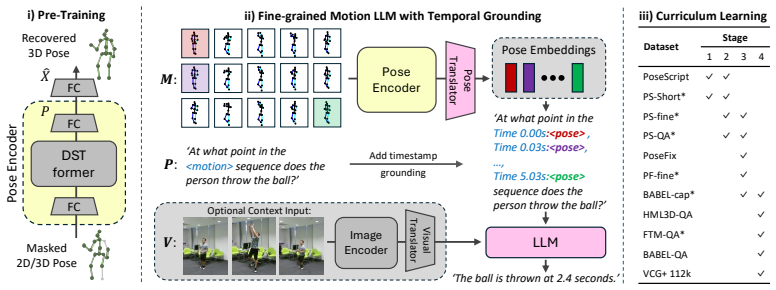
Motion as timestamped skeletal pose sequences fed to an LLM, with a unified pose encoder and a four-task training mixture of pose captioning, pose QA, motion captioning, and motion QA.
If this is right
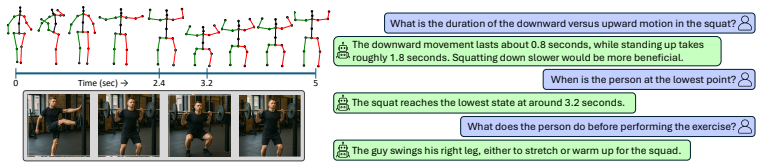
- Explicit timestamp tokens allow reasoning about motion order, duration, and rhythm.
- Diverse supervision from pose and motion tasks drives most of the performance gains.
- Staged training adds only a small extra benefit.
- The unified encoder allows the same model to handle 2D or 3D skeletal data, optionally with video context.
- The method exceeds prior 3D-based approaches on multiple benchmarks even when restricted to 2D skeletal input.
Where Pith is reading between the lines
- This representation could enable motion analysis from standard 2D pose detectors in everyday settings like fitness apps or security cameras.
- It opens the possibility of training effective models with less reliance on expensive 3D motion capture data.
- The approach might be tested on multi-person or interactive motions to see if timestamps scale to complex scenarios.
- Integrating this with other LLM capabilities like planning could lead to systems that describe and suggest corrections for observed movements.
Load-bearing premise
The premise that timestamp tokens in the input sequence combined with the constructed training mixture suffice to let the LLM effectively reason about motion timing and details.
What would settle it
An ablation removing the timestamp tokens and measuring the drop in performance on questions involving motion duration or sequence order would directly test the contribution of explicit temporal encoding.
Figures




read the original abstract
In this work, we propose \methodname, an LLM-based model for fine-grained human motion understanding that represents motion as a sequence of skeletal poses with explicit timestamps for each pose. Each pose encodes body joint positions and is temporally grounded with timestamp tokens, allowing the model to reason about motion order, duration, and rhythm. To study what supervision is needed for motion-language reasoning, we construct a diverse training mixture spanning pose captioning, pose question answering, motion captioning, and motion question answering. Our ablations show that the primary gains come from the diversity of pose- and motion-level supervision, while staged training provides a smaller additional benefit. Different from previous works that rely on ground-truth 3D motion capture, our approach supports both 2D and 3D skeletal motion representations through a unified pose encoder, and can optionally incorporate video to provide contextual information. Extensive experiments on BABEL-QA, HuMMan-QA, CompMo, NTU-RGB+D, and QEVD-Coach demonstrate that our method achieves state-of-the-art performance across multiple benchmarks, highlighting the effectiveness of explicit temporal encoding and diverse pose- and motion-level supervision for fine-grained human motion understanding. Notably, even when using only 2D skeletal input, our approach surpasses previous 3D-based methods.
Editorial analysis
A structured set of objections, weighed in public.
Referee Report
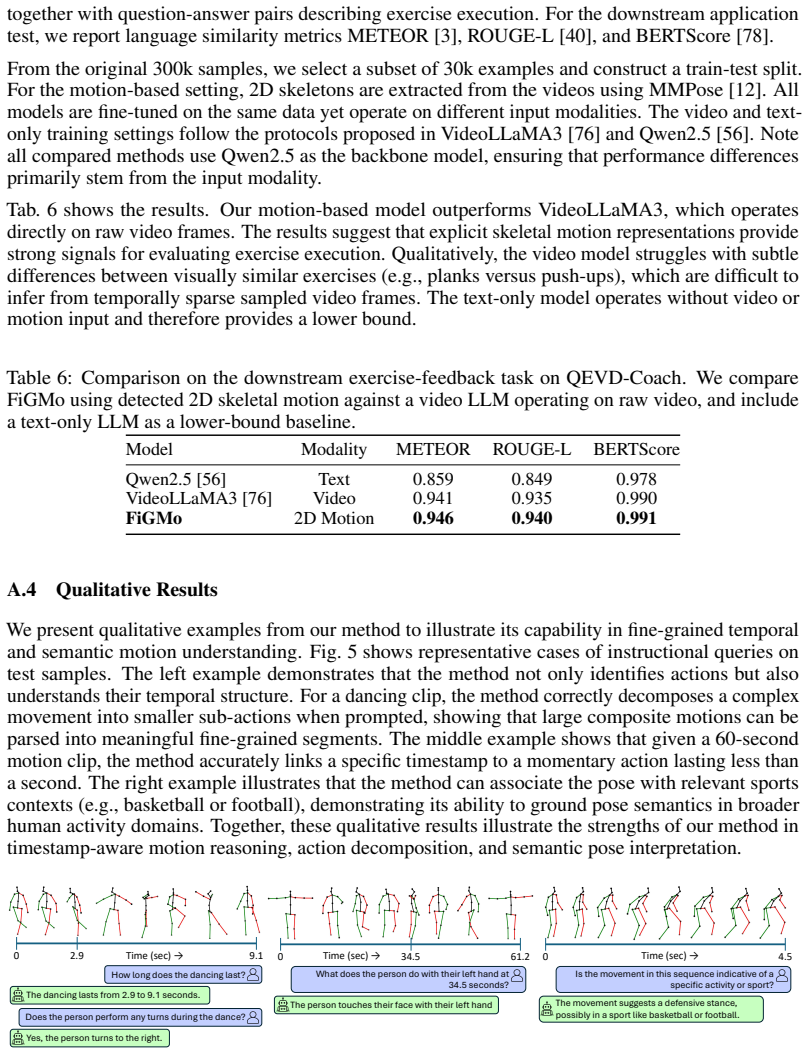
Summary. The paper proposes exttt{\\methodname}, an LLM-based model for fine-grained human motion understanding. Human motion is encoded as a sequence of skeletal poses, each augmented with explicit timestamp tokens, and processed by a unified pose encoder that supports both 2D and 3D inputs (optionally with video context). Training uses a diverse mixture of pose captioning, pose QA, motion captioning, and motion QA tasks. The central empirical claim is that this yields state-of-the-art results on BABEL-QA, HuMMan-QA, CompMo, NTU-RGB+D, and QEVD-Coach, with 2D-only input surpassing prior 3D-based methods; ablations attribute primary gains to supervision diversity and a smaller benefit to staged training.
Significance. If the reported results and ablations hold under scrutiny, the work would establish that explicit timestamp-based temporal grounding plus a broad pose/motion supervision mixture enables LLMs to perform fine-grained motion reasoning at a level competitive with or superior to specialized 3D pipelines. This would be notable for lowering the barrier to high-quality motion understanding (no ground-truth 3D mocap required) and for providing concrete evidence on the value of supervision diversity in motion-language models.
major comments (2)
- [Abstract] Abstract: The central claim credits 'explicit temporal encoding' (timestamp tokens) with enabling the LLM to reason about motion order, duration, and rhythm, yet the described ablations only vary supervision diversity and staged training. No direct comparison of the identical architecture with versus without timestamp tokens is reported, leaving open whether the sequence of poses alone suffices for the claimed SOTA gains on BABEL-QA, HuMMan-QA, etc.
- [Abstract] Abstract: The manuscript asserts 'state-of-the-art performance across multiple benchmarks' and that 'even when using only 2D skeletal input, our approach surpasses previous 3D-based methods,' but supplies no quantitative metrics, baseline comparisons, error bars, or ablation tables. Without these data the magnitude, statistical reliability, and attribution of gains to the proposed components cannot be assessed.
minor comments (1)
- [Abstract] The method name is written as \methodname in the abstract; a concrete name or acronym should be introduced at first use for readability.
Simulated Author's Rebuttal
We thank the referee for the constructive feedback on our manuscript. We address the two major comments point by point below, providing clarifications and committing to revisions where they strengthen the work.
read point-by-point responses
-
Referee: [Abstract] Abstract: The central claim credits 'explicit temporal encoding' (timestamp tokens) with enabling the LLM to reason about motion order, duration, and rhythm, yet the described ablations only vary supervision diversity and staged training. No direct comparison of the identical architecture with versus without timestamp tokens is reported, leaving open whether the sequence of poses alone suffices for the claimed SOTA gains on BABEL-QA, HuMMan-QA, etc.
Authors: We acknowledge that our reported ablations focus on supervision diversity and staged training rather than isolating the timestamp tokens. The timestamps form an integral part of the input representation to explicitly support reasoning over duration and rhythm; however, to directly substantiate their contribution, we will add a controlled ablation comparing the full model against an identical architecture without timestamp tokens in the revised manuscript. revision: yes
-
Referee: [Abstract] Abstract: The manuscript asserts 'state-of-the-art performance across multiple benchmarks' and that 'even when using only 2D skeletal input, our approach surpasses previous 3D-based methods,' but supplies no quantitative metrics, baseline comparisons, error bars, or ablation tables. Without these data the magnitude, statistical reliability, and attribution of gains to the proposed components cannot be assessed.
Authors: The abstract is a concise summary and does not contain numerical results, which follows standard practice for brevity. All quantitative metrics, SOTA comparisons on BABEL-QA, HuMMan-QA, CompMo, NTU-RGB+D and QEVD-Coach, baseline tables, ablation results, and any error bars are provided in full in the Experiments section. We will verify that cross-references from the abstract to these tables are explicit in the revision. revision: no
Circularity Check
No circularity; empirical SOTA claims rest on benchmark results, not self-referential definitions or fits
full rationale
The paper presents an LLM-based architecture with timestamp-augmented pose sequences and a mixed supervision regime, then reports performance on external benchmarks (BABEL-QA, HuMMan-QA, etc.). No derivation chain, uniqueness theorem, or parameter fit is invoked whose output is definitionally identical to its input. Ablation descriptions vary supervision diversity and staging but do not reduce any claimed gain to a tautology. Self-citations, if present, are not load-bearing for the central empirical result. The work is therefore self-contained against external benchmarks.
Axiom & Free-Parameter Ledger
axioms (1)
- domain assumption LLMs can effectively reason about motion order, duration, and rhythm when motion is represented as timestamped skeletal pose sequences.
Reference graph
Works this paper leans on
-
[1]
Posetrack: A benchmark for human pose estimation and tracking, 2018
Mykhaylo Andriluka, Umar Iqbal, Eldar Insafutdinov, Leonid Pishchulin, Anton Milan, Juergen Gall, and Bernt Schiele. Posetrack: A benchmark for human pose estimation and tracking, 2018
2018
-
[2]
Edge computing and cloud computing for internet of things: A review.Informatics, 11(4), 2024
Francesco Cosimo Andriulo, Marco Fiore, Marina Mongiello, Emanuele Traversa, and Vera Zizzo. Edge computing and cloud computing for internet of things: A review.Informatics, 11(4), 2024
2024
-
[3]
METEOR: An automatic metric for MT evaluation with improved correlation with human judgments
Satanjeev Banerjee and Alon Lavie. METEOR: An automatic metric for MT evaluation with improved correlation with human judgments. In Jade Goldstein, Alon Lavie, Chin-Yew Lin, and Clare V oss, editors,Proceedings of the ACL Workshop on Intrinsic and Extrinsic Evaluation Measures for Machine Translation and/or Summarization, pages 65–72, Ann Arbor, Michigan,...
2005
-
[4]
Beit: Bert pre-training of image trans- formers, 2022
Hangbo Bao, Li Dong, Songhao Piao, and Furu Wei. Beit: Bert pre-training of image trans- formers, 2022
2022
-
[5]
B˘alt˘are¸ tu, P
A. B˘alt˘are¸ tu, P. Benschop, and Jan C Van Gemert. Are we smply biased: Identifying ethical biases in action recognition. Master’s thesis, Delft University of Technology, Delft, The Netherlands, 2025
2025
-
[6]
Gender shades: Intersectional accuracy disparities in commercial gender classification
Joy Buolamwini and Timnit Gebru. Gender shades: Intersectional accuracy disparities in commercial gender classification. In Sorelle A. Friedler and Christo Wilson, editors,Proceedings of the 1st Conference on Fairness, Accountability and Transparency, volume 81 ofProceedings of Machine Learning Research, pages 77–91. PMLR, 23–24 Feb 2018
2018
-
[7]
Quo vadis, action recognition? a new model and the kinetics dataset
Joao Carreira and Andrew Zisserman. Quo vadis, action recognition? a new model and the kinetics dataset. InCVPR, pages 6299–6308, 2017
2017
-
[8]
Szeyi Chan, Shihan Fu, Jiachen Li, Bingsheng Yao, Smit Desai, Mirjana Prpa, and Dakuo Wang. Human and llm-based voice assistant interaction: An analytical framework for user verbal and nonverbal behaviors.arXiv preprint arXiv:2408.16465, 2024
-
[9]
Poselifter: Absolute 3d human pose lifting network from a single noisy 2d human pose, 2020
Ju Yong Chang, Gyeongsik Moon, and Kyoung Mu Lee. Poselifter: Absolute 3d human pose lifting network from a single noisy 2d human pose, 2020
2020
-
[10]
Ling-Hao Chen, Shunlin Lu, Ailing Zeng, Hao Zhang, Benyou Wang, Ruimao Zhang, and Lei Zhang. Motionllm: Understanding human behaviors from human motions and videos.arXiv preprint arXiv:2405.20340, 2024
-
[11]
Sportscap: Monocular 3d human motion capture and fine-grained understanding in challenging sports videos.IJCV, 129(10):2846–2864, 2021
Xin Chen, Anqi Pang, Wei Yang, Yuexin Ma, Lan Xu, and Jingyi Yu. Sportscap: Monocular 3d human motion capture and fine-grained understanding in challenging sports videos.IJCV, 129(10):2846–2864, 2021
2021
-
[12]
Openmmlab pose estimation toolbox and benchmark, 2020
MMPose Contributors. Openmmlab pose estimation toolbox and benchmark, 2020
2020
-
[13]
Posescript: Linking 3d human poses and natural language.IEEE TPAMI, 2024
Ginger Delmas, Philippe Weinzaepfel, Thomas Lucas, Francesc Moreno-Noguer, and Grégory Rogez. Posescript: Linking 3d human poses and natural language.IEEE TPAMI, 2024
2024
-
[14]
Posefix: Correcting 3d human poses with natural language, 2024
Ginger Delmas, Philippe Weinzaepfel, Francesc Moreno-Noguer, and Grégory Rogez. Posefix: Correcting 3d human poses with natural language, 2024
2024
-
[15]
Bert: Pre-training of deep bidirectional transformers for language understanding, 2019
Jacob Devlin, Ming-Wei Chang, Kenton Lee, and Kristina Toutanova. Bert: Pre-training of deep bidirectional transformers for language understanding, 2019
2019
-
[16]
Skeletr: Towards skeleton-based action recognition in the wild
Haodong Duan, Mingze Xu, Bing Shuai, Davide Modolo, Zhuowen Tu, Joseph Tighe, and Alessandro Bergamo. Skeletr: Towards skeleton-based action recognition in the wild. InICCV, pages 13634–13644, 2023
2023
-
[17]
Revisiting skeleton-based action recognition
Haodong Duan, Yue Zhao, Kai Chen, Dahua Lin, and Bo Dai. Revisiting skeleton-based action recognition. InCVPR, pages 2969–2978, 2022. 10
2022
-
[18]
Motion question answering via modular motion programs
Mark Endo, Joy Hsu, Jiaman Li, and Jiajun Wu. Motion question answering via modular motion programs. InInternational Conference on Machine Learning, pages 9312–9328. PMLR, 2023
2023
-
[19]
Regulation (EU) 2016/679 of the European Parliament and of the Council
European Parliament and Council of the European Union. Regulation (EU) 2016/679 of the European Parliament and of the Council
2016
-
[20]
Humocon: Concept discovery for human motion understanding
Qihang Fang, Chengcheng Tang, Bugra Tekin, Shugao Ma, and Yanchao Yang. Humocon: Concept discovery for human motion understanding. InCVPR, pages 7179–7190, 2025
2025
-
[21]
Chatpose: Chatting about 3d human pose
Yao Feng, Jing Lin, Sai Kumar Dwivedi, Yu Sun, Priyanka Patel, and Michael J Black. Chatpose: Chatting about 3d human pose. InCVPR, pages 2093–2103, 2024
2093
-
[22]
Privacy- preserving 3-d skeleton-based video action recognition via graph convolution network.IEEE Transactions on Consumer Electronics, 71(2):6627–6641, 2025
Xuesong Gao, Keqiu Li, Xiulong Liu, Jie Nie, Weiqiang Chen, and Yonghong Tian. Privacy- preserving 3-d skeleton-based video action recognition via graph convolution network.IEEE Transactions on Consumer Electronics, 71(2):6627–6641, 2025
2025
-
[23]
Momask: Generative masked modeling of 3d human motions
Chuan Guo, Yuxuan Mu, Muhammad Gohar Javed, Sen Wang, and Li Cheng. Momask: Generative masked modeling of 3d human motions. InCVPR, pages 1900–1910, 2024
1900
-
[24]
Generating diverse and natural 3d human motions from text
Chuan Guo, Shihao Zou, Xinxin Zuo, Sen Wang, Wei Ji, Xingyu Li, and Li Cheng. Generating diverse and natural 3d human motions from text. InProceedings of the IEEE/CVF Conference on Computer Vision and Pattern Recognition (CVPR), pages 5152–5161, June 2022
2022
-
[25]
Masked Autoencoders Are Scalable Vision Learners
Kaiming He, Xinlei Chen, Saining Xie, Yanghao Li, Piotr Dollár, and Ross B. Girshick. Masked autoencoders are scalable vision learners.CoRR, abs/2111.06377, 2021
work page internal anchor Pith review Pith/arXiv arXiv 2021
-
[26]
Hu, Yelong Shen, Phillip Wallis, Zeyuan Allen-Zhu, Yuanzhi Li, Shean Wang, Lu Wang, and Weizhu Chen
Edward J. Hu, Yelong Shen, Phillip Wallis, Zeyuan Allen-Zhu, Yuanzhi Li, Shean Wang, Lu Wang, and Weizhu Chen. Lora: Low-rank adaptation of large language models, 2021
2021
-
[27]
Catalin Ionescu, Dragos Papava, Vlad Olaru, and Cristian Sminchisescu. Human3.6m: Large scale datasets and predictive methods for 3d human sensing in natural environments.IEEE Transactions on Pattern Analysis and Machine Intelligence, 36(7):1325–1339, 2014
2014
-
[28]
Privacy-Preserving Human Activity Recognition System for Assisted Living Environments .IEEE Transactions on Artificial Intelligence, 5(05):2342–2357, May 2024
Ankit Jain, Rajendra Akerkar, and Abhishek Srivastava. Privacy-Preserving Human Activity Recognition System for Assisted Living Environments .IEEE Transactions on Artificial Intelligence, 5(05):2342–2357, May 2024
2024
-
[29]
Motiongpt: Human motion as a foreign language.NeurIPS, 36:20067–20079, 2023
Biao Jiang, Xin Chen, Wen Liu, Jingyi Yu, Gang Yu, and Tao Chen. Motiongpt: Human motion as a foreign language.NeurIPS, 36:20067–20079, 2023
2023
-
[30]
Zhang, Panna Felsen, and Jitendra Malik
Angjoo Kanazawa, Jason Y . Zhang, Panna Felsen, and Jitendra Malik. Learning 3d human dynamics from video, 2019
2019
-
[31]
Katrina Karkazis and Jennifer R. Fishman. Tracking u.s. professional athletes: The ethics of biometric technologies.The American Journal of Bioethics, 17(1):45–60, 2017. PMID: 27996918
2017
-
[32]
Kuehne, H
H. Kuehne, H. Jhuang, E. Garrote, T. Poggio, and T. Serre. Hmdb: A large video database for human motion recognition. In2011 International Conference on Computer Vision, pages 2556–2563, 2011
2011
-
[33]
Llava-onevision: Easy visual task transfer, 2024
Bo Li, Yuanhan Zhang, Dong Guo, Renrui Zhang, Feng Li, Hao Zhang, Kaichen Zhang, Peiyuan Zhang, Yanwei Li, Ziwei Liu, and Chunyuan Li. Llava-onevision: Easy visual task transfer, 2024
2024
-
[34]
Imore: Implicit program-guided reasoning for human motion q&a, 2025
Chen Li, Chinthani Sugandhika, Yeo Keat Ee, Eric Peh, Hao Zhang, Hong Yang, Deepu Rajan, and Basura Fernando. Imore: Implicit program-guided reasoning for human motion q&a, 2025
2025
-
[35]
Unimotion: Unifying 3d human motion synthesis and understanding, 2024
Chuqiao Li, Julian Chibane, Yannan He, Naama Pearl, Andreas Geiger, and Gerard Pons-moll. Unimotion: Unifying 3d human motion synthesis and understanding, 2024
2024
-
[36]
Videochat: Chat-centric video understanding, 2024
KunChang Li, Yinan He, Yi Wang, Yizhuo Li, Wenhai Wang, Ping Luo, Yali Wang, Limin Wang, and Yu Qiao. Videochat: Chat-centric video understanding, 2024. 11
2024
-
[37]
Chatmotion: A multimodal multi-agent for human motion analysis.arXiv preprint arXiv:2502.18180, 2025
Lei Li, Sen Jia, Jianhao Wang, Zhaochong An, Jiaang Li, Jenq-Neng Hwang, and Serge Belongie. Chatmotion: A multimodal multi-agent for human motion analysis.arXiv preprint arXiv:2502.18180, 2025
-
[38]
Human motion instruction tuning
Lei Li, Sen Jia, Jianhao Wang, Zhongyu Jiang, Feng Zhou, Ju Dai, Tianfang Zhang, Zongkai Wu, and Jenq-Neng Hwang. Human motion instruction tuning. InCVPR, pages 17582–17591, 2025
2025
-
[39]
Video-llava: Learning united visual representation by alignment before projection
Bin Lin, Yang Ye, Bin Zhu, Jiaxi Cui, Munan Ning, Peng Jin, and Li Yuan. Video-llava: Learning united visual representation by alignment before projection. InProceedings of the 2024 Conference on Empirical Methods in Natural Language Processing, pages 5971–5984, 2024
2024
-
[40]
ROUGE: A package for automatic evaluation of summaries
Chin-Yew Lin. ROUGE: A package for automatic evaluation of summaries. InText Summariza- tion Branches Out, pages 74–81, Barcelona, Spain, July 2004. Association for Computational Linguistics
2004
-
[41]
Tsm: Temporal shift module for efficient video understand- ing
Ji Lin, Chuang Gan, and Song Han. Tsm: Temporal shift module for efficient video understand- ing. InICCV, pages 7083–7093, 2019
2019
-
[42]
Motion-x: A large-scale 3d expressive whole-body human motion dataset.Advances in Neural Information Processing Systems, 2023
Jing Lin, Ailing Zeng, Shunlin Lu, Yuanhao Cai, Ruimao Zhang, Haoqian Wang, and Lei Zhang. Motion-x: A large-scale 3d expressive whole-body human motion dataset.Advances in Neural Information Processing Systems, 2023
2023
-
[43]
Draw-and-understand: Leveraging visual prompts to enable mllms to comprehend what you want, 2025
Weifeng Lin, Xinyu Wei, Ruichuan An, Peng Gao, Bocheng Zou, Yulin Luo, Siyuan Huang, Shanghang Zhang, and Hongsheng Li. Draw-and-understand: Leveraging visual prompts to enable mllms to comprehend what you want, 2025
2025
-
[44]
Polyslgen: Online multimodal speaking-listening reaction generation in polyadic interaction
Zhi-Yi Lin, Thomas Markhorst, Jouh Yeong Chew, and Xucong Zhang. Polyslgen: Online multimodal speaking-listening reaction generation in polyadic interaction. InProceedings of the IEEE/CVF Conference on Computer Vision and Pattern Recognition (CVPR), pages 29379–29390, June 2026
2026
-
[45]
Visual instruction tuning, 2023
Haotian Liu, Chunyuan Li, Qingyang Wu, and Yong Jae Lee. Visual instruction tuning, 2023
2023
-
[46]
Ntu rgb+ d 120: A large-scale benchmark for 3d human activity understanding.IEEE TPAMI, 42(10):2684–2701, 2019
Jun Liu, Amir Shahroudy, Mauricio Perez, Gang Wang, Ling-Yu Duan, and Alex C Kot. Ntu rgb+ d 120: A large-scale benchmark for 3d human activity understanding.IEEE TPAMI, 42(10):2684–2701, 2019
2019
-
[47]
Videogpt+: Integrating image and video encoders for enhanced video understanding, 2024
Muhammad Maaz, Hanoona Rasheed, Salman Khan, and Fahad Khan. Videogpt+: Integrating image and video encoders for enhanced video understanding, 2024
2024
-
[48]
Amass: Archive of motion capture as surface shapes
Naureen Mahmood, Nima Ghorbani, Nikolaus F Troje, Gerard Pons-Moll, and Michael J Black. Amass: Archive of motion capture as surface shapes. InICCV, pages 5442–5451, 2019
2019
-
[49]
Muppet: Multi-person 2d-to-3d pose lifting
Thomas Markhorst, Zhi-Yi Lin, Jouh Yeong Chew, Jan Van Gemert, and Xucong Zhang. Muppet: Multi-person 2d-to-3d pose lifting. InProceedings of the IEEE/CVF Conference on Computer Vision and Pattern Recognition (CVPR) Workshops, pages 5320–5330, June 2026
2026
-
[50]
A survey on bias and fairness in machine learning, 2022
Ninareh Mehrabi, Fred Morstatter, Nripsuta Saxena, Kristina Lerman, and Aram Galstyan. A survey on bias and fairness in machine learning, 2022
2022
-
[51]
Skeleton-dml: Deep metric learning for skeleton-based one-shot action recognition
Raphael Memmesheimer, Simon Häring, Nick Theisen, and Dietrich Paulus. Skeleton-dml: Deep metric learning for skeleton-based one-shot action recognition. InProceedings of the IEEE/CVF Winter Conference on Applications of Computer Vision, pages 3702–3710, 2022
2022
-
[52]
Sl-dml: Signal level deep metric learning for multimodal one-shot action recognition
Raphael Memmesheimer, Nick Theisen, and Dietrich Paulus. Sl-dml: Signal level deep metric learning for multimodal one-shot action recognition. In2020 25th International conference on pattern recognition (ICPR), pages 4573–4580. IEEE, 2021
2021
-
[53]
What to say and when to say it: Live fitness coaching as a testbed for situated interaction, 2024
Sunny Panchal, Apratim Bhattacharyya, Guillaume Berger, Antoine Mercier, Cornelius Bohm, Florian Dietrichkeit, Reza Pourreza, Xuanlin Li, Pulkit Madan, Mingu Lee, Mark Todorovich, Ingo Bax, and Roland Memisevic. What to say and when to say it: Live fitness coaching as a testbed for situated interaction, 2024. 12
2024
-
[54]
Babel: Bodies, action and behavior with english labels
Abhinanda R Punnakkal, Arjun Chandrasekaran, Nikos Athanasiou, Alejandra Quiros-Ramirez, and Michael J Black. Babel: Bodies, action and behavior with english labels. InCVPR, pages 722–731, 2021
2021
-
[55]
Llms are good action recognizers, 2024
Haoxuan Qu, Yujun Cai, and Jun Liu. Llms are good action recognizers, 2024
2024
-
[56]
Qwen2.5 technical report, 2025
Qwen, :, An Yang, Baosong Yang, Beichen Zhang, Binyuan Hui, Bo Zheng, Bowen Yu, Chengyuan Li, Dayiheng Liu, Fei Huang, Haoran Wei, Huan Lin, Jian Yang, Jianhong Tu, Jianwei Zhang, Jianxin Yang, Jiaxi Yang, Jingren Zhou, Junyang Lin, Kai Dang, Keming Lu, Keqin Bao, Kexin Yang, Le Yu, Mei Li, Mingfeng Xue, Pei Zhang, Qin Zhu, Rui Men, Runji Lin, Tianhao Li,...
2025
-
[57]
One-shot action recognition in challenging therapy scenarios
Alberto Sabater, Laura Santos, Jose Santos-Victor, Alexandre Bernardino, Luis Montesano, and Ana C Murillo. One-shot action recognition in challenging therapy scenarios. InCVPR, pages 2777–2785, 2021
2021
-
[58]
Camera-based monitoring of neck move- ments for cervical rehabilitation mobile applications.Sensors, 21(6), 2021
Iosune Salinas-Bueno, Maria Francesca Roig-Maimó, Pau Martínez-Bueso, Katia San-Sebastián- Fernández, Javier Varona, and Ramon Mas-Sansó. Camera-based monitoring of neck move- ments for cervical rehabilitation mobile applications.Sensors, 21(6), 2021
2021
-
[59]
Humanizing human- robot interaction: On the importance of mutual understanding.IEEE Technology and Society Magazine, 37(1):22–29, 2018
Alessandra Sciutti, Martina Mara, Vincenzo Tagliasco, and Giulio Sandini. Humanizing human- robot interaction: On the importance of mutual understanding.IEEE Technology and Society Magazine, 37(1):22–29, 2018
2018
-
[60]
Finegym: A hierarchical video dataset for fine-grained action understanding
Dian Shao, Yue Zhao, Bo Dai, and Dahua Lin. Finegym: A hierarchical video dataset for fine-grained action understanding. InCVPR, pages 2616–2625, 2020
2020
-
[61]
Optimize cloud computations using edge computing
Sachchidanand Singh. Optimize cloud computations using edge computing. In2017 Interna- tional Conference on Big Data, IoT and Data Science (BID), pages 49–53, 2017
2017
-
[62]
Ucf101: A dataset of 101 human actions classes from videos in the wild, 2012
Khurram Soomro, Amir Roshan Zamir, and Mubarak Shah. Ucf101: A dataset of 101 human actions classes from videos in the wild, 2012
2012
-
[63]
Yolo Y . Tang, Jing Bi, Siting Xu, Luchuan Song, Susan Liang, Teng Wang, Daoan Zhang, Jie An, Jingyang Lin, Rongyi Zhu, Ali V osoughi, Chao Huang, Zeliang Zhang, Pinxin Liu, Mingqian Feng, Feng Zheng, Jianguo Zhang, Ping Luo, Jiebo Luo, and Chenliang Xu. Video understanding with large language models: A survey, 2025
2025
-
[64]
Motionclip: Exposing human motion generation to clip space
Guy Tevet, Brian Gordon, Amir Hertz, Amit H Bermano, and Daniel Cohen-Or. Motionclip: Exposing human motion generation to clip space. InECCV, pages 358–374. Springer, 2022
2022
-
[65]
Learning spatiotemporal features with 3d convolutional networks
Du Tran, Lubomir Bourdev, Rob Fergus, Lorenzo Torresani, and Manohar Paluri. Learning spatiotemporal features with 3d convolutional networks. InICCV, pages 4489–4497, 2015
2015
-
[66]
Fg-t2m: Fine-grained text-driven human motion generation via diffusion model
Yin Wang, Zhiying Leng, Frederick WB Li, Shun-Cheng Wu, and Xiaohui Liang. Fg-t2m: Fine-grained text-driven human motion generation via diffusion model. InProceedings of the IEEE/CVF international conference on computer vision, pages 22035–22044, 2023
2023
-
[67]
Smith, Daniel Khashabi, and Hannaneh Hajishirzi
Yizhong Wang, Yeganeh Kordi, Swaroop Mishra, Alisa Liu, Noah A. Smith, Daniel Khashabi, and Hannaneh Hajishirzi. Self-instruct: Aligning language models with self-generated instruc- tions, 2023
2023
-
[68]
MotionGPT-2: A General-Purpose Motion-Language Model for Motion Generation and Understanding
Yuan Wang, Di Huang, Yaqi Zhang, Wanli Ouyang, Jile Jiao, Xuetao Feng, Yan Zhou, Pengfei Wan, Shixiang Tang, and Dan Xu. Motiongpt-2: A general-purpose motion-language model for motion generation and understanding.arXiv preprint arXiv:2410.21747, 2024
work page internal anchor Pith review Pith/arXiv arXiv 2024
-
[69]
Multimodal dialog act classification for digital character conversations
Philine Witzig, Rares Constantin, Nikola Kovacevic, and Rafael Wampfler. Multimodal dialog act classification for digital character conversations. InProceedings of the 6th ACM conference on conversational user interfaces, pages 1–14, 2024
2024
-
[70]
Motion- agent: A conversational framework for human motion generation with llms
Qi Wu, Yubo Zhao, Yifan Wang, Xinhang Liu, Yu-Wing Tai, and Chi-Keung Tang. Motion- agent: A conversational framework for human motion generation with llms. 2025. 13
2025
-
[71]
Dense motion captioning, 2025
Shiyao Xu, Benedetta Liberatori, Gül Varol, and Paolo Rota. Dense motion captioning, 2025
2025
-
[72]
Improving fine-grained understanding for retrieval in human motion and text.IEEE Signal Processing Letters, 2024
Sheng Yan, Yong Wang, Xin Du, Hongchang Jin, and Mengyuan Liu. Improving fine-grained understanding for retrieval in human motion and text.IEEE Signal Processing Letters, 2024
2024
-
[73]
Spatial temporal graph convolutional networks for skeleton-based action recognition
Sijie Yan, Yuanjun Xiong, and Dahua Lin. Spatial temporal graph convolutional networks for skeleton-based action recognition. InAAAI, volume 32, 2018
2018
-
[74]
Vid2seq: Large-scale pretraining of a visual language model for dense video captioning, 2023
Antoine Yang, Arsha Nagrani, Paul Hongsuck Seo, Antoine Miech, Jordi Pont-Tuset, Ivan Laptev, Josef Sivic, and Cordelia Schmid. Vid2seq: Large-scale pretraining of a visual language model for dense video captioning, 2023
2023
-
[75]
Osprey: Pixel understanding with visual instruction tuning, 2025
Yuqian Yuan, Wentong Li, Jian Liu, Dongqi Tang, Xinjie Luo, Chi Qin, Lei Zhang, and Jianke Zhu. Osprey: Pixel understanding with visual instruction tuning, 2025
2025
-
[76]
Videollama 3: Frontier multimodal foundation models for image and video understanding, 2025
Boqiang Zhang, Kehan Li, Zesen Cheng, Zhiqiang Hu, Yuqian Yuan, Guanzheng Chen, Sicong Leng, Yuming Jiang, Hang Zhang, Xin Li, Peng Jin, Wenqi Zhang, Fan Wang, Lidong Bing, and Deli Zhao. Videollama 3: Frontier multimodal foundation models for image and video understanding, 2025
2025
-
[77]
Finemogen: Fine-grained spatio-temporal motion generation and editing, 2023
Mingyuan Zhang, Huirong Li, Zhongang Cai, Jiawei Ren, Lei Yang, and Ziwei Liu. Finemogen: Fine-grained spatio-temporal motion generation and editing, 2023
2023
-
[78]
Weinberger, and Yoav Artzi
Tianyi Zhang, Varsha Kishore, Felix Wu, Kilian Q. Weinberger, and Yoav Artzi. Bertscore: Evaluating text generation with bert, 2020
2020
-
[79]
Motion-X++: A large-scale multimodal 3D whole-body human motion dataset,
Yuhong Zhang, Jing Lin, Ailing Zeng, Guanlin Wu, Shunlin Lu, Yurong Fu, Yuanhao Cai, Ruimao Zhang, Haoqian Wang, and Lei Zhang. Motion-x++: A large-scale multimodal 3d whole-body human motion dataset.arXiv preprint arXiv:2501.05098, 2025
-
[80]
Temporal relational reasoning in videos
Bolei Zhou, Alex Andonian, Aude Oliva, and Antonio Torralba. Temporal relational reasoning in videos. InECCV, pages 803–818, 2018
2018
discussion (0)
Sign in with ORCID, Apple, or X to comment. Anyone can read and Pith papers without signing in.