REVIEW 4 major objections 4 minor 18 references
The 2-Category of Topological Quantum Computation
T0 review · 4 major / 4 minor · reviewed 2026-08-07 · deepseek-v4-flash
Pith's one-line read A braided fusion 2-category, with anyon types as objects and fusion spaces as morphisms, is argued to be the single structure behind both anyonic hardware and topological quantum computation.
desk verdict A promising 2-categorical organizing idea for topological quantum computation, undermined by an under-specified definition of the 2-category itself. read the letter →
The pith
A machine-rendered reading of the paper's core claim, the machinery that carries it, and where it could break.
The reading
What carries the argument
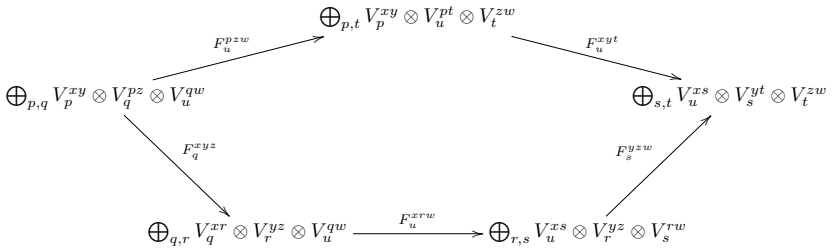
The central object is a strict braided fusion 2-category, skeletal at the level of 0-morphisms, with Hom-categories that are unitary braided fusion categories. Here 0-morphisms are anyon types $X_i$; 1-morphisms are the fusion spaces $V^k_{ij}$; and 2-morphisms are the fusion ($F$) and braiding ($R$) matrices. The pentagonator and hexagonators of the braided monoidal 2-category are taken to be identity, so the pentagonal and hexagonal equations of a TQC model appear as commutative diagrams among vector spaces. This object carries the argument because it assigns the two product structures to different levels: $\times$ and $+$ act on 0-morphisms (physical fusion), while $\otimes$ and $\oplus$ act on 1-morphisms (linear-algebraic composition).
What would settle it
A concrete check is to write out explicit source and target 0-morphisms for every fusion space in the Fibonacci model and verify the composition laws of a 2-category; if no assignment of domains and codomains satisfies the axioms, the claimed 2-category cannot exist as stated.
Extended reading notes
Core claim
The paper's central claim is that the right unifying structure for anyonic theory and topological quantum computation is a braided fusion 2-category, not a single unitary ribbon fusion category. At the 0-morphism level sit the anyon types; between two 0-morphisms $X_i$ and $X_j$ sits a Hom-category whose objects are fusion spaces $V^k_{ij}$ (the computational spaces); and the 2-morphisms inside these Hom-categories are the fusion and braiding matrices, $F$ and $R$. The paper argues that this single structure separates the hardware (anyon types, their fusion and braiding) from the computational model (Hilbert spaces of operations and matrices acting on them), and makes superselection automatic: fusion spaces belonging to different Hom-categories cannot be coherently superposed. The pentagonal and hexagonal equations for a TQC model are recovered as coherence conditions of the 2-category, with the pentagonator and hexagonators taken to be identity in the strict case.
Load-bearing premise
The load-bearing premise is that a fusion space $V^k_{ij}$, which is indexed by three anyon types $i, j, k$, can be placed into a 2-category whose 0-morphisms are anyon types; but a 2-category requires every such space to have a definite starting and ending anyon type, and the paper does not specify those.
Editorial extensions
If this is right
- If the 2-categorical picture is right, superselection is not an extra axiom: states in different Hom-categories cannot be coherently superposed because the category structure itself separates them.
- Fusion of anyons ($\times$, $+$ at the object level) and tensor products of vector spaces ($\otimes$, $\oplus$ at the 1-morphism level) are distinguished by construction, resolving a conflation in the literature.
- The pentagonal and hexagonal equations for F- and R-matrices become coherence diagrams of a strict braided monoidal 2-category, so each TQC model automatically satisfies them once the 2-category exists.
- Fibonacci, Ising, and Moore-Read models are not separate categorical formalisms but Hom-categories inside one braided fusion 2-category, with their qubit spaces realized as decompositions of fusion spaces such as $V^\tau_{(\tau\tau)\tau}$.
- The computational category of a TQC model is a Hom-category of the 2-category, so it inherits the structure of a unitary braided fusion category, matching the earlier result that it lives inside Hilb.
Reading between the lines
- A natural test of the proposal is to construct an actual braided fusion 2-category for Fibonacci anyons by specifying explicit source and target 0-morphisms for each fusion space; the paper leaves this construction open.
- If the conjecture that skeletality and strictness coexist in fusion 2-categories holds, then the coherence data (pentagonator, hexagonators) can be trivialized in every TQC model, which would make the 2-categorical description canonical.
- The superselection argument could be strengthened by showing that every observable in the Hom-category of a fixed object annihilates cross-Hom-category matrix elements, turning Definition 6 into a theorem of the 2-category rather than a structural assertion.
- One could probe the framework by asking whether braiding on the 2-category induces the braiding matrices on the Hom-categories, which would make the hardware-computation correspondence functorial rather than merely descriptive.
Editorial analysis
A structured set of objections, weighed in public.
Referee Report
Summary. The paper proposes that the unifying categorical formalism for anyonic theories and topological quantum computation is a braided fusion 2-category. In this picture, 0-morphisms are anyon types, objects of Hom-categories (1-morphisms) are fusion spaces, and 2-morphisms are fusion and braiding matrices. The author argues that this structure separates the monoidal product of anyons from the tensor product of vector spaces, and that superselection rules emerge automatically because states with different total charge live in different Hom-categories. The paper illustrates the proposal with Fibonacci, Ising, and fermionic Moore-Read anyon models, and sketches how pentagon and hexagon equations are recovered from the coherence of a braided monoidal 2-category.
Significance. If the construction were made rigorous, the proposed 2-category would provide a conceptually useful unification of the hardware and computational-model aspects of topological quantum computation, and it would give a structural explanation of superselection rules. The paper also correctly identifies a real and often-blurred distinction between fusion products of anyons and tensor products of Hilbert spaces. However, the manuscript does not deliver a fully defined 2-category: the source and target of the proposed 1-morphisms are never specified, the role of the label k in V^k_ij is ambiguous, and the claimed recovery of pentagon and hexagon equations is circular because those equations were already imposed as axioms. The paper contains no machine-checked proofs or fully worked derivations, and the strictness/skeletality assumption on which the construction rests is explicitly admitted to be unproved.
major comments (4)
- [Definition 5, Section 5.4] Definition 5 does not actually define a 2-category because the proposed 1-morphisms V^k_ij are never assigned a source and a target 0-morphism. In a 2-category, every object of a Hom-category is a 1-morphism with specified domain and codomain, but the paper only supplies the triple of anyon labels (i,j,k). This is load-bearing: Section 6's claim that superselection is automatic depends on V^alpha_sigma sigma and V^alpha'_sigma sigma residing in different Hom-categories, and that statement cannot be formulated without a precise assignment of each fusion space to a Hom-category.
- [Definition 5 and Section 5.1] There is a circularity in the treatment of the pentagon and hexagon equations. Definition 5 explicitly includes as axioms that fusion matrices in each Hom-category satisfy the pentagonal equation and that braiding matrices satisfy the hexagonal equations. Section 5.1 then claims to 'recover' these equations from the coherence of a braided monoidal 2-category. Since the equations were already assumed in the definition, the recovery is vacuous. The author would need to remove these equations from Definition 5 and prove that they follow from the pentagonator and hexagonator coherence conditions.
- [Definition 5 and Section 5.1] The rule by which a fusion space V^k_ij is assigned to a particular Hom-category is ambiguous. The definition states that 'for each object Xi, there exists a Hom-category HomCat_Xi' and then states that objects in HomCat_Xi are fusion spaces indexed by anyonic types, V^k_ij, without specifying which k values occur in which Hom-category. If every HomCat_Xi contains all fusion spaces V^k_ij, then the Hom-categories are not separated by the label k and the superselection argument in Section 6 collapses. The examples suggest the intended rule is V^k_ij belongs to HomCat_k, but this rule is not stated in the general definition, and even with such a rule the source and target of the corresponding 1-morphisms remain undefined.
- [Section 5.4, Definition 5] The construction relies essentially on the assumption that the 2-category can be made strict and skeletal at the level of objects, yet the paper explicitly states that 'whether this holds in general for arbitrary fusion 2-categories remains to be shown in future work.' Since the pentagon and hexagon recovery arguments in Section 5.1 use this strictness and skeletality, the central framework is conditional on an unproved statement. A conjecture may be acceptable as a research direction, but it cannot support the paper's main claim as a completed formalism.
minor comments (4)
- [Section 3, Definition 1] The notation for the monoidal product is inconsistent: the definition uses both Xi ⊗ Xj and Xi × Xj for the same operation, although Remark 4 emphasizes that this product is not the linear-algebra tensor product.
- [Section 5.1, Eq. (2)] The symbol ⊙ in Equation (2) is used without a definition, and the composition of 2-morphisms in the diagram preceding it is not formally described.
- [Section 5.1] There is a typo in 'Kiatev' which should be 'Kitaev'.
- [Definition 4 and examples in Section 5] Definition 4 requires that Hom-categories are unitary braided fusion categories, but the examples list only selected simple objects such as HomCat_tau = <V^tau_1tau, V^tau_tautau>; the tensor product, direct sums, duals, and braiding within each Hom-category are not specified, so it is unclear that the listed examples form fusion categories in the required sense.
Circularity Check
The two headline 'emergences' are definitional: superselection is inserted by the Hom-category labeling, and the pentagon/hexagon equations are axioms that are then 'recovered' by assuming strictness.
-
self definitional
[Definition 5 and Section 6 (Superselection rules)]
"Definition 5: 'For each object Xi, there exists a Hom-category, denoted as HomCatXi. ... Objects in HomCatXi (i.e., 1-morphisms) are fusion spaces indexed by anyonic types, V k ij.' Section 6: 'Our approach handles superselection rules automatically because the computational categories are now the Hom-categories labeled by objects of the 2-category. Hence, when computation is restricted to a Hom-category, for example HomX, one is working with vector spaces indexed only by the single object X, as explicitly shown in the above examples.'"
The paper's stated aim is that superselection 'emerges naturally from the structure, rather than being externally enforced' (Section 2). But the automatic superselection is produced by manually assigning each fusion space V^k_ij to the Hom-category HomCat_Xi according to its total-charge label k, exactly as done in the Fibonacci, Ising, and Moore-Read examples (e.g., V^1_tautau in HomCat1 and V^tau_tautau in HomCat_tau). The general Definition 5 does not state this assignment rule and even appears to place every V^k_ij in every HomCat_Xi, in which case the superselection conclusion would fail. Either way, the superselection separation is an input built into the indexing, not a consequence derived from 2-category coherence.
-
self definitional
[Section 5.1 (The 2-Category of Fibonacci Anyons) and Definition 5]
"Definition 5: 'Fusion matrices F l ijk in each Hom-category satisfy the pentagonal equation (cf. Figure 3). Braiding matrices R k ij in each Hom-category satisfy the hexagonal equations (cf. Figure 4).' Section 5.1: 'The next step is to recover the pentagonal equation from the equations of braided monoidal 2-categories. ... The monoidal 2-category is strict. Thus, all a-morphisms and modification π are identities.'"
The pentagonal and hexagonal equations are already imposed as axioms on the Hom-categories in Definition 5 (and already on the TQC category in Definition 2). The 'recovery' then assumes a strict braided monoidal 2-category with identity pentagonator/hexagonator, so the diagram of F- and R-matrices is required to commute by that assumed coherence. Equation (2) literally sets the vertical composition of F-matrices equal to π, and with π taken to be identity the pentagon equation is read back out. The derivation is therefore the same equation that was put in, relabeled as a coherence condition.
full rationale
The paper contains two load-bearing definitional loops. First, the superselection rule, which Section 6 presents as automatic, is actually installed by the choice of which fusion spaces are listed in which Hom-category; in every worked example the upper label k of V^k_ij is used to place it in HomCat_Xi, so the 'emergence' is just the indexing. Second, the consistency equations (pentagon and hexagon) are stated as part of the definition of the TQC category and again as axioms on each Hom-category in Definition 5, and the paper's Section 5.1 'recovery' of them from a strict braided monoidal 2-category is a restatement of the same equations with the pentagonator/hexagonator set to identities. These loops affect the paper's advertised central claims, so the circularity score is high (8): the results are forced by definition, not by independent derivation. The paper is not wholly empty, however: the concrete decompositions of fusion spaces in the Fibonacci, Ising, and Moore-Read examples (e.g., V^tau_(tautau)tau ~= V^1_tautau ⊗ V^tau_1tau ⊕ V^tau_tautau ⊗ V^tau_tautau) are non-trivial computations, and the citations of [BN96], [DR18], and [Kit06] provide external definitions and equations. Self-citations such as [AK22] and [Ahm20] are used for background claims, but they are not the main source of circularity. The circularity is also compounded by an under-specification: Definition 5 never assigns sources and targets to the purported 1-morphisms V^k_ij, so the stated 2-category is not actually constructed; this is a correctness gap rather than a circular step, but it reinforces that the superselection conclusion rests on informal indexing choices rather than on a verified 2-categorical structure.
Assumptions & free parameters
assumptions (5)
- domain assumption Anyonic theories are formalized by unitary ribbon fusion categories.
- domain assumption The category underlying topological quantum computation is a subcategory of Hilb, as shown in [AK22].
- ad hoc to paper The 2-category can be made strict and skeletal at the level of 0-morphisms.
- ad hoc to paper Hom-categories are unitary braided fusion categories.
- ad hoc to paper Fusion spaces V^k_ij can be objects of Hom-categories without specifying source and target 1-morphisms.
invented entities (1)
-
The braided fusion 2-category of topological quantum computing
Cite this review
Pith. "Pith review of The 2-Category of Topological Quantum Computation." pith.science (2026). https://pith.science/paper/BC6SIWCJ
@misc{pith2026250522171,
  author       = {Pith},
  title        = {Pith review of: The 2-Category of Topological Quantum Computation},
  year         = {2026},
  howpublished = {\url{https://pith.science/paper/BC6SIWCJ}},
  note         = {Machine review of arXiv:2505.22171}
}
read the original abstract
Unitary Ribbon Fusion Categories (URFC) formalize anyonic theories. It has been widely assumed that the same category formalizes a topological quantum computing model. However, in previous work, we addressed and resolved this confusion and demonstrated while the former could be any fusion category, the latter is always a subcategory of Hilb. In this paper, we argue that a categorical formalism that captures and unifies both anyonic theories (the Hardware of quantum computing) and a model of topological quantum computing is a braided (fusion) 2-category. In this 2-category, 0-morphisms describe anyonic types and Hom-categories describe different models of quantum computing. This picture provides an insightful perspective on superselection rules. It presents furthermore a clear distinction between fusion of anyons versus tensor products as defined in linear algebra, between vector spaces of 1-morphisms. The former represents a monoidal product and sum between 0-morphisms and the latter a tensor product and direct sum between 1-morphisms.
Figures


Figures from the paper (4 more)


Reference graph
Works this paper leans on
-
[1]
Roadmap to fault tolerant quantum computation using topological qubit arrays
David Aasen, Morteza Aghaee, Zulfi Alam, Mariusz Andrzejczuk, Andrey Antipov, Mikhail Astafev, Lukas Avilovas, Amin Barzegar, Bela Bauer, Jonathan Becker, et al. Roadmap to fault tolerant quantum computation using topological qubit arrays. arXiv preprint arXiv:2502.12252 , 2025
arXiv 2025
-
[2]
Monoidal 2-Categories: A Review
Fatimah Ahmadi. Monoidal 2-categories: A review. arXiv preprint arXiv:2011.02830 , 2020
work page Pith review arXiv 2011
-
[3]
Bicategorical aspects of topological quantum computation, 2022
Fatimah Rita Ahmadi. Bicategorical aspects of topological quantum computation, 2022
work page 2022
-
[4]
The ZX-calculus as a Language for Topological Quantum Computation
Fatimah Rita Ahmadi and Aleks Kissinger. Topological quantum computation through the lens of categorical quantum mechanics. arXiv preprint arXiv:2211.03855 , 2022
work page Pith review arXiv 2022
-
[5]
New directions in the pursuit of majorana fermions in solid state systems
Jason Alicea. New directions in the pursuit of majorana fermions in solid state systems. Reports on progress in physics , 75(7):076501, 2012
work page 2012
-
[6]
Topological quantum field theory
Michael F Atiyah. Topological quantum field theory. Publications Math \'e matiques de l'IH \'E S , 68:175--186, 1988
work page 1988
-
[7]
John C Baez and Martin Neuchl. Higher dimensional algebra: I. braided monoidal 2-categories. Advances in Mathematics , 121(2):196--244, 1996
work page 1996
-
[8]
Fusion 2-categories and a state-sum invariant for 4-manifolds
Christopher L Douglas and David J Reutter. Fusion 2-categories and a state-sum invariant for 4-manifolds. arXiv preprint arXiv:1812.11933 , 2018
arXiv 2018
Show all 18 references
-
[9]
A modular functor which is universal for quantum computation
Michael H Freedman, Michael Larsen, and Zhenghan Wang. A modular functor which is universal for quantum computation. Communications in Mathematical Physics , 227(3):605--622, 2002
2002
-
[10]
Superselection rules
Domenico Giulini. Superselection rules. From chemistry to consciousness: The legacy of Hans Primas , pages 45--70, 2016
2016
-
[11]
Fault-tolerant quantum computation by anyons
A Yu Kitaev. Fault-tolerant quantum computation by anyons. Annals of Physics , 303(1):2--30, 2003
2003
-
[12]
Anyons in an exactly solved model and beyond
Alexei Kitaev. Anyons in an exactly solved model and beyond. Annals of Physics , 321(1):2--111, 2006
2006
- [13]
-
[14]
Basic category theory , volume 143
Tom Leinster. Basic category theory , volume 143. Cambridge University Press, 2014
2014
-
[15]
Mathematics of topological quantum computing
Eric Rowell and Zhenghan Wang. Mathematics of topological quantum computing. Bulletin of the American Mathematical Society , 55(2):183--238, 2018
2018
-
[16]
Topological quantum computation
Sankar Das Sarma, Michael Freedman, and Chetan Nayak. Topological quantum computation. Physics today , 59(7):32--38, 2006
2006
-
[17]
Topological quantum
Steven H Simon. Topological quantum . Oxford University Press, 2023
2023
-
[18]
Topological quantum computation
Zhenghan Wang. Topological quantum computation . Number 112. American Mathematical Soc., 2010
2010
Reviewed August 7, 2026 · model on record in the stance chip above.
Discussion (0). Sign in to comment.