REVIEW 4 major objections 6 minor 38 references
Push-Pull Optimization of Quantum Controls
T0 review · 4 major / 6 minor · reviewed 2026-08-14 · deepseek-v4-flash
Pith's one-line read This paper claims that adding a penalized average fidelity to a set of orthogonal target operators speeds convergence and improves solutions in quantum control.
desk verdict A clean and useful trick for GRAPE, but the Krotov implementation is underived and the headline numbers are tuned in-sample; send it for review but demand a rewrite. read the letter →
The pith
A machine-rendered reading of the paper's core claim, the machinery that carries it, and where it could break.
The reading
What carries the argument
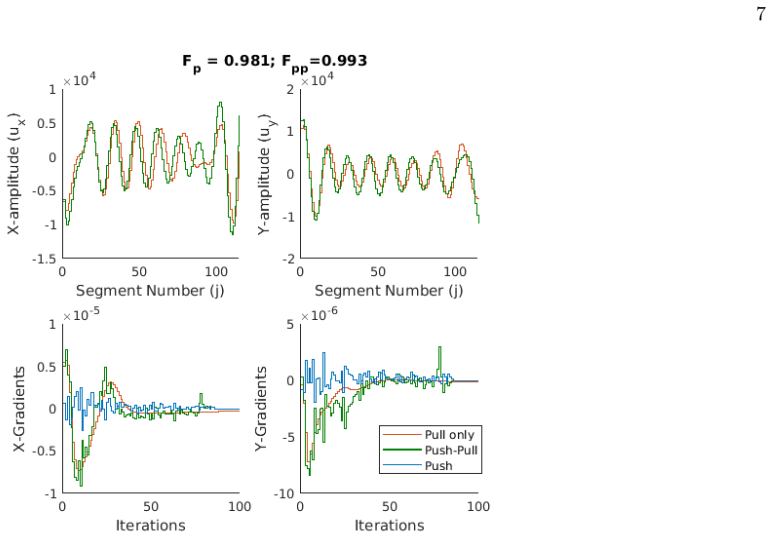
The load-bearing object is the push-pull performance function $J_{\mathrm{PP}} = F - \alpha F_o - \sum_k \lambda_k r_k$: the target fidelity $F$ pulls the search toward the target, while $F_o$, the mean fidelity to $L \le d-1$ orthogonal operators, pushes the search away from directions orthogonal to it. In GRAPE this enters by replacing the gradient with $G = g(U_t) - (\alpha/L)\sum_l g(V_l)$; in Krotov it enters through extra co-sequences and terminal Lagrange multipliers for each orthogonal operator. The argument is carried by this gradient modulation, which the supplement shows varying more rapidly than in pull-only runs.
What would settle it
Fix $L$ and $\alpha$ before the runs and average the final fidelity over many randomly drawn orthogonal-operator sets; if the mean no longer beats pull-only GRAPE and Krotov on the CNOT, singlet-transfer, and QFT tasks, the central claim fails. An 8-qubit QFT with $L=1$ would test whether the advantage survives further scaling.
Extended reading notes
Core claim
The central claim is that replacing the target-only objective with the push-pull performance function $J_{\mathrm{PP}} = F - \alpha F_o - \sum_k \lambda_k r_k$—where $F$ is the target fidelity and $F_o$ is the average fidelity to $L$ orthogonal operators that each have zero overlap with the target—makes quantum control optimization converge faster and to better solutions. The mechanism is a pull toward the target combined with a push away from the orthogonal operators, which the authors argue produces more thorough exploration of the parameter space. Numerically, PP-GRAPE and PP-Krotov beat their pull-only counterparts in mean final fidelity in every tested case, and an NMR experiment preparing long-lived singlet order used a 30% shorter sequence with 27% higher singlet order than the standard one.
Load-bearing premise
The load-bearing premise is that a small, randomly regenerated set of orthogonal operators, used with a fixed push weight, reliably improves optimization on every control task; the paper asserts this empirically after selecting the best operator-set size from the same runs, rather than proving it or cross-validating it.
Editorial extensions
If this is right
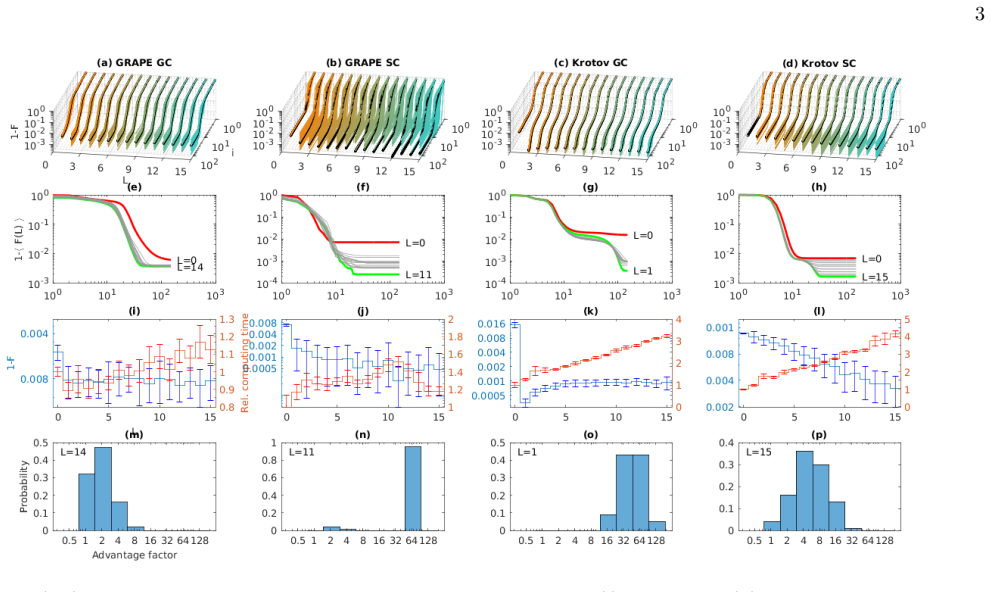
- Adding a push term to the performance function improves mean final fidelity over pull-only GRAPE and Krotov in every two-qubit case tested, with advantage factors up to 64.
- PPOQC can be added to both gradient-ascent and variational-principle routines; PP-GRAPE adds negligible computing time as $L$ grows, while PP-Krotov's time rises linearly.
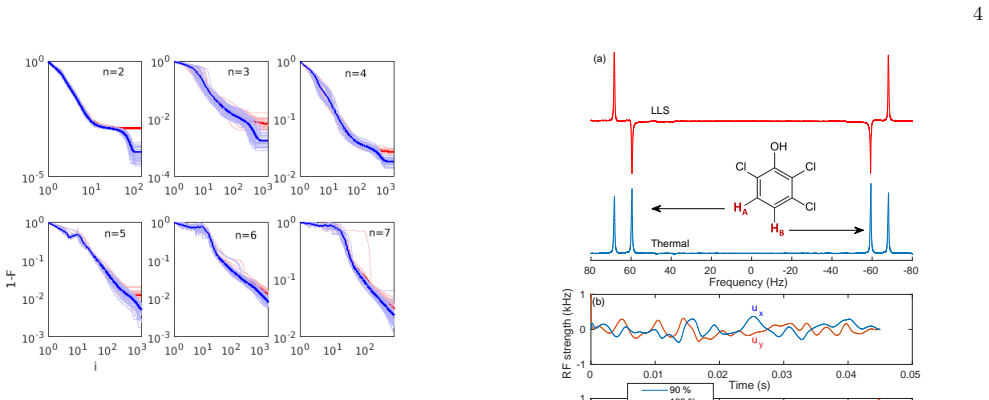
- The advantage persists for larger registers: a single PP-Krotov sequence implements an $n$-qubit quantum Fourier transform with $n$ up to 7.
- An experimental PP-Krotov sequence prepares long-lived singlet order in NMR with a 30% shorter pulse that yields 27% higher singlet order than the standard sequence and tolerates 10% RF inhomogeneity.
Reading between the lines
- Because the advantage factor is computed after picking $L_{\mathrm{best}}$ from the same runs and the push weight is scanned in the supplement, the reported gains are in-sample; averaging over pre-fixed $(L,\alpha)$ choices would give a fairer estimate.
- The push term behaves like an exploration regularizer that modulates gradients during the search, so PPOQC may also help in other settings where target-only gradients stall, such as open-system control and gate compilation.
- A natural testable extension is an adaptive push weight $\alpha(i)$ that starts large to explore and decays toward zero; if such a schedule preserves the gains, sensitivity to the fixed value $\alpha=0.2$ would no longer matter.
Signed reviews
Editorial analysis
A structured set of objections, weighed in public.
Referee Report
Summary. The paper proposes 'push-pull optimization of quantum controls' (PPOQC), a modification of the standard quantum optimal-control objective that adds a penalty term depending on a set of operators orthogonal to the target. The combined objective is JPP = F - alpha Fo - sum lambda_k r_k (Eq. 5), where Fo is the average fidelity to L orthogonal operators (V_l for gate control, R_l for state control). The authors show how to incorporate this objective into GRAPE, giving PP-GRAPE via modified gradients (Eq. 7), and into Krotov's method, giving PP-Krotov via a revised update rule (Eq. 14). They report numerical results for two-qubit CNOT and singlet-state transfer (Fig. 2), for quantum Fourier transforms on up to seven qubits (Fig. 3), and an NMR demonstration preparing long-lived singlet order in 2,3,6-trichlorophenol with a pulse sequence that is 30% shorter and yields 27% higher singlet order than the standard method (Fig. 4). The central claim is that the push-pull objective leads to faster convergence, better exploration of parameter space, and higher final fidelities than standard pull-only algorithms.
Significance. If the central claim holds, the paper offers a simple and potentially general modification to two widely used quantum-control optimization routines, with large reported improvements (in some cases two orders of magnitude in infidelity) and a concrete experimental demonstration. The strength of the manuscript lies in the transparent definition of the push-pull objective, the explicit incorporation into GRAPE and Krotov frameworks, the broad numerical evidence up to seven qubits, and the experimental verification of a PP-Krotov state-control sequence. The paper also honestly shows that the computational overhead of PP-Krotov grows linearly in L and that the advantage factor varies by task. However, the manuscript does not provide machine-checked proofs or reproducible code, and the PP-Krotov update is introduced without a derivation from the stated objective. The reported advantage factors are computed after selecting Lbest on the same test problems, and the push weight alpha is tuned on the same suite, so the out-of-sample predictive content of the numerical claims is not yet established.
major comments (4)
- [Push-pull Krotov (PP-Krotov), Eq. (14)] The update rule in Eq. (14) is not derived from the variational principle applied to the stated objective JPP in Eq. (5). For a Krotov maximization of the combined terminal objective F - alpha Fo, the terminal costate should be the single combined boundary B_N = <Ut|U0:N>Ut - (alpha/L) sum_l <Vl|U0:N>Vl for gate control, and the first-order update should have the form of Eq. (11) with this combined boundary. Instead, Eq. (14) appends an extra term containing ~v_{jkl}, which is defined in terms of the same u^{(i)}_{jk} being updated, so the equation is implicit and the paper does not explain how it is solved or iterated. Since PP-Krotov supplies much of the numerical evidence (Figs. 2e-h and 3) and the experimental demonstration (Fig. 4), the central claim requires either a derivation of Eq. (14) from a well-defined Lagrangian/costate system or a precise statement of the actually implemented iteration together with a proof or numerical check that it optimizes (or at least monotonically improves) JPP.
- [Introduction and Numerical analysis] The text states that the set of orthogonal operators 'can be generated randomly and efficiently in every iteration,' but the numerical experiments do not specify whether {V_l} (or {R_l}) is fixed during a given optimization run or regenerated at each iteration. If the set is regenerated during the run, the objective JPP itself changes from iteration to iteration, so the comparison with pull-only methods is not a comparison against a well-defined fixed objective. If the set is fixed, that should be stated explicitly. This ambiguity affects the interpretation of the convergence curves in Figs. 2 and 3 and should be resolved before the numerical superiority claim can be assessed.
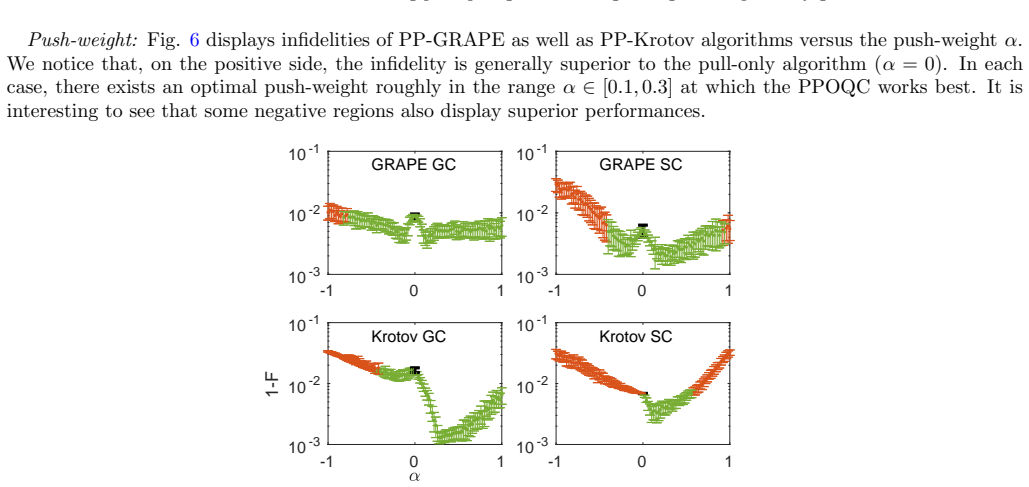
- [Numerical analysis, Fig. 2(m-p), and Supplementary Fig. 6] The advantage factor is defined as (1-F(L=0))/(1-F(Lbest)) with Lbest chosen as the set giving the maximum mean final fidelity on the same test problems, and the push weight is fixed at alpha=0.2 after a scan over alpha reported in Supplementary Fig. 6. These selections are made in-sample on the very problems used for the comparison, so the reported gains (up to a factor of 64) may reflect favorable selection rather than a general property of the method. To support the claim that push-pull optimization is superior, the authors should either use a predetermined rule for alpha and L (for example, a fixed small L and alpha in [0.1, 0.3]) or report hold-out/cross-validated performance on problems not used for tuning.
- [Numerical analysis and Experimental demonstration] No code, data, or complete parameter sets (for example, the values of epsilon, delta, eta, kappa, penalty constants lambda_k, and the initial-guess generation protocol) are provided, and the NMR pulse sequence is shown only graphically. Because the central claim rests on numerical comparisons and the experimental demonstration depends on a specific implementation of Eq. (14), the absence of these details prevents independent verification of the results. The authors should make the code and data available or, at minimum, provide full parameter tables and a precise algorithmic pseudocode for both PP-GRAPE and PP-Krotov.
minor comments (6)
- [Eq. (5) and Introduction] The push weight alpha is restricted to -1 <= alpha <= 1, but the text does not explain why negative values are allowed or what a negative push weight would mean dynamically; this deserves a brief comment.
- [Krotov optimization, Eqs. (8)-(12)] The notation in the Krotov section is confusing: the performance function is J but the Lagrangian is denoted L, and the stationarity condition 'partial L / partial F = 0' mixes the functional and a variable; defining the variational derivative clearly would improve readability.
- [Supplementary Fig. 7] The caption contains the typo 'Eovlution' (should be 'Evolution'), and the figure itself is visually dense; labeling the panels and axes more explicitly would help.
- [References] Reference [9] is cited as 'eMagRes (2007)' without volume or article identifier, which is incomplete by journal standards.
- [Supplementary Material, 'A naive model'] The Bloch-sphere model is presented as a heuristic hint rather than a derivation; this is acceptable, but the text should explicitly caution that the model uses an instantaneous state and does not capture the full feedback dynamics of the optimization.
- [Experimental section, Fig. 4] The comparison with the 'standard method' (Ref. [35]) reports a 27% higher singlet order and a 30% shorter sequence, but the standard pulse shape and its fidelity under the same RF inhomogeneity are not shown; a quantitative side-by-side comparison would strengthen the experimental claim.
Circularity Check
No significant circularity: the push-pull objective is defined up front, the GRAPE gradient follows algebraically from that objective, and the reported gains are empirical comparisons rather than conclusions forced by construction.
full rationale
The paper's central derivation is the PP-GRAPE gradient (Eq. 7), which follows directly from the push-pull performance function JPP = F - alpha Fo - sum lambda r (Eq. 5) by linearity: since Fo is the average fidelity to the orthogonal operators, the gradient is g(Ut) - (alpha/L) sum_l g(Vl). This is an algebraic consequence of the stated objective, not a circular reduction. The PP-Krotov update rule (Eq. 14) is asserted rather than derived from the stated variational principle, and it contains a self-referential co-sequence construction; however, this is a correctness or completeness gap in the derivation, not circularity, because the algorithm's performance is still an empirical outcome that could in principle fail. The reported advantage factors are computed after selecting Lbest as the L with maximum mean final fidelity and after scanning alpha in the supplement, so the numerical gains are optimistic hyperparameter-selected results rather than out-of-sample predictions. This is a selection-bias concern, not a circularity concern: the advantage is not enforced by the definition of the objective or by any fitted parameter being renamed as a prediction. The paper does not invoke any load-bearing self-citation, uniqueness theorem imported from the authors' prior work, or ansatz smuggled in via citation. Every comparison with pull-only GRAPE/Krotov is an empirical benchmark on the same control tasks, so the central claim retains independent content. The main risks are the unverified derivation of PP-Krotov and the lack of cross-validation for alpha and Lbest, but these fall under correctness and robustness rather than circularity. No circular step meeting the evidentiary standard could be identified, so the circularity score is 0.
Assumptions & free parameters
free parameters (4)
- push weight alpha =
0.2 in main simulations; scanned over [-1, 1] in Supplement Fig. 6
- orthogonal-set size L =
Lbest per task, selected from L in [1, 15]
- penalty constants lambda_k =
not specified in text
- algorithm hyperparameters (epsilon, delta, eta, kappa) =
not fully specified
assumptions (5)
- standard math The Hilbert-Schmidt overlap defines a valid inner product on operators, so target-orthogonal operators can be constructed and fidelities F are in [0, 1].
- domain assumption The system evolves unitarily under piecewise-constant controls, with segment propagators U_j = exp(-i H_j tau).
- ad hoc to paper A small, randomly generated subset of orthogonal operators provides a useful pushing direction that improves convergence.
- domain assumption The Krotov Lagrangian and Lagrange-multiplier formalism remain valid for the revised push-pull update rule in Eq. 14.
- domain assumption The high-temperature, high-field approximation rho0 = I_Az + I_Bz describes the thermal NMR state of the two-proton system.
Cite this review
Pith. "Pith review of Push-Pull Optimization of Quantum Controls." pith.science (2026). https://pith.science/paper/BCMTAGQK
@misc{pith2026190806283,
  author       = {Pith},
  title        = {Pith review of: Push-Pull Optimization of Quantum Controls},
  year         = {2026},
  howpublished = {\url{https://pith.science/paper/BCMTAGQK}},
  note         = {Machine review of arXiv:1908.06283}
}
abstract
Quantum optimal control involves setting up an objective function that evaluates the quality of an operator representing the realized process w.r.t. the target process. Here we propose a stronger objective function which incorporates not only the target operator but also a set of its orthogonal operators. We find significantly superior convergence of optimization routines with the combined influences of all the operators. We refer to this method as the $\textit{push-pull}$ optimization. In particular, we describe adopting the push-pull optimization to a gradient based approach and a variational-principle based approach. We carry out extensive numerical simulations of the push-pull optimization of quantum controls on a pair of Ising coupled qubits. Finally, we demonstrate its experimental application by preparing a long-lived singlet-order in a two-qubit system using NMR techniques.
Figures

Figures from the paper (4 more)


Reference graph
Works this paper leans on
-
[1]
A. E. Bryson, Applied optimal control: optimization, es- timation and control (Routledge, 2018)
work page 2018
-
[2]
In each case, we use a fixed set of one hundred random guess-sequences. PP-GRAPE and PP-Krotov algorithms were run for var- ious sizes of orthogonal sets (L∈ [1, 15] with push weight α = 0.2) and compared with the pull-only (L = 0) results (Fig. 2(a-d)). PPOQC outperformed the pull-only algo- rithms in terms of the mean final fidelity in all the cases (Fig. ...
work page 2012
-
[3]
J. Werschnik and E. Gross, Journal of Physics B: Atomic, Molecular and Optical Physics 40, R175 (2007)
work page 2007
-
[4]
L. S. Pontryagin, Mathematical theory of optimal pro- cesses (Routledge, 2018)
work page 2018
-
[5]
P. Brumer and M. Shapiro, Accounts of Chemical Re- search 22, 407 (1989)
work page 1989
-
[6]
D. Dong and I. R. Petersen, IET Control Theory & Ap- plications 4, 2651 (2010)
work page 2010
-
[7]
D. J. Tannor and S. A. Rice, The Journal of chemical physics 83, 5013 (1985)
work page 1985
- [8]
Show all 38 references
-
[9]
To setup the co-sequence {~u(i) jk} we first evaluate the 3 FIG. 2. (a-d) Infidelity 1 −F of two-qubit controls versus iteration number ( i) and number (L) of orthogonal operators for GRAPE and Krotov as indicated. Black lines represent mean infidelities. (e-h) Mean infidelity ver...
-
[10]
W. Zhu, J. Botina, and H. Rabitz, The Journal of Chem- ical Physics 108, 1953 (1998)
1998
-
[11]
N. C. Nielsen, C. Kehlet, S. J. Glaser, and N. Khaneja, eMagRes (2007)
2007
-
[12]
J. P. Palao and R. Kosloff, Physical review letters 89, 188301 (2002)
2002
-
[13]
Doria, T
P. Doria, T. Calarco, and S. Montangero, Physical re- view letters 106, 190501 (2011)
2011
-
[14]
E. M. Fortunato, M. A. Pravia, N. Boulant, G. Tekle- mariam, T. F. Havel, and D. G. Cory, The Journal of chemical physics 116, 7599 (2002)
2002
-
[15]
Khaneja, T
N. Khaneja, T. Reiss, C. Kehlet, T. Schulte-Herbr¨ uggen, and S. J. Glaser, Journal of magnetic resonance 172, 296 (2005)
2005
-
[16]
De Fouquieres, S
P. De Fouquieres, S. Schirmer, S. Glaser, and I. Kuprov, Journal of Magnetic Resonance 212, 412 (2011)
2011
-
[17]
Machnes, E
S. Machnes, E. Ass´ emat, D. Tannor, and F. K. Wilhelm, Physical review letters 120, 150401 (2018)
2018
-
[18]
Krotov, in Doklady Mathematics , Vol
V. Krotov, in Doklady Mathematics , Vol. 78 (Springer,
-
[19]
I. I. Maximov, Z. Toˇ sner, and N. C. Nielsen, The Journal of Chemical Physics 128, 05B609 (2008)
2008
-
[20]
D. M. Reich, M. Ndong, and C. P. Koch, The Journal of chemical physics 136, 104103 (2012)
2012
-
[21]
Caneva, T
T. Caneva, T. Calarco, and S. Montangero, Physical Review A 84, 022326 (2011)
2011
-
[22]
Sørensen, M
J. Sørensen, M. Aranburu, T. Heinzel, and J. Sherson, Physical Review A 98, 022119 (2018)
2018
-
[23]
Bhole, V
G. Bhole, V. Anjusha, and T. Mahesh, Physical Review A 93, 042339 (2016)
2016
-
[24]
Khurana and T
D. Khurana and T. Mahesh, Journal of Magnetic Reso- nance 284, 8 (2017)
2017
-
[25]
C. Chen, D. Dong, H.-X. Li, J. Chu, and T.-J. Tarn, IEEE transactions on neural networks and learning sys- tems 25, 920 (2013)
2013
-
[26]
Zhang, Z
X.-M. Zhang, Z. Wei, R. Asad, X.-C. Yang, and X. Wang, arXiv preprint arXiv:1902.02157 (2019)
2019 arXiv
-
[27]
L. M. Vandersypen and I. L. Chuang, Reviews of modern physics 76, 1037 (2005)
2005
-
[28]
Dolde, V
F. Dolde, V. Bergholm, Y. Wang, I. Jakobi, B. Nayde- nov, S. Pezzagna, J. Meijer, F. Jelezko, P. Neumann, T. Schulte-Herbr¨ uggen,et al., Nature communications 5, 3371 (2014)
2014
-
[29]
Singer, U
K. Singer, U. Poschinger, M. Murphy, P. Ivanov, F. Ziesel, T. Calarco, and F. Schmidt-Kaler, Reviews of Modern Physics 82, 2609 (2010)
2010
-
[30]
Shim and C
Y.-P. Shim and C. Tahan, Nature communications 7, 11059 (2016)
2016
-
[31]
M. S. Vinding, I. I. Maximov, Z. Toˇ sner, and N. C. Nielsen, The Journal of chemical physics 137, 054203 (2012)
2012
-
[32]
Chakrabarti and H
R. Chakrabarti and H. Rabitz, International Reviews in Physical Chemistry 26, 671 (2007)
2007
-
[33]
A. N. Pechen and D. J. Tannor, Physical review letters 106, 120402 (2011)
2011
-
[34]
Shankar, Principles of quantum mechanics (Springer Science & Business Media, 2012)
R. Shankar, Principles of quantum mechanics (Springer Science & Business Media, 2012)
2012
-
[35]
Krotov, Global methods in optimal control theory , Vol
V. Krotov, Global methods in optimal control theory , Vol. 195 (CRC Press, 1995)
1995
-
[36]
Carravetta, O
M. Carravetta, O. G. Johannessen, and M. H. Levitt, Physical review letters 92, 153003 (2004)
2004
-
[37]
Carravetta and M
M. Carravetta and M. H. Levitt, Journal of the American Chemical Society 126, 6228 (2004)
2004
-
[38]
Pileio, Progress in nuclear magnetic resonance spec- troscopy 98, 1 (2017)
G. Pileio, Progress in nuclear magnetic resonance spec- troscopy 98, 1 (2017). 6 SUPPLEMENT AL INFORMA TION A naive model: Consider a single qubit state control problem with target being the pure state ρt = (1 +σy)/2 and its orthogonal state beingρ⊥ = (1 +σx)/2. Consider an in...
2017
Reviewed August 14, 2026 · model on record in the stance chip above.
Discussion (0). Continue with ORCID to comment.