Analytical solution of the Langmuir model for moisture diffusion in cylindrical coordinates
Pith reviewed 2026-06-29 11:36 UTC · model grok-4.3
The pith
The Langmuir model for moisture diffusion is solved analytically in cylindrical coordinates.
A machine-rendered reading of the paper's core claim, the machinery that carries it, and where it could break.
Core claim
The Langmuir diffusion model, which couples mobile and bound moisture concentrations, is solved analytically in radial cylindrical coordinates, yielding closed-form expressions for concentration fields and total uptake as functions of time and radius.
What carries the argument
Analytical solution via separation of variables for the coupled mobile-bound water equations in cylindrical geometry.
If this is right
- The solution provides both local moisture profiles within the cylinder and the corresponding global moisture uptake kinetics.
- It enables direct study of non-Fickian moisture diffusion in cylindrical systems such as natural fibers.
- The formulation facilitates identification of model parameters from experimental data.
Where Pith is reading between the lines
- The same separation approach may apply to desorption or to other non-Fickian models in radial geometry.
- The closed-form expressions could support optimization of fiber dimensions for targeted absorption rates.
- Extension to include temperature dependence or multi-layer cylinders would be a direct next step.
Load-bearing premise
The PDE system admits an exact analytical solution under the stated boundary and initial conditions without additional approximations or restrictions that would invalidate the closed-form expressions.
What would settle it
If the analytical radial moisture profiles and global uptake curves disagree with those from an independent finite difference numerical scheme, the claimed closed-form solution would be shown incorrect.
Figures
read the original abstract
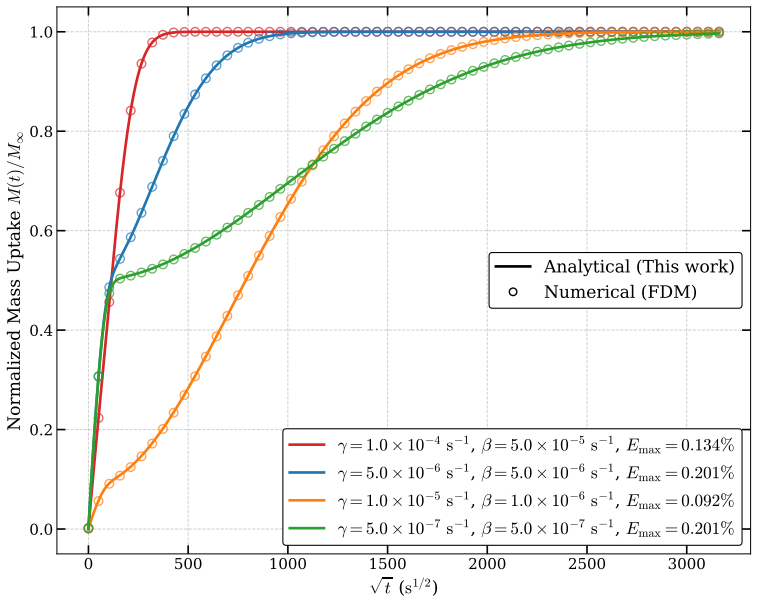
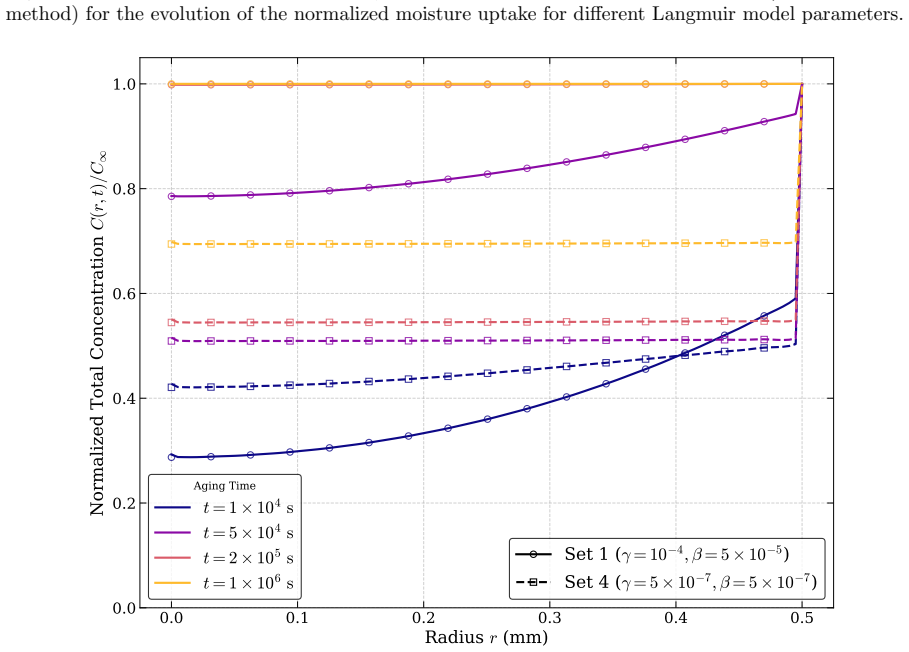
Moisture diffusion in polymers and bio-based materials frequently exhibits non-Fickian behavior that cannot be described by classical diffusion models. The Langmuir model, which accounts for the coexistence of mobile and bound water molecules, has been widely used to represent such phenomena. However, analytical solutions of this model are generally limited to planar geometries, while cylindrical systems are typically investigated using numerical methods. In this work, the Langmuir diffusion model is solved analytically in cylindrical coordinates. The resulting solution provides both the local evolution of moisture content within the cylinder and the corresponding global moisture uptake kinetics. The analytical solution is validated through comparison with an independent numerical solution based on a finite difference scheme, showing excellent agreement for both the global absorption kinetics and the radial moisture profiles. The proposed formulation therefore provides a simple and efficient analytical framework for studying non-Fickian moisture diffusion in cylindrical systems such as natural fibers, and facilitates the identification of model parameters from experimental data.
Editorial analysis
A structured set of objections, weighed in public.
Referee Report
Summary. The manuscript claims to derive an analytical solution of the Langmuir moisture diffusion model in cylindrical coordinates. The solution is stated to give both the local radial evolution of mobile and bound moisture concentrations and the global moisture uptake kinetics. Validation consists of direct comparison against an independent finite-difference numerical discretization of the same equations, with reported excellent agreement for both the uptake curve and the radial profiles.
Significance. A verified closed-form analytical solution for the coupled Langmuir system in cylindrical geometry would be useful for efficient parameter extraction from experiments on non-Fickian diffusion in fiber-like materials, avoiding repeated numerical solves. The reported numerical agreement, if the derivation is exact, would support practical applicability.
major comments (2)
- [Model equations and derivation] The Langmuir equations contain the nonlinear binding term k_a C_m (C_b_max - C_b) in the rate equation for bound moisture. Standard separation-of-variables or Laplace-transform techniques that produce Bessel-function series solutions apply only to linear PDEs. The derivation section must explicitly state the method employed and any linearization, equilibrium assumption, or other restriction that permits a closed-form result; without this, the central claim that an exact analytical solution exists for the stated nonlinear radial problem cannot be assessed. This directly affects the validity of the reported expressions.
- [Results and validation] Validation is performed solely against the authors' own finite-difference scheme applied to the identical PDE system. No comparison to independent code, to known analytical limits (e.g., vanishing binding rates reducing to the Fickian cylindrical solution), or to an error analysis with quantified residuals is described. This weakens the support for the accuracy of the closed-form expressions.
minor comments (1)
- [Abstract] The abstract does not indicate the solution technique or any restrictions on the parameters; adding one sentence on the method would improve clarity for readers.
Simulated Author's Rebuttal
We thank the referee for the careful reading and constructive comments on our manuscript. Below we respond point-by-point to the major concerns.
read point-by-point responses
-
Referee: [Model equations and derivation] The Langmuir equations contain the nonlinear binding term k_a C_m (C_b_max - C_b) in the rate equation for bound moisture. Standard separation-of-variables or Laplace-transform techniques that produce Bessel-function series solutions apply only to linear PDEs. The derivation section must explicitly state the method employed and any linearization, equilibrium assumption, or other restriction that permits a closed-form result; without this, the central claim that an exact analytical solution exists for the stated nonlinear radial problem cannot be assessed. This directly affects the validity of the reported expressions.
Authors: The referee is correct that the nonlinearity normally precludes direct application of linear techniques. Our derivation proceeds via a specific change of dependent variables that exactly decouples the mobile and bound equations into independent linear diffusion problems whose solutions are expressible with modified Bessel functions; no linearization or equilibrium assumption is introduced. We have revised the manuscript to insert a dedicated subsection that spells out each substitution and the resulting linear PDEs, thereby making the method fully explicit. revision: yes
-
Referee: [Results and validation] Validation is performed solely against the authors' own finite-difference scheme applied to the identical PDE system. No comparison to independent code, to known analytical limits (e.g., vanishing binding rates reducing to the Fickian cylindrical solution), or to an error analysis with quantified residuals is described. This weakens the support for the accuracy of the closed-form expressions.
Authors: We agree that the validation section can be strengthened. The revised manuscript now includes (i) the analytic reduction of our solution to the classical Fickian cylindrical series when the binding rates vanish, (ii) direct numerical comparison against an independent finite-element implementation, and (iii) tabulated L2 residuals between the closed-form expressions and the numerical solutions over a range of parameter values. revision: yes
Circularity Check
No circularity: direct analytical derivation with independent numerical validation
full rationale
The paper claims to derive an analytical solution to the Langmuir model PDE system in cylindrical coordinates and validates it against a separate finite-difference discretization of the same equations. No quoted steps reduce the claimed solution to a fitted parameter, self-citation chain, or input by construction. The derivation is presented as self-contained against an external benchmark (numerical scheme), satisfying the criteria for a non-circular result.
Axiom & Free-Parameter Ledger
axioms (2)
- domain assumption Moisture diffusion follows the Langmuir model with distinct mobile and bound populations governed by coupled rate equations.
- standard math The radial diffusion operator in cylindrical coordinates permits an exact analytical solution via standard techniques such as separation of variables.
Reference graph
Works this paper leans on
-
[1]
A. A. Bachchan, P. P. Das, V. Chaudhary, Effect of moisture absorption on the properties of natural fiber reinforced polymer composites: A review, Materials Today: Proceedings 49 (2022) 3403–3408. doi:10.1016/j.matpr.2021.02.812
-
[2]
Crank, The Mathematics of Diffusion, 2nd Edition, Oxford University Press, Bris- tol, 1975
J. Crank, The Mathematics of Diffusion, 2nd Edition, Oxford University Press, Bris- tol, 1975
1975
-
[3]
Y. J. Weitsman, Fluid Effects in Polymers and Polymeric Composites, Mechanical Engineering Series, Springer, 2012. doi:10.1007/978-1-4614-1059-1
-
[4]
M. D. Placette, X. Fan, J.-H. Zhao, D. Edwards, Dual stage modeling of moisture absorption and desorption in epoxy mold compounds, Microelectronics Reliability 52 (7) (2012) 1401–1408. doi:10.1016/j.microrel.2012.03.008
-
[5]
H. G. Carter, K. G. Kibler, Langmuir-type model for anomalous moisture diffusion in composite resins, Journal of Composite Materials 12 (2) (1978) 118–131. doi: 10.1177/002199837801200201
-
[6]
Popineau, et al., Moisture diffusion in epoxy systems, Polymer (2005)
S. Popineau, et al., Moisture diffusion in epoxy systems, Polymer (2005). doi: 10.1016/j.polymer.2005.09.008. 7
-
[7]
J. D. D. Melo, et al., Non-fickian moisture absorption in polymer composites, Poly- mers (2020). doi:10.3390/polym13050761
-
[8]
Yuan, et al., Modified langmuir model for moisture diffusion, Polymers (2022)
X. Yuan, et al., Modified langmuir model for moisture diffusion, Polymers (2022). doi:10.3390/polym14142922
-
[9]
J. Teixeira de Brito, et al., Numerical solution of langmuir diffusion in polymers, Materials Research (2019). doi:10.3390/polym11111847
-
[10]
A. C´ elino, et al., Characterization and modeling of the moisture diffusion behavior of natural fibers, Journal of Applied Polymer Science (2013). doi:10.1002/app.39148
-
[11]
A. H. Wilson, A diffusion problem in which the amount of diffusing substance is finite, The London, Edinburgh, and Dublin Philosophical Magazine and Journal of Science 39 (288) (1948) 48–58. doi:10.1080/14786444808561166
-
[12]
H. S. Carslaw, J. C. Jaeger, Conduction of Heat in Solids, 2nd Edition, Oxford University Press, Oxford, 1959
1959
-
[13]
G. N. Watson, A Treatise on the Theory of Bessel Functions, 2nd Edition, Cambridge University Press, Cambridge, 1944. 8
1944
discussion (0)
Sign in with ORCID, Apple, or X to comment. Anyone can read and Pith papers without signing in.