REVIEW 2 major objections 5 minor 45 references
A non-monotonic spatial reparametrization turns exact soliton solutions of shifted nonlocal NLS and MKdV equations into loop-type folded wave profiles without changing the underlying PDE solutions.
Reviewed by Pith at T0; open to challenge. T0 means a machine referee read the full paper against a public rubric. the ladder, T0–T4 →
T0 review · grok-4.5
2026-07-14 08:38 UTC pith:BDCVYGNY
load-bearing objection Clean geometric reparametrization of the author's prior solitons; elementary, correctly executed, and modest in novelty and significance. the 2 major comments →
Loop-type geometric folding of exact solutions of shifted nonlocal NLS and MKdV equations
The pith
A machine-rendered reading of the paper's core claim, the machinery that carries it, and where it could break.
Core claim
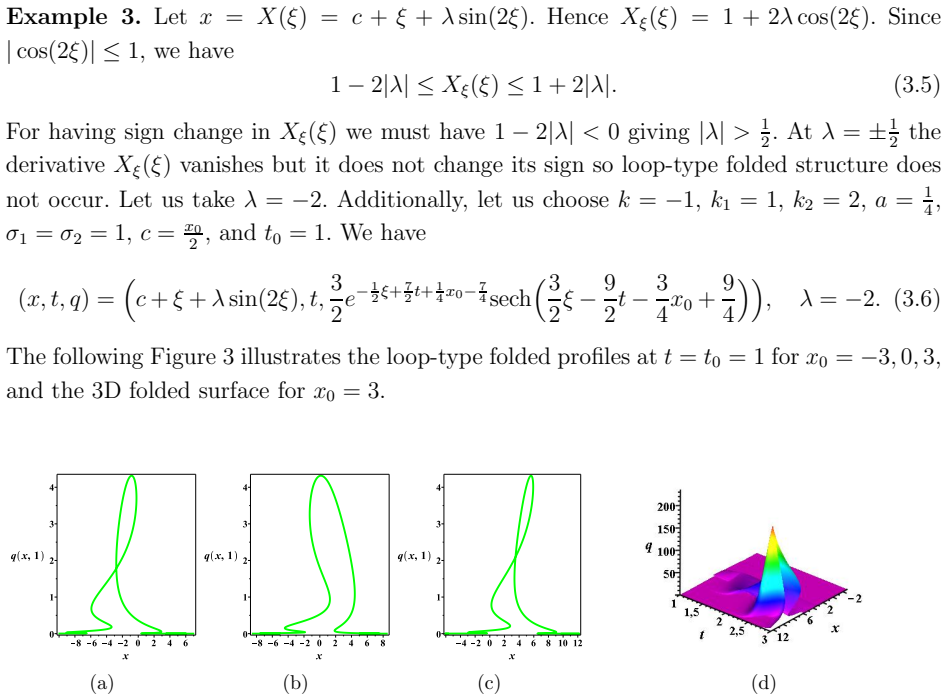
Whenever the spatial folding map X(ξ) = c + ξ + λ F(ξ) has a derivative that changes sign on an interval, the parametric surface (X(ξ), t, q(ξ, t)) built from an exact soliton solution q of a shifted nonlocal NLS or MKdV equation is non-injective and therefore exhibits a loop-type folded profile. The folding affects only the spatial parametrization; the underlying exact solution of the original equation is left unchanged. Suitable choices of the deformation function F and of the soliton and shift parameters generate regular loops, oscillating folds or singular structures.
What carries the argument
The folding map X(ξ) = c + ξ + λ F(ξ) together with the elementary sign-change criterion on X_ξ: if the continuous derivative changes sign then X is non-injective and the parametric graph (X(ξ), t, q(ξ, t)) is a loop-type folded profile.
Load-bearing premise
The paper treats a purely geometric reparametrization of the spatial coordinate as a meaningful framework for the shifted nonlocal equations even though the resulting folded graphs are explicitly not new solutions of those equations.
What would settle it
Take any concrete one-soliton solution listed in the paper, apply a folding map whose derivative never changes sign (for example |λ| small enough that X_ξ stays positive), and check whether a loop still appears; if a multi-valued profile forms without a sign change, the sufficient condition fails.
If this is right
- Any exact solution of a shifted nonlocal NLS or MKdV equation can be turned into a multi-valued geometric profile by a non-monotonic spatial reparametrization.
- The same elementary sign-change test applies uniformly to one-soliton and two-soliton solutions and to both real and complex shifted reductions.
- Deformation parameters (amplitude, frequency, localization) control the number, size and visibility of loops independently of the soliton parameters.
- Solution parameters can select regular, oscillatory or singular folded profiles from the same two-soliton formula.
- The construction extends immediately to other shifted nonlocal models that already possess explicit exact solutions.
Where Pith is reading between the lines
- Rewriting the original PDE in the new parameter ξ would produce a variable-coefficient or singular equation whose solutions are precisely the folded graphs; that deformed equation is left for future work but is the natural next object.
- The same non-monotonic maps could be applied to breathers, rogue waves or higher-order solitons already known for these equations, yielding a catalogue of folded multi-soliton geometries.
- Because the folding is purely geometric, the same technique applies to any (1+1)-dimensional wave equation that possesses an explicit solution, not only to the integrable shifted nonlocal family.
Editorial analysis
A structured set of objections, weighed in public.
Referee Report
Summary. The paper proposes a simplified geometric construction of loop-type folded profiles for exact one- and two-soliton solutions of several shifted nonlocal NLS and MKdV equations previously obtained by the author. Starting from a known solution q(x,t), a non-monotonic spatial reparametrization x=X(ξ)=c+ξ+λF(ξ) is introduced; Proposition 2.1 states that a sign change of X_ξ is sufficient for non-injectivity of X and hence for a multi-valued parametric graph (X(ξ),t,q(ξ,t)). Explicit examples with hyperbolic, trigonometric, Jacobi elliptic and localized oscillatory folding maps are plotted for the real and complex shifted reductions, and the influence of the folding amplitude λ, the internal parameters of F, and the soliton parameters (k_j, δ_j, x_0, t_0) on the resulting regular, oscillating or singular loop geometries is illustrated. The author repeatedly emphasizes that the construction does not produce new solutions of the original PDEs, only geometric reparametrizations of already-known exact solutions.
Significance. The technical content is elementary real analysis applied to previously published soliton formulas; the resulting multi-valued graphs are correctly generated once the sign-change criterion is met. The work is carefully scoped: it does not claim new PDE solutions, and it distinguishes the pure reparametrization (X(ξ),q(ξ,t)) from the alternative that inserts X into the argument of q. Within the foldon literature the construction is a modest, transparent extension from (2+1)-dimensional variable-separation methods to (1+1)-dimensional shifted nonlocal equations. Its main value is illustrative and pedagogical rather than foundational; it supplies a concrete catalogue of how different folding maps and soliton parameters shape loop geometries, which may be of interest to readers working on geometric representations of nonlocal waves.
major comments (2)
- The central claim is only that a sign-changing X_ξ produces multi-valued graphs of already-known solutions. While Proposition 2.1 is correct, the manuscript never supplies a dynamical or physical reason why these particular reparametrizations are natural for the shifted nonlocal equations themselves (beyond the formal analogy with foldons). Section 5 sketches a possible future derivation of deformed PDEs in the ξ-variable, but that step is left entirely open; without it the present work remains a collection of parametric plots rather than a framework that interacts with the nonlocal structure. A short, concrete illustration of how the original equation transforms under x=X(ξ) (even for one simple F) would substantially strengthen the claim that the construction is more than pure geometry.
- All soliton formulas are imported from Ref. [21] without re-derivation or independent verification. For the two-soliton case (Example 7) the explicit expression for |q|^{2} is omitted “due to complexity,” so the singular profile in Fig. 9(c) cannot be checked by the reader. At minimum the denominator zeros that produce the singularity should be stated analytically, and a reproducible notebook or supplementary file containing the plotted expressions should be provided.
minor comments (5)
- Abstract and Introduction: “foldon” is used without a precise definition; a one-sentence reminder that foldons are elastic multi-valued localized structures would help non-specialists.
- Eq. (2.1) and subsequent examples: the centering choice c=x_0/2 is stated only for space-shifted reductions; a uniform statement covering the free-c cases would avoid ambiguity.
- Figures 1–10: axis labels and color scales are missing or low-resolution in the arXiv rendering; vector graphics or higher-resolution panels would improve readability.
- Typographical: “frame work” (Abstract), “profiles” (throughout), and occasional missing spaces after punctuation should be corrected.
- References [25]–[30] on biological/physical folding are cited only for motivation; a brief remark on whether any of those systems are modeled by the shifted nonlocal equations would clarify the intended physical link.
Circularity Check
No significant circularity: elementary non-injectivity of a C1 map applied to independently obtained soliton solutions yields multi-valued graphs by construction, with transparent self-citation of prior solutions only as inputs.
specific steps
-
self citation load bearing
[Section 3 opening paragraph and Eqs. (3.1)–(3.16); also Section 4 Eq. (4.1)]
"In this part we shall use the one-soliton solutions of the shifted nonlocal NLS equations (1.3)–(1.7) and the shifted nonlocal MKdV equations (1.10)–(1.13) by Type 1 and Type 2 approaches obtained in [21]."
The explicit soliton formulas that are subsequently folded are taken entirely from the author's own prior paper [21]. While the folding step itself is independent, the concrete profiles shown in all figures rest on this self-citation; the circularity is minor because [21] supplies only the input functions, not the geometric claim.
full rationale
The paper's central derivation is Proposition 2.1 (Section 2): if X_ξ = 1 + λ F'(ξ) changes sign on an interval then X is non-injective, so the parametric graph (X(ξ), t, q(ξ, t)) is multi-valued (loop-type). This is a direct quotation of a standard elementary-analysis fact (cited to Rudin) and does not depend on any fitted quantity, uniqueness theorem, or ansatz smuggled from the author's prior work. All explicit one- and two-soliton formulas (Eqs. (3.1), (3.4), (3.7), (3.11), (3.16), (4.1)) are imported from the author's earlier paper [21] via Type-1/Type-2 reductions of the AKNS system; those reductions are independent of the folding construction and are used only as fixed input functions q. The folding maps themselves (tanh, sin, sn, Gaussian-modulated cos, etc.) are chosen by hand and the paper repeatedly states (Abstract, Remark after Example 2, Conclusion) that the resulting graphs are geometric reparametrizations, not new solutions of the shifted nonlocal PDEs. No prediction is forced by a fit, no uniqueness is imported to forbid alternatives, and no known empirical pattern is merely renamed. The sole self-citation is therefore non-load-bearing for the claimed geometric framework, producing only a minor score of 1.
Axiom & Free-Parameter Ledger
free parameters (3)
- folding amplitude \lambda =
e.g. -2, -3, -6
- folding function F and its internal constants (m, \alpha, …)
- soliton wave numbers k_j, phases \delta_j, shift parameters x0,t0, coupling k
axioms (3)
- standard math If a C^{1} map X:I\to R has a derivative that changes sign on I, then X is non-injective (standard real analysis).
- domain assumption The one- and two-soliton formulas previously obtained by Type-1/Type-2 reductions of the coupled AKNS system under shifted nonlocal reductions are exact solutions of the listed shifted nonlocal NLS and MKdV equations.
- ad hoc to paper A parametric graph (X(\xi),t,q(\xi,t)) with non-injective X is a legitimate 'loop-type folded profile' of the original solution even though it does not satisfy the original PDE.
invented entities (1)
-
loop-type folded profile (via non-monotonic spatial reparametrization of a (1+1)-dimensional solution)
no independent evidence
read the original abstract
Based on the notion of foldon, we introduce a geometric framework for constructing folded parametric wave representations of exact solutions of some shifted nonlocal nonlinear Schr\"{o}dinger and modified Korteweg-de Vries equations. Unlike the method of constructing loops in $(2+1)$-dimensional integrable models based on universal variable separation approach or hodograph transformation, we consider a simplified geometric approach of constructing loop-type folded profiles via non-monotonic parametrization of the spatial coordinate associated with the exact solution of the $(1+1)$-dimensional shifted nonlocal equations. A sufficient condition under which folding takes place is provided in the form of sign change of the derivative of folding map. Applying one- and two-soliton solutions of various shifted nonlocal nonlinear Schr\"{o}dinger and modified Korteweg-de Vries equations found earlier, we show how different folding maps generate different loop-type folded profiles. In particular, we analyze the influence of deformation parameters and solution parameters on the geometry of folded waves. We show that the effect of the folding leads only to the modification of the spatial parametrization and generates various geometric structures like regular loop-type, oscillating-type, and singular-type folded profiles for certain values of parameters.
Figures




Reference graph
Works this paper leans on
-
[1]
M. J. Ablowitz and Z. H. Musslimani, Integrable nonlocal nonlinear S chr¨ odinger equation, Phys. Rev. Lett. 110, 064105, 2013
2013
-
[2]
M. J. Ablowitz and Z. H. Musslimani, Inverse scattering transfor m for the integrable nonlocal nonlinear Schr¨ odinger equation, Nonlinearity 29, 915–946, 2016
2016
-
[3]
M. J. Ablowitz and Z. H. Musslimani, Integrable nonlocal nonlinear e quations, Stud. Appl. Math. 139 (1), 7–59, 2016
2016
-
[4]
Ablowitz, B.F
M.J. Ablowitz, B.F. Feng, X.D. Luo, and Z.H. Musslimani, Inverse sca ttering transform for the nonlocal reverse space-time nonlinear Schr¨ odinger equa tion, Theor. Math. Phys. 196(3), 1241–1267, 2018
2018
-
[5]
A. S. Fokas, Integrable multidimensional versions of the nonloca l Schr¨ odinger equation, Nonlinearity 29, 319, 2016
2016
-
[6]
J. L. Ji and Z. N. Zhu, On a nonlocal modified Korteweg-de Vries e quation: Integrability, Darboux transformation and soliton solutions, Commun. Nonlinear S ci. Numer. Simulat. 42, 699, 2017
2017
-
[7]
J. L. Ji and Z. N. Zhu, Soliton solutions of an integrable nonlocal m odified Korteweg-de Vries equation through inverse scattering transform, J. Math. A nal. Appl. 453, 973, 2017
2017
-
[8]
V. S. Gerdjikov and A. Saxena, Complete integrability of nonlocal nonlinear Schr¨ odinger equation, J. Math. Phys. 58(1), 013502, 2017
2017
-
[9]
L. Y. Ma, S. F. Shen, and Z. N. Zhu, Soliton solution and gauge equ ivalence for an integrable nonlocal complex modified Korteweg-de Vries equation J. Math. Phys. 58, 103501, 2017
2017
-
[10]
B. F. Feng, X. D. Luo, M. J. Ablowitz, and Z. H. Musslimani, Gener al soliton solution to a nonlocal nonlinear Schr¨ odinger equation with zero and nonzer o boundary conditions, Nonlinearity 31(12), 5385–5409, 2018
2018
-
[11]
G¨ urses and A
M. G¨ urses and A. Pekcan, Nonlocal nonlinear Schr¨ odinger eq uations and their soliton solutions, J. Math. Phys. 59, 051501, 2018
2018
-
[12]
S. Y. Lou, Alice-Bob systems, ˆP − ˆT − ˆC symmetry invariant and symmetry breaking soliton solutions, J. Math. Phys. 59, 083507, 2018
2018
-
[13]
G¨ urses and A
M. G¨ urses and A. Pekcan, Nonlocal nonlinear modified KdV equa tions and their soliton solutions, Commun. Nonlinear Sci. Numer. Simulat. 67, 427–448, 2019. 16
2019
-
[14]
Yang, General N-solitons and their dynamics in several nonlo cal nonlinear Schr¨ odinger equations, Phys
J. Yang, General N-solitons and their dynamics in several nonlo cal nonlinear Schr¨ odinger equations, Phys. Lett A 383(4), 328–337, 2019
2019
-
[15]
Zhang and Z
G. Zhang and Z. Yan, Inverse scattering transforms and solit on solutions of focusing and defocusing nonlocal mKdV equations with nonzero boundary co nditions, Phys. D 402, 132170, 2020
2020
-
[16]
W. X. Ma, Inverse scattering for nonlocal reverse-time nonlin ear Schr¨ odinger equations, Appl. Math. Lett. 102, 106161, 2020
2020
-
[17]
W. X. Ma, Soliton hierarchies and soliton solutions of type ( − λ ⋆, − λ) reduced nonlocal nonlinear Schr¨ odinger equations of arbitrary even order, Partial Dif. Equ. Appl. Math. 7, 100515, 2023
2023
-
[18]
S. Y. Lou, Multi-place physics and multi-place nonlocal systems, Commun. Theoret. Phys. 72, 057001, 2020
2020
-
[19]
M. J. Ablowitz and Z. H. Musslimani, Integrable space-time shifte d nonlocal nonlinear equations, Phys. Lett. A 409, 127516, 2021
2021
-
[20]
M. J. Ablowitz, Z. H. Musslimani, and N. J. Ossi, Inverse scatter ing transform for continuous and discrete space-time shifted integrable equations, Stud. Appl. Math. 153(4), e12764, 2024
2024
-
[21]
G¨ urses and A
M. G¨ urses and A. Pekcan, Soliton solutions of the shifted nonlo cal NLS and MKdV equations, Phys. Lett. A 422, 127793, 2022
2022
-
[22]
Baylı and A
S. Baylı and A. Pekcan, Shifted nonlocal reductions of 5-comp onent Maccari system, Phys. Scr. 101 (1), 015201, 2026
2026
-
[23]
S. Y. Lou and F. Huang, Alice-Bob physics: Coherent solutions o f nonlocal KdV systems, Sci. Rep. 7, Art. No. 869, 2017
2017
-
[24]
M. J. Ablowitz, D. J. Kaup, A. C. Newell, and H. Segur, The invers e scattering transform-Fourier analysis for nonlinear problems, Stud. Appl. Ma th. 53(4), 249–315, 1974
1974
-
[25]
C. B. Anfinsen, Principles that govern the folding of protein cha ins, 181(4096), 223–230, 1973
1973
-
[26]
K. A. Dill and J. L. MacCallum, The protein-folding problem, 50 yea rs on, 338(6110), 1042–1046, 2012
2012
-
[27]
D. C. Van Essen, A tension-based theory of morphogenesis an d compact wiring in the central nervous system, Nature 385, 313–318, 1997. 17
1997
-
[28]
P. V. Bayly, L. A. Taber, and C. D. Kroenke, Mechanical force s in cerebral cortical folding: A review of measurements and models, J. Mech. Behav. Biom ed. Mater. 29, 568– 581, 2014
2014
-
[29]
Cerda and L
E. Cerda and L. Mahadevan, Geometry and physics of wrinkling, Phys. Rev. Lett. 90(7), 074302, 2003
2003
-
[30]
T. A. Witten, Stress focusing in elastic sheets, Rev. Mod. Phys . 79, 643, 2007
2007
-
[31]
X. Y. Tang, S. Y. Lou, and Y. Zhang, Localized excitations in (2 + 1)-dimensional systems Phys. Rev. E 66, 046601, 2002
2002
-
[32]
S. Y. Lou, C. L. Chen, and X. Y. Tang, (2 + 1)-dimensional (M+N )-component AKNS system: Painlev´ e integrability, infinitely many symmetries, similarity reductions and exact solutions, J. Math. Phys. 43, 4078, 2002
2002
-
[33]
X. Y. Tang and S. Y. Lou, Folded solitary waves and foldons in (2 + 1) dimensions, Commun. Theor. Phys. 40, 62-66, 2003
2003
-
[34]
J. F. Zhang, Z. M. Lu, and Y. L. Liu, Folded solitary waves and fo ldons in the (2 + 1)- dimensional long dispersive wave equation, Z. Naturforsch. 58a, 280–284, 2003
2003
-
[35]
W. H. Huang and J. F. Zhang, Folded localized excitations of the M accari system, Acta Phys. Pol. B, 35(8), 2051–2058, 2004
2051
-
[36]
C. L. Zheng, L. Q. Chen, and J. F. Zhang, Multi-valued solitary- waves in multidimen- sional soliton systems, Chin. Phys. B, 13(5), 592–597, 2004
2004
-
[37]
C. L. Bai and H. Zhao, New localized coherent structures to th e dispersive long-wave equation in (2 + 1)-dimensional space, Chin. J. Phys. 43(3)-I, 400–407, 2005
2005
-
[38]
C. L. Bai and H. Zhao, New localized structures of a (2+1)-dime nsional system obtained by variable separation approach, Eur. Phys. J. B 44, 543–550, 2005
2005
-
[39]
W. H. Huang, Periodic folded waves for a (2 + 1)-dimensional mod ified dispersive water wave eqaution, Chin. Phys. B, 18(8), 3163–3168, 2009
2009
-
[40]
Y. Lei, S. H. Ma, and J. P. Fang, Folded localized excitations in the (2 + 1)-dimensional modified dispersive water-wave system, Chin. Phys. B 22(1), 010506, 2013
2013
-
[41]
L. Li, Y. Yan, and Y. Xie, Localized excitation and folded solitary w ave for an extended (3+1)-dimensional B-type Kadomtsev–Petviashvili equation, Non linear Dyn. 109, 2013- 2027, 2022
2013
-
[42]
D. Wu, J. Zhao, M. Zhu, L. Li, and H. Zheng, Non-compatible fully symmetric Davey–Stewartson system: Localized excitation and folded solitar y wave, Results Phys. 60, 107668, 2024. 18
2024
-
[43]
Matsuno, Multiloop soliton and multibreather solutions of the s hort pulse model equation, J
Y. Matsuno, Multiloop soliton and multibreather solutions of the s hort pulse model equation, J. Phys. Soc. Jpn. 76(8), 084003, 2007
2007
-
[44]
Stalin and M
S. Stalin and M. Senthilvelan, Multi-loop soliton solutions and their in teraction in the Degasperis-Procesi equation, Phys. Scr. 86, 015006, 2012
2012
-
[45]
Rudin, Principles of Mathematical Analysis
W. Rudin, Principles of Mathematical Analysis. 3rd Edition, McGra w-Hill, New York, 1976. 19
1976
discussion (0)
Sign in with ORCID, Apple, or X to comment. Anyone can read and Pith papers without signing in.