REVIEW 3 major objections 5 minor 19 references
Personalized Diffusion Model Reshapes Cold-Start Bundle Recommendation
T0 review · 3 major / 5 minor · reviewed 2026-08-07 · deepseek-v4-flash
Pith's one-line read DisCo generates each cold bundle as a probability distribution over items and outperforms cold-start bundle baselines by up to 1155%.
desk verdict The diffusion backbone is a plausible new wrapper, but the missing item-overlap baseline means the reported gains do not yet demonstrate that DisCo is more than a learned shortcut to the user's past items. read the letter →
The pith
A machine-rendered reading of the paper's core claim, the machinery that carries it, and where it could break.
The reading
What carries the argument
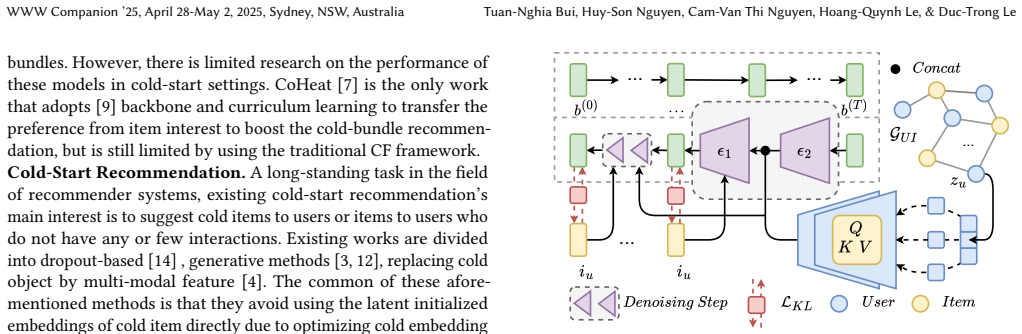
The load-bearing object is DisCo's guided diffusion process over bundle-as-distribution vectors: $b_u^{(0)} \in \mathbb{R}^{|I|}$ is the item distribution of a bundle, corrupted over $T$ steps by a Gaussian noise scheduler, and reconstructed by a neural reverse transition $\mu_\theta(b_u^{(t)}, i_u, z_u^*, t) = \epsilon_1(\epsilon_2(b_u^{(t)}) \oplus z_u^*) + i_u$. The conditioning signal $z_u^*$ is produced by graph propagation over the user-item interaction graph followed by a disentangled multi-head self-attention module that splits the user representation into aspect chunks. Training combines a simplified reconstruction loss $\mathcal{L}_R$ with a KL regularization loss $\mathcal{L}_{KL}$ that pushes the generated distribution toward the user's historical item distribution, injecting item-level preference and discouraging the generative process from collapsing onto redundant bundles. This lets the model synthesize a probabilistic bundle without ever updating an embedding for the cold bundle itself.
What would settle it
Construct a cold-start split where every item of every held-out test bundle is removed from the user-item training matrix $Y$, so no test bundle shares items with any user's training history, then measure DisCo's Recall@20 and nDCG@20. A large drop from the reported 72%-1723% gains would show the method exploits item-history overlap rather than learning bundle structure.
Extended reading notes
Core claim
The central claim is that a personalized diffusion model can synthesize a whole bundle in item-distribution space from user and item signals alone, without relying on learned embeddings of cold bundles. For each user, DisCo samples a noisy version of the user's past item interactions as a bundle vector in $\mathbb{R}^{|I|}$, then denoises it with a neural reverse process conditioned on a graph-enhanced, disentangled user representation. The generated distribution is scored against candidate bundles by dot product, and a KL regularization term pushes the generated distribution toward the user's historical item distribution, injecting item preference and preventing the generative model from collapsing onto redundant positive bundles. The paper reports that this pipeline outperforms five comparative baselines by a large margin on Youshu, iFashion, and Meal.
Load-bearing premise
DisCo's scoring assumes that a good bundle for a user is one whose items overlap with the user's historical item interactions: the KL loss explicitly pushes the generated distribution toward the user's past item distribution, and the reverse network adds that distribution directly.
Editorial extensions
If this is right
- Cold bundles can be scored without any user-bundle interaction history, so the method applies in completely cold bundle settings where latent-factor baselines return near-zero results.
- The KL regularization is not a side detail: removing it collapses performance, with R@20 dropping from 0.0526 to 0.0265 on Youshu and to 0.0039 on iFashion and Meal.
- Distribution-space generation is compatible with standard top-K evaluation, since generated bundles are ranked by dot product against binary candidate vectors.
- The reported gains, ranging from roughly 72% to 1723% depending on dataset and metric, hold across five seeds with $p < 0.05$.
- The same conditioning machinery can be reused for any downstream task that needs a user's bundle-level preference expressed as an item distribution.
Reading between the lines
- Because the KL term targets $\delta(i_u)$, the model effectively treats bundle preference as item-history overlap; a held-out split that removes test-bundle items from training would likely cut the reported gains sharply.
- The architecture could plausibly extend to cold users by conditioning on side information or a user-item graph, and to cold items by replacing item embeddings with content-derived features.
- The bias-avoidance KL term could be tuned to trade diversity against precision, giving practitioners a control knob for bundle novelty.
- A natural testable extension is to use the generated item distribution as a prior for downstream reranking or explainable recommendation, since the distribution itself names the items driving the score.
Editorial analysis
A structured set of objections, weighed in public.
Referee Report
Summary. This paper proposes DisCo, a diffusion-based model for cold-start bundle recommendation. For each user, DisCo builds a personalized representation by LightGCN propagation on the user–item graph and a disentangled multi-head attention module, then runs a DDPM-style reverse process whose mean network is conditioned on the user representation and on the user's past item-interaction vector. The final ranking score is the dot product between the generated item vector and the candidate bundle's binary item vector. Training combines a reconstruction loss and a KL term that encourages the softmax of the generated vector to be close to the softmax of the user's past item distribution. The authors report large improvements over five baselines on Youshu, iFashion, and Meal, with especially large gains over CoHeat, and they provide a code repository.
Significance. If valid, the paper would offer a new way of handling cold bundles by generating user-specific item distributions without relying on user-bundle embeddings, and it would provide evidence that diffusion models can beat strong collaborative baselines in this setting. The manuscript is concrete about the architecture, reports results over five seeds, and makes code available. However, the reported evidence does not currently isolate the diffusion model from a much simpler item-overlap mechanism that is built into the scoring function and training objective. Until that mechanism is tested against a parameter-free overlap baseline, the significance of the claimed gains is uncertain; the contribution would be more convincing if the paper showed that the diffusion backbone itself, rather than the i_u skip connection plus the KL regularizer, is responsible for the improvement.
major comments (3)
- [Section 3.2, Eq. (8); Section 3.3, Eq. (11); Table 2] The model has a built-in item-overlap shortcut. The reverse mean adds the user's past item vector i_u at every step (Eq. 8), the KL loss forces softmax(mu_theta) toward delta(i_u) (Eq. 11), and the score (Eq. 10) is a dot product with the candidate bundle's binary item vector. A parameter-free baseline y_{u,b} = i_u · b_tilde would capture most of this mechanism, and the w/o KL collapse in Table 2 is exactly what the shortcut predicts. The paper must add this overlap baseline, and it should also report ablations that remove the i_u skip connection while keeping the KL term, and remove the KL term while keeping the skip, so that the reader can attribute the gains to the diffusion process rather than to the user-history feature.
- [Section 4.1, Problem Formulation and dataset split] The evaluation treats bundles as cold by partitioning bundles, but the paper does not state whether items that appear in test bundles are removed from the user-item matrix Y before computing i_u and before constructing the LightGCN graph. If they are not removed, the method has direct access to test-bundle item information at inference through Eq. (8), Eq. (10), and Eq. (11), and the comparison is not a fair cold-start test. Please clarify the split and, if necessary, rerun with a time-based split or with test-bundle items excluded from Y.
- [Section 3.2, Eq. (7) and Eq. (10)] The claim that DisCo 'generates a bundle in distribution space' is not supported by the model's output: mu_theta returns an unconstrained real vector in R^{|I|}, with no non-negativity or normalization guarantee, and a softmax appears only inside the KL term. The final score uses the raw vector, not a normalized distribution. Either modify the output head/decoder to produce a proper probability distribution (for example, by applying softmax at inference) and use that distribution consistently in both scoring and the KL loss, or revise the terminology to describe a learned score vector rather than a distribution.
minor comments (5)
- [Table 1] Please report standard deviations for the five seeds and specify exactly which significance test was used for the dagger marks; mean-only results and an unspecified p-value do not support the strength of the claimed improvements.
- [Eq. (9)] The notation mu_theta(b_t, t) omits the conditioning variables i_u and z*_u used in Eq. (7); either align the notation or define a shorthand, since the current form is inconsistent.
- [Section 3.2] Please define X*_u explicitly: it should be clear whether it is the set of bundles the user interacted with or the user's item history, and how b_u^(0) is constructed from a bundle's item set.
- [Fig. 2 and Section 4.2] The caption of Fig. 2 lists several methods that are not discussed in the table or text; please state which results were taken from [7] and which were rerun by the authors.
- [Throughout] There are several typos and inconsistencies, for example 'many progresses' in Section 1 and 'DiSCo' vs. 'DisCo' in Table 1; a careful proofread is needed.
Circularity Check
DisCo's ranking reduces to an item-overlap heuristic: Eq. (8) injects the user's item distribution i_u into every reverse step, Eq. (11) trains the output toward δ(i_u), and Eq. (10) scores bundles by dot product, so the reported gains are forced by the user-item input rather than by diffusion generation.
-
fitted input called prediction
[Section 3.2, Eq. (8); Section 3.3, Eqs. (10)-(11)]
"μθ(b(t)u, iu, z∗u, t)=ϵ1(ϵ2(b(t)u)⊕z∗u)+iu, where iu is the past item interacted distribution of user u. (8) ... y_{u,b}=b′(0)u · b̃, (10) ... L(t−1)KL = E t,u∼U [DKL(δ(iu)||δ(μθ(b(t)u, iu, z∗u, t)))] (11)"
Eq. (8) adds the user's own item distribution i_u to every reverse mean; Eq. (11) trains the softmax of the output toward δ(i_u); Eq. (10) then scores a bundle by a dot product with the generated vector. Together, the learned ranking is, by construction, close to the overlap i_u·z_b between the user's past items and the candidate bundle's items. The reported large margin over CoHeat is therefore not evidence for the diffusion backbone; a parameter-free item-overlap baseline would capture the same signal. The w/o KL ablation (Table 2) collapses on iFashion and Meal, confirming the result is driven by the injected i_u/KL shortcut, not by denoising. No such overlap baseline is reported.
full rationale
DisCo's core ranking formula is the dot product in Eq. (10). The only place the model can learn bundle preference is through the reverse mean in Eq. (8), which contains a direct additive term i_u (the user's past-item distribution), and through Eq. (11), which explicitly minimizes KL divergence between δ(i_u) and the softmax of the reverse mean. Thus the generated distribution is trained to be approximately the user's own item distribution. On the cold-bundle split, only user-bundle interactions are held out; the user-item matrix Y remains available, so this i_u signal is present for every test user. Consequently, the ranking reduces to an item-overlap heuristic. The ablation w/o KL dropping to near-zero on iFashion and Meal is exactly what this reduction predicts. This is not a self-citation issue: the cited prior works are not load-bearing for the main claim. The circularity is that the headline prediction is forced by the model's own training objective and input, and the paper never compares against the trivial overlap baseline that its own equations imply. Score is 7 rather than 8 because a residual learned term ε1(ε2(b_u^{(t)})⊕z*) remains in principle; however the ablation shows the dominant effect is the injected i_u/KL mechanism.
Assumptions & free parameters
free parameters (6)
- Noise schedule endpoints =
beta_1=1e-5, beta_T=0.2
- Number of diffusion steps T =
100
- Graph and attention depth =
2 LightGCN layers, 2 attention heads, 4 chunks
- KL regularization weight =
implicit weight 1 in Eq. 12
- Weight decay tau =
1e-5
- Embedding and hidden dimension =
tuned in {64, 128}, final value not stated
assumptions (4)
- standard math The DDPM forward and reverse Gaussian process from Ho et al. applies directly to bundle item-distribution vectors.
- domain assumption User-item interactions transfer to bundle preferences, and the user's past item vector i_u is a valid conditioning and target for bundle generation.
- domain assumption LightGCN on the user-item graph provides useful collaborative signal for cold-start bundles.
- ad hoc to paper Gaussian-perturbed item distributions remain meaningful representations for recommendation scoring via dot product with binary bundle vectors.
invented entities (2)
-
Probabilistic bundle representation in item-distribution space (b_u^(0))
-
Disentangled user aspect chunks
Cite this review
Pith. "Pith review of Personalized Diffusion Model Reshapes Cold-Start Bundle Recommendation." pith.science (2026). https://pith.science/paper/BDWFLIVH
@misc{pith2026250514901,
  author       = {Pith},
  title        = {Pith review of: Personalized Diffusion Model Reshapes Cold-Start Bundle Recommendation},
  year         = {2026},
  howpublished = {\url{https://pith.science/paper/BDWFLIVH}},
  note         = {Machine review of arXiv:2505.14901}
}
abstract
Bundle recommendation aims to recommend a set of items to each user. However, the sparser interactions between users and bundles raise a big challenge, especially in cold-start scenarios. Traditional collaborative filtering methods do not work well for this kind of problem because these models rely on interactions to update the latent embedding, which is hard to work in a cold-start setting. We propose a new approach (DisCo), which relies on a personalized Diffusion backbone, enhanced by disentangled aspects for the user's interest, to generate a bundle in distribution space for each user to tackle the cold-start challenge. During the training phase, DisCo adjusts an additional objective loss term to avoid bias, a prevalent issue while using the generative model for top-$K$ recommendation purposes. Our empirical experiments show that DisCo outperforms five comparative baselines by a large margin on three real-world datasets. Thereby, this study devises a promising framework and essential viewpoints in cold-start recommendation. Our materials for reproducibility are available at: https://github.com/bt-nghia/DisCo.
Figures


Reference graph
Works this paper leans on
-
[1]
Oren Barkan, Noam Koenigstein, Eylon Yogev, and Ori Katz. 2019. CB2CF: a neural multiview content-to-collaborative filtering model for completely cold item recommendations. In RecSys 2019. 228–236
work page 2019
-
[2]
Tuan-Nghia Bui, Huy-Son Nguyen, Cam-Van Nguyen Thi, Hoang-Quynh Le, and Duc-Trong Le. 2024. BRIDGE: Bundle Recommendation via Instruction-Driven Generation. arXiv preprint arXiv:2412.18092 (2024)
arXiv 2024
-
[3]
Hao Chen, Zefan Wang, Feiran Huang, Xiao Huang, Yue Xu, Yishi Lin, Peng He, and Zhoujun Li. 2022. Generative adversarial framework for cold-start item recommendation. In SIGIR 2022. 2565–2571
work page 2022
-
[4]
Xiaoyu Du, Xiang Wang, Xiangnan He, Zechao Li, Jinhui Tang, and Tat-Seng Chua. 2020. How to learn item representation for cold-start multimedia recom- mendation?. In MM 2020. 3469–3477
work page 2020
-
[5]
Xiangnan He, Kuan Deng, Xiang Wang, Yan Li, Yongdong Zhang, and Meng Wang. 2020. Lightgcn: Simplifying and powering graph convolution network for recommendation. In SIGIR 2020. 639–648
work page 2020
-
[6]
Jonathan Ho, Ajay Jain, and Pieter Abbeel. 2020. Denoising diffusion probabilistic models. NeurIPS 33 (2020), 6840–6851
work page 2020
-
[7]
Hyunsik Jeon, Jong-eun Lee, Jeongin Yun, and U Kang. 2024. Cold-start Bundle Recommendation via Popularity-based Coalescence and Curriculum Heating. In WWW 2024. 3277–3286
work page 2024
-
[8]
Yunshan Ma, Yingzhi He, Xiang Wang, Yinwei Wei, Xiaoyu Du, Yuyangzi Fu, and Tat-Seng Chua. 2024. MultiCBR: Multi-view Contrastive Learning for Bundle Recommendation. TOIS 42, 4 (2024), 1–23
work page 2024
Show all 19 references
-
[9]
Yunshan Ma, Yingzhi He, An Zhang, Xiang Wang, and Tat-Seng Chua. 2022. Crosscbr: Cross-view contrastive learning for bundle recommendation. In KDD
2022
-
[10]
Huy-Son Nguyen, Tuan-Nghia Bui, Long-Hai Nguyen, Hung Hoang, Cam-Van Thi Nguyen, Hoang-Quynh Le, and Duc-Trong Le. 2024. Bundle Recommendation with Item-Level Causation-Enhanced Multi-view Learning. In ECML-PKDD 2024. 324–341
2024
-
[11]
Steffen Rendle, Christoph Freudenthaler, Zeno Gantner, and Lars Schmidt-Thieme
-
[12]
Kihyuk Sohn, Honglak Lee, and Xinchen Yan. 2015. Learning structured output representation using deep conditional generative models. NeurIPS 28 (2015)
2015
-
[13]
Ashish Vaswani, Noam Shazeer, Niki Parmar, Jakob Uszkoreit, Llion Jones, Aidan N Gomez, Łukasz Kaiser, and Illia Polosukhin. 2017. Attention is all you need. NeurIPS 30 (2017)
2017
-
[14]
Maksims Volkovs, Guangwei Yu, and Tomi Poutanen. 2017. Dropoutnet: Address- ing cold start in recommender systems. NeurIPS 30 (2017)
2017
-
[15]
Yinwei Wei, Xiang Wang, Qi Li, Liqiang Nie, Yan Li, Xuanping Li, and Tat-Seng Chua. 2021. Contrastive learning for cold-start recommendation. In MM 2021. 5382–5390
2021
-
[16]
Xu Zhao, Yi Ren, Ying Du, Shenzheng Zhang, and Nian Wang. 2022. Improv- ing item cold-start recommendation via model-agnostic conditional variational autoencoder. In SIGIR 2022. 2595–2600
2022
-
[17]
Zhihui Zhou, Lilin Zhang, and Ning Yang. 2023. Contrastive collaborative filtering for cold-start item recommendation. In WWW 2023. 928–937
2023
-
[18]
Ziwei Zhu, Shahin Sefati, Parsa Saadatpanah, and James Caverlee. 2020. Recom- mendation for new users and new items via randomized training and mixture-of- experts transformation. In SIGIR 2020. 1121–1130
2020
-
[2009]
In UAI 2009
BPR: Bayesian personalized ranking from implicit feedback. In UAI 2009. 452–461
2009
Reviewed August 7, 2026 · model on record in the stance chip above.
Discussion (0). Continue with ORCID to comment.