REVIEW 4 major objections 6 minor 28 references
Beyond Rigid AI: Towards Natural Human-Machine Symbiosis for Interoperative Surgical Assistance
T0 review · 4 major / 6 minor · reviewed 2026-08-06 · deepseek-v4-flash
Pith's one-line read Perception Agent lets surgeons segment known and never-seen objects in real time by voice, using motion-based prompting with a segment-anything tracker, and matches manual prompting accuracy on a public surgical benchmark.
desk verdict A clever agentic pipeline for hands-free surgical segmentation that is better motivated than measured; the headline quantitative claim tracks known tools, not novel-element segmentation. read the letter →
The pith
A machine-rendered reading of the paper's core claim, the machinery that carries it, and where it could break.
The reading
What carries the argument
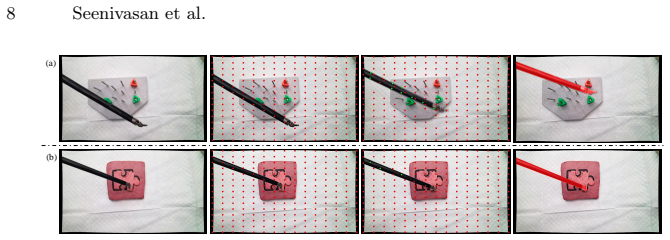
The carrying mechanism is a coordinated pipeline of three foundation models anchored by a memory repository. SAM2, a promptable image-and-video segmentation model, generates masks from point prompts and keeps a memory bank of previous frames. CoTracker3, a dense any-point tracker, follows a grid of query points across video frames and produces the motion trajectories that drive novel-object discovery. The two novel prompting strategies compute per-point displacement and cosine similarity between trajectories, selecting points whose motion matches either the most strongly moving object in the scene or the reference object's motion template, then injecting those points as SAM2 prompts. In parallel, the agent stores a memory embedding of a newly segmented object in the repository so that later requests for the same object can be answered immediately without re-prompting.
What would settle it
Run the object-centric routine on a video where a never-before-seen instrument is held perfectly still while the scene is also still; the pipeline will have no trajectory signal to select prompt points and should fail to segment the object. To test the parity claim directly, compute the agent's Dice on all EndoVis18 test instruments using object-centric-derived memory and compare it to manual-prompt memory; a gap larger than a stated margin on clearly moving instruments would refute the claim of on-par performance.
Extended reading notes
Core claim
The central claim is that rigid, fixed-category surgical perception can be replaced by a flexible perception pipeline that treats the surgeon's spoken request as the prompt. Perception Agent transcribes speech, uses a prompt-engineered LLM to decide whether the requested element is already known or needs to be discovered, and then drives SAM2 with either a stored memory embedding or with point prompts derived from motion trajectories. For previously unseen elements, two mechanisms are proposed: object-centric segmentation, which selects tracked points that move most uniformly with the manipulated instrument, and reference-based segmentation, which selects candidate points whose motion matches a known reference object such as the needle driver holding a graft. The paper reports that on the EndoVis18 dataset, using memory created by the object-centric approach gives average Dice 0.963, comparable to 0.965 with manually prompted memory, and shows qualitative success on novel instruments, phantom tissue grafts, and gauze in simulated surgical settings.
Load-bearing premise
The agent only finds a novel object by motion: if the target object does not move coherently on its own or in sync with a reference tool, the motion filters cannot select points to prompt the segmenter, so unseen static objects cannot be segmented.
Editorial extensions
If this is right
- Surgeons can request tracking of a known instrument by name during an operation and receive real-time segmentation without manual clicking, because memory embeddings are reused across cases.
- Objects never seen during training, including custom grafts, gauze, or tissue held by a tool, become segmentable on demand as long as they exhibit coherent motion relative to the scene or in sync with a reference object.
- A novel element is memorized when first encountered, so in a later surgery the same element can be segmented directly from memory.
- The approach matches manual-prompting accuracy on a public benchmark, suggesting that the added flexibility does not impose a clear segmentation-quality penalty for known instruments.
Reading between the lines
- The motion-dependence of the two novel mechanisms implies a testable boundary: static novel objects, or objects whose motion exactly matches the background, will not be discoverable; appearance-based or text-prompted discovery would be a natural next step.
- The memory repository behaves like one-shot learning from interaction, and a hierarchical memory structure could encode part-whole relationships or surgical roles to make the agent more useful across related procedures.
- Because the agent produces masks without manual annotation effort, the same prompting machinery could be reused to generate pseudo-labels for training downstream surgical models or to support instrument-pose estimation.
- The reference-based mechanism, which compares candidate trajectories against a known reference object, could be extended to track deformable tissue whose motion is only partially coupled to the tool, though the paper does not quantify performance on such cases.
Editorial analysis
A structured set of objections, weighed in public.
Referee Report
Summary. The paper introduces Perception Agent, an interactive system that combines automatic speech recognition (Whisper), an LLM (GPT-4o), point tracking (CoTracker3), and SAM2 to segment surgical instruments and novel objects on demand. Two motion-based prompting mechanisms are proposed for unseen elements: object-centric segmentation (Eqs. 1-2) and reference-based segmentation (Eq. 3). The system stores masks in a memory repository for reuse in later surgeries. Experiments on EndoVis18 compare SAM2 tracking using prior memory created by manual prompting versus the object-centric approach, and qualitative dVRK experiments demonstrate segmentation of novel instruments, gauze, and phantom tissue grafts. The paper claims real-time, on-par performance with manual prompting.
Significance. If the central claims were fully supported, the work would be a useful systems-level demonstration of composing foundation models for interactive surgical perception, with a plausible path to reducing manual prompting burden. The use of a public benchmark, held-out test sequences, cross-dataset memory (EndoVis17 to EndoVis18), and qualitative dVRK demos are strengths. However, the quantitative evidence does not directly measure the novel-element segmentation step, the sample size is very small, real-time performance is not measured, and key parameters are unspecified. The contribution is therefore at the prototype/demonstration stage; the underlying idea is timely and worth further development, but the published claims need to be scaled back or supported by additional experiments.
major comments (4)
- [Section 3.1 / Table 1] The quantitative comparison does not measure the quality of the novel-element mask produced by the object-centric prompting mechanism. In both rows of the comparison study, the object-centric or manual prompt is used only to create a memory from a single frame, and the reported Dice/mIoU values are computed over subsequent frames while SAM2 tracks from that stored memory. The initial mask generated from the motion-filtered point set (Eqs. 1 and 2) is never evaluated against ground truth. Consequently, the abstract's claim that the agent performs 'on par with considerably more labor-intensive manual-prompting strategies' is only supported for memory-based tracking of already-known instruments, not for the segmentation of previously unseen elements. Please add an evaluation of the first-frame prompted mask, or a frame-wise evaluation starting from the initial prompt, and separately report the initial mask Dice/IoU. Also, the large gap between average Dice (0.96) and mIoU (0.62-0.74) suggests overprediction and should be analyzed rather than left unexplained.
- [Section 3.1] The parity claim rests on only three instruments from the EndoVis18 training set that happened to satisfy the motion criterion, with no error bars, confidence intervals, or significance testing. Since the object-centric approach is inherently limited to targets with significant coherent motion, the paper should quantify how often this condition holds in the dataset and report per-instrument variability. Without this, the numerical similarity between 0.963 and 0.965 (Table 1) is not a robust demonstration of parity.
- [Abstract / Sections 1 and 3] The real-time claim is unsupported. No latency, frame rate, or end-to-end runtime is reported anywhere; the pipeline includes speech recognition, an LLM call, dense point tracking, and SAM2 inference, each with substantial latency. Please include timing measurements for the speech-to-segmentation loop and for both novel-element mechanisms on the dVRK setup, or qualify the real-time claim as a design goal.
- [Section 2.2(c-d)] The method's free parameters are not specified, which prevents replication and sensitivity analysis: the motion threshold gamma in Eq. (2) and Eq. (3), the number of query points Qp, the top-k matching points, the displacement threshold, and the tracking frame windows (16 and 48 frames) are all introduced without values. Please report the values used in the experiments and a sensitivity study for at least gamma and top-k.
minor comments (6)
- [Title] The title uses 'Interoperative', which appears to be a typo for 'intraoperative'; the text consistently uses 'intraoperative'.
- [Table 1] Table 1 is difficult to interpret because the first row reports all seven test instruments while the comparison rows report a three-instrument subset (T1, T3, T4, T5) with a different average; please restructure the table to distinguish the full test set from the subset and align column headings.
- [Section 2.2 / Eqs. (2)-(3)] Equations (2) and (3) define cosine similarity with a division by ||Vi(t)||, which is undefined for static points with zero motion; the manuscript should state how zero-motion tracks are handled in the computation.
- [Section 3.1] The phrase 'cherry-picked frame' is informal and the sentence contains a typo ('well-define'); please describe the frame-selection criterion objectively.
- [Section 3.2 / Figs. 4-5] The novel-element segmentation results are only qualitative; a small quantitative evaluation, such as manual annotation of a few frames, would strengthen the demonstration.
- [Reproducibility] No code, model weights, or demo video are provided; a reproducibility statement or public link would be helpful.
Circularity Check
No circular reasoning: the evaluation is on held-out frames and no fitted parameter is reused as a prediction target.
full rationale
The paper's derivation chain is self-contained and contains no circular step. The Perception Agent composes externally trained foundation models (SAM2, CoTracker3, Whisper, GPT-4o) with a memory repository; the only home-grown components are prompt-engineering and motion-based point filtering with displacement and cosine-similarity thresholds. The object-centric mechanism (Eqs. 1-2) and reference-based mechanism (Eq. 3) are not fit to the test data: they select prompt points from training or intraoperative frames by motion coherence, and Table 1 then measures SAM2's memory-based tracking Dice on held-out EndoVis18 sequences with the resulting memory. Manual-prompting and object-centric memories are compared on the same test frames; no fitted parameter is renamed as a prediction. Self-citations (e.g., Refs. 21 and 23) are used only to support the peripheral statement that SAM has been validated in surgery and are not load-bearing; no uniqueness theorem or ansatz is imported from prior author work. The Discussion's acknowledgment that 'segmenting unseen static surgical elements remains a challenge due to the lack of movement cues' is a stated limitation of the motion-based prompting, not evidence of circularity. One should separately note that the abstract's quantitative claim is narrower than what Table 1 directly measures (known-instrument tracking with prior memory rather than first-time novel-element segmentation), but that is an evaluation-coverage issue, not circular reasoning.
Assumptions & free parameters
free parameters (5)
- motion threshold gamma =
not reported
- top-k matching points =
not reported
- number of query points Qp =
not reported
- displacement threshold for static points =
not reported
- tracking frame windows =
16 and 48 frames
assumptions (6)
- domain assumption The target novel element exhibits significant and uniform motion relative to the scene (object-centric approach)
- domain assumption The target element moves coherently with the reference object (reference-based approach)
- domain assumption CoTracker3 provides reliable point tracks in endoscopic video
- domain assumption Speech recognition and LLM parsing correctly interpret surgeon intent
- domain assumption SAM2 point prompts yield accurate segmentation masks for surgical instruments
- domain assumption Memory embeddings of an instrument from one surgery transfer to another surgery
Cite this review
Pith. "Pith review of Beyond Rigid AI: Towards Natural Human-Machine Symbiosis for Interoperative Surgical Assistance." pith.science (2026). https://pith.science/paper/BDXL56NY
@misc{pith2026250723088,
  author       = {Pith},
  title        = {Pith review of: Beyond Rigid AI: Towards Natural Human-Machine Symbiosis for Interoperative Surgical Assistance},
  year         = {2026},
  howpublished = {\url{https://pith.science/paper/BDXL56NY}},
  note         = {Machine review of arXiv:2507.23088}
}
read the original abstract
Emerging surgical data science and robotics solutions, especially those designed to provide assistance in situ, require natural human-machine interfaces to fully unlock their potential in providing adaptive and intuitive aid. Contemporary AI-driven solutions remain inherently rigid, offering limited flexibility and restricting natural human-machine interaction in dynamic surgical environments. These solutions rely heavily on extensive task-specific pre-training, fixed object categories, and explicit manual-prompting. This work introduces a novel Perception Agent that leverages speech-integrated prompt-engineered large language models (LLMs), segment anything model (SAM), and any-point tracking foundation models to enable a more natural human-machine interaction in real-time intraoperative surgical assistance. Incorporating a memory repository and two novel mechanisms for segmenting unseen elements, Perception Agent offers the flexibility to segment both known and unseen elements in the surgical scene through intuitive interaction. Incorporating the ability to memorize novel elements for use in future surgeries, this work takes a marked step towards human-machine symbiosis in surgical procedures. Through quantitative analysis on a public dataset, we show that the performance of our agent is on par with considerably more labor-intensive manual-prompting strategies. Qualitatively, we show the flexibility of our agent in segmenting novel elements (instruments, phantom grafts, and gauze) in a custom-curated dataset. By offering natural human-machine interaction and overcoming rigidity, our Perception Agent potentially brings AI-based real-time assistance in dynamic surgical environments closer to reality.
Figures


Figures from the paper (2 more)

Reference graph
Works this paper leans on
-
[1]
arXiv preprint arXiv:2001.11190 (2020)
Allan,M.,Kondo,S.,Bodenstedt,S.,Leger,S.,Kadkhodamohammadi,R.,Luengo, I., Fuentes, F., Flouty, E., Mohammed, A., Pedersen, M., et al.: 2018 robotic scene segmentation challenge. arXiv preprint arXiv:2001.11190 (2020)
arXiv 2020
-
[2]
arXiv preprint arXiv:1902.06426 (2019)
Allan, M., Shvets, A., Kurmann, T., Zhang, Z., Duggal, R., Su, Y.H., Rieke, N., Laina, I., Kalavakonda, N., Bodenstedt, S., et al.: 2017 robotic instrument segmen- tation challenge. arXiv preprint arXiv:1902.06426 (2019)
arXiv 2019
-
[3]
arXiv preprint arXiv:2411.18018 (2024)
Ding, H., Gao, Z., Planche, B., Luan, T., Sharma, A., Zheng, M., Lou, A., Chen, T., Unberath, M., Wu, Z.: Neural finite-state machines for surgical phase recognition. arXiv preprint arXiv:2411.18018 (2024)
arXiv 2024
-
[4]
arXiv preprint arXiv:2407.11906 (2024)
Ding, H., Lu, T., Zhang, Y., Liang, R., Shu, H., Seenivasan, L., Long, Y., Dou, Q., Gao, C., Unberath, M.: Segstrong-c: Segmenting surgical tools robustly on non-adversarial generated corruptions–an endovis’ 24 challenge. arXiv preprint arXiv:2407.11906 (2024)
arXiv 2024
-
[5]
arXiv preprint arXiv:2409.13107 (2024)
Ding, H., Seenivasan, L., Shu, H., Byrd, G., Zhang, H., Xiao, P., Barragan, J.A., Taylor, R.H., Kazanzides, P., Unberath, M.: Towards robust automation of surgical systems via digital twin-based scene representations from foundation models. arXiv preprint arXiv:2409.13107 (2024)
arXiv 2024
-
[6]
International Journal of Computer As- sisted Radiology and Surgery18(6), 1009–1016 (2023)
Ding, H., Wu, J.Y., Li, Z., Unberath, M.: Rethinking causality-driven robot tool segmentation with temporal constraints. International Journal of Computer As- sisted Radiology and Surgery18(6), 1009–1016 (2023)
work page 2023
-
[7]
In: International conference on medical image computing and computer-assisted intervention
Ding, H., Zhang, J., Kazanzides, P., Wu, J.Y., Unberath, M.: Carts: Causality- driven robot tool segmentation from vision and kinematics data. In: International conference on medical image computing and computer-assisted intervention. pp. 387–398. Springer (2022)
work page 2022
-
[8]
arXiv preprint arXiv:2410.20026 (2024)
Ding, H., Zhang, Y., Shu, H., Lian, X., Kim, J.W., Krieger, A., Unberath, M.: Towards robust algorithms for surgical phase recognition via digital twin-based scene representation. arXiv preprint arXiv:2410.20026 (2024)
arXiv 2024
Show all 28 references
-
[9]
Computer methods and programs in biomedicine190, 105378 (2020)
de la Fuente López, E., García, Á.M., Del Blanco, L.S., Marinero, J.C.F., Turiel, J.P.: Automatic gauze tracking in laparoscopic surgery using image texture anal- ysis. Computer methods and programs in biomedicine190, 105378 (2020)
2020
-
[10]
Gui, S., Wang, Z., Chen, J., Zhou, X., Zhang, C., Cao, Y.: Mt4mtl-kd: a multi- teacherknowledgedistillationframeworkfortripletrecognition.IEEETransactions on Medical Imaging43(4), 1628–1639 (2023) 10 Seenivasan et al
2023
-
[11]
European Surgical Research65(1), 22–39 (2024)
Guni, A., Varma, P., Zhang, J., Fehervari, M., Ashrafian, H.: Artificial intelligence in surgery: the future is now. European Surgical Research65(1), 22–39 (2024)
2024
-
[12]
In: Proceedings of the IEEE/CVF international conference on computer vision
Holm, F., Ghazaei, G., Czempiel, T., Özsoy, E., Saur, S., Navab, N.: Dynamic scene graph representation for surgical video. In: Proceedings of the IEEE/CVF international conference on computer vision. pp. 81–87 (2023)
2023
-
[13]
In: Medical Image Comput- ing and Computer Assisted Intervention–MICCAI 2020: 23rd International Con- ference, Lima, Peru, October 4–8, 2020, Proceedings, Part III 23
Islam, M., Seenivasan, L., Ming, L.C., Ren, H.: Learning and reasoning with the graph structure representation in robotic surgery. In: Medical Image Comput- ing and Computer Assisted Intervention–MICCAI 2020: 23rd International Con- ference, Lima, Peru, October 4–8, 2020, Proc...
2020
-
[14]
Karaev, N., Makarov, I., Wang, J., Neverova, N., Vedaldi, A., Rupprecht, C.: Co- tracker3: Simpler and better point tracking by pseudo-labelling real videos (2024), https://arxiv.org/abs/2410.11831
2024 arXiv
-
[15]
In: 2014 IEEE international conference on robotics and automation (ICRA)
Kazanzides, P., Chen, Z., Deguet, A., Fischer, G.S., Taylor, R.H., DiMaio, S.P.: An open-source research kit for the da vinci® surgical system. In: 2014 IEEE international conference on robotics and automation (ICRA). pp. 6434–6439. IEEE (2014)
2014
-
[16]
In: Proceedings of the IEEE/CVF international conference on computer vision
Kirillov, A., Mintun, E., Ravi, N., Mao, H., Rolland, C., Gustafson, L., Xiao, T., Whitehead, S., Berg, A.C., Lo, W.Y., et al.: Segment anything. In: Proceedings of the IEEE/CVF international conference on computer vision. pp. 4015–4026 (2023)
2023
-
[17]
Medical Image Analysis78, 102433 (2022)
Nwoye, C.I., Yu, T., Gonzalez, C., Seeliger, B., Mascagni, P., Mutter, D., Marescaux, J., Padoy, N.: Rendezvous: Attention mechanisms for the recognition of surgical action triplets in endoscopic videos. Medical Image Analysis78, 102433 (2022)
2022
-
[18]
arXiv preprint arXiv:2408.00714 (2024)
Ravi, N., Gabeur, V., Hu, Y.T., Hu, R., Ryali, C., Ma, T., Khedr, H., Rädle, R., Rolland, C., Gustafson, L., et al.: Sam 2: Segment anything in images and videos. arXiv preprint arXiv:2408.00714 (2024)
2024 arXiv
-
[19]
Sensors 22(14), 5180 (2022)
Sánchez-Brizuela, G., Santos-Criado, F.J., Sanz-Gobernado, D., de la Fuente- López, E., Fraile, J.C., Pérez-Turiel, J., Cisnal, A.: Gauze detection and segmen- tation in minimally invasive surgery video using convolutional neural networks. Sensors 22(14), 5180 (2022)
2022
-
[20]
Seenivasan, L., Mitheran, S., Islam, M., Ren, H.: Global-reasoned multi-task learn- ingmodelforsurgicalsceneunderstanding.IEEERoboticsandAutomationLetters 7(2), 3858–3865 (2022)
2022
-
[21]
arXiv preprint arXiv:2408.04098 (2024)
Shen, Y., Ding, H., Shao, X., Unberath, M.: Performance and non-adversarial robustness of the segment anything model 2 in surgical video segmentation. arXiv preprint arXiv:2408.04098 (2024)
2024 arXiv
-
[22]
International journal of computer assisted radiology and surgery18(6), 1077–1084 (2023)
Shu, H., Liang, R., Li, Z., Goodridge, A., Zhang, X., Ding, H., Nagururu, N., Sahu, M., Creighton, F.X., Taylor, R.H., et al.: Twin-s: a digital twin for skull base surgery. International journal of computer assisted radiology and surgery18(6), 1077–1084 (2023)
2023
-
[23]
In: Proceedings of the IEEE/CVF Conference on Computer Vision and Pattern Recognition
Soberanis-Mukul, R.D., Cheng, J., Mangulabnan, J.E., Vedula, S.S., Ishii, M., Hager, G., Taylor, R.H., Unberath, M.: Gsam+ cutie: Text-promptable tool mask annotation for endoscopic video. In: Proceedings of the IEEE/CVF Conference on Computer Vision and Pattern Recognition. p...
2024
-
[24]
Venugopal, A., Moccia, S., Foti, S., Routray, A., MacLachlan, R.A., Perin, A., Mat- tos,L.S.,Yu,A.K.,Leonardo,J.,DeMomi,E.,etal.:Real-timevesselsegmentation and reconstruction for virtual fixtures for an active handheld microneurosurgical instrument.Internationaljournalofcompu...
2022
-
[25]
Medical image analysis 15(1), 22–34 (2011)
Wu, X., Luboz, V., Krissian, K., Cotin, S., Dawson, S.: Segmentation and recon- struction of vascular structures for 3d real-time simulation. Medical image analysis 15(1), 22–34 (2011)
2011
-
[26]
In: Proceedings of the 31st ACM International Conference on Multimedia
Xi, N., Meng, J., Yuan, J.: Chain-of-look prompting for verb-centric surgical triplet recognition in endoscopic videos. In: Proceedings of the 31st ACM International Conference on Multimedia. pp. 5007–5016 (2023)
2023
-
[27]
In: International Conference on Medical Image Computing and Computer-Assisted Intervention
Yang, S., Luo, L., Wang, Q., Chen, H.: Surgformer: Surgical transformer with hierarchical temporal attention for surgical phase recognition. In: International Conference on Medical Image Computing and Computer-Assisted Intervention. pp. 606–616. Springer (2024)
2024
-
[28]
In: Proceedings of the AAAI Conference on Artificial Intelligence
Yue, W., Zhang, J., Hu, K., Xia, Y., Luo, J., Wang, Z.: Surgicalsam: Efficient class promptable surgical instrument segmentation. In: Proceedings of the AAAI Conference on Artificial Intelligence. vol. 38, pp. 6890–6898 (2024)
2024
Reviewed August 6, 2026 · model on record in the stance chip above.
Discussion (0). Sign in to comment.