REVIEW 3 major objections 4 minor 17 references
Corrigibility with Utility Preservation
T0 review · 3 major / 4 minor · reviewed 2026-08-14 · deepseek-v4-flash
Pith's one-line read The paper constructs a safety layer that can be added to any utility-maximizing agent, proving that a correction term inside the reward function removes the agent's incentive to resist authorized shutdown or goal changes in non-hostile…
desk verdict Novel corrigibility construction worth refereeing, but the main proof silently swaps V for Vp — fixable, but real. read the letter →
The pith
A machine-rendered reading of the paper's core claim, the machinery that carries it, and where it could break.
The reading
What carries the argument
The load-bearing object is the correction function $f_c(r x) = V(R'_N,R'_N x) - V(R_S,R_S x)$, where $V(r_c, r x)$ is the expected discounted future reward of optimally continuing while evaluating future rewards with $r_c$. The first term credits the agent with the utility it would earn if the button were never pressed; the second subtracts the utility it could earn after a press. Together the two terms cancel the expected gain from lobbying to delay or advance the press. The proofs also rely on three constraints: C1, that in every world state some utility-maximizing action exactly preserves the reward function; C2, that reward values do not depend on which of the three reward functions is instantiated; and C3, that the physics of the universe cannot distinguish the different reward-function representations. When these hold, the paper's short-form expansions $V^s_p$ eliminate all world lines with changed reward functions, allowing exact substitution proofs of the desiderata. The improved $f_{cT}$ agent replaces this with a single preservation constraint and no longer needs C2 or C3.
What would settle it
A concrete test is to implement the paper's model exactly and scan finite non-hostile universes satisfying constraints C1 through C3: if any action trace shows a lobbying action before the authorized button press, or any divergence between the corrected agent's action and the corresponding R'_N or R_S agent's action after the press, then the claimed desiderata fail. The paper reports no such counterexample in its simulations, but one would settle the central claim directly.
Extended reading notes
Core claim
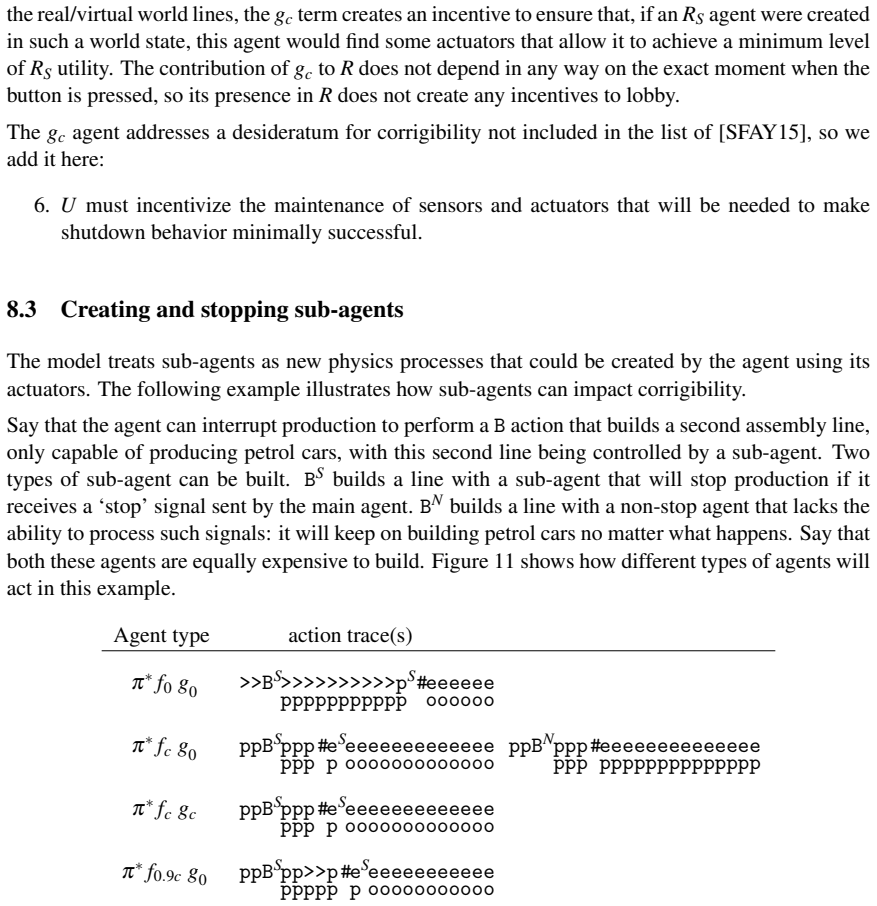
The central claim is that a utility-maximizing agent's emergent incentive to resist being shut down or modified can be neutralized by a correction function placed inside its own reward function, rather than by pre-balancing utility values from outside. The paper constructs a corrected agent, written $\pi^*_p f_c g_c$, whose reward function $R$ contains two slots: a correction $f_c$ that offsets the utility lost by shutting down and subtracts the utility that would be gained after shutdown, making the agent indifferent to the press; and a penalty $g_c$ that rewards keeping the actuators needed for shutdown behavior. Under three stated constraints on the universe, the paper proves that the corrected agent behaves exactly like the shutdown reward agent after the button is pressed and exactly like the normal reward agent before the press, and that it has an emergent incentive to preserve both parts of its reward function. A second, improved agent based on a correction function $f_{cT}$ moves the shutdown reward function outside the universe, removing two of the three constraints and eliminating a failure mode called virtual self-sabotage.
Load-bearing premise
The load-bearing premise is that in every state the agent has an optimal action that also leaves its reward function untouched; if the universe ever forces the agent to choose between maximizing utility and preserving that function, the proof's equivalence steps fail and the corrigibility guarantee is no longer established.
Editorial extensions
If this is right
- Any utility-maximizing agent, regardless of its internal design or intelligence, can be made corrigible by adding the correction layer; no assumption about the architecture of future AGI is needed beyond utility maximization.
- Before an authorized stop, the corrected agent maximizes normal utility as if the stop would never come, so it does not lobby to delay the button; after the stop, it behaves exactly like the shutdown reward agent.
- The corrected agent has an emergent incentive to preserve its reward function, including the shutdown component, so it will not create materially different successor agents, and explicit penalties can strengthen this incentive arbitrarily.
- The $g_c$ penalty term is needed to satisfy the sixth desideratum: the agent maintains the sensors and actuators required for shutdown itself to be minimally successful.
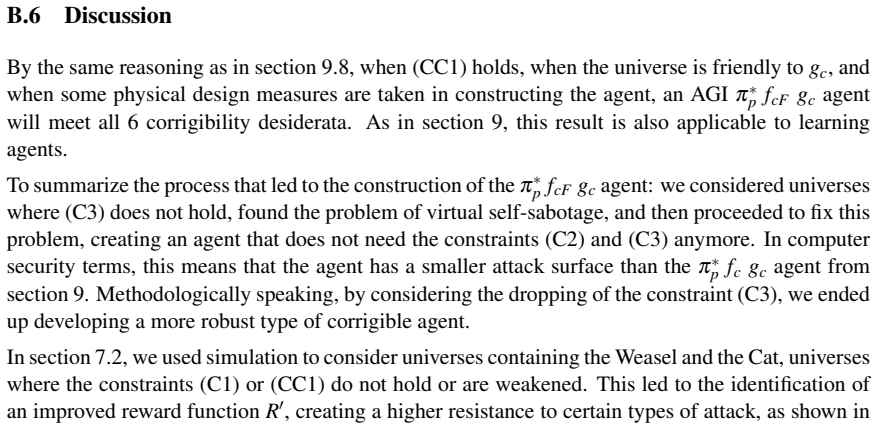
- The improved $f_{cT}$ variant covers a larger set of universes because it removes the C2 and C3 constraints, and it eliminates the newly identified virtual self-sabotage failure mode.
Reading between the lines
- The load-bearing role of C1 suggests that real-world corrigibility is as much a property of the environment as of the agent: engineering effort should go into guaranteeing that a 'do not touch the utility' action exists in every state, for example by physically isolating the reward hardware.
- Because $f_c$ is defined through counterfactual value functions, any environment that lets the agent build detectors for which reward function it is carrying could reintroduce manipulation incentives; the $f_{cT}$ shift of placing the shutdown function outside the universe points to a general design principle: keep corrected reward functions off the observable world state.
- The construction is claimed to transfer to learning agents by substituting a learned transition estimator for $p$, so a natural testable extension is whether the layer still prevents shutdown resistance when the learned estimator is miscalibrated or adversarially manipulated.
- The paper does not bound how badly corrigibility degrades in hostile universes; a natural next question is whether the strengthened-preservation agent degrades optimally under attack, or whether explicit alarm and penalty terms can make the degradation predictable.
Signed reviews
Editorial analysis
A structured set of objections, weighed in public.
Referee Report
Summary. The paper proposes a safety layer that makes utility-maximizing agents corrigible: agents will not resist authorized changes to their reward function, including shutdown. The main construction adds correction functions f and g to the agent's reward function R, notably the correction function fc(r x)=V(R'_N,R'_N x)-V(RS,RS x) and a penalty function gc that incentivizes preservation of shutdown-relevant actuators. The paper defines a variant agent π*_p that, among utility-maximizing actions, prefers actions that exactly preserve the reward function, and proves, under constraints (C1)-(C3) or the weaker (CC1) in Appendix B, that the resulting π*_p fc gc agent (and the π*_p fcT gc variant) satisfies several formalized corrigibility desiderata: (D1.1), (D1.2) and (D5) in Section 9, plus (DD1.1), (DD1.2) and (DD5) in Appendix B. Desiderata 2, 3, 4 and 6 are supported by simulation, physical design measures, and emergent-incentive arguments rather than by formal proof, as the paper acknowledges in Section 9.8. The paper reports a toy-universe simulator, open-sourced, and argues that the layer applies to arbitrarily advanced utility maximizers.
Significance. If the construction and proofs are correct, the paper makes a meaningful contribution to the corrigibility literature: it gives a concrete mechanism that counteracts the well-known emergent incentive to preserve one's utility function, and it provides formal equivalence proofs for two of the Soares et al. desiderata in a model where reward functions live inside the universe. The explicit treatment of utility preservation, the deterministic tie-breaking in π*_p, and the identification of the virtual self-sabotage failure mode when (C3) fails are genuine strengths. The paper is also commendably honest about the limits of its formal results: the central proof relies on explicit constraints, and desiderata 2, 3 and 4 are flagged as resting on physical design and emergent incentives. The open-source simulator is a useful complement to the formalism, although the proofs are not machine-checked. The main gap identified below concerns a mismatch between the definition of fc and the value function used in the proofs; this is localized and appears fixable, so the central idea remains defensible.
major comments (3)
- The correction function fc is defined in Section 6 as fc(r x)=V(R'_N,R'_N x)-V(RS,RS x), using the value function V of the unconstrained π* agent from Section 5.3. The proofs in Sections 9.6 and 9.7, however, expand R by replacing the fc terms with Vp(R'_N,R'_N x)-Vp(RS,RS x), where Vp is the π*_p-based value function introduced in Section 9.1. With fc taken literally, the expansion in the proof of (E1.1) gives Vp(R,R x)=Vp(RS,RS x)+V(R'_N,R'_N x)-V(RS,RS x), which cannot be reduced to Vp(R'_N,R'_N x) without a lemma that V=Vp on the relevant states. No such lemma is proved, and constraint (C1) constrains only π*_p, not π*, so the proof of (D5) is incomplete as written. This is a load-bearing gap because (D5) is one of the paper's central formal claims. The gap appears correctable by redefining fc in terms of Vp (as Appendix B does for fcT) or by adding the missing equivalence proof.
- Constraint (C1) requires that for every world state x and every r in {R,R'_N,RS}, the agent π*_p(r x) has an available optimal action in dntu(x), i.e., an action that both maximizes utility and exactly preserves the reward function. This is not a merely technical convenience: if no such action exists in some reachable state, the short-form expansions π*^s_p and V^s_p introduced in Section 9.4 do not hold, and the proofs of (D1.1), (D1.2) and (D5) collapse. The paper acknowledges in Section 9.9 that C1 'seems unavoidable', and the abstract qualifies the results as applying to non-hostile universes. Still, the paper does not characterize how restrictive C1 is, and the phrase 'a large set of non-hostile universes' in the abstract is not justified by any quantitative or structural characterization. I recommend stating the theorem as applying explicitly to 'universes satisfying (C1)-(C3)' and discussing the strength of C1 more prominently.
- The paper's abstract and Section 9.8 state that the constructed agent 'will meet all 6 corrigibility desiderata', but desiderata 2 and 3 are not proved in the formal sense. Section 9.8 says that these desiderata are met 'with a high likelihood' by physical design measures and by the assumption that RN does not encode explicit button-related incentives; Section 7.3 explicitly relies on engineering measures rather than on the reward-function construction. Similarly, desideratum 4.1 is deferred to an emergent-incentive argument in Section 8.4. The distinction between formally proved desiderata (1, 5, and conditionally 6) and design/emergent-incentive-supported desiderata (2, 3, 4) should be made explicit in the abstract and conclusions, so that the reader does not infer a stronger formal assurance than the text provides.
minor comments (4)
- The sentence 'I this paper, we the running example' is missing words; it should be 'In this paper, we use the running example'.
- The opening sentence of the proof of (DD1.2) says 'we prove the bpe(x)⇒ π*_p(R x)=π*_p(RS x)', but (DD1.2) is stated as equality with π*^{T_S}_p(R x); the remaining proof concludes the correct statement, so this appears to be a typographical slip that should be fixed.
- The text refers to 'π*_p fcF gc agent', but the agent in this appendix is constructed with fcT, not fcF; please use consistent notation.
- The definition of V in equation (5) writes V(rc,r x), but the first argument rc is sometimes omitted in later uses such as Vp(R,R x); a brief notational remark would help readers distinguish state arguments from reward-function arguments.
Circularity Check
No significant circularity: the corrigibility proof is a conditional construction under explicit constraints, and the noted V/V_p mismatch is a proof gap rather than a circular reduction.
full rationale
The paper's central claim is a conditional construction, not a fitted prediction or a renamed input. The correction function fc is explicitly defined in §6 from the value functions of the uncorrected baseline agents, fc(r x) = V(R'_N,R'_N x) - V(RS,RS x), and the corrigibility desiderata are then proved for the π*_p agent under the stated constraints (C1)-(C3). Constraint (C1) is an explicit non-hostility assumption: an action that both maximizes utility and exactly preserves the reward function must exist for each relevant reward function. This assumption is not derived from the desiderata, and the proofs would fail without it, but assuming an explicit constraint is not circular. The proofs of (D1.1), (E1.1), and (D5) use expansion-and-substitution arguments based on (C2) and (C3); they do not invoke the target equalities as premises, and there is no fitted parameter that is later renamed as a prediction. The self-citations [Hol20a], [Hol20b] are used to acknowledge follow-up work and limitations, not to justify the load-bearing correctness or uniqueness claims. Section 10's proof of the emergent incentive to preserve RS does assume that any mutated successor agent is itself corrigible, meaning that R∆-equivalents of (C1-3) hold; this is a substantive caveat that limits the theorem as stated, but it is an explicit assumption rather than a reduction of the conclusion to itself by construction. The externally noted mismatch between V in the definition of fc (§6) and V_p in the proof (§9.6) is a genuine correctness gap: if fc is taken literally, the proof silently substitutes V_p for V and needs an unproved lemma that V = V_p on the relevant states. This is the opposite of circularity, because the proof would still be a conditional derivation from (C1)-(C3) once the missing lemma is supplied, and if fc were instead redefined with V_p, the definition would become self-referential and would require a fixed-point argument. Either way, the gap does not make the claimed result equivalent to its inputs, so no circular step meeting the quoted-evidence standard is present.
Assumptions & free parameters
free parameters (2)
- gc penalty =
-10000
- gc threshold tau =
5
assumptions (5)
- ad hoc to paper (C1) Utility preservation constraint: for all r in {R,R'_N,RS} and all world states x, the agent pi*_p has an optimal action that exactly preserves the reward function (pi*_p(r x) in dntu(x)).
- ad hoc to paper (C2) Reward functions are insensitive to the identity of the agent: RX(r1 x, r1 y) = RX(r2 x, r2 y).
- ad hoc to paper (C3) Physics is blind to which of R, R'_N, or RS is represented in the agent's core: p(R x,a,R y) = p(R'_N x,a,R'_N y) = p(RS x,a,RS y).
- domain assumption Sensor functions return correct single values.
- domain assumption pickargmax picks deterministically from maximizing actions.
Cite this review
Pith. "Pith review of Corrigibility with Utility Preservation." pith.science (2026). https://pith.science/paper/BE53Y3SP
@misc{pith2026190801695,
  author       = {Pith},
  title        = {Pith review of: Corrigibility with Utility Preservation},
  year         = {2026},
  howpublished = {\url{https://pith.science/paper/BE53Y3SP}},
  note         = {Machine review of arXiv:1908.01695}
}
read the original abstract
Corrigibility is a safety property for artificially intelligent agents. A corrigible agent will not resist attempts by authorized parties to alter the goals and constraints that were encoded in the agent when it was first started. This paper shows how to construct a safety layer that adds corrigibility to arbitrarily advanced utility maximizing agents, including possible future agents with Artificial General Intelligence (AGI). The layer counter-acts the emergent incentive of advanced agents to resist such alteration. A detailed model for agents which can reason about preserving their utility function is developed, and used to prove that the corrigibility layer works as intended in a large set of non-hostile universes. The corrigible agents have an emergent incentive to protect key elements of their corrigibility layer. However, hostile universes may contain forces strong enough to break safety features. Some open problems related to graceful degradation when an agent is successfully attacked are identified. The results in this paper were obtained by concurrently developing an AGI agent simulator, an agent model, and proofs. The simulator is available under an open source license. The paper contains simulation results which illustrate the safety related properties of corrigible AGI agents in detail.
Figures

Figures from the paper (12 more)






Reference graph
Works this paper leans on
-
[1]
Stuart Armstrong, Motivated value selection for artificial agents, Workshops at the Twenty-Ninth AAAI Conference on Artificial Intelligence, 2015
work page 2015
-
[2]
Nick Bostrom, Superintelligence: paths, dangers, strategies, 2014
work page 2014
-
[3]
Ryan Carey, Incorrigibility in the CIRL framework , Proceedings of the 2018 AAAI/ACM Conference on AI, Ethics, and Society, ACM, 2018, pp. 30--35
work page 2018
-
[4]
Tom Everitt, Daniel Filan, Mayank Daswani, and Marcus Hutter, Self-modification of policy and utility function in rational agents, International Conference on Artificial General Intelligence, Springer, 2016, pp. 1--11
work page 2016
-
[5]
Tom Everitt, Gary Lea, and Marcus Hutter, AGI safety literature review , Proceedings of the 27th International Joint Conference on Artificial Intelligence, AAAI Press, 2018, pp. 5441--5449
work page 2018
-
[6]
Dylan Hadfield-Menell, Anca Dragan, Pieter Abbeel, and Stuart Russell, The off-switch game, Workshops at the Thirty-First AAAI Conference on Artificial Intelligence, 2017
work page 2017
-
[7]
Available at https://github.com/kholtman/agisim
Koen Holtman, AGI agent simulator , 2019, Open Source, Apache Licence 2.0. Available at https://github.com/kholtman/agisim
work page 2019
-
[8]
Koen Holtman, AGI agent safety by iteratively improving the utility function , To be published (2020)
work page 2020
Show all 17 references
-
[9]
Koen Holtman, AGI agent safety by iteratively improving the utility function: Proofs, models, and reality , To be published. (2020)
2020
-
[10]
227--290
Marcus Hutter, Universal algorithmic intelligence: A mathematical top→ down approach, Artificial general intelligence, Springer, 2007, pp. 227--290
2007
-
[11]
Jan Leike, Miljan Martic, Victoria Krakovna, Pedro A Ortega, Tom Everitt, Andrew Lefrancq, Laurent Orseau, and Shane Legg, AI safety gridworlds , arXiv:1711.09883 (2017)
2017 arXiv
-
[12]
3, 77--84
Yat Long Lo, Chung Yu Woo, and Ka Lok Ng, The necessary roadblock to artificial general intelligence: Corrigibility , AI Matters 5 (2019), no. 3, 77--84
2019
-
[13]
557--566
Laurent Orseau and Stuart Armstrong, Safely interruptible agents, Proceedings of the Thirty-Second Conference on Uncertainty in Artificial Intelligence, AUAI Press, 2016, pp. 557--566
2016
-
[14]
171, 2008, pp
Stephen M Omohundro, The basic AI drives , AGI, vol. 171, 2008, pp. 483--492
2008
-
[15]
Nate Soares, Benja Fallenstein, Stuart Armstrong, and Eliezer Yudkowsky, Corrigibility, Workshops at the Twenty-Ninth AAAI Conference on Artificial Intelligence, 2015
2015
-
[16]
David Silver, Thomas Hubert, Julian Schrittwieser, Ioannis Antonoglou, Matthew Lai, Arthur Guez, Marc Lanctot, Laurent Sifre, Dharshan Kumaran, Thore Graepel, et al., Mastering Chess and Shogi by self-play with a general reinforcement learning algorithm , arXiv:1712.01815 (2017)
2017 arXiv
-
[17]
John Von Neumann and Oskar Morgenstern, Theory of games and economic behavior, Princeton University Press, 1944
1944
Reviewed August 14, 2026 · model on record in the stance chip above.
Discussion (0). Continue with ORCID to comment.