REVIEW 4 major objections 4 minor 73 references
Threshold Effects in Heavy Quarkonium Spectroscopy and Decays
T0 review · 4 major / 4 minor · reviewed 2026-08-14 · deepseek-v4-flash
Pith's one-line read Threshold meson–meson loops make X(3872) a mostly molecular state
desk verdict Useful proceedings-style summary of a published coupled-channel model, but the renormalization factor in Eq. (7) looks sign-inconsistent and the paper adds no new results. read the letter →
The pith
A machine-rendered reading of the paper's core claim, the machinery that carries it, and where it could break.
The reading
What carries the argument
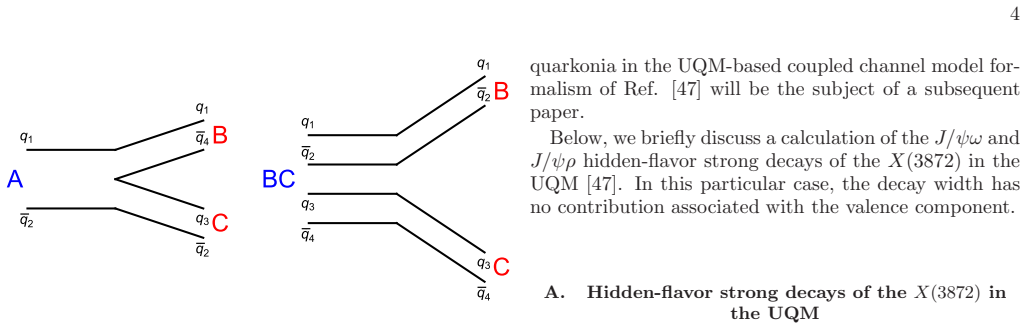
The central object is the self-energy $\Sigma(M_A)=\sum_{BC\ell J}\int_0^\infty k^2dk\,|\langle BCk\ell J|T^\dagger|A\rangle|^2/(M_A-E_B-E_C)$, computed with a $^3P_0$ pair-creation operator $T^\dagger$ that couples the bare quarkonium state $|A\rangle$ to meson–meson continuum states $|BC\rangle$. The paper's renormalization prescription replaces $M_A=E_A+\Sigma(M_A)$ by $M_A=E_A+\Sigma(M_A)+\Delta$, where $\Delta$ is the smallest self-energy correction among the multiplet members, which removes the convergence problem of the standard UQM. The molecular fraction is controlled by the continuum probability $P^{\rm cont}_A=\sum_{BC\ell J}\int q^2dq\,|\langle BCq\ell J|T^\dagger|A\rangle|^2/(M_A-E_B-E_C)^2$, evaluated with a rescaled pair-creation strength $\tilde\gamma^{\rm eff}_{0,i}=\gamma^{\rm eff}_0\sqrt{R_i}$, where $R_i=(\Sigma(M_i)-\Delta)/\Sigma(M_i)$.
What would settle it
Measure the hc(2P) state: the model explicitly assumes its physical mass equals its bare mass of 3956 MeV, so finding hc(2P) shifted by tens of MeV would directly falsify the multiplet-subtraction assumption; alternatively, a lattice QCD calculation of the χc1(2P) self-energy that gives a shift much smaller than the claimed −65 MeV would rule out the threshold-dominance picture.
Extended reading notes
Core claim
The central claim is that a UQM-based coupled-channel model, with one subtraction constant per multiplet, can reproduce the masses of the χc(2P) and χb(3P) quarkonia including threshold corrections. The key quantitative results are that the χc1(2P), identified with X(3872), receives a −65 MeV self-energy shift and acquires a 0.853 continuum (D D̄, D D̄*, ...) probability, while the other χc(2P) members shift by −30 MeV or 0, breaking the usual χ-multiplet mass pattern Mχ0 < Mχ1 ≈ Mh < Mχ2. In contrast, the χb(3P) members shift by only −2 to −7 MeV, leaving the bottomonium multiplet pattern intact and the states almost pure bb̄. The paper interprets this contrast as evidence that threshold effects selectively turn some charmonium states into molecular-like objects, while bottomonium states remain essentially unquenched.
Load-bearing premise
The calculation treats the observed χc0(3915), χc1(3872), and χc2(3930) as the three spin partners of the χc(2P) multiplet and takes the unobserved hc(2P) mass to be its bare value; if that experimental classification is wrong, the claimed threshold-induced breaking of the multiplet mass pattern is not established.
Editorial extensions
If this is right
- X(3872) is predicted to be predominantly a D0D̄*0-like molecular state, with only a 14.7% valence charmonium core, so its internal structure is far from a plain c c̄ state.
- Threshold corrections of up to −65 MeV are large enough to break the usual spin-mass ordering of the χc(2P) multiplet, meaning simple quark-model mass patterns can be unreliable when open-flavor thresholds are nearby.
- The χb(3P) multiplet remains essentially a pure bottomonium multiplet, with threshold shifts of only a few MeV, so bottomonium spectroscopy is much less affected by meson–meson loops.
- The same formalism predicts the hidden-flavor decay ratio Γ(X → J/ψω)/Γ(X → J/ψρ) = 0.6, which agrees with the measured 0.8 ± 0.3, suggesting the molecular component can simultaneously explain the mass and the decay pattern of X(3872).
- The renormalized coupled-channel prescription, subtracting the smallest self-energy of a multiplet, provides a route to computing other observables, such as open-flavor strong decay amplitudes, without the convergence issues that plagued earlier UQM calculations.
Reading between the lines
- If the 85.3% molecular fraction is correct, X(3872) should sit very close to the D0D̄*0 threshold and have a large D0D̄*0 scattering length; a high-precision measurement of its line shape near threshold could test this picture directly.
- Applying the same multiplet-by-multiplet subtraction scheme to other quarkonia, such as χc(3P) or ψ(4S)-like states, would make a concrete prediction about which states should show strong threshold distortions and which should stay almost pure quarkonia.
- The single free parameter Δ per multiplet is a testable modelling choice: replacing it with a fitted subtraction constant determined from more states would show whether the scheme is a general renormalization procedure or an ad hoc calibration.
- The assumed equality of the unobserved hc(2P) physical mass with its bare mass is a strong constraint; a future measurement of hc(2P) that shows a sizable shift would require modifying the multiplet pattern and the interpretation of the threshold effects.
Signed reviews
Editorial analysis
A structured set of objections, weighed in public.
Referee Report
Summary. The paper proposes a UQM-based coupled-channel approach to heavy quarkonium-like states, in which bare quark-model masses E_A are corrected by meson-meson loop self-energies Σ(M_A) plus a per-multiplet subtraction Δ. It applies the method to the χc(2P) and χb(3P) multiplets, reporting mass shifts that move χc1(2P) toward X(3872) and describing χc(2P) states as having significant molecular components (P_cont=0.853 for X(3872)) while χb(3P) states remain almost pure. It also sketches the calculation of open-flavor and hidden-flavor decay widths, quoting a J/ψω to J/ψρ ratio compatible with data. The paper is a concise, reference-heavy summary of a published companion calculation rather than a full self-contained derivation.
Significance. If the model and the numerical results are correct, the paper would provide a simple renormalization prescription for UQM loop calculations and a concrete diagnostic for quarkonium-like versus molecular states. The central idea is valuable, and the comparison with experiment at the 30–50 MeV level is a genuine strength. However, the quantitative claim about the X(3872) continuum probability and the methodological claim about convergence are currently undermined by an algebraic inconsistency in Eq. (7) and by unresolved normalization and assignment issues. The paper provides no machine-checked proofs or code; its numerical input is transparently traced to cited models and to Ref. [47].
major comments (4)
- [III B, Eqs. (7)–(8) and Tables I–II] The sign convention in Eq. (7) is inconsistent with Eq. (5) and Table I. For the χc(2P) multiplet, Table I implies raw self-energies Σ ≈ (−32, −16, −81, −46) MeV for hc, χc0, χc1, χc2, with Δ = +16 MeV if Σ + Δ is the tabulated quantity. Then for χc1, R = (Σ−Δ)/Σ = (−81−16)/(−81) ≈ 1.198, so Eq. (8) increases the pair-creation strength and would produce a self-energy of about −97 MeV, not the −65 MeV reported. If instead one takes Δ = −16 MeV, Eq. (7) does give R ≈ 0.802, but then Σ + Δ for χc0 would be −32 MeV, contradicting the zero entry in Table I. Thus the equations and the table are mutually inconsistent. Recomputing P_cont with the rescaling that reproduces the −65 MeV shift gives P_cont ≈ 0.82 rather than 0.853, so the qualitative molecular-dominance conclusion survives, but the headline value in Table II must be recalculated.
- [III B, Eq. (6) and Table II] The probability definition is ambiguous: Eq. (6) writes P_cont as an unnormalized sum over 1/(M_A−E_B−E_C)^2, while the wave function in Eq. (1) contains an explicit normalization factor N. The paper does not state whether Table II includes N or whether the renormalized γ̃ of Eq. (8) is intended to absorb it. Since P_val = 1 − P_cont is used, the normalization convention is consequential and should be stated explicitly.
- [III A, Table I] The interpretation of the χc(2P) multiplet rests on a debated assignment. The table labels the 0++ candidate as 'χc0(3915) or χc0(2P)', but the argument that threshold effects break the χ-multiplet pattern, and the choice of Δ itself, depend on identifying that state as the 2P partner. If χc0(3915) is not χc0(2P), the smallest self-energy, Δ, and all R_i would change, and the pattern-breaking claim would not be established. The paper should either justify the assignment or present the conclusions as conditional on it.
- [III B, Eqs. (7)–(8)] The renormalization prescription is asserted but not derived. The text states that a single Δ removes the convergence problem of UQM, but no argument or numerical demonstration shows that the physical results are stable as the tower of intermediate states is extended. Since the novelty of the paper is precisely this prescription, a convergence test (e.g., M_A and P_cont as functions of the number of included channels) is needed to support the central methodological claim.
minor comments (4)
- [III A] Figure 1 is referred to in the text, but only the caption is present in the manuscript; the plot itself is missing.
- [III A] There are a few grammatical slips, e.g., 'It is worth to observe' should be 'It is worth observing'.
- [IV A, Eq. (12)] Equation (12) is called a ratio of amplitudes, but the written object is a ratio of decay widths; the text should say widths.
- [III B] The definitions of γ0^eff and the vertex form factors are only given by reference to Ref. [59]; for a self-contained journal submission, these definitions should be reproduced or at least summarized.
Circularity Check
Only a minor renormalization-convention row is by construction; the central X(3872) continuum probability and multiplet mass shifts are genuine model calculations.
-
self definitional
[Section III, Eq. (5), and Section III A, Table I]
"This consists in the substitution of Eq. (3) with M_A =E_A + Σ(M_A) + ∆ , where ∆ is the only one free parameter for each multiplet. It is defined as the smallest self-energy correction (in terms of absolute value) of a multiplet member [47]."
Because Δ is chosen from the computed self-energies of the multiplet, the member with the smallest |Σ| automatically has Σ+Δ=0. In Table I, χc0(2P) and χb0(3P) are therefore listed with M^th exactly equal to their bare masses (3916 and 10522 MeV) and are included in the statement that the predictions agree with data. The zero threshold correction for these rows is a renormalization convention, not a computed threshold effect. This is only a partial, by-construction element: the χc1(2P) shift of −65 MeV and the resulting X(3872) continuum probability 0.853 are not forced by this convention.
full rationale
The paper's central derivation is not circular. The coupled-channel equations (4)-(6) define self-energies and continuum probabilities from the same 3P0 pair-creation vertices, but the calculation is a model computation with parameters taken from earlier published work, not a fit to the X(3872) probability. Δ is an explicit, stated renormalization parameter; the per-multiplet subtraction makes one row of Table I zero by construction, but this does not fix the relative shifts that drive the claimed pattern breaking or the large continuum probability for χc1(2P). Using experimental meson masses as input to evaluate Σ is a methodological shortcut that reduces the independence of the mass comparison, but the final M^th values are not set equal to M^exp by construction (e.g., 3888 vs 3871.69 MeV), so it is not a fitted-input circularity. Heavy reliance on Ref. [47] by the same author is self-citation, but the present paper displays the relevant equations and does not use the citation to forbid alternative models or as the sole evidence for the central claim. The reader-noted sign issue in R_i = (Σ − Δ)/Σ would be a numerical/correctness problem, not a circularity, and therefore does not raise this score.
Assumptions & free parameters
free parameters (4)
- Per-multiplet subtraction Δ =
Not tabulated separately; chosen as the smallest |Σ_i| in each multiplet (Section III)
- Effective pair-creation strength γ0 =
Taken from Ferretti et al. [59], Eq. (12)
- Bare quarkonium masses E_A =
Table I: e.g. 3953 MeV for χc1(2P), 10538 MeV for χb1(3P)
- UQM vertex and form-factor parameters =
Extracted from Refs. [42,43,63]
assumptions (5)
- domain assumption The UQM wave function expansion, Eq. (1), is a valid representation of a physical meson as a bare quark-antiquark core plus meson-meson higher Fock components.
- domain assumption The 3P0 pair-creation operator with the adopted form factors gives the correct coupling between bare and continuum sectors.
- ad hoc to paper A single per-multiplet subtraction Δ removes the convergence problem without distorting the relative splittings.
- domain assumption A complete set of 1S1S meson-meson intermediate states is sufficient for the χc(2P) and χb(3P) multiplets.
- domain assumption The observed states χc0(3915), χc1(3872), and χc2(3930) are the members of the χc(2P) multiplet.
Cite this review
Pith. "Pith review of Threshold Effects in Heavy Quarkonium Spectroscopy and Decays." pith.science (2026). https://pith.science/paper/BFMCZXNI
@misc{pith2026190805710,
  author       = {Pith},
  title        = {Pith review of: Threshold Effects in Heavy Quarkonium Spectroscopy and Decays},
  year         = {2026},
  howpublished = {\url{https://pith.science/paper/BFMCZXNI}},
  note         = {Machine review of arXiv:1908.05710}
}
abstract
The possible importance of threshold effects in heavy quarkonium spectroscopy is discussed. The starting point is the calculation of the spectrum of heavy quarkonium-like states with self-energy/threshold corrections. Two different approaches are compared: I) The Unquenched Quark Model (UQM); II) A novel coupled-channel model, based on the UQM formalism. The latter provides a possible solution to the long-standing problem of convergence in UQM calculations; it also makes it possible to distinguish between states which are almost pure quarkonia and exotic states, characterized by non-negligible threshold (or continuum) components in their wave functions. The UQM-based coupled-channel model is used to study the $\chi_{\rm c}(2P)$ and $\chi_{\rm b}(3P)$ multiplets: $\chi_{\rm c}(2P)$'s are described as charmonium-like states with non-negligible molecular-type components in their wave functions, $\chi_{\rm b}(3P)$'s as almost pure bottomonia. Other possible applications of the UQM and the UQM-based coupled-channel model formalisms to the calculation of other observables, like the strong decay amplitudes, are also discussed.
Figures

Reference graph
Works this paper leans on
- [47]
-
[1]
S. K. Choi et al. [Belle Collaboration], Phys. Rev. Lett. 91, 262001 (2003)
2003
-
[2]
Acosta et al
D. Acosta et al. [CDF Collaboration], Phys. Rev. Lett. 93, 072001 (2004)
2004
-
[3]
V. M. Abazov et al. [D0 Collaboration], Phys. Rev. Lett. 93, 162002 (2004)
2004
-
[4]
Tanabashi et al
M. Tanabashi et al. [Particle Data Group], Phys. Rev. D 98, 030001 (2018)
2018
- [5]
-
[6]
S. L. Olsen, T. Skwarnicki and D. Zieminska, Rev. Mod. Phys. 90, 015003 (2018)
2018
-
[7]
M. Karliner, J. L. Rosner and T. Skwarnicki, Ann. Rev. Nucl. Part. Sci. 68, 17 (2018)
work page 2018
Show all 73 references
-
[8]
F. K. Guo, C. Hanhart, U. G. Meißner, Q. Wang, Q. Zhao and B. S. Zou, Rev. Mod. Phys. 90, 015004 (2018)
2018
-
[9]
Y. R. Liu, H. X. Chen, W. Chen, X. Liu and S. L. Zhu, Prog. Part. Nucl. Phys. 107, 237 (2019)
2019
-
[10]
R. L. Jaffe, Phys. Rev. D 15, 281 (1977)
1977
-
[11]
I. M. Barbour and D. K. Ponting, Z. Phys. C 5, 221 (1980); I. M. Barbour and J. P. Gilchrist, Z. Phys. C 7, 225 (1981) Erratum: [Z. Phys. C 8, 282 (1981)]
1980
-
[12]
J. D. Weinstein and N. Isgur, Phys. Rev. D 27, 588 (1983)
1983
-
[13]
Silvestre-Brac and C
B. Silvestre-Brac and C. Semay, Z. Phys. C 57, 273 (1993)
1993
-
[14]
D. M. Brink and F. Stancu, Phys. Rev. D 57, 6778 (1998)
1998
-
[15]
Maiani, F
L. Maiani, F. Piccinini, A. D. Polosa and V. Riquer, Phys. Rev. D 71, 014028 (2005)
2005
-
[16]
Barnea, J
N. Barnea, J. Vijande and A. Valcarce, Phys. Rev. D 73, 054004 (2006)
2006
-
[17]
Santopinto and G
E. Santopinto and G. Galat` a, Phys. Rev. C 75, 045206 (2007)
2007
-
[18]
Ebert, R
D. Ebert, R. N. Faustov, V. O. Galkin and W. Lucha, Phys. Rev. D 76, 114015 (2007); D. Ebert, R. N. Faustov and V. O. Galkin, Phys. Atom. Nucl. 72, 184 (2009)
2007
-
[19]
C. Deng, J. Ping and F. Wang, Phys. Rev. D 90, 054009 (2014)
2014
-
[20]
L. Zhao, W. Z. Deng and S. L. Zhu, Phys. Rev. D 90, 094031 (2014)
2014
-
[21]
M. N. Anwar, J. Ferretti, F. K. Guo, E. Santopinto and B. S. Zou, Eur. Phys. J. C 78, 647 (2018); M. N. Anwar, J. Ferretti and E. Santopinto, Phys. Rev. D 98, 094015 (2018)
2018
-
[22]
Hughes, E
C. Hughes, E. Eichten and C. T. H. Davies, Phys. Rev. D 97, 054505 (2018)
2018
-
[23]
J. Wu, Y. R. Liu, K. Chen, X. Liu and S. L. Zhu, Phys. Rev. D 97, 094015 (2018)
2018
-
[24]
S. S. Agaev, K. Azizi, B. Barsbay and H. Sundu, Nucl. Phys. B 939, 130 (2019)
2019
-
[25]
M. S. Liu, Q. F. L¨ u, X. H. Zhong and Q. Zhao, Phys. Rev. D 100, 016006 (2019)
2019
-
[26]
G. J. Wang, L. Meng and S. L. Zhu, arXiv:1907.05177
1907 arXiv
-
[27]
J. D. Weinstein and N. Isgur, Phys. Rev. D 41, 2236 (1990)
1990
-
[28]
A. V. Manohar and M. B. Wise, Nucl. Phys. B 399, 17 (1993)
1993
-
[29]
N. A. T¨ ornqvist, Z. Phys. C 61, 525 (1994); Phys. Lett. B 590, 209 (2004)
1994
-
[30]
Martins, D
K. Martins, D. Blaschke and E. Quack, Phys. Rev. C 51, 2723 (1995); C. Pe˜ na and D. Blaschke, Acta Phys. Polon. Supp. 5, 963 (2012)
1995
-
[31]
Hanhart, Y
C. Hanhart, Y. S. Kalashnikova, A. E. Kudryavtsev and A. V. Nefediev, Phys. Rev. D 76, 034007 (2007)
2007
-
[32]
C. E. Thomas and F. E. Close, Phys. Rev. D 78, 034007 (2008)
2008
-
[33]
V. Baru, A. A. Filin, C. Hanhart, Y. S. Kalashnikova, A. E. Kudryavtsev and A. V. Nefediev, Phys. Rev. D 84, 074029 (2011)
2011
-
[34]
M. P. Valderrama, Phys. Rev. D 85, 114037 (2012)
2012
-
[35]
Aceti, R
F. Aceti, R. Molina and E. Oset, Phys. Rev. D 86, 113007 (2012)
2012
-
[36]
F. K. Guo, C. Hidalgo-Duque, J. Nieves and M. P. Valderrama, Phys. Rev. D 88, 054007 (2013)
2013
-
[37]
Heikkila, S
K. Heikkila, S. Ono and N. A. Tornqvist, Phys. Rev. D 29, 110 (1984) Erratum: [Phys. Rev. D 29, 2136 (1984)]
1984
-
[38]
M. R. Pennington and D. J. Wilson, Phys. Rev. D 76, 077502 (2007)
2007
-
[39]
B. -Q. Li, C. Meng and K. T. Chao, Phys. Rev. D 80, 014012 (2009)
2009
-
[40]
I. V. Danilkin and Y. A. Simonov, Phys. Rev. Lett. 105, 102002 (2010)
2010
-
[41]
P. G. Ortega, J. Segovia, D. R. Entem and F. Fernandez, Phys. Rev. D 81, 054023 (2010); P. G. Ortega, D. R. En- tem and F. Fernandez, J. Phys. G 40, 065107 (2013)
2010
-
[42]
Ferretti, G
J. Ferretti, G. Galat` a and E. Santopinto, Phys. Rev. C 88, 015207 (2013)
2013
-
[43]
Ferretti and E
J. Ferretti and E. Santopinto, Phys. Rev. D 90, 094022 (2014)
2014
-
[44]
N. N. Achasov and E. V. Rogozina, Mod. Phys. Lett. A 30, 1550181 (2015)
2015
-
[45]
X. W. Kang and J. A. Oller, Eur. Phys. J. C 77, 399 (2017)
2017
-
[46]
Y. Lu, M. N. Anwar and B. S. Zou, Phys. Rev. D 94, 034021 (2016); M. N. Anwar, Y. Lu and B. S. Zou, Phys. 6 Rev. D 99, 094005 (2019)
2016
-
[48]
Dubynskiy and M
S. Dubynskiy and M. B. Voloshin, Phys. Lett. B 666, 344 (2008)
2008
-
[49]
F. K. Guo, C. Hanhart and U. G. Meißner, Phys. Lett. B 665, 26 (2008); Phys. Rev. Lett. 102, 242004 (2009)
2008
-
[50]
Z. G. Wang and X. H. Zhang, Commun. Theor. Phys. 54, 323 (2010); Eur. Phys. J. C 66, 419 (2010)
2010
-
[51]
M. B. Voloshin, Phys. Rev. D 87, 091501 (2013)
2013
-
[52]
Li and M
X. Li and M. B. Voloshin, Mod. Phys. Lett. A 29, 1450060 (2014)
2014
-
[53]
Q. Wang, M. Cleven, F. K. Guo, C. Hanhart, U. G. Meißner, X. G. Wu and Q. Zhao, Phys. Rev. D 89, 034001 (2014); M. Cleven, F. K. Guo, C. Hanhart, Q. Wang and Q. Zhao, Phys. Rev. D 92, 014005 (2015)
2014
-
[54]
Brambilla, G
N. Brambilla, G. Krein, J. Tarr´ us Castell` a and A. Vair o, Phys. Rev. D 93, 054002 (2016)
2016
-
[55]
Alberti, G
M. Alberti, G. S. Bali, S. Collins, F. Knechtli, G. Moir and W. S¨ oldner, Phys. Rev. D 95, 074501 (2017)
2017
-
[56]
J. Y. Panteleeva, I. A. Perevalova, M. V. Polyakov and P. Schweitzer, Phys. Rev. C 99, 045206 (2019)
2019
-
[57]
Ferretti, Phys
J. Ferretti, Phys. Lett. B 782, 702 (2018); Few Body Syst. 60, 17 (2019); J. Ferretti, E. Santopinto, M. Naeem Anwar and M. A. Bedolla, Phys. Lett. B 789, 562 (2019)
2018
-
[58]
Santopinto and R
E. Santopinto and R. Bijker, Few Body Syst. 44, 95 (2008); Phys. Rev. C 82, 062202 (2010); R. Bijker and E. Santopinto, Phys. Rev. C 80, 065210 (2009); E. San- topinto, R. Bijker and J. Ferretti, Few Body Syst. 50, 199 (2011); R. Bijker, J. Ferretti and E. Santopinto, Phys. Re...
2008
-
[59]
Ferretti, G
J. Ferretti, G. Galat` a, E. Santopinto and A. Vassallo, Phys. Rev. C 86, 015204 (2012)
2012
-
[60]
Ferretti, G
J. Ferretti, G. Galat` a and E. Santopinto, Phys. Rev. D 90, 054010 (2014)
2014
- [61]
-
[62]
Geiger and N
P. Geiger and N. Isgur, Phys. Rev. D 41, 1595 (1990); Phys. Rev. Lett. 67, 1066 (1991)
1990
-
[63]
Bijker, J
R. Bijker, J. Ferretti, G. Galat` a, H. Garc ´ ıa-Tecocoa tzi and E. Santopinto, Phys. Rev. D 94, 074040 (2016); H. Garc ´ ıa-Tecocoatzi, R. Bijker, J. Ferretti, G. Galat` a and E. Santopinto, Few Body Syst. 57, 985 (2016); J. Fer- retti and E. Santopinto, Phys. Rev. D 97, 114...
2016 arXiv
-
[64]
Godfrey and N
S. Godfrey and N. Isgur, Phys. Rev. D 32, 189 (1985)
1985
-
[65]
Barnes, S
T. Barnes, S. Godfrey and E. S. Swanson, Phys. Rev. D 72, 054026 (2005)
2005
-
[66]
Godfrey and K
S. Godfrey and K. Moats, Phys. Rev. D 92, 054034 (2015)
2015
-
[67]
Micu, Nucl
L. Micu, Nucl. Phys. B 10, 521 (1969)
1969
-
[68]
Le Yaouanc, L
A. Le Yaouanc, L. Oliver, O. Pene and J. C. Raynal, Phys. Rev. D 8, 2223 (1973)
1973
-
[69]
Kokoski and N
R. Kokoski and N. Isgur, Phys. Rev. D 35, 907 (1987)
1987
-
[70]
Capstick and W
S. Capstick and W. Roberts, Phys. Rev. D 47, 1994 (1993); 49, 4570 (1994)
1993
-
[71]
Barnes and E
T. Barnes and E. S. Swanson, Phys. Rev. D 46, 131 (1992); T. Barnes, E. S. Swanson, C. Y. Wong and X. M. Xu, Phys. Rev. C 68, 014903 (2003)
1992
-
[72]
Itzykson and J
C. Itzykson and J. B. Zuber, Quantum Field Theory , McGraw-Hill (1980)
1980
-
[73]
del Amo Sanchez et al
P. del Amo Sanchez et al. [BaBar Collaboration], Phys. Rev. D 82, 011101 (2010)
2010
Reviewed August 14, 2026 · model on record in the stance chip above.
Discussion (0). Continue with ORCID to comment.