REVIEW 4 major objections 5 minor 25 references
Heavy quarkonia properties from a hard-wall confinement potential model with conformal symmetry perturbing effects
T0 review · 4 major / 5 minor · reviewed 2026-08-14 · deepseek-v4-flash
Pith's one-line read One small symmetry-breaking parameter reproduces heavy quarkonium masses and radii.
desk verdict Competent NU-method solution of a known potential, but the centrifugal approximation invalidates the connection to the original potential, and the fit to quarkonia is significantly worse than claimed. read the letter →
The pith
A machine-rendered reading of the paper's core claim, the machinery that carries it, and where it could break.
The reading
What carries the argument
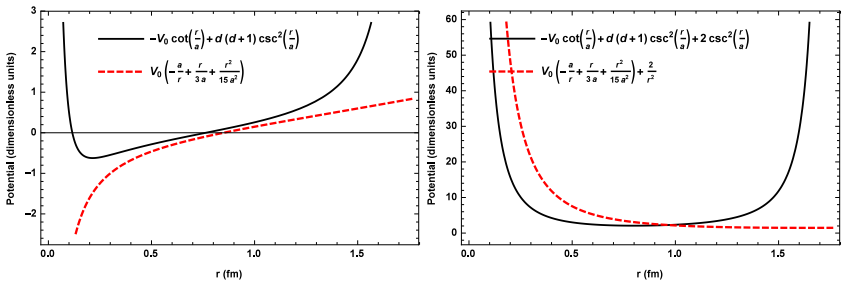
The load-bearing object is the hard-wall potential $V(r/a) = -V_0 \cot(r/a) + d(d+1)\csc^2(r/a)$, solved for nonzero angular momentum by writing the centrifugal term as $1/r^2 \approx \csc^2(r/a)/a^2$. That identity converts the radial equation into the angular equation on a three-sphere $S^3$, whose isometry $SO(4)$ lies inside the conformal group $SO(2,4)$; the $d$-term then plays the role of a conformal-symmetry perturbation. The closed-form energies follow from a generalized hypergeometric solution method, and the wave functions are expressed through finite orthogonal polynomials with an orthogonality relation inherited from the sphere.
What would settle it
Numerically solve the radial wave equation for the same potential with the true centrifugal term $1/r^2$ and compare the excited-state masses to the closed-form values in Tables 1 and 2: if the shifts are larger than the experimental uncertainties, the reported ``exact'' spectrum belongs to the approximated potential, not the physical one.
Extended reading notes
Core claim
The central discovery is that the exact solution of the hard-wall cotangent-plus-cosecant-squared potential, under the approximation that replaces $1/r^2$ by $\csc^2(r/a)/a^2$, turns the radial problem into motion on a three-dimensional sphere, whose isometry group $SO(4)$ is the maximal compact subgroup of the conformal group $SO(2,4)$. In the $d=0$ limit the energy formula $E_{n\ell} = \frac{\hbar^2}{2\mu a^2}(n+\ell+1)^2 - \frac{\hbar^2 V_0^2}{8\mu a^2 (n+\ell+1)^2}$ reproduces a spectrum degenerate in $N=n+\ell+1$, and the small $d$ term removes those degeneracies within each $SO(4)$ multiplet but does not mix different multiplets. Fitting the two parameters $a$ and $d$ to the observed $1S$ and $2P$ masses of charmonium and bottomonium produces predicted masses and root-mean-square radii in reasonable agreement with experiment, including the observed $c\bar c$ to $b\bar b$ radius ratio near $2:1$. The author concludes that conformal symmetry remains a viable dynamical symmetry in all regimes of QCD, with $d$ quantifying its violation in the heavy-flavor sector.
Load-bearing premise
The whole exact-solution construction rests on replacing the true centrifugal barrier $1/r^2$ by $\csc^2(r/a)/a^2$, which is accurate only for $r/a \ll 1$, while the wave functions extend all the way to the hard wall at $r = a\pi$.
Editorial extensions
If this is right
- One parameter set $(a,d,V_0,\mu)$ yields both the mass spectra and the root-mean-square radii for each quarkonium family.
- At $d=0$, states with the same $N=n+\ell+1$ are degenerate, explaining near-degeneracies such as $2S$–$1P$; the small fitted $d$ lifts these degeneracies without mixing multiplets.
- The model reproduces the signs of the level splittings but underestimates their magnitudes, so improved splittings are expected from relativistic kinematics.
- The charmonium-to-bottomonium radius ratio comes out close to the experimental $2:1$, driven mainly by the ratio of the fitted wall sizes $a$, indicating stronger localization of the $b\bar b$ system.
- The fitted $d$ increases from charm to bottom by a factor of about $1.6$, consistent with the larger heavy-quark mass causing a stronger conformal-symmetry violation.
Reading between the lines
- Inference: because the cosecant substitution for the centrifugal term is accurate only for $r/a \ll 1$, the ``exact'' formula may be an approximate description of the physical potential; a numerical solution with the true $1/r^2$ term would show how much the excited states change.
- Inference: the clean mass dependence of $d$ suggests a future model could parameterize $d$ as a function of quark mass and extend the same potential to other flavors, such as strangeonium or toponium.
- Inference: if conformal symmetry is genuinely dynamical here, the same wave functions should control transition rates and decay constants; computing those observables would test the model beyond masses and radii.
Signed reviews
Editorial analysis
A structured set of objections, weighed in public.
Referee Report
Summary. The paper solves the radial Schrödinger equation for a hard-wall trigonometric Rosen-Morse potential, after replacing the centrifugal term 1/r^2 by csc^2(r/a)/a^2, using the Nikiforov-Uvarov method. It obtains closed-form energy eigenvalues and wave functions in terms of Romanovski polynomials, fits the potential parameters a and d to the 1S and 2P masses of charmonium and bottomonium, and presents predicted mass spectra and root-mean-square radii. The central claim is that a small conformal-symmetry-breaking parameter d suffices to describe heavy quarkonia and that conformal symmetry remains a viable dynamical symmetry in the heavy-flavor sector.
Significance. If the central claims were established, the paper would provide a simple analytic potential model for heavy quarkonia with closed-form wave functions and an explicit dynamical-symmetry interpretation. Strengths include the self-contained NU derivation, explicit polynomial wave functions, and detailed comparison tables for both c-cbar and b-bbar. However, the two load-bearing issues identified below—the inconsistent printed eigenvalue formula and the uncontrolled centrifugal approximation—currently prevent the results from supporting the conformal-symmetry interpretation. The empirical agreement is also more modest than the text claims, and the smallness of d is in part a fit outcome.
major comments (4)
- [Sec. 2.2, Eq. (29)] The printed energy formula is inconsistent with the derivation. Solving the second condition in Eq. (22) for the dimensionless energy gives E = (hbar^2/(2 mu a^2))[(alpha-1)^2 - V0^2/(4(alpha-1)^2)], i.e. Eq. (29) should contain (alpha-1)^2, not (-alpha-1)^2, in both places. For d=0, alpha = -(n+ell), so (alpha-1)^2 = (n+ell+1)^2, which reproduces Eq. (30). The printed version gives (-alpha-1)^2 = (n+ell-1)^2; for the 1P state (n=0, ell=1, d=0) it yields zero energy, contradicting the value 3.333 GeV in Table 1. Because every numerical result in the paper is generated from this formula, the inconsistency is load-bearing and must be corrected.
- [Sec. 2.2, Eq. (16)] The replacement 1/r^2 ≈ csc^2(r/a)/a^2 is introduced with the stated condition r/a << 1, but the wave functions are supported on the full interval [0, a*pi]. With the fitted values a=0.56 fm for c-cbar and a=0.29 fm for b-bbar, the rms radii in Table 3 (0.85-1.03 fm and 0.44-0.52 fm) correspond to r/a values around 1.5-1.8, where the csc^2 approximation differs from the true 1/r^2 term by factors of 1.4 at r/a=1 and 2.5 at r/a=pi/2. Thus Eq. (29) is the exact spectrum of a different potential, one with a csc^2 barrier, rather than of Eq. (11) with the true centrifugal term. The SO(4)/conformal interpretation follows directly from the csc^2 form and therefore does not automatically apply to the flat-space potential. The authors should quantify the error by solving the flat-space equation with the true 1/r^2 term numerically and comparing the resulting spectra.
- [Sec. 3.1, Tables 1-2] The claim of 'pretty good agreement' with data is not supported by the numbers. In Table 1 the 2S charmonium mass is off by -315 MeV and the 3S by -231 MeV; in Table 2 the 2S bottomonium mass is off by -234 MeV. These deviations are large compared with the typical splittings being modeled. Since the 1S and 2P masses are fitted by construction, the predictive content of the model is limited to the remaining states, and those show systematic deviations. The text should report a quantitative measure of fit quality and should not use 'good agreement' without qualification, especially in light of the paper's own statement in Sec. 4 that the level splittings are 'strongly underestimated.'
- [Sec. 3.1 and Sec. 4] The smallness of d is presented as evidence that conformal symmetry is only mildly broken, but d is one of two parameters fitted to the 1S and 2P masses. The fitted value of d is therefore an output of the fit, not a prediction, and cannot by itself support the claim that conformal symmetry is a viable dynamical symmetry. The paper should state this explicitly and identify a test of the symmetry-breaking parameter that does not rely on the fitted states, such as the rms radii or the relative splittings among the higher states.
minor comments (5)
- [Sec. 2.2, Eq. (16)] The condition r/a << 1 is stated but never quantified; please specify the range over which the approximation is intended to hold and compare it with the actual support of the wave functions used in the fits.
- [Sec. 3.2, Eqs. (59) and (63)] The ratio in Eq. (59) is computed from the model values in Table 3, yet the text describes the closed-form result in Eq. (63) as 'pretty close to the experimental one given in (59).' Equation (59) is not an experimental quantity; this wording should be corrected.
- [Sec. 3.2, Eqs. (60)-(62)] The closed-form rms expression uses the small-angle approximation sin^nu(r/a) ≈ (r/a)^nu and extends the integration to infinity, although the original problem has a hard wall at r=a*pi. The full integral is already computed for Table 3, so the approximate closed form is unnecessary and its use should be justified or removed.
- [Sec. 3.1, Tables 1-2] The experimental values are cited collectively to Refs. [18,19], but individual states would benefit from explicit PDG names and uncertainties; some rows in the comparison column are left as '—' without explanation.
- [General] There are numerous typographical and notation issues, including 'Such"odinger,' inconsistent use of H_tRM(r/a) versus H(r/a), and the undefined symbols V_c and U0 in the text around Eq. (18); these should be cleaned up in a revision.
Circularity Check
Fit anchors and fitted d are reused as evidence; un-fitted levels and radii remain genuine predictions.
-
fitted input called prediction
[Section 3.1 (Mass spectra), after Eq. (47)]
"By adjusting masses of 1S and 2P states of b¯b and c¯c mesons, we extracted the values of these parameters for each one of the two sectors. Then, the remaining states in each one of the two spectra are predicted using the obtained parameters according to Eqs. (47) and (29). The results are presented in Tables (1-2). These show that our energy formula can reproduce the masses in pretty good agreement with data."
The 1S and 2P rows in Tables 1 and 2 are the input data used to fix a and d, so their agreement is automatic and not a test. The 'pretty good agreement' claim mixes these two fitted anchor states per sector with the genuinely predicted remaining levels. The paper is transparent about the fit, but the tabulated validation of the previously fitted states is circular by construction.
-
self definitional
[Abstract and Section 4 (Conclusions)]
"We observe that a relatively small conformal symmetry perturbing term in the potential suffices to achieve good agreement with data. ... Our major conclusion is that conformal symmetry seems to remain present as a viable dynamical symmetry in all regimes of QCD."
The 'conformal symmetry perturbing term' is d(d+1)csc^2(r/a), and d is one of the two parameters fitted to the 1S and 2P masses in Section 3.1. Its fitted smallness is then presented as evidence that conformal symmetry is only mildly broken. The model already defines this term as a conformal-symmetry perturbation after Eq. (17), so concluding from the small fitted d that conformal symmetry is viable restates the ansatz rather than testing it independently.
full rationale
The exact-solution part of the paper is not circular: given the csc^2 replacement in Eq. (16), the NU derivation and the energy formula Eq. (29) follow by straightforward algebra, and the model is then used to predict states not involved in the fit. No load-bearing self-citation chain appears; the cited works are by other authors. The main circularity is limited to (i) presenting the 1S and 2P anchor masses, which were used to fix a and d, as part of the 'good agreement' validation, and (ii) reusing the small fitted value of d as evidence for the conformal-symmetry interpretation. The remaining levels, the splittings, and the r.m.s. radii are genuine extrapolations from the fitted parameters, which keeps the overall circularity score moderate. The uncontrolled approximation in Eq. (16), where 1/r^2 is replaced by csc^2(r/a)/a^2 despite wave functions extending to r/a = pi, is a serious correctness concern about whether the solved potential is the original one, but it is not a circularity and is not counted in this score.
Assumptions & free parameters
free parameters (4)
- a (potential scale / hard-wall radius) =
c_c: 2.822 GeV^-1 (0.56 fm); b_b: 1.468 GeV^-1 (0.290 fm)
- d (conformal symmetry perturbing parameter) =
c_c: 0.109; b_b: 0.131
- alpha_s (strong coupling setting V0 = alpha_s N_c) =
0.2 (chosen)
- Constituent quark masses =
m_c = 1.50 GeV, m_b = 4.67 GeV
assumptions (6)
- standard math The Nikiforov-Uvarov method correctly produces polynomial solutions under the stated conditions on tau, sigma, and sigma_tilde.
- domain assumption The hard-wall boundary conditions u(0) = u(a*pi) = 0 and the infinite wall at r = a*pi are physical for quarkonia.
- ad hoc to paper The centrifugal term approximation 1/r^2 is approximately csc^2(r/a)/a^2 for the relevant range.
- domain assumption For d = 0, the equation with the approximate centrifugal term represents quantum motion on S3 with SO(4) symmetry, the maximal compact subgroup of the conformal group SO(2,4).
- domain assumption The non-relativistic Schrödinger equation is adequate for heavy quarkonia despite the large quark masses.
- standard math The orthogonality and completeness properties of the Romanovski polynomials are as stated in the cited reference [16].
Cite this review
Pith. "Pith review of Heavy quarkonia properties from a hard-wall confinement potential model with conformal symmetry perturbing effects." pith.science (2026). https://pith.science/paper/BFPNMCUZ
@misc{pith2026190807707,
  author       = {Pith},
  title        = {Pith review of: Heavy quarkonia properties from a hard-wall confinement potential model with conformal symmetry perturbing effects},
  year         = {2026},
  howpublished = {\url{https://pith.science/paper/BFPNMCUZ}},
  note         = {Machine review of arXiv:1908.07707}
}
abstract
Heavy $c\bar c$ and $b\bar b $ quarkonia are considered as systems confined within a hard-wall potential shaped after a linear combination of a cotangent-- with a square co-secant function. Wave functions and energy spectra are then obtained in closed forms in solving by the Nikiforov-Uvarov method the associated radial Schr\"{o}dinger equation in the presence of a centrifugal term. The interest in this potential is that in one parametrization it can account for a conformal symmetry of the strong interaction, and in another for its perturbation, a reason for which we here employ it to study status of conformal symmetry in the heavy flavor sector. The resulting predictions on heavy quarkonia mass spectra and root mean square radii are compared with the available experimental data, as well as with predictions by other theoretical approaches. We observe that a relatively small conformal symmetry perturbing term in the potential suffices to achieve good agreement with data.
Figures


Figures from the paper (1 more)

Reference graph
Works this paper leans on
-
[1]
Hsiang-nan Li, Guey-Lin Lin, and Wei-Min Zhang, Proceed ings of the Fifth International Workshop Particle Physics Phenomenology, World Scientific Publishing Co. Pte . Ltd (2001)
work page 2001
-
[2]
N. Brambilla et.al, Heavy Quarkonium Physics , CERN Y ellow Report, CERN-2005-005, Geneva: CERN, 2005.- 487 p
work page 2005
-
[3]
Current Topics in Heavy Quarkonium Physics
N. Brambilla, Current T opics in Heavy Quarkonium Physics, arXiv:1106.1051v1 [hep-ph]
-
[4]
A. Andronic et al., Heavy-flavour and quarkonium product ion in the LHC era: from protonproton to heavy- ion collisions, Eur. Phys. J. C 76, no. 3, 107 (2016)
work page 2016
-
[5]
A. Deur, V . Burkert, J. P . Chen, and W . Korsch, Determinat ion of the effective strong coupling constant αS,g1(Q2) from CLAS spin structure function data, Phys. Lett. 665, 349 (2008)
work page 2008
-
[6]
N. Rosen and Philip M. Morse, On the Vibrations of Polyato mic Molecules, Phys. Rev. 42, 210 (1932)
work page 1932
-
[7]
M. Kirchbach and C. B. Compean, Modelling duality betwee n bound and resonant meson spectra by means of free quantum motions on the de Sitter space-time dS4, Eur. Phys. J A 52 210 (2016). Addendum:M. Kirchbach, C. B. Compean, Eur. Phys. J. A 53 65 (2017)
work page 2016
-
[8]
V . V . Gritsev, Y u. A. Kurochkin, Model of excitations in quantum dots based on quantum mechanics in spaces of constant curvature, Phys. Rev. B, 64 035308 (2001)
work page 2001
Show all 25 references
-
[9]
Jean-Michel Caillol, Martin Trulsson, A new dipolar pot ential for numerical simulations of polar fluids on the 4D hypersphere, J. Chem. Phys. 141, 124111 (2014)
2014
-
[10]
Kirchbach and C.B
M. Kirchbach and C.B. Compean, Protons electromagneti c form factors from a non-power confinement po- tential, Nucl. Phys. A (2018). 14
2018
-
[11]
Compean and M
C.B. Compean and M. Kirchbach, The trigonometric Rosen Morse potential in the supersymmetric quantum mechanics and its exact solutions, J. Phys. A: Math. Gen. 39 5 47 (2006)
2006
-
[12]
Hall, Nasser Saad, Exact and ap proximate solutions of Schr¨ odingers equation for a class of trigonometric potentials, Cent
Hakan Ciftci, Richard L. Hall, Nasser Saad, Exact and ap proximate solutions of Schr¨ odingers equation for a class of trigonometric potentials, Cent. Eur. J. Phys. 11(1 ), 37-48 (2013)
2013
-
[13]
S. A. S. Ahmed and L. Buragohain, Generation of new class es of exactly solvable potential from the trigono- metric Rosen-Morse potential, Indian J. Phys. 84 (6), 741-7 44 (2010)
2010
-
[14]
Chun-Sheng Jia, Tao Chen, Liang-Zhong Yi, Shu-Rong Lin , Equivalence of the deformed RosenMorse po- tential energy model and Tietz potential energy model, J Mat h Chem 51:21652172 (2013)
2013
-
[15]
A F Nikiforov and V B Uvarov, Special Functions of Mathem atical Physics, (Birkhauser,Basel, 1988)
1988
-
[16]
Raposo, Hans J
Alvaro P . Raposo, Hans J. Weber, David E. AlvarezCastil lo, Mariana Kirchbach, Romanovski polynomials in selected physics problems, CEJP 5(3) 253284 (2007)
2007
-
[17]
Bhardwaj, and Fakir Chand, Mass Spectr a of Heavy and Light Mesons Using Asymptotic Iteration Method, Commun
Richa Rani, S.B. Bhardwaj, and Fakir Chand, Mass Spectr a of Heavy and Light Mesons Using Asymptotic Iteration Method, Commun. Theor. Phys. 70 179 (2018)
2018
-
[18]
Tanabashi et al
M. Tanabashi et al. (Particle Data Group), Phys. Rev. D 9 8, 030001 (2018)
2018
-
[19]
Olive et
K.A. Olive et. al. (Particle Data Group), Chinese Physi cs C V ol. 38, No. 9 090001 (2014)
2014
-
[20]
Group Theory
Robert Gilmore, “Group Theory”, in Mathematical T ools for Physicists, ed. Michael Grinfeld (Wiley-VCH, 2015), Chpt 5.11-5.12.4
2015
-
[21]
Tapashi Das, D. K. Choudhury, K. K. Pathak, RMS and charg e radii in a potential model, Indian J Phys 90: 1307 (2016)
2016
-
[22]
Swanson, B a nd Bs meson spectroscopy, Phys
Stephen Godfrey, Kenneth Moats, and Eric S. Swanson, B a nd Bs meson spectroscopy, Phys. Rev. D 94, 054025 (2016)
2016
-
[23]
Eichten, Chris Quigg, Mesons with Beauty and Ch arm: Spectroscopy, Phys.Rev.D49:5845-5856,1994
Estia J. Eichten, Chris Quigg, Mesons with Beauty and Ch arm: Spectroscopy, Phys.Rev.D49:5845-5856,1994
1994
-
[24]
Maezawa and P
Y . Maezawa and P . Petreczky, Quark masses and strong cou pling constant in 2+1 flavor QCD, Phys. Rev. D 94, 034507 (2016)
2016
-
[25]
Gonz´ alez, Long-distance behavior of the quark-ant iquark static potential
P . Gonz´ alez, Long-distance behavior of the quark-ant iquark static potential. Application to light-quark mesons and heavy quarkonia, Phys. Rev. D 80, 054010 (2009). 15
2009
Reviewed August 14, 2026 · model on record in the stance chip above.
Discussion (0). Continue with ORCID to comment.