REVIEW 4 major objections 6 minor 67 references
Understanding the transition from paroxysmal to persistent atrial fibrillation from micro-anatomical re-entry in a simple model
T0 review · 4 major / 6 minor · reviewed 2026-08-14 · deepseek-v4-flash
Pith's one-line read This paper claims that in a simple model of atrial fibrillation, persistent episodes arise from re-entrant circuits that are easier to activate than to deactivate, with no change in model parameters.
desk verdict A careful dissection of the CMP model that identifies asymmetric re-entrant circuits as the driver of persistent AF, with a real but fixable weakness in the cCMP control. read the letter →
The pith
A machine-rendered reading of the paper's core claim, the machinery that carries it, and where it could break.
The reading
What carries the argument
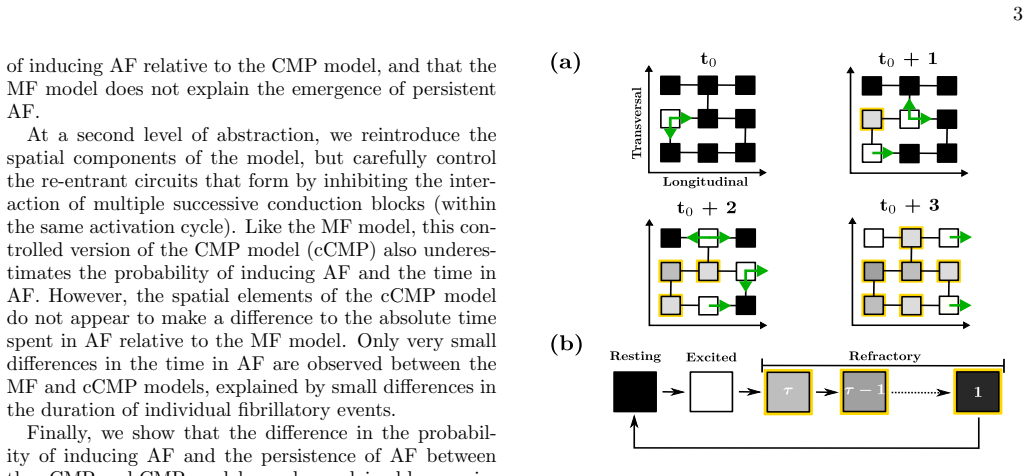
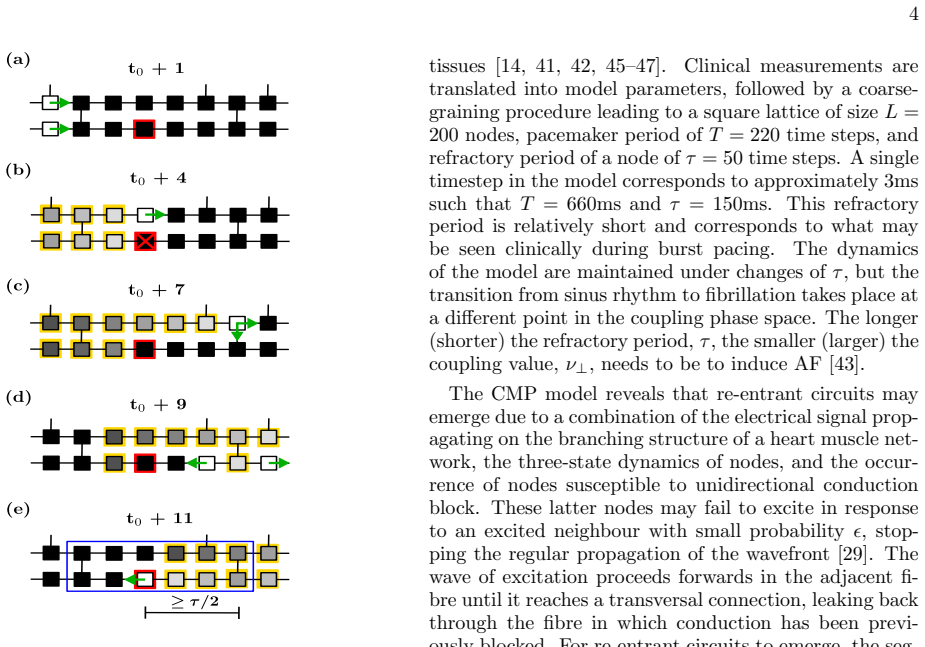
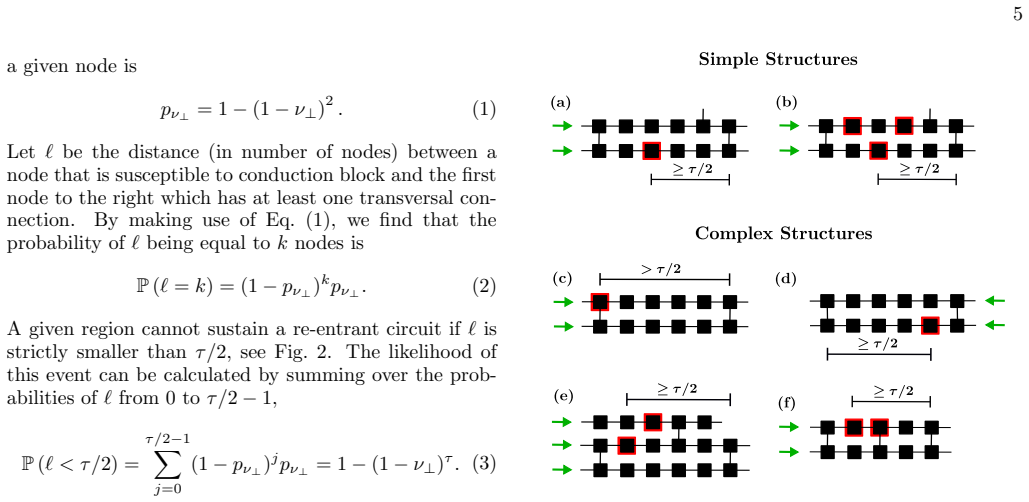
The load-bearing object is the CMP lattice model's 'critical structure', a local arrangement of a conduction-blocking node and a transverse-connection-free segment of length at least $\tau/2$ that can host a re-entrant circuit when the block fails. The paper classifies structures as simple or complex depending on how many successive conduction-block failures are needed to activate and to terminate them. Two auxiliary constructions carry the argument: a mean-field model in which each simple critical structure is a particle undergoing birth-death dynamics with rates set by $\epsilon/T$ and $\epsilon/\langle \ell \rangle$, and a controlled CMP model (cCMP) in which conduction-blocking nodes are placed only on isolated simple-critical segments so that complex circuits cannot form. The difference in AF probability and time in AF between the full model and these simplifications is what isolates the contribution of asymmetric complex circuits. The analytic risk formula $R=1-[1-(1-\nu_\perp)^\tau]^{\delta L^2}$ provides the baseline against which the model's excess AF is measured.
What would settle it
Run the cCMP construction but instead of deleting the 'extra' conduction-blocking nodes, keep them in place with failure probability set to zero (inert nodes), so the lattice geometry and connectivity are identical to the CMP model while no conduction block can occur outside simple segments. If time in AF in this inert-node control matches the cCMP value, the gap is due to the presence of blocking-prone nodes in complex configurations; if it rises toward the CMP value, the paper's attribution to complex circuits is not the whole story.
Extended reading notes
Core claim
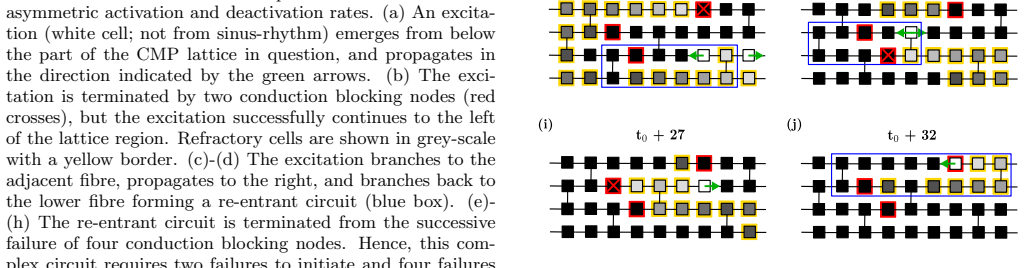
The paper's central claim is that persistent AF in the CMP model is caused by re-entrant circuits with an asymmetry in the probability of activation relative to deactivation. A simple circuit turns on when one susceptible node fails and turns off when one susceptible node fails, so its on and off rates are balanced, and a mean-field birth-death description captures its behaviour; the continuous mean-field solution shows that a finite set of such circuits cannot keep the system in AF almost all the time. Complex circuits break this balance: some need two successive cell failures to initiate but four to terminate, and others are coupled so that the termination of one circuit immediately re-ignites a neighbour. With these circuits present, the same lattice parameters can generate fibrillatory episodes from a few seconds to more than a month, and the gap between the full model and the controlled model collapses as the density of conduction-blocking nodes is reduced and complex circuits become rare.
Load-bearing premise
The argument that the cCMP-CMP gap is caused by complex asymmetric circuits assumes that removing all conduction-blocking nodes that are not part of an isolated simple critical segment changes nothing else about wavefront collisions, refractoriness, or suppression of neighbouring circuits; if deleting those nodes alters wave dynamics for reasons unrelated to circuit complexity, the measured gap could be produced without the proposed mechanism.
Editorial extensions
If this is right
- If the claim is correct, the full spectrum of AF persistence in the model emerges without changing any parameter; a single fixed coupling value $\nu_\perp=0.11$ can yield sinus rhythm, paroxysmal AF, and persistent AF depending only on the local positions of vulnerable nodes.
- Mean-field birth-death descriptions with a finite number of independent drivers cannot explain persistent AF, so any model that treats AF persistence as a simple on/off balance of fixed-rate drivers will miss the mechanism.
- Reducing the fraction of conduction-blocking nodes $\delta$ suppresses complex circuits and makes the full model's behaviour coincide with the controlled model, identifying high local density of vulnerable nodes as proarrhythmic in a way that simple-circuit count alone does not capture.
- Ablation strategies would preferentially need to target complex or coupled structures whose termination requires many simultaneous failures, rather than merely any region that can host a simple re-entrant circuit.
Reading between the lines
- A testable extension is to build an 'inert-node control': in a cCMP lattice, keep the deleted conduction-blocking nodes in place but set their failure probability to zero; if the cCMP-CMP gap persists, connectivity changes, not circuit asymmetry, are responsible.
- If the asymmetry mechanism generalizes, the distribution of AF episode durations in a fixed patient substrate should be heavy-tailed over many orders of magnitude, much wider than a single exponential; clinical event-duration histograms could be inspected for such spread before attributing persistent AF to remodelling.
- The number of required simultaneous failures suggests a quantitative link between local fibrosis density and persistence: scanning a realistic fibre map for regions where multiple vulnerable nodes lie within one activation cycle of a re-entry path should predict where persistent drivers are anchored.
Signed reviews
Editorial analysis
A structured set of objections, weighed in public.
Referee Report
Summary. This paper analyzes the Christensen-Manani-Peters (CMP) cellular-automaton model of atrial fibrillation to explain why different simulations at identical parameters produce AF episodes ranging from seconds to months. The authors first derive a mean-field (MF) birth-death model in which the number of 'simple' re-entrant circuits, counted from the lattice, determines AF statistics, and they show analytically that this MF model underestimates time in AF and cannot produce persistent AF for realistic N. They then introduce a 'controlled' CMP (cCMP) model in which conduction-block-susceptible nodes are placed only on isolated segments that can support simple re-entrant circuits, and they compare this with a random-placement CMP copy. The gap in AF probability and time in AF between CMP and cCMP is attributed to complex critical structures whose activation requires fewer conduction-block failures than their deactivation, including self-contained asymmetric structures and coupled structures that re-initiate on termination. The paper concludes that persistent AF arises from these asymmetric re-entrant circuits, so that parameter variation or remodelling is not needed to explain diverse AF persistence.
Significance. If the central claim holds, the paper provides a mechanism for the paroxysmal-to-persistent transition in a minimal model, with potential implications for how local fibrosis architecture, rather than global burden, determines AF persistence. The work has genuine strengths: the continuous-time mean-field solution in Appendix A is an exact derivation; the enhanced MF model in Appendix B is a useful robustness check; the simulations extend to 10^9 timesteps, much longer than typical biophysical models; and the structural examples in Figs. 9 and 10 are clearly presented. The paper also explicitly acknowledges several limitations of the CMP model and the difficulty of verifying complete detection of critical structures. However, the central evidence for the mechanism rests on a controlled comparison that is confounded by changes in total block-node density, and the inference to higher-order structures is not quantitatively validated. These issues are load-bearing for the main claim, so the paper requires major revision rather than acceptance in its current form.
major comments (4)
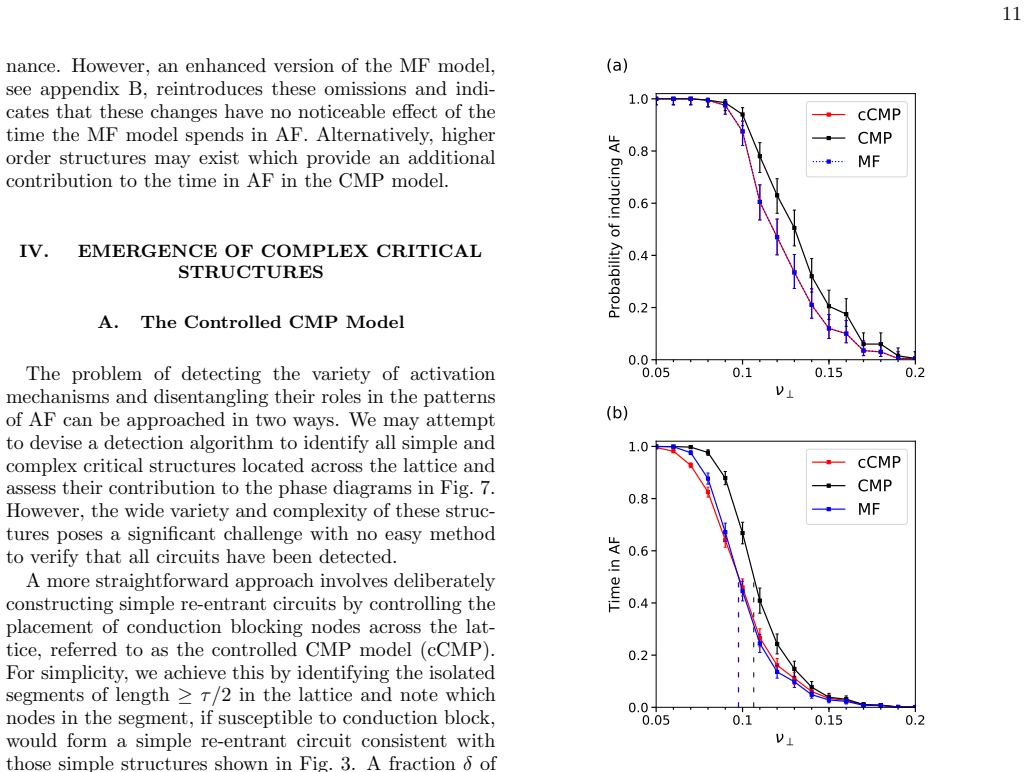
- [Section IV A] The cCMP control does not isolate complex critical structures because it changes the total density of conduction-blocking nodes. In cCMP, block-susceptible nodes are placed only on eligible nodes within isolated segments of length at least tau/2, at fraction delta of those eligible nodes, while the CMP comparison places block nodes at probability delta on all L^2 nodes. The two models therefore differ not only in the presence of multi-block complex structures but also in total block-node count, refractory landscape, and wavefront-collision effects. The conclusion in Section IV B that the CMP-cCMP gap is caused by complex asymmetric structures requires a control in which total block-node density and, ideally, the number of simple critical structures are matched while only the complex multi-block configurations are suppressed.
- [Section IV B] The statement that 'by construction, the cCMP and CMP models contain the same number of simple critical structures' is not supported by the construction described in Section IV A. The cCMP model places block nodes only on selected segment nodes, whereas the CMP copy places them randomly across the whole lattice; these two procedures do not generally yield the same number of simple critical structures. If the counts differ, the subsequent inference that 'some higher order critical structures must exist' is a non sequitur, because the observed gap could be due to a different number of simple structures or to different total density rather than to complex structures.
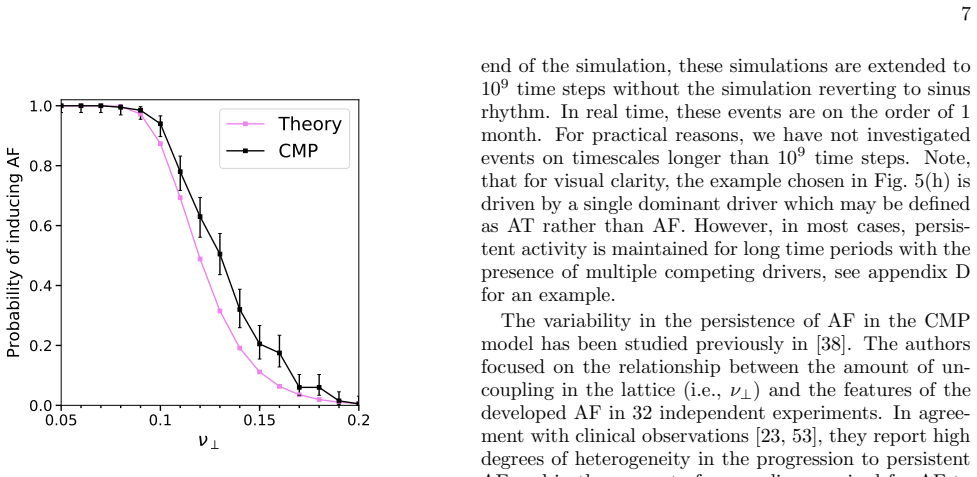
- [Section IV B and Fig. 12] The collapse of the CMP and cCMP curves at low delta in Fig. 12 is presented as evidence that complex structures dominate at high delta, but this collapse is also exactly what would be expected if the gap were driven by the total density of conduction-blocking nodes, since the absolute density difference between the two models shrinks as delta decreases. The figure therefore does not discriminate between the proposed asymmetric-structure mechanism and a generic density effect. A matched-density control, or a direct quantitative count of complex structures, is needed to make the mechanism claim.
- [Section IV A and Section VI] The paper itself states in Section IV A that there is 'no easy method to verify that all circuits have been detected,' and the central mechanism is supported by hand-selected examples (Figs. 9-11) and by elimination through the cCMP comparison. Given the confound identified above, the existence and causal role of asymmetric complex structures is not quantitatively established. The authors should either provide a validated detection algorithm for complex structures or design a cleaner intervention that affects only multi-block complex configurations.
minor comments (6)
- [Abstract] There is a typo in the first sentence: 'arrhytmia' should be 'arrhythmia', and later 'assymetry' should be 'asymmetry'.
- [Figs. 7, 8, 12] The phase diagrams show averages over 200 simulations but no error bars or confidence intervals, making it difficult to assess whether the reported differences, especially near the sharp transitions, are statistically meaningful. Adding confidence bands would strengthen the quantitative claims.
- [Section II C, Eq. (5)] The AF threshold is defined as 1.1 times L, which equals 220 for L=200, but the text states '1.1×L (220) nodes' without noting that this is specific to the chosen lattice size. Please clarify whether the threshold is 220 nodes or 1.1L generally.
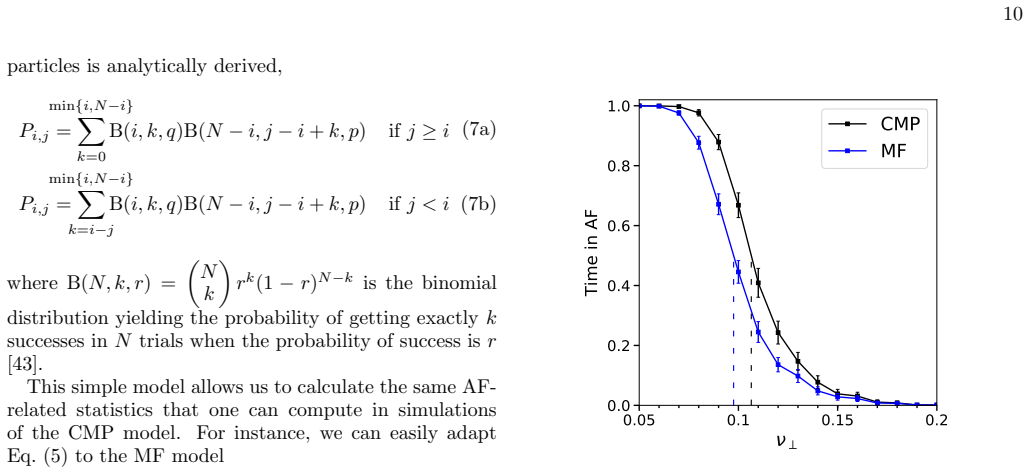
- [Section III] The statement that the MF model 'spends significantly less time in AF' than the CMP model is not accompanied by any statistical test or uncertainty estimate; a quantitative comparison of distributions or confidence intervals would be appropriate.
- [Appendix B] The eMF model is described as 'perfectly compatible' with the MF model, but again no error bars or statistical measures are given; a quantitative statement of compatibility would be more informative.
- [Appendix E, Fig. 19] The error bars in Fig. 19 are stated to be 95% confidence intervals over 50 simulations, but the main-text figures (e.g., Figs. 7 and 8) do not report the number of simulations beyond '200 simulations'; please make the simulation counts and uncertainty measures consistent throughout.
Circularity Check
No circularity: the MF/cMF calculations are genuine derivations from calibrated inputs, and the cCMP comparison is an external controlled simulation whose main weakness is a confound, not a definitional reduction.
full rationale
The paper's derivation chain is self-contained rather than circular. The mean-field model is calibrated from the CMP lattice (N counted from simple critical structures, p and q from epsilon, T, and <ell>), and the continuous-time formula Eq. (A7) follows from a genuine master-equation solution; the MF/cMF underprediction of CMP time-in-AF is an empirical comparison to simulation output, not a quantity defined to match it. The cCMP construction is a controlled intervention: block-susceptible nodes are restricted to isolated segments of length at least tau/2, and the CMP baseline is an independent copy with random block nodes at probability delta, so the CMP-cCMP gap is measured rather than postulated. The risk curve Eq. (4) and AF definition Eq. (5) are cited from prior work by the same group, but they are not load-bearing in a circular way: Eqs. (1)-(4) are re-derived geometrically in the paper and Eq. (5) is a threshold whose qualitative conclusions are robust and which is checked against simulated electrograms. The genuine weakness is a confound: CMP has approximately delta L^2 block nodes while cCMP has roughly delta M with M much smaller than L^2, so the gap conflates higher-order critical structures with total block-node density and wavefront-interaction effects; the 'therefore' in Section IV B overstates what the control establishes. That is a correctness risk, not a circular reduction of the conclusion to its inputs, so no circular step is recorded.
Assumptions & free parameters
free parameters (3)
- AF threshold in active nodes =
220 active nodes (1.1L)
- Failure probability epsilon =
0.05
- Default fraction of conduction-block nodes delta =
0.01 (varied in Fig. 12)
assumptions (4)
- ad hoc to paper Simple critical structures activate with rate epsilon/T in sinus rhythm and epsilon/<l> in AF, and deactivate with rate epsilon/<l> (Eq. 6).
- ad hoc to paper The number N of simple critical structures detected by inspecting the CMP lattice fully represents the system's potential re-entrant circuits.
- domain assumption The cCMP model differs from the CMP model only in the placement of conduction-blocking nodes.
- domain assumption One simulation time step equals approximately 3 ms of real time.
Cite this review
Pith. "Pith review of Understanding the transition from paroxysmal to persistent atrial fibrillation from micro-anatomical re-entry in a simple model." pith.science (2026). https://pith.science/paper/BFZAU5OC
@misc{pith2026190801646,
  author       = {Pith},
  title        = {Pith review of: Understanding the transition from paroxysmal to persistent atrial fibrillation from micro-anatomical re-entry in a simple model},
  year         = {2026},
  howpublished = {\url{https://pith.science/paper/BFZAU5OC}},
  note         = {Machine review of arXiv:1908.01646}
}
read the original abstract
Atrial fibrillation (AF) is the most common cardiac arrhytmia, characterised by the chaotic motion of electrical wavefronts in the atria. In clinical practice, AF is classified under two primary categories: paroxysmal AF, short intermittent episodes separated by periods of normal electrical activity, and persistent AF, longer uninterrupted episodes of chaotic electrical activity. However, the precise reasons why AF in a given patient is paroxysmal or persistent is poorly understood. Recently, we have introduced the percolation based Christensen-Manani-Peters (CMP) model of AF which naturally exhibits both paroxysmal and persistent AF, but precisely how these differences emerge in the model is unclear. In this paper, we dissect the CMP model to identify the cause of these different AF classifications. Starting from a mean-field model where we describe AF as a simple birth-death process, we add layers of complexity to the model and show that persistent AF arises from re-entrant circuits which exhibit an asymmetry in their probability of activation relative to deactivation. As a result, different simulations generated at identical model parameters can exhibit fibrillatory episodes spanning several orders of magnitude from a few seconds to months. These findings demonstrate that diverse, complex fibrillatory dynamics can emerge from very simple dynamics in models of AF.
Figures
Figures from the paper (18 more)







Reference graph
Works this paper leans on
-
[1]
N. J. Patel, V. Atti, R. D. Mitrani, J. F. Viles-Gonzalez, and J. J. Goldberger, Heart 104, 1989 (2018)
work page 2018
-
[2]
R. G. Hart and J. L. Halperin, Stroke 32, 803 (2001)
work page 2001
- [3]
-
[4]
U. Schotten, D. Dobrev, P. G. Platonov, H. Kottkamp, and G. Hindricks, J. Intern. Med. 279, 428 (2016)
work page 2016
-
[5]
V. V. Fedorov and B. J. Hansen, JACC: Clin. Electro- physiol. 4, 84 (2018)
work page 2018
- [6]
-
[7]
I. Mann, B. Sandler, N. Linton, and P. Kanagaratnam, Arrhythm. Electrophysiol. Rev. 7, 49 (2018)
work page 2018
-
[8]
H. Calkins, G. Hindricks, R. Cappato, Y.-H. Kim, E. B. Saad, L. Aguinaga, J. G. Akar, V. Badhwar, J. Brugada, J. Camm, et al. , Heart Rhythm 14, e275 (2017)
work page 2017
Show all 67 references
-
[9]
Shivkumar, K
K. Shivkumar, K. A. Ellenbogen, J. D. Hummel, J. M. Miller, and J. S. Steinberg, J. Cardiovasc. Electrophysiol. 23, 1277 (2012)
2012
-
[10]
S. Lee, J. Sahadevan, C. M. Khrestian, I. Cakulev, A. Markowitz, and A. L. Waldo, Circulation 132, 2108 (2015)
2015
-
[11]
S. M. Narayan, D. E. Krummen, P. Clopton, K. Shiv- kumar, and J. M. Miller, J. Am. Coll. Cardiol. 62, 138 (2013)
2013
-
[12]
Ha¨ ıssaguerre, M
M. Ha¨ ıssaguerre, M. Hocini, A. Denis, A. J. Shah, Y. Ko- matsu, S. Yamashita, M. Daly, S. Amraoui, S. Zellerhoff, M.-Q. Picat, et al. , Circulation 130, 530 (2014)
2014
-
[13]
S. M. Narayan, M. N. Vishwanathan, C. A. B. Kowalewski, T. Baykaner, M. Rodrigo, J. A. B. Zaman, and P. J. Wang, Rev. Port. Cardiol. 36, 9 (2017)
2017
-
[14]
B. J. Hansen, J. Zhao, T. A. Csepe, B. T. Moore, N. Li, L. A. Jayne, A. Kalyanasundaram, P. Lim, A. Bratasz, K. A. Powell, et al. , Eur. Heart J. 36, 2390 (2015)
2015
-
[15]
B. J. Hansen, T. A. Csepe, J. Zhao, A. J. Ignozzi, J. D. Hummel, and V. V. Fedorov, Circ. Arrhythm. Electro- physiol. 9, e004398 (2016)
2016
-
[16]
T. A. Csepe, B. J. Hansen, and V. V. Fedorov, Trends Cardiovas. Med. 27, 1 (2017)
2017
-
[17]
Baykaner, A
T. Baykaner, A. J. Rogers, G. L. Meckler, J. A. B. Za- man, R. Navara, M. Rodrigo, M. Alhusseini, C. A. B. Kowalewski, M. N. Viswanathan, S. M. Narayan, et al. , Circ. Arrhythm. Electrophysiol. 11, e006119 (2018)
2018
-
[18]
Falkenberg, A
M. Falkenberg, A. J. Ford, A. C. Li, R. Lawrence, A. Ciacci, N. S. Peters, and K. Christensen, Phys. Rev. E 100, 062406 (2019)
2019
-
[19]
Atrial Fibrillation Follow-up Investigation of Rhythm Management (AFFIRM) Investigators, New England Journal of Medicine 347, 1825 (2002)
2002
-
[20]
Ha¨ ıssaguerre, P
M. Ha¨ ıssaguerre, P. Ja¨ ıs, D. C. Shah, A. Takahashi, M. Hocini, G. Quiniou, S. Garrigue, A. Le Mouroux, P. Le M´ etayer, and J. Cl´ ementy, New Engl. J. Med. 339, 659 (1998)
1998
-
[21]
Tutuianu, J
C. Tutuianu, J. Szilagy, R. Pap, and L. S´ aghy, Journal of atrial fibrillation 8, 1226 (2015)
2015
-
[22]
Sugihara, R
C. Sugihara, R. Veasey, N. Freemantle, S. Podd, S. Fur- niss, and N. Sulke, EP Europace 17, 864 (2015)
2015
-
[23]
Kottkamp, European Heart Journal 34, 2731 (2013)
H. Kottkamp, European Heart Journal 34, 2731 (2013)
2013
-
[24]
M. C. Wijffels, C. J. Kirchhof, R. Dorland, and M. A. Allessie, Circulation 92, 1954 (1995)
1995
-
[25]
T. E. Walters, A. Nisbet, G. M. Morris, G. Tan, M. Mearns, E. Teo, N. Lewis, A. Ng, P. Gould, G. Lee, S. Joseph, J. B. Morton, D. Zentner, P. Sanders, P. M. Kistler, and J. M. Kalman, Heart Rhythm 13, 331 (2016)
2016
-
[26]
Burstein and S
B. Burstein and S. Nattel, Journal of the American Col- lege of Cardiology 51, 802 (2008)
2008
-
[27]
Friedrichs, S
K. Friedrichs, S. Baldus, and A. Klinke, Frontiers in physiology 3, 214 (2012)
2012
-
[28]
P. G. Platonov, L. B. Mitrofanova, V. Orshanskaya, and S. Y. Ho, Journal of the American College of Cardiology 58, 2225 (2011)
2011
-
[29]
Christensen, K
K. Christensen, K. A. Manani, and N. S. Peters, Phys. Rev. Lett. 114, 028104 (2015)
2015
-
[30]
R. H. Clayton, O. Bernus, E. M. Cherry, H. Dierckx, F. H. Fenton, L. Mirabella, A. V. Panfilov, F. B. Sachse, G. Seemann, and H. Zhang, Prog. Biophys. Mol. Bio. 104, 22 (2011)
2011
-
[31]
S. A. Niederer, J. Lumens, and N. A. Trayanova, Nat. Rev. Cardiol. 16, 100 (2019)
2019
-
[32]
T. A. Gokhale, E. Medvescek, and C. S. Henriquez, Chaos 27, 093909 (2017)
2017
-
[33]
Makowiec, J
D. Makowiec, J. Wdowczyk, and Z. R. Struzik, Front. Physiol. 9, 1859 (2019)
2019
-
[34]
M. F. McGillivray, W. Cheng, N. S. Peters, and K. Chris- tensen, Roy. Soc. Open Sci. 5, 172434 (2018)
2018
-
[35]
Y. T. Lin, E. T. Y. Chang, J. Eatock, T. Galla, and R. H. Clayton, J. Royal Soc. Interface 14, 20160968 (2017)
2017
-
[36]
Falkenberg, D
M. Falkenberg, D. Hickey, L. Terrill, A. Ciacci, N. S. Peters, and K. Christensen, in 2019 Computing in Car- diology (CinC) (2019) pp. 1–4
2019
-
[37]
J. Zhao, T. D. Butters, H. Zhang, A. J. Pullan, I. J. LeGrice, G. B. Sands, and B. H. Smaill, Circ. Arrhythm. Electrophysiol. 5, 361 (2012)
2012
-
[38]
K. A. Manani, K. Christensen, and N. S. Peters, Phys. Rev. E 94, 042401 (2016)
2016
-
[39]
Zahid, H
S. Zahid, H. Cochet, P. M. Boyle, E. L. Schwarz, K. N. Whyte, E. J. Vigmond, R. Dubois, M. Hocini, M. Has- saguerre, P. Jas, and N. A. Trayanova, Cardiovascular Research 110, 443 (2016)
2016
-
[40]
Dharmaprani, M
D. Dharmaprani, M. Schopp, P. Kuklik, D. Chapman, A. Lahiri, L. Dykes, F. Xiong, M. Aguilar, B. Strauss, L. Mitchell, et al. , bioRxiv , 599142 (2019)
2019
-
[41]
R. A. Luke and J. E. Saffitz, J. Clin. Investig. 87, 1594 (1991)
1991
-
[42]
Verheule, E
S. Verheule, E. Wilson, T. Everett, S. Shanbhag, C. Golden, and J. Olgin, Circulation 107, 2615 (2003)
2003
-
[43]
K. A. Manani, Imperial College London PhD Thesis (2016)
2016
-
[44]
See Supplemental Material at [URL will be inserted by publisher] for videos, full schematic critical structure di- agrams, real critical structures and snapshots of the full CMP model domain
-
[45]
R. M. Lang, M. Bierig, R. B. Devereux, F. a. Flach- skampf, E. Foster, P. a. Pellikka, M. H. Picard, M. J. Roman, J. Seward, J. S. Shanewise, S. D. Solomon, K. T. Spencer, M. S. J. Sutton, and W. J. Stewart, J. Am. Soc. Echocardiogr. 18, 1440 (2005)
2005
-
[46]
Maceira, J
A. Maceira, J. Cos´ ın-Sales, M. Roughton, S. Prasad, and D. Pennell, J. Cardiovasc. Magn. Reson. 12, 65 (2010)
2010
-
[47]
Nakamura, N
K. Nakamura, N. Funabashi, M. Uehara, M. Ueda, T. Murayama, H. Takaoka, and I. Komuro, International journal of cardiology 148, 139 (2011). 25
2011
-
[48]
Handa, X
B. Handa, X. Li, N. Baxan, C. Roney, A. Shchendrygina, C. A. Mansfield, R. Jabbour, D. Pitcher, R. A. Chowd- hury, N. S. Peters, and F. S. Ng, Unpublished (2019)
2019
-
[49]
M. G. Chelu, J. B. King, E. G. Kholmovski, J. Ma, P. Gal, Q. Marashly, M. A. AlJuaid, G. Kaur, M. A. Sil- ver, K. A. Johnson, P. Suksaranjit, B. D. Wilson, F. T. Han, A. Elvan, and N. F. Marrouche, Journal of the American Heart Association 7, e006313 (2018)
2018
-
[50]
T. S. Tsang, M. E. Barnes, K. R. Bailey, C. L. Leibson, S. C. Montgomery, Y. Takemoto, P. M. Diamond, M. A. Marra, B. J. Gersh, D. O. Wiebers, et al., in Mayo Clinic Proceedings, Vol. 76 (Elsevier, 2001) pp. 467–475
2001
-
[51]
M. S. Spach and J. P. Boineau, Pacing and clinical elec- trophysiology 20, 397 (1997)
1997
-
[52]
Note, it is coincidental in this case that T = 220 = 1.1L
-
[53]
Veasey, C
R. Veasey, C. Sugihara, K. Sandhu, G. Dhillon, N. Free- mantle, S. Furniss, and A. Sulke, Journal of Interven- tional Cardiac Electrophysiology 44, 23 (2015)
2015
-
[54]
G. K. Moe, W. C. Rheinboldt, and J. Abildskov, Amer- ican heart journal 67, 200 (1964)
1964
-
[55]
G. Moe, Am. Heart. J. 58, 59 (1959)
1959
-
[56]
AF begets AF
where the authors study the emergence of AF from the accumulation of fibrosis in a local region of the my- ocardium and across the myocardium as a whole. In particular, the authors associate the risk of inducing AF with the approach from above of the site (or bond) oc- cupation...
-
[57]
Alonso and M
S. Alonso and M. B¨ ar, Phys. Rev. Lett. 110, 158101 (2013)
2013
-
[58]
Alonso, R
S. Alonso, R. W. dos Santos, and M. B¨ ar, PloS One 11, e0166972 (2016)
2016
-
[59]
I. V. Kazbanov, K. H. Ten Tusscher, and A. V. Panfilov, Scientific reports 6, 20835 (2016)
2016
-
[60]
Vigmond, A
E. Vigmond, A. Pashaei, S. Amraoui, H. Cochet, and M. Ha¨ ıssaguerre, Heart Rhythm13, 1536 (2016)
2016
-
[61]
Fenton and A
F. Fenton and A. Karma, Chaos: An Interdisciplinary Journal of Nonlinear Science 8, 20 (1998)
1998
-
[62]
D. A. Wolf-Gladrow, in Lattice Gas Cellular Automata and Lattice Boltzmann Models (Springer, 2000) pp. 159– 246
2000
-
[63]
Christensen and N
K. Christensen and N. R. Moloney, Complexity and Crit- icality (Imperial College Press, 2005)
2005
-
[64]
Soltesz and K
I. Soltesz and K. Staley, Computational neuroscience in epilepsy (Academic Press, 2011)
2011
-
[65]
Rodrigues, D
S. Rodrigues, D. Barton, R. Szalai, O. Benjamin, M. P. Richardson, and J. R. Terry, Journal of computational neuroscience 27, 507 (2009)
2009
-
[66]
Marten, S
F. Marten, S. Rodrigues, O. Benjamin, M. P. Richard- son, and J. R. Terry, Philosophical Transactions of the Royal Society A: Mathematical, Physical and Engineer- ing Sciences 367, 1145 (2009)
2009
-
[67]
R. P. Martins, K. Kaur, E. Hwang, R. J. Ramirez, B. C. Willis, D. Filgueiras-Rama, S. R. Ennis, Y. Take- moto, D. Ponce-Balbuena, M. Zarzoso, R. P. O’Connell, H. Musa, G. Guerrero-Serna, U. M. R. Avula, M. F. Swartz, S. Bhushal, M. Deo, S. V. Pandit, O. Berenfeld, and J. Jalif...
2014
Reviewed August 14, 2026 · model on record in the stance chip above.
Discussion (0). Continue with ORCID to comment.