REVIEW 2 major objections 2 minor 77 references
Efficient Quantum Error Mitigation for Unitary k-Designs
T0 review · 2 major / 2 minor · reviewed 2026-06-28 · grok-4.3
Pith's one-line read Circuit balancing estimates depolarization in unitary k-designs from gate benchmarks and corrects it via Pauli twirling without extra two-qubit gates.
desk verdict Circuit balancing gives a low-overhead mitigation route for k-design circuits but the coherent-error step rests on an assumption that needs explicit checking. read the letter →
The pith
A machine-rendered reading of the paper's core claim, the machinery that carries it, and where it could break.
The reading
What carries the argument
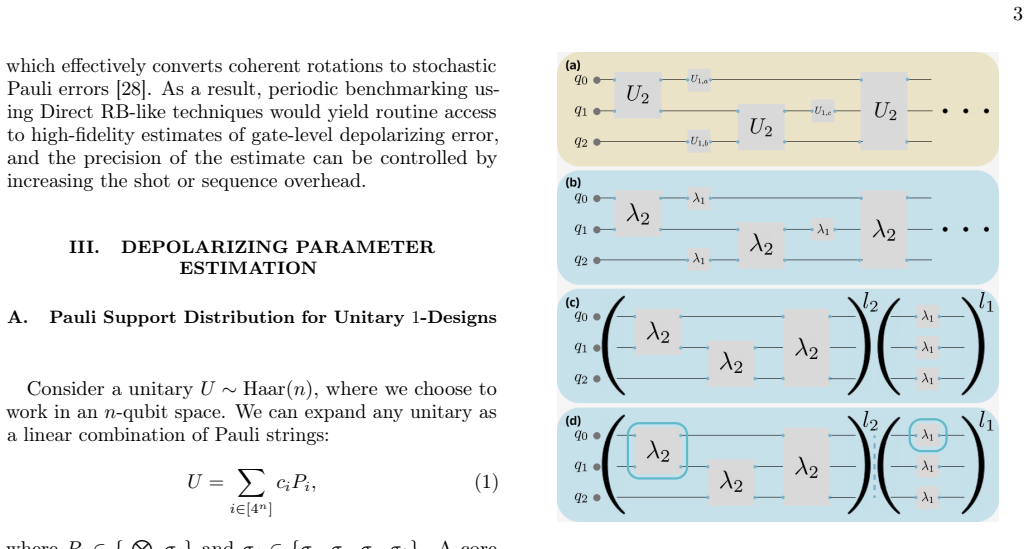
Circuit balancing, the procedure that combines unitary k-design Pauli support distributions with gate benchmarking data to estimate and invert circuit-wide depolarization via Pauli twirling.
What would settle it
Execute the same unitary k-design ensemble on hardware both with and without the balancing-plus-twirling mitigation; if the mitigated runs show no statistically significant drop in measured infidelity relative to the unmitigated runs, or if the predicted depolarization fails to match observed error rates, the central claim is falsified.
Extended reading notes
Core claim
By exploiting the known uniformity of Pauli support distributions in unitary k-designs, circuit balancing combined with gate benchmarking data yields an estimate of circuit-wide depolarization; this estimate can be inverted through Pauli twirling to suppress the diagnosed error, producing lower average random-circuit infidelity on simulators and on superconducting hardware without any increase in two-qubit gate count.
Load-bearing premise
That the Pauli support distributions of unitary k-designs are sufficiently uniform and known to allow accurate estimation of circuit-wide depolarization solely from gate benchmarking data, even when coherent errors are also present.
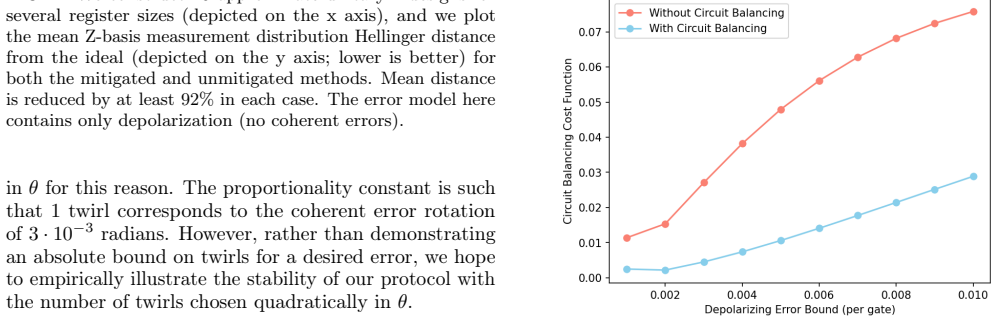
Editorial extensions
If this is right
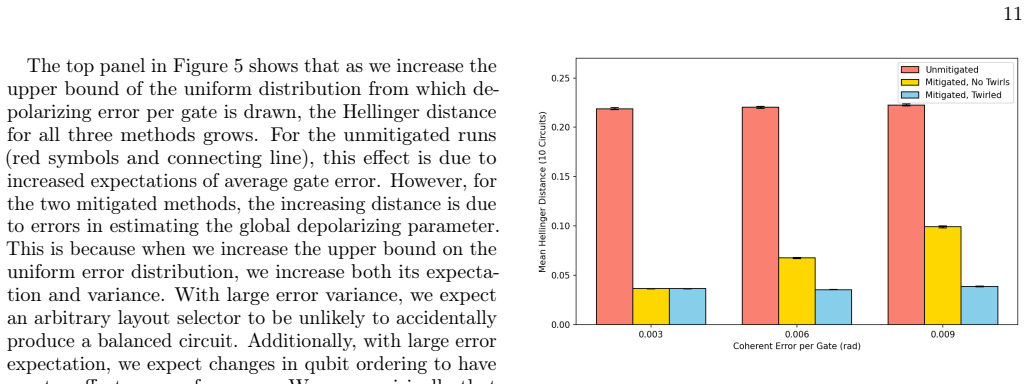
- Average infidelity of random circuits drawn from unitary k-design ensembles decreases on both simulators and real devices.
- The number of Pauli twirls required to reach a target fidelity is given by explicit asymptotics that depend only on the estimated depolarization strength.
- The method remains effective when coherent errors coexist with depolarizing noise because twirling converts the coherent component into an effective depolarizing channel.
- No additional two-qubit gates are introduced, so the technique scales without increasing the dominant source of error on current hardware.
Reading between the lines
- The same uniformity assumption could be tested on other circuit families whose Pauli support statistics are known or measurable.
- If gate benchmarking data can be collected once per device, the mitigation cost becomes essentially the cost of the twirling shots alone.
- Extension to larger system sizes would require confirming that the k-design property continues to produce sufficiently flat Pauli support at the scale of interest.
Signed reviews
Editorial analysis
A structured set of objections, weighed in public.
Referee Report
Summary. The paper claims that unitary k-design structure enables 'circuit balancing' to estimate circuit-wide depolarization rates solely from per-gate benchmarking data, which can then be inverted via Pauli twirling to mitigate depolarizing (and coherent) errors in random circuits without any two-qubit gate overhead; this is supported by numerical simulations across settings and by hardware runs on IBM Fez showing reduced average infidelity.
Significance. If the estimation step holds, the approach would supply a low-overhead mitigation technique for ensembles with no preferred Pauli support (e.g., quantum-chaos or black-hole dynamics simulations), avoiding the depth and shot costs of folding methods and the intractability of tensor-network alternatives.
major comments (2)
- [Abstract] Abstract: the central claim that circuit depolarization can be estimated from gate benchmarking data 'even in the presence of coherent error' and then inverted by Pauli twirling is load-bearing, yet the manuscript supplies no derivation showing how the benchmarking data are mapped to the circuit-level rate when coherent errors distort the assumed uniform Pauli support of the k-design; any finite-k or depth-dependent deviation would render the diagnosed rate incorrect and leave residual error after twirling.
- The numerical and hardware results (IBM Fez runs) report infidelity reductions but provide no explicit description of data-exclusion rules, error-bar computation, or the precise fitting procedure used to extract the depolarization parameter from benchmarking; without these, the quantitative support for the 'significant' reductions cannot be verified.
minor comments (2)
- Notation for the circuit-balancing procedure and the twirling asymptotics should be introduced with explicit equations rather than descriptive prose.
- The abstract states the method works for 'unitary k-designs' but does not specify the minimal k for which the uniformity assumption is invoked; this should be stated in the methods.
Simulated Author's Rebuttal
We thank the referee for their constructive comments on our manuscript. We address each major point below and will incorporate revisions to strengthen the presentation.
read point-by-point responses
-
Referee: [Abstract] Abstract: the central claim that circuit depolarization can be estimated from gate benchmarking data 'even in the presence of coherent error' and then inverted by Pauli twirling is load-bearing, yet the manuscript supplies no derivation showing how the benchmarking data are mapped to the circuit-level rate when coherent errors distort the assumed uniform Pauli support of the k-design; any finite-k or depth-dependent deviation would render the diagnosed rate incorrect and leave residual error after twirling.
Authors: We agree that an explicit derivation is needed to make the mapping rigorous. The manuscript relies on the uniform Pauli support property of unitary k-designs to justify estimating circuit-wide depolarization from per-gate data, with Pauli twirling then inverting the diagnosed rate. However, we acknowledge that the interaction between coherent errors and this support (including potential finite-k or depth-dependent deviations) is not derived in detail. In the revised manuscript we will add a dedicated subsection deriving the estimation procedure step by step, showing how the k-design averaging preserves the required uniformity sufficiently for the inversion to hold, and quantifying the residual error under finite-k and finite-depth conditions. revision: yes
-
Referee: [—] The numerical and hardware results (IBM Fez runs) report infidelity reductions but provide no explicit description of data-exclusion rules, error-bar computation, or the precise fitting procedure used to extract the depolarization parameter from benchmarking; without these, the quantitative support for the 'significant' reductions cannot be verified.
Authors: We concur that these procedural details are essential for verification and reproducibility. The current manuscript reports the infidelity reductions but omits the precise data-handling steps. In the revised version we will add an explicit subsection (or appendix) describing the data-exclusion rules applied to the IBM Fez runs, the method used to compute error bars, and the exact fitting procedure (including functional form and optimization method) for extracting the depolarization parameter from the benchmarking data. revision: yes
Circularity Check
No significant circularity; derivation uses external benchmarking data and stated k-design properties
full rationale
The paper's central technique estimates circuit-wide depolarization from gate benchmarking data by leveraging the known Pauli support uniformity of unitary k-designs, then inverts via Pauli twirling. This chain relies on independent external inputs (benchmarking data) and the mathematical definition of k-designs rather than any fitted parameter renamed as a prediction or self-citation chain. No equations reduce the output to the input by construction, no ansatz is smuggled via prior work, and the handling of coherent errors is presented as an extension of the method rather than a definitional tautology. The result is therefore self-contained against external benchmarks.
Assumptions & free parameters
Cite this review
Pith. "Pith review of Efficient Quantum Error Mitigation for Unitary k-Designs." pith.science (2026). https://pith.science/paper/BG5HDOGS
@misc{pith2026260603891,
  author       = {Pith},
  title        = {Pith review of: Efficient Quantum Error Mitigation for Unitary k-Designs},
  year         = {2026},
  howpublished = {\url{https://pith.science/paper/BG5HDOGS}},
  note         = {Machine review of arXiv:2606.03891}
}
read the original abstract
Quantum circuit ensembles that have the properties of unitary k-designs represent applications where there is no obvious bias toward any particular Pauli support, as is the case in simulating systems exhibiting ''quantum chaos,'' which range from quantum dynamics near black holes to gapless spin fluid analysis. However, noisy hardware makes quantum circuits prone to a myriad of error sources, of which depolarizing and coherent error can be particularly destructive. To combat depolarizing error, popular techniques typically involve circuit or gate folding, which can be time-intensive procedures due to increased circuit depth and shot overhead. Other tensor-network-based mitigation techniques suffer from intractability in high-entanglement regimes. In this work, we leverage the structure of unitary k-design Pauli support distributions by introducing a technique we name ''circuit balancing,'' along with gate benchmarking data, in order to estimate circuit-wide depolarization. We describe how to invert the diagnosed circuit depolarization even in the presence of coherent error, via Pauli twirling. We provide asymptotics to estimate the number of twirls needed to maintain a desired output fidelity. We test our method numerically in a variety of simulation settings and find that it can significantly reduce average random circuit infidelity. Further, we employ our methods to find significant infidelity reductions when running a random circuit ensemble on a contemporary superconducting quantum computer, IBM Fez. Overall, we show that the method effectively reduces gate-based error for unitary k-designs without incurring any two-qubit gate overhead.
Figures
Figures from the paper (4 more)
Reference graph
Works this paper leans on
-
[1]
Now, in order to analyze the stability ofN2(Pi), we calculate its variance underP i ∼U P
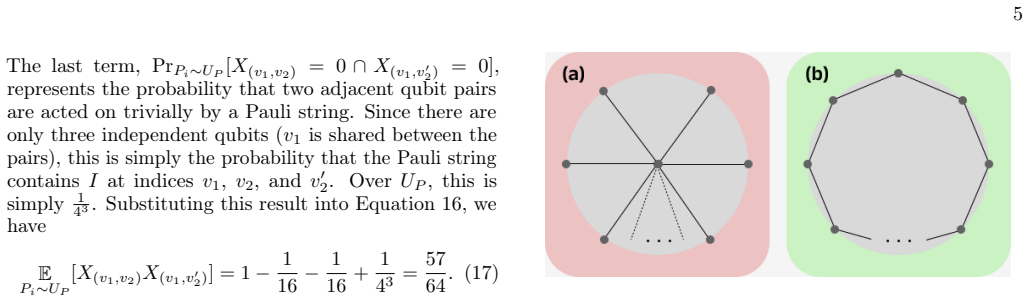
As a result, for the two-qubit edge variableX(v1,v2)(Pi), we have E Pi∼UP [X(v1,v2)(Pi)] = 15 16 .(10) Since the indicator expectation is constant, then by lin- earity, we can determine the expectation ofN2 as E Pi∼UP [N2(Pi)] = 15 16 |E|,(11) where |E| denotes the size of the setE. Now, in order to analyze the stability ofN2(Pi), we calculate its varianc...
-
[2]
Thus, we need only consider the covariance summation over pairs of adjacent edges in our connectivity graph
are independent and thus have zero covariance. Thus, we need only consider the covariance summation over pairs of adjacent edges in our connectivity graph. In this case, the indicator variables are no longer independent. Without loss of generality, we will assume thatv1 is the shared qubit, such that Cov Pi∼UP [X(v1,v2), X(v1,v′ 2)] = E Pi∼UP [X(v1,v2)X(v...
-
[3]
(15) Using the principle of inclusion-exclusion, we can rewrite this as E Pi∼UP [X(v1,v2)X(v1,v′ 2)] = 1−( Pr Pi∼UP [X(v1,v2) = 0] + Pr Pi∼UP [X(v1,v′
= 1]. (15) Using the principle of inclusion-exclusion, we can rewrite this as E Pi∼UP [X(v1,v2)X(v1,v′ 2)] = 1−( Pr Pi∼UP [X(v1,v2) = 0] + Pr Pi∼UP [X(v1,v′
-
[4]
= 0] −Pr Pi∼UP [X(v1,v2) = 0∩X (v1,v′
-
[5]
(16) It is clear that PrPi∼UP [X(v1,v2) = 0] = PrPi∼UP [X(v1,v′
= 0]). (16) It is clear that PrPi∼UP [X(v1,v2) = 0] = PrPi∼UP [X(v1,v′
-
[6]
5 The last term, PrPi∼UP [X(v1,v2) = 0 ∩X (v1,v′
= 0] = 1 16 from previous analysis. 5 The last term, PrPi∼UP [X(v1,v2) = 0 ∩X (v1,v′
-
[7]
Since there are only three independent qubits (v1 is shared between the pairs), this is simply the probability that the Pauli string contains I at indices v1, v2, and v′
= 0], represents the probability that two adjacent qubit pairs are acted on trivially by a Pauli string. Since there are only three independent qubits (v1 is shared between the pairs), this is simply the probability that the Pauli string contains I at indices v1, v2, and v′
-
[8]
Over UP, this is simply 1
Show all 77 references
-
[9]
balanced
Substituting this result into Equation 16, we have E Pi∼UP [X(v1,v2)X(v1,v′ 2)] = 1− 1 16 − 1 16 + 1 43 = 57 64 .(17) We can then substitute this result into Equation 14 to- gether with our existing results for the independent indi- cator expectations to produce Cov Pi∼UP [X(v...
-
[10]
Using a fixed λtarget, find the number of equivalent gates per qubit pair,k(i,j)
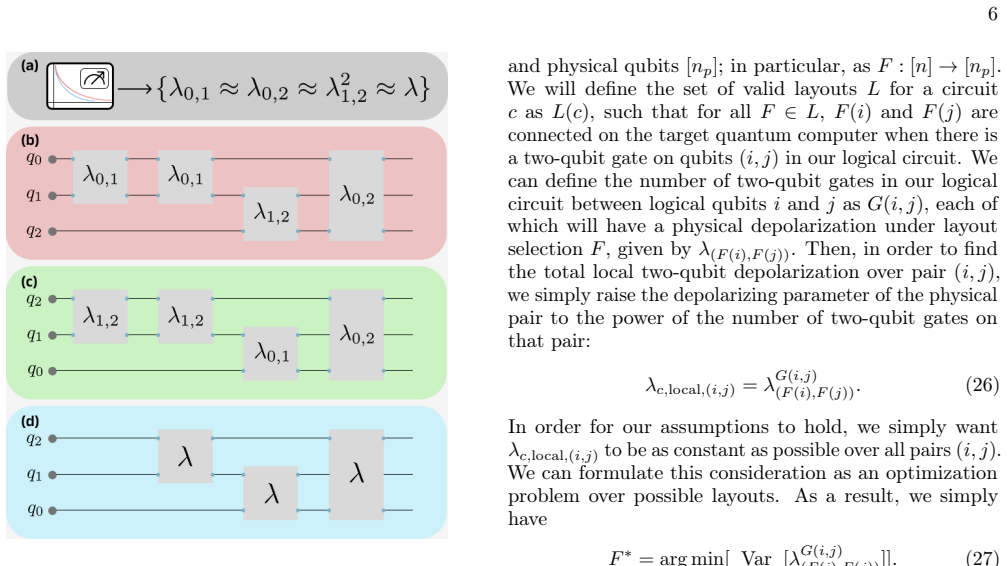
Given a circuit implementing a unitaryk-design and a quantum computer with benchmarked two-qubit gate depolarizing error, approximate a solution to the optimization problem presented in Section IIIC above. Using a fixed λtarget, find the number of equivalent gates per qubit pa...
-
[11]
As such, each gate contributes a global depolarization parameter of approximatelyλ 15 16 target
Since the circuit has been balanced, then each qubit pair experiences roughly the same number of equiv- alent gates with parameterλtarget. As such, each gate contributes a global depolarization parameter of approximatelyλ 15 16 target
-
[12]
Now, we can estimate the register-wide depolarizing parameter, λn, bycountingthecontributionfromev- ery equivalent two-qubit gate:λn ≈λ 15 16 P (i,j)∈E k(i,j) target . IV. DEPOLARIZING NOISE INVERSION A. Problem Setting and Procedure In an experimental setting, we can assume w...
-
[13]
Neglecting single-qubit gate error, calculate the ef- fective global depolarizing parameter,λn, for the target circuit via the procedure given in Section IIID after circuit balancing as in Section IIIC
-
[14]
Produce an average distribu- tionD noisy, avg ={b i, pi}
Produce t Pauli twirls (each over all two-qubit gates) for the target circuit and run them on the target quantum computer. Produce an average distribu- tionD noisy, avg ={b i, pi}
-
[15]
Invert the depolarizing noise to produce an estimate of the noiseless distributionD′ = {bi, S−1(λn, pi)} using the estimatedλn
-
[16]
As such, the final step is to produceD∗ = projCD′, where C is the probability simplex of appropriate dimension
If there is a slight error in ourλn estimation process, then D′ may not be a valid probability distribution. As such, the final step is to produceD∗ = projCD′, where C is the probability simplex of appropriate dimension. We anticipate (and show empirically in Section V) that t...
-
[17]
Hellinger distance
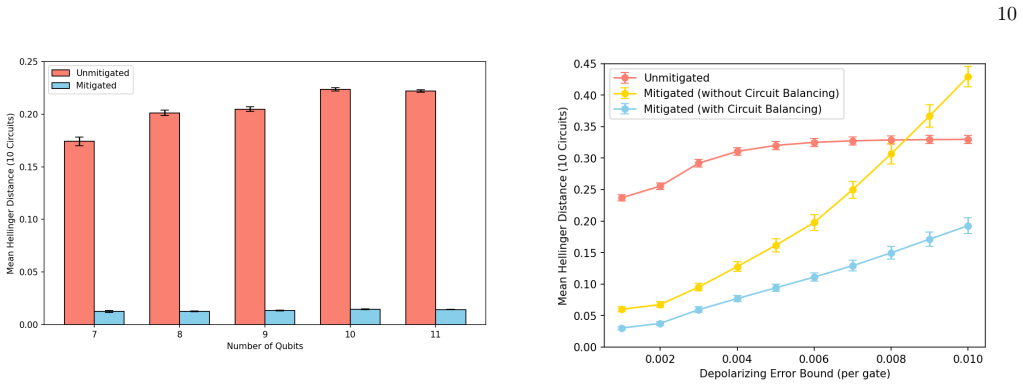
Depolarizing Noise Only: Scaling System Size To study the sensitivity of the depolarizing noise cor- rection method to system size, for each7 ≤n≤ 11, 9 we construct a simulated all-to-all connected quantum computer whose two-qubit gates have local, two-qubit de- polarizing par...
-
[18]
As a result, there is very little additional optimization that circuit balanc- ing can achieve
Depolarizing Noise Only: Scaling Error Asymmetry One drawback of our approximate unitary 2-design ap- proach is that circuits will naturally have similar numbers of two-qubit gates on each qubit pair. As a result, there is very little additional optimization that circuit balan...
-
[19]
We introduce co- herent error via a fixed XX-rotation after each CNOT gate, parametrized by angleθ
Depolarizing and Coherent Error Lastly, in order to test our method against coherent error, we take a similar approach to Section VA1, ex- cept that we fixn= 10and reproduce experiments with varying amounts of coherent error. We introduce co- herent error via a fixed XX-rotati...
-
[20]
Depolarizing Noise Only: Scaling System Size First, in the absence of coherent error, we present the mean Hellinger infidelities over various register sizes in Figure 4. Although the depth for each register size is kept fixed, the number of two-qubit gates per layer increases ...
-
[21]
Depolarizing Noise Only: Scaling Error Asymmetry We now construct10random six-qubit unitaries and use Qiskit L3 transpilation to produce circuits with large gate asymmetries. The transpiler produced the same gate counts for each unitary, indicating that it may have found a uni...
-
[22]
First, we note that without mitigation, the mean Hellinger distance is quite high and is not significantly affected by varying the coherent error strength
Depolarizing and Coherent Error We now also introduce coherent error to the system with register size n = 10(once again fixing the depolarizing error bound to0 .001as in VB1) and run the protocol again to obtain the results for mean circuit Hellinger distance presented in Figu...
-
[23]
We now turn to the realistic setting of benchmarking this method on an actual quantum computer
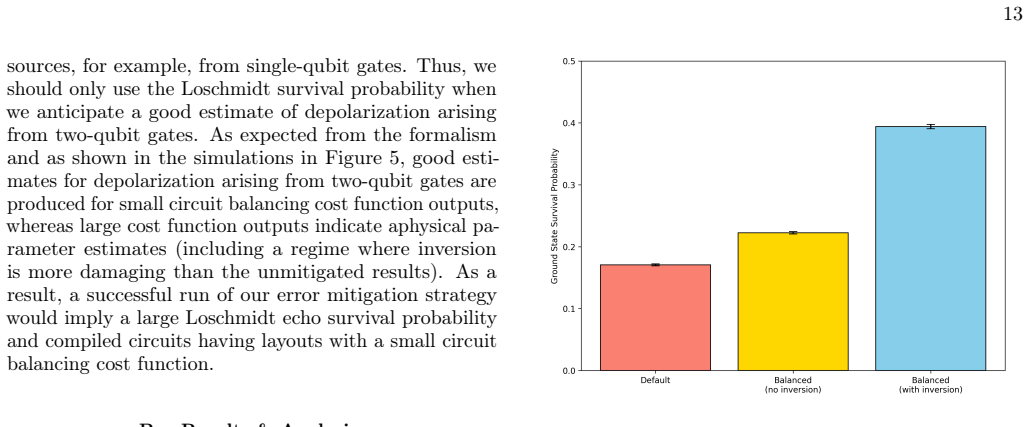
Loschmidt Echo Our numerical experiments shed light on the capability of estimated depolarizing noise inversion under many ide- alized assumptions, including exact two-qubit gate error estimates, no shot noise, and no crosstalk. We now turn to the realistic setting of benchmar...
-
[24]
Circuit Construction We construct10approximate unitary 2-designs, each over a10-qubit register, by implementing a forward uni- tary U composed of30layers. Each layer consists of a random single-qubit unitary applied to each register qubit, followed by a CNOT gate applied to ea...
-
[25]
Rather than directly reporting depo- larizing parameters, this reports estimated gate infidelities from benchmarking,i.e., the 2-qubit gate infidelities r
Device Two-Qubit Depolarizing Parameter Extraction Our target quantum computer is IBM Fez, a supercon- ducting qubit lattice with 156 qubits whose performance is regularly (daily) benchmarked and whose statistics are reported through IBM Quantum Cloud and can be accessed via Q...
-
[26]
balanced
Compilation & Circuit Balancing As mentioned previously, exactly solving the circuit balancing optimization problem is classically hard over a large device size. Instead, we use a Qiskit compiler pass manager with optimization level2using SABRE routing and layout selecting met...
-
[27]
For our device runs, we have used10000shots per circuit and20Pauli twirls such that the shots are evenly distributed over each twirl
Other Error Mitigation & Device Run Parameters As mentioned in Section VIC, we envision that the methods presented in this work will be used in conjunction with other error mitigation techniques. For our device runs, we have used10000shots per circuit and20Pauli twirls such th...
-
[28]
However, when estimating circuit-wide depolarization, it will not penalize overestimates
Limitations of the Loschmidt Echo As mentioned, the Loschmidt echo produces a relevant experimental setting due to its resistance to shot noise in resolving arbitrary benchmarking distributions. However, when estimating circuit-wide depolarization, it will not penalize overest...
-
[29]
Another source of error associated with randomized benchmarking is the presence of crosstalk
To reduce the negative impacts of imperfect gate error estimation, one can suppress the error bar of a randomized benchmarking protocol by increasing the number of sequences and/or shots per sequence untilϵ is sufficiently reduced to make the multiplicative error tolerable for...
-
[30]
Gambetta, and Joseph Emerson
Easwar Magesan, J.M. Gambetta, and Joseph Emerson. Scalable and robust randomized benchmarking of quan- tum processes.Phys. Rev. Lett., 2011
2011
-
[31]
Benchmarking quantum logic op- erations relative to thresholds for fault tolerance.npj Quantum Information, 2023
Akel Hashim et al. Benchmarking quantum logic op- erations relative to thresholds for fault tolerance.npj Quantum Information, 2023
2023
-
[32]
Lecture notes on information scrambling, quantum chaos, and haar-random states
Marcin Płodzień. Lecture notes on information scrambling, quantum chaos, and haar-random states. arXiv:2511.14397, 2025
2025
-
[33]
Resource-efficient context-aware dy- namical decoupling embedding for arbitrary large-scale quantum algorithms.PRX Quantum, 2024
Paul Coote et al. Resource-efficient context-aware dy- namical decoupling embedding for arbitrary large-scale quantum algorithms.PRX Quantum, 2024
2024
-
[34]
Sutherland et al
R.T. Sutherland et al. Passive dynamical decoupling of trapped-ion qubits and qudits.Phys. Rev. A., 2024
2024
-
[35]
Nation et al
Paul D. Nation et al. Scalable mitigation of measurement errors on quantum computers.PRX Quantum, 2021
2021
-
[36]
Digital zero noise extrapola- tion for quantum error mitigation.IEEE, 2021
Tudor Giurgica-Tiron et al. Digital zero noise extrapola- tion for quantum error mitigation.IEEE, 2021
2021
-
[37]
Best practices for quantum error mitigation with digital zero-noise extrapolation.2023 International Conference on Quantum Computing and Engineering, 2023
Ritajit Majumdar et al. Best practices for quantum error mitigation with digital zero-noise extrapolation.2023 International Conference on Quantum Computing and Engineering, 2023
2023
-
[38]
Error mitigation for short-depth quantum circuits.Phys
Kristan Temme et al. Error mitigation for short-depth quantum circuits.Phys. Rev. Lett., 2017
2017
-
[39]
Probabilistic error cancella- tion with sparse pauli–lindblad models on noisy quantum processors.Nature, 2023
Ewout van den Berg et al. Probabilistic error cancella- tion with sparse pauli–lindblad models on noisy quantum processors.Nature, 2023
2023
-
[40]
Scalable tensor-network er- ror mitigation for near-term quantum computing
Sergei Filippov et al. Scalable tensor-network er- ror mitigation for near-term quantum computing. arXiv:2307.11740v2, 2023
2023
-
[41]
Tensor network noise character- ization for near-term quantum computers.Phys
Stefano Mangini et al. Tensor network noise character- ization for near-term quantum computers.Phys. Rev. Research, 2024
2024
-
[42]
Error mitigation thresholds in noisy random quantum circuits.Phys
Pradeep Niroula et al. Error mitigation thresholds in noisy random quantum circuits.Phys. Rev. B, 2025
2025
-
[43]
Quantum supremacy using a pro- grammable superconducting processor.Nature, 2019
Frank Arute et al. Quantum supremacy using a pro- grammable superconducting processor.Nature, 2019
2019
-
[44]
Extending the computational reach of a noisy superconducting quantum processor.Na- ture, 2019
Abhinav Kandala et al. Extending the computational reach of a noisy superconducting quantum processor.Na- ture, 2019
2019
-
[45]
Scalable error mitigation for noisy quantum circuits produces competitive expectation values
Youngseok Kim et al. Scalable error mitigation for noisy quantum circuits produces competitive expectation values. Nat. Physics, 2023
2023
-
[46]
Resource efficient zero noise extrapolation with identity insertions.Phys
Andre He et al. Resource efficient zero noise extrapolation with identity insertions.Phys. Rev. A, 2020
2020
-
[47]
Inverted-circuit zero-noise extrapo- lation for quantum gate error mitigation.Phys
Kathrin Koenig et al. Inverted-circuit zero-noise extrapo- lation for quantum gate error mitigation.Phys. Rev. A, 2024
2024
-
[48]
Optimization of richardson extrapolation for quantum error mitigation.Phys
Michael Krebsbach et al. Optimization of richardson extrapolation for quantum error mitigation.Phys. Rev. A, 2022
2022
-
[49]
Direct analysis of zero- noise extrapolation: Polynomial methods, error bounds, and simultaneous physical-algorithmic error mitigation
Pegah Mohammadipour et al. Direct analysis of zero- noise extrapolation: Polynomial methods, error bounds, and simultaneous physical-algorithmic error mitigation. Quantum, 2025
2025
-
[50]
Hrushikesh Pramod Patil et al. Folding-free zne: A com- prehensive quantum zero-noise extrapolation approach for mitigating depolarizing and decoherence noise.Proceed- ings IEEE International Conference on Computer Design, 2023
2023
-
[51]
Improving zero-noise extrapolation for quantum-gate error mitigation using a noise-aware folding method.arXiv:2401.12495, 2024
Leanghok Hour et al. Improving zero-noise extrapolation for quantum-gate error mitigation using a noise-aware folding method.arXiv:2401.12495, 2024
2024
-
[52]
Evidence for the utility of quantum computing before fault tolerance.Nature, 2023
Youngseok Kim et al. Evidence for the utility of quantum computing before fault tolerance.Nature, 2023
2023
-
[53]
Characterizing large-scale quan- tum computers via cycle benchmarking.Nature, 2019
Alexander Erhard et al. Characterizing large-scale quan- tum computers via cycle benchmarking.Nature, 2019
2019
-
[54]
Direct randomized benchmarking for multi-qubit devices.Phys
Timothy Proctor et al. Direct randomized benchmarking for multi-qubit devices.Phys. Rev. Lett., 2019
2019
-
[55]
Polloreno et al
A.M. Polloreno et al. A theory of direct randomized benchmarking.Quantum, 2025
2025
-
[56]
Efficient measurement of quantum gate error by interleaved randomized benchmarking.Phys
Easwar Magesan et al. Efficient measurement of quantum gate error by interleaved randomized benchmarking.Phys. Rev. Lett, 2012
2012
-
[57]
Noise tailoring for scalable quantum computation via randomized compiling.Phys
Emerson Wallman. Noise tailoring for scalable quantum computation via randomized compiling.Phys. Rev. A, 2015
2015
-
[58]
Exact and approximate unitary 2-designs and their application to fidelity estimation.Phys
Christoph Dankert et al. Exact and approximate unitary 2-designs and their application to fidelity estimation.Phys. Rev. A, 2009
2009
-
[59]
Characterizing quantum supremacy in near-term devices.Nature, 2018
Sergio Boixo et al. Characterizing quantum supremacy in near-term devices.Nature, 2018
2018
-
[60]
Simulating prethermalization using near-term quantum computers.PRX Quantum, 2023
Yilun Yang et al. Simulating prethermalization using near-term quantum computers.PRX Quantum, 2023
2023
-
[61]
Tackling the qubit mapping problem for nisq-era quantum devices.ACM, 2019
Gushu Li et al. Tackling the qubit mapping problem for nisq-era quantum devices.ACM, 2019
2019
-
[62]
Logical error rates for 16 the surface code under a mixed coherent and stochastic circuit-level noise model inspired by trapped ions.Phys
Tyler LeBlond, Peter Groszkowski, Justin Lietz, Christo- pher Seck, and Ryan Bennink. Logical error rates for 16 the surface code under a mixed coherent and stochastic circuit-level noise model inspired by trapped ions.Phys. Rev. Research, 2025
2025
-
[63]
Randomized bench- marking with confidence.New J
Joel Wallman and Steven Flammia. Randomized bench- marking with confidence.New J. Phys., 2014
2014
-
[64]
Random quantum circuits are approx- imate unitary t designs in deptho(nt5+o(1)).Quantum, 2022
Johnas Haferkamp. Random quantum circuits are approx- imate unitary t designs in deptho(nt5+o(1)).Quantum, 2022
2022
-
[65]
Qiskit: An open-source frame- work for quantum computing.Zenodo, 2019
Gadi Aleksandrowicz et al. Qiskit: An open-source frame- work for quantum computing.Zenodo, 2019
2019
-
[66]
Benchmarking fidelity metrics of quantum computers.IEEE International Conference on Quantum Computing and Engineering, 2025
Shubdeep Mohapatra et al. Benchmarking fidelity metrics of quantum computers.IEEE International Conference on Quantum Computing and Engineering, 2025
2025
-
[67]
Dynamics of loschmidt echoes and fidelity decay.Phys
Thomas Gorin et al. Dynamics of loschmidt echoes and fidelity decay.Phys. Rept., 2006
2006
-
[68]
Model-free readout-error mit- igation for quantum expectation values.Phys
Ewout van den Berg et al. Model-free readout-error mit- igation for quantum expectation values.Phys. Rev. A, 2022
2022
-
[69]
Comparative performance analysis of quantum feature maps for quantum kernel-based machine learning.Scientific Reports, 2026
Ravi Kumar Jha. Comparative performance analysis of quantum feature maps for quantum kernel-based machine learning.Scientific Reports, 2026
2026
-
[70]
Noisy quantum kernel machines.Phys
Valentin Heyraud, Zejian Li, Zakari Denis, Alexandre Le Boité, and Cristiano Ciuti. Noisy quantum kernel machines.Phys. Rev. A, 2022
2022
-
[71]
Pino et al
J.M. Pino et al. Demonstration of the trapped-ion quantum-ccd computer architecture.Nature, 2021
2021
-
[72]
Moses et al
S.A. Moses et al. A race track trapped-ion quantum processor.Phys. Rev. X, 2023
2023
-
[73]
Detecting crosstalk errors in quan- tum information processors.Quantum, 2020
Mohan Sarovar et al. Detecting crosstalk errors in quan- tum information processors.Quantum, 2020
2020
-
[74]
Gambetta et al
J.M. Gambetta et al. Characterization of addressability by simultaneous randomized benchmarking.Phys. Rev. Lett., 2012
2012
-
[75]
Experimental benchmarking of an automated deterministic error-suppression workflow for quantum algorithms.Phys
Pranav Mundada et al. Experimental benchmarking of an automated deterministic error-suppression workflow for quantum algorithms.Phys. Rev. A, 2023
2023
-
[76]
A polynomial-time classical algo- rithm for noisy random circuit sampling.STOC 2023: Proceedings of the 55th Annual ACM Symposium on The- ory of Computing, 2023
Dorit Aharonov et al. A polynomial-time classical algo- rithm for noisy random circuit sampling.STOC 2023: Proceedings of the 55th Annual ACM Symposium on The- ory of Computing, 2023
2023
-
[77]
Limitations of noisy geometrically local quantum circuits.arXiv:2510.06346, 2025
Jon Nelson et al. Limitations of noisy geometrically local quantum circuits.arXiv:2510.06346, 2025
2025
Reviewed June 28, 2026 · model on record in the stance chip above.
Discussion (0). Continue with ORCID to comment.