REVIEW 3 major objections 6 minor 38 references
Metric Learning With HORDE: High-Order Regularizer for Deep Embeddings
T0 review · 3 major / 6 minor · reviewed 2026-08-14 · deepseek-v4-flash
Pith's one-line read Matching high-order moments of deep-feature maps, not just their mean, reduces the scattering problem and outperforms previous metric-learning methods on four image-retrieval benchmarks.
desk verdict Solid empirical regularizer for deep metric learning; the theory section is not proven, but consistent gains and released code carry the paper. read the letter →
The pith
A machine-rendered reading of the paper's core claim, the machinery that carries it, and where it could break.
The reading
What carries the argument
The load-bearing object is the approximated high-order moment feature map, built with a Random Maclaurin factorization: $\varphi_k(x) = (W_1^\top x) \odot (W_2^\top x) \odot \cdots \odot (W_k^\top x)$, computed recursively so that the k-th moment reuses the previous one. Each moment is pooled over the image, embedded, and fed into a metric-learning loss, and the HORDE loss is the sum of these per-moment losses. The theoretical link is the Taylor expansion of the Gaussian kernel, which expresses the Maximum Mean Discrepancy as a weighted sum of differences of vectorized moments; this yields HORDE as an upper bound on MMD and, via the known relation between MMD and the Wasserstein distance, as a lower bound on the Wasserstein distance. That chain of inequalities is what makes optimizing moment distances a principled proxy for aligning the whole deep-feature distribution.
What would settle it
On CUB-200-2011, take a trained HORDE model and its baseline and measure the empirical Maximum Mean Discrepancy and Wasserstein distance between deep-feature sets of same-class image pairs; if HORDE reduces the moment differences without reducing these distribution-level distances, the claimed concentration mechanism is not what produces the retrieval improvements.
Extended reading notes
Core claim
The central claim is that the scattering problem, where deep features are spread out even when their mean is discriminative, can be corrected by regularizing the shape of the feature distribution rather than only its center. HORDE computes approximations of the second through K-th moments of the spatial deep features of each image, applies the same metric-learning loss to an embedding of each moment, and adds those per-moment losses to the standard loss. Minimizing moment distances for similar images drives their feature distributions to coincide, while maximizing them for dissimilar images keeps the distributions apart. The paper proves that the sum of moment differences is an upper bound on the squared Maximum Mean Discrepancy and a lower bound on the squared Wasserstein distance, so the regularizer is a tractable stand-in for full distribution matching. Across four benchmarks, HORDE consistently improves contrastive, triplet, and binomial-deviance baselines, and it also raises the performance of the ABE ensemble method, producing state-of-the-art Recall@1 results.
Load-bearing premise
The regularizer treats the spatial features of a feature map as independent samples from a per-image distribution, so the empirical mean of each moment must be a faithful estimate; if those features are strongly correlated or position-dependent, matching moments may not align the true distributions.
Editorial extensions
If this is right
- On CUB-200-2011 and Cars-196, adding HORDE to contrastive, triplet, or binomial-deviance losses improves Recall@1 compared with the same backbone without the regularizer.
- HORDE also improves the ABE ensemble method, reaching state-of-the-art Recall@1 of 62.7% on CUB-200-2011 and 86.4% on Cars-196.
- Concatenating the learned high-order moments at test time, then reducing them with PCA to the embedding dimension, gives further retrieval gains over using only the mean representation.
- The regularizer transfers to large-scale retrieval, raising the binomial-deviance baseline by 5.2% Recall@1 on Stanford Online Products and by 3.1% on In-Shop Clothes Retrieval.
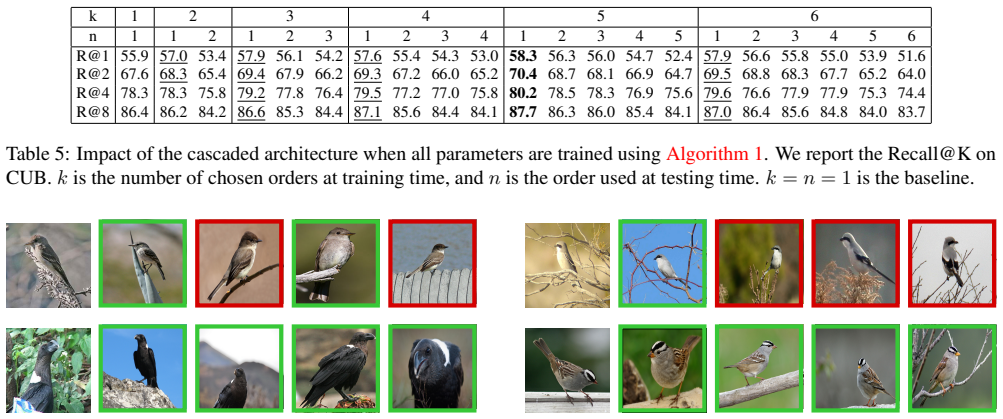
- Training with five or six moments is reported to be more stable and to reach peak accuracy about one thousand steps sooner than the baseline on CUB-200-2011.
Reading between the lines
- If moment matching is what actually concentrates deep-feature distributions, the same regularizer could help other tasks that aggregate deep features, such as face verification or person re-identification, beyond the four retrieval benchmarks tested.
- The independent-samples assumption suggests a testable extension: weighting spatial features by a smoothness kernel, so neighboring positions count less redundantly, might make the moment estimates more faithful when features are spatially correlated.
- Because the theory ties moment matching to MMD and Wasserstein distances, HORDE could plausibly serve as a cheap distribution-alignment regularizer in domain adaptation or generative modeling, where matching feature distributions across domains is the explicit goal.
- The stability gains reported with higher moment orders could be explored further by scheduling moment orders during training, for instance adding them one at a time, to separate a curriculum effect from pure regularization strength.
Signed reviews
Editorial analysis
A structured set of objections, weighed in public.
Referee Report
Summary. The paper proposes HORDE, a regularizer for deep metric learning that appends DML-style losses on high-order moment approximations of the spatial deep-feature distribution. The moments are computed with Random Maclaurin features, with a recursive/cascaded variant whose projection matrices can be learned. The authors claim that pulling moments of similar-image features together and pushing apart those of dissimilar images reduces the "scattering" of deep features and makes the average-pooled representation more robust. They state two theorems: that the high-order moment distance upper-bounds the squared MMD and lower-bounds the squared 1-Wasserstein distance. They report Recall@K improvements over several baselines on CUB-200-2011, Cars-196, Stanford Online Products, and In-Shop Clothes Retrieval, including an ensemble variant, and provide ablations on CUB.
Significance. The distribution-aware regularization idea is simple and well motivated, and the empirical contribution is credible: the paper reports consistent gains across four datasets, multiple loss functions, and an ensemble method, with code released and ablations that isolate the Random Maclaurin variant, the learned projections, and the cascaded architecture. If the theoretical claims were correct, the paper would provide a clean connection between moment matching and distributional distances. As it stands, however, the proofs of both theorems contain load-bearing gaps, and the implemented objective is not obviously the quantity analyzed in the theorems. The empirical value of the method is therefore the main basis for publication, and the theoretical section must be corrected or substantially weakened before the paper can be accepted.
major comments (3)
- [Section 3.2, Theorem 2 (Eqs. (18)-(21))] The claimed positive lower bound is not established. In Eq. (19), a' is defined as min_k a_k with a_k = (2γ)^k/k!; since a_k tends to 0 as k tends to infinity, a' = 0 and therefore a = αa'/K = 0 in Eq. (21), making the bound vacuous. If the minimum is intended only over 1 ≤ k ≤ p, the proof still does not justify the step from the pointwise kernel lower bound k(x,y) ≥ α∑ a_k <x^{⊗k}, y^{⊗k}> to an MMD lower bound. Because MMD²(I,J) = E[k(x,x')] + E[k(y,y')] - 2E[k(x,y)], a pointwise lower bound on k makes the negative cross term more negative while making the positive diagonal terms larger, so no inequality between the MMD values follows. The inference is invalid in general; for example, with the constant kernel k ≡ 1 and L(x,y) = xy on {±1}, L ≤ k pointwise but MMD_L²(δ_1,δ_{-1}) = 4 > MMD_k² = 0. Thus Theorem 2's Wasserstein lower bound is unsupported.
- [Section 3.2, Theorem 1 (Eqs. (13)-(17))] The same pointwise-to-MMD inference flaw invalidates the upper-bound proof. The proof uses Eq. (15), k(x,y) ≤ 1 + ∑_{k=1}^∞ a_k <x^{⊗k}, y^{⊗k}>, and then Eq. (17) to conclude an inequality on MMD². A pointwise bound between kernels does not imply the corresponding bound between MMD values, and the authors do not show that the difference kernel is positive definite, which would be the required condition. In addition, the constant '1' appearing in Eqs. (13) and (17) cannot arise from the feature map in Eq. (16): a constant feature contributes zero to the MMD of two probability measures, so the stated bound with the '+1' term does not follow from the proposed feature map even if the kernel domination were valid. Theorem 1 is therefore not proved as written.
- [Section 3.1 vs. 3.2, Eq. (8) and Algorithm 1] The regularizer actually optimized is not the quantity treated in Theorems 1-2. Equations (7)-(8) and Algorithm 1 apply a DML loss to random or learned Maclaurin projections of empirical spatial averages, whereas the theorems concern exact high-order moment tensors E_{x∼I}[x^{⊗k}] under a Gaussian kernel on R^c. No error bound or equivalence argument connects the projected empirical moments to the exact moments, and no argument shows that the learned projections preserve the moment-distance ordering used in the theorems. Furthermore, Section 3.2 models an image as a distribution from which spatial deep features are sampled i.i.d.; for convolutional feature maps, spatial positions are correlated and non-exchangeable, so this assumption is unverified and may not hold. The theoretical justification should either be repaired to cover the actual objective or removed from the central claims.
minor comments (6)
- [Section 3.2, Eq. (11)] The symbol K denotes both the number of high-order moments (Eq. (7)) and the uniform bound on moment norms (Eq. (11)); please use distinct symbols, for example M for the bound.
- [Section 3.2, Eq. (17)] In the second sum, the expectation is written as Ex∼J[x^{⊗k}], but it should be Ey∼J[y^{⊗k}].
- [Algorithm 1] The pseudocode fixes the projection matrices W1,...,WK as random {−1,+1} matrices, while the main text and Section 5.2 describe a trainable cascade; please state that Algorithm 1 describes the untrained variant or add the learning rule for the projectors.
- [Section 4] The sentence 'we train HORDE using 5 high-order moments with 5 classes and 8 images per instance per batch' is unclear; presumably it should read '8 images per class per batch'.
- [Tables 3-5] The k/n column layout is very hard to parse; grouping columns by k with explicit n labels, or splitting into subtables, would make the ablation results much clearer.
- [Theorems 1-2] The remainder terms o(γ^pK/p!) make the statements asymptotic in p, but the theorems are then invoked as if they justify arbitrary finite p; please state explicitly the range of p for which the bounds are intended.
Circularity Check
No significant circularity: HORDE is evaluated on external benchmarks and the theoretical bounds are derived from independent definitions, not from the method's own fitted values.
full rationale
The central derivation chain is a regularizer defined by moment distances (Eq. 7-8), a theoretical connection through Taylor expansion of the Gaussian kernel (Eq. 15-21), and benchmark evaluation (Tables 1-2). None of these steps reduces to its inputs by construction. Hyperparameters (number of moments K, dimension 8192, embeddings 512) are fixed by the authors and not fitted to test labels; the test-time concatenation and PCA is a representation choice, not a label-based prediction. The theoretical analysis may contain correctness gaps, such as the potentially vanishing constant in Theorem 2, but a vacuous or invalid bound is a mathematical error rather than circular reasoning. Self-citations are limited to contextual references and are not load-bearing. The empirical improvements are measured on standard external benchmarks against independent baselines, so the derivation is self-contained.
Assumptions & free parameters
free parameters (4)
- Number of high-order moments K =
5 (CUB/CARS), 4 (SOP/INSHOP)
- Random projection dimension d =
8192
- Embedding dimension =
512
- Batch composition =
5 classes x 8 images (CUB/CARS); 2 images x 40 classes (SOP/INSHOP)
assumptions (4)
- domain assumption Deep features within an image are treated as i.i.d. samples from an image-specific distribution.
- domain assumption All moments of the feature distributions exist and are bounded by a common constant K (Eq. 11).
- standard math The Random Maclaurin approximation provides a consistent estimator of the inner product between high-order moments (Eq. 2).
- standard math MMD is a lower bound of the Wasserstein distance (Eq. 20).
Cite this review
Pith. "Pith review of Metric Learning With HORDE: High-Order Regularizer for Deep Embeddings." pith.science (2026). https://pith.science/paper/BG6Y5MRU
@misc{pith2026190802735,
  author       = {Pith},
  title        = {Pith review of: Metric Learning With HORDE: High-Order Regularizer for Deep Embeddings},
  year         = {2026},
  howpublished = {\url{https://pith.science/paper/BG6Y5MRU}},
  note         = {Machine review of arXiv:1908.02735}
}
read the original abstract
Learning an effective similarity measure between image representations is key to the success of recent advances in visual search tasks (e.g. verification or zero-shot learning). Although the metric learning part is well addressed, this metric is usually computed over the average of the extracted deep features. This representation is then trained to be discriminative. However, these deep features tend to be scattered across the feature space. Consequently, the representations are not robust to outliers, object occlusions, background variations, etc. In this paper, we tackle this scattering problem with a distribution-aware regularization named HORDE. This regularizer enforces visually-close images to have deep features with the same distribution which are well localized in the feature space. We provide a theoretical analysis supporting this regularization effect. We also show the effectiveness of our approach by obtaining state-of-the-art results on 4 well-known datasets (Cub-200-2011, Cars-196, Stanford Online Products and Inshop Clothes Retrieval).
Figures


Reference graph
Works this paper leans on
-
[1]
Cross- modal retrieval in the cooking context: Learning se- mantic text-image embeddings
Micael Carvalho, R ´emi Cad`ene, David Picard, Laure Soulier, Nicolas Thome, and Matthieu Cord. Cross- modal retrieval in the cooking context: Learning se- mantic text-image embeddings. In The 41st Interna- tional ACM SIGIR Conference on Research & Devel- opment in Information Retrieval, 2018. 1
work page 2018
-
[2]
Beyond triplet loss: A deep quadru- plet network for person re-identification
Weihua Chen, Xiaotang Chen, Jianguo Zhang, and Kaiqi Huang. Beyond triplet loss: A deep quadru- plet network for person re-identification. In The IEEE Conference on Computer Vision and Pattern Recogni- tion (CVPR), July 2017. 2
work page 2017
-
[3]
Learn- ing a similarity metric discriminatively, with appli- cation to face verification
Sumit Chopra, Raia Hadsell, and Yann LeCun. Learn- ing a similarity metric discriminatively, with appli- cation to face verification. In The IEEE Conference on Computer Vision and Pattern Recognition (CVPR),
-
[4]
Deep adversarial metric learning
Yueqi Duan, Wenzhao Zheng, Xudong Lin, Jiwen Lu, and Jie Zhou. Deep adversarial metric learning. In The IEEE Conference on Computer Vision and Pattern Recognition (CVPR), June 2018. 2
work page 2018
-
[5]
Deep metric learning with hierarchical triplet loss
Weifeng Ge. Deep metric learning with hierarchical triplet loss. In The European Conference on Computer Vision (ECCV), September 2018. 6, 7
work page 2018
-
[6]
A kernel method for the two-sample-problem
Arthur Gretton, Karsten M Borgwardt, Malte Rasch, Bernhard Sch ¨olkopf, and Alex J Smola. A kernel method for the two-sample-problem. In Advances in neural information processing systems, pages 513– 520, 2007. 4, 5
work page 2007
-
[7]
Smart mining for deep metric learning
Ben Harwood, Vijay Kumar B G, Gustavo Carneiro, Ian Reid, and Tom Drummond. Smart mining for deep metric learning. In The IEEE International Confer- ence on Computer Vision (ICCV), Oct 2017. 2
work page 2017
-
[8]
Batch normaliza- tion: Accelerating deep network training by reducing internal covariate shift
Sergey Ioffe and Christian Szegedy. Batch normaliza- tion: Accelerating deep network training by reducing internal covariate shift. In Proceedings of the 32nd International Conference on Machine Learning , Jul
Show all 38 references
-
[9]
Negative evidences and co-occurrences in image retrieval: the benefit of PCA and whitening
Herv ´e J ´egou and Ondrej Chum. Negative evidences and co-occurrences in image retrieval: the benefit of PCA and whitening. In The European Conference on Computer Vision (ECCV), Oct. 2012. 3
2012
-
[10]
Random fea- ture maps for dot product kernels
Purushottam Kar and Harish Karnick. Random fea- ture maps for dot product kernels. In Proceedings of the Fifteenth International Conference on Artificial In- telligence and Statistics, Apr 2012. 3
2012
-
[11]
Attention-based ensemble for deep metric learning
Wonsik Kim, Bhavya Goyal, Kunal Chawla, Jungmin Lee, and Keunjoo Kwon. Attention-based ensemble for deep metric learning. In The European Conference on Computer Vision (ECCV), September 2018. 2, 6, 7
2018
-
[12]
3d object representations for fine-grained cate- gorization
Jonathan Krause, Michael Stark, Jia Deng, and Li Fei- Fei. 3d object representations for fine-grained cate- gorization. In 4th International IEEE Workshop on 3D Representation and Recognition (3dRR-13) , Dec
-
[13]
Deep variational metric learning
Xudong Lin, Yueqi Duan, Qiyuan Dong, Jiwen Lu, and Jie Zhou. Deep variational metric learning. InThe European Conference on Computer Vision (ECCV) , September 2018. 2, 3, 6
2018
-
[14]
Deep relative distance learning: Tell the difference between similar vehicles
Hongye Liu, Yonghong Tian, Yaowei Yang, Lu Pang, and Tiejun Huang. Deep relative distance learning: Tell the difference between similar vehicles. In The IEEE Conference on Computer Vision and Pattern Recognition (CVPR), June 2016. 1
2016
-
[15]
Deepfashion: Powering robust clothes recognition and retrieval with rich annotations
Ziwei Liu, Ping Luo, Shi Qiu, Xiaogang Wang, and Xiaoou Tang. Deepfashion: Powering robust clothes recognition and retrieval with rich annotations. InPro- ceedings of IEEE Conference on Computer Vision and Pattern Recognition (CVPR), June 2016. 1, 2, 6
2016
-
[16]
Leung, Sergey Ioffe, and Saurabh Singh
Yair Movshovitz-Attias, Alexander Toshev, Thomas K. Leung, Sergey Ioffe, and Saurabh Singh. No fuss distance metric learning using proxies. In The IEEE International Conference on Computer Vision (ICCV), Oct 2017. 2
2017
-
[17]
Deep metric learning via facility lo- cation
Hyun Oh Song, Stefanie Jegelka, Vivek Rathod, and Kevin Murphy. Deep metric learning via facility lo- cation. In The IEEE Conference on Computer Vision and Pattern Recognition (CVPR), July 2017. 2
2017
-
[18]
Deep metric learning via lifted struc- tured feature embedding
Hyun Oh Song, Yu Xiang, Stefanie Jegelka, and Sil- vio Savarese. Deep metric learning via lifted struc- tured feature embedding. In The IEEE Conference on Computer Vision and Pattern Recognition (CVPR), June 2016. 1, 2, 6
2016
-
[19]
Bier - boosting independent embed- dings robustly
Michael Opitz, Georg Waltner, Horst Possegger, and Horst Bischof. Bier - boosting independent embed- dings robustly. In The IEEE International Conference on Computer Vision (ICCV), Oct 2017. 1, 2, 3, 6
2017
-
[20]
Deep metric learning with BIER: boosting independent embeddings robustly
Michael Opitz, Georg Waltner, Horst Possegger, and Horst Bischof. Deep metric learning with BIER: boosting independent embeddings robustly. IEEE transactions on pattern analysis and machine intelli- gence, 2018. 6
2018
-
[21]
Metric learning with adaptive density discrimination
Oren Rippel, Manohar Paluri, Piotr Dollar, and Lubomir Bourdev. Metric learning with adaptive density discrimination. International Conference on Learning Representations (ICLR), May 2016. 2
2016
-
[22]
Facenet: A unified embedding for face recog- nition and clustering
Florian Schroff, Dmitry Kalenichenko, and James Philbin. Facenet: A unified embedding for face recog- nition and clustering. In The IEEE Conference on Computer Vision and Pattern Recognition (CVPR) , June 2015. 1, 2
2015
-
[23]
Improved deep metric learning with multi-class n-pair loss objective
Kihyuk Sohn. Improved deep metric learning with multi-class n-pair loss objective. In Advances in Neu- ral Information Processing Systems 29, Dec 2016. 1, 2
2016
-
[24]
Sriperumbudur, Arthur Gretton, Kenji Fukumizu, Bernhard Sch¨olkopf, and Gert R.G
Bharath K. Sriperumbudur, Arthur Gretton, Kenji Fukumizu, Bernhard Sch¨olkopf, and Gert R.G. Lanck- riet. Hilbert space embeddings and metrics on proba- bility measures. J. Mach. Learn. Res., Aug 2010. 5
2010
-
[25]
Going deeper with convolutions
Christian Szegedy, Wei Liu, Yangqing Jia, Pierre Ser- manet, Scott Reed, Dragomir Anguelov, Dumitru Er- han, Vincent Vanhoucke, and Andrew Rabinovich. Going deeper with convolutions. In The IEEE Con- ference on Computer Vision and Pattern Recognition (CVPR), June 2015. 1, 6
2015
-
[26]
Learning deep embeddings with histogram loss
Evgeniya Ustinova and Victor Lempitsky. Learning deep embeddings with histogram loss. In Advances in Neural Information Processing Systems 29, Dec 2016. 1, 2, 7
2016
-
[27]
The Caltech-UCSD Birds-200-2011 Dataset
Catherine Wah, Steve Branson, Peter Welinder, Pietro Perona, and Serge Belongie. The Caltech-UCSD Birds-200-2011 Dataset. Technical Report CNS-TR- 2011-001, California Institute of Technology, 2011. 2, 6, 7
2011
-
[28]
Cosface: Large margin cosine loss for deep face recognition
Hao Wang, Yitong Wang, Zheng Zhou, Xing Ji, Di- hong Gong, Jingchao Zhou, Zhifeng Li, and Wei Liu. Cosface: Large margin cosine loss for deep face recognition. In The IEEE Conference on Computer Vision and Pattern Recognition (CVPR), June 2018. 2
2018
-
[29]
Deep metric learning with angular loss
Jian Wang, Feng Zhou, Shilei Wen, Xiao Liu, and Yuanqing Lin. Deep metric learning with angular loss. In The IEEE International Conference on Computer Vision (ICCV), Oct 2017. 2, 6
2017
-
[30]
Xun Wang, Xintong Han, Weilin Huang, Dengke Dong, and Matthew R. Scott. Multi-similarity loss with general pair weighting for deep metric learning. In The IEEE Conference on Computer Vision and Pat- tern Recognition (CVPR), June 2019. 6, 7
2019
-
[31]
Jnatas Wehrmann and Rodrigo C. Barros. Bidirec- tional retrieval made simple. In The IEEE Conference on Computer Vision and Pattern Recognition (CVPR), June 2018. 1
2018
-
[32]
Deep asymmetric metric learning via rich re- lationship mining
Xinyi Xu, Yanhua Yang, Cheng Deng, and Feng Zheng. Deep asymmetric metric learning via rich re- lationship mining. In The IEEE Conference on Com- puter Vision and Pattern Recognition (CVPR) , pages 4076 – 4085, June 2019. 6
2019
-
[33]
Deep randomized ensembles for metric learning
Hong Xuan, Richard Souvenir, and Robert Pless. Deep randomized ensembles for metric learning. In The European Conference on Computer Vision (ECCV), September 2018. 2
2018
-
[34]
Correcting the triplet selection bias for triplet loss
Baosheng Yu, Tongliang Liu, Mingming Gong, Changxing Ding, and Dacheng Tao. Correcting the triplet selection bias for triplet loss. In The European Conference on Computer Vision (ECCV) , September
-
[35]
Hard- aware deeply cascaded embedding
Yuhui Yuan, Kuiyuan Yang, and Chao Zhang. Hard- aware deeply cascaded embedding. InThe IEEE Inter- national Conference on Computer Vision (ICCV), Oct
-
[36]
Hardness-aware deep metric learning
Wenzhao Zheng, Zhaodong Chen, Jiwen Lu, and Jie Zhou. Hardness-aware deep metric learning. In The IEEE Conference on Computer Vision and Pattern Recognition (CVPR), pages 72 – 81, June 2019. 6
2019
-
[37]
Learning deep features for discriminative localization
Bolei Zhou, Aditya Khosla, Agata Lapedriza, Aude Oliva, and Antonio Torralba. Learning deep features for discriminative localization. In The IEEE Con- ference on Computer Vision and Pattern Recognition (CVPR), June 2016. 1, 2
2016
-
[38]
Effi- cient online local metric adaptation via negative sam- ples for person re-identification
Jiahuan Zhou, Pei Yu, Wei Tang, and Ying Wu. Effi- cient online local metric adaptation via negative sam- ples for person re-identification. In The IEEE Inter- national Conference on Computer Vision (ICCV), Oct
Reviewed August 14, 2026 · model on record in the stance chip above.
Discussion (0). Continue with ORCID to comment.