REVIEW 3 major objections 7 minor 52 references
Topological transport in monolayer jacutingaite
T0 review · 3 major / 7 minor · reviewed 2026-08-11 · deepseek-v4-flash
Pith's one-line read Monolayer jacutingaite, already predicted to be a large-gap Kane-Mele quantum spin Hall insulator, should reveal six distinct topological phases under electric and laser fields, each identifiable by its finite-frequency spin- and…
desk verdict A standard but useful finite-frequency optical conductivity calculation for jacutingaite; the core spectra are worth referee time, but the S-QHI Chern numbers and several internal references need correction before the results can be relied on. read the letter →
The pith
A machine-rendered reading of the paper's core claim, the machinery that carries it, and where it could break.
The reading
What carries the argument
The load-bearing object is the four-band Kane-Mele Hamiltonian $\hat H_{\eta,s}=\hbar v_F(\eta k_x\sigma_x+k_y\sigma_y)+(\eta s\lambda_{\rm so}+\lambda_z+\eta\lambda_\omega)\sigma_z$ at the two valleys $K,K'$ and two spins. The single control parameter is the Dirac mass $\Delta_{\eta,s}=\eta s\lambda_{\rm so}+\lambda_z+\eta\lambda_\omega$: a phase transition occurs whenever one mass changes sign, and the spin/valley Chern numbers $C_{\eta,s}=(\eta/2)\,\mathrm{sgn}(\Delta_{\eta,s})$ label the phase. The optical calculation is carried by the Kubo formula, whose longitudinal and Hall components depend on $\Delta_{\eta,s}$ and on $M=\max(|\Delta_{\eta,s}|,2|\mu_F|)$; the Hall term is proportional to $\eta\Delta_{\eta,s}\tan^{-1}(\hbar\Omega/M)/\hbar\Omega$, which is what makes the transverse response valley- and spin-selective and hence phase-sensitive.
What would settle it
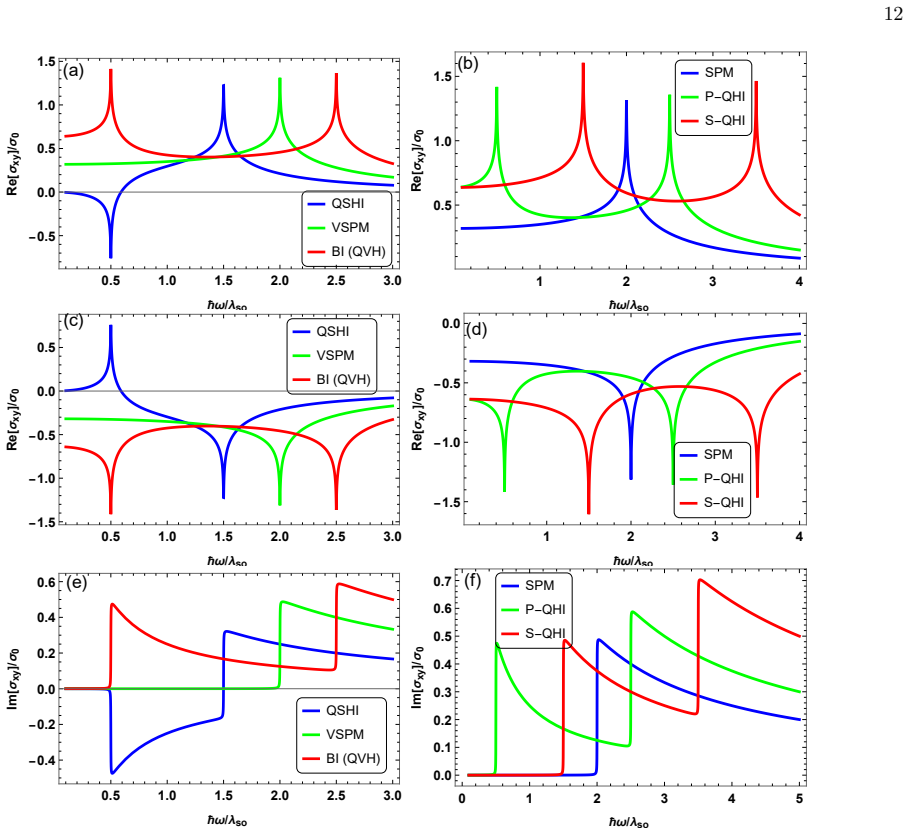
Measure the frequency-dependent $\sigma_{xx}(\omega)$ and $\sigma_{xy}(\omega)$ of a gated monolayer Pt2HgSe3 sample under circularly polarized drive and compare with the predicted resonance pattern: for example, in the K valley at $\lambda_z=0$, $\lambda_\omega=0$, the claim gives a spin-down interband edge at $\hbar\omega=0.5\lambda_{\rm so}$ and a spin-up edge at $1.5\lambda_{\rm so}$, with the Hall conductivity changing sign between them. If sweeping the gate voltage or laser intensity across the claimed phase boundary fails to move these edges according to $2|\Delta_{\eta,s}|$, or if spin mixing produces transitions the calculation forbids, the central claim would be refuted.
Extended reading notes
Core claim
The paper's central discovery is that the spin- and valley-resolved optical conductivities of monolayer jacutingaite are topological phase markers. Working from the effective Hamiltonian with Dirac mass $\Delta_{\eta,s}=\eta s\lambda_{\rm so}+\lambda_z+\eta\lambda_\omega$, where $\eta$ is the valley index, $s$ the spin, $\lambda_{\rm so}$ the intrinsic spin-orbit coupling, $\lambda_z$ the staggered potential, and $\lambda_\omega$ the Floquet mass from the laser, the authors compute Berry curvature, spin/valley Chern numbers, density of states, and the finite-frequency Kubo conductivities $\sigma_{xx}$ and $\sigma_{xy}$. They show that the signs of the four masses determine six phases, and that the interband Hall response $\sigma_{xy}^{\rm inter}\propto (2\eta\Delta_{\eta,s}/\hbar\Omega)\tan^{-1}(\hbar\Omega/M)$ produces resonances at photon energies $2|\Delta_{\eta,s}|$ whose positions, signs, and number of peaks are characteristic of each phase. They further show that raising the chemical potential blocks some interband transitions by Pauli exclusion, leaving intraband Drude features in specific spin channels.
Load-bearing premise
The load-bearing premise is that jacutingaite's low-energy electrons are exactly described by a simple two-band model with only three energy offsets—spin-orbit, electric-field, and laser-induced—with no extra spin-mixing term, and that the laser is fast and weak enough to act only through one averaged offset; the paper's numeric check of that fast-and-weak condition mixes up wavelength and frequency units, so the condition is not actually demonstrated.
Editorial extensions
If this is right
- The finite-frequency longitudinal and Hall conductivities can be used experimentally to distinguish QSHI, VSPM, SPM, BI, P-QHI, and S-QHI phases in the same monolayer without contacting edge states.
- Tuning the electric field or the laser intensity continuously shifts the photon energies of the intra- and interband transition peaks, since these are set by combinations of $\lambda_z$, $\lambda_\omega$, and $\lambda_{\rm so}$.
- Changing the chemical potential selectively Pauli-blocks some spin-down interband transitions, so the same sample can be switched between interband-dominated and Drude-dominated optical response.
- The direction of the transverse spin and valley current can be controlled by choosing the photon energy, because the finite-frequency Hall conductivity changes sign at valley-specific resonances.
- Circular dichroism, Faraday, and Kerr spectra derived from the computed conductivities should carry the phase information, offering magneto-optic and valleytronic probes in the THz range.
Reading between the lines
- If these fingerprints survive in a real sample, optical conductivity would give a contactless phase diagram of jacutingaite, potentially easier than transport edge-state measurements in exfoliated flakes.
- Because all results come from the Kane-Mele mass structure, the same finite-frequency signatures should appear—scaled by $\lambda_{\rm so}$—in other buckled Dirac materials, but jacutingaite's much larger gap should make them observable at more practical frequencies.
- The paper's numerical justification for the off-resonant condition mislabels 500 nm light as 0.6 THz; taken at face value that drive is not off-resonant, so the cleanest test of the predictions would use genuinely THz radiation or a corrected estimate of $a\omega_0/v_F$.
- Excitonic and other many-body corrections, absent from the single-particle Kubo calculation, could shift or split the predicted absorption edges, so the sharpest quantitative test may need to wait for measurements that include such effects.
Editorial analysis
A structured set of objections, weighed in public.
Referee Report
Summary. The paper studies a low-energy Kane-Mele model for monolayer jacutingaite (Pt2HgSe3) in the presence of a staggered sublattice potential and an off-resonant circularly polarized laser field. It derives the four-band Dirac spectrum, computes Berry curvatures and Chern numbers, maps out a phase diagram with QSHI, VSPM, SPM, BI, P-QHI, and S-QHI phases, and uses Kubo formulas to obtain finite-frequency spin- and valley-resolved longitudinal and Hall conductivities. The authors claim that the optical conductivities provide distinct fingerprints of each topological phase and that the photon energies of intra- and interband transitions can be tuned by the external fields and by doping-induced Pauli blocking.
Significance. The paper addresses a timely and relevant problem: identifying observable finite-frequency optical signatures of the topological phases in a large-gap Kane-Mele material. The theoretical framework is standard, the spin-orbit coupling is taken from prior DFT work, and the Kubo expressions are based on established references; there is no fitting to experimental data and the calculations are reproducible in principle. The central claim that each phase has a distinct conductivity spectrum is plausible and would be useful for experimental proposals. However, the internal inconsistencies in the S-QHI Chern numbers, the incorrect numerical justification of the Floquet condition, and the missing definitions of the spin and valley Hall combinations undermine the reliability of the phase classification and of the interpretation of several figures. These issues are fixable within the manuscript's scope, but they must be addressed before the results can be accepted.
major comments (3)
- [Section II, Table I, Eqs. (12)-(14)] The S-QHI row of Table I is not compatible with the paper's own Chern-number definitions. With C↑=1 and C↓=0, Eq. (13) gives Cs=(1−0)/2=0.5, and with CK=1 and CK′=0, Eq. (14) gives Cv=(1−0)/2=0.5, yet the table lists Cs=1 and Cv=1. The same conclusion follows from Eq. (12) at the representative S-QHI point (λz=λso, λω=1.5λso): the four masses are 3.5λso, 1.5λso, −1.5λso, and 0.5λso, which yields C↑=1, C↓=0, CK=1, and CK′=0, hence Cs=Cv=0.5 rather than 1. The text also contradicts Table I: the paragraph defining the S-QHI phase states C=Cv=0, while Table I gives Cv=1. Since Figs. 7-10 present the S-QHI curves as a distinct topological fingerprint, the phase label, the Chern numbers, and the boundary of this region must be recomputed or explicitly redefined before those curves can be interpreted. I note that the claim that this S-QHI point has a vanishing Dirac mass does not hold for the stated parameters: the smallest mass is 0.5λso, so the representative point is gapped; the inconsistency in Cs and Cv nevertheless stands.
- [Section II, Eq. (7), off-resonant condition] The numerical example used to justify the off-resonant Floquet approximation is wrong by six orders of magnitude. Light of wavelength 500 nm has frequency about 600 THz, not 0.6 THz, and 0.6 THz corresponds to a wavelength of about 500 µm. With the quoted numbers a≈3 Å and vF≈10^5 m/s, the ratio aω0/vF is about 11 only if ω0 is the 600 THz value; for 0.6 THz the ratio is about 0.011, which violates the stated condition aω0≫ vF. Consequently, the claim that “these conditions are readily met in typical scenarios” and that “for THz radiation, this condition is even more strictly satisfied” is not supported. The estimate must be corrected, or the validity discussion must be restricted to optical frequencies.
- [Section IV, Eqs. (23)-(24), Figs. 7-8] The paper never defines the “spin Hall” and “valley Hall” conductivities that are plotted in Figs. 7-8. Equations (23)-(24) define σxy for each valley and spin flavor, but it is not stated whether the figures show σxy^{η,s} separately, the spin Hall combination (σ↑−σ↓)/2, or the valley Hall combination (σK−σK′)/2. This ambiguity makes the sign discussion in the text, such as the statement that the first negative peak at 0.5λso is associated with spin-down and the positive peak with spin-up in the K (K′) valley, impossible to verify against Eq. (24). These signs are part of the claimed control of the transverse current direction, so the plotted quantities must be defined explicitly and the signs reconciled with the formula.
minor comments (7)
- [Table I] Table I contains two identical QSHI rows; the duplicate should be removed.
- [Fig. 9] The labels in Fig. 9 do not match the phase definitions: panel (d) is labeled “SPM” for λz=0, λω=0.5λso, although SPM is defined at λω=λso, and panel (f) is labeled “S-QHI” for λz=0, λω=0.5λso, although S-QHI is defined at λz=λso, λω=1.5λso.
- [Section IV] The figure references in Section IV are inconsistent: the longitudinal conductivity spectra described as Figs. 6(a)-(d) are actually in Fig. 7, and the imaginary longitudinal conductivity described as Fig. 8(c)-(d) is in Fig. 7(c)-(d); Fig. 6 is the phase diagram.
- [Fig. 8 caption] The caption of Fig. 8 reuses subplot labels (c) and (d) and refers to the imaginary parts as panels (c)-(d) when they are actually panels (e)-(f); this should be corrected.
- [Table II] Table II contains apparent parameter errors: the P-QHI row gives transition energies 0.5λso and 2.5λso, which correspond to (λz,λω)=(0,1.5λso) rather than the listed (1,1), and the QSHI row (0,0) should have a single spin-degenerate interband threshold at 2λso rather than a spin-down threshold at λso.
- [Section IV] The text states that the charge-neutral case has µF=0 and then says that the simulations use µF=λso; this contradiction should be resolved.
- [Throughout] There are numerous typographical errors, including “spintronics pprogram”, “and and”, and the malformed inequality “| ±λz ± λω = 0| > λso”; these should be corrected in a thorough revision.
Circularity Check
No circular derivation: the optical conductivities are computed from an externally parameterized Kane-Mele Hamiltonian via standard Kubo formulas; the self-citations are non-load-bearing.
full rationale
The paper's central claim is that spin- and valley-resolved optical conductivities depend on the topological phase. The model Hamiltonian in Eq. (8) contains only externally set inputs: the spin-orbit coupling lambda_so = 81.2 meV is taken from prior DFT work [21], and lambda_z and lambda_omega are tunable field parameters. The effective Dirac masses Delta_{eta,s} are not fitted to any conductivity data. The topological phases are labeled by Chern numbers obtained from the standard formula C_{eta,s} = (eta/2) sgn(Delta_{eta,s}) in Eq. (12), and the conductivities are computed from the Kubo formulas in Eqs. (19)-(24), which are cited to several sources, including but not limited to the authors' prior work [46,48]. The resulting spectra are explicit functions of the same masses, so the phase dependence of the spectra follows from the Hamiltonian; this is derivation, not circularity. No parameter is fitted to the predicted conductivity, no prediction is statistically forced by fitting a subset of the data, and no uniqueness theorem from the authors' own prior work is invoked to forbid alternative choices. The self-citations [46,48] supply standard formulas for Berry curvature and Kubo conductivity and are corroborated by independent references [49,50], so they are not load-bearing. The paper's apparent internal inconsistencies, such as the S-QHI row of Table I giving C_up = 1 and C_down = 0 while Eq. (13) would give C_s = 0.5, are correctness concerns about the phase classification, not circular reductions of the derivation. Therefore the circularity score is low.
Assumptions & free parameters
free parameters (4)
- staggered potential lambda_z =
swept from 0 to 2*lambda_so
- optical field strength lambda_omega =
swept from 0 to 1.5*lambda_so (signed by helicity)
- broadening Gamma =
0.002*lambda_so (Fig. 6) or 10^-3*lambda_so (Figs. 7, 8, 10)
- chemical potential mu_F =
0, 0.6*lambda_so, 1.6*lambda_so in different figures
assumptions (4)
- domain assumption ML-jacutingaite low-energy bands are well described by the Kane-Mele Hamiltonian (Eq. 1) with SOC lambda_so and no Rashba coupling.
- domain assumption The off-resonant Floquet expansion (Eqs. 5-7) is valid, requiring a*omega_0 >> v_F and A << 1 and |E| < hbar*omega_0/2.
- standard math Kubo formulas (Eqs. 20-24) from Refs. [48,50] give the longitudinal and Hall optical conductivities at T=0 for each massive Dirac cone.
- domain assumption Spin is conserved in optical transitions (no Rashba term), so interband transitions couple only same-spin bands.
Cite this review
Pith. "Pith review of Topological transport in monolayer jacutingaite." pith.science (2026). https://pith.science/paper/BGISCXLF
@misc{pith2026241216965,
  author       = {Pith},
  title        = {Pith review of: Topological transport in monolayer jacutingaite},
  year         = {2026},
  howpublished = {\url{https://pith.science/paper/BGISCXLF}},
  note         = {Machine review of arXiv:2412.16965}
}
abstract
Monolayer-jacutingaite (Pt2HgSe3) has been predicted to be the first large-gap Kane-Mele quantum spin Hall insulator. Materials in the jacutingaite family undergo topological phase transitions (TPTs), i.e., from a topologically non-trivial to a semimetallic phase and further to the normal insulating phase when exposed to electric fields and off-resonance, high-frequency and high-intensity laser irradiation. In this article, we investigate the rich tapestry of topological phases in this unique material in the presence of an appropriate choice of off-resonance circularly polarized laser fields and staggered sublattice potentials. The interplay of these stimuli with large spin-orbit coupling, due to the buckled structure of jacutingaite materials, results in the emergence of quantum spin Hall insulator, valley-spin-polarized metal, spin-polarized metal, photo-induced quantum Hall insulator, anomalous quantum Hall insulator and band insulator phases. By analyzing the band structures, we compute Berry curvatures in different topological regimes for the $K$ and $K'$ valleys. Furthermore, by using the Kubo formula, we calculate the spin-valley resolved longitudinal and Hall conductivities as a function of photon energies showing that the conductivities exhibit a strong topological state dependence. The photon energy of the intraband and interband optical transitions can be tuned by varying the electric and optical fields. Finally, we demonstrate that by modulating the chemical potential, some of the allowed optical transitions become Pauli blocked due to the optical selection rules
Figures


Figures from the paper (7 more)




Reference graph
Works this paper leans on
-
[1]
M. Z. Hasan and C. L. Kane, Colloquium: topological insulators, Reviews of modern physics 82, 3045 (2010)
2010
-
[2]
Qi and S.-C
X.-L. Qi and S.-C. Zhang, Topological insulators and superconductors, Rev. Mod. Phys. 83, 1057 (2011)
2011
-
[3]
B. A. Bernevig, Topological insulators and topological superconductors (Princeton university press, 2013)
2013
-
[4]
C. L. Kane and E. J. Mele, Quantum spin hall effect in graphene, Phys. Rev. Lett. 95, 226801 (2005)
2005
-
[5]
C. L. Kane and E. J. Mele, Z2 topological order and the quantum spin hall effect, Phys. Rev. Lett. 95, 146802 (2005)
2005
-
[6]
B. A. Bernevig and S.-C. Zhang, Quantum spin hall effect, Phys. Rev. Lett. 96, 106802 (2006)
work page 2006
-
[7]
M. Z. Hasan and C. L. Kane, Colloquium: Topological insulators, Rev. Mod. Phys. 82, 3045 (2010)
2010
- [8]
Show all 52 references
-
[9]
C.-C. Liu, W. Feng, and Y. Yao, Quantum spin hall effect in silicene and two-dimensional germanium, Phys. Rev. Lett. 107, 076802 (2011)
2011
-
[10]
Ezawa, Spin-valley optical selection rule and strong circular dichroism in silicene, Phy
M. Ezawa, Spin-valley optical selection rule and strong circular dichroism in silicene, Phy. Rev. B 86, 161407 (2012)
2012
-
[11]
Y. Xu, B. Yan, H.-J. Zhang, J. Wang, G. Xu, P. Tang, W. Duan, and S.-C. Zhang, Large-gap quantum spin hall insulators in tin films, Phys. Rev. Lett. 111, 136804 (2013)
2013
-
[12]
J. R. Schaibley, H. Yu, G. Clark, P. Rivera, J. S. Ross, K. L. Seyler, W. Yao, and X. Xu, Valleytronics in 2D materials, Nat. Rev. Mat. 1, 16055 (2016)
2016
-
[13]
Zhang, T.-R
Y. Zhang, T.-R. Chang, B. Zhou, Y.-T. Cui, H. Yan, Z. Liu, F. Schmitt, J. Lee, R. Moore, Y. Chen, et al. , Direct observation of the transition from indirect to di- rect bandgap in atomically thin epitaxial mose2, Natu. Nanotech. 9, 111 (2014)
2014
-
[14]
Z. Ye, T. Cao, K. Obrien, H. Zhu, X. Yin, Y. Wang, S. G. Louie, and X. Zhang, Probing excitonic dark states in single-layer tungsten disulphide, Nature 513, 214 (2014)
2014
-
[15]
K. F. Mak and J. Shan, Photonics and optoelectronics of 2d semiconductor transition metal dichalcogenides, Nature Photonics 10, 216 (2016)
2016
-
[16]
X. Xu, W. Yao, D. Xiao, and T. F. Heinz, Spin and pseudospins in layered transition metal dichalcogenides, Nature Physics 10, 343 (2014)
2014
-
[17]
X. Qian, J. Liu, L. Fu, and J. Li, Quantum spin hall effect in two-dimensional transition metal dichalco- genides, Science 346, 1344 (2014)
2014
-
[18]
S. Wu, V. Fatemi, Q. D. Gibson, K. Watanabe, T. Taniguchi, R. J. Cava, and P. Jarillo-Herrero, Obser- vation of the quantum spin hall effect up to 100 kelvin in a monolayer crystal, Science 359, 76 (2018)
2018
-
[19]
L. Peng, Y. Yuan, G. Li, X. Yang, J.-J. Xian, C.-J. Yi, Y.-G. Shi, and Y.-S. Fu, Observation of topological states residing at step edges of wte2, Nat. Com. 8, 659 (2017)
2017
-
[20]
Rasche, A
B. Rasche, A. Isaeva, A. Gerisch, M. Kaiser, W. Van den Broek, C. T. Koch, U. Kaiser, and M. Ruck, Crys- tal growth and real structure effects of the first weak 3d stacked topological insulator bi14rh3i9, Chemistry of Materials 25, 2359 (2013)
2013
-
[21]
Marrazzo, M
A. Marrazzo, M. Gibertini, D. Campi, N. Mounet, and N. Marzari, Prediction of a large-gap and switchable kane-mele quantum spin hall insulator, Phys. Rev. Lett. 120, 117701 (2018)
2018
-
[22]
Cabral, H
A. Cabral, H. Galbiatti, R. Kwitko-Ribeiro, and B. Lehmann, Platinum enrichment at low temperatures and related microstructures, with examples of hongshi- ite (ptcu) and empirical pt2hgse3from itabira, minas 16 gerais, brazil, Terra Nova 20, 32 (2008)
2008
-
[23]
Vymazalov´ a, F
A. Vymazalov´ a, F. Laufek, M. Dr´ abek, A. R. Cabral, J. Haloda, T. Sidorinov´ a, B. Lehmann, H. F. Galbi- atti, and J. Drahokoupil, Jacutingaite, pt2hgse3, a new platinum-group mineral species from the cauˆ e iron-ore deposit, itabira district, minas gerais, brazil, The Cana...
2012
-
[24]
Longuinhos, A
R. Longuinhos, A. Vymazalov´ a, A. R. Cabral, S. S. Alexandre, R. W. Nunes, and J. Ribeiro-Soares, Ra- man spectrum of layered jacutingaite (pt2hgse3) crys- talsexperimental and theoretical study, Journal of Ra- man Spectroscopy 51, 357 (2020)
2020
-
[25]
Kandrai, P
K. Kandrai, P. Vancs´ o, G. Kukucska, J. Koltai, G. Baranka, ´A. Hoffmann, ´A. Pekker, K. Kamar´ as, Z. E. Horv´ ath, A. Vymazalov´ a,et al. , Signature of large-gap quantum spin hall state in the layered mineral jacutin- gaite, Nano Letters 20, 5207 (2020)
2020
-
[26]
J. I. Facio, S. K. Das, Y. Zhang, K. Koepernik, J. van den Brink, and I. C. Fulga, Dual topology in ja- cutingaite pt 2 hgse 3, Phy. Rev. Mat. 3, 074202 (2019)
2019
-
[27]
Longuinhos Monteiro Lobato and J
R. Longuinhos Monteiro Lobato and J. Ribeiro-Soares, Mechanical properties of layered tilkerodeite (pd2hgse3) and jacutingaite (pt2hgse3) crystals: Insights on the in- terlayer, intralayer interactions, and phonons, Journal of Applied Physics 130, 10.1063/5.0053171 (2021)
2021 doi
-
[28]
Rademaker and M
L. Rademaker and M. Gibertini, Gate-tunable imbal- anced kane-mele model in encapsulated bilayer jacutin- gaite, Phys. Rev. Mater. 5, 044201 (2021)
2021
-
[29]
M. U. Rehman, Z. Qiao, and J. Wang, Valley- symmetry-broken magnetic topological responses in (pt/pd) 2 hgse 3/crgete 3 and pd 2 hgse 3/cri 3 through interfacial coupling, Phy. Rev. B 105, 165417 (2022)
2022
-
[30]
Cucchi, A
I. Cucchi, A. Marrazzo, E. Cappelli, S. Ricc` o, F. Bruno, S. Lisi, M. Hoesch, T. Kim, C. Cacho, C. Besnard, et al., Bulk and surface electronic structure of the dual- topology semimetal pt 2 hgse 3, Phys. Rev. Lett. 124, 106402 (2020)
2020
-
[31]
Bafekry, M
A. Bafekry, M. Obeid, C. V. Nguyen, M. Gherghere- hchi, and M. B. Tagani, Graphene hetero-multilayer on layered platinum mineral jacutingaite (pt 2 hgse 3): van der waals heterostructures with novel optoelectronic and thermoelectric performances, Journal of Materials Chemistry...
2020
-
[32]
Hajati and Z
Y. Hajati and Z. Rashidian, Valley and spin resonant tunneling current in ferromag- netic/nonmagnetic/ferromagnetic silicene junction, AIP Advances 6, 10.1063/1.4942043 (2016)
2016 doi
-
[33]
D. Wang, Z. Huang, Y. Zhang, and G. Jin, Spin- valley filter and tunnel magnetoresistance in asymmet- rical silicene magnetic tunnel junctions, Phys. Rev. B 93, 195425 (2016)
2016
-
[34]
Ezawa, Photoinduced topological phase transition and a single dirac-cone state in silicene, Phys
M. Ezawa, Photoinduced topological phase transition and a single dirac-cone state in silicene, Phys. Rev. Lett. 110, 026603 (2013)
2013
-
[35]
K. F. Mak, K. He, J. Shan, and T. F. Heinz, Con- trol of valley polarization in monolayer mos2 by optical helicity, Nat. Nanotech. 7, 494 (2012)
2012
-
[36]
S. Feng, C. Cong, S. Konabe, J. Zhang, J. Shang, Y. Chen, C. Zou, B. Cao, L. Wu, N. Peimyoo,et al., En- gineering valley polarization of monolayer ws2: a phys- ical doping approach, Small 15, 1805503 (2019)
2019
-
[37]
Hao, R.-Y
X.-J. Hao, R.-Y. Yuan, T. Ji, and Y. Guo, Switch ef- fect for spin-valley electrons in monolayer WSe2 struc- tures subjected to optical field and Fermi velocity bar- rier, Journal of Applied Physics 128, 154303 (2020)
2020
-
[38]
Vargiamidis, P
V. Vargiamidis, P. Vasilopoulos, and N. Neophytou, Tunable topological phases in monolayer pt 2hgse3 with exchange fields, Phys. Rev. B 106, 205416 (2022)
2022
-
[39]
Alipourzadeh, Y
M. Alipourzadeh, Y. Hajati, and J. Berakdar, Photoin- duced phases in jacutingaite monolayer, Phys. Rev. Res. 5, 043263 (2023)
2023
-
[40]
M. U. Rehman, M. Kiani, and J. Wang, Jacutingaite family: An efficient platform for coexistence of spin val- ley hall effects, valley spin-valve realization, and layer spin crossover, Phys. Rev. B 105, 195439 (2022)
2022
-
[41]
Ezawa, Spin valleytronics in silicene: Quantum spin hall–quantum anomalous hall insulators and single- valley semimetals, Phys
M. Ezawa, Spin valleytronics in silicene: Quantum spin hall–quantum anomalous hall insulators and single- valley semimetals, Phys. Rev. B 87, 155415 (2013)
2013
-
[42]
Zubair, P
M. Zubair, P. Vasilopoulos, and M. Tahir, Valley- controlled transport in graphene wse 2 heterostructures under off-resonant polarized light, Physical Review B 106, 205402 (2022)
2022
-
[43]
Kitagawa, T
T. Kitagawa, T. Oka, A. Brataas, L. Fu, and E. Demler, Transport properties of nonequilibrium systems under the application of light: Photoinduced quantum hall in- sulators without landau levels, Physical Review BCon- densed Matter and Materials Physics84, 235108 (2011)
2011
-
[44]
Rodriguez-Lopez, W
P. Rodriguez-Lopez, W. J. Kort-Kamp, D. A. Dalvit, and L. M. Woods, Casimir force phase transitions in the graphene family, Nature Communications 8, 14699 (2017)
2017
-
[45]
Oka and H
T. Oka and H. Aoki, Photovoltaic hall effect in graphene, Physical Review BCondensed Matter and Materials Physics 79, 081406 (2009)
2009
-
[46]
M. Shah, N. A. Khan, and M. Sajid, Optical conductiv- ity of ultrathin floquet topological insulators, Journal of Physics D: Applied Physics 55, 415103 (2022)
2022
-
[47]
Ezawa, Topological phase transition and electrically tunable diamagnetism in silicene, The European Phys- ical Journal B 85, 1 (2012)
M. Ezawa, Topological phase transition and electrically tunable diamagnetism in silicene, The European Phys- ical Journal B 85, 1 (2012)
2012
-
[48]
M. Shah, M. S. Anwar, R. Asgari, and G. Xianlong, Photonic spin hall effect in haldane model materials, Phys. Rev. B 109, 235418 (2024)
2024
-
[49]
M. Shah, Probing topological quantum phase transi- tions via photonic spin hall effects in spin-orbit coupled 2d quantum materials, Journal of Physics D: Applied Physics 55, 105105 (2021)
2021
-
[50]
W. J. d. M. Kort-Kamp, Topological phase transitions in the photonic spin hall effect, Physical Review Letters 119, 147401 (2017)
2017
-
[51]
Wunderlich, B
J. Wunderlich, B. Kaestner, J. Sinova, and T. Jung- wirth, Experimental observation of the spin-hall effect in a two-dimensional spin-orbit coupled semiconductor system, Phys. Rev. Lett. 94, 047204 (2005)
2005
-
[52]
Y. K. Kato, R. C. Myers, A. C. Gossard, and D. D. Awschalom, Observation of the spin hall effect in semi- conductors, Science 306, 1910 (2004)
2004
Reviewed August 11, 2026 · model on record in the stance chip above.
Discussion (0). Continue with ORCID to comment.