REVIEW 4 major objections 5 minor 44 references
Domain Lexical Knowledge-based Word Embedding Learning for Text Classification under Small Data
T0 review · 4 major / 5 minor · reviewed 2026-08-07 · deepseek-v4-flash
Pith's one-line read A lexicon-trained projection sharpens BERT embeddings and lifts small-data text classification.
desk verdict A practical lexicon-based embedding enhancement for BERT that shows consistent gains on sentiment and QA, but the emotion recognition results are undercut by a class-label mismatch between the lexicon and the datasets. read the letter →
The pith
A machine-rendered reading of the paper's core claim, the machinery that carries it, and where it could break.
The reading
What carries the argument
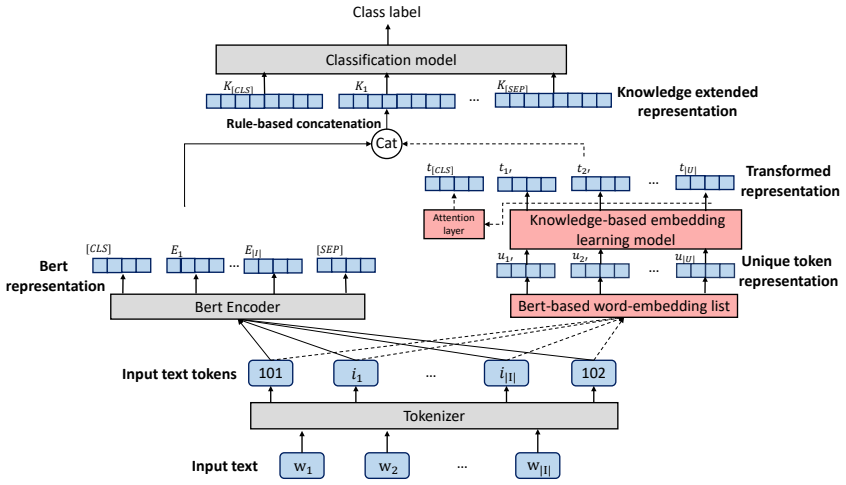
The load-bearing mechanism is the knowledge-based embedding learning model, a five-layer feedforward network trained with two losses. The center loss (Eqns. (1) and (2)), applied to the second-layer output, contracts non-neutral words toward their class centroid and separates class centroids from each other under either Euclidean distance or cosine similarity; a cross-entropy loss on the final layer supplies the class signal. Training data comes from the knowledge acquisition algorithm (Algorithm 1), which starts from seed class labels, expands them through related-word retrieval from ConceptNet and synonym retrieval from WordNet, relabels a word when a stronger relatedness score contradicts its current label, and deletes words whose synonym parents disagree. The trained network is frozen and used as a deterministic map from any BERT word-unique embedding to a knowledge-extended vector; the final representation is a rule-based concatenation of the original BERT vector and the projected vector, so contextual information is preserved while class-discriminative information is added.
What would settle it
Train the projection on a corrupted version of the lexicon—randomly reassigning, say, 20% of non-neutral words to the wrong class—and rerun the 20%-training SST2 experiment with the DualCl classifier. If accuracy remains near the reported level, the gains do not depend on class-conditional lexical knowledge; if it falls back toward the BERT baseline, lexicon purity is the active ingredient.
Extended reading notes
Core claim
The paper’s central claim is that the reason BERT underperforms in keyword-dominated classification is not a lack of contextual understanding but a lack of class-discriminative geometry in its word embeddings, and that a lightweight learned map can supply that geometry. Concretely, the authors propose a five-layer network that takes a BERT word-unique embedding—the vector at the token’s index when the word is fed to BERT alone—and projects it into a space where within-class similarity and between-class difference are maximized. Training uses lexicons: a manually built sentiment lexicon for sentiment tasks and automatically harvested lexicons for emotion and question answering, with all other BERT tokens treated as a neutral class whose geometry is not constrained. The frozen projected vectors are concatenated with the original BERT representations, giving the classifier both contextual and knowledge-based signals. The authors report that this raises accuracy across six datasets and four classifiers, and that the same projection recipe applied to GloVe also improves performance.
Load-bearing premise
The load-bearing premise is that the automatically harvested lexicon is clean enough that the words labeled for each class really do belong to that class; if many harvested words are mislabeled or overlap between classes, the center loss will pull together words that should not share a class and the concatenated representation sent to the classifier will be degraded.
Editorial extensions
If this is right
- Across SST2, CR, and RT, the enhanced embeddings outperform plain BERT, RoBERTa, and CoSE under every tested classifier and every training-data fraction, with the widest margins at the 20% split.
- In fine-grained emotion recognition and question answering, the same method produces larger relative gains than in binary sentiment, and it rescues a contrastive dual-channel classifier that otherwise starts near chance at 20% training data.
- Because the projection is trained once on a lexicon and then frozen, it improves classification without fine-tuning BERT, avoiding the instability and overfitting that small datasets cause during fine-tuning.
- The mechanism is not tied to contextual embeddings: applying the same knowledge-based projection to GloVe vectors also improves accuracy on CR, ISEAR, and TREC, especially at small training fractions.
Reading between the lines
- A direct test of the causal mechanism would be to randomly shuffle class labels in the lexicon and retrain the projection: if accuracy at the 20% splits stays high, the gains are not actually coming from lexical knowledge.
- The method’s sensitivity to lexicon purity implies that a class-word filter—for example, removing words whose BERT similarity to the opposite class centroid is higher than to their own—should further improve the reported numbers, and the improvement should be largest on automatically harvested emotion and QA lexicons.
- Because the projection is an auxiliary frozen component, it is natural to combine it with fine-tuned rather than frozen BERT, which could stack contextual adaptation on top of the class-discriminative geometry; the paper does not test this combination.
Editorial analysis
A structured set of objections, weighed in public.
Referee Report
Summary. The paper proposes a method for enhancing pre-trained word embeddings (notably BERT) for text classification by training a small neural projector on domain-specific lexicons. The projector is trained with a center loss plus cross-entropy so that same-label words are pulled together and different-label words are separated, after which the projected word representations are concatenated with BERT token embeddings for downstream classifiers. The authors also contribute Algorithm 1, which acquires class-specific lexicons from ConceptNet, relatedwords.org, and WordNet. Experiments cover six datasets (SST-2, CR, RT, ISEAR, AMAN, TREC), four classifiers, and training-data fractions from 20% to 100%, reporting consistent accuracy improvements and very large gains for the DualCl model under 20% data; an extension to GloVe is also presented.
Significance. If the reported effects are real, the method is practically useful: it avoids fine-tuning large pre-trained models, is modular and computationally cheap, works with multiple embedding types, and is backed by released code and datasets. The diagnostic experiments in Section 3.1 are also a useful illustration of BERT embedding limitations for sentiment-bearing keywords. However, the central evidence is weakened by two load-bearing issues: a mismatch between the emotion lexicon labels and the downstream dataset labels, and the absence of error bars or significance tests for the classification comparisons. The similarity-based evaluation in Tables 3-5 is also largely in-sample with respect to the training objective.
major comments (4)
- [Section 4.1, Table 2 vs. Table 8] The emotion lexicons in Table 2 use labels anger, sad, fear, happy, boredom, worry, love, surprise, and neutral, but the ISEAR classes in Table 6 are joy, sadness, fear, anger, guilt, disgust, and shame, and the AMAN classes are angry, disgust, happy, neutral, surprise, sad, and fear. Since the center loss in Eqns (1)-(2) needs a class center for each downstream class, classes such as joy, guilt, disgust, and shame have no centers in the emotion lexicon. The substantial gains reported in Table 8 for ISEAR and AMAN therefore cannot be attributed to the stated mechanism unless an undocumented label mapping exists. The similarity analysis in Table 4, which evaluates the same mismatched lexicon labels, does not establish improvement on the actual dataset classes.
- [Section 4.1.1, Tables 3-5] The within-class and between-class similarity improvements in Tables 3-5 are computed on the same lexicon that was used to train the knowledge-based embedding model, and the reported changes directly reflect the center-loss objective being minimized. These numbers are therefore not independent evidence that the embeddings generalize to unseen words or to the target classification labels. The paper should either evaluate the transformed embeddings on held-out lexical items or on an external similarity benchmark, or rely solely on the downstream classification results.
- [Section 4.2.2, Tables 7-9] The classification results are reported as averages over five seeds with no standard deviations, confidence intervals, or significance tests. Many improvements are small (for example, 0.61 to 2.69 percentage points in several sentiment-analysis rows), so the claim of consistent superiority across datasets and classifiers is not statistically supported. Reporting per-seed variance and a paired significance test across the five repeats would be needed to establish that the gains are not due to random split variation.
- [Section 4.1, Table 5 vs. Table 2] The TREC lexicon columns in Table 5 list labels "abbreviation", "entity", "destination", "human", "location", "numeric", and "neutral", while Table 2 lists "location", "human", "description", "abbreviation", "numeric", "entity", and "neutral". The label "destination" appears only in Table 5 and "description" appears only in Table 2. If this is a typo, it should be corrected; if it is not, the mapping between the lexicon used for similarity evaluation and the TREC classes used in Table 8 is unclear.
minor comments (5)
- [Introduction] The sentence "the above issue hiders discriminative feature learning" contains a typo: "hiders" should be "hinders".
- [Table 2] The heading "Questing Answering" should read "Question Answering".
- [Table 3] The word "nertral" in the last row should be "neutral".
- [Algorithm 1] The pseudocode conditions in lines 9-21 are difficult to follow, especially the condition "if syni is not in the KV and L"; clarifying the intended logic and indentation would improve reproducibility.
- [Section 4.1] The statement that "The labels of the lexicon are based on the evaluated datasets" is contradicted by the emotion lexicon labels in Table 2, as noted in the major comments; the sentence should be reconciled with the table.
Circularity Check
No load-bearing circularity: classification results are externally evaluated on held-out splits, the one self-citation is background, and the only in-sample element is a similarity analysis that re-reports the training objective.
-
fitted input called prediction
[Section 4.1.1 (Similarity Measures and Analysis), Tables 3-5, with Eqns (1)-(2)]
"The knowledge-based embedding learning model aims to maximize within-class similarity and minimize between-class similarity using available lexical knowledge. The model is evaluated based on the changes in within-class and between-class embedding similarity before and after knowledge-based learning."
The center loss in Eqns (1)-(2) is minimized over the lexicon words, and Tables 3-5 report within-class and between-class cosine/Euclidean similarity on exactly those same lexicon words. The reported improvement is therefore a direct restatement of the training objective, not an independent prediction. This is non-load-bearing because the paper's central claims rest on held-out classification accuracy in Tables 7-9.
full rationale
The paper's primary claim is that the BERTCK embedding improves text classification accuracy, especially under small data. That claim is supported by held-out evaluations: the projection is trained on a fixed lexicon (Liu et al. sentiment lexicon or Algorithm 1 output) and frozen before downstream training, and the downstream classifiers are trained only on training splits, with test labels never used to fit the projection. Thus the accuracy numbers do not reduce to a fitted parameter. The similarity analysis in Section 4.1.1 is in-sample: it measures within-class and between-class similarity on the same lexicon used to minimize the center loss, so those numbers moving as expected is close to a tautology, but the paper uses this only as a sanity check and explicitly says it 'could facilitate' classification rather than treating it as the primary evidence. The self-citation to Zhu and Mao (2023) for the observation that BERT maps opposite-polarity sentiment words similarly is background motivation, and the paper provides its own Figure 1 examples, so it is not load-bearing. A more serious validity concern, though not a circularity, is that the Table 2 emotion lexicon labels (anger, sad, fear, happy, boredom, worry, love, surprise, neutral) do not match the ISEAR/AMAN class labels in Table 6 (joy, sadness, fear, anger, guilt, disgust, shame; angry, disgust, happy, neutral, surprise, sad, fear), leaving some target classes without a class center; the conclusion also admits lexicon overlap across classes. These issues affect attribution of the emotion results to the stated mechanism but do not make the reported accuracy a fitted value. Overall, no load-bearing circularity is present.
Assumptions & free parameters
free parameters (4)
- dropout_rate =
0.4
- learning_rate =
5e-5
- projector_hidden_dims =
768-512-768-512-300-|Class|
- related_score_threshold =
si > 0
assumptions (4)
- domain assumption A BERT token vector produced by feeding a word alone through BERT is a meaningful word-level representation.
- domain assumption Labels can be propagated from seed keywords to related words and synonyms without a large error rate.
- domain assumption The projector trained on the lexicon generalizes to all BERT tokens used at test time.
- domain assumption Neutral words should not be clustered and can be excluded from the center-loss attraction.
Cite this review
Pith. "Pith review of Domain Lexical Knowledge-based Word Embedding Learning for Text Classification under Small Data." pith.science (2026). https://pith.science/paper/BGMA5APL
@misc{pith2026250601621,
  author       = {Pith},
  title        = {Pith review of: Domain Lexical Knowledge-based Word Embedding Learning for Text Classification under Small Data},
  year         = {2026},
  howpublished = {\url{https://pith.science/paper/BGMA5APL}},
  note         = {Machine review of arXiv:2506.01621}
}
read the original abstract
Pre-trained language models such as BERT have been proved to be powerful in many natural language processing tasks. But in some text classification applications such as emotion recognition and sentiment analysis, BERT may not lead to satisfactory performance. This often happens in applications where keywords play critical roles in the prediction of class labels. Our investigation found that the root cause of the problem is that the context-based BERT embedding of the keywords may not be discriminative enough to produce discriminative text representation for classification. Motivated by this finding, we develop a method to enhance word embeddings using domain-specific lexical knowledge. The knowledge-based embedding enhancement model projects the BERT embedding into a new space where within-class similarity and between-class difference are maximized. To implement the knowledge-based word embedding enhancement model, we also develop a knowledge acquisition algorithm for automatically collecting lexical knowledge from online open sources. Experiment results on three classification tasks, including sentiment analysis, emotion recognition and question answering, have shown the effectiveness of our proposed word embedding enhancing model. The codes and datasets are in https://github.com/MidiyaZhu/KVWEFFER.
Figures

Reference graph
Works this paper leans on
-
[1]
Saima Aman and Stan Szpakowicz. 2008. Using roget’s thesaurus for fine-grained emotion recognition. In Proceedings of the Third International Joint Conference on Natural Language Processing: Volume-I
work page 2008
-
[2]
Magdalena Marta Biesialska, Bardia Rafieian, and Marta Ruiz Costa-Juss \`a . 2020. Enhancing word embeddings with knowledge extracted from lexical resources. In ACL 2020, The 58th Annual Meeting of the Association for Computational Linguistics: proceedings of the student research workshop: July 5-July 10, 2020, pages 271--278. Association for Computationa...
work page 2020
-
[3]
Qianben Chen, Richong Zhang, Yaowei Zheng, and Yongyi Mao. 2022. Dual contrastive learning: Text classification via label-aware data augmentation. arXiv preprint arXiv:2201.08702
arXiv 2022
-
[4]
Pedro Colon-Hernandez, Yida Xin, Henry Lieberman, Catherine Havasi, Cynthia Breazeal, and Peter Chin. 2021. Retrogan: a cyclic post-specialization system for improving out-of-knowledge and rare word representations. Findings of the Association for Computational Linguistics: ACL-IJCNLP 2021
work page 2021
-
[5]
Leyang Cui, Yu Wu, Shujie Liu, and Yue Zhang. 2021. Knowledge enhanced fine-tuning for better handling unseen entities in dialogue generation. In Proceedings of the 2021 Conference on Empirical Methods in Natural Language Processing, pages 2328--2337
work page 2021
-
[6]
Jacob Devlin, Ming-Wei Chang, Kenton Lee, and Kristina Toutanova. 2018. Bert: Pre-training of deep bidirectional transformers for language understanding. arXiv preprint arXiv:1810.04805
arXiv 2018
-
[7]
Xiaowen Ding, Bing Liu, and Philip S Yu. 2008. A holistic lexicon-based approach to opinion mining. In Proceedings of the 2008 international conference on web search and data mining, pages 231--240
work page 2008
-
[8]
Goran Glava s and Ivan Vuli \'c . 2018. Explicit retrofitting of distributional word vectors. In Proceedings of the 56th Annual Meeting of the Association for Computational Linguistics (Volume 1: Long Papers), pages 34--45
work page 2018
Show all 44 references
-
[9]
Alec Go, Richa Bhayani, and Lei Huang. 2009. Twitter sentiment classification using distant supervision. CS224N project report, Stanford, 1(12):2009
2009
-
[10]
Taichi Ishiwatari, Yuki Yasuda, Taro Miyazaki, and Jun Goto. 2020. Relation-aware graph attention networks with relational position encodings for emotion recognition in conversations. In Proceedings of the 2020 Conference on Empirical Methods in Natural Language Processing (EM...
2020
-
[11]
Shaoxiong Ji, Shirui Pan, Erik Cambria, Pekka Marttinen, and S Yu Philip. 2021. A survey on knowledge graphs: Representation, acquisition, and applications. IEEE transactions on neural networks and learning systems, 33(2):494--514
2021
-
[12]
Marjan Kamyab, Guohua Liu, and Michael Adjeisah. 2021. Attention-based cnn and bi-lstm model based on tf-idf and glove word embedding for sentiment analysis. Applied Sciences, 11(23):11255
2021
-
[13]
Jawad Khan, Niaz Ahmad, Shah Khalid, Farman Ali, and Youngmoon Lee. 2023. Sentiment and context-aware hybrid dnn with attention for text sentiment classification. IEEE Access, 11:28162--28179
2023
-
[14]
Wenbo Li, Tetsu Matsukawa, Hiroto Saigo, and Einoshin Suzuki. 2020. Context-aware latent dirichlet allocation for topic segmentation. In Pacific-Asia Conference on Knowledge Discovery and Data Mining, pages 475--486. Springer
2020
-
[15]
Xin Li and Dan Roth. 2002. Learning question classifiers. In COLING 2002: The 19th International Conference on Computational Linguistics
2002
-
[16]
Shengbin Liang, Jiangyong Jin, Wencai Du, and Shenming Qu. 2023. A multi-channel text sentiment analysis model integrating pre-training mechanism. Information Technology and Control, 52(2):263--275
2023
-
[17]
Zhouhan Lin, Minwei Feng, Cicero dos Santos, Mo Yu, Bing Xiang, Bowen Zhou, and Yoshua Bengio. 2017. A structured self-attentive sentence embedding. In International Conference on Learning Representations. International Conference on Learning Representations, ICLR
2017
-
[18]
Bing Liu, Minqing Hu, and Junsheng Cheng. 2005. Opinion observer: analyzing and comparing opinions on the web. In Proceedings of the 14th international conference on World Wide Web, pages 342--351
2005
-
[19]
Yinhan Liu, Myle Ott, Naman Goyal, Jingfei Du, Mandar Joshi, Danqi Chen, Omer Levy, Mike Lewis, Luke Zettlemoyer, and Veselin Stoyanov. 2019. Roberta: A robustly optimized bert pretraining approach. arXiv preprint arXiv:1907.11692
2019 arXiv
-
[20]
Jaron Mar and Jiamou Liu. 2020. What’s in a gist? towards an unsupervised gist representation for few-shot large document classification. In Advances in Knowledge Discovery and Data Mining: 24th Pacific-Asia Conference, PAKDD 2020, Singapore, May 11--14, 2020, Proceedings, Par...
2020
-
[21]
Saif M Mohammad and Felipe Bravo-Marquez. 2017. Wassa-2017 shared task on emotion intensity. arXiv preprint arXiv:1708.03700
2017 arXiv
-
[22]
Marius Mosbach, Maksym Andriushchenko, and Dietrich Klakow. 2020. On the stability of fine-tuning bert: Misconceptions, explanations, and strong baselines. In International Conference on Learning Representations
2020
-
[23]
James Mutinda, Waweru Mwangi, and George Okeyo. 2023. Sentiment analysis of text reviews using lexicon-enhanced bert embedding (lebert) model with convolutional neural network. Applied Sciences, 13(3):1445
2023
-
[24]
Behzad Naderalvojoud and Ebru Akcapinar Sezer. 2020. Sentiment aware word embeddings using refinement and senti-contextualized learning approach. Neurocomputing, 405:149--160
2020
-
[25]
Bo Pang and Lillian Lee. 2005. Seeing stars: exploiting class relationships for sentiment categorization with respect to rating scales. In Proceedings of the 43rd Annual Meeting on Association for Computational Linguistics, pages 115--124
2005
-
[26]
Ted Pedersen, Siddharth Patwardhan, Jason Michelizzi, et al. 2004. Wordnet:: Similarity-measuring the relatedness of concepts. In AAAI, volume 4, pages 25--29
2004
-
[27]
Jeffrey Pennington, Richard Socher, and Christopher D Manning. 2014. Glove: Global vectors for word representation. In Proceedings of the 2014 conference on empirical methods in natural language processing (EMNLP), pages 1532--1543
2014
-
[28]
Seyed Mahdi Rezaeinia, Rouhollah Rahmani, Ali Ghodsi, and Hadi Veisi. 2019. Sentiment analysis based on improved pre-trained word embeddings. Expert Systems with Applications, 117:139--147
2019
-
[29]
Klaus R Scherer and Harald G Wallbott. 1994. Evidence for universality and cultural variation of differential emotion response patterning. Journal of personality and social psychology, 66(2):310
1994
-
[30]
Richard Socher, Alex Perelygin, Jean Wu, Jason Chuang, Christopher D Manning, Andrew Y Ng, and Christopher Potts. 2013. Recursive deep models for semantic compositionality over a sentiment treebank. In Proceedings of the 2013 conference on empirical methods in natural language...
2013
-
[31]
Robyn Speer, Joshua Chin, and Catherine Havasi. 2017. Conceptnet 5.5: An open multilingual graph of general knowledge. In Proceedings of the AAAI conference on artificial intelligence, volume 31
2017
-
[32]
Chi Sun, Luyao Huang, and Xipeng Qiu. 2019. Utilizing bert for aspect-based sentiment analysis via constructing auxiliary sentence. In Proceedings of the 2019 Conference of the North American Chapter of the Association for Computational Linguistics: Human Language Technologies...
2019
-
[33]
Yu Sun, Shuohuan Wang, Yukun Li, Shikun Feng, Hao Tian, Hua Wu, and Haifeng Wang. 2020. Ernie 2.0: A continual pre-training framework for language understanding. In Proceedings of the AAAI conference on artificial intelligence, volume 34, pages 8968--8975
2020
-
[34]
Varsha Suresh and Desmond C Ong. 2021. Not all negatives are equal: Label-aware contrastive loss for fine-grained text classification. arXiv preprint arXiv:2109.05427
2021 arXiv
-
[35]
Hande Aka Uymaz and Senem Kumova Metin. 2022. Vector based sentiment and emotion analysis from text: A survey. Engineering Applications of Artificial Intelligence, 113:104922
2022
-
[36]
Ivan Vuli \'c , Goran Glava s , Nikola Mrk s i \'c , and Anna Korhonen. 2018. Post-specialisation: Retrofitting vectors of words unseen in lexical resources. In Proceedings of the 2018 Conference of the North American Chapter of the Association for Computational Linguistics: H...
2018
-
[37]
Binqiang Wang, Gang Dong, Yaqian Zhao, Rengang Li, Qichun Cao, Kekun Hu, and Dongdong Jiang. 2023. Hierarchically stacked graph convolution for emotion recognition in conversation. Knowledge-Based Systems, 263:110285
2023
-
[38]
Jin Wang, You Zhang, Liang-Chih Yu, and Xuejie Zhang. 2022. Contextual sentiment embeddings via bi-directional gru language model. Knowledge-Based Systems, 235:107663
2022
-
[39]
Xiaoyan Yan, Fanghong Jian, and Bo Sun. 2021. Sakg-bert: Enabling language representation with knowledge graphs for chinese sentiment analysis. IEEE Access, 9:101695--101701
2021
-
[40]
Cheng Zhang and Hayato Yamana. 2021. Improving text classification using knowledge in labels. In 2021 IEEE 6th International Conference on Big Data Analytics (ICBDA), pages 193--197. IEEE
2021
-
[41]
Revisiting few-sample bert fine-tuning
Tianyi Zhang, Felix Wu, Arzoo Katiyar, Kilian Q Weinberger, and Yoav Artzi. Revisiting few-sample bert fine-tuning. In International Conference on Learning Representations
-
[42]
Qinghua Zhao, Shuai Ma, and Shuo Ren. 2022. Kesa: A knowledge enhanced approach to sentiment analysis. In Proceedings of the 2nd Conference of the Asia-Pacific Chapter of the Association for Computational Linguistics and the 12th International Joint Conference on Natural Langu...
2022
-
[43]
Jiangbin Zheng, Yile Wang, Ge Wang, Jun Xia, Yufei Huang, Guojiang Zhao, Yue Zhang, and Stan Li. 2022. Using context-to-vector with graph retrofitting to improve word embeddings. In Proceedings of the 60th Annual Meeting of the Association for Computational Linguistics (Volume...
2022
-
[44]
Zixiao Zhu and Kezhi Mao. 2023. Knowledge-based bert word embedding fine-tuning for emotion recognition. Neurocomputing, 552:126488
2023
Reviewed August 7, 2026 · model on record in the stance chip above.
Discussion (0). Sign in to comment.