REVIEW 3 major objections 4 minor 56 references
Interface Engineering in Hybrid Iodide CH3NH3PbI3 Perovskite Using Lewis Base and Graphene towards High Performance Solar Cells
T0 review · 3 major / 4 minor · reviewed 2026-08-14 · deepseek-v4-flash
Pith's one-line read The paper claims that adding thiocarbamide and graphene to the CH3NH3PbI3 surface gives the strongest binding, removes deep trap states under iodine-rich conditions, and raises the iodine migration barrier, lifting measured efficiency…
desk verdict A useful comparative DFT study of Lewis-base/graphene interfaces on MAPI, with a conditional trap-passivation claim that needs more support before the central ranking is accepted. read the letter →
The pith
A machine-rendered reading of the paper's core claim, the machinery that carries it, and where it could break.
The reading
What carries the argument
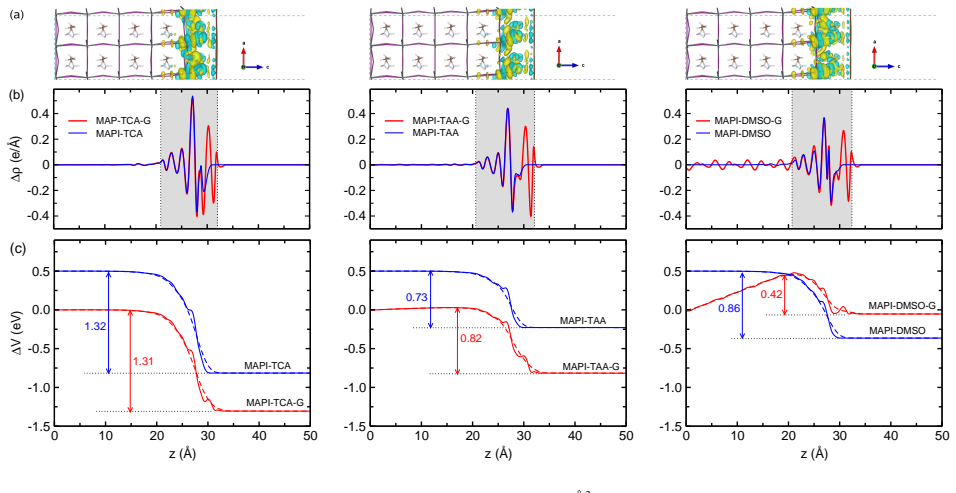
The central object is a slab model of the $\mathrm{PbI_2}$-terminated $\mathrm{CH_3NH_3PbI_3}(110)$ surface covered by a monolayer of one of three Lewis bases (TCA, TAA, or DMSO) and a graphene layer, studied with density functional theory using a van der Waals-corrected functional. The argument runs through four connected quantities: adsorption and interlayer binding energies per carbon atom for binding strength; the interface dipole and work-function change for electron extraction; defect formation energies together with total and local density of states to classify deep versus shallow trap levels; and activation barriers for vacancy-mediated iodine migration along the edge of a $\mathrm{PbI_5}$ octahedron. The S-donor lone pair binds to Pb atoms while the $\mathrm{NH_2}$ and $\mathrm{CH_3}$ groups hydrogen-bond to iodine atoms, which is why TCA binds strongest and, under iodine-rich conditions, leaves no deep traps.
What would settle it
Grow thiocarbamide-treated $\mathrm{CH_3NH_3PbI_3}$ under deliberately iodine-poor (Pb-rich) conditions and measure sub-gap absorption or deep-level photoluminescence; if a mid-gap state near the predicted lead-on-iodine antisite level appears, the deep-trap-elimination claim fails for those conditions.
Extended reading notes
Core claim
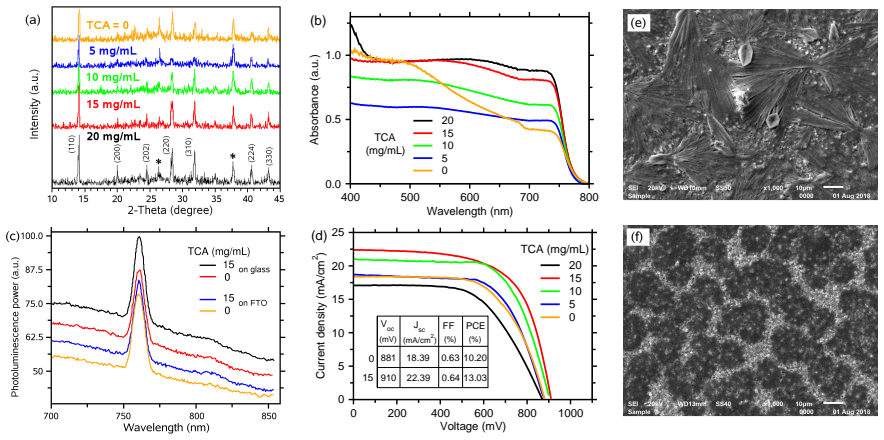
The central discovery is a mechanistic ranking of three $\mathrm{CH_3NH_3PbI_3}$-Lewis base-graphene interfaces. In the MAPI-TCA-G interface, the S-donor TCA forms the strongest adsorption and interlayer binding, the shortest graphene-to-surface distance, and a work-function reduction directed toward graphene that should promote electron extraction. Defect-formation analysis on the $\mathrm{PbI_2}$-terminated (110) surface shows that under iodine-rich conditions the only defect creating deep trap states in the TCA and TAA interfaces is the Pb-on-I antisite ($\mathrm{Pb_I}$), whose formation energy is high enough (5.15 eV for TCA) that it is unlikely to form, while the DMSO interface retains deep traps for all tested defects. Vacancy-mediated iodine migration barriers are highest with TCA, indicating slower degradation. A companion experiment with thiocarbamide at 15 mg/mL raises the efficiency from 10.20% to 13.03%, in line with these predictions.
Load-bearing premise
The deep-trap-elimination claim depends on the perovskite being formed under iodine-rich conditions, where the only deep trap (a lead atom sitting on an iodine site) costs 5.15 eV to form, and the paper does not verify that the actual devices were iodine-rich.
Editorial extensions
If this is right
- If the central claim is right, S-donor Lewis bases such as thiocarbamide should outperform the O-donor DMSO in perovskite-graphene devices, with TCA the best of the three studied.
- Under iodine-rich processing, TCA and TAA interfaces should show no deep mid-gap defect states, so non-radiative recombination should be suppressed, while DMSO interfaces should retain traps.
- The higher iodine migration barrier with the TCA interface implies slower iodine-vacancy-mediated degradation and improved operational stability.
- The work-function reduction at the MAPI-TCA-G interface should favor electron transfer from perovskite to graphene, improving charge extraction.
- The measured efficiency gain, from 10.20% to 13.03% with 15 mg/mL TCA, is the experimental counterpart of the predicted trap removal and stronger interface bonding.
Reading between the lines
- The iodine-rich assumption could be tested by varying halide stoichiometry during TCA-treated film growth; the model predicts deep traps should reappear under Pb-rich conditions because the Pb-on-I antisite becomes cheap to form.
- The same Lewis-base-graphene design may extend to other hybrid perovskites such as formamidinium lead iodide, since the acid-base binding mechanism does not depend on the methylammonium cation specifically.
- Time-resolved photoluminescence on TCA-treated films should show longer carrier lifetimes if the predicted deep-trap removal is real, a measurement the paper does not report.
- Devices made with and without the graphene layer but with the same TCA treatment could isolate how much of the efficiency gain comes from the molecule versus the graphene contact.
Signed reviews
Editorial analysis
A structured set of objections, weighed in public.
Referee Report
Summary. The paper combines DFT calculations and device experiments to study MAPI(110) interfaces with three Lewis bases (thiocarbamide, thioacetamide, dimethyl sulfoxide) and a graphene layer. The DFT part quantifies interface binding, charge redistribution, interface dipoles and work function changes, defect formation energies for vacancies and antisites under I-rich and Pb-rich conditions, density-of-states analysis of defect levels, and iodine migration barriers. The authors conclude that the MAPI-TCA-G system is the most desirable for efficiency and stability because it binds most strongly, suppresses deep trap states (only the PbI antisite is deep and it is argued to be absent under I-rich conditions), and gives the highest iodine migration barrier. The experimental part reports a PCE increase from 10.20% to 13.03% when 15 mg/mL TCA is added to the perovskite precursor, which the authors interpret as support for their theoretical predictions.
Significance. If established, the results would provide a mechanistic rationale for Lewis-base/graphene interface engineering in halide perovskite solar cells and a concrete design rule favoring S-donor molecules. The paper has genuine strengths: it uses first-principles calculations without parameter fitting to the target PCE, includes van der Waals corrections, uses Monte Carlo sampling for adsorbate configurations, and directly connects the simulation to a new experiment. However, the central 'deep trap states elimination' claim and the resulting 'most desirable' ranking rest on two untested assumptions: that the experimental growth conditions are iodine-rich, and that GGA-level DOS without spin-orbit coupling reliably classifies defect levels as deep or shallow. These issues need to be resolved before the mechanistic conclusion can be accepted.
major comments (3)
- [Defect analysis (Table 2, Figure 3)] The claim of 'deep trap states elimination' is not supported by a direct comparison to the bare MAPI(110) surface. Figure 3a shows TDOS only for the MAPI-mol-G interface systems, with and without each defect. To demonstrate that the interface eliminates deep traps, the same defect DOS must be shown for the bare MAPI(110) slab computed with the identical methodology. Without this baseline, the reader cannot distinguish whether the interface itself passivates the defects or whether the defects are intrinsically shallow or deep on the clean surface. This baseline is load-bearing for the abstract's 'deep trap states elimination' statement and for the ranking of the three interface systems.
- [Defect formation energies (Table 2) and experimental conditions (Figure 4)] The passivation conclusion relies on the I-rich chemical-potential endpoint, but the manuscript never demonstrates that the experimental TCA devices are processed under I-rich conditions. Table 2 gives E_f(PbI) = 5.15 eV under I-rich, but this drops to 1.39 eV under Pb-rich; under Pb-rich the deep PbI antisite would be abundant and the claimed suppression fails. The experiments report no I/Pb stoichiometry, precursor ratio, or chemical-potential analysis, and the text offers no kinetic argument for why a thermodynamic formation energy should prevent non-equilibrium PbI incorporation during solution processing. The statement 'the I-rich condition is favorable for surface trap passivation' is therefore an unverified auxiliary hypothesis rather than a demonstrated property of the TCA interface.
- [Methodology (Figure 1 caption and Figure 3)] The deep/shallow classification is made from neutral-defect DOS at the GGA level (BLYP) without spin-orbit coupling (SOC) and without charged-defect transition levels. For lead iodide perovskites, SOC strongly modifies the band-edge character and can shift defect levels by several tenths of an eV, which is exactly the margin that separates a deep mid-gap state from a shallow state. In addition, the thermodynamic identity of a defect as a recombination center is properly established through charge-state transition levels, not through the neutral DOS alone. The authors should either repeat key defect calculations with SOC and/or a hybrid functional, or compute transition levels, before asserting that TCA and TAA interfaces eliminate deep traps while DMSO does not.
minor comments (4)
- [Figure 3 caption] The caption has a labeling inconsistency: panel (c) is used twice ('Top view of vacancy-mediated I atom migration... and (c) their activation barriers'), and Figure 3d is referenced in the main text. The fourth panel should be labeled (d).
- [Figure 4 caption and main text] The SEM images are referred to in the text as '(Figure 4e)' and '(Figure 4f)', but the caption reads 'SEM images for the perovskite films coated on FTO (d) without and (f) with 15 mg/mL TCA'. The '(d)' appears to be a typo for '(e)'.
- [Table 1] The formation energy E_f is listed in kJ/mol without specifying whether the value is per molecule, per surface cell, or per adsorbed monolayer. The text discusses 'adsorption energies per molecule' for different coverages, so Table 1 should state the normalization explicitly to allow comparison with the SI values.
- [Interface dipole decomposition] The decomposition of the interface dipole into bond dipole and molecular dipole components is essential for the work-function analysis, but the main text gives only the final numbers (e.g., TCA molecular dipole −1.2 D and bond dipole 5.4 D) and refers the reader to the SI. A one-sentence definition of how these components are computed would improve readability.
Circularity Check
No significant circularity: the DFT predictions are forward calculations and the experiment is an after-the-fact validation, not a fitted input.
full rationale
The paper's central results are forward DFT quantities: interface binding energies, interlayer distances, work-function changes, defect formation energies, and iodine migration barriers. None of these are fitted to the measured PCE, and the experimental section (TCA concentration series yielding 13.03% vs 10.20%) is presented as validation after the prediction, not as an input to it. The comparison between S-donor and O-donor Lewis bases follows from the computed energetics and electronic structure, and the ranking of MAPI-TCA-G as most desirable is a synthesis of those computed quantities. The self-citations (refs. 30, 47, 52) are background experimental or prior-simulation support and are not load-bearing in the sense of defining the target result: ref. 30 is used for the Lewis-base adduct strategy and refs. 47 and 52 for earlier defect and ion-transport calculations, but the present formation energies, DOS classifications, and barriers are recomputed here. The 'I-rich condition' invoked in the defect analysis is an explicit chemical-potential assumption, not a circular definition: the paper does not claim the experimental device is I-rich, and the formation energies are obtained from DFT rather than from the measured efficiency. Whether the actual growth conditions are I-rich, or whether GGA without spin-orbit coupling correctly classifies deep versus shallow states, are correctness questions, not demonstrations that the derivation is equivalent to its inputs. No equation or fitted parameter is reused as a prediction, and no self-citation chain forces the conclusion. The work is self-contained against its own external benchmark, so the circularity score is 0.
Assumptions & free parameters
assumptions (3)
- domain assumption The PbI2-terminated (110) surface is the most stable and experimentally relevant surface of MAPI
- domain assumption GGA-DFT without spin-orbit coupling reliably classifies defect levels as deep or shallow
- domain assumption The device operates under iodine-rich conditions that suppress PbI defects
Cite this review
Pith. "Pith review of Interface Engineering in Hybrid Iodide CH3NH3PbI3 Perovskite Using Lewis Base and Graphene towards High Performance Solar Cells." pith.science (2026). https://pith.science/paper/BH2ALLPW
@misc{pith2026190805237,
  author       = {Pith},
  title        = {Pith review of: Interface Engineering in Hybrid Iodide CH3NH3PbI3 Perovskite Using Lewis Base and Graphene towards High Performance Solar Cells},
  year         = {2026},
  howpublished = {\url{https://pith.science/paper/BH2ALLPW}},
  note         = {Machine review of arXiv:1908.05237}
}
read the original abstract
Perovskite solar cells have achieved a substantial breakthrough via advanced interface engineerings. Reports have emphasized that combining the hybrid perovskites with Lewis base and graphene improve the performance; the underlying mechanisms are not yet fully understood. Here, using density functional theory, we show that upon the formation of CH3NH3PbI3 interfaces with three different Lewis base molecules and graphene, the binding strength with S-donors thiocarbamide and thioacetamide is higher than with O-donor dimethyl sulfoxide, while the interface dipole and work function reduction tend to increase from S-donors to O-donor. Furthermore, we provide evidences of deep trap states elimination in the S-donor perovskite interfaces through the analysis of defect formation on CH3NH3PbI3(110) surface, and of stability enhancement by estimating activation barriers for iodine atom migrations. These theoretical predictions are in line with the experimental observation of performance enhancement in the perovskites prepared using thiocarbamide.
Figures


Figures from the paper (1 more)
Reference graph
Works this paper leans on
-
[1]
L. K. Ono, N.-G. Park, K. Zhu, W. Huang, Y . Qi, Perovskite Solar Cells– Towards Commercialization, ACS Energy Lett. 2 (2017) 1749–1751
work page 2017
-
[2]
Z. Li, T. R. Klein, D. H. Kim, M. Yang, J. J. Berry, M. F. A. M. van Hest, K. Zhu, Scalable Fabrication of Perovskite Solar Cells, Nat. Rev. Mater. 3 (2018) 18017
work page 2018
-
[3]
Y . Li, L. Ji, R. Liu, C. Zhang, C. H. Mak, X. Zou, H.-H. Shen, S.-Y . Leu, H.-Y . Hsu, A Review on Morphology Engineering for Highly E fficient and Stable Hybrid Perovskite Solar Cells, J. Mater. Chem. A 6 (2018) 12842–12875
work page 2018
-
[4]
Schulz, Interface Design for Metal Halide Perovskite Solar Cells, ACS Energy Lett
P. Schulz, Interface Design for Metal Halide Perovskite Solar Cells, ACS Energy Lett. 3 (2018) 1287–1293
work page 2018
-
[5]
S. B. Naghadeh, B. Luo, G. Abdelmageed, Y .-C. Pu, C. Zhang, J. Z. Zhang, Photophysical Properties and Improved Stability of Organic- Inorganic Perovskite by Surface Passivation, J. Phys. Chem. C 122 (2018) 15799–15818
work page 2018
-
[6]
S. Ye, H. Rao, Z. Zhao, L. Zhang, H. Bao, W. Sun, Y . Li, F. Gu, J. Wang, Z. Liu, Z. Bian, C. Huang, A Breakthrough Efficiency of 19.9% Obtained in Inverted Perovskite Solar Cells by Using an Efficient Trap State Passi- vator Cu(thiourea)I, J. Am. Chem. Soc. 139 (2017) 7504–7512
work page 2017
-
[7]
D. Shen, A. Pang, Y . Li, J. Dou, M. Wei, Metal-Organic Frameworks at Interfaces of Hybrid Perovskite Solar Cells for Enhanced Photovoltaic Properties, Chem. Commun. 54 (2018) 1253–1256
work page 2018
-
[8]
M. Stolterfoht, C. M. Wol ff, J. A. M ´arquez, S. Zhang, C. J. Hages, D. Rothhardt, S. Albrecht, P. L. Burn, P. Meredith, T. Unold, D. Ne- her, Visualization and Suppression of Interfacial Recombination for High- Efficiency Large-Area Pin Perovskite Solar Cells, Nat. Energy 3 (2018) 847–854
work page 2018
Show all 56 references
-
[9]
X. Wen, J. Wu, D. Gao, C. Lin, Interfacial Engineering with Amino- Functionalized Graphene for E fficient Perovskite Solar Cells, J. Mater. Chem. A 4 (2016) 13482–13487
2016
-
[10]
Qian, Z.-Y
C.-X. Qian, Z.-Y . Deng, K. Yang, J. Feng, M.-Z. Wang, Z. Yang, S. Liu, H.-J. Feng, Interface engineering of CsPbBr 3/TiO2 heterostruc- ture with enhanced optoelectronic properties for all-inorganic perovskite solar cells, Appl. Phys. Lett. 112 (2018) 093901
2018
-
[11]
H. Li, G. Tong, T. Chen, H. Zhu, G. Li, Y . Chang, L. Wang, Y . Jiang, In- terface Engineering Using a Perovskite Derivative Phase for Efficient and Stable CsPbBr3 Solar Cells, J. Mater. Chem. A 6 (2018) 14255–14261
2018
-
[12]
Lee, H.-S
J.-W. Lee, H.-S. Kim, N.-G. Park, Lewis Acid-Base Adduct Approach for High E fficiency Perovskite Solar Cells, Acc. Chem. Res. 49 (2016) 311–319. 5
2016
-
[13]
J. A. Christians, P. Schulz, J. S. Tinkham, T. H. Schloemer, S. P. Har- vey, B. J. T. de Villers, A. Sellinger, J. J. Berry, J. M. Luther, Tailored Interfaces of Unencapsulated Perovskite Solar Cells for>1,000 hour Op- erational Stability, Nat. Energy 3 (2018) 68–74
2018
-
[14]
L. K. Ono, Y . B. Qi, Surface and Interface Aspects of Organometal Halide Perovskite Materials and Solar Cells, J. Phys. Chem. Lett. 7 (2016) 4764– 4794
2016
-
[15]
Zhang, M
S. Zhang, M. Stolterfoht, A. Armin, Q. Lin, F. Zu, J. Sobus, H. Jin, N. Koch, P. Meredith, P. L. Burn, D. Neher, Interface Engineering of Solution-Processed Hybrid Organohalide Perovskite Solar Cells, ACS Appl. Mater. Interfaces 10 (2018) 21681–21687
2018
-
[16]
L. Qiu, L. K. Ono, Y . Jiang, M. R. Leyden, S. R. Raga, S. Wang, Y . Qi, Engineering Interface Structure to Improve E fficiency and Stability of Organometal Halide Perovskite Solar Cells, J. Phys. Chem. B 122 (2018) 511–520
2018
-
[17]
Lindblad, D
R. Lindblad, D. Bi, B. w. Park, J. Oscarsson, M. Gorgoi, H. Siegbahn, M. Odelius, E. M. J. Johansson, H. Rensmo, Electronic Structure of TiO2/CH3NH3PbI3 Perovskite Solar Cell Interfaces, J. Phys. Chem. Lett. 5 (2014) 648–653
2014
-
[18]
Roiati, E
V . Roiati, E. Mosconi, A. Listorti, S. Colella, G. Gigli, F. de Angelis, Stark Effect in Perovskite/TiO2 Solar Cells: Evidence of Local Interfacial Order, Nano Lett. 14 (2014) 2168–2174
2014
-
[19]
Uratani, K
H. Uratani, K. Yamashita, Charge Carrier Trapping at Surface Defects of Perovskite Solar Cell Absorbers: A First-Principles Study, J. Phys. Chem. Lett. 8 (2017) 742–746
2017
-
[20]
Zheng, B
X. Zheng, B. Chen, J. Dai, Y . Fang, Y . Bai, Y . Lin, H. Wei, X. C. Zeng, J. Huang, Defect Passivation in Hybrid Perovskite Solar Cells using Qua- ternary Ammonium Halide Anions and Cations, Nat. Energy 2 (2017) 17102
2017
-
[21]
Grancini, C
G. Grancini, C. Rold ´a-Carmona, I. Zimmermann, E. Mosconi, X. Lee, D. Martineau, S. Narbey, F. Oswald, F. D. Angelis, M. Graetzel, M. K. Nazeeruddin, One-Year Stable Perovskite Solar Cells by 2D/3D Interface Engineering, Nat. Commun. 8 (2017) 15684
2017
-
[22]
Q. Wang, Y . Shao, Q. Dong, Z. Xiao, Y . Yuan, J. Huang, Large Fill-Factor Bilayer Iodide Perovskite Solar Cells Fabricated by Low-Temperature So- lution Process, Energy Environ. Sci. 7 (2014) 2359–2365
2014
-
[23]
Y . Shao, Z. Xiao, C. Bi, Y . Yuan, J. Huang, Origin and Elimination of Photocurrent Hysterisis by Fullerene Passivation in CH3NH3PbI3 Planar Hetero Junction Solar Cells, Nat. Commun. 5 (2014) 5784
2014
-
[24]
J. Xu, A. Buin, A. H. Ip, W. Li, O. V oznyy, R. Comin, M. Yuan, S. Jeon, Z. Ning, J. J. McDowell, P. Kanjanaboos, J. P. Sun, X. Lan, L. N. Quan, D. H. Kim, I. G. Hill, P. Maksymovych, E. H. Sargent, Perovskite- Fullerene Hybrid Materials Suppress Hysterisis in Planar Diodes, N...
2015
-
[25]
Hadadian, J
M. Hadadian, J. P. Correa-Baena, E. K. Goharshadi, A. Ummadisingu, J. Y . Seo, J. Luo, S. Gholipour, S. M. Zakeeruddin, M. Saliba, A. Abate, M. Gratzel, A. Hagfeldt, Enhancement E fficiency of Perovskite Solar Cells via N-Doped Graphene: Crystal Modification and Surface Passi- va...
2016
-
[26]
J. T. W. Wang, Z. Wang, S. Pathak, W. Zhang, D. W. deQuilettes, F. Wisnivesky-Rocca-Rivarola, J. Huang, P. K. Nayak, J. B. Patel, H. A. M. Yusof, Y . Vaynzof, R. Zhu, I. Ramirez, J. Zhang, C. Ducati, C. Grovenor, M. B. Johnston, D. S. Ginger, R. J. Nicholas, H. J. Snaith, Effici...
2016
-
[27]
Abate, M
A. Abate, M. Saliba, D. J. Hollman, S. D. Stranks, K. Wojciechowski, R. Avolio, G. Grancini, A. Petrozza, H. J. Snaith, Supermolecular Halo- gen Bond Passivation of Organic-Inorganic Halide Perovskite Solar Cells, Nano Lett. 14 (2014) 3247–3254
2014
-
[28]
N. K. Noel, A. Abate, S. D. Stranks, E. S. Parrott, V . M. Burlakov, A. Goriely, H. J. Snaith, Enhanced Photoluminescence and Solar Cell Per- formance via Lewis Base Passivation of OrganicInorganic Lead Halide Perovskites, ACS Nano 8 (2014) 9815–9821
2014
-
[29]
S. Ye, H. Rao, W. Yan, Y . Li, W. Sun, H. Peng, Z. Liu, Z. Bian, Y . Li, C. Huang, A Strategy to Simplify the Preparation Process of Perovskite Solar Cells by Co-Deposition of a Hole-Conductor and a Perovskite Layer, Adv. Mater. 28 (2016) 9648–9654
2016
-
[30]
Ko, G.-I
S.-G. Ko, G.-I. Ryu, B. Kim, G.-J. Cha, J.-H. Ri, G.-S. Sonu, U.-C. Kim, Effects of Thiourea on The Perovskite Crystallization for Fully Printable Solar Cells, Sol. Energy Mater. Sol. Cells 196 (2019) 105–110
2019
-
[31]
Hsieh, Y
C. Hsieh, Y . Liao, Y . Lin, C. Chen, C. Tsai, W. Diaua, S. Chuang, Low- Temperature, Simple and Efficient Preparation of Perovskite Solar Cells Using Lewis Bases Urea and Thiourea as Additives: Stimulating Large Grain Growth and Providing a PCE Up To 18.8%, RSC Adv. 8 (2018) 19610–
2018
-
[32]
Bonaccorso, L
F. Bonaccorso, L. Colombo, G. Yu, M. Stoller, V . Tozzini, A. C. Ferrari, R. S. Ruoff, V . Pellegrini, Graphene, Related Two-Dimensional Crystals, and Hybrid Systems for Energy Conversion and Storage, Science 347 (2015) 1246501
2015
-
[33]
K. P. Loh, S. W. Tong, J. Wu, Graphene and Graphene-like Molecules: Prospects in Solar Cells, J. Am. Chem. Soc. 138 (2016) 1095–1102
2016
-
[34]
Capasso, L
A. Capasso, L. Salamandra, G. Faggio, T. Dikonimos, F. Buonocore, V . Morandi, L. Ortolani, N. Lisi, Chemical Vapor Deposited Graphene- Based Derivative As High-Performance Hole Transport Material for Or- ganic Photovoltaics, ACS Appl. Mater. Interfaces 8 (2016) 23844–23853
2016
-
[35]
J. Li, J. X. Yao, X. Y . Liao, R. L. Yu, H. R. Xia, W. T. Sun, L. M. Peng, A Contact Study in Hole Conductor Free Perovskite Solar Cells with Low Temperature Processed Carbon Electrodes, RSC Adv. 7 (2017) 20732– 20737
2017
-
[36]
L. Liu, A. Mei, T. Liu, P. Jiang, Y . Sheng, L. Zhang, H. Han, Fully Printable Mesoscopic Perovskite Solar Cells with Organic Silane Self- Assembled Monolayer, J. Am. Chem. Soc. 137 (2015) 1790–1793
2015
-
[37]
Y . Rong, Z. Ku, A. Mei, T. Liu, M. Xu, S. Ko, X. Li, H. Han, Hole- Conductor-Free Mesoscopic TiO 2/CH3NH3PbI3 Heterojunction Solar Cells Based on Anatase Nanosheets and Carbon Counter Electrodes, J. Phys. Chem. Lett. 5 (2014) 2160–2164
2014
-
[38]
Poglitsch, D
A. Poglitsch, D. Weber, Dynamic Disorder in Methylammoniumtri- halogenoplumbates (ii) Observed by Millimeter-Wave Spectroscopy, J. Chem. Phys. 87 (1987) 6373–6378
1987
-
[39]
J. H. Heo, S. H. Im, J. H. Noh, T. N. Mandal, C.-S. Lim, J. A. Chang, Y . H. Lee, H.-J. Kim, A. Sarkar, M. K. Nazeeruddin, et al., Efficient Inorganic- Organic Hybrid Heterojunction Solar Cells Containing Perovskite Com- pound and Polymeric Hole Conductors, Nat. Photonics 7 (201...
2013
-
[40]
Zibouche, G
N. Zibouche, G. V olonakis, F. Giustino, Graphene Oxide /Perovskite In- terfaces For Photovoltaics, J. Phys. Chem. C 122 (2018) 16715–16726
2018
-
[41]
V olonakis, F
G. V olonakis, F. Giustino, Ferroelectric Graphene-Perovskite Interfaces, J. Phys. Chem. Lett. 6 (2015) 2496–2502
2015
-
[42]
Haruyama, K
J. Haruyama, K. Sodeyama, L. Han, Y . Tateyama, Termination Depen- dence of Tetragonal CH3NH3PbI3 Surfaces for Perovskite Solar Cells, J. Phys. Chem. Lett. 5 (2014) 2903–2909
2014
-
[43]
Haruyama, K
J. Haruyama, K. Sodeyama, L. Han, Y . Tateyama, Surface Properties of CH3NH3PbI3 for Perovskite Solar Cells, Acc. Chem. Res. 49 (2016) 554– 561
2016
-
[44]
Wharf, T
I. Wharf, T. Gramstad, R. Makhija, M. Onyszchuk, Synthesis and Vi- brational Spectra of Some Lead(I1) Halide Adducts with O-, S-, and N- Donor Atom Ligands, Can. J. Chem. 54 (1976) 3430–3438
1976
-
[45]
W. Liu, B. Schuler, Y . Xu, N. Moll, G. Meyer, L. Gross, A. Tkatchenko, Identical Binding Energies and Work Functions for Distinct Adsorption Structures: Olympicenes on the Cu(111) Surface, J. Phys. Chem. Lett. 7 (2016) 1022–1027
2016
-
[46]
St ¨ahler, P
J. St ¨ahler, P. Rinke, Global and Local Aspects of the Surface Poten- tial Landscape for Energy Level Alignment at Organic-ZnO Interfaces, Chem. Phys. 485-486 (2017) 149–165
2017
-
[47]
Kye, C.-J
Y .-H. Kye, C.-J. Yu, U.-G. Jong, Y . Chen, A. Walsh, Critical Role of Water in Defect Aggregation and Chemical Degradation of Perovskite Solar Cells, J. Phys. Chem. Lett 9 (2018) 2196–2201
2018
-
[48]
M. H. Du, Density Functional Calculations of Native Defects in CH3NH3PbI3: Effects of Spin-Orbit Coupling and Self-Interaction Error, J. Phys. Chem. Lett. 6 (2015) 1461–1466
2015
-
[49]
A. Buin, P. Pietsch, J. Xu, O. V oznyy, A. H. Ip, R. Comin, E. H. Sargent, Materials Processing Routes to Trap-Free Halide Perovskites, Nano Lett. 14 (2014) 6281–6286
2014
-
[50]
W.-J. Yin, T. Shi, Y . Yan, Unusual defect physics in CH 3NH3PbI3 per- ovskite solar cell absorber, Appl. Phys. Lett. 104 (2014) 063903
2014
-
[51]
Kim, S.-H
J. Kim, S.-H. Lee, J. H. Lee, K.-H. Hong, The Role of Intrinsic Defects in Methylammonium Lead Iodide Perovskite, J. Phys. Chem. Lett. 5 (2014) 1312–1317
2014
-
[52]
Jong, C.-J
U.-G. Jong, C.-J. Yu, G.-C. Ri, A. P. McMahon, N. M. Harrison, P. R. F. Barnes, A. Walsh, Influence of Water Intercalation and Hydration on Chemical Decomposition and Ion Transport in Methylammonium Lead Halide Perovskites, J. Mater. Chem. A 6 (2018) 1067–1074
2018
-
[53]
Aristidou, C
N. Aristidou, C. Eames, I. Sanchez-Molina, X. Bu1, J. Kosco, M. S. Is- 6 lam, S. A. Haque, Fast Oxygen Di ffusion and Iodide Defects Mediate Oxygen-Induced Degradation of Perovskite Solar Cells, Nat. Commun. 8 (2017) 15218
2017
-
[54]
Eames, J
C. Eames, J. M. Frost, P. R. F. Barnes, B. C. O’Regan, A. Walsh, M. S. Islam, Ionic Transport in Hybrid Lead Iodide Perovskite Solar Cells, Nat. Commun. 6 (2015) 7497
2015
-
[55]
J. M. Azpiroz, E. Mosconi, J. Bisquert, F. de Angelisa, Defects Migration in Methylammonium Lead Iodide and their Role in Perovskite Solar Cells Operation, Energy Environ. Sci. 8 (2015) 2118–2127
2015
-
[56]
Haruyama, K
J. Haruyama, K. Sodeyama, L. Han, Y . Tateyama, First-Principles Study of Ion Diffusion in Perovskite Solar Cell Sensitizers, J. Am. Chem. Soc. 137 (2015) 10048–10051. 7
2015
Reviewed August 14, 2026 · model on record in the stance chip above.
Discussion (0). Continue with ORCID to comment.